OVERVIEW OF
SYSTEMIC
MODELING
APPROACHES
ROSS APTED
TASK
To give an overview of systemic modeling approaches
       Discuss selected systemic accident modeling
       techniques and the academic literature surrounding
       them.
       To expanded the frame work for comparing accident
       modeling techniques set out in Comparison of some
       selected methods for accident investigation
       (Sklet, 2004)


       To Compare selected techniques using the expanded
       framework
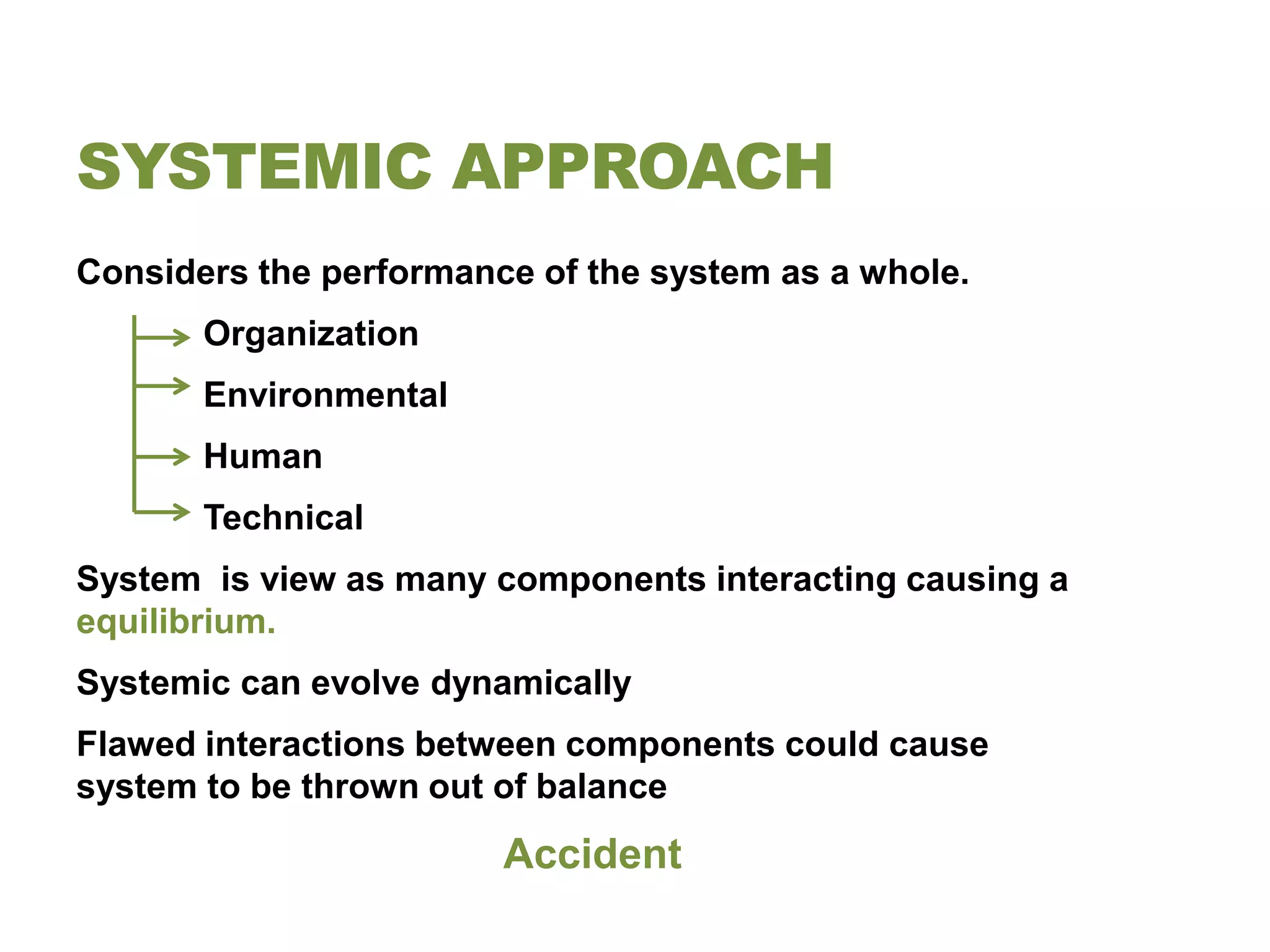
SYSTEMIC APPROACH
Considers the performance of the system as a whole.
       Organization
       Environmental
       Human
       Technical
System is view as many components interacting causing a
equilibrium.
Systemic can evolve dynamically
Flawed interactions between components could cause
system to be thrown out of balance
                        Accident
METHODS REVIEWED
Cognitive Reliability Error Analysis Method (CREAM)
(Hollnagel E. , Cognitive Reliability and Error Analysis Method., 1998)


The Functional Resonance Analysis Method (FRAM)
(Hollnagel E. , FRAM – The Functional Resonance Analysis Method, 2012)


AcciMap
(Rasmussen, 1997)


Systems-Theoretic Accident Model and Processes (STAMP)
(Leveson, 2004)
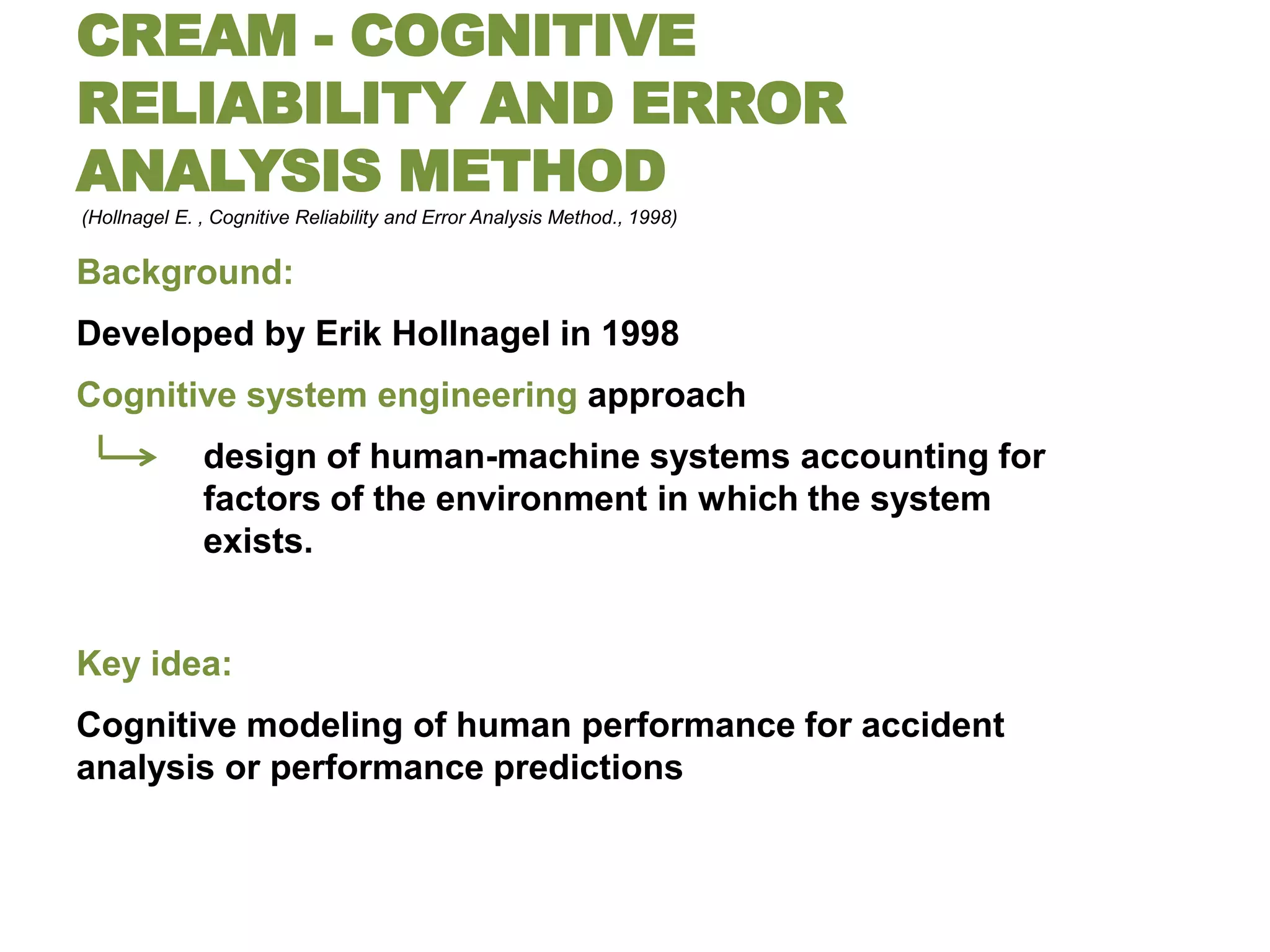
CREAM - COGNITIVE
RELIABILITY AND ERROR
ANALYSIS METHOD
(Hollnagel E. , Cognitive Reliability and Error Analysis Method., 1998)


Background:
Developed by Erik Hollnagel in 1998
Cognitive system engineering approach
              design of human-machine systems accounting for
              factors of the environment in which the system
              exists.


Key idea:
Cognitive modeling of human performance for accident
analysis or performance predictions
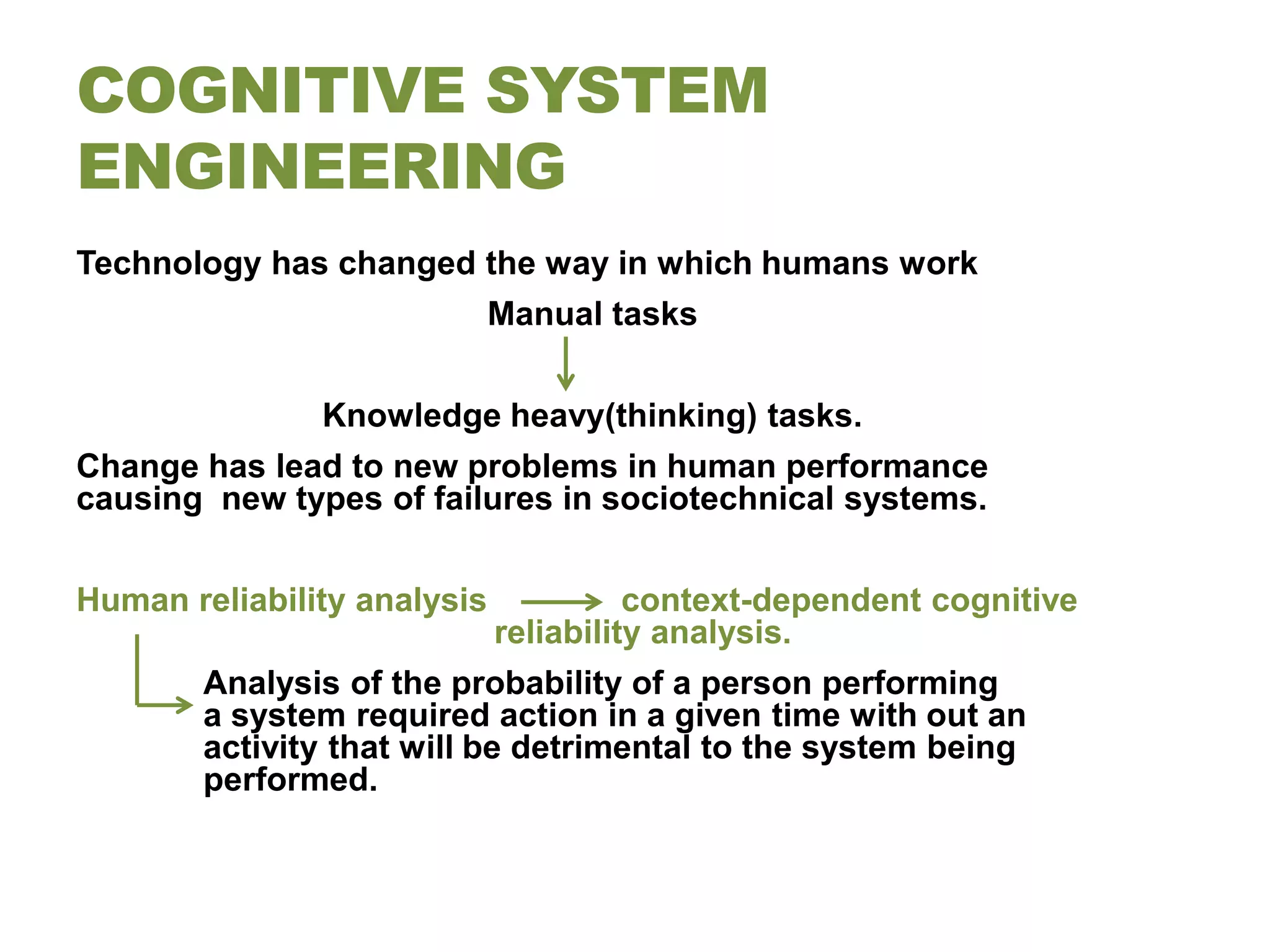
COGNITIVE SYSTEM
ENGINEERING
Technology has changed the way in which humans work
                             Manual tasks


               Knowledge heavy(thinking) tasks.
Change has lead to new problems in human performance
causing new types of failures in sociotechnical systems.


Human reliability analysis             context-dependent cognitive
                             reliability analysis.
        Analysis of the probability of a person performing
        a system required action in a given time with out an
        activity that will be detrimental to the system being
        performed.
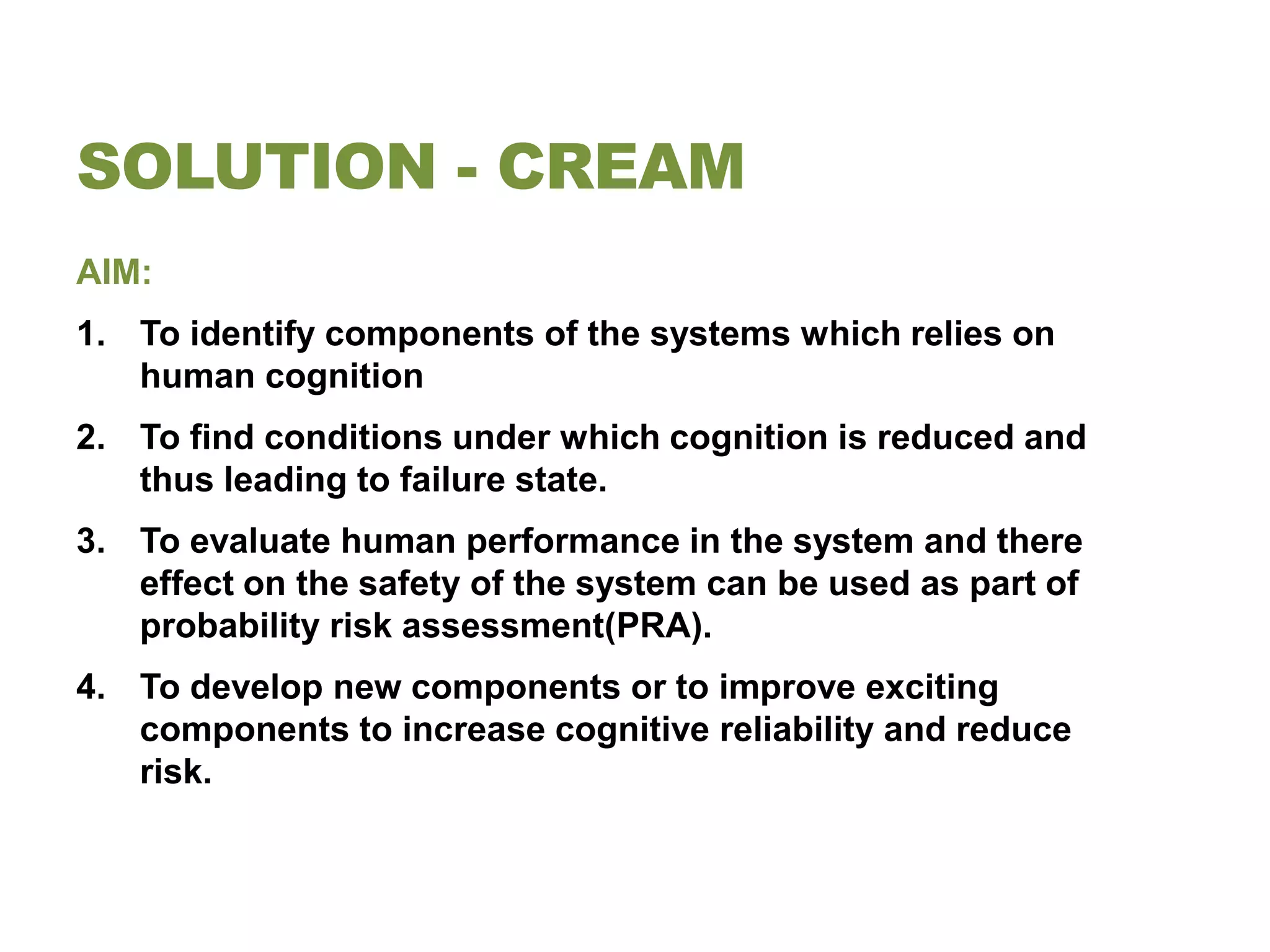
SOLUTION - CREAM
AIM:
1. To identify components of the systems which relies on
   human cognition
2. To find conditions under which cognition is reduced and
   thus leading to failure state.
3. To evaluate human performance in the system and there
   effect on the safety of the system can be used as part of
   probability risk assessment(PRA).
4. To develop new components or to improve exciting
   components to increase cognitive reliability and reduce
   risk.
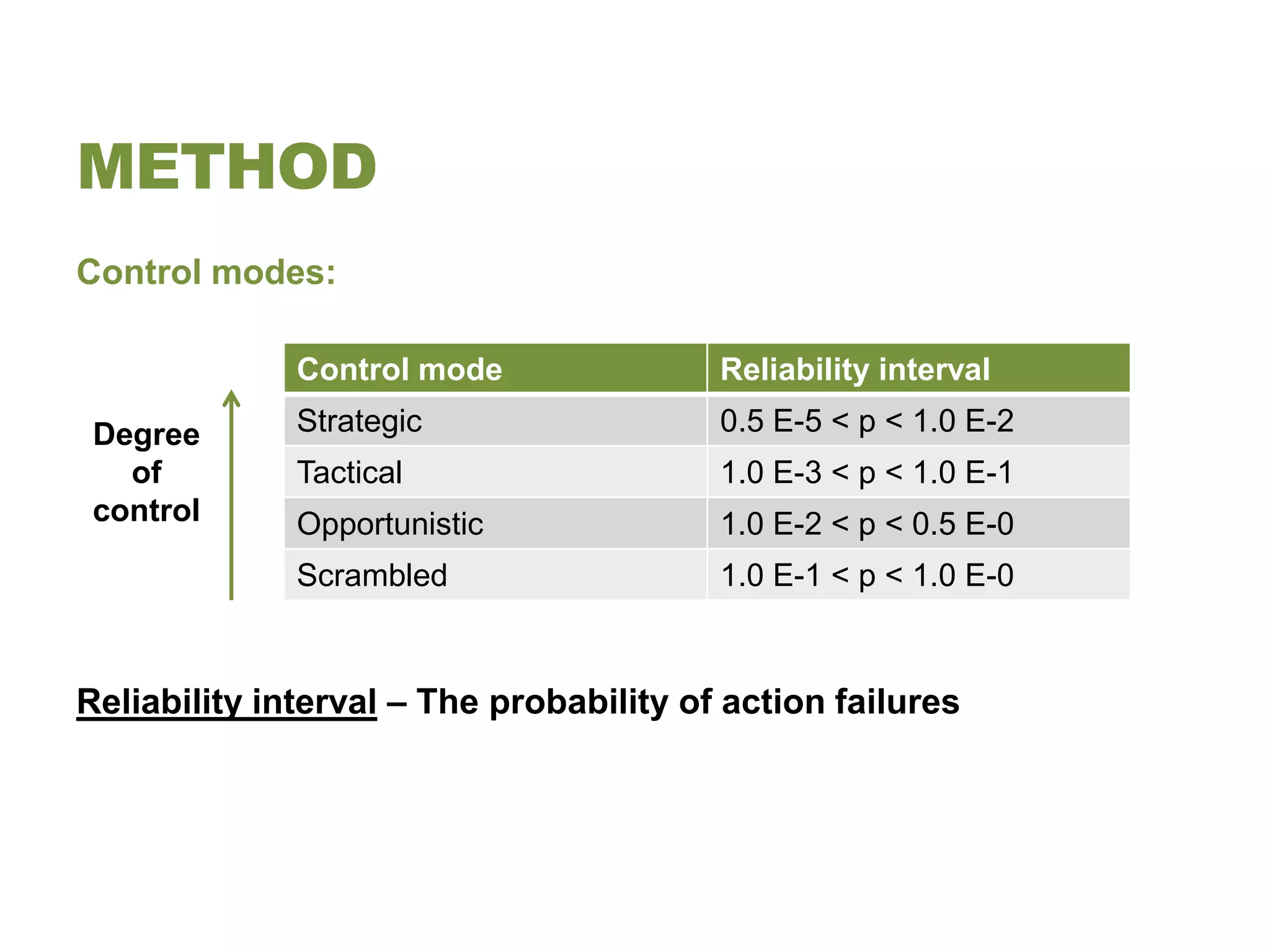
METHOD
Control modes:

              Control mode               Reliability interval

 Degree       Strategic                  0.5 E-5 < p < 1.0 E-2
   of         Tactical                   1.0 E-3 < p < 1.0 E-1
 control      Opportunistic              1.0 E-2 < p < 0.5 E-0
              Scrambled                  1.0 E-1 < p < 1.0 E-0


Reliability interval – The probability of action failures
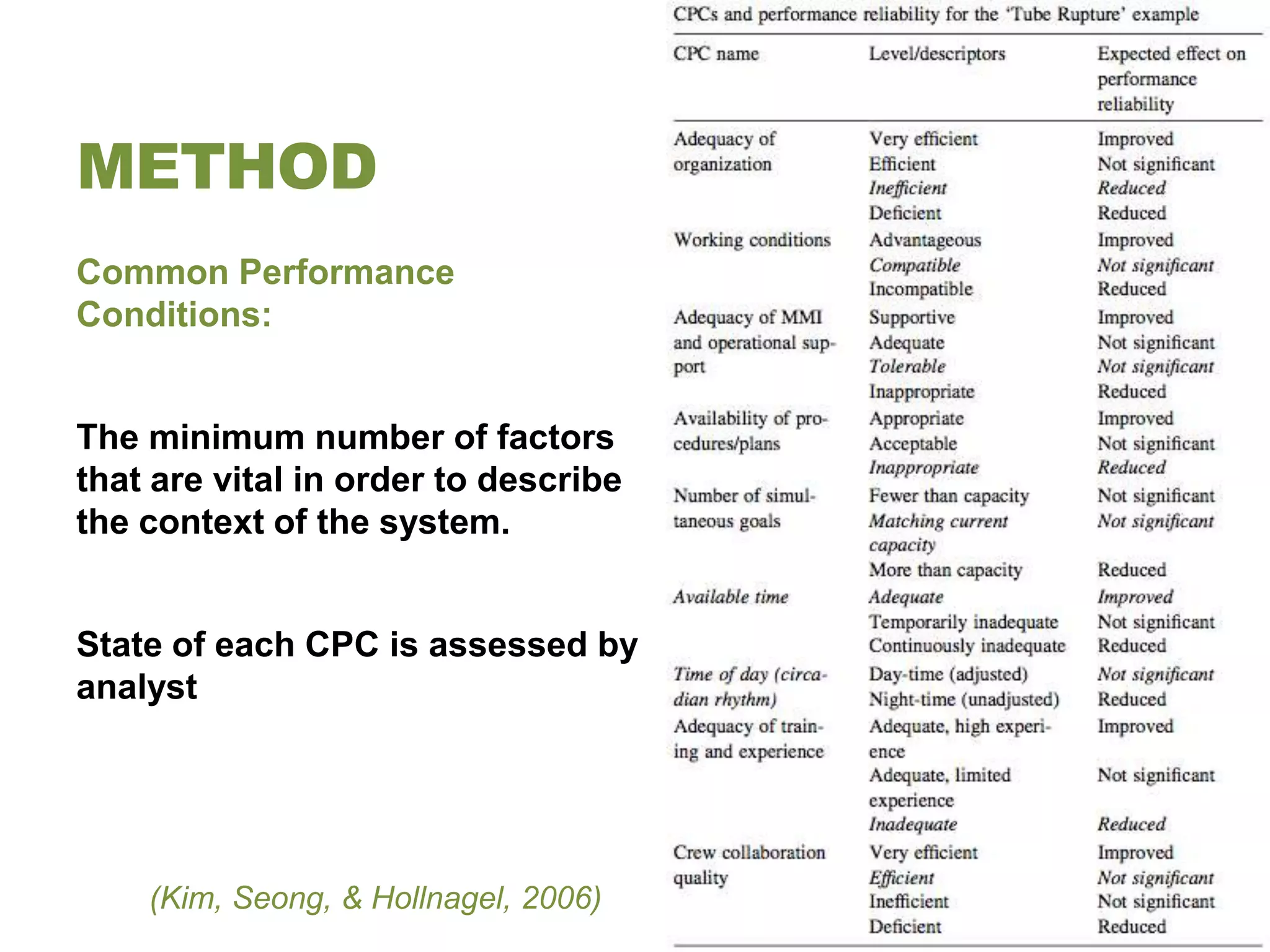
METHOD
Common Performance
Conditions:


The minimum number of factors
that are vital in order to describe
the context of the system.


State of each CPC is assessed by
analyst


    (Kim, Seong, & Hollnagel, 2006)
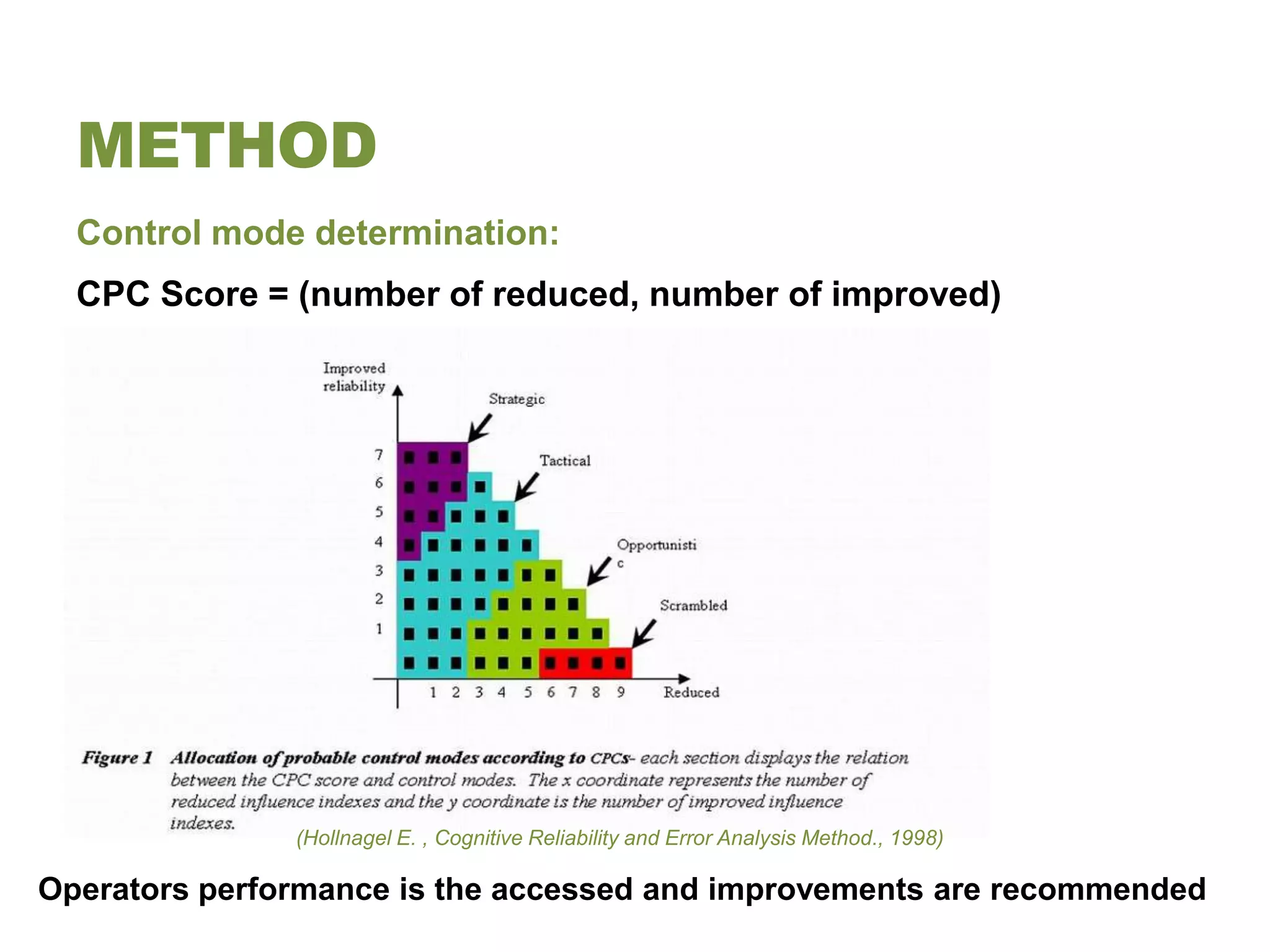
METHOD
  Control mode determination:
  CPC Score = (number of reduced, number of improved)


               (Hollnagel E. , Cognitive Reliability and Error Analysis Method., 1998)

Operators performance is the accessed and improvements are recommended
FRAM - FUNCTIONAL
RESONANCE ANALYSIS
METHOD
(Hollnagel E. , FRAM – The Functional Resonance Analysis Method, 2012)

Background:
Developed by Erik Hollnagel in 2004
Performance variability
       Performance in a system whither internal, external
dynamically fluctuates. Variability in complex systems is
normal.
Key idea:
Models how components of a system resonate and interact
with each other causing the system to lose balance leading
to accidents.
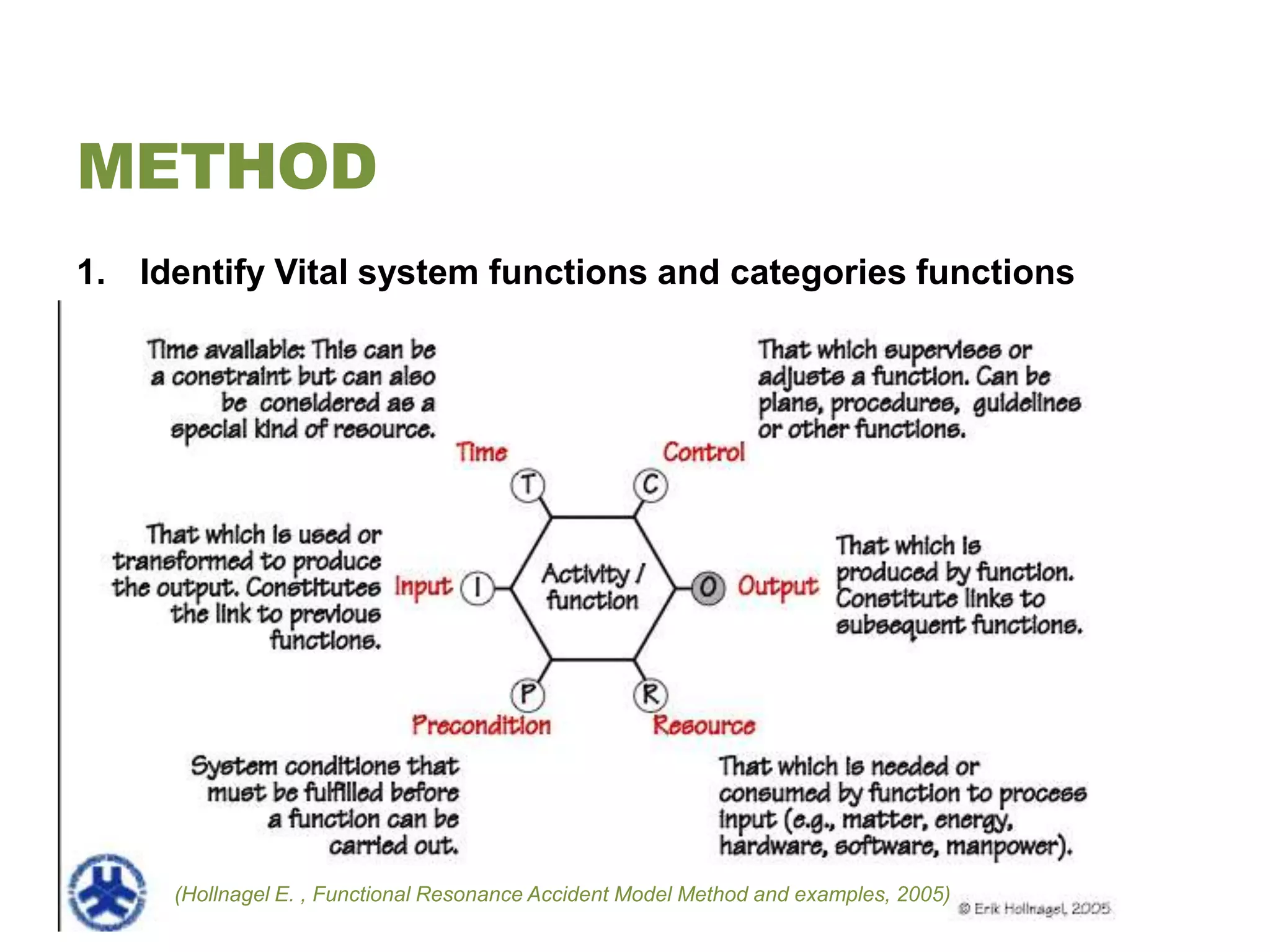
METHOD
1. Identify Vital system functions and categories functions


     (Hollnagel E. , Functional Resonance Accident Model Method and examples, 2005)
METHOD
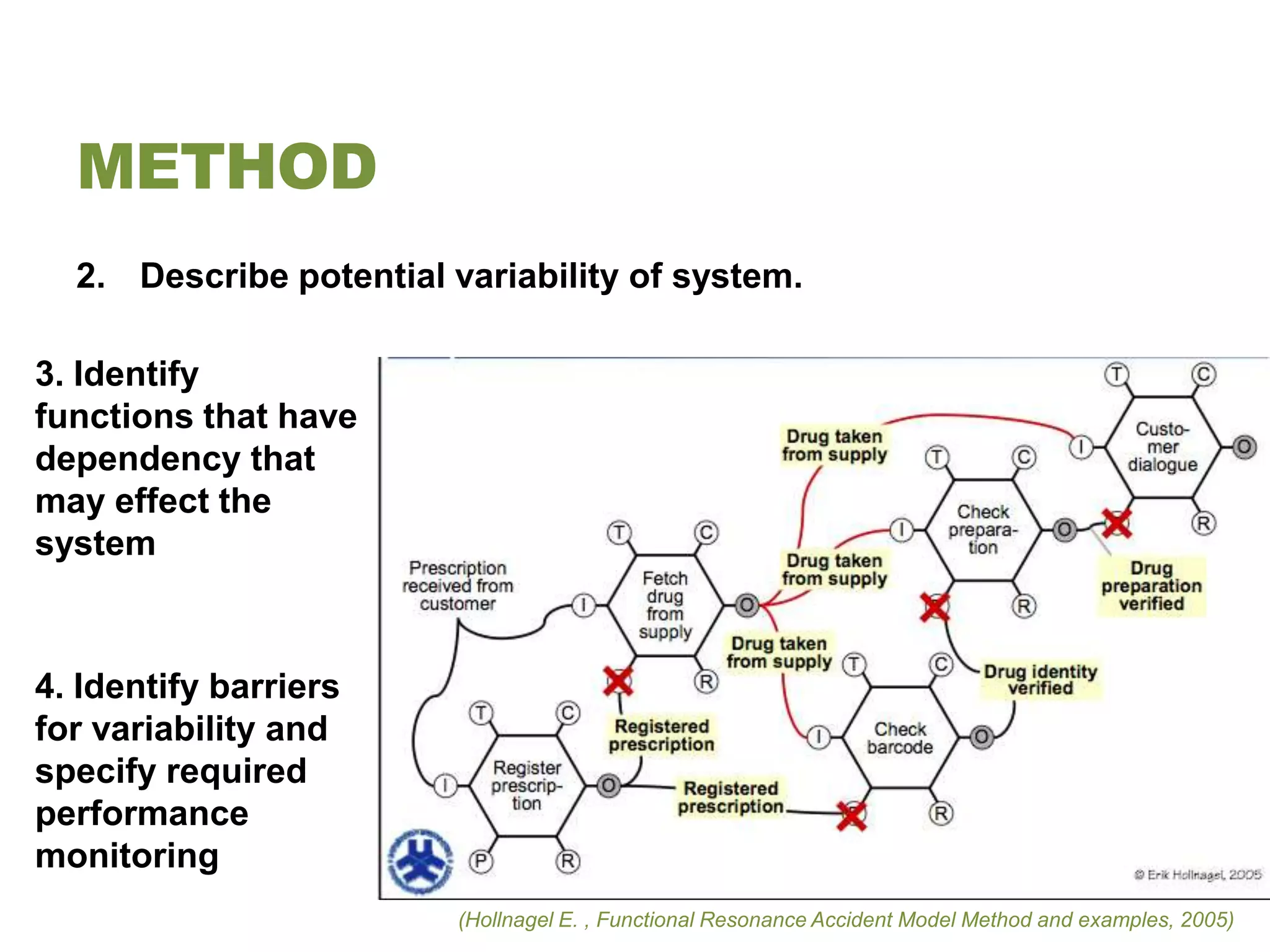
  2. Describe potential variability of system.

3. Identify
functions that have
dependency that
may effect the
system


4. Identify barriers
for variability and
specify required
performance
monitoring
                         (Hollnagel E. , Functional Resonance Accident Model Method and examples, 2005)
ACCI-MAP
(Rasmussen, 1997)

Background:
Developed by J. Rasmussen and I. Svedung in 2000
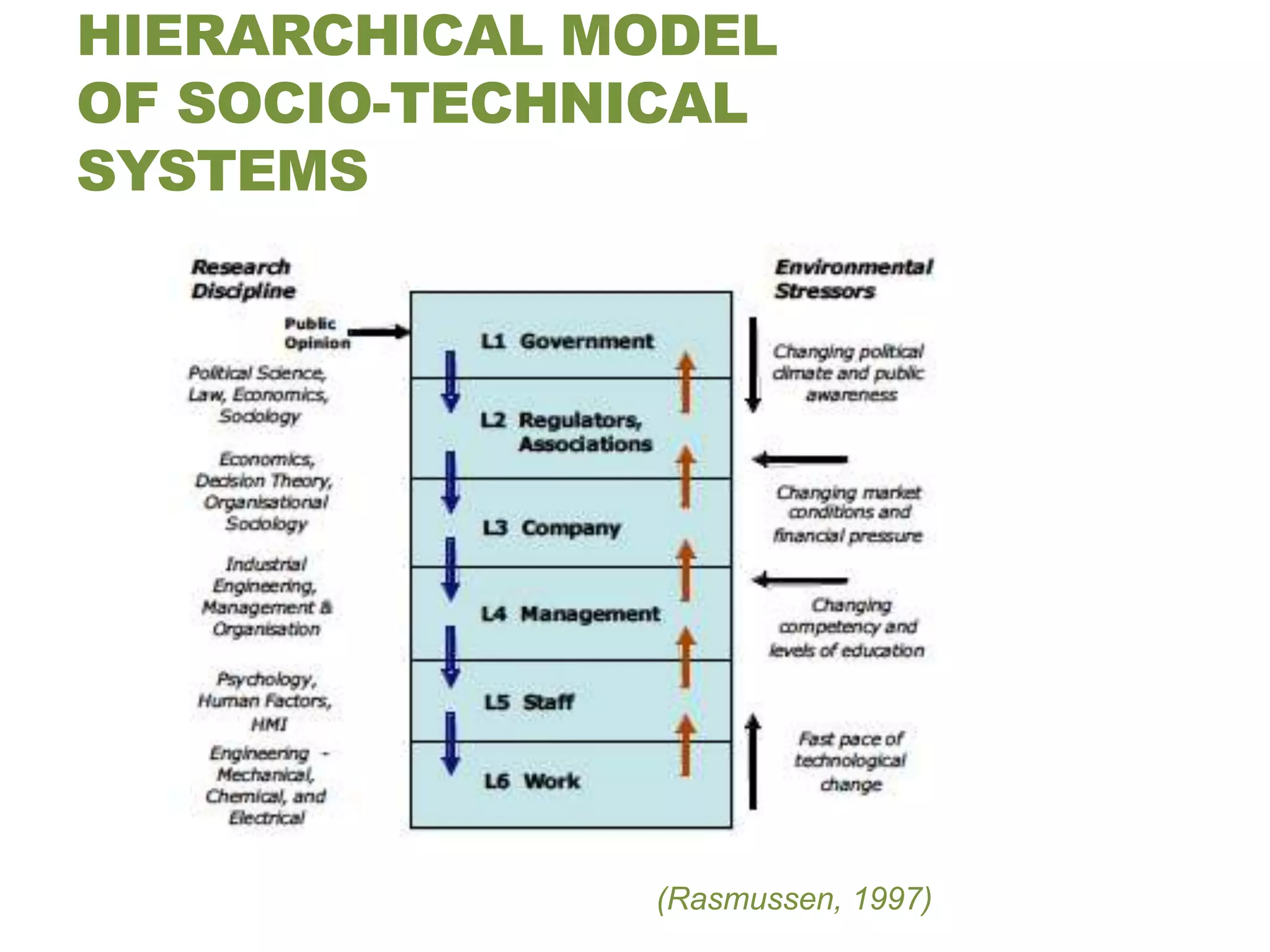
Utilizes Rasmussen hierarchical model of socio-technical
systems


Key idea:


A model that describes an accident in terms of different
levels of socio-technical systems
HIERARCHICAL MODEL
OF SOCIO-TECHNICAL
SYSTEMS


              (Rasmussen, 1997)
METHOD
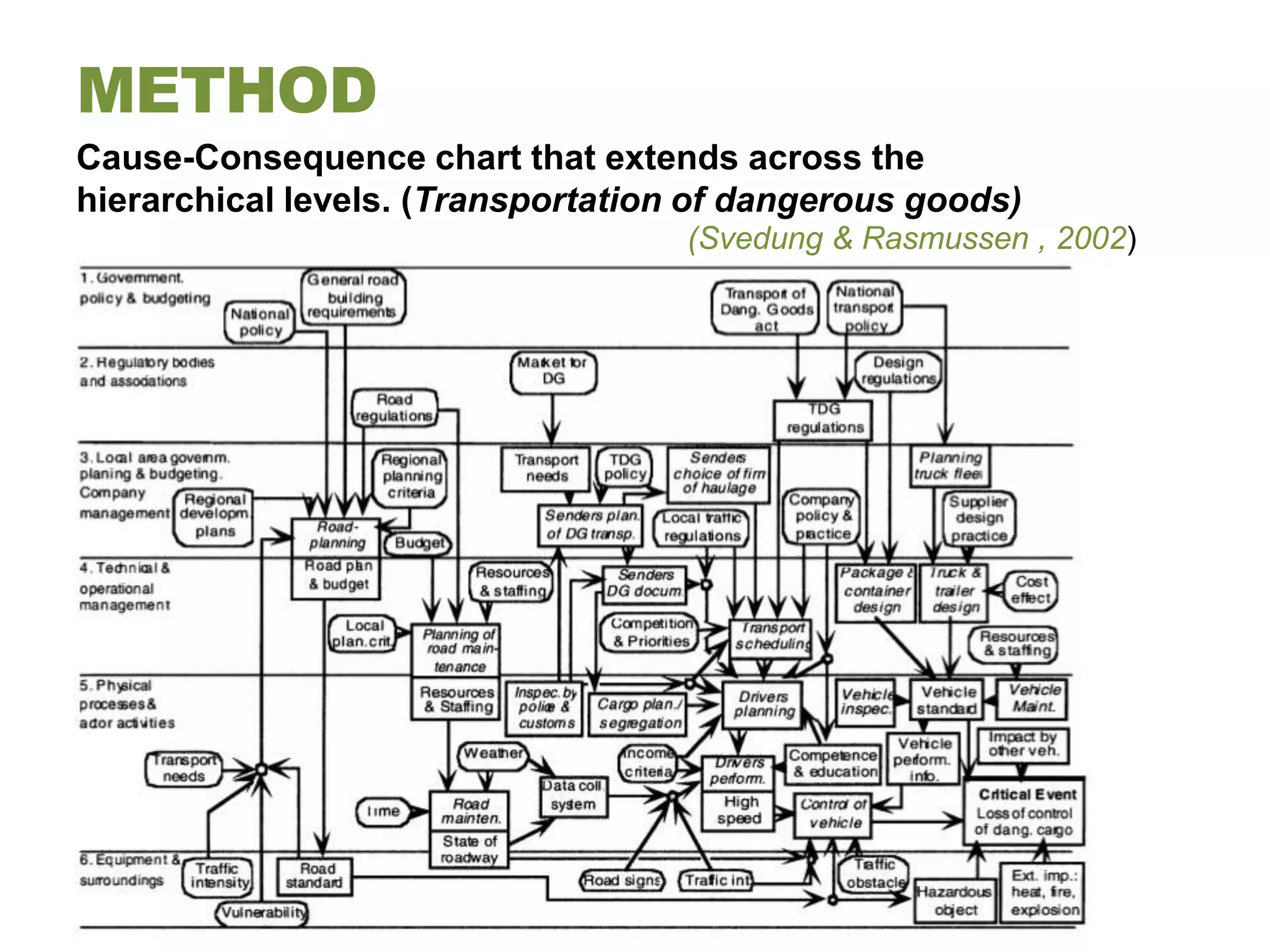
Cause-Consequence chart that extends across the
hierarchical levels. (Transportation of dangerous goods)
                                    (Svedung & Rasmussen , 2002)
STAMP - SYSTEMS-THEORETIC
ACCIDENT MODEL AND
PROCESSES
(Leveson, 2004)

Background:
Developed by Nancy Leveson in 2004
System theory
            Systems are self regulating, this is achieved through
            feedback loops


Key idea:
Accidents do not occur as a result of individual component
failures. Accidents are a results of external forces and
dysfunctional interactions of components not being correctly
managed .
METHOD
1. Development of hierarchical control structure which
   show the interactions between different system
   components, safety regulations and constraints.
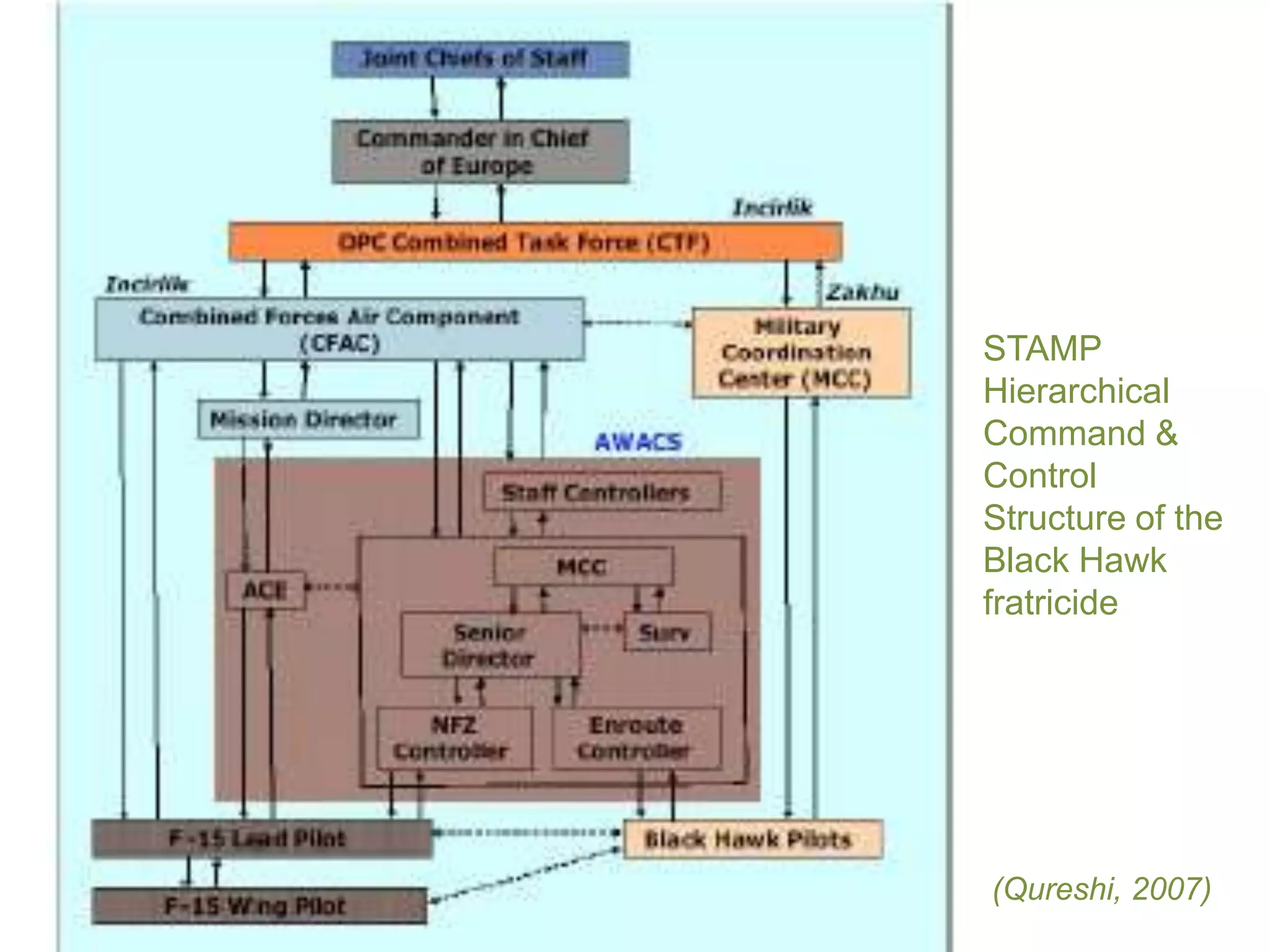
STAMP
Hierarchical
Command &
Control
Structure of the
Black Hawk
fratricide


(Qureshi, 2007)
METHOD
Identification of flawed control measures and there causes
looking at component interactions.


       Can identify constraints at each level
       Can see dysfunctional interactions
       Chain of events
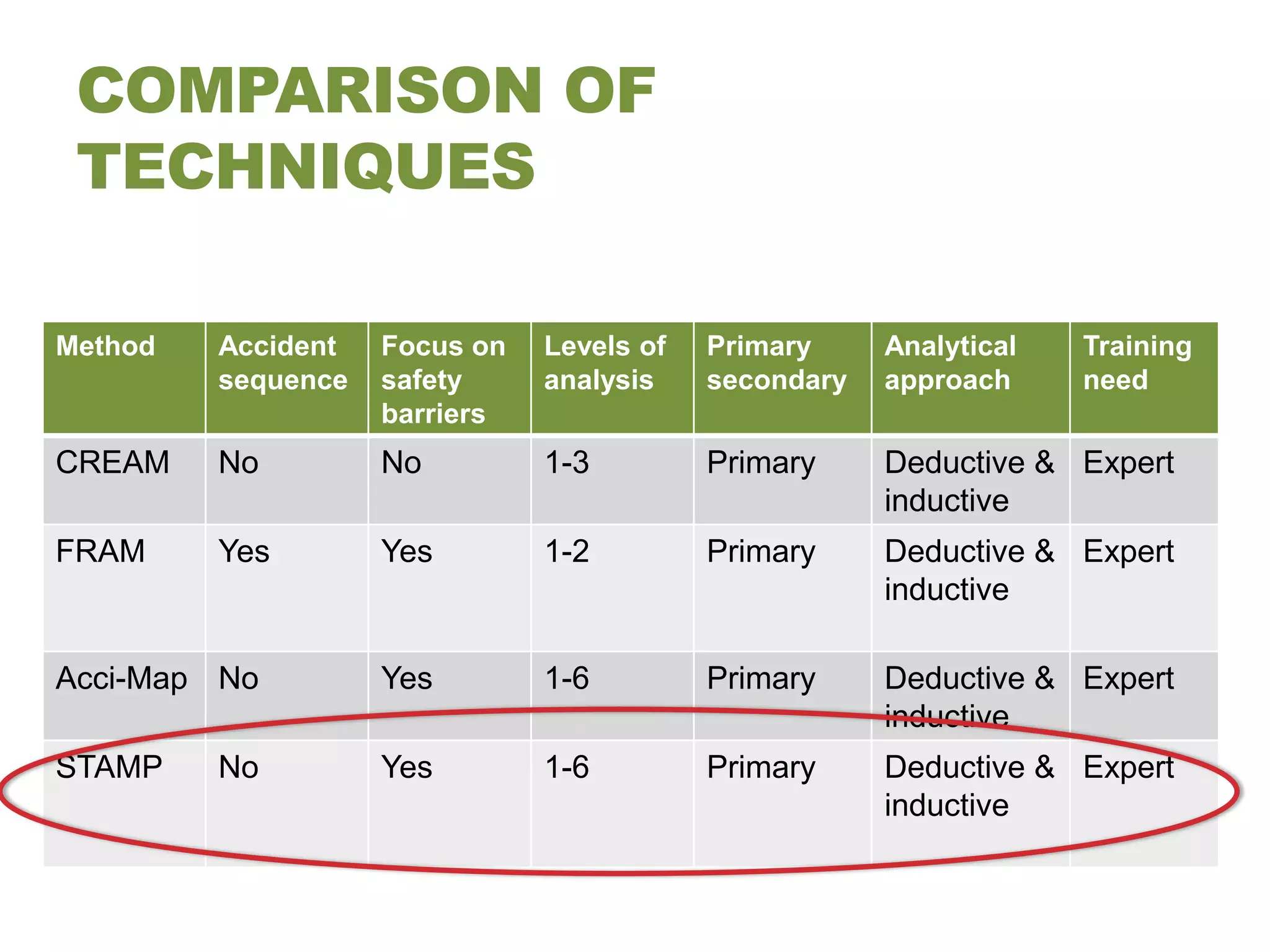
COMPARISON OF
 TECHNIQUES

Method   Accident   Focus on   Levels of   Primary     Analytical   Training
         sequence   safety     analysis    secondary   approach     need
                    barriers
CREAM    No         No         1-3         Primary     Deductive & Expert
                                                       inductive
FRAM     Yes        Yes        1-2         Primary     Deductive & Expert
                                                       inductive

Acci-Map No         Yes        1-6         Primary     Deductive & Expert
                                                       inductive
STAMP    No         Yes        1-6         Primary     Deductive & Expert
                                                       inductive
REFERENCES
Hollnagel, E. (1998). Cognitive Reliability and Error Analysis Method. Oxford: Elsevier Science Ltd.
Hollnagel, E. (2012). FRAM – The Functional Resonance Analysis Method. Farnham: Ashgate.
Hollnagel, E. (2005). Functional Resonance Accident Model Method and examples. COGNITIVE SYSTEMS
ENGINEERING LABORATORY . University of Linköping.
Hollnagel, E. (2002). Understanding accidents-from root causes to performance variability. Human Factors and
Power Plants, 2002. Proceedings of the 2002 IEEE 7th Conference on , (pp. 1 - 1-6 ).
Kim, M., Seong, P., & Hollnagel, E. (2006). A probabilistic approach for determining the control mode in CREAM.
Reliability Engineering and System Safety , 191-199.
Leveson, N. G. (2004). A new accident model for engineering safer systems. Safety Science , 237-270.
Qureshi, Z. H. (2007). A review of accident modelling approaches for complex socio-technical systems. SCS '07
Proceedings of the twelfth Australian workshop on Safety critical systems and software and safety-related
programmable systems (pp. 47-59). Darlinghurst: Australian Computer Society.
Rasmussen, J. (1997). Risk management in a dynamic society: a modelling problem. Safety Sci. , 183–213.
Sklet, S. (2004). Comparison of some selected methods for accident investigation. Journal of hazardous
materials , 29-37.
Svedung, I., & Rasmussen , J. (2002). Graphic representation of accident scenarios: mapping system structure
and the causation of accident. Safety Science , 397-417.

Overview of Systemic Modeling Approaches

  • 1.
  • 2.
    TASK To give anoverview of systemic modeling approaches Discuss selected systemic accident modeling techniques and the academic literature surrounding them. To expanded the frame work for comparing accident modeling techniques set out in Comparison of some selected methods for accident investigation (Sklet, 2004) To Compare selected techniques using the expanded framework
  • 3.
    SYSTEMIC APPROACH Considers theperformance of the system as a whole. Organization Environmental Human Technical System is view as many components interacting causing a equilibrium. Systemic can evolve dynamically Flawed interactions between components could cause system to be thrown out of balance Accident
  • 4.
    METHODS REVIEWED Cognitive ReliabilityError Analysis Method (CREAM) (Hollnagel E. , Cognitive Reliability and Error Analysis Method., 1998) The Functional Resonance Analysis Method (FRAM) (Hollnagel E. , FRAM – The Functional Resonance Analysis Method, 2012) AcciMap (Rasmussen, 1997) Systems-Theoretic Accident Model and Processes (STAMP) (Leveson, 2004)
  • 5.
    CREAM - COGNITIVE RELIABILITYAND ERROR ANALYSIS METHOD (Hollnagel E. , Cognitive Reliability and Error Analysis Method., 1998) Background: Developed by Erik Hollnagel in 1998 Cognitive system engineering approach design of human-machine systems accounting for factors of the environment in which the system exists. Key idea: Cognitive modeling of human performance for accident analysis or performance predictions
  • 6.
    COGNITIVE SYSTEM ENGINEERING Technology haschanged the way in which humans work Manual tasks Knowledge heavy(thinking) tasks. Change has lead to new problems in human performance causing new types of failures in sociotechnical systems. Human reliability analysis context-dependent cognitive reliability analysis. Analysis of the probability of a person performing a system required action in a given time with out an activity that will be detrimental to the system being performed.
  • 7.
    SOLUTION - CREAM AIM: 1.To identify components of the systems which relies on human cognition 2. To find conditions under which cognition is reduced and thus leading to failure state. 3. To evaluate human performance in the system and there effect on the safety of the system can be used as part of probability risk assessment(PRA). 4. To develop new components or to improve exciting components to increase cognitive reliability and reduce risk.
  • 8.
    METHOD Control modes: Control mode Reliability interval Degree Strategic 0.5 E-5 < p < 1.0 E-2 of Tactical 1.0 E-3 < p < 1.0 E-1 control Opportunistic 1.0 E-2 < p < 0.5 E-0 Scrambled 1.0 E-1 < p < 1.0 E-0 Reliability interval – The probability of action failures
  • 9.
    METHOD Common Performance Conditions: The minimumnumber of factors that are vital in order to describe the context of the system. State of each CPC is assessed by analyst (Kim, Seong, & Hollnagel, 2006)
  • 10.
    METHOD Controlmode determination: CPC Score = (number of reduced, number of improved) (Hollnagel E. , Cognitive Reliability and Error Analysis Method., 1998) Operators performance is the accessed and improvements are recommended
  • 11.
    FRAM - FUNCTIONAL RESONANCEANALYSIS METHOD (Hollnagel E. , FRAM – The Functional Resonance Analysis Method, 2012) Background: Developed by Erik Hollnagel in 2004 Performance variability Performance in a system whither internal, external dynamically fluctuates. Variability in complex systems is normal. Key idea: Models how components of a system resonate and interact with each other causing the system to lose balance leading to accidents.
  • 12.
    METHOD 1. Identify Vitalsystem functions and categories functions (Hollnagel E. , Functional Resonance Accident Model Method and examples, 2005)
  • 13.
    METHOD 2.Describe potential variability of system. 3. Identify functions that have dependency that may effect the system 4. Identify barriers for variability and specify required performance monitoring (Hollnagel E. , Functional Resonance Accident Model Method and examples, 2005)
  • 14.
    ACCI-MAP (Rasmussen, 1997) Background: Developed byJ. Rasmussen and I. Svedung in 2000 Utilizes Rasmussen hierarchical model of socio-technical systems Key idea: A model that describes an accident in terms of different levels of socio-technical systems
  • 15.
  • 16.
    METHOD Cause-Consequence chart thatextends across the hierarchical levels. (Transportation of dangerous goods) (Svedung & Rasmussen , 2002)
  • 17.
    STAMP - SYSTEMS-THEORETIC ACCIDENTMODEL AND PROCESSES (Leveson, 2004) Background: Developed by Nancy Leveson in 2004 System theory Systems are self regulating, this is achieved through feedback loops Key idea: Accidents do not occur as a result of individual component failures. Accidents are a results of external forces and dysfunctional interactions of components not being correctly managed .
  • 18.
    METHOD 1. Development ofhierarchical control structure which show the interactions between different system components, safety regulations and constraints.
  • 19.
    STAMP Hierarchical Command & Control Structure ofthe Black Hawk fratricide (Qureshi, 2007)
  • 20.
    METHOD Identification of flawedcontrol measures and there causes looking at component interactions. Can identify constraints at each level Can see dysfunctional interactions Chain of events
  • 21.
    COMPARISON OF TECHNIQUES Method Accident Focus on Levels of Primary Analytical Training sequence safety analysis secondary approach need barriers CREAM No No 1-3 Primary Deductive & Expert inductive FRAM Yes Yes 1-2 Primary Deductive & Expert inductive Acci-Map No Yes 1-6 Primary Deductive & Expert inductive STAMP No Yes 1-6 Primary Deductive & Expert inductive
  • 22.
    REFERENCES Hollnagel, E. (1998).Cognitive Reliability and Error Analysis Method. Oxford: Elsevier Science Ltd. Hollnagel, E. (2012). FRAM – The Functional Resonance Analysis Method. Farnham: Ashgate. Hollnagel, E. (2005). Functional Resonance Accident Model Method and examples. COGNITIVE SYSTEMS ENGINEERING LABORATORY . University of Linköping. Hollnagel, E. (2002). Understanding accidents-from root causes to performance variability. Human Factors and Power Plants, 2002. Proceedings of the 2002 IEEE 7th Conference on , (pp. 1 - 1-6 ). Kim, M., Seong, P., & Hollnagel, E. (2006). A probabilistic approach for determining the control mode in CREAM. Reliability Engineering and System Safety , 191-199. Leveson, N. G. (2004). A new accident model for engineering safer systems. Safety Science , 237-270. Qureshi, Z. H. (2007). A review of accident modelling approaches for complex socio-technical systems. SCS '07 Proceedings of the twelfth Australian workshop on Safety critical systems and software and safety-related programmable systems (pp. 47-59). Darlinghurst: Australian Computer Society. Rasmussen, J. (1997). Risk management in a dynamic society: a modelling problem. Safety Sci. , 183–213. Sklet, S. (2004). Comparison of some selected methods for accident investigation. Journal of hazardous materials , 29-37. Svedung, I., & Rasmussen , J. (2002). Graphic representation of accident scenarios: mapping system structure and the causation of accident. Safety Science , 397-417.