What is Software?
Definition:
• Various kinds of programs used to operate
computers and related devices
Case #1: Writing Software for
Processes
Microsoft’s Business Solutions Division:
• Teams formed for different industries
• Injected industry-specific codes directly into
its core software platforms
• Hired business technology professionals
steeped in sector-specific knowledge
Case #1: Writing Software for
Processes
Microsoft’s New Strategy:
• Creating accelerators aimed at business processes
common to companies in a given industry
• Inserting industry-enabling layers to serve the needs
of a broad base of companies in a particular sector
• Seeking partnerships with vendors that have deep
industry roots
Case #1: Writing Software for
Processes
1. A common phrase among IT professionals is
“The world views its data through
Windows”. Why does Microsoft dominate
the desktop and networked software
market? Visit its website at
www.microsoft.com and review its broad
range of software products and services to
help with your answer.
Case #1: Writing Software for
Processes
2. How successful will Microsoft be in competing with
software vendors who specialize in vertical market
applications like health care, retail, and specialty
services? Why?
3. Do you agree with Microsoft’s strategy to develop
industry-specific partners to capitalize on
opportunities in both large and small business
sectors? Is there an advantage or a disadvantage
to being one of Microsoft’s partners in this type of
relationship? Explain.
Case #1: Writing Software for
Processes
4. Does Microsoft’s entry into industry-specific
applications signal the end for smaller
industry-specific software developers?
What changes in strategy by such developers
are necessary to compete with Microsoft?
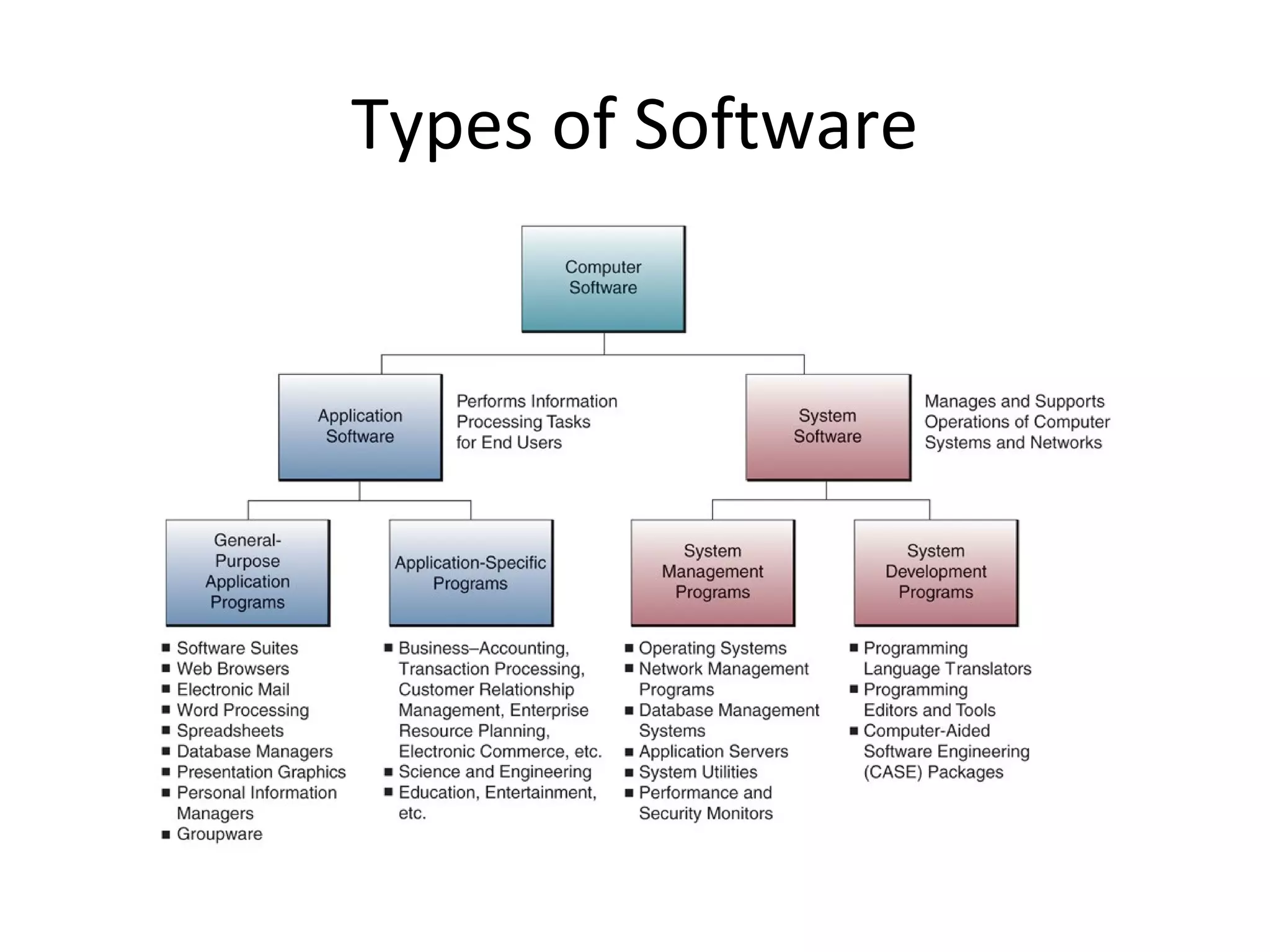
Types of Software
Types of Software
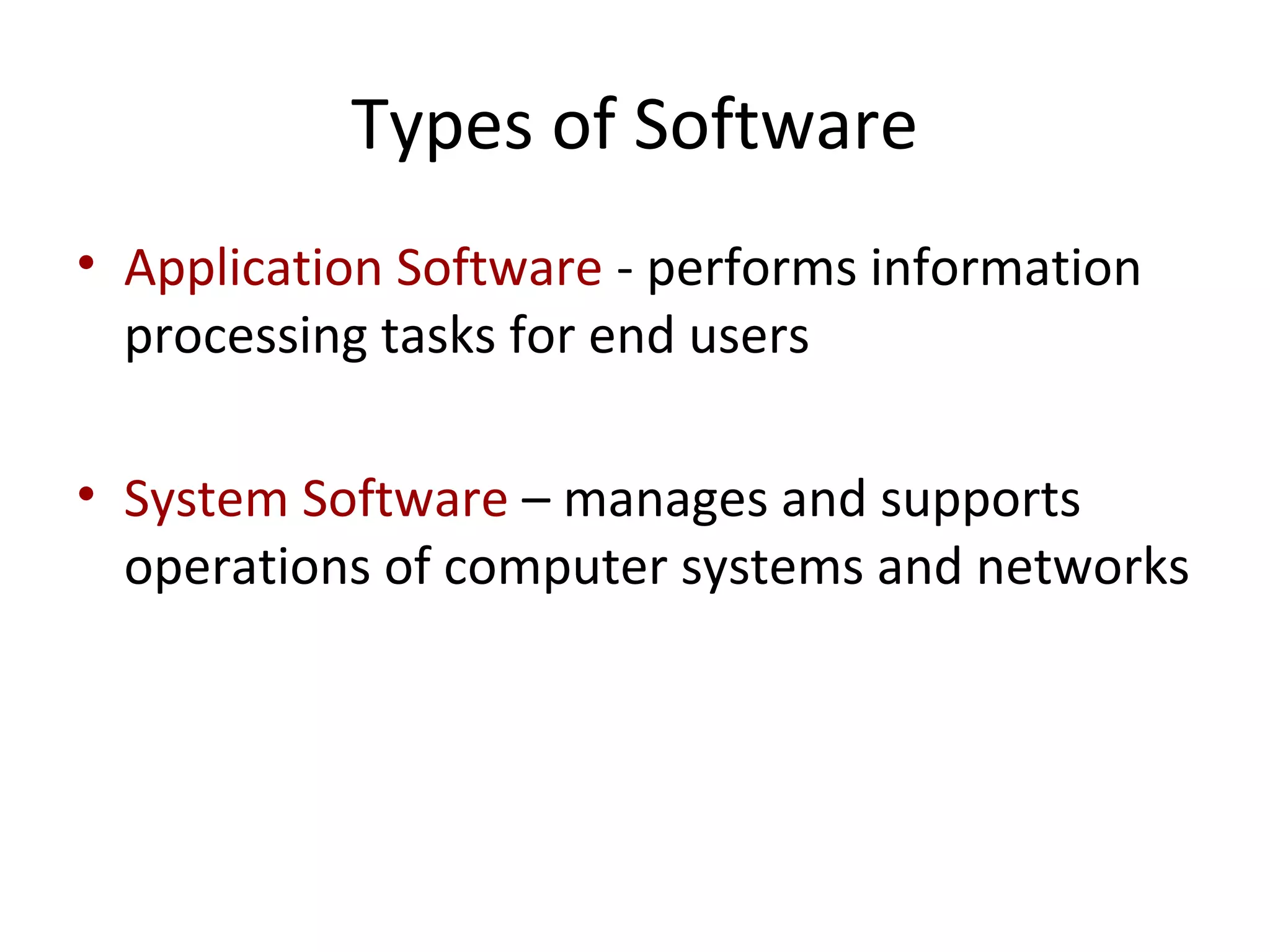
• Application Software - performs information
processing tasks for end users
• System Software – manages and supports
operations of computer systems and networks
Application Software
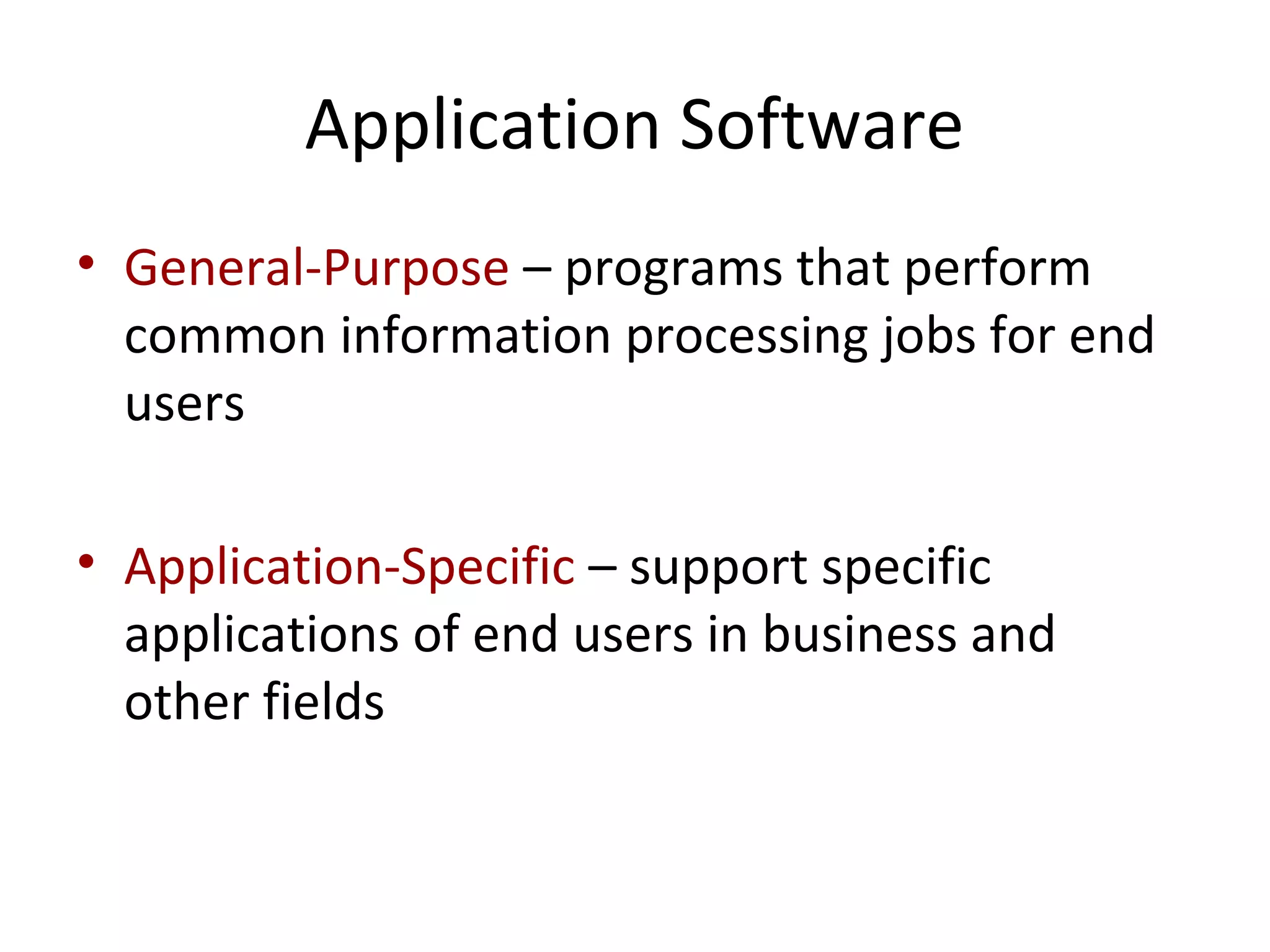
• General-Purpose – programs that perform
common information processing jobs for end
users
• Application-Specific – support specific
applications of end users in business and
other fields
How is Software Developed?
• Custom Software – software applications that
are developed within an organization for use
by that organization
• Commercial Off-the-shelf (COTS) Software –
software that is developed by a software
developer with the intention of selling the
software in multiple copies
General-Purpose Application Software
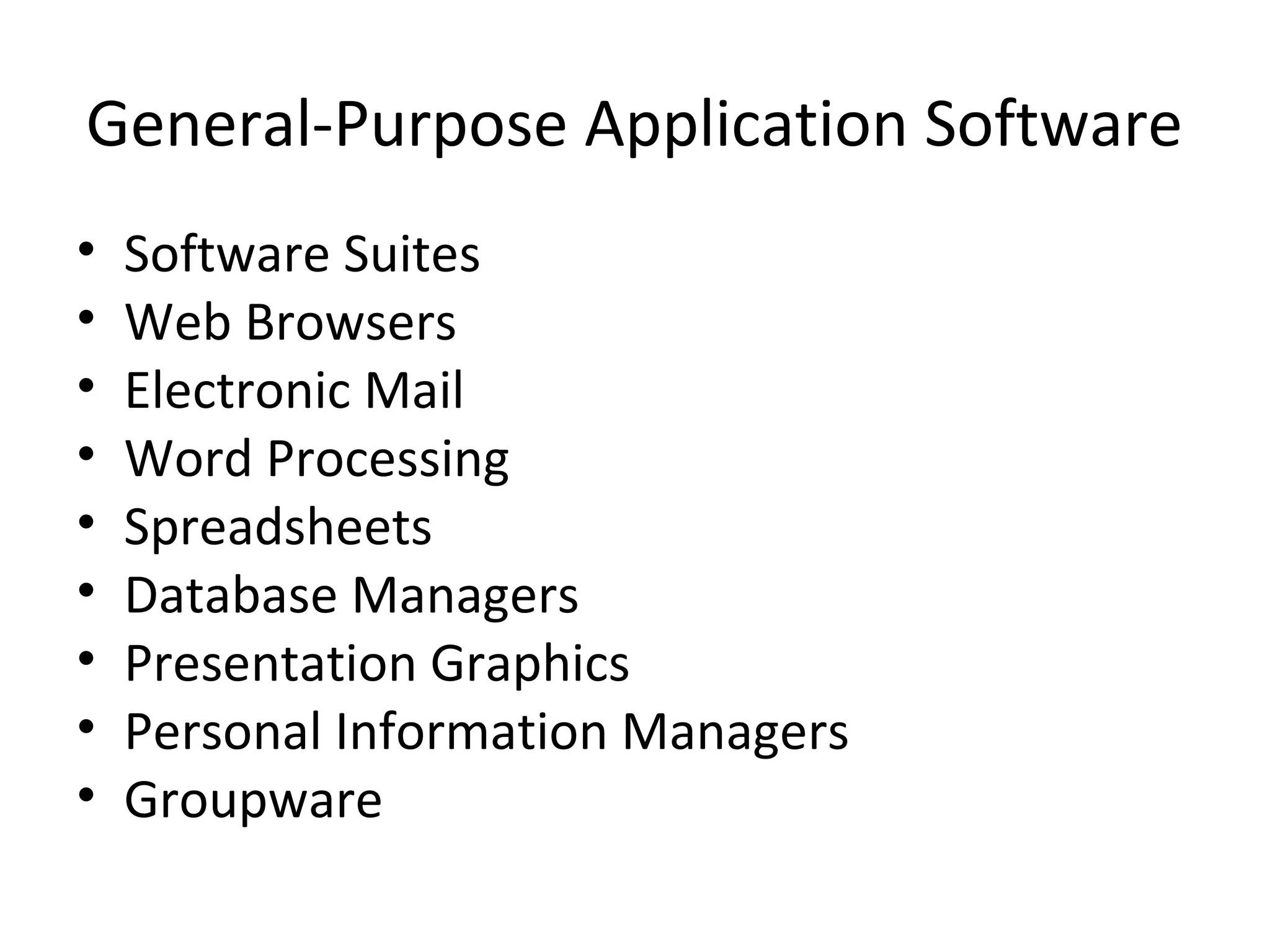
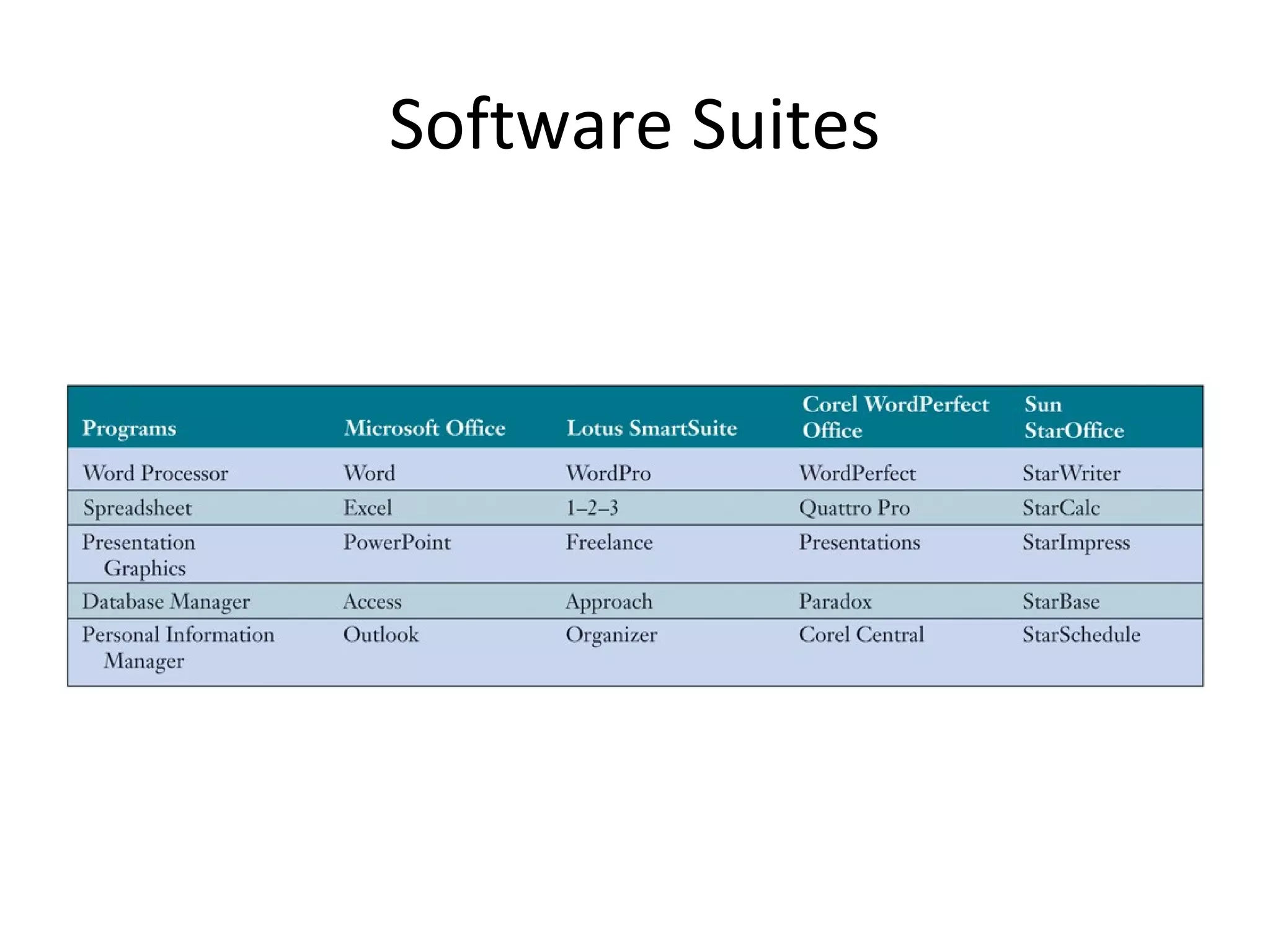
• Software Suites
• Web Browsers
• Electronic Mail
• Word Processing
• Spreadsheets
• Database Managers
• Presentation Graphics
• Personal Information Managers
• Groupware
Software Suites
Integrated Packages
Definition:
• Combine some of the functions of several
programs into one software package
Graphical User Interface (GUI)
Definition:
• Icons, tool and status bars, menus, and so on,
which gives an application its look and feel
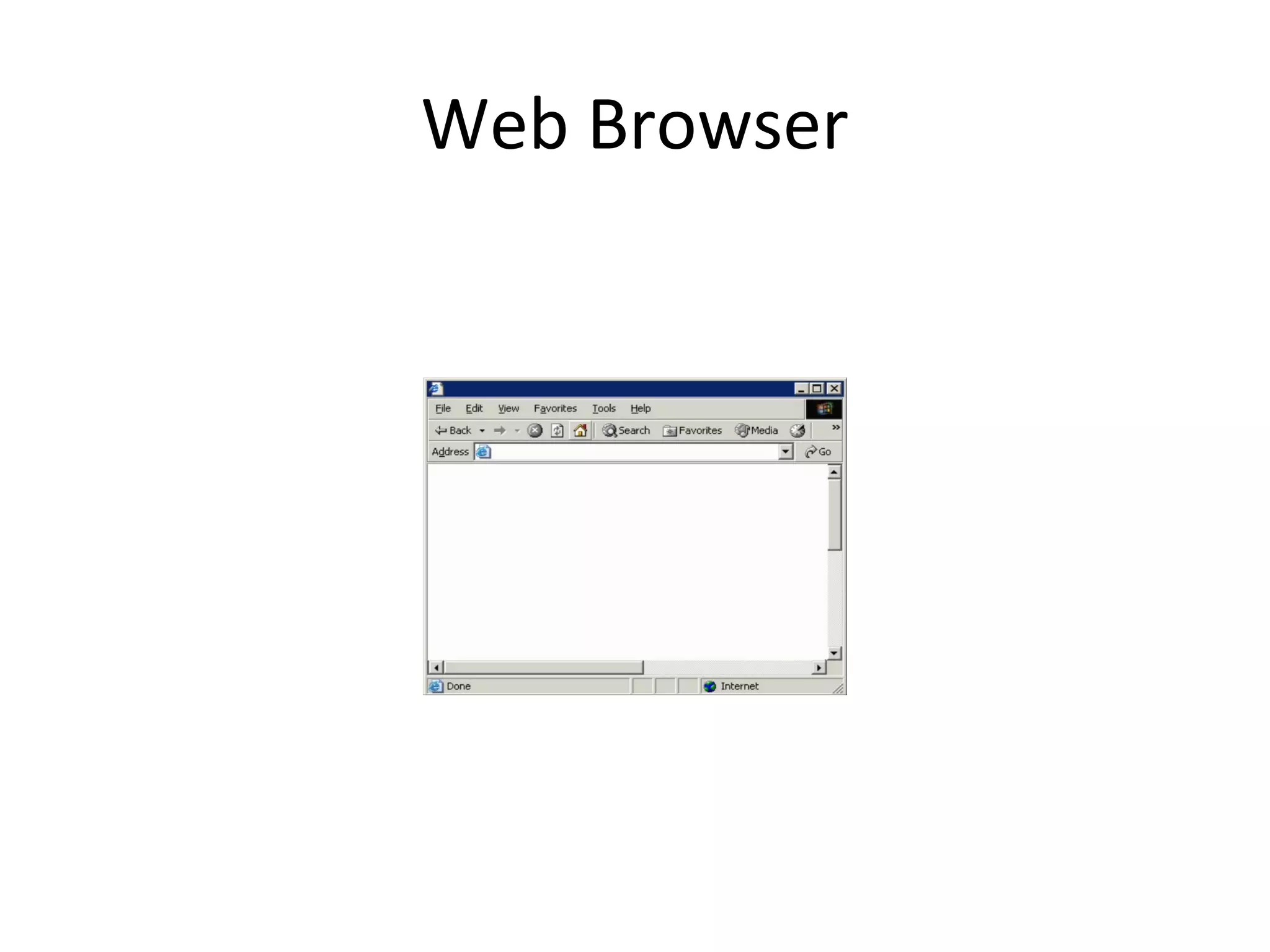
Web Browser
Definition:
• Software interface used to point and click
through the hyperlinked resources of the
Internet
Web Browser
Electronic Mail & Instant Messaging
• Electronic Mail – software used to send and
receive electronic messages and file
attachments via the Internet, intranets or
extranets
• Instant Messaging (IM) – software used to
send and receive electronic messages
instantly to facilitate real time communication
and collaboration
E-mail
Word Processing & Desktop Publishing
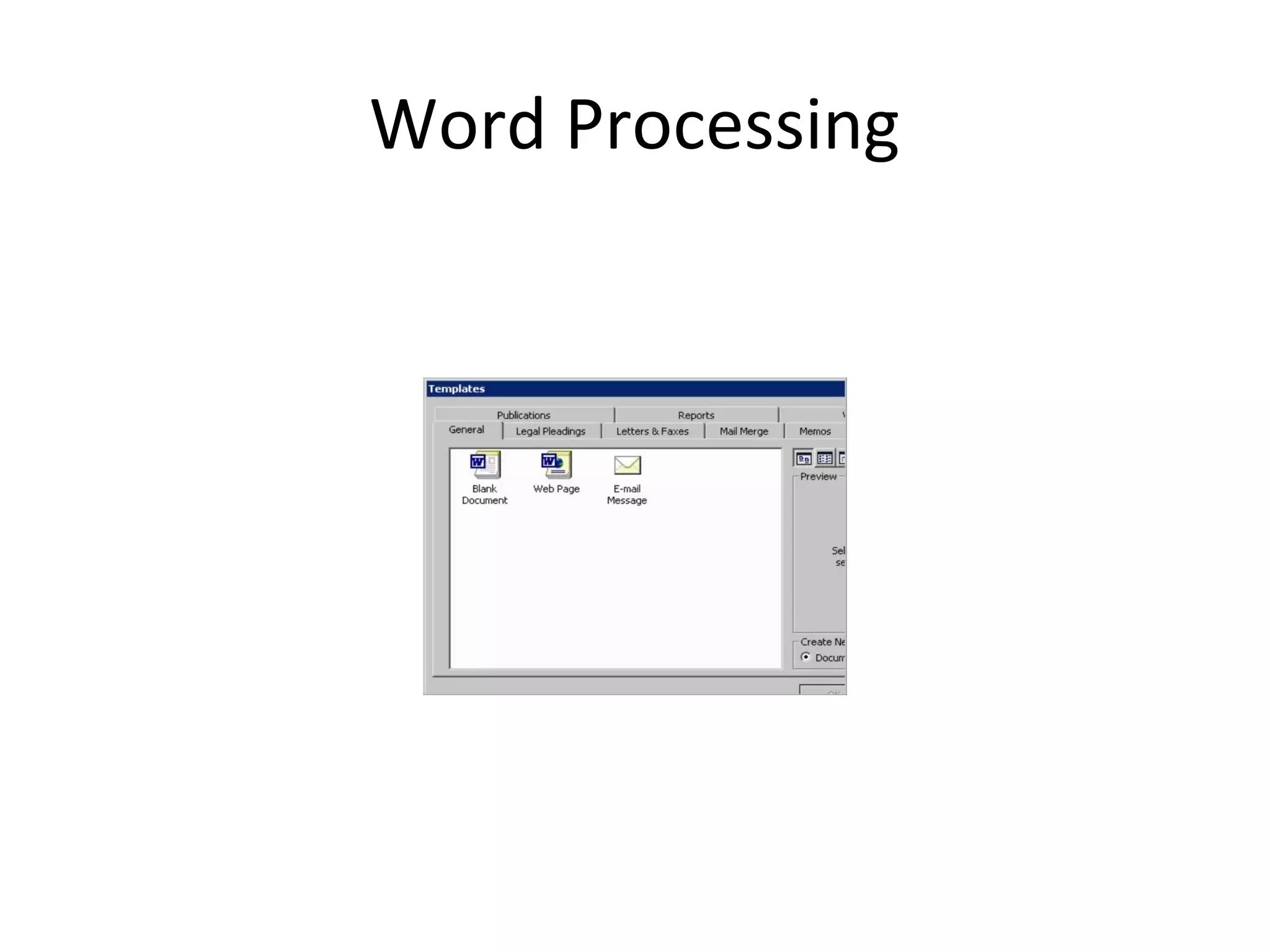
• Word Processing – software that supports the
creation, editing, revision and printing of
documents
• Desktop Publishing (DTP) – software that
supports the production of materials that look
professionally published
Word Processing
Electronic Spreadsheets
Definition:
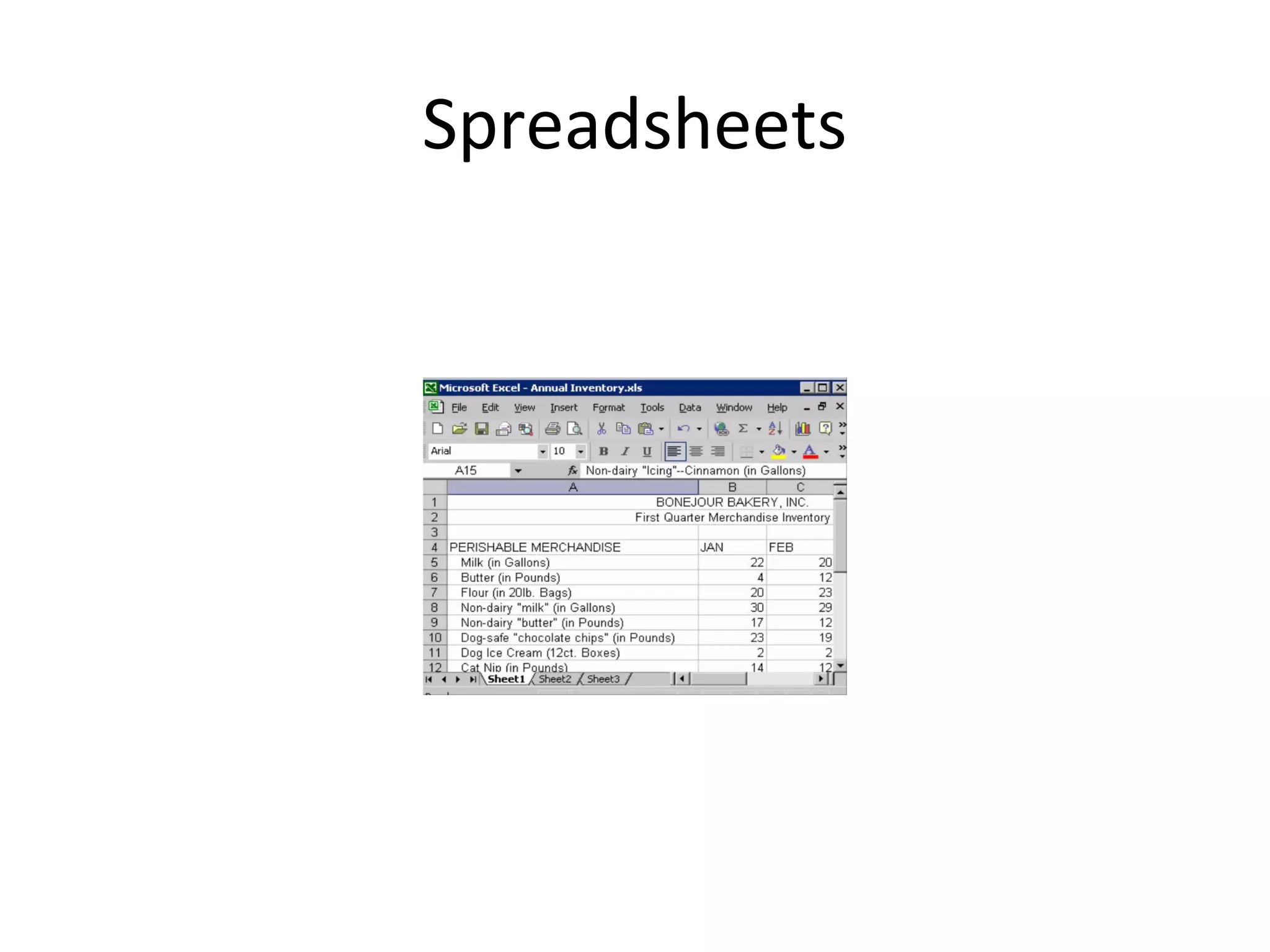
• Software that supports the development of
electronic worksheets consisting of rows and
columns used for business analysis, planning
and modeling
Spreadsheets
Presentation Graphics
Definition:
• Software that helps convert numeric data into
graphics displays and prepare multimedia
presentations including graphics, photos,
animation, and video clips
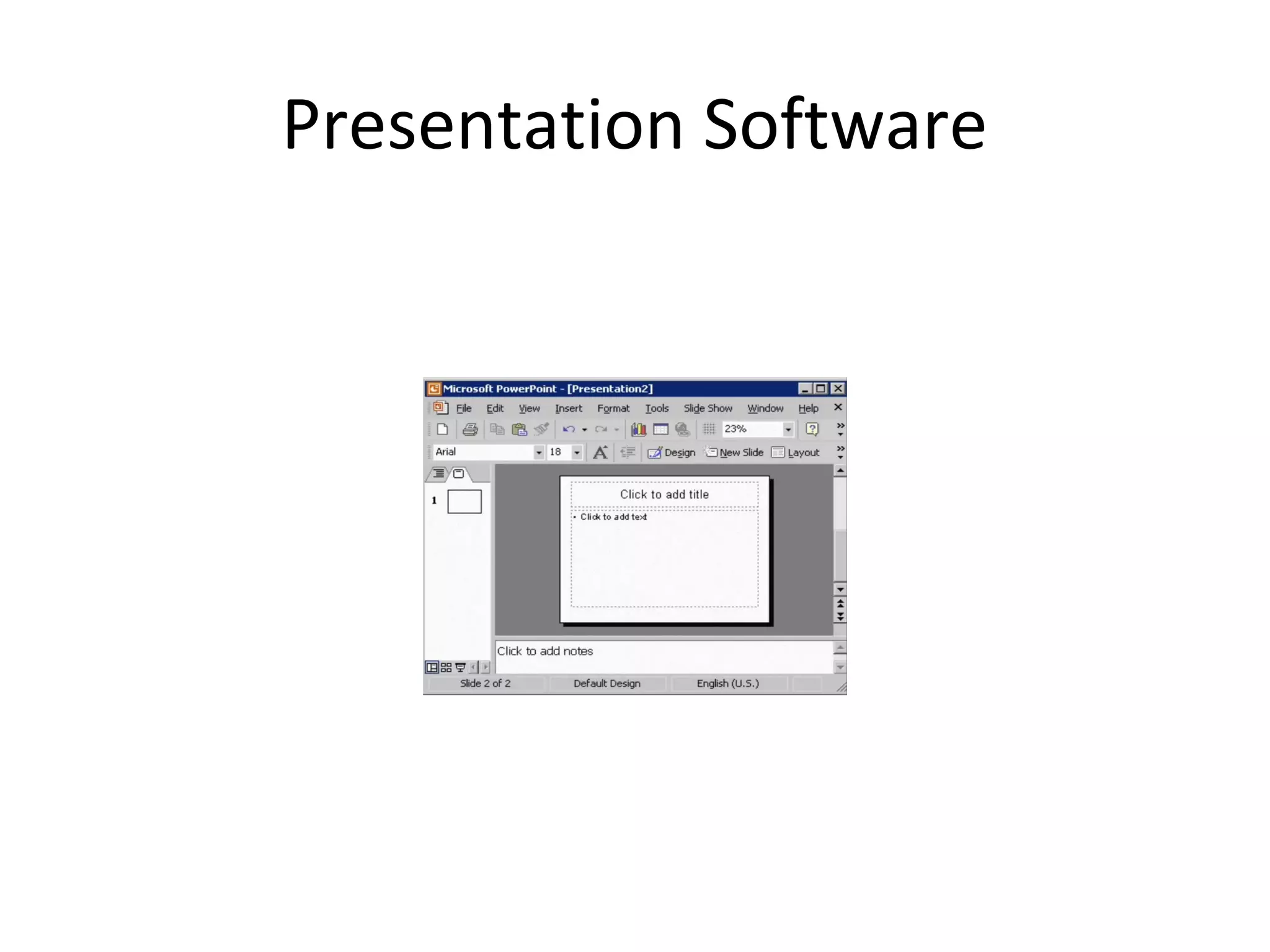
Presentation Software
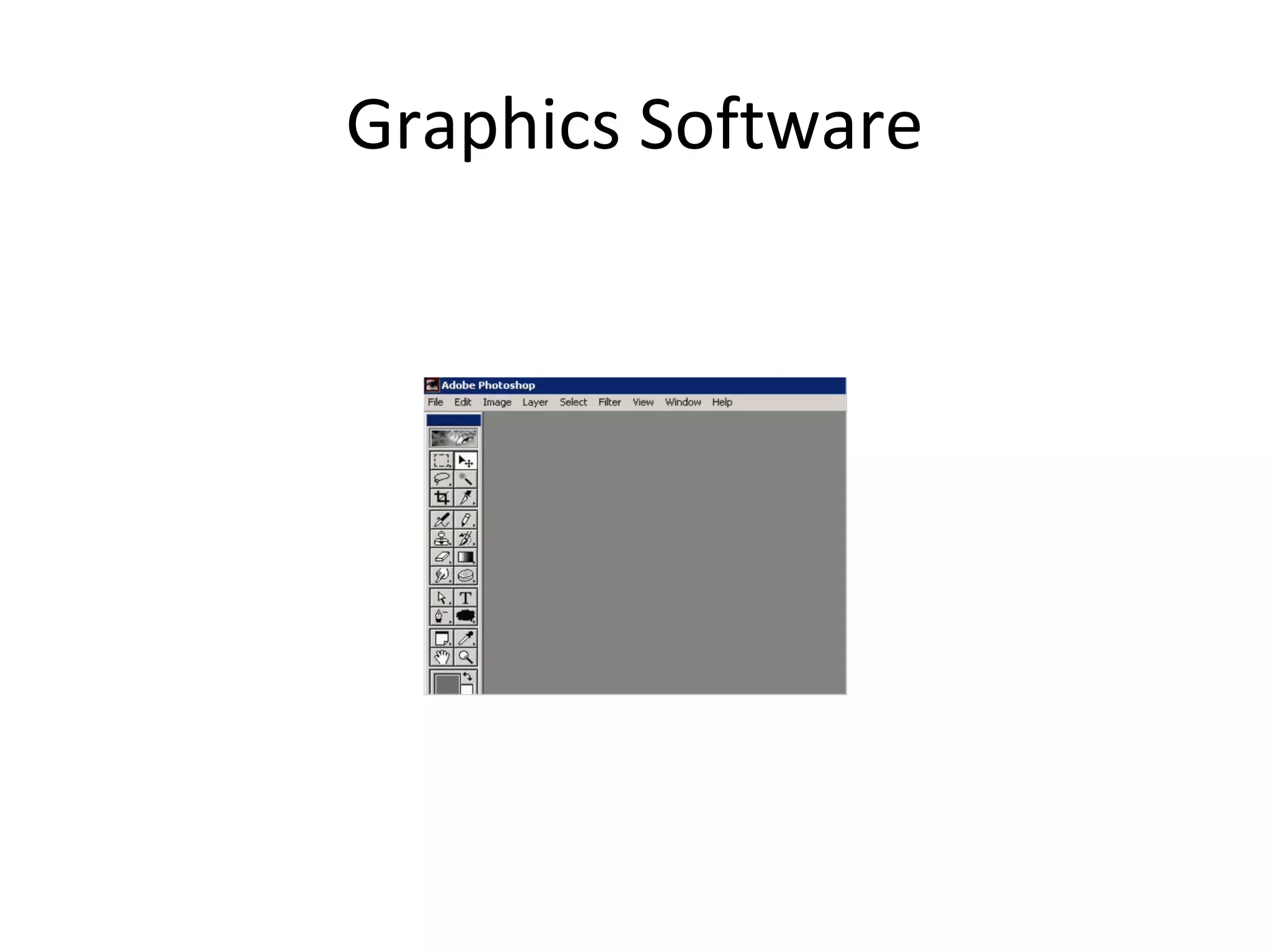
Graphics Software
Video Software
Personal Information Manager (PIM)
Definition:
• Software for end user productivity and
collaboration
Groupware
Definition:
• Software that helps workgroups and teams
work together to accomplish group
assignments
Software Alternatives
• Purchase Commercial Off-The-Shelf software
• Application Service Providers – companies
that own, operate, and maintain application
software and the computer system resources
required to offer the use of the application
software for a fee as a service over the
Internet
Software Licensing
• Purchasing the right to use specific software
under the terms of the software licensing
agreement
• Protects the vendor’s intellectual property
right
Case #2: New Face of Web Services
Web Services:
• Provide third-party programmers and business
partners with access to some data and basic
website functionality
• Independent developers can build
applications to satisfy market niches that
customers want
C Case #2: New Face of Web Services
eBay:
• 40% of items listed for sale on eBay come through its API
Amazon:
• Product Details
• Search Capabilities
• Customer Reviews
• Sales Rankings
• Wish Lists
• Registries
Case #2: New Face of Web Services
1. What are the purpose and business value of Web
services?
2. What are the benefits of Web services to Amazon,
eBay and their developer partners?
3. What are the business challenges of Web services?
Visit the Web services websites of IBM and
Microsoft to help with your answer.
4. What can be done to improve the business use of
Web services today?
System Software
• System Management Programs – programs that
manage the hardware, software, network, and data
resources of computer systems during the execution
of various information processing jobs of end users
• System Development Programs – programs that help
users develop information system programs and
procedures and prepare user programs for computer
processing
Operating System
Definition:
• An integrated system of programs that
manages the operations of the CPU, controls
the input/output and storage resources and
activities of the computer system, and
provides various support services as the
computer executes the application programs
of users
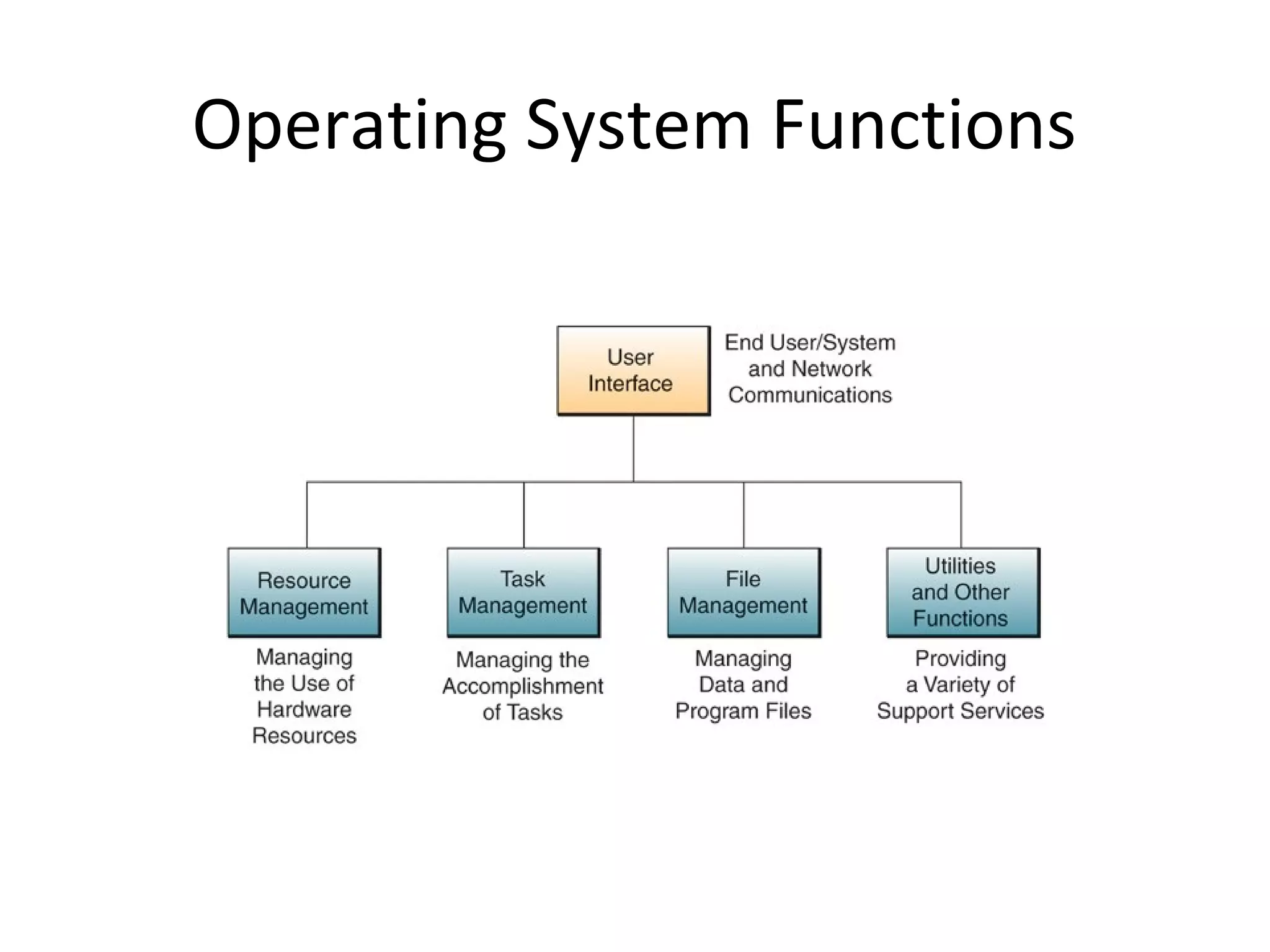
Operating System Functions
User Interface
Definition:
• The part of the operating system that allows
you to communicate with it so you can load
programs, access files, and accomplish other
tasks
Types of User Interfaces
• Command-Driven
• Menu-Driven
• Graphical User Interfaces
Resource Management
Definition:
• Programs to manage the hardware and
networking resources of a computer system,
including its CPU, memory, secondary storage
devices, telecommunications processors, and
input/output peripherals
File Management
Definition:
• Programs that control the creation, deletion,
and access of files of data and programs as
well as keeping track of the physical location
of files on magnetic disks and other secondary
storage devices
Task Management
Definition:
• Programs that control which task gets access
to the CPU and for how much time
• Multitasking – approach that allows for
several computing tasks to be performed in a
seemingly simultaneous fashion
Popular Operating Systems
• Microsoft Windows
• UNIX
• Linux
• Mac OS X
Other System Management Programs
• Performance Monitors – programs that monitor
and adjust the performance and usage of one or
more computer systems to keep them running
efficiently
• Security Monitors – programs that monitor and
control the use of computer systems and provide
warning messages and record evidence of
unauthorized use of computer resources
Application Servers
Definition:
• Software which provides an interface between
an operating system and application programs
of users
• Middleware – software that helps diverse
software applications and networked
computer systems exchange data and work
together more efficiently
Programming Language
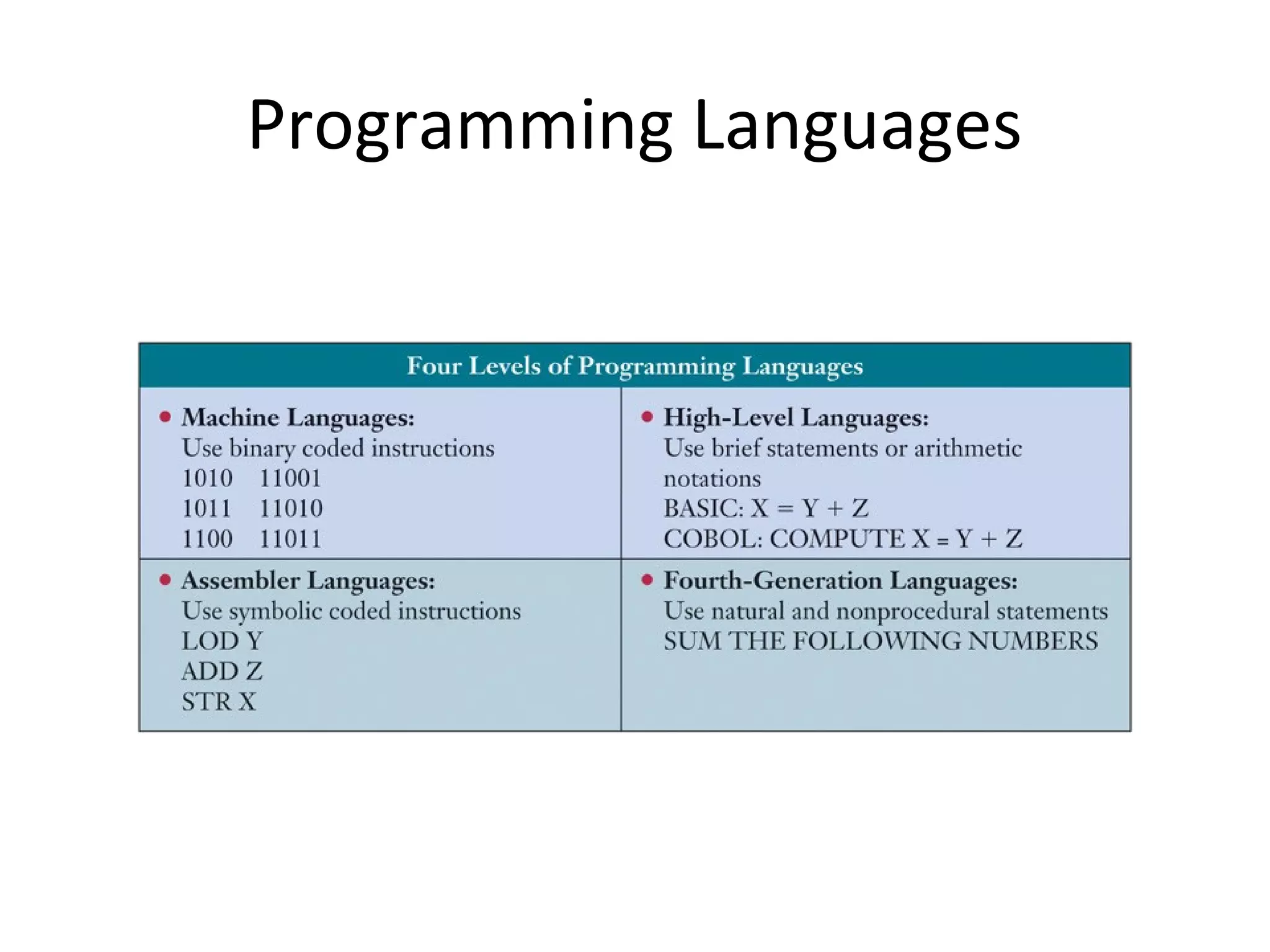
Programming Languages
Machine Languages
• All program instructions had to be written
using binary codes unique to each computer
• Programmers had to have a detailed
knowledge of the internal operations of the
specific type of CPU
Assembler Languages
• Alphabetic abbreviations and symbols are
used to represent operation codes and
storage locations
• Language translator programs are required to
convert the instructions into machine
instructions
High-Level Languages
• Instructions that use brief statements or
arithmetic expressions
• Each statement generates several machine
instructions when translated by compilers or
interpreters
Fourth-Generation Languages
• Nonprocedural – programmers specify results
while computer determines the sequence of
instructions that will accomplish those results
• Natural Language – very close to human
language
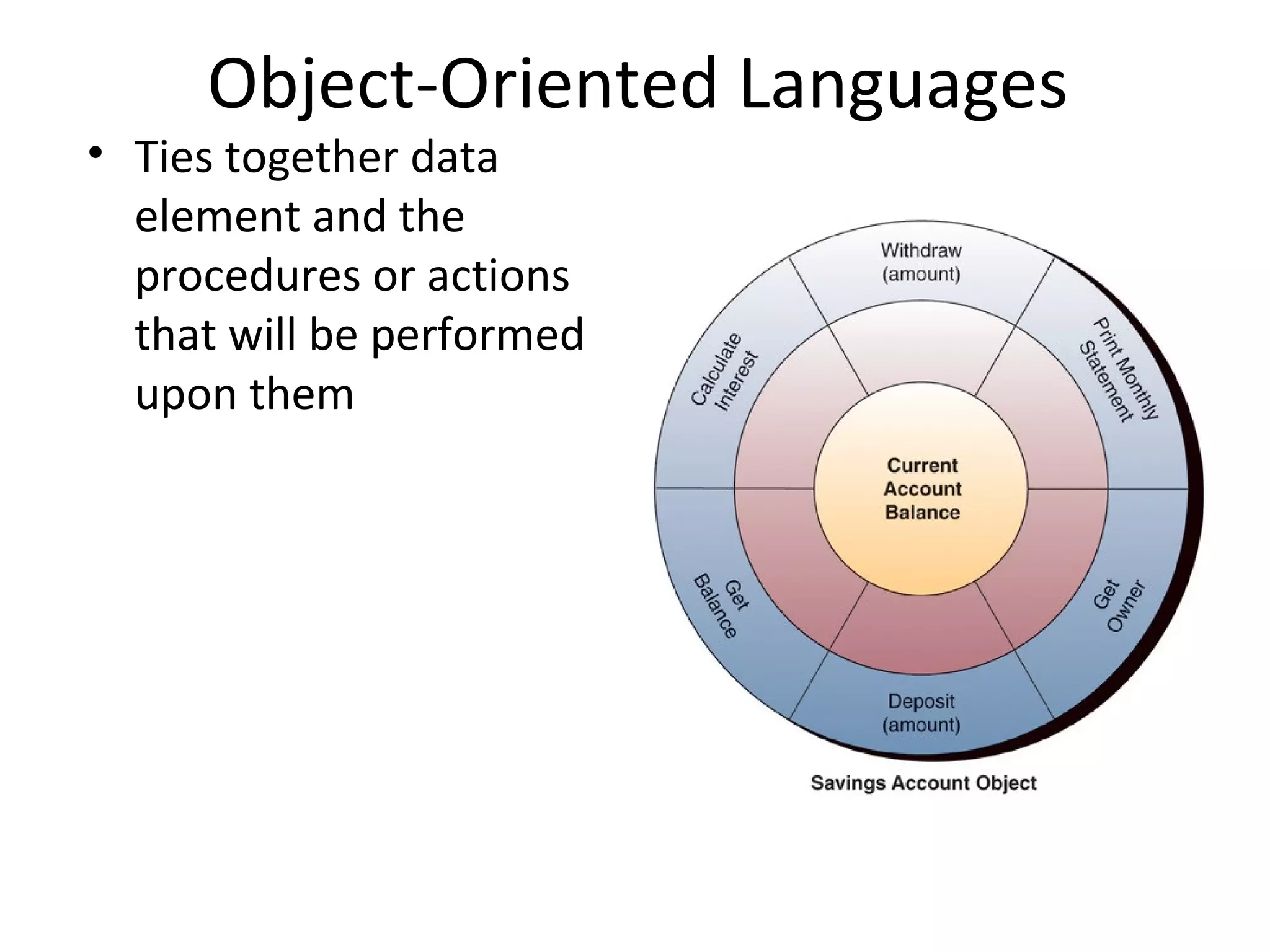
Object-Oriented Languages
• Ties together data
element and the
procedures or actions
that will be performed
upon them
Web Languages
• HTML – a page description language that creates
hypertext or hypermedia documents
• XML – describes the contents of Web pages by
applying identifying tags or contextual labels to the
data in Web documents
• Java – an object-oriented programming language
that is simple, secure and platform independent
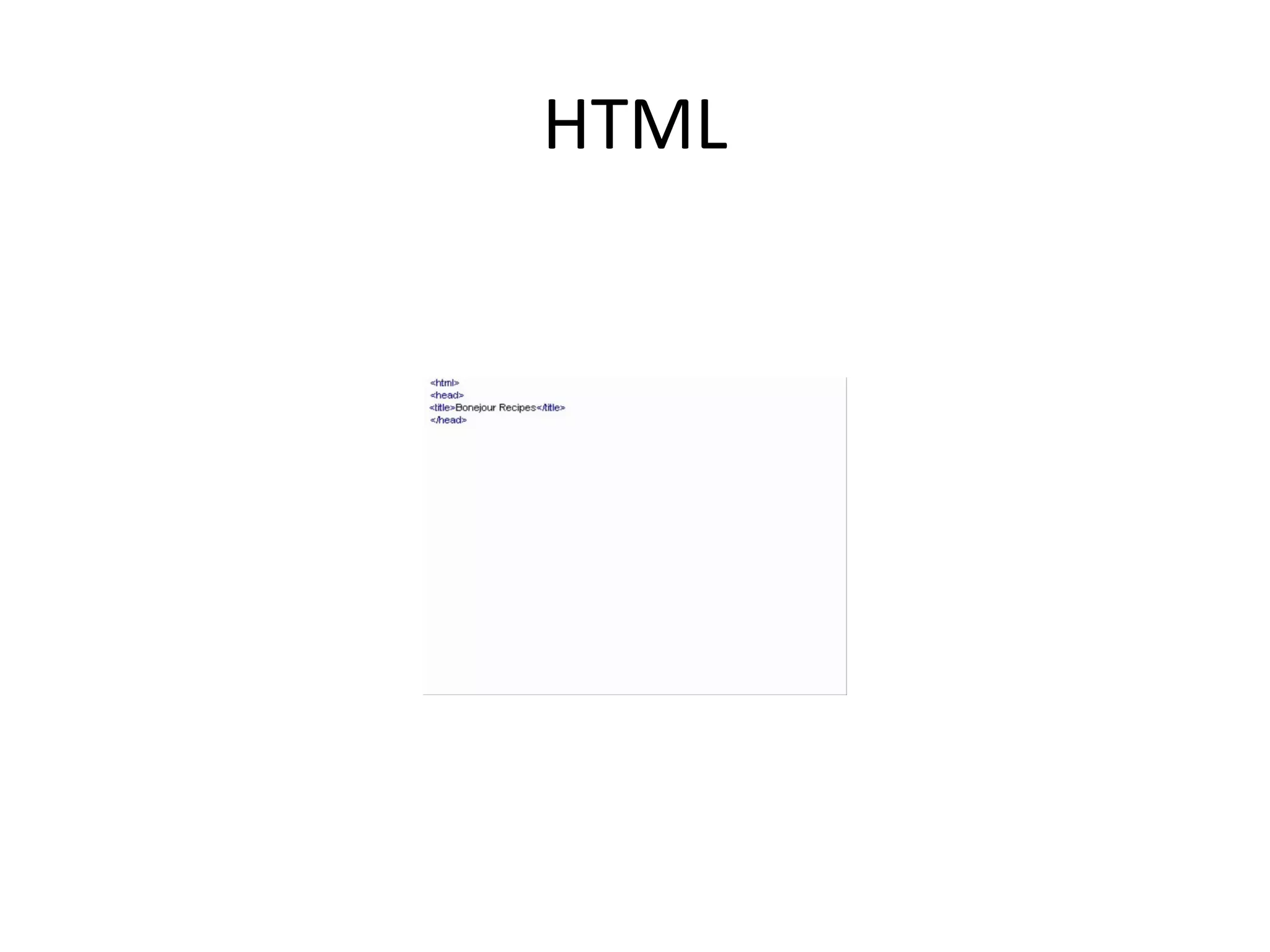
HTML
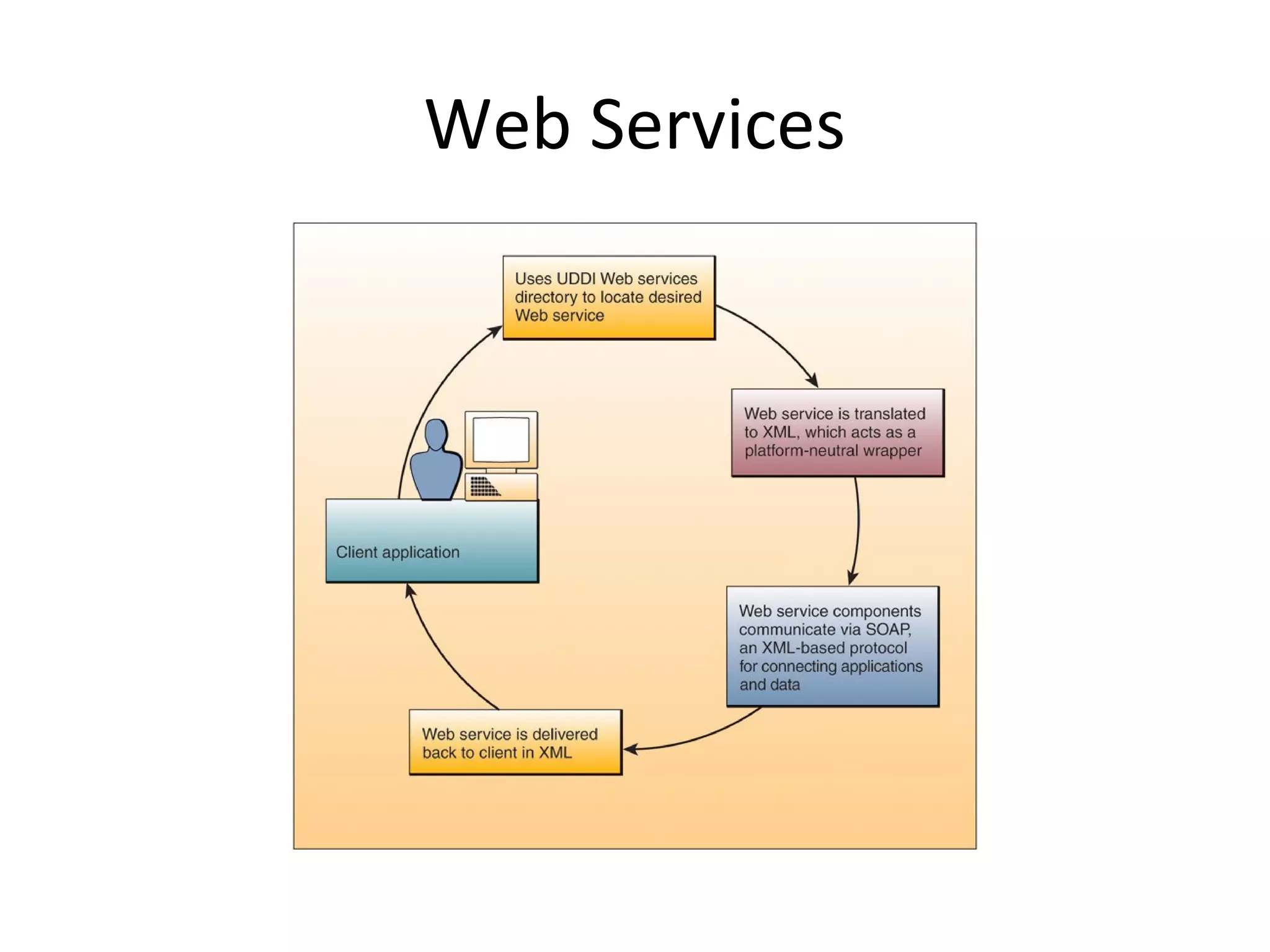
Web Services
Definition:
• Software components that are based on a
framework of Web and object-oriented
standards and technologies for using the Web
to electronically link the applications of
different user and different computing
platforms
Web Services
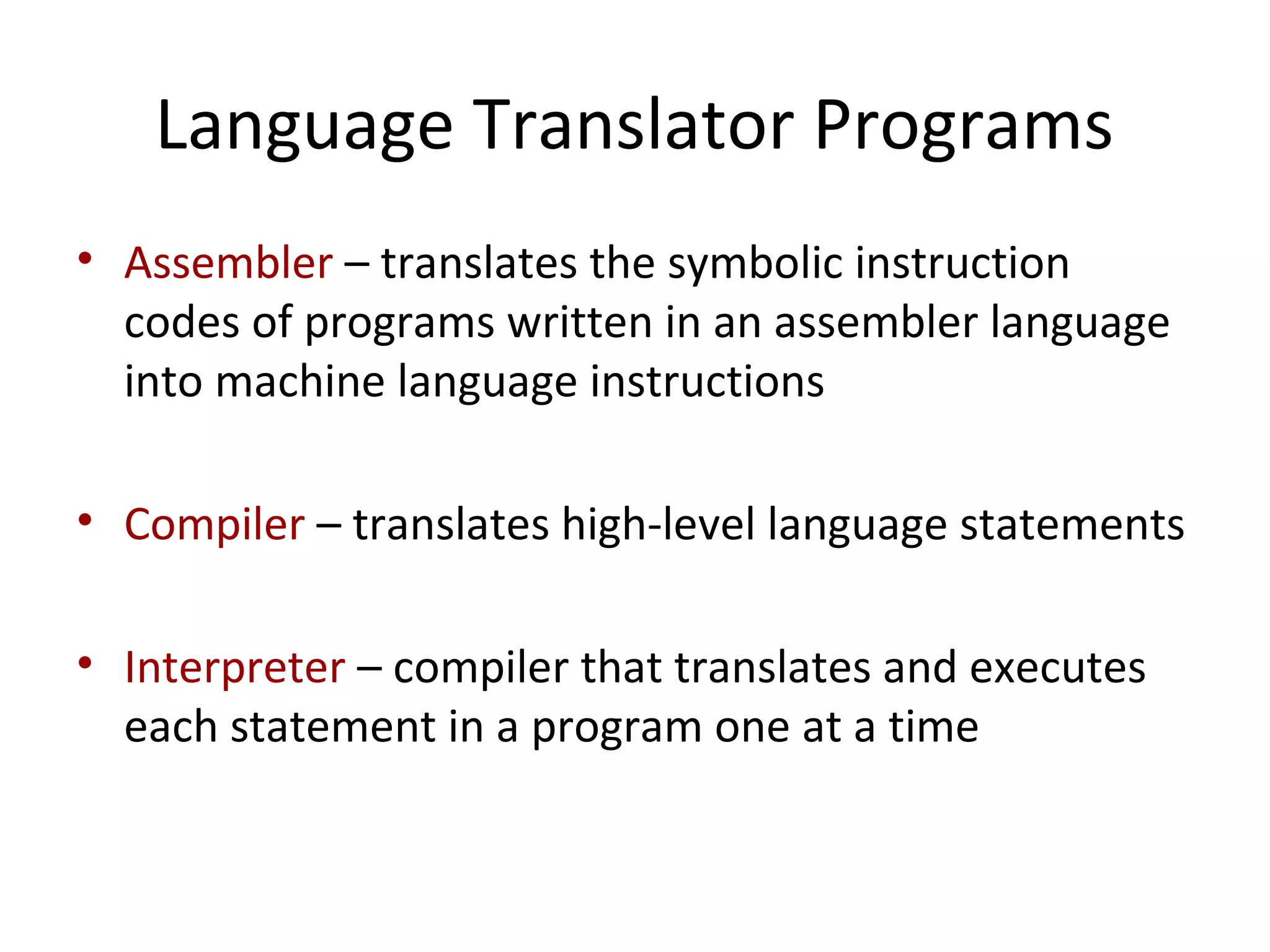
Language Translator Programs
• Assembler – translates the symbolic instruction
codes of programs written in an assembler language
into machine language instructions
• Compiler – translates high-level language statements
• Interpreter – compiler that translates and executes
each statement in a program one at a time
Programming Tools
• Graphical Programming Interfaces
• Programming Editors
• Debuggers
• CASE tools
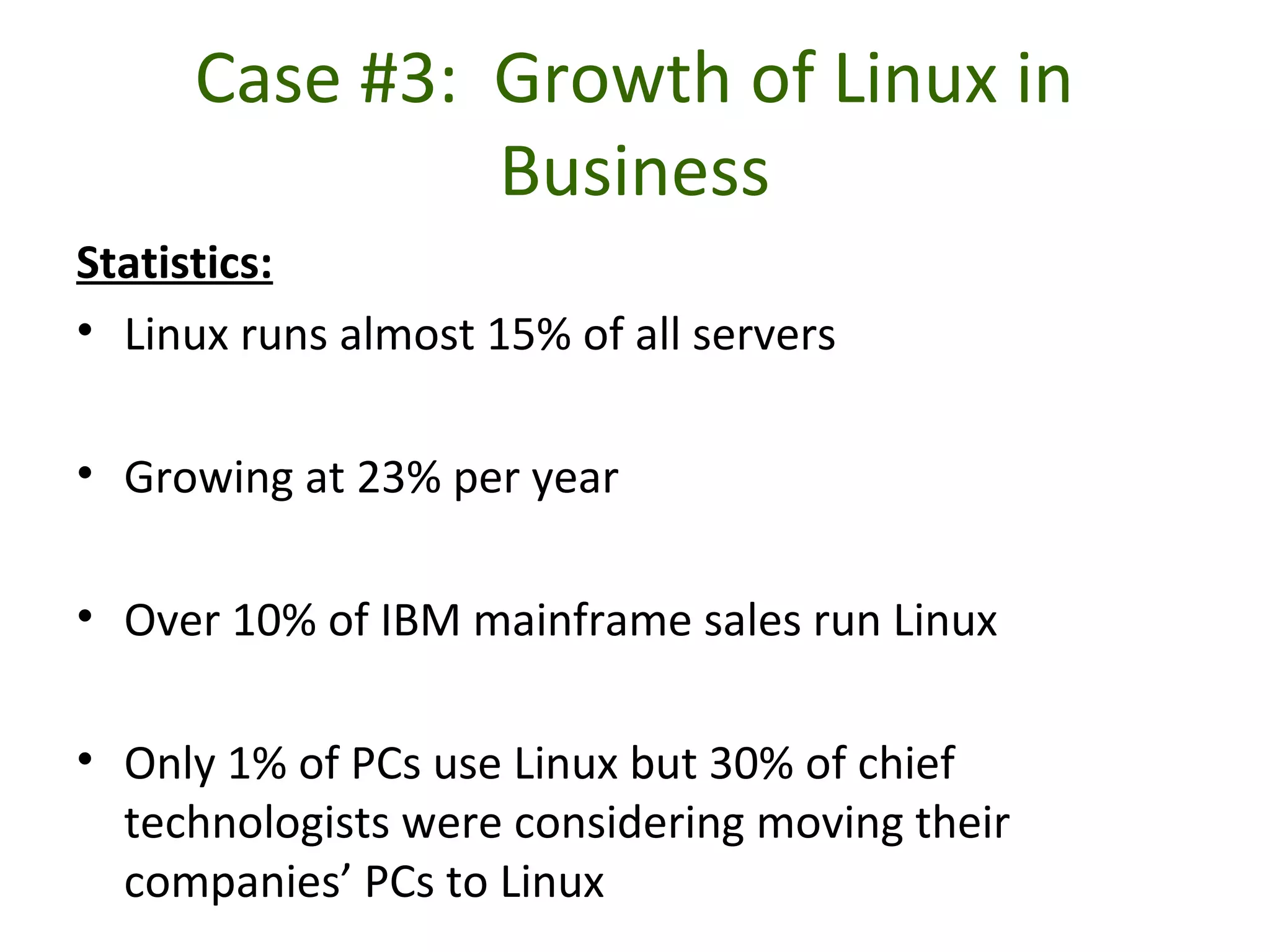
Case #3: Growth of Linux in
Business
Statistics:
• Linux runs almost 15% of all servers
• Growing at 23% per year
• Over 10% of IBM mainframe sales run Linux
• Only 1% of PCs use Linux but 30% of chief
technologists were considering moving their
companies’ PCs to Linux
Case #3: Growth of Linux in
Business
How did Linux get into the mainstream?
• Low-cost alternative in sagging economy
• Intel loosened its relationship with Microsoft
• IBM made an effort to be Linux-compatible
• Fear of Microsoft gaining a stranglehold on corporate
customers
Case #3: Growth of Linux in
Business
Open Source:
• Free
• Stable
• Easily fixed if bugs appear
Case #3: Growth of Linux in
Business
1. Should businesses continue to switch to the
Linux operating system on servers and
mainframes? Why or why not?
2. Should business and consumer PC users
switch to Linux PC operating systems like
Lindows and software suites like Sun’s Star
Office? Why or why not?
Case #3: Growth of Linux in
Business
3. Should the IT departments of companies like
Merrill Lynch contribute their software
improvements to the open-source
community for products like Linux? Explain
your reasoning.
Case #4: Using Java in Business
Benefits:
• Java can run on any hardware or operating
systems
• Easy to modify code as needs expand
• Networking capabilities reduce the need for
remote servers
• Easy to integrate with middleware and
databases
Case #4: Using Java in Business
1. What are the benefits of Java as a programming
language for retail POS applications compared to
other programming languages?
2. What are the benefits of Java for the development
of e-commerce portals for customers and suppliers
like PartsEdge?
3. Why do companies like Mark’s Work Wearhouse
frequently team Java with the Linux operating
system?
Summary
• Computer software consists of applications
software that directs the performance of a
particular use of computers to meet the
information processing needs of users, and
system software that controls and supports
the operations of a computer system as it
performs various information processing
tasks.
Summary
• Application software includes general-purpose and
application-specific categories.
• General-purpose application programs perform
common information processing jobs for end users.
• Application-specific programs accomplish
information processing tasks that support specific
business functions.
Summary
• System software can be subdivided into system
management programs and system development
programs.
• System management programs manage the
hardware, software, network, and data resources of
a computer system during its execution of
information processing jobs.
• System development programs help IS specialists
develop computer programs to support business
processes.
Summary
• An operating system is an integrated system
of programs that supervises the operation of
the CPU, controls the input/output and
storage functions of the computer system,
and provides various support services.
Summary
• Programming languages require the use of a
variety of programming packages to help
programmers develop computer programs,
and language translator programs to convert
programming language instructions into
machine language instruction codes.

Overview of softwares and their applications

  • 1.
    What is Software? Definition: •Various kinds of programs used to operate computers and related devices
  • 2.
    Case #1: WritingSoftware for Processes Microsoft’s Business Solutions Division: • Teams formed for different industries • Injected industry-specific codes directly into its core software platforms • Hired business technology professionals steeped in sector-specific knowledge
  • 3.
    Case #1: WritingSoftware for Processes Microsoft’s New Strategy: • Creating accelerators aimed at business processes common to companies in a given industry • Inserting industry-enabling layers to serve the needs of a broad base of companies in a particular sector • Seeking partnerships with vendors that have deep industry roots
  • 4.
    Case #1: WritingSoftware for Processes 1. A common phrase among IT professionals is “The world views its data through Windows”. Why does Microsoft dominate the desktop and networked software market? Visit its website at www.microsoft.com and review its broad range of software products and services to help with your answer.
  • 5.
    Case #1: WritingSoftware for Processes 2. How successful will Microsoft be in competing with software vendors who specialize in vertical market applications like health care, retail, and specialty services? Why? 3. Do you agree with Microsoft’s strategy to develop industry-specific partners to capitalize on opportunities in both large and small business sectors? Is there an advantage or a disadvantage to being one of Microsoft’s partners in this type of relationship? Explain.
  • 6.
    Case #1: WritingSoftware for Processes 4. Does Microsoft’s entry into industry-specific applications signal the end for smaller industry-specific software developers? What changes in strategy by such developers are necessary to compete with Microsoft?
  • 7.
  • 8.
    Types of Software •Application Software - performs information processing tasks for end users • System Software – manages and supports operations of computer systems and networks
  • 9.
    Application Software • General-Purpose– programs that perform common information processing jobs for end users • Application-Specific – support specific applications of end users in business and other fields
  • 10.
    How is SoftwareDeveloped? • Custom Software – software applications that are developed within an organization for use by that organization • Commercial Off-the-shelf (COTS) Software – software that is developed by a software developer with the intention of selling the software in multiple copies
  • 11.
    General-Purpose Application Software •Software Suites • Web Browsers • Electronic Mail • Word Processing • Spreadsheets • Database Managers • Presentation Graphics • Personal Information Managers • Groupware
  • 12.
  • 13.
    Integrated Packages Definition: • Combinesome of the functions of several programs into one software package
  • 14.
    Graphical User Interface(GUI) Definition: • Icons, tool and status bars, menus, and so on, which gives an application its look and feel
  • 15.
    Web Browser Definition: • Softwareinterface used to point and click through the hyperlinked resources of the Internet
  • 16.
  • 17.
    Electronic Mail &Instant Messaging • Electronic Mail – software used to send and receive electronic messages and file attachments via the Internet, intranets or extranets • Instant Messaging (IM) – software used to send and receive electronic messages instantly to facilitate real time communication and collaboration
  • 18.
  • 19.
    Word Processing &Desktop Publishing • Word Processing – software that supports the creation, editing, revision and printing of documents • Desktop Publishing (DTP) – software that supports the production of materials that look professionally published
  • 20.
  • 21.
    Electronic Spreadsheets Definition: • Softwarethat supports the development of electronic worksheets consisting of rows and columns used for business analysis, planning and modeling
  • 22.
  • 23.
    Presentation Graphics Definition: • Softwarethat helps convert numeric data into graphics displays and prepare multimedia presentations including graphics, photos, animation, and video clips
  • 24.
  • 25.
  • 26.
  • 27.
    Personal Information Manager(PIM) Definition: • Software for end user productivity and collaboration
  • 28.
    Groupware Definition: • Software thathelps workgroups and teams work together to accomplish group assignments
  • 29.
    Software Alternatives • PurchaseCommercial Off-The-Shelf software • Application Service Providers – companies that own, operate, and maintain application software and the computer system resources required to offer the use of the application software for a fee as a service over the Internet
  • 30.
    Software Licensing • Purchasingthe right to use specific software under the terms of the software licensing agreement • Protects the vendor’s intellectual property right
  • 31.
    Case #2: NewFace of Web Services Web Services: • Provide third-party programmers and business partners with access to some data and basic website functionality • Independent developers can build applications to satisfy market niches that customers want
  • 32.
    C Case #2:New Face of Web Services eBay: • 40% of items listed for sale on eBay come through its API Amazon: • Product Details • Search Capabilities • Customer Reviews • Sales Rankings • Wish Lists • Registries
  • 33.
    Case #2: NewFace of Web Services 1. What are the purpose and business value of Web services? 2. What are the benefits of Web services to Amazon, eBay and their developer partners? 3. What are the business challenges of Web services? Visit the Web services websites of IBM and Microsoft to help with your answer. 4. What can be done to improve the business use of Web services today?
  • 34.
    System Software • SystemManagement Programs – programs that manage the hardware, software, network, and data resources of computer systems during the execution of various information processing jobs of end users • System Development Programs – programs that help users develop information system programs and procedures and prepare user programs for computer processing
  • 35.
    Operating System Definition: • Anintegrated system of programs that manages the operations of the CPU, controls the input/output and storage resources and activities of the computer system, and provides various support services as the computer executes the application programs of users
  • 36.
  • 37.
    User Interface Definition: • Thepart of the operating system that allows you to communicate with it so you can load programs, access files, and accomplish other tasks
  • 38.
    Types of UserInterfaces • Command-Driven • Menu-Driven • Graphical User Interfaces
  • 39.
    Resource Management Definition: • Programsto manage the hardware and networking resources of a computer system, including its CPU, memory, secondary storage devices, telecommunications processors, and input/output peripherals
  • 40.
    File Management Definition: • Programsthat control the creation, deletion, and access of files of data and programs as well as keeping track of the physical location of files on magnetic disks and other secondary storage devices
  • 41.
    Task Management Definition: • Programsthat control which task gets access to the CPU and for how much time • Multitasking – approach that allows for several computing tasks to be performed in a seemingly simultaneous fashion
  • 42.
    Popular Operating Systems •Microsoft Windows • UNIX • Linux • Mac OS X
  • 43.
    Other System ManagementPrograms • Performance Monitors – programs that monitor and adjust the performance and usage of one or more computer systems to keep them running efficiently • Security Monitors – programs that monitor and control the use of computer systems and provide warning messages and record evidence of unauthorized use of computer resources
  • 44.
    Application Servers Definition: • Softwarewhich provides an interface between an operating system and application programs of users • Middleware – software that helps diverse software applications and networked computer systems exchange data and work together more efficiently
  • 45.
  • 46.
  • 47.
    Machine Languages • Allprogram instructions had to be written using binary codes unique to each computer • Programmers had to have a detailed knowledge of the internal operations of the specific type of CPU
  • 48.
    Assembler Languages • Alphabeticabbreviations and symbols are used to represent operation codes and storage locations • Language translator programs are required to convert the instructions into machine instructions
  • 49.
    High-Level Languages • Instructionsthat use brief statements or arithmetic expressions • Each statement generates several machine instructions when translated by compilers or interpreters
  • 50.
    Fourth-Generation Languages • Nonprocedural– programmers specify results while computer determines the sequence of instructions that will accomplish those results • Natural Language – very close to human language
  • 51.
    Object-Oriented Languages • Tiestogether data element and the procedures or actions that will be performed upon them
  • 52.
    Web Languages • HTML– a page description language that creates hypertext or hypermedia documents • XML – describes the contents of Web pages by applying identifying tags or contextual labels to the data in Web documents • Java – an object-oriented programming language that is simple, secure and platform independent
  • 53.
  • 54.
    Web Services Definition: • Softwarecomponents that are based on a framework of Web and object-oriented standards and technologies for using the Web to electronically link the applications of different user and different computing platforms
  • 55.
  • 56.
    Language Translator Programs •Assembler – translates the symbolic instruction codes of programs written in an assembler language into machine language instructions • Compiler – translates high-level language statements • Interpreter – compiler that translates and executes each statement in a program one at a time
  • 57.
    Programming Tools • GraphicalProgramming Interfaces • Programming Editors • Debuggers • CASE tools
  • 58.
    Case #3: Growthof Linux in Business Statistics: • Linux runs almost 15% of all servers • Growing at 23% per year • Over 10% of IBM mainframe sales run Linux • Only 1% of PCs use Linux but 30% of chief technologists were considering moving their companies’ PCs to Linux
  • 59.
    Case #3: Growthof Linux in Business How did Linux get into the mainstream? • Low-cost alternative in sagging economy • Intel loosened its relationship with Microsoft • IBM made an effort to be Linux-compatible • Fear of Microsoft gaining a stranglehold on corporate customers
  • 60.
    Case #3: Growthof Linux in Business Open Source: • Free • Stable • Easily fixed if bugs appear
  • 61.
    Case #3: Growthof Linux in Business 1. Should businesses continue to switch to the Linux operating system on servers and mainframes? Why or why not? 2. Should business and consumer PC users switch to Linux PC operating systems like Lindows and software suites like Sun’s Star Office? Why or why not?
  • 62.
    Case #3: Growthof Linux in Business 3. Should the IT departments of companies like Merrill Lynch contribute their software improvements to the open-source community for products like Linux? Explain your reasoning.
  • 63.
    Case #4: UsingJava in Business Benefits: • Java can run on any hardware or operating systems • Easy to modify code as needs expand • Networking capabilities reduce the need for remote servers • Easy to integrate with middleware and databases
  • 64.
    Case #4: UsingJava in Business 1. What are the benefits of Java as a programming language for retail POS applications compared to other programming languages? 2. What are the benefits of Java for the development of e-commerce portals for customers and suppliers like PartsEdge? 3. Why do companies like Mark’s Work Wearhouse frequently team Java with the Linux operating system?
  • 65.
    Summary • Computer softwareconsists of applications software that directs the performance of a particular use of computers to meet the information processing needs of users, and system software that controls and supports the operations of a computer system as it performs various information processing tasks.
  • 66.
    Summary • Application softwareincludes general-purpose and application-specific categories. • General-purpose application programs perform common information processing jobs for end users. • Application-specific programs accomplish information processing tasks that support specific business functions.
  • 67.
    Summary • System softwarecan be subdivided into system management programs and system development programs. • System management programs manage the hardware, software, network, and data resources of a computer system during its execution of information processing jobs. • System development programs help IS specialists develop computer programs to support business processes.
  • 68.
    Summary • An operatingsystem is an integrated system of programs that supervises the operation of the CPU, controls the input/output and storage functions of the computer system, and provides various support services.
  • 69.
    Summary • Programming languagesrequire the use of a variety of programming packages to help programmers develop computer programs, and language translator programs to convert programming language instructions into machine language instruction codes.