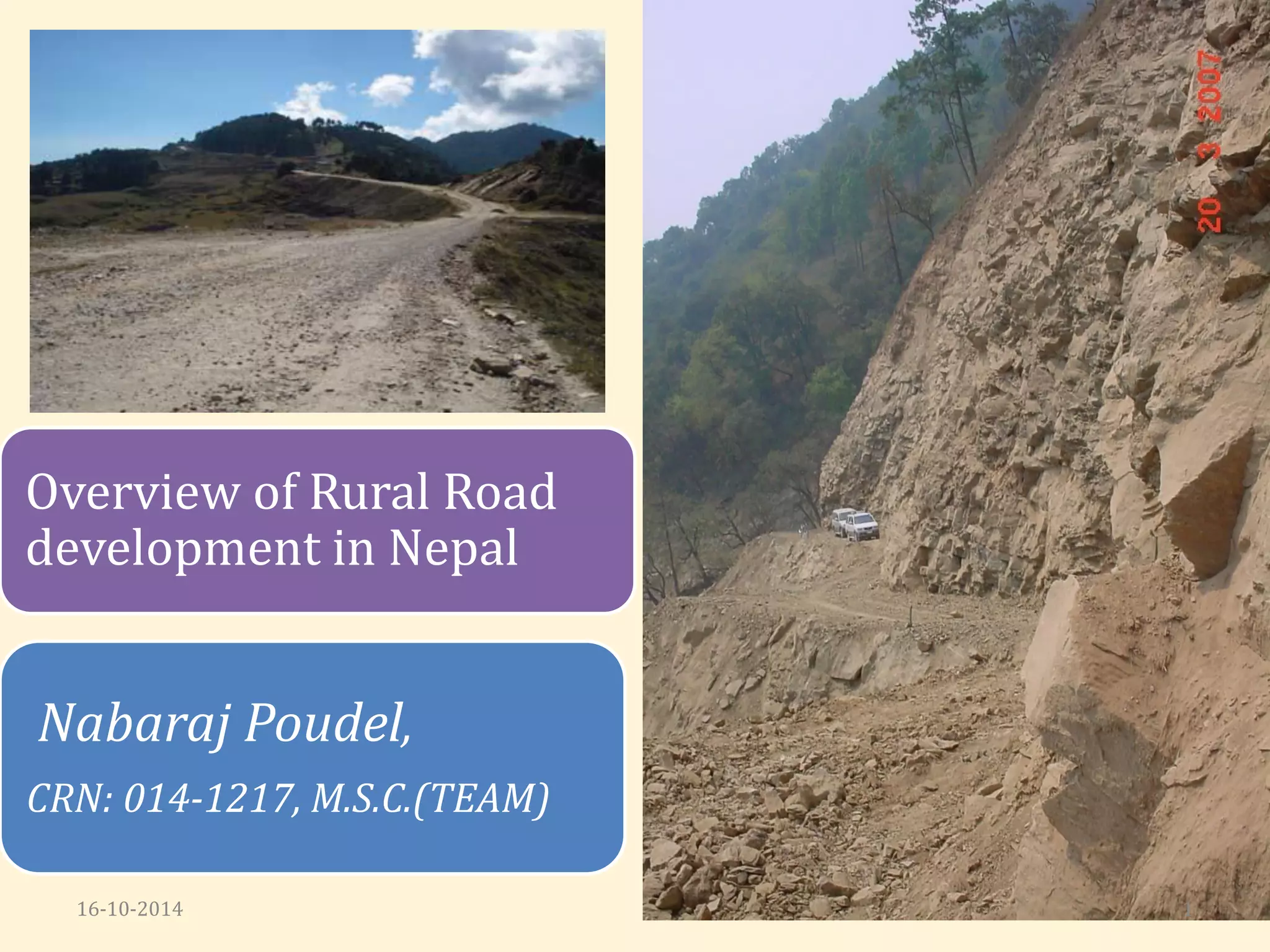
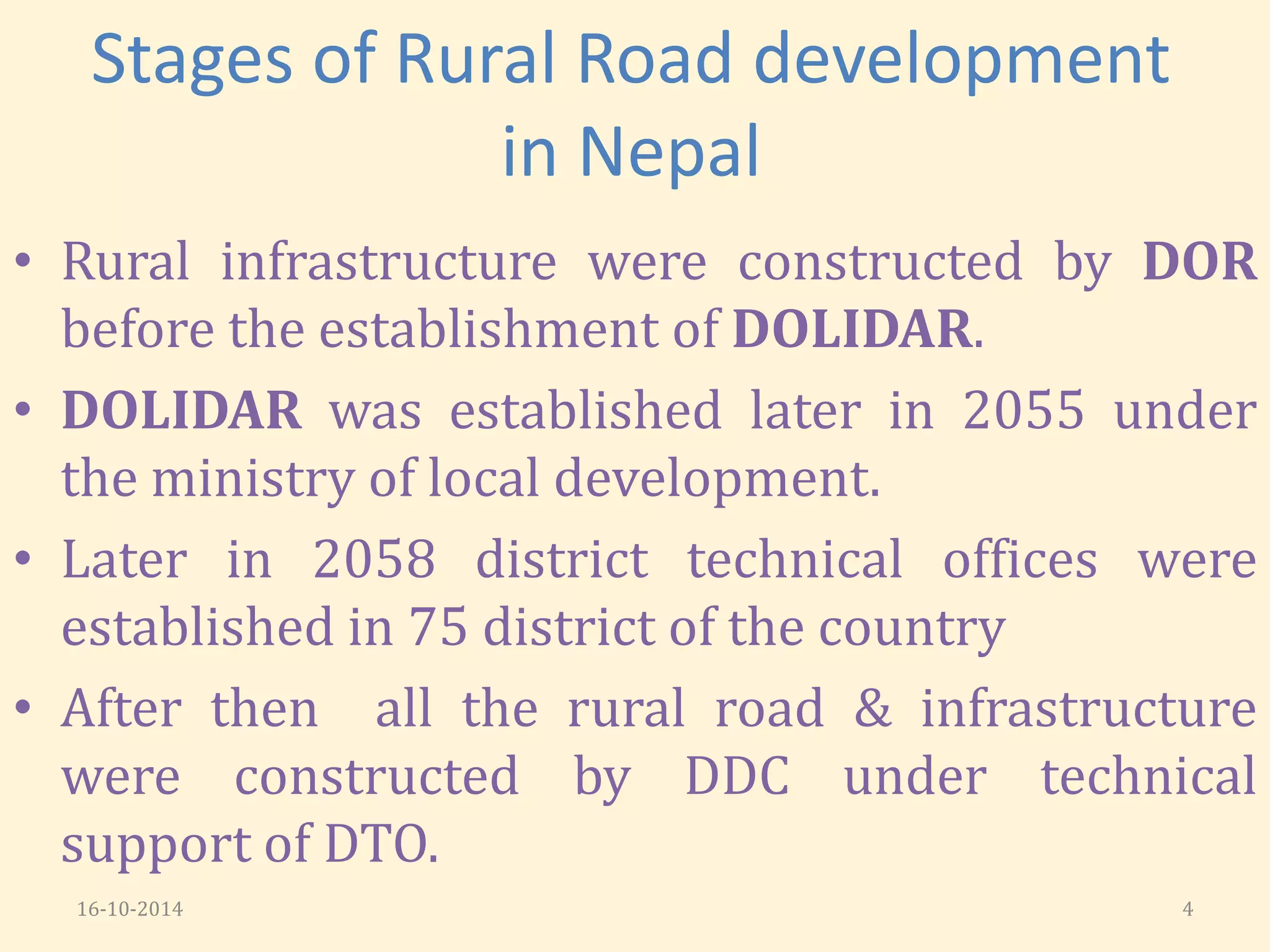
Overview of Rural Road 
development in Nepal 
Nabaraj Poudel, 
CRN: 014-1217, M.S.C.(TEAM) 
16-10-2014 1
Acronyms 
AWR All Weather Road 
DDC District development committee 
DOR Department of Road 
DOLIDAR Department of local infrastructure Development and 
Agricultural Road 
DFID Department for international development 
DTO District Technical Office 
DTMP District Transport Master Plan 
FWT Fair Weather Track 
FWR Fair weather Road 
GON Government of Nepal 
GTZ German Technical cooperation 
LRIP Local Road Improvement Programme 
SDC Swiss Agency For Development & Cooperation 
VDC Village Development committee 
LRN Local Road Network 
2
History 
• In Nepal, the technological development of low-cost, 
environment friendly rural road based on peopleǯs 
participation has been taking place since the mid 1980s. 
• The local road improvement programme (LRIP) supported 
by GTZ and helvetas in Palpa district implemented the 
environment friendly improvement and construction of 96 
km of road in 1986. 
• GTZ supported the construction of 65 km of environment-friendly 
road in Dhading district in 1987. 
• With the advent of Multiparty democracy in 1989,there has 
been a tremendous demand of constructing rural road in 
rural areas. 
16-10-2014 
Source:Ministry of local 
development,LGCDP,UNDP,UNEP 
3
Stages of Rural Road development 
in Nepal 
• Rural infrastructure we re constructed by DOR 
before the establishment of DOLIDAR. 
• DOLIDAR was established later in 2055 under 
the ministry of local development. 
• Later in 2058 district technical offices were 
established in 75 district of the country 
• After then all the rural road & infrastructure 
were constructed by DDC under technical 
support of DTO. 
16-10-2014 4
Background 
Nepal rural road standards(NRSS) were introduced in 
2055 BS to set the classification & geometric design 
standards for Local road Network(LRN) to be followed by all 
involving in the road development network including user 
committees,VDCs,DDCs,DTOs,DOLIDAR and its development 
partners. 
It was revised in 2010 AD in which existing district road 
were reclassified as district road ǮAǯ and all previous village 
roads were reclassified as district roads ǮBǯ with no change in 
their geometric parameters. 
In march 2012 AD, Nepal road sector assesment study was 
completed together with recommendation regarding 
simplifying DTMP to make it easier to understand,cheaper 
to implement and less time consuming. 
16-10-2014 SOURCE: Nepal Rural Road Standard(2055) 1ST revision. 
5
Background cont… 
This review concluded that LRN investment should 
change its approach to new construction & 
concentrate on upgrading to a core network of 
maintainable,all-weather road linking the district 
centre to the VDC HQs office or growth centre. 
The all-weather construction of the core network 
has meant that the design speed of district road has 
had to be increased which has prompted a review of 
geometric design standards for LRN. 
16-10-2014 SOURCE: Nepal Rural Road Standard(2055) 1ST revision. 
6
Rural road classification 
District Road (Core Network) 
Important Road joining VDCs HQs office or Nearest economic centre to the district 
headquarters, via either a neighbouring district headquarters or Strategic road 
network 
Village Road 
Smaller road not falling under District Road(core network)category are Village 
roads,including other Agriculture road. 
16-10-2014 SOURCE: NRRS(2055) 3
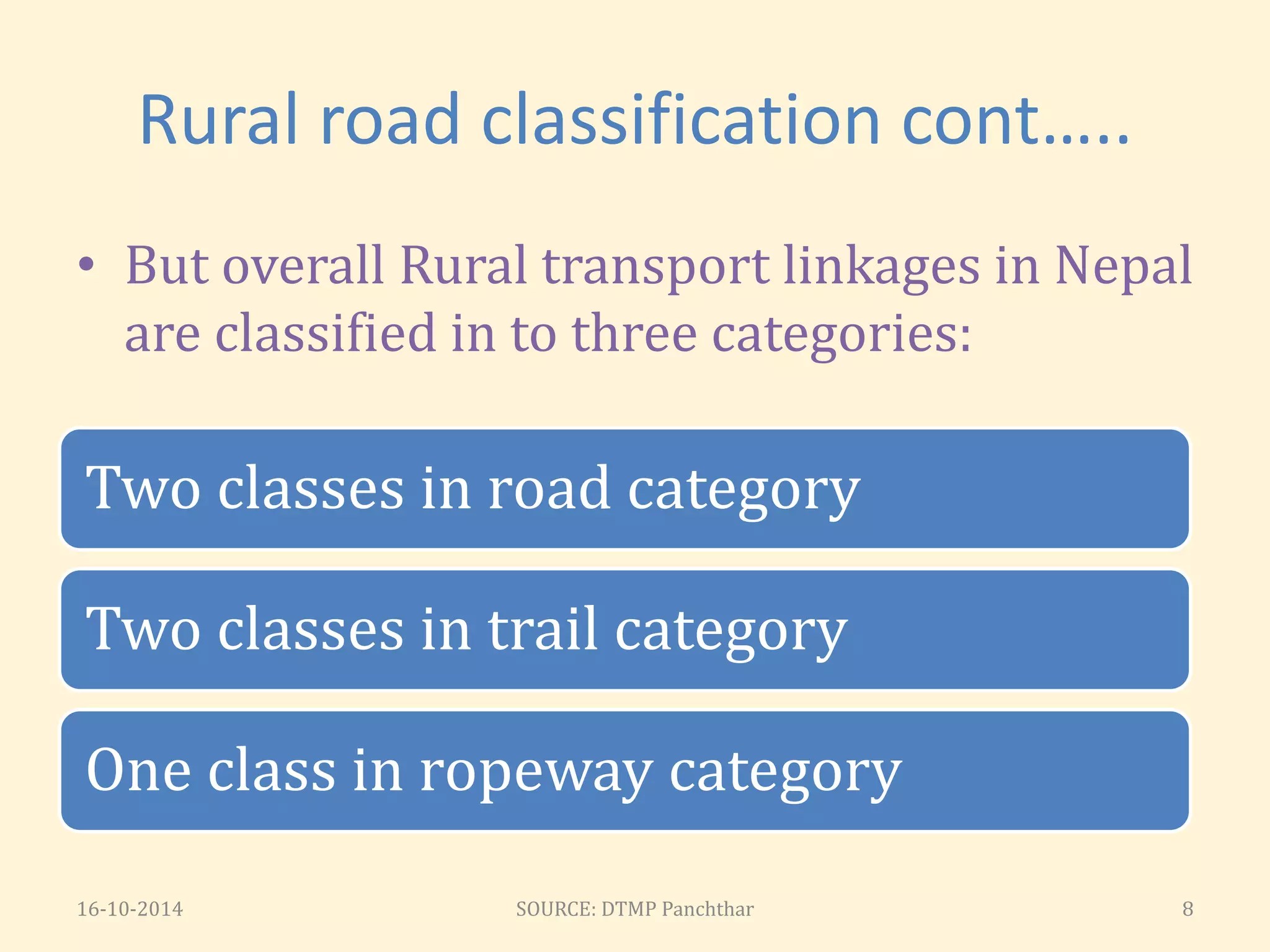
‘ural road ĐlassifiĐation Đont….. 
• But overall Rural transport linkages in Nepal 
are classified in to three categories: 
Two classes in road category 
Two classes in trail category 
One class in ropeway category 
16-10-2014 SOURCE: DTMP Panchthar 8
• Strategic 
function(natio-nal 
integration) 
• PubFliuc ndcetmioannd o f 
linkage 
Level of users • Direct relation 
• Increase in 
opportunities 
with 
geometric 
dimension 
• Technical 
standard(eart-hern, 
graveled 
& paved) 
Traffic Volume 
Topography 
• Environmentally 
sensitive area 
16-10-2014 
SOURCE: DTMP Panchthar 
9 
Criteria for classification
16-10-2014 
SOURCE: DTMP Panchthar 
10 
Finally
According to National transport policy 
2058 
• Local road system: 
 Roads those are not the parts of central road system and where project 
formulation ,construction, maintenance and repair have to be done by 
local institution shall be classified as local road system. 
• The road system may be: 
 District road 
 Village road 
 Agricultural road 
 Main trails/Mule tracks 
 Village trails/Mule tracks 
16-10-2014 11
National Planning 
Commission(NPC) 
Ministry of finance 
Ministry of Local 
development 
DOLIDAR 
District development 
committees 
VDCs & Communities 
16-10-2014 
Source: Nepal Rural Road 
standards(2055) 1st Revision 
5 
Planning Framework of Rural road
Rural road networking in Nepal as per 2012 
S.N Description Rural road Length (km) Total 
Blacktopped Gravel Earthen 
1 Eastern 
development 
region 
173 3015 6248 9436 
2 Central 
development 
region 
679 4977 13095 18751 
3 Western 
development 
region 
646 2377 11258 14282 
4 Mid western 
development reg. 
77 2378 3139 5594 
5 Far western 
development reg. 
0 1855 1026 2881 
Total 1576 14602 34766 50944 
16-10-2014 Source: Rural road inventory 
2069(DOLIDAR) 
13
AppliĐaďle only for ‘ural ‘oad Class ͚A͛, ͚B͛, ͚C͛ and ͚D͛ 
16-10-2014 
SOURCE: DTMP 
14 
Design standard
16-10-2014 
SOURCE: DTMP 
15 
Design standard Đont…..
16-10-2014 
SOURCE: DTMP 
16 
Design standard Đont…..
Major policy framework of GON 
for Rural infrastructure 
Agricultural perspective plan,APP(1997-2017) 
National transport policy,2001 
Poverty Reduction strategy paper 2001 
A 20-year road plan 2002-2022 
Priority investment plan 1997 
Local self government act 1999 and regulation 
2000 
16-10-2014 17
Major policy framework of GON for 
‘ural infrastruĐture Đont….. 
National plan for rural road maintenance 1999 
Local infrastructure development policy 2061 
Nepal Road Board act 2002 
National 3 year interim plan 2062-2065 
16-10-2014 18
Agricultural Perspective plan,APP(1997-2017) 
• The agricultural road investment in the APP is essential to the high value 
commodity strategy i.e. to connect by all weather road for boosting 
production of high economic value fruits and herbs production pocket in 
the hills and mountains for commercial purpose wherever feasible. 
Ecologica 
l zone 
20 years Target Phase 1(first 10 yrs 
target) 
Phase 2(second 10 yrs 
target) 
Physical 
km 
Financial Rs 
million 
Physical 
km 
Financial 
Rs million 
Physical 
km 
Financial Rs 
million 
Terai 3400 
2805 3400 
2805 
0 
Hill 1950 4875 
1428 
3570 
522 
1305 
Mountain 850 
4250 318 1590 532 2660 
Total 6200 
11930 
5146 
7965 
1054 
3965 
16-10-2014 Source:Business paper,Bhim upadhya 19
National Transport Policy of 
Nepal 2001 
• The principal objective of the policy is to develop 
a reliable, cost effective, safe facility oriented and 
sustainable transport system that promotes and 
sustains the economic,social,cultural and tourism 
development of Nepal as a whole. 
• The strategies pinpointed are the responsibility 
demarcation between central and local level, 
decentralized governance system by utilizing the 
local level resources and private sector 
involvement. 
16-10-2014 20
Poverty Reduction Strategy Paper 2001 
• Poverty was explicitly stated as an objective only 
since the sixth plan in 1980. 
• The action for the approach include policy 
changes, institutional reforms and implementing 
targeted programs and projects. 
• GON has established poverty alleviation fund to 
strengthen, coordinate, support and monitor 
targeted activities directed towards meeting the 
goal of poverty reduction focusing community 
preferences. 
16-10-2014 21
A 20-Year Road Plan(2002-2022) 
• The road density for 10000 population and 100 sq km are 
6.68 and 10.4 respectively which are comparatively lower 
then other countries in the south Asian region. 
• This plan has made an urgent change of strategy to 
concentrate resources in a limited number of prioritized 
road projects to ensure that the projects are completed 
within a reasonable period of time. 
• A total of 4040 km roads are to be newly built in the plan 
period. 
16-10-2014 22
Local self government act 1999 and 
Regulation 2000. 
• Nepal has two tier system of governance viz. central 
and local and three types of local government and units 
called local bodies viz. village 
development committees(VDCs) ,Municipalities and 
District Development Committees(DDCs) 
• The local bodies are governed by a separate Local self 
government act 1999. 
• Local bodies have institutional responsibilities, rights and 
power necessary to formulate and carry out plans at local 
level as per their needs ,priorities and demand. 
16-10-2014 23
National strategy for Rural 
Infrastructure Development 1997 
• The strategy as its key objective states that the 
development of basic rural infrastructure country-wide in 
a planned and sustainable means by adopting the labour 
based ,local resources oriented, environment friendly 
means and in accordance with the decentralized 
Participatory approach in line with strategy to the poverty 
alleviation objective in National plan in such a way that 
maximum employment income opportunity is created to 
local residents. 
16-10-2014 24
National Plan for rural road 
maintenance 1999 
• This plan is approved by the GON with the objective of 
initiating regular maintenance, repair or reconstruction/ 
rehabilitation of built road infrastructures in the past 
which have been overlooked at the cost of new 
construction projects. 
• The modality of the maintenance is primarily labour-based 
and local resources oriented to create local employment 
and income. 
• Approximately 22,000 km of road to be maintained 
properly is addressed by the plan. 
16-10-2014 25
Local infrastructure Development 
Policy 2061 
• This policy identifies 7 sector as the local 
infrastructures viz. Rural transport, rural drinking 
water and sanitation, rural electrification, small 
and middle size irrigation programms,solid waste 
management, rural housing ,township program 
and social infrastructures. 
• For transport accessibility, it has set the basic 
needs of access as 2 hours to a nearby motorable 
road in the terai region and that of 4 hours in the 
hills and mountain regions. 
16-10-2014 26
Nepal Road Board act 2002 
• It is estimated that Nepal at present has about NRs 70 billion worth of 
road infrastructure asset to be maintained & operated regularly. 
• The total road network including rural roads are estimated at more 
than 22000 km. 
• DOR is responsible government organization for maintenance of 
strategic roads and local bodies are responsible for local roads 
• The fund so far made has not been adequate and priority for proper 
maintenance did not receive due importance in practice in the past. 
• Therefore GON enacted a special act to mobilize resources 
autonomously by creating its own fund under the act called Nepal Road 
Board Act 2002 to take care seriously of maintenance to begin with and 
later to rehabilitation and reconstruction at the minimum cost. 
16-10-2014 27
Development Process of Rural Road in 
Nepal 
16-10-2014 
Source:Rural road technical design 
manual 
28 
Trails and 
pedestrians(in the 
hills and 
mountains) 
Investment from 
the local 
communities, local 
authorities, donor 
projects,NGOs,gove 
rnment line 
agencies 
FWT( In the terai 
and valley plains) 
FWR(Basic 
Access) 
Initial 
Capital 
Investment) 
AWR(Improve 
d transport) 
Maintenance 
investment 
over the 
designed life 
of the road 
Sustained 
AWR 
Investment for 
black toping 
and other 
improvement 
plus 
maintainance 
Efficient 
improved 
& 
sustainabl 
e road 
Social 
Approach 
Economic 
Approach
Steps for preparing / Updating DTMP(from 
DOLIDAR Approach 
16-10-2014 SOURCE: Rural road technical design 
manual 
29 
Prepare and finalize indicative development potential map of the district 
Prepare district inventory map of rural road network 
Collection of demand for new transport linkages from VDCs 
Prepare draft perspective plan of district rural road network 
Synchronizing the draft perspective plans of adjoining district 
Acceptance of the perspective plan of district rural road network 
Preparation of five year rural road master plan of district 
Updating year wise list of prioritized road links and approval
Indicative development potential map with market and 
service center 
16-10-2014 30
District road inventory map preparation 
Name and total 
length of existing 
road. 
Road 
status(Blacktop/ 
gravel/earthen 
Surface 
condition(good/fair/ 
poor 
Serviceability(all 
weather/fair weather 
16-10-2014 31
Facts 
• Some roads have been 
included in the SRN 
because of political 
interest 
• While some strategic 
roads have been left as 
LRN roads until they are 
upgraded 
Gravelling of postal road by DDC before 
transferring it to DOR as SRN road 
16-10-2014 32
Facts.. 
Unsafe transport in the LRN Poor Earthen road surface causing 
access problems during rainy season 
16-10-2014 33
Funding sources for rural roads(% of 
LRN Budget 
16-10-2014 
Source: Nepal road sector assessment 
study by ADB,DFID&SDC 
34
Conclusion 
 Nepal need quality of expert in order to develop rural 
infrastructures. 
 Foreign donors are very much interested to assist by 
providing grants or loans to Nepal to develop rural 
infrastructures. 
 Proper allocation of budget is necessary in time. 
 Government policy and act should be supportive to all 
concerned investors and consultants 
16-10-2014 35
References 
• GON,WB,ADB,DFID,SDC., 2013. Nepal road sector assesment study. 
Kathmandu,Nepal: World Bank 
• GON,DOLIDAR., 2012. Nepal Rural Road Standard. 
Kathmandu,Nepal: DOLIDAR 
• Ministry of local development,LGCDP,UNDP,UNEP., 2011. 
Economic Analysis of Local Government Investment in Rural Road in Nepal. 
Kathmandu Nepal: Ministry of Local development. 
• Upadhyaya, Bhim., 2012. Rural infrastructure Development 
Prospect and status of consultancy Business in Nepal. 
Business paper, pp. 1-11 
• DDC., DTMP Panchthar district. 
16-10-2014 36
Thank You 
16-10-2014 37

Overview of rural road development in nepal.Msc Class presentation at Nepal engineering college

  • 1.
    Overview of RuralRoad development in Nepal Nabaraj Poudel, CRN: 014-1217, M.S.C.(TEAM) 16-10-2014 1
  • 2.
    Acronyms AWR AllWeather Road DDC District development committee DOR Department of Road DOLIDAR Department of local infrastructure Development and Agricultural Road DFID Department for international development DTO District Technical Office DTMP District Transport Master Plan FWT Fair Weather Track FWR Fair weather Road GON Government of Nepal GTZ German Technical cooperation LRIP Local Road Improvement Programme SDC Swiss Agency For Development & Cooperation VDC Village Development committee LRN Local Road Network 2
  • 3.
    History • InNepal, the technological development of low-cost, environment friendly rural road based on peopleǯs participation has been taking place since the mid 1980s. • The local road improvement programme (LRIP) supported by GTZ and helvetas in Palpa district implemented the environment friendly improvement and construction of 96 km of road in 1986. • GTZ supported the construction of 65 km of environment-friendly road in Dhading district in 1987. • With the advent of Multiparty democracy in 1989,there has been a tremendous demand of constructing rural road in rural areas. 16-10-2014 Source:Ministry of local development,LGCDP,UNDP,UNEP 3
  • 4.
    Stages of RuralRoad development in Nepal • Rural infrastructure we re constructed by DOR before the establishment of DOLIDAR. • DOLIDAR was established later in 2055 under the ministry of local development. • Later in 2058 district technical offices were established in 75 district of the country • After then all the rural road & infrastructure were constructed by DDC under technical support of DTO. 16-10-2014 4
  • 5.
    Background Nepal ruralroad standards(NRSS) were introduced in 2055 BS to set the classification & geometric design standards for Local road Network(LRN) to be followed by all involving in the road development network including user committees,VDCs,DDCs,DTOs,DOLIDAR and its development partners. It was revised in 2010 AD in which existing district road were reclassified as district road ǮAǯ and all previous village roads were reclassified as district roads ǮBǯ with no change in their geometric parameters. In march 2012 AD, Nepal road sector assesment study was completed together with recommendation regarding simplifying DTMP to make it easier to understand,cheaper to implement and less time consuming. 16-10-2014 SOURCE: Nepal Rural Road Standard(2055) 1ST revision. 5
  • 6.
    Background cont… Thisreview concluded that LRN investment should change its approach to new construction & concentrate on upgrading to a core network of maintainable,all-weather road linking the district centre to the VDC HQs office or growth centre. The all-weather construction of the core network has meant that the design speed of district road has had to be increased which has prompted a review of geometric design standards for LRN. 16-10-2014 SOURCE: Nepal Rural Road Standard(2055) 1ST revision. 6
  • 7.
    Rural road classification District Road (Core Network) Important Road joining VDCs HQs office or Nearest economic centre to the district headquarters, via either a neighbouring district headquarters or Strategic road network Village Road Smaller road not falling under District Road(core network)category are Village roads,including other Agriculture road. 16-10-2014 SOURCE: NRRS(2055) 3
  • 8.
    ‘ural road ĐlassifiĐationĐont….. • But overall Rural transport linkages in Nepal are classified in to three categories: Two classes in road category Two classes in trail category One class in ropeway category 16-10-2014 SOURCE: DTMP Panchthar 8
  • 9.
    • Strategic function(natio-nal integration) • PubFliuc ndcetmioannd o f linkage Level of users • Direct relation • Increase in opportunities with geometric dimension • Technical standard(eart-hern, graveled & paved) Traffic Volume Topography • Environmentally sensitive area 16-10-2014 SOURCE: DTMP Panchthar 9 Criteria for classification
  • 10.
    16-10-2014 SOURCE: DTMPPanchthar 10 Finally
  • 11.
    According to Nationaltransport policy 2058 • Local road system:  Roads those are not the parts of central road system and where project formulation ,construction, maintenance and repair have to be done by local institution shall be classified as local road system. • The road system may be:  District road  Village road  Agricultural road  Main trails/Mule tracks  Village trails/Mule tracks 16-10-2014 11
  • 12.
    National Planning Commission(NPC) Ministry of finance Ministry of Local development DOLIDAR District development committees VDCs & Communities 16-10-2014 Source: Nepal Rural Road standards(2055) 1st Revision 5 Planning Framework of Rural road
  • 13.
    Rural road networkingin Nepal as per 2012 S.N Description Rural road Length (km) Total Blacktopped Gravel Earthen 1 Eastern development region 173 3015 6248 9436 2 Central development region 679 4977 13095 18751 3 Western development region 646 2377 11258 14282 4 Mid western development reg. 77 2378 3139 5594 5 Far western development reg. 0 1855 1026 2881 Total 1576 14602 34766 50944 16-10-2014 Source: Rural road inventory 2069(DOLIDAR) 13
  • 14.
    AppliĐaďle only for‘ural ‘oad Class ͚A͛, ͚B͛, ͚C͛ and ͚D͛ 16-10-2014 SOURCE: DTMP 14 Design standard
  • 15.
    16-10-2014 SOURCE: DTMP 15 Design standard Đont…..
  • 16.
    16-10-2014 SOURCE: DTMP 16 Design standard Đont…..
  • 17.
    Major policy frameworkof GON for Rural infrastructure Agricultural perspective plan,APP(1997-2017) National transport policy,2001 Poverty Reduction strategy paper 2001 A 20-year road plan 2002-2022 Priority investment plan 1997 Local self government act 1999 and regulation 2000 16-10-2014 17
  • 18.
    Major policy frameworkof GON for ‘ural infrastruĐture Đont….. National plan for rural road maintenance 1999 Local infrastructure development policy 2061 Nepal Road Board act 2002 National 3 year interim plan 2062-2065 16-10-2014 18
  • 19.
    Agricultural Perspective plan,APP(1997-2017) • The agricultural road investment in the APP is essential to the high value commodity strategy i.e. to connect by all weather road for boosting production of high economic value fruits and herbs production pocket in the hills and mountains for commercial purpose wherever feasible. Ecologica l zone 20 years Target Phase 1(first 10 yrs target) Phase 2(second 10 yrs target) Physical km Financial Rs million Physical km Financial Rs million Physical km Financial Rs million Terai 3400 2805 3400 2805 0 Hill 1950 4875 1428 3570 522 1305 Mountain 850 4250 318 1590 532 2660 Total 6200 11930 5146 7965 1054 3965 16-10-2014 Source:Business paper,Bhim upadhya 19
  • 20.
    National Transport Policyof Nepal 2001 • The principal objective of the policy is to develop a reliable, cost effective, safe facility oriented and sustainable transport system that promotes and sustains the economic,social,cultural and tourism development of Nepal as a whole. • The strategies pinpointed are the responsibility demarcation between central and local level, decentralized governance system by utilizing the local level resources and private sector involvement. 16-10-2014 20
  • 21.
    Poverty Reduction StrategyPaper 2001 • Poverty was explicitly stated as an objective only since the sixth plan in 1980. • The action for the approach include policy changes, institutional reforms and implementing targeted programs and projects. • GON has established poverty alleviation fund to strengthen, coordinate, support and monitor targeted activities directed towards meeting the goal of poverty reduction focusing community preferences. 16-10-2014 21
  • 22.
    A 20-Year RoadPlan(2002-2022) • The road density for 10000 population and 100 sq km are 6.68 and 10.4 respectively which are comparatively lower then other countries in the south Asian region. • This plan has made an urgent change of strategy to concentrate resources in a limited number of prioritized road projects to ensure that the projects are completed within a reasonable period of time. • A total of 4040 km roads are to be newly built in the plan period. 16-10-2014 22
  • 23.
    Local self governmentact 1999 and Regulation 2000. • Nepal has two tier system of governance viz. central and local and three types of local government and units called local bodies viz. village development committees(VDCs) ,Municipalities and District Development Committees(DDCs) • The local bodies are governed by a separate Local self government act 1999. • Local bodies have institutional responsibilities, rights and power necessary to formulate and carry out plans at local level as per their needs ,priorities and demand. 16-10-2014 23
  • 24.
    National strategy forRural Infrastructure Development 1997 • The strategy as its key objective states that the development of basic rural infrastructure country-wide in a planned and sustainable means by adopting the labour based ,local resources oriented, environment friendly means and in accordance with the decentralized Participatory approach in line with strategy to the poverty alleviation objective in National plan in such a way that maximum employment income opportunity is created to local residents. 16-10-2014 24
  • 25.
    National Plan forrural road maintenance 1999 • This plan is approved by the GON with the objective of initiating regular maintenance, repair or reconstruction/ rehabilitation of built road infrastructures in the past which have been overlooked at the cost of new construction projects. • The modality of the maintenance is primarily labour-based and local resources oriented to create local employment and income. • Approximately 22,000 km of road to be maintained properly is addressed by the plan. 16-10-2014 25
  • 26.
    Local infrastructure Development Policy 2061 • This policy identifies 7 sector as the local infrastructures viz. Rural transport, rural drinking water and sanitation, rural electrification, small and middle size irrigation programms,solid waste management, rural housing ,township program and social infrastructures. • For transport accessibility, it has set the basic needs of access as 2 hours to a nearby motorable road in the terai region and that of 4 hours in the hills and mountain regions. 16-10-2014 26
  • 27.
    Nepal Road Boardact 2002 • It is estimated that Nepal at present has about NRs 70 billion worth of road infrastructure asset to be maintained & operated regularly. • The total road network including rural roads are estimated at more than 22000 km. • DOR is responsible government organization for maintenance of strategic roads and local bodies are responsible for local roads • The fund so far made has not been adequate and priority for proper maintenance did not receive due importance in practice in the past. • Therefore GON enacted a special act to mobilize resources autonomously by creating its own fund under the act called Nepal Road Board Act 2002 to take care seriously of maintenance to begin with and later to rehabilitation and reconstruction at the minimum cost. 16-10-2014 27
  • 28.
    Development Process ofRural Road in Nepal 16-10-2014 Source:Rural road technical design manual 28 Trails and pedestrians(in the hills and mountains) Investment from the local communities, local authorities, donor projects,NGOs,gove rnment line agencies FWT( In the terai and valley plains) FWR(Basic Access) Initial Capital Investment) AWR(Improve d transport) Maintenance investment over the designed life of the road Sustained AWR Investment for black toping and other improvement plus maintainance Efficient improved & sustainabl e road Social Approach Economic Approach
  • 29.
    Steps for preparing/ Updating DTMP(from DOLIDAR Approach 16-10-2014 SOURCE: Rural road technical design manual 29 Prepare and finalize indicative development potential map of the district Prepare district inventory map of rural road network Collection of demand for new transport linkages from VDCs Prepare draft perspective plan of district rural road network Synchronizing the draft perspective plans of adjoining district Acceptance of the perspective plan of district rural road network Preparation of five year rural road master plan of district Updating year wise list of prioritized road links and approval
  • 30.
    Indicative development potentialmap with market and service center 16-10-2014 30
  • 31.
    District road inventorymap preparation Name and total length of existing road. Road status(Blacktop/ gravel/earthen Surface condition(good/fair/ poor Serviceability(all weather/fair weather 16-10-2014 31
  • 32.
    Facts • Someroads have been included in the SRN because of political interest • While some strategic roads have been left as LRN roads until they are upgraded Gravelling of postal road by DDC before transferring it to DOR as SRN road 16-10-2014 32
  • 33.
    Facts.. Unsafe transportin the LRN Poor Earthen road surface causing access problems during rainy season 16-10-2014 33
  • 34.
    Funding sources forrural roads(% of LRN Budget 16-10-2014 Source: Nepal road sector assessment study by ADB,DFID&SDC 34
  • 35.
    Conclusion  Nepalneed quality of expert in order to develop rural infrastructures.  Foreign donors are very much interested to assist by providing grants or loans to Nepal to develop rural infrastructures.  Proper allocation of budget is necessary in time.  Government policy and act should be supportive to all concerned investors and consultants 16-10-2014 35
  • 36.
    References • GON,WB,ADB,DFID,SDC.,2013. Nepal road sector assesment study. Kathmandu,Nepal: World Bank • GON,DOLIDAR., 2012. Nepal Rural Road Standard. Kathmandu,Nepal: DOLIDAR • Ministry of local development,LGCDP,UNDP,UNEP., 2011. Economic Analysis of Local Government Investment in Rural Road in Nepal. Kathmandu Nepal: Ministry of Local development. • Upadhyaya, Bhim., 2012. Rural infrastructure Development Prospect and status of consultancy Business in Nepal. Business paper, pp. 1-11 • DDC., DTMP Panchthar district. 16-10-2014 36
  • 37.