Unit I
INTRODUCTION – REVIEW
BASIC TERMINOLOGIES IN
RESEARCH
Nursing research
• A systematic, objective, process of analyzing
phenomena of importance to nursing.
Theory
• A set of related statements that describes or
explains phenomena in a systematic way.
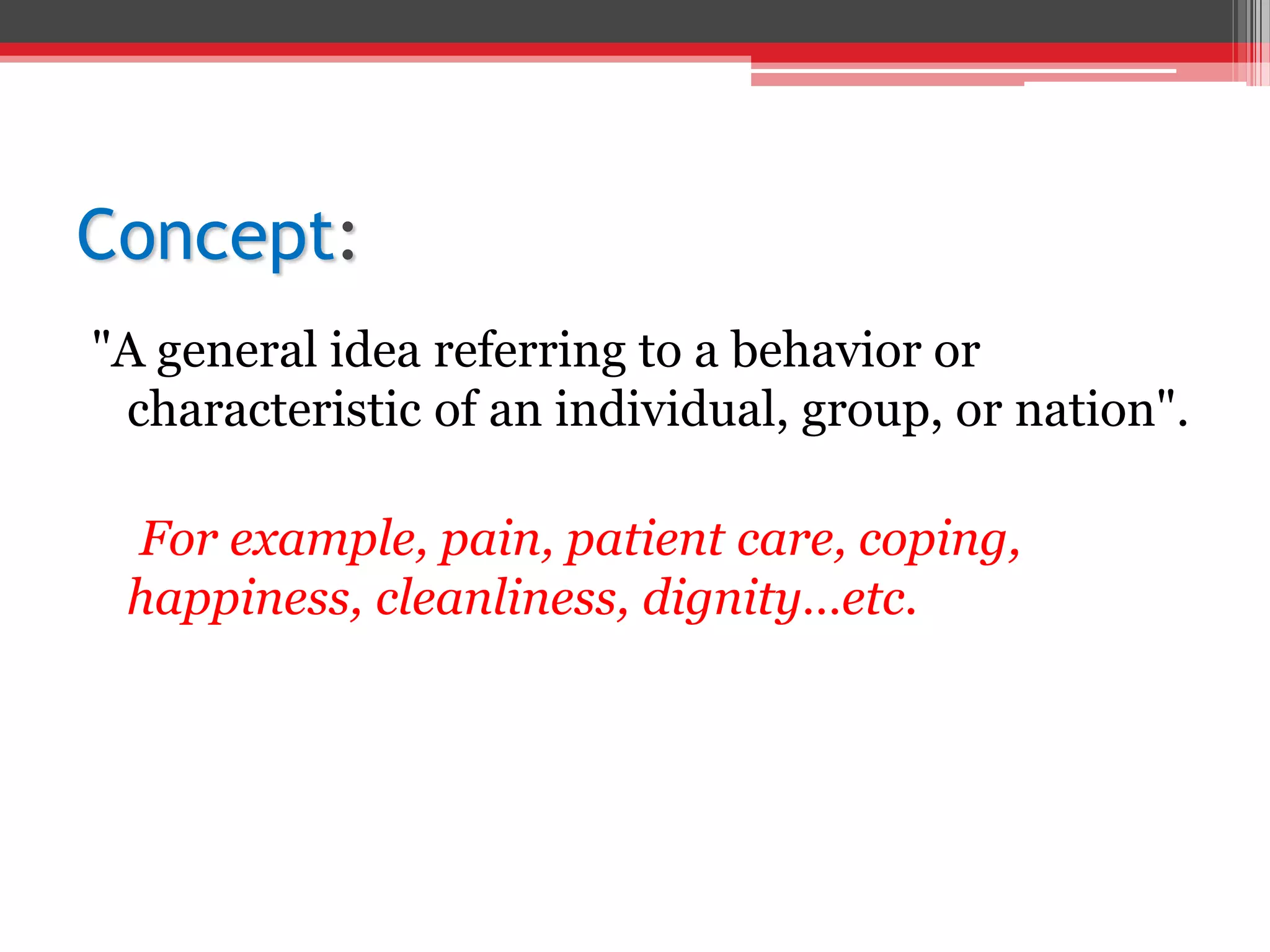
Concept:
"A general idea referring to a behavior or
characteristic of an individual, group, or nation".
For example, pain, patient care, coping,
happiness, cleanliness, dignity…etc.
Construct:
• "A concept specified in such a way that it is
observable in the real world, in order to
facilitate testing of the idea".
• For example, position, in real world has many
different meanings in gynecology, in surgery and
in management.
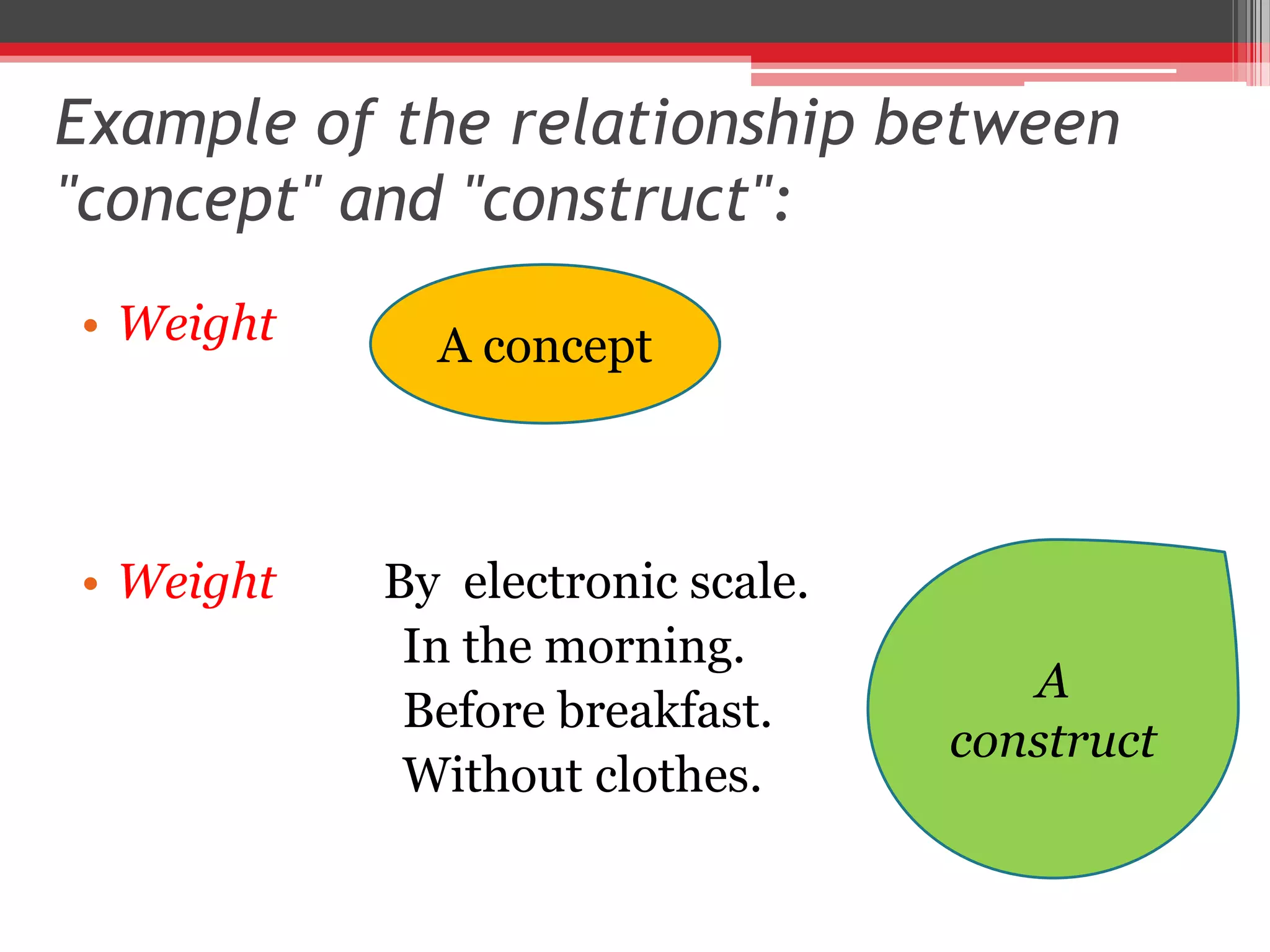
Example of the relationship between
"concept" and "construct":
• Weight
• Weight By electronic scale.
In the morning.
Before breakfast.
Without clothes.
A
construct
A concept
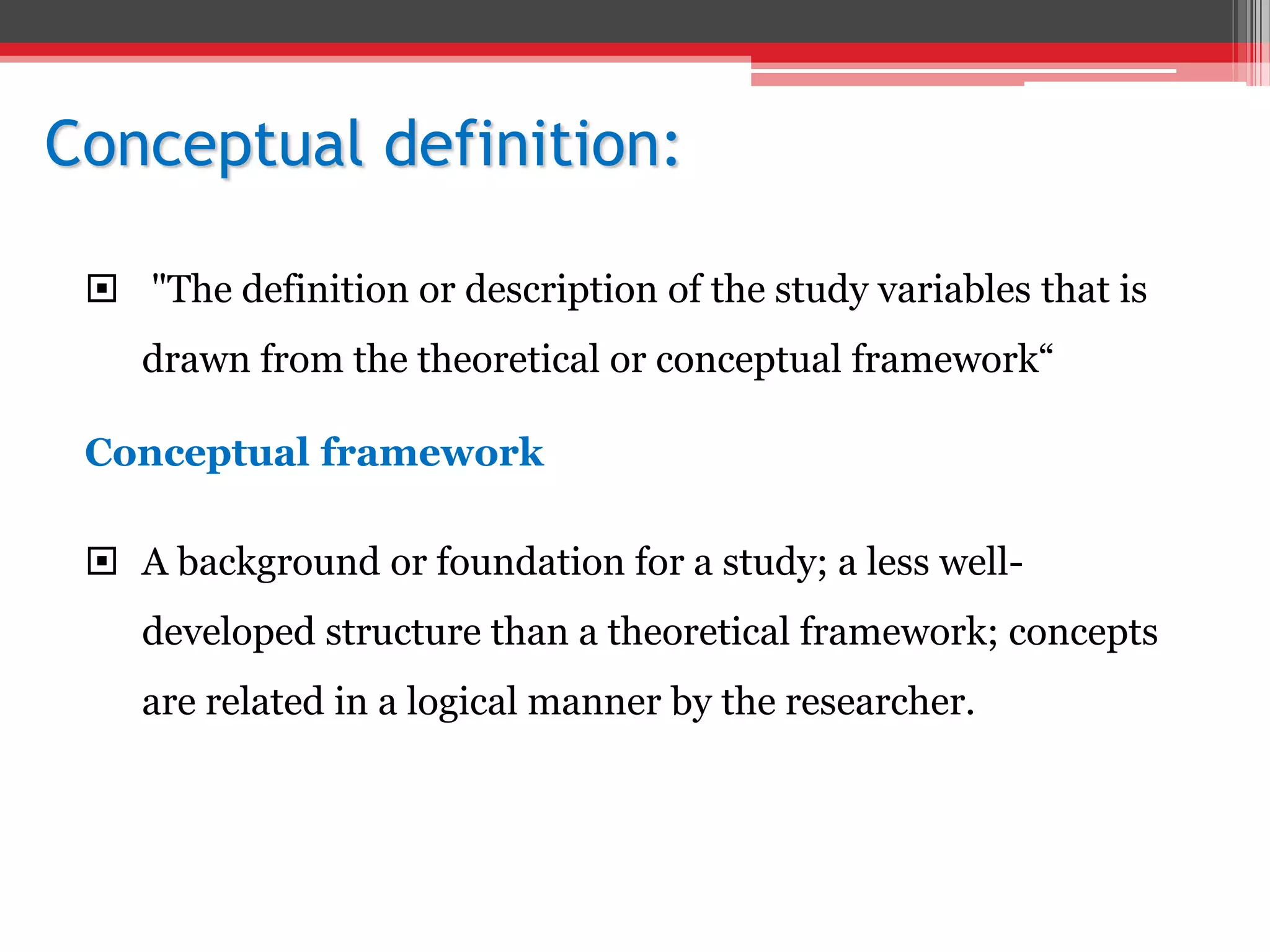
Conceptual definition:
 "The definition or description of the study variables that is
drawn from the theoretical or conceptual framework“
Conceptual framework
 A background or foundation for a study; a less well-
developed structure than a theoretical framework; concepts
are related in a logical manner by the researcher.
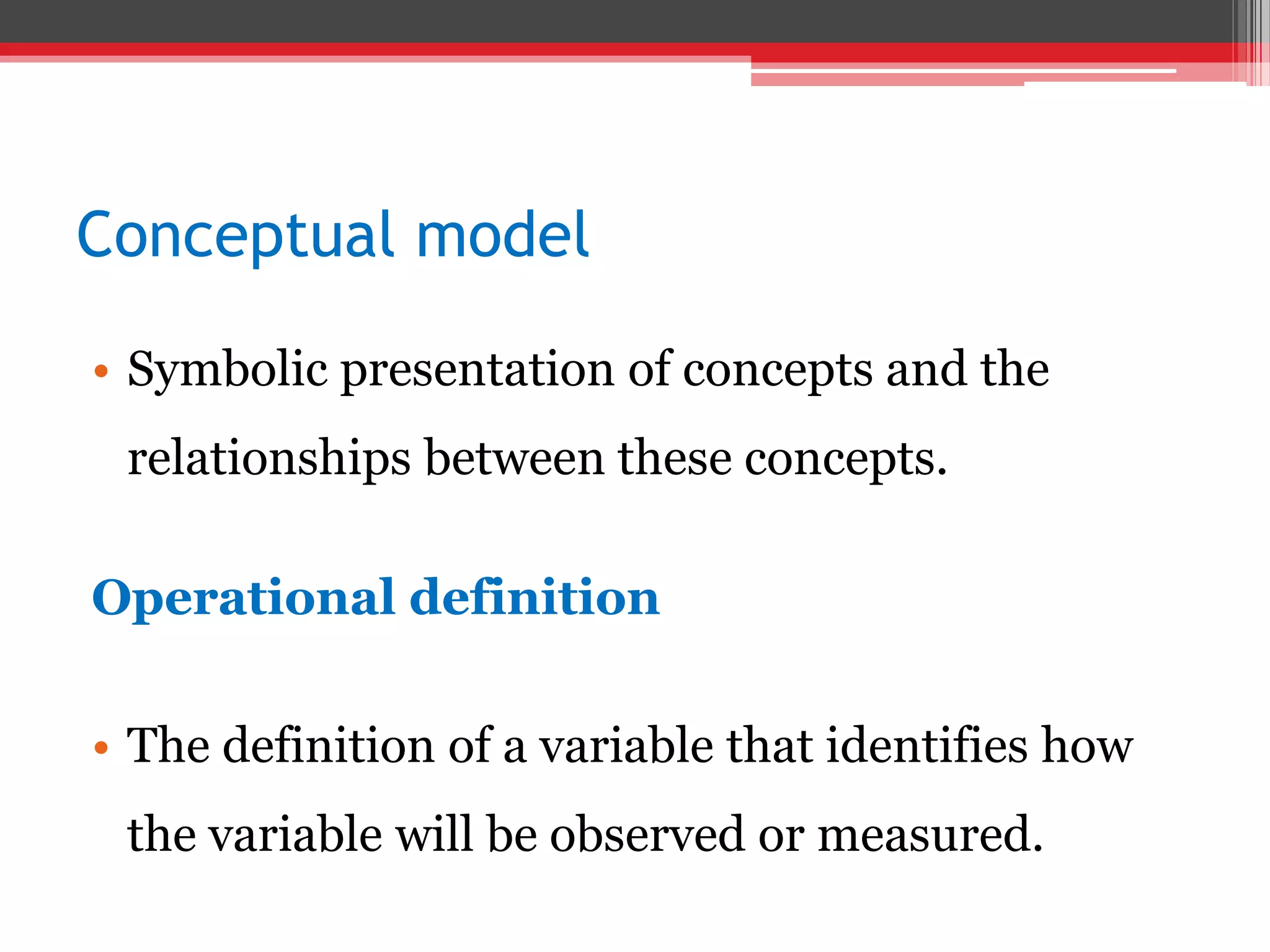
Conceptual model
• Symbolic presentation of concepts and the
relationships between these concepts.
Operational definition
• The definition of a variable that identifies how
the variable will be observed or measured.
Assumption:
 "A statement of principles whose correctness
has not been proven, but is taken for granted
on the basis of logical reasoning".
"health is a priority for all people"
Hypothesis:
 "A statement of predicted or expected
relationships between the variables of the
research (dep. & indep. variables)".
Hypothesis lead to empirical studies that are
seeking to confirm or disconfirm these
predictions.
Research design
• The overall plan for gathering data in a research
study.
Pilot study:
"A small scale trial done in preparation of a major
research".
Validity:
“Degree or extent to which the tool or instrument
measures what it is supposed to measure".
For example, a ruler measures the height not
the weight, while the scale measures the weight
not the height.
Reliability:
• Degree or extent of consistency or dependability
with which a study tool measures the variable
over time, by different persons".
Population:
• “Group of people who are going to be studied, and to whom
should the study result apply".
• It is the complete set of persons or objects that possess some
common characteristics of interest to the researcher.
For example, in a research studying the factors affecting the
nurse's workload , bed-side nurses are the population .
Target population
• The entire group of people or objects to which the
researcher wishes to generalize the findings of a
study.
Accessible population
• The group of people or objects that is available to
the researcher for a particular study.
Sample:
• "Are those persons – in the population- from whom
data will be actually collected, and from whom
generalizations about the population will be
made".
• A subset of the population that is selected to
represent the population.
Variable:
"A concept that is observable, measurable, and
has a dimension that can vary".
For example, temperature is a variable that is
observable, measurable, and varies from high
to low.
Types of Variables
1. Dichotomous variables
2. Attribute variable
3. Active variables.
4. Dependent and independent variables .
5. Extraneous variable
1. Dichotomous variables.
Variables that vary in only two values.
For example:
Male Vs female.
Alive Vs dead.
Day Vs night.
2. Attribute variable / demographic
variables:
A pre-existing characteristic or attribute such as
age, sex …etc. which the researcher simply
observes and measures.
4. Dependent and independent
variables
 Independent variable: “Variable that is
believed to cause or influence the dependent
variable".
 Dependent variable: “Variable that is
influenced by the independent variable".
Does Smoking Cause Lung cancer ?
Does Nursing care Cause Rapid recovery?
Does Drug (a) Cause Improvement ?
Cause Effect
Independent variable Dependent variable
Extraneous variable/ intervening
variable
• Variable that confound the relationship between
the dependent and independent variables, thus it
needs to be controlled.
• E.g., "air pollution" is an extraneous variable
interferes with studying the relationship between
smoking "independent variable" and lung cancer
"dependent variable".
Data:
Pieces of information that are collected as they
pertain to the study".
Limitations:
• "Weaknesses in a research“
• Uncontrolled extraneous variables, that limit
the generalizability of the findings.
Measurement
• A process in scientific research that uses rules to assign
numbers to objects.
Abstract
A brief summary of a completed research or a proposal. It
contains purpose, method and major findings of the
study, located at the beginning of a report or a proposal.
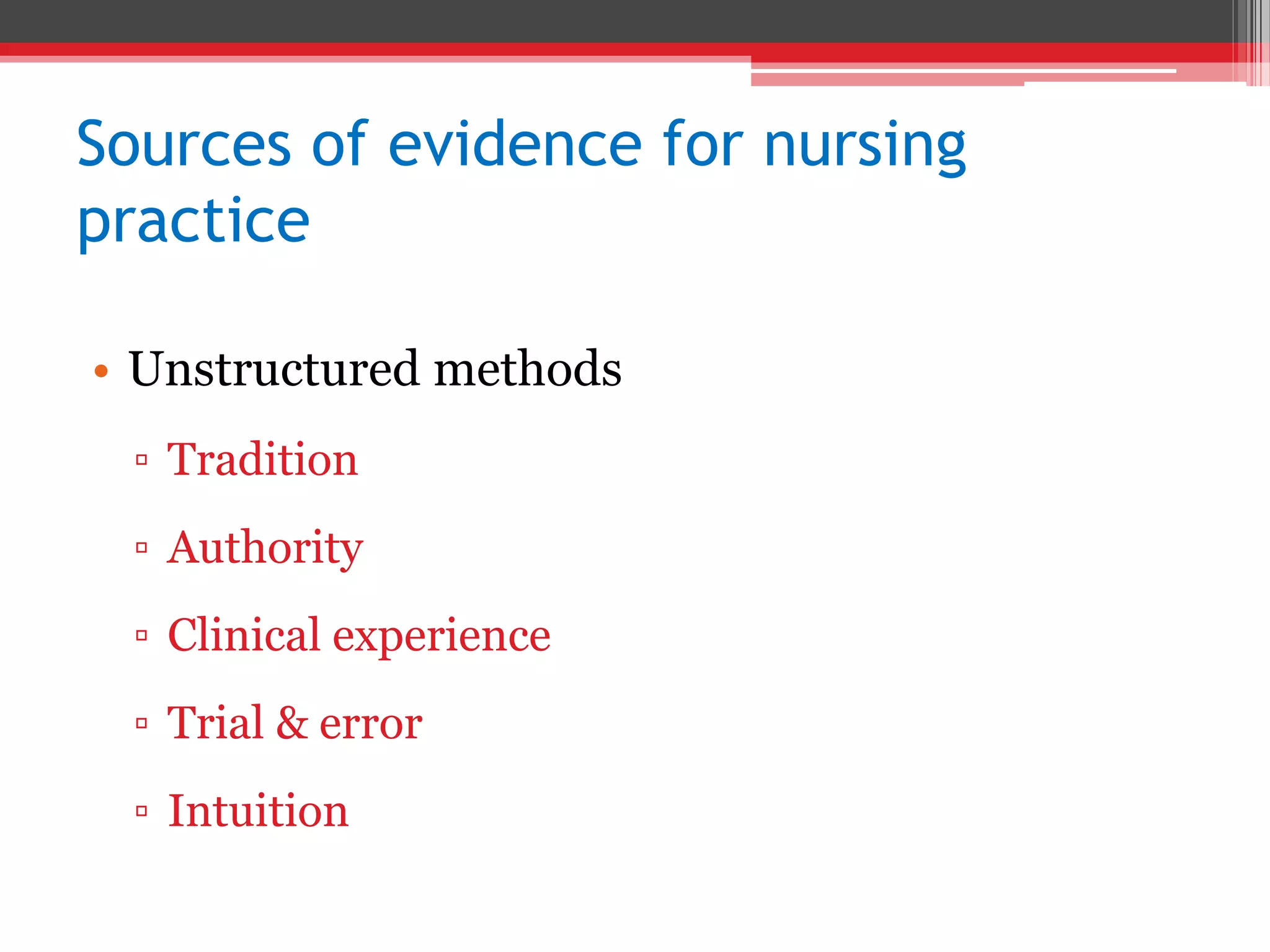
Sources of evidence for nursing
practice
• Unstructured methods
▫ Tradition
▫ Authority
▫ Clinical experience
▫ Trial & error
▫ Intuition
• Structured methods
▫ Logical reasoning
 Inductive reasoning - generalization from specific
 Deductive reasoning -developing specific
prediction from generalization
▫ Assembled information
▫ Disciplined research
▫ Problem solving
Problem solving
Definition
The process of analyzing & solving a problem.
Problem solving process
Problem
definition
Problem
analysis
Generating
possible
solutions
Analyzing
the
solutions
Selecting
the best
solutions
Implementing
the solutions
Evaluation
and revision
Scientific methods
 Defined as controlled systematic investigations
routed in a objective reality aiming to develop
general knowledge about natural phenomenon.
Characteristics
 Orderly & systematic
 Attempt to control extraneous variable that are
not under direct investigation
 Findings are based on empirical evidence
 Findings can be generalized
 Based on assumptions or hypothesis
 Conducted to develop or test theories
Purposes
• Description
• Exploration
• Explanation
• Prediction
• Control
• Prescription
• Identification of relationship of facts
Steps of scientific process
Selecting the
topic &
identifying the
problem
Define
objectives
ROL
Defining
concepts and
variables
Stating
hypothesis
Identifying
assumptions
and
implications
Determine
ethical
implication
Describe r/s
design &
methods for d/c
Define study
population &
sample
Plan for data
analysis &
discussion
Collecting data
from subjects
Analysing &
interpreting
Communicating
study findings
Limitations
• Moral or ethical problem
• Human complexity
• Measurement problems
• Extraneous variable
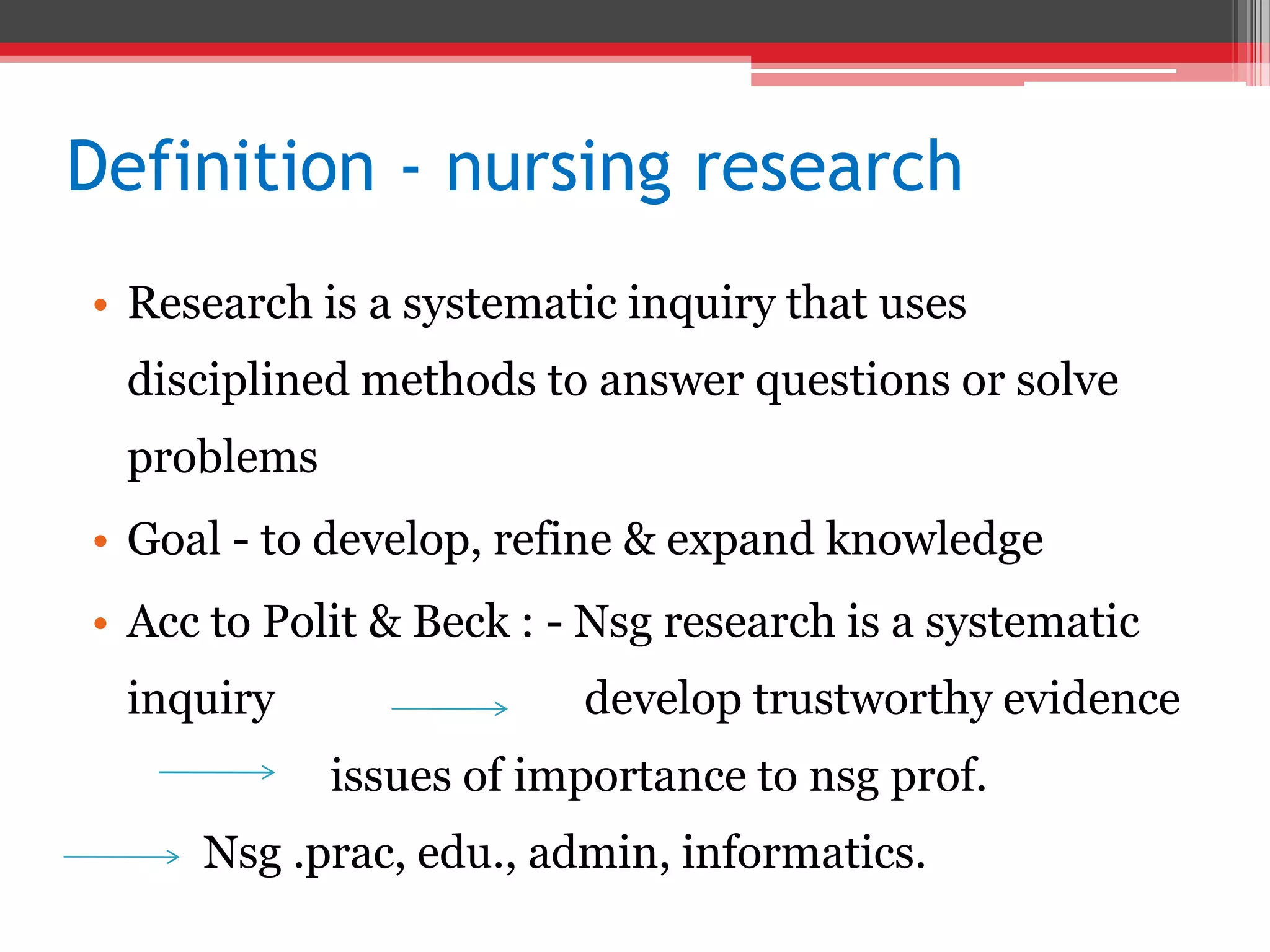
Definition - nursing research
• Research is a systematic inquiry that uses
disciplined methods to answer questions or solve
problems
• Goal - to develop, refine & expand knowledge
• Acc to Polit & Beck : - Nsg research is a systematic
inquiry develop trustworthy evidence
issues of importance to nsg prof.
Nsg .prac, edu., admin, informatics.
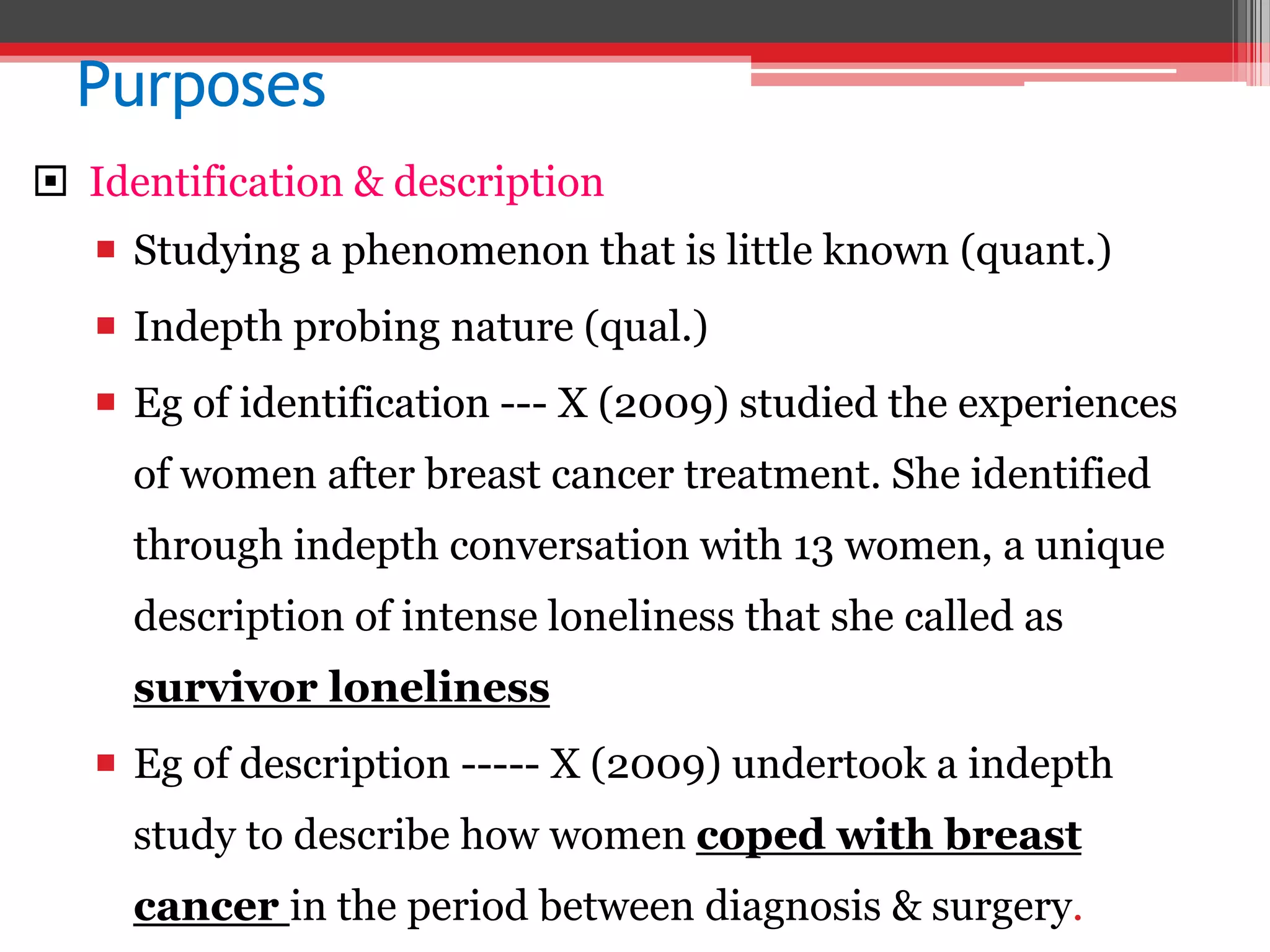
Purposes
 Identification & description
 Studying a phenomenon that is little known (quant.)
 Indepth probing nature (qual.)
 Eg of identification --- X (2009) studied the experiences
of women after breast cancer treatment. She identified
through indepth conversation with 13 women, a unique
description of intense loneliness that she called as
survivor loneliness
 Eg of description ----- X (2009) undertook a indepth
study to describe how women coped with breast
cancer in the period between diagnosis & surgery.
Exploration
▫ The researcher investigates the full nature of the
phenomenon , the manner in which it is
manifested and related factors.
 Explanation
▫ Explanatory r/s understands the underpinnings of
the natural phenomenon and explain the
systematic relationship among them.
Prediction & Control
• The researcher makes prediction and control a
phenomenon based on research finding.
▫ Eg: a research has shown that the incidence of Down’s
syndrome in infants increase with age of the mother.
We can predict that a women aged 40 yrs is at risk of
bearing a child with Down’s syndrome than a women
aged 26 yrs.
▫ We can partially control the outcome by educating the
women about the risk.
Purposes linked to EBP
• Treatment , therapy or intervention
▫ Studies are designed to develop evidence based
treatment decision ---- how to prevent a d/s ,
decide on a therapy, or compare b/w two
therapies.
• Diagnosis & assessment
For development and evaluation of formal
instruments to screen , diagnose and assess pt.
conditions.
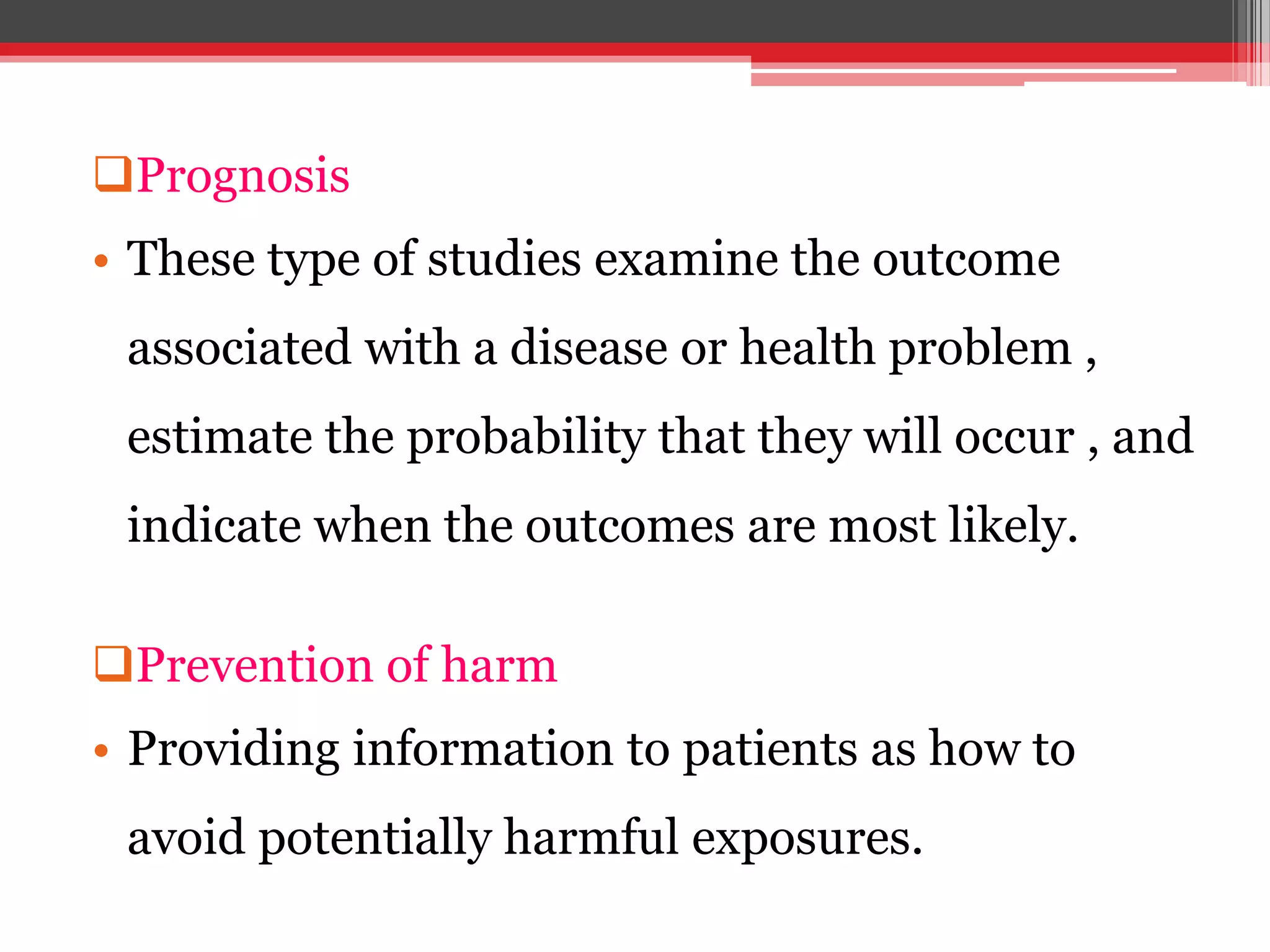
Prognosis
• These type of studies examine the outcome
associated with a disease or health problem ,
estimate the probability that they will occur , and
indicate when the outcomes are most likely.
Prevention of harm
• Providing information to patients as how to
avoid potentially harmful exposures.
Etiology or causation
▫ To know the cause of a d/s so as to prevent it
▫ To identify the factors that affect or cause illness,
mortality or morbidity
Meaning and processes
▫ r/s provide evidences about what health & illness
mean to clients, what barriers they face to practice
positive healthy life style, what processes they
experience in transisition through a health care crisis.
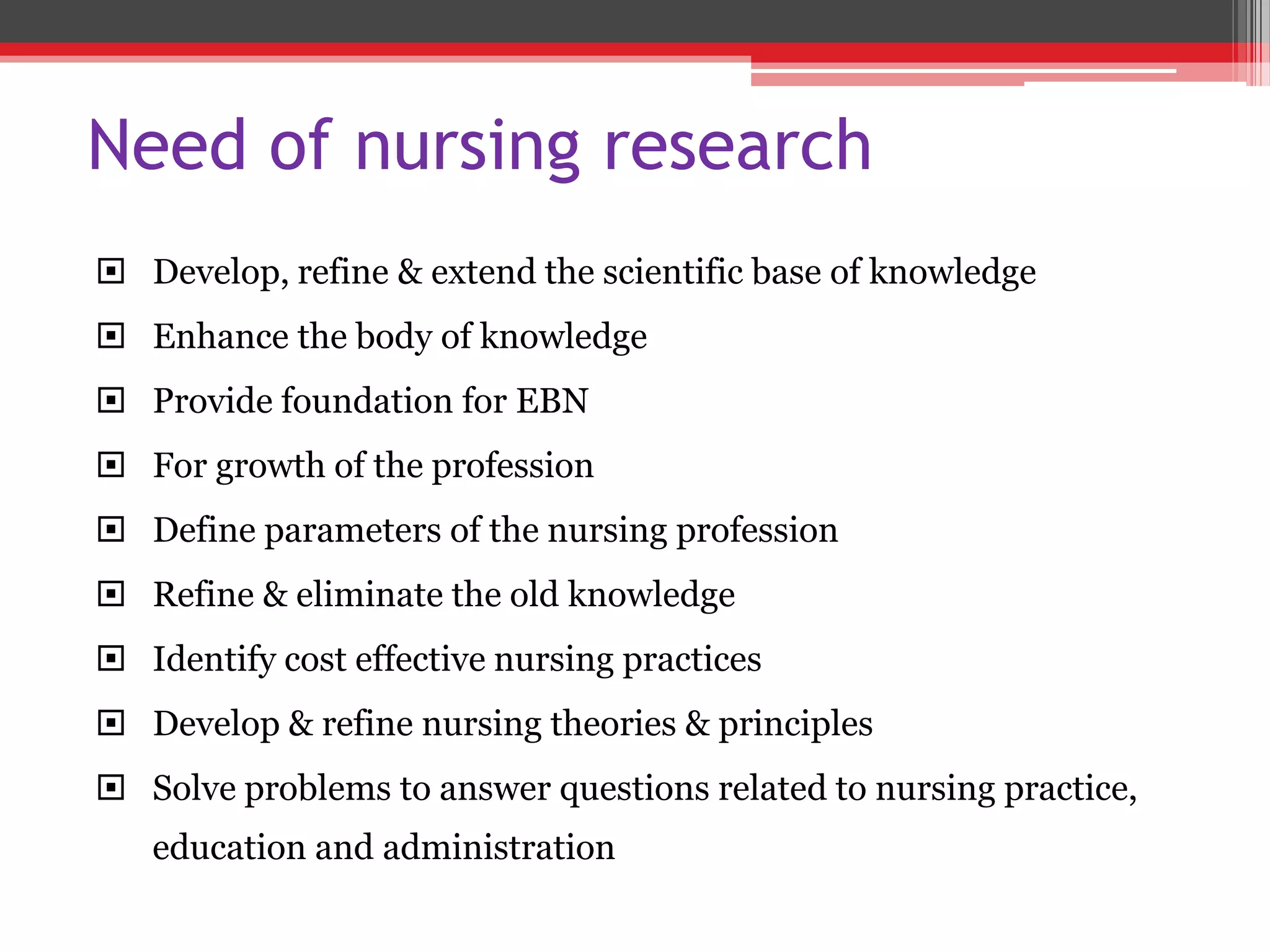
Need of nursing research
 Develop, refine & extend the scientific base of knowledge
 Enhance the body of knowledge
 Provide foundation for EBN
 For growth of the profession
 Define parameters of the nursing profession
 Refine & eliminate the old knowledge
 Identify cost effective nursing practices
 Develop & refine nursing theories & principles
 Solve problems to answer questions related to nursing practice,
education and administration
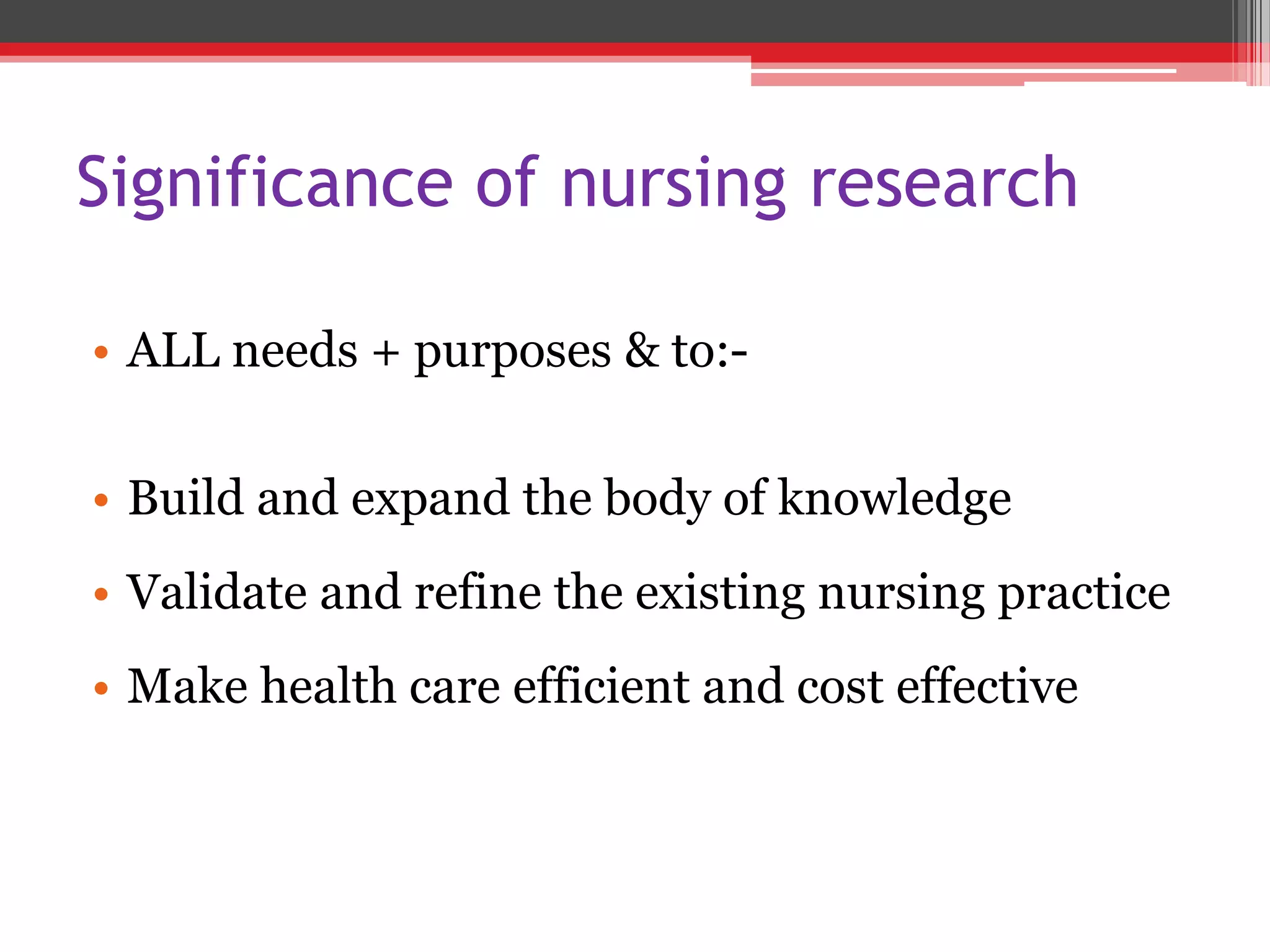
Significance of nursing research
• ALL needs + purposes & to:-
• Build and expand the body of knowledge
• Validate and refine the existing nursing practice
• Make health care efficient and cost effective
Characteristics of good research
• Orderly & systematic process
• Based on current professional issue
• Begin with clearly defined objectives
• Emphasize to develop , refine & expand the body of
knowledge
• Directed towards developing or testing theories
• Finding solution to a problem
• Dedicated to develop empirical evidence
 Strive to collect first hand information
 Logical process
 Generate findings to refine and improve professional practices
 Use of appropriate methodology
 Conduct on representative sample
 Conducted through appropriate use of methods and tools for data
collection
 Carefully recorded and reported
 Adequately & appropriately analyzed research
 Patiently carried out
 Researcher’s expertise , interest and motivation
 Adequately communicated
Qualities of a good researcher
R - research oriented
E - efficient
S - scientific
E - effective
A - active
R - resourceful
C - creative
H - honest
E - economical
R - religious
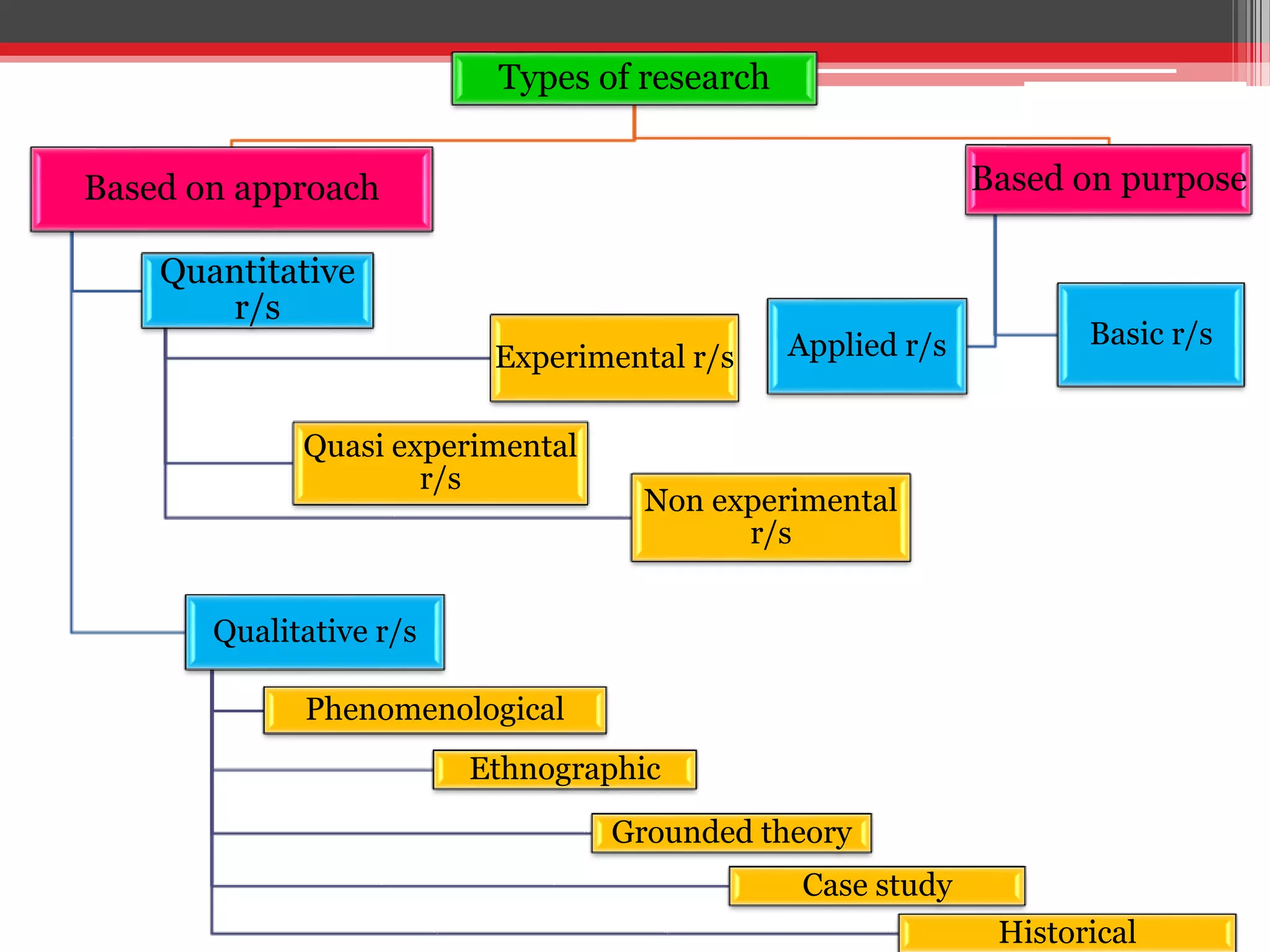
Types of research
Based on approach
Quantitative
r/s
Experimental r/s
Quasi experimental
r/s
Non experimental
r/s
Qualitative r/s
Phenomenological
Ethnographic
Grounded theory
Case study
Historical
Based on purpose
Basic r/sApplied r/s
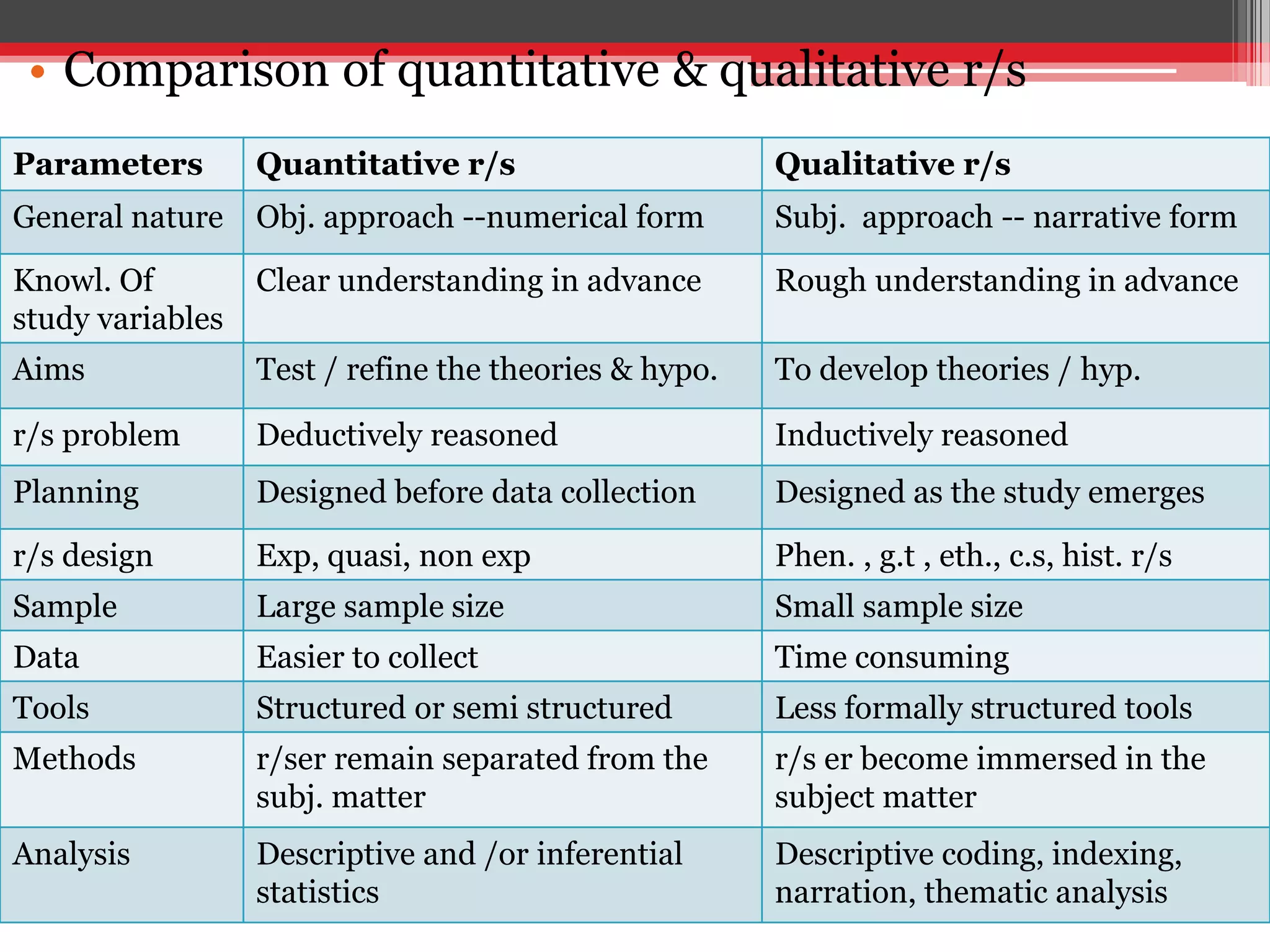
• Comparison of quantitative & qualitative r/s
Parameters Quantitative r/s Qualitative r/s
General nature Obj. approach --numerical form Subj. approach -- narrative form
Knowl. Of
study variables
Clear understanding in advance Rough understanding in advance
Aims Test / refine the theories & hypo. To develop theories / hyp.
r/s problem Deductively reasoned Inductively reasoned
Planning Designed before data collection Designed as the study emerges
r/s design Exp, quasi, non exp Phen. , g.t , eth., c.s, hist. r/s
Sample Large sample size Small sample size
Data Easier to collect Time consuming
Tools Structured or semi structured Less formally structured tools
Methods r/ser remain separated from the
subj. matter
r/s er become immersed in the
subject matter
Analysis Descriptive and /or inferential
statistics
Descriptive coding, indexing,
narration, thematic analysis
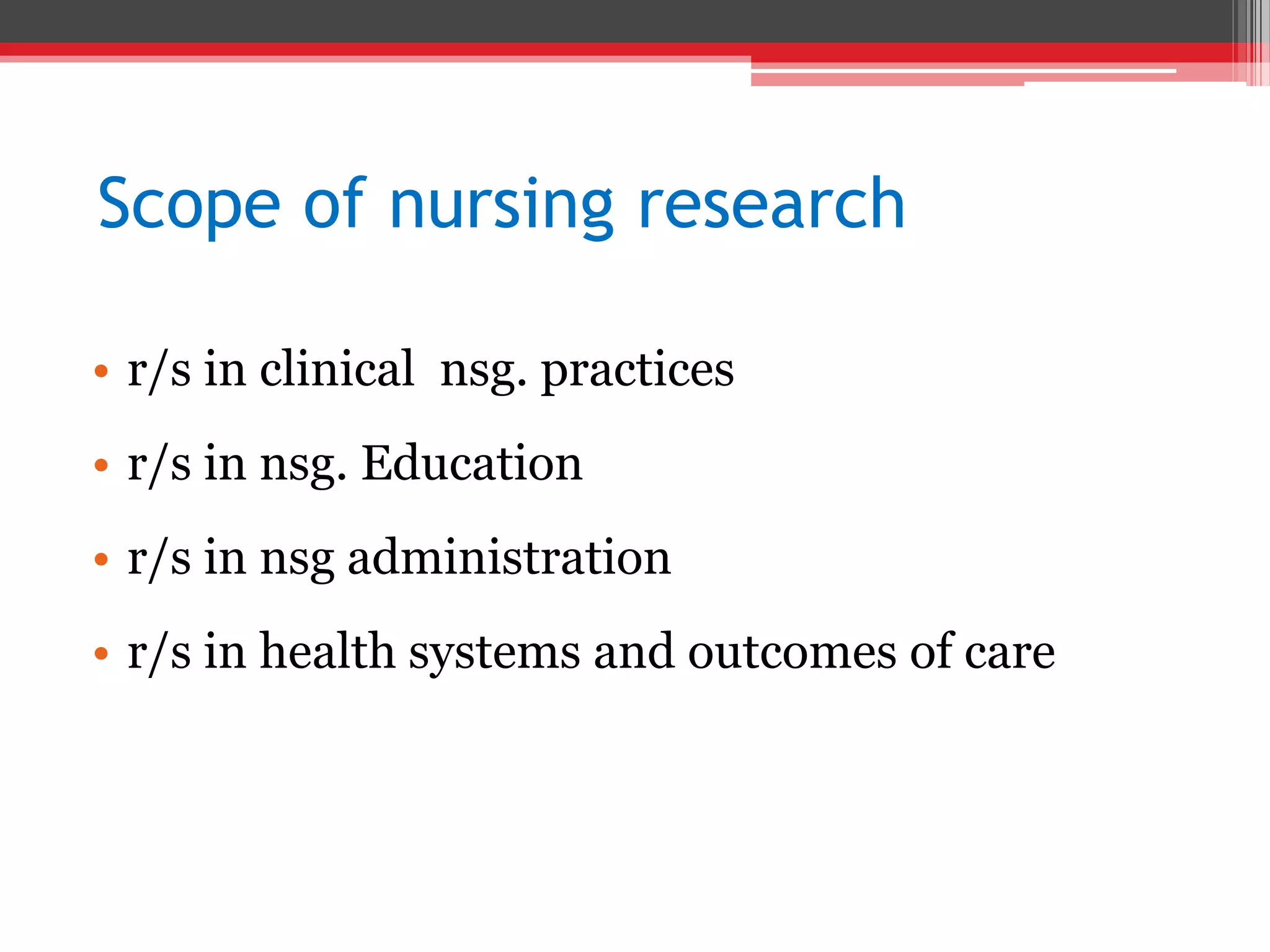
Scope of nursing research
• r/s in clinical nsg. practices
• r/s in nsg. Education
• r/s in nsg administration
• r/s in health systems and outcomes of care
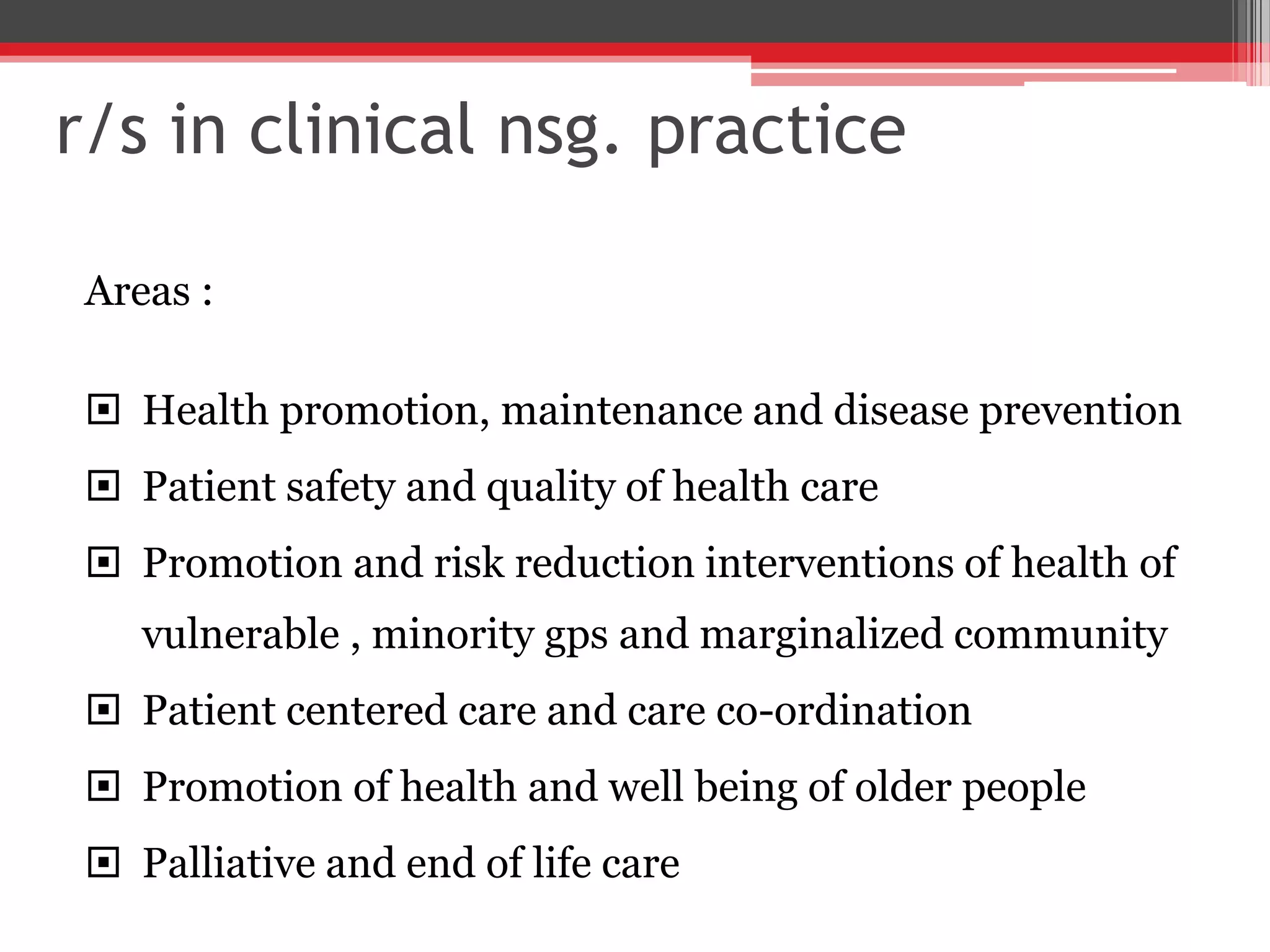
r/s in clinical nsg. practice
Areas :
 Health promotion, maintenance and disease prevention
 Patient safety and quality of health care
 Promotion and risk reduction interventions of health of
vulnerable , minority gps and marginalized community
 Patient centered care and care co-ordination
 Promotion of health and well being of older people
 Palliative and end of life care
• Care implication of genetic testing and
therapeutics
• Nurse’s working envt.
• Home care and community health care practices
• Treatment compliance and adherence t
treatment
r/s in nursing education
 Testing effectivity & efficiency of old teaching methods and
generating new methods
 Curriculum taught and learning exp. Of nsg. Students at UG &PG
level
 Extent of strict discipline required for nsg students to improve
learning
 Promoting clinical and class room learning among students
 Refining & generating evaluation methods
 Identifying and managing problems of absenteeism and lack of
motivation
r/s in nursing administration
• Assessing existing organizational structure , span of
control, communication, staffing pattern, wages,
benefits, performance evaluation practice.
• Refining old know. Regarding nsg administrative
phenomenon
• Developing and testing different administrative methods
to enhance swift administration , employee & customer
satisfaction
• Recruitment , deployment, retention, and
effective use of nursing personnel in providing
the quality of nursing care
• Any phenomenon related to nsg administrative
issue.
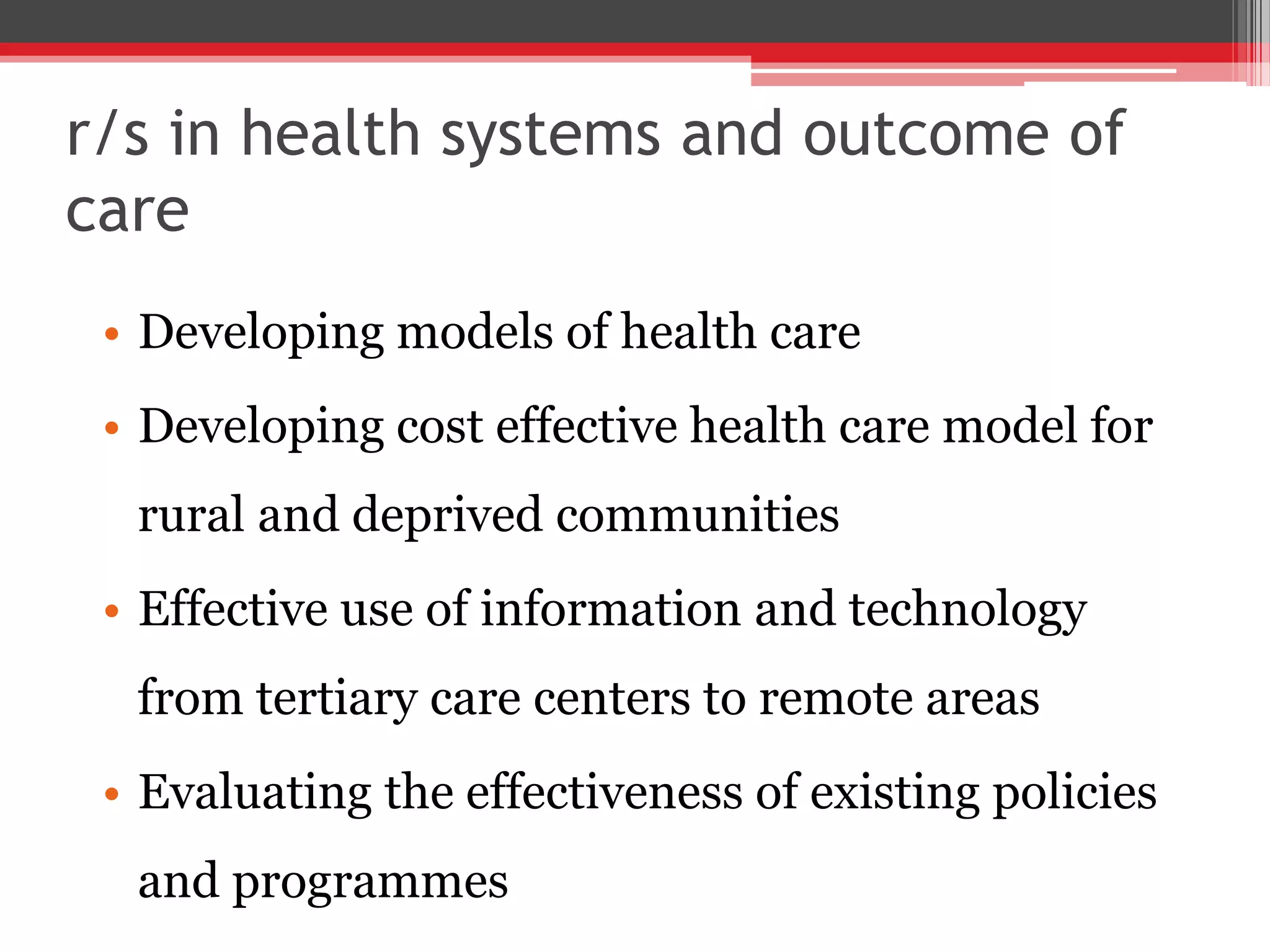
r/s in health systems and outcome of
care
• Developing models of health care
• Developing cost effective health care model for
rural and deprived communities
• Effective use of information and technology
from tertiary care centers to remote areas
• Evaluating the effectiveness of existing policies
and programmes
Problems & challenges in nursing ,
health and social research
 Lack of disciplined research
 Handling multiple variables
 Difficulty in controlling external variable
 minimal possibility of laboratory r/s
 Lack of standardized tools
 Measuring qualitative phenomenon throu’ quantitative means
 Lack of interest among researchers
 Ethical constraints
 Lack of qualitative research expertise
Overview of research process
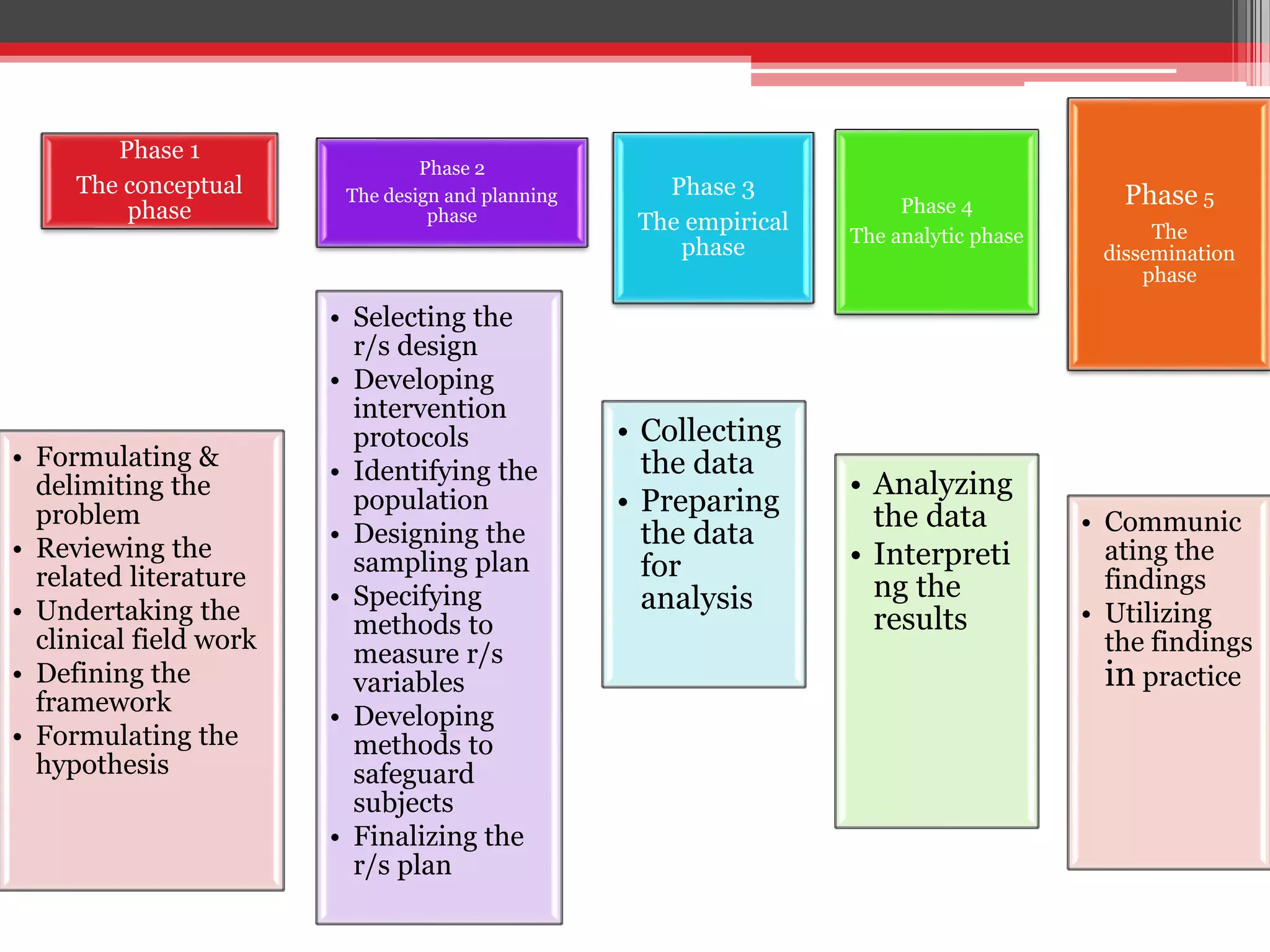
Phase 1
The conceptual
phase
• Formulating &
delimiting the
problem
• Reviewing the
related literature
• Undertaking the
clinical field work
• Defining the
framework
• Formulating the
hypothesis
Phase 2
The design and planning
phase
• Selecting the
r/s design
• Developing
intervention
protocols
• Identifying the
population
• Designing the
sampling plan
• Specifying
methods to
measure r/s
variables
• Developing
methods to
safeguard
subjects
• Finalizing the
r/s plan
Phase 3
The empirical
phase
• Collecting
the data
• Preparing
the data
for
analysis
Phase 4
The analytic phase
• Analyzing
the data
• Interpreti
ng the
results
Phase 5
The
dissemination
phase
• Communic
ating the
findings
• Utilizing
the findings
in practice
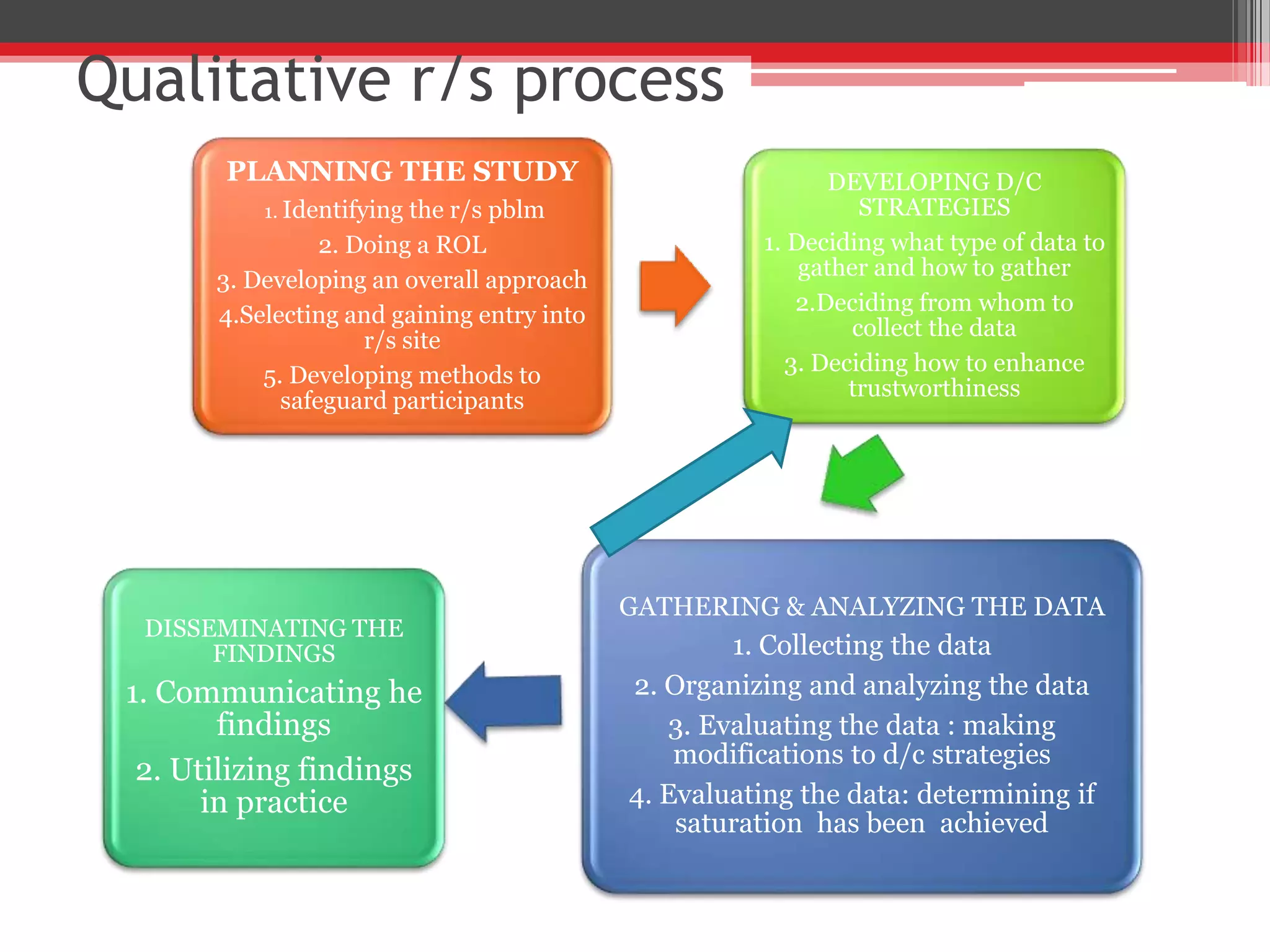
Qualitative r/s process
PLANNING THE STUDY
1. Identifying the r/s pblm
2. Doing a ROL
3. Developing an overall approach
4.Selecting and gaining entry into
r/s site
5. Developing methods to
safeguard participants
DEVELOPING D/C
STRATEGIES
1. Deciding what type of data to
gather and how to gather
2.Deciding from whom to
collect the data
3. Deciding how to enhance
trustworthiness
DISSEMINATING THE
FINDINGS
1. Communicating he
findings
2. Utilizing findings
in practice
GATHERING & ANALYZING THE DATA
1. Collecting the data
2. Organizing and analyzing the data
3. Evaluating the data : making
modifications to d/c strategies
4. Evaluating the data: determining if
saturation has been achieved
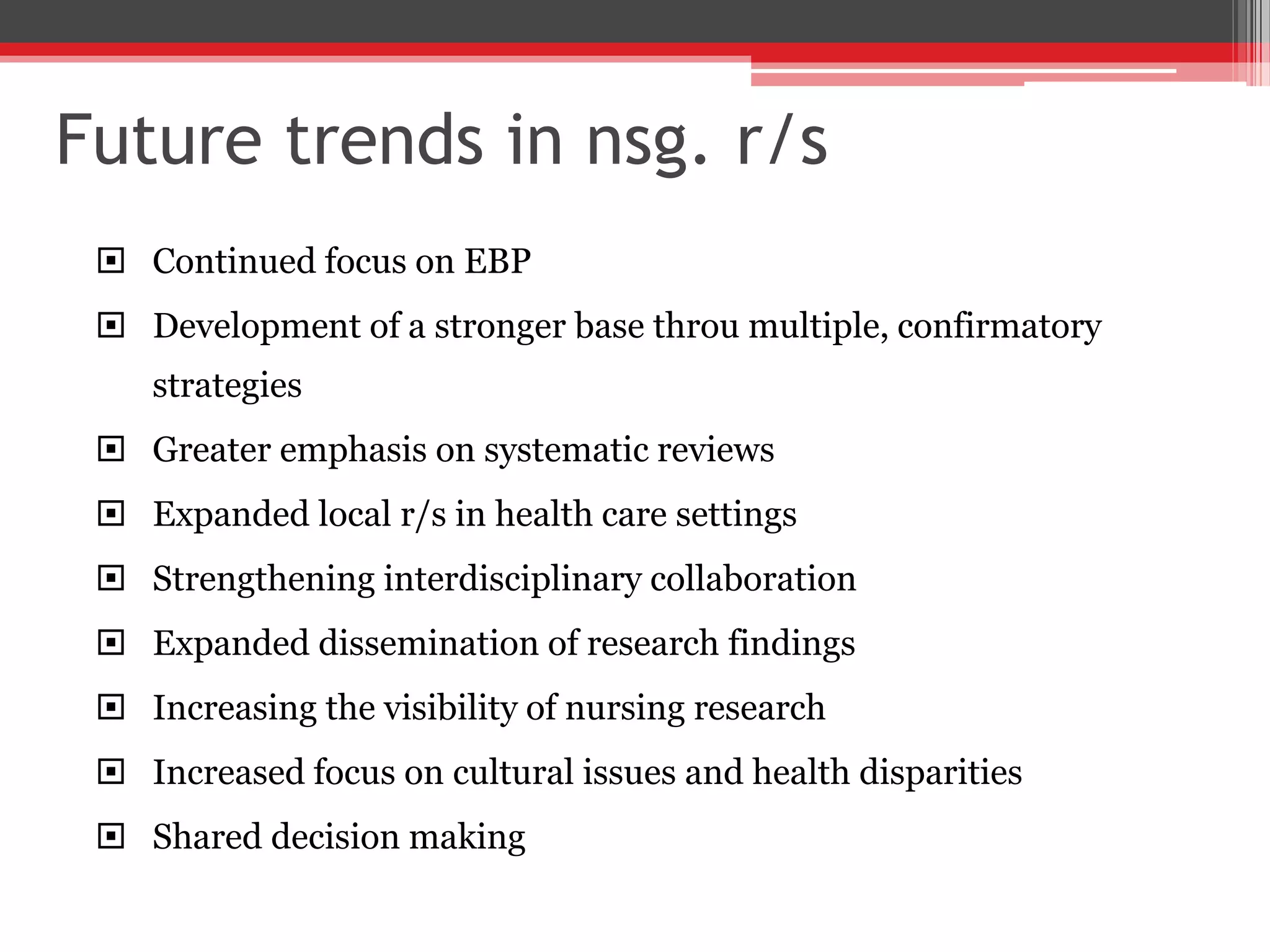
Future trends in nsg. r/s
 Continued focus on EBP
 Development of a stronger base throu multiple, confirmatory
strategies
 Greater emphasis on systematic reviews
 Expanded local r/s in health care settings
 Strengthening interdisciplinary collaboration
 Expanded dissemination of research findings
 Increasing the visibility of nursing research
 Increased focus on cultural issues and health disparities
 Shared decision making
• Acc to David Sackett : EBP is the integration of
best research evidence with clinical expertise
and patient values.
Purposes - EBP
• Specify the way in which a decision has to be
made based on evidence
• Eliminate unsound or excessively risky practices
• Provide highest quality and most cost efficient
nursing care possible
Steps of EBP
Formulating a
clear question
based on a
clinical problem
Literature review
to search beat
available
evidence
Analysis of
strengths and
weaknesses of
evidences
Use of best
evidences in
clinical practice
Evaluating the
efficacy of
empirical
evidences
Barriers in EBP
 Overwhelming amt of information available and
contradictory findings
 lack of professional ability to critically appraise r/s
 Lack of time, workload pressure, competing priorities of pt
care can impede use of EBP
 Lack of knowledge of r/s methods
 Lack of support from prof. colleagues and org.
 Shortage of r/s in some areas of nsg.
 Resistance to change
 Lack of CE programs
 Lack of interest to create the envt of EBP
 Physician’s dominance in clinical practices
Definition
• It is the act of moral principles that the
researcher has to follow while conducting
nursing research to ensure the rights and welfare
of individuals, groups or community under
study.
Development of ethical codes
• The ten commandments in bible are the best
example of a code of conduct
• Ethical principles frequently change with time
and the development of new knowledge
• The 1947 Nuremberg Code resulted from the
revelations of unethical human behaviour from
World War II
• The criteria's of Nuremberg Code:
▫ The researcher must :
 Inform subjects about the study
 Be based on animal experiments if possible
 Try to avoid injury to research subjects
 Be qualified to conduct research
 Stop the study if problems arise
• In 1978 The National Commission for Protection of
Human Subjects of Biomedical and Behavioural
Research was formed
• The report by this Commision submitted in 1979-
titled as the Belmont report is now being utilized in
the research ethics.
Importance of ethics
• Protect the vulnerable gp - harmful effects of the
experimental interventions
• Safeguard the participants from exploitation by
r/sers
• Establish risk - benefit ratio for study subjects
• Ensure fullest respect, dignity, privacy, disclose
of information and fair treatment for stud
subjects
• Build the capability of the subjects to accept or
reject participation in study
Ethical principles for protecting study
participants
Acc to Belmont Report :-
1.Principle of beneficence – research subjects
should be protected from harm
2.Principle of justice – research subjects should
get fair treatment
3.Principle of respect for human dignity -
research subjects must have the autonomy and
self determination
1.Principle of beneficence
• Beneficence - imposes a duty on r/sers to
minimize harm and maximize benefits.
• covers multiple dimension :-
 Rt. To freedom from ham & discomfort
 Rt to protection from exploitation
 Rt to freedom from harm & discomfort
 r/sers have an obligation to prevent , avoid or minimize
harm to subjects
 Harm or discomfort can be physical, emotional, social,
financial.
 Establish risk - benefit ratio
 Rt. To protection from exploitation
 Involvement in a study must not expose the samples to
damage.
 Assure the samples that the information they provide
will not be used against them.
3.Principle of respect for human
dignity
• Include the rt to self determination and the right
to full disclosure.
• Rt to self determination
▫ means that the participants can voluntarily decide
whether to take part in the study
▫ People have the rt to ask questions, refuse to give
information and to withdraw from the study.
▫ Also include freedom from coercion - threat of
penalty if failing to participate in the study/
excessive rewards for agreeing to participate in the
study
• Rt to full disclosure
▫ Means that the r/ser has fully described the nature of the
study, the persons right to refuse participation , the r/sers
responsibility and the likely risk and benefits.
▫ Full disclosure + self determination = informed consent
▫ Covert data collection (concealment) - collection of data
without the participants knowledge & consent
▫ Deception - deliberately withholding information about the
study / providing false information
3.Rt to justice
• Includes participant’s right to fair treatment and
their right to privacy.
• Rt .to fair treatment
▫ Equitable distribution of benefits and burdens of
research
▫ Distributive justice
• Rt to privacy
▫ anonymity of participants & confidentiality of
information must be maintained
▫ No information collected from study participants
can be used for other than r/s purpose
Informed consent
• Adequate information about the r/s is given in a
simple & easily understandable unambiguous
language in a document - informed consent
form
Content / elements of informed consent
form
 Participant status
 Study goals
 Type of data
 Procedures
 Nature of commitment
 Sponsorship
 Participant selection
 Potential risks
 Potential benefits
 Alternatives
 Compensation
 Confidentiality pledge
 Voluntary consent
 Rt to withdraw & withhold
information
 Contact information
ICMR ethical guidelines for biomedical
research
 Principles of :
 Essentiality
 Voluntariness, IC, community agreement
 Non exploitation
 Privacy and confidentiality
 Precaution & risk minimization
 Professional competence
 Accountability & transparency
 Maximization of public interest & distributive justice
 Institutional agreements
 Public domain
 Totality of responsibility
 Compliance
Code of ethics for nurses in India
• The nurse respects the uniqueness of an
individual in provision of care
• The nurse respects the rights of the individuals
as partners in care and helps in making
informed choices
• The nurse respects individuals’ rt to privacy,
maintains confidentiality and shares
information judiciously
• The nurse maintains competence in order to
render quality nursing care
• The nurse is obliged to practice within the frame
work of ethical, professional and legal
boundaries
• The nurse is obliged to work harmoniously with
the members of the health team
• The nurse commits to reciprocate the trust
invested in nursing profession by the society
Ethical responsibilities of a nurse
researcher
• Ensures the respect of individuals autonomy in
consenting to participate in r/s
• Adequate protection of the vulnerable group
• Ensure optimum balance b/w benefit risk ratio
• Privacy, confidentiality, anonymity must be
promised
• Maintain competence in identified r/s area
Overview of nursing research process

Overview of nursing research process

  • 1.
  • 2.
  • 3.
    Nursing research • Asystematic, objective, process of analyzing phenomena of importance to nursing. Theory • A set of related statements that describes or explains phenomena in a systematic way.
  • 4.
    Concept: "A general ideareferring to a behavior or characteristic of an individual, group, or nation". For example, pain, patient care, coping, happiness, cleanliness, dignity…etc.
  • 5.
    Construct: • "A conceptspecified in such a way that it is observable in the real world, in order to facilitate testing of the idea". • For example, position, in real world has many different meanings in gynecology, in surgery and in management.
  • 6.
    Example of therelationship between "concept" and "construct": • Weight • Weight By electronic scale. In the morning. Before breakfast. Without clothes. A construct A concept
  • 7.
    Conceptual definition:  "Thedefinition or description of the study variables that is drawn from the theoretical or conceptual framework“ Conceptual framework  A background or foundation for a study; a less well- developed structure than a theoretical framework; concepts are related in a logical manner by the researcher.
  • 8.
    Conceptual model • Symbolicpresentation of concepts and the relationships between these concepts. Operational definition • The definition of a variable that identifies how the variable will be observed or measured.
  • 9.
    Assumption:  "A statementof principles whose correctness has not been proven, but is taken for granted on the basis of logical reasoning". "health is a priority for all people"
  • 10.
    Hypothesis:  "A statementof predicted or expected relationships between the variables of the research (dep. & indep. variables)". Hypothesis lead to empirical studies that are seeking to confirm or disconfirm these predictions.
  • 11.
    Research design • Theoverall plan for gathering data in a research study. Pilot study: "A small scale trial done in preparation of a major research".
  • 12.
    Validity: “Degree or extentto which the tool or instrument measures what it is supposed to measure". For example, a ruler measures the height not the weight, while the scale measures the weight not the height.
  • 13.
    Reliability: • Degree orextent of consistency or dependability with which a study tool measures the variable over time, by different persons".
  • 14.
    Population: • “Group ofpeople who are going to be studied, and to whom should the study result apply". • It is the complete set of persons or objects that possess some common characteristics of interest to the researcher. For example, in a research studying the factors affecting the nurse's workload , bed-side nurses are the population .
  • 15.
    Target population • Theentire group of people or objects to which the researcher wishes to generalize the findings of a study. Accessible population • The group of people or objects that is available to the researcher for a particular study.
  • 16.
    Sample: • "Are thosepersons – in the population- from whom data will be actually collected, and from whom generalizations about the population will be made". • A subset of the population that is selected to represent the population.
  • 17.
    Variable: "A concept thatis observable, measurable, and has a dimension that can vary". For example, temperature is a variable that is observable, measurable, and varies from high to low.
  • 18.
    Types of Variables 1.Dichotomous variables 2. Attribute variable 3. Active variables. 4. Dependent and independent variables . 5. Extraneous variable
  • 19.
    1. Dichotomous variables. Variablesthat vary in only two values. For example: Male Vs female. Alive Vs dead. Day Vs night.
  • 20.
    2. Attribute variable/ demographic variables: A pre-existing characteristic or attribute such as age, sex …etc. which the researcher simply observes and measures.
  • 21.
    4. Dependent andindependent variables  Independent variable: “Variable that is believed to cause or influence the dependent variable".  Dependent variable: “Variable that is influenced by the independent variable".
  • 22.
    Does Smoking CauseLung cancer ? Does Nursing care Cause Rapid recovery? Does Drug (a) Cause Improvement ? Cause Effect Independent variable Dependent variable
  • 23.
    Extraneous variable/ intervening variable •Variable that confound the relationship between the dependent and independent variables, thus it needs to be controlled. • E.g., "air pollution" is an extraneous variable interferes with studying the relationship between smoking "independent variable" and lung cancer "dependent variable".
  • 24.
    Data: Pieces of informationthat are collected as they pertain to the study". Limitations: • "Weaknesses in a research“ • Uncontrolled extraneous variables, that limit the generalizability of the findings.
  • 25.
    Measurement • A processin scientific research that uses rules to assign numbers to objects. Abstract A brief summary of a completed research or a proposal. It contains purpose, method and major findings of the study, located at the beginning of a report or a proposal.
  • 27.
    Sources of evidencefor nursing practice • Unstructured methods ▫ Tradition ▫ Authority ▫ Clinical experience ▫ Trial & error ▫ Intuition
  • 28.
    • Structured methods ▫Logical reasoning  Inductive reasoning - generalization from specific  Deductive reasoning -developing specific prediction from generalization ▫ Assembled information ▫ Disciplined research ▫ Problem solving
  • 29.
    Problem solving Definition The processof analyzing & solving a problem.
  • 30.
  • 31.
    Scientific methods  Definedas controlled systematic investigations routed in a objective reality aiming to develop general knowledge about natural phenomenon. Characteristics  Orderly & systematic  Attempt to control extraneous variable that are not under direct investigation  Findings are based on empirical evidence  Findings can be generalized  Based on assumptions or hypothesis  Conducted to develop or test theories
  • 32.
    Purposes • Description • Exploration •Explanation • Prediction • Control • Prescription • Identification of relationship of facts
  • 33.
    Steps of scientificprocess Selecting the topic & identifying the problem Define objectives ROL Defining concepts and variables Stating hypothesis Identifying assumptions and implications Determine ethical implication Describe r/s design & methods for d/c Define study population & sample Plan for data analysis & discussion Collecting data from subjects Analysing & interpreting Communicating study findings
  • 34.
    Limitations • Moral orethical problem • Human complexity • Measurement problems • Extraneous variable
  • 35.
    Definition - nursingresearch • Research is a systematic inquiry that uses disciplined methods to answer questions or solve problems • Goal - to develop, refine & expand knowledge • Acc to Polit & Beck : - Nsg research is a systematic inquiry develop trustworthy evidence issues of importance to nsg prof. Nsg .prac, edu., admin, informatics.
  • 36.
    Purposes  Identification &description  Studying a phenomenon that is little known (quant.)  Indepth probing nature (qual.)  Eg of identification --- X (2009) studied the experiences of women after breast cancer treatment. She identified through indepth conversation with 13 women, a unique description of intense loneliness that she called as survivor loneliness  Eg of description ----- X (2009) undertook a indepth study to describe how women coped with breast cancer in the period between diagnosis & surgery.
  • 37.
    Exploration ▫ The researcherinvestigates the full nature of the phenomenon , the manner in which it is manifested and related factors.  Explanation ▫ Explanatory r/s understands the underpinnings of the natural phenomenon and explain the systematic relationship among them.
  • 38.
    Prediction & Control •The researcher makes prediction and control a phenomenon based on research finding. ▫ Eg: a research has shown that the incidence of Down’s syndrome in infants increase with age of the mother. We can predict that a women aged 40 yrs is at risk of bearing a child with Down’s syndrome than a women aged 26 yrs. ▫ We can partially control the outcome by educating the women about the risk.
  • 39.
    Purposes linked toEBP • Treatment , therapy or intervention ▫ Studies are designed to develop evidence based treatment decision ---- how to prevent a d/s , decide on a therapy, or compare b/w two therapies. • Diagnosis & assessment For development and evaluation of formal instruments to screen , diagnose and assess pt. conditions.
  • 40.
    Prognosis • These typeof studies examine the outcome associated with a disease or health problem , estimate the probability that they will occur , and indicate when the outcomes are most likely. Prevention of harm • Providing information to patients as how to avoid potentially harmful exposures.
  • 41.
    Etiology or causation ▫To know the cause of a d/s so as to prevent it ▫ To identify the factors that affect or cause illness, mortality or morbidity Meaning and processes ▫ r/s provide evidences about what health & illness mean to clients, what barriers they face to practice positive healthy life style, what processes they experience in transisition through a health care crisis.
  • 42.
    Need of nursingresearch  Develop, refine & extend the scientific base of knowledge  Enhance the body of knowledge  Provide foundation for EBN  For growth of the profession  Define parameters of the nursing profession  Refine & eliminate the old knowledge  Identify cost effective nursing practices  Develop & refine nursing theories & principles  Solve problems to answer questions related to nursing practice, education and administration
  • 43.
    Significance of nursingresearch • ALL needs + purposes & to:- • Build and expand the body of knowledge • Validate and refine the existing nursing practice • Make health care efficient and cost effective
  • 44.
    Characteristics of goodresearch • Orderly & systematic process • Based on current professional issue • Begin with clearly defined objectives • Emphasize to develop , refine & expand the body of knowledge • Directed towards developing or testing theories • Finding solution to a problem • Dedicated to develop empirical evidence
  • 45.
     Strive tocollect first hand information  Logical process  Generate findings to refine and improve professional practices  Use of appropriate methodology  Conduct on representative sample  Conducted through appropriate use of methods and tools for data collection  Carefully recorded and reported  Adequately & appropriately analyzed research  Patiently carried out  Researcher’s expertise , interest and motivation  Adequately communicated
  • 46.
    Qualities of agood researcher R - research oriented E - efficient S - scientific E - effective A - active R - resourceful C - creative H - honest E - economical R - religious
  • 48.
    Types of research Basedon approach Quantitative r/s Experimental r/s Quasi experimental r/s Non experimental r/s Qualitative r/s Phenomenological Ethnographic Grounded theory Case study Historical Based on purpose Basic r/sApplied r/s
  • 49.
    • Comparison ofquantitative & qualitative r/s Parameters Quantitative r/s Qualitative r/s General nature Obj. approach --numerical form Subj. approach -- narrative form Knowl. Of study variables Clear understanding in advance Rough understanding in advance Aims Test / refine the theories & hypo. To develop theories / hyp. r/s problem Deductively reasoned Inductively reasoned Planning Designed before data collection Designed as the study emerges r/s design Exp, quasi, non exp Phen. , g.t , eth., c.s, hist. r/s Sample Large sample size Small sample size Data Easier to collect Time consuming Tools Structured or semi structured Less formally structured tools Methods r/ser remain separated from the subj. matter r/s er become immersed in the subject matter Analysis Descriptive and /or inferential statistics Descriptive coding, indexing, narration, thematic analysis
  • 50.
    Scope of nursingresearch • r/s in clinical nsg. practices • r/s in nsg. Education • r/s in nsg administration • r/s in health systems and outcomes of care
  • 51.
    r/s in clinicalnsg. practice Areas :  Health promotion, maintenance and disease prevention  Patient safety and quality of health care  Promotion and risk reduction interventions of health of vulnerable , minority gps and marginalized community  Patient centered care and care co-ordination  Promotion of health and well being of older people  Palliative and end of life care
  • 52.
    • Care implicationof genetic testing and therapeutics • Nurse’s working envt. • Home care and community health care practices • Treatment compliance and adherence t treatment
  • 53.
    r/s in nursingeducation  Testing effectivity & efficiency of old teaching methods and generating new methods  Curriculum taught and learning exp. Of nsg. Students at UG &PG level  Extent of strict discipline required for nsg students to improve learning  Promoting clinical and class room learning among students  Refining & generating evaluation methods  Identifying and managing problems of absenteeism and lack of motivation
  • 54.
    r/s in nursingadministration • Assessing existing organizational structure , span of control, communication, staffing pattern, wages, benefits, performance evaluation practice. • Refining old know. Regarding nsg administrative phenomenon • Developing and testing different administrative methods to enhance swift administration , employee & customer satisfaction
  • 55.
    • Recruitment ,deployment, retention, and effective use of nursing personnel in providing the quality of nursing care • Any phenomenon related to nsg administrative issue.
  • 56.
    r/s in healthsystems and outcome of care • Developing models of health care • Developing cost effective health care model for rural and deprived communities • Effective use of information and technology from tertiary care centers to remote areas • Evaluating the effectiveness of existing policies and programmes
  • 57.
    Problems & challengesin nursing , health and social research  Lack of disciplined research  Handling multiple variables  Difficulty in controlling external variable  minimal possibility of laboratory r/s  Lack of standardized tools  Measuring qualitative phenomenon throu’ quantitative means  Lack of interest among researchers  Ethical constraints  Lack of qualitative research expertise
  • 58.
  • 59.
    Phase 1 The conceptual phase •Formulating & delimiting the problem • Reviewing the related literature • Undertaking the clinical field work • Defining the framework • Formulating the hypothesis Phase 2 The design and planning phase • Selecting the r/s design • Developing intervention protocols • Identifying the population • Designing the sampling plan • Specifying methods to measure r/s variables • Developing methods to safeguard subjects • Finalizing the r/s plan Phase 3 The empirical phase • Collecting the data • Preparing the data for analysis Phase 4 The analytic phase • Analyzing the data • Interpreti ng the results Phase 5 The dissemination phase • Communic ating the findings • Utilizing the findings in practice
  • 60.
    Qualitative r/s process PLANNINGTHE STUDY 1. Identifying the r/s pblm 2. Doing a ROL 3. Developing an overall approach 4.Selecting and gaining entry into r/s site 5. Developing methods to safeguard participants DEVELOPING D/C STRATEGIES 1. Deciding what type of data to gather and how to gather 2.Deciding from whom to collect the data 3. Deciding how to enhance trustworthiness DISSEMINATING THE FINDINGS 1. Communicating he findings 2. Utilizing findings in practice GATHERING & ANALYZING THE DATA 1. Collecting the data 2. Organizing and analyzing the data 3. Evaluating the data : making modifications to d/c strategies 4. Evaluating the data: determining if saturation has been achieved
  • 61.
    Future trends innsg. r/s  Continued focus on EBP  Development of a stronger base throu multiple, confirmatory strategies  Greater emphasis on systematic reviews  Expanded local r/s in health care settings  Strengthening interdisciplinary collaboration  Expanded dissemination of research findings  Increasing the visibility of nursing research  Increased focus on cultural issues and health disparities  Shared decision making
  • 63.
    • Acc toDavid Sackett : EBP is the integration of best research evidence with clinical expertise and patient values.
  • 64.
    Purposes - EBP •Specify the way in which a decision has to be made based on evidence • Eliminate unsound or excessively risky practices • Provide highest quality and most cost efficient nursing care possible
  • 65.
    Steps of EBP Formulatinga clear question based on a clinical problem Literature review to search beat available evidence Analysis of strengths and weaknesses of evidences Use of best evidences in clinical practice Evaluating the efficacy of empirical evidences
  • 66.
    Barriers in EBP Overwhelming amt of information available and contradictory findings  lack of professional ability to critically appraise r/s  Lack of time, workload pressure, competing priorities of pt care can impede use of EBP  Lack of knowledge of r/s methods  Lack of support from prof. colleagues and org.  Shortage of r/s in some areas of nsg.  Resistance to change  Lack of CE programs  Lack of interest to create the envt of EBP  Physician’s dominance in clinical practices
  • 68.
    Definition • It isthe act of moral principles that the researcher has to follow while conducting nursing research to ensure the rights and welfare of individuals, groups or community under study.
  • 69.
    Development of ethicalcodes • The ten commandments in bible are the best example of a code of conduct • Ethical principles frequently change with time and the development of new knowledge • The 1947 Nuremberg Code resulted from the revelations of unethical human behaviour from World War II
  • 70.
    • The criteria'sof Nuremberg Code: ▫ The researcher must :  Inform subjects about the study  Be based on animal experiments if possible  Try to avoid injury to research subjects  Be qualified to conduct research  Stop the study if problems arise • In 1978 The National Commission for Protection of Human Subjects of Biomedical and Behavioural Research was formed • The report by this Commision submitted in 1979- titled as the Belmont report is now being utilized in the research ethics.
  • 71.
    Importance of ethics •Protect the vulnerable gp - harmful effects of the experimental interventions • Safeguard the participants from exploitation by r/sers • Establish risk - benefit ratio for study subjects • Ensure fullest respect, dignity, privacy, disclose of information and fair treatment for stud subjects • Build the capability of the subjects to accept or reject participation in study
  • 72.
    Ethical principles forprotecting study participants Acc to Belmont Report :- 1.Principle of beneficence – research subjects should be protected from harm 2.Principle of justice – research subjects should get fair treatment 3.Principle of respect for human dignity - research subjects must have the autonomy and self determination
  • 73.
    1.Principle of beneficence •Beneficence - imposes a duty on r/sers to minimize harm and maximize benefits. • covers multiple dimension :-  Rt. To freedom from ham & discomfort  Rt to protection from exploitation
  • 74.
     Rt tofreedom from harm & discomfort  r/sers have an obligation to prevent , avoid or minimize harm to subjects  Harm or discomfort can be physical, emotional, social, financial.  Establish risk - benefit ratio  Rt. To protection from exploitation  Involvement in a study must not expose the samples to damage.  Assure the samples that the information they provide will not be used against them.
  • 75.
    3.Principle of respectfor human dignity • Include the rt to self determination and the right to full disclosure. • Rt to self determination ▫ means that the participants can voluntarily decide whether to take part in the study ▫ People have the rt to ask questions, refuse to give information and to withdraw from the study. ▫ Also include freedom from coercion - threat of penalty if failing to participate in the study/ excessive rewards for agreeing to participate in the study
  • 76.
    • Rt tofull disclosure ▫ Means that the r/ser has fully described the nature of the study, the persons right to refuse participation , the r/sers responsibility and the likely risk and benefits. ▫ Full disclosure + self determination = informed consent ▫ Covert data collection (concealment) - collection of data without the participants knowledge & consent ▫ Deception - deliberately withholding information about the study / providing false information
  • 77.
    3.Rt to justice •Includes participant’s right to fair treatment and their right to privacy. • Rt .to fair treatment ▫ Equitable distribution of benefits and burdens of research ▫ Distributive justice
  • 78.
    • Rt toprivacy ▫ anonymity of participants & confidentiality of information must be maintained ▫ No information collected from study participants can be used for other than r/s purpose
  • 79.
    Informed consent • Adequateinformation about the r/s is given in a simple & easily understandable unambiguous language in a document - informed consent form
  • 80.
    Content / elementsof informed consent form  Participant status  Study goals  Type of data  Procedures  Nature of commitment  Sponsorship  Participant selection  Potential risks  Potential benefits  Alternatives  Compensation  Confidentiality pledge  Voluntary consent  Rt to withdraw & withhold information  Contact information
  • 81.
    ICMR ethical guidelinesfor biomedical research  Principles of :  Essentiality  Voluntariness, IC, community agreement  Non exploitation  Privacy and confidentiality  Precaution & risk minimization  Professional competence  Accountability & transparency  Maximization of public interest & distributive justice  Institutional agreements  Public domain  Totality of responsibility  Compliance
  • 82.
    Code of ethicsfor nurses in India • The nurse respects the uniqueness of an individual in provision of care • The nurse respects the rights of the individuals as partners in care and helps in making informed choices • The nurse respects individuals’ rt to privacy, maintains confidentiality and shares information judiciously • The nurse maintains competence in order to render quality nursing care
  • 83.
    • The nurseis obliged to practice within the frame work of ethical, professional and legal boundaries • The nurse is obliged to work harmoniously with the members of the health team • The nurse commits to reciprocate the trust invested in nursing profession by the society
  • 84.
    Ethical responsibilities ofa nurse researcher • Ensures the respect of individuals autonomy in consenting to participate in r/s • Adequate protection of the vulnerable group • Ensure optimum balance b/w benefit risk ratio • Privacy, confidentiality, anonymity must be promised • Maintain competence in identified r/s area

Editor's Notes

  • #28 Methods of accquiring know. In nsg.