OVERHEAD ANALYSISTo estimate the cost of each productTo calculate the cost of any work-in-progressTo attempt to control costs by comparing actual with estimatedObjectives of Cost Accounting:
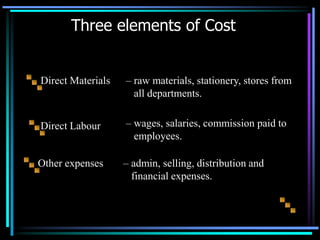
Three elements of CostDirect MaterialsDirect Labour Other expenses– raw materials, stationery, stores from      all departments.– wages, salaries, commission paid to    employees.– admin, selling, distribution and    financial expenses.
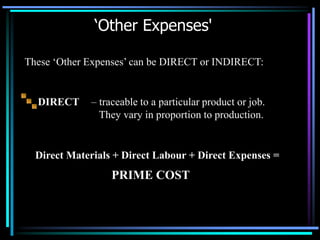
‘Other Expenses'DIRECTThese ‘Other Expenses’ can be DIRECT or INDIRECT:– traceable to a particular product or job.     They vary in proportion to production.Direct Materials + Direct Labour + Direct Expenses =PRIME COST
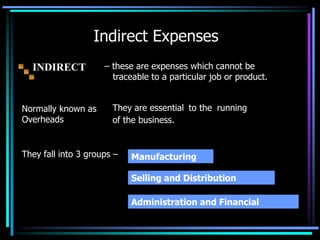
INDIRECTIndirect Expenses– these are expenses which cannot be    traceable to a particular job or product.They are essentialto therunning of the business.Normally known as OverheadsThey fall into 3 groups –ManufacturingSelling and DistributionAdministration and Financial
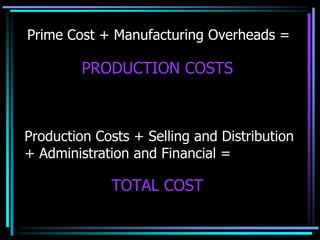
Prime Cost + Manufacturing Overheads =PRODUCTION COSTSProduction Costs + Selling and Distribution + Administration and Financial =TOTAL COST
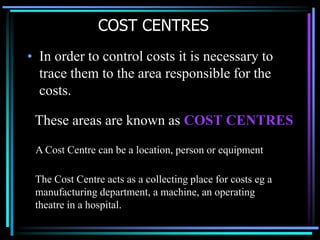
COST CENTRES In order to control costs it is necessary to trace them to the area responsible for the costs. These areas are known as COST CENTRESA Cost Centre can be a location, person or equipmentThe Cost Centre acts as a collecting place for costs eg a manufacturing department, a machine, an operating theatre in a hospital.
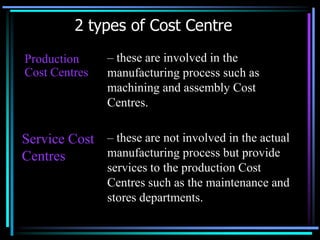
2 types of Cost Centre– these are involved in the manufacturing process such as machining and assembly Cost Centres.Production Cost CentresService Cost Centres– these are not involved in the actual manufacturing process but provide services to the production Cost Centres such as the maintenance and stores departments.
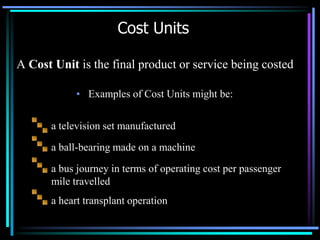
a television set manufactureda ball-bearing made on a machinea bus journey in terms of operating cost per passenger    mile travelleda heart transplant operationCost UnitsA Cost Unit is the final product or service being costedExamples of Cost Units might be:
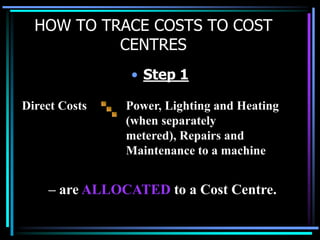
HOW TO TRACE COSTS TO COST CENTRES Power, Lighting and Heating (when separately metered), Repairs and Maintenance to a machineStep 1Direct Costs– are ALLOCATED to a Cost Centre.
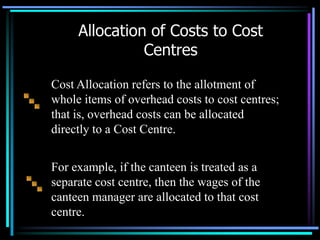
Cost Allocation refers to the allotment of whole items of overhead costs to cost centres; that is, overhead costs can be allocated directly to a Cost Centre.For example, if the canteen is treated as a separate cost centre, then the wages of the canteen manager are allocated to that cost centre.Allocation of Costs to Cost Centres
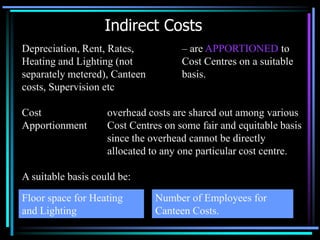
Indirect CostsDepreciation, Rent, Rates, Heating and Lighting (not separately metered), Canteen costs, Supervision etc– are APPORTIONED to Cost Centres on a suitable basis.Cost Apportionmentoverhead costs are shared out among various Cost Centres on some fair and equitable basis since the overhead cannot be directly allocated to any one particular cost centre.A suitable basis could be:Floor space for Heating and LightingNumber of Employees for Canteen Costs.
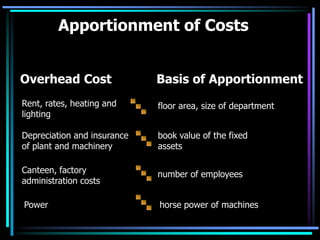
Apportionment of Costsfloor area, size of departmentbook value of the fixed assetsnumber of employees  horse power of machines Overhead Cost	            Basis of ApportionmentRent, rates, heating and lightingDepreciation and insurance of plant and machineryCanteen, factory administration costs Power
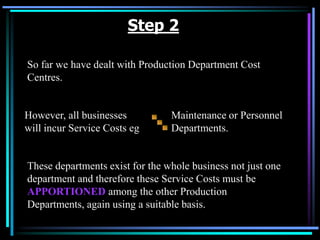
Step 2Maintenance or Personnel Departments.So far we have dealt with Production Department Cost Centres.  However, all businesses will incur Service Costs egThese departments exist for the whole business not just one department and therefore these Service Costs must be APPORTIONEDamong the other Production Departments, again using a suitable basis.
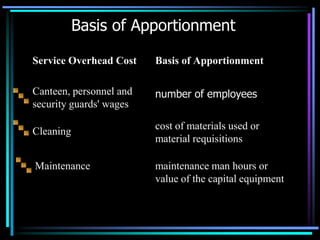
Basis of ApportionmentCanteen, personnel and security guards' wagesCleaning	 Maintenance  Service Overhead Cost	Basis of Apportionmentnumber of employeescost of materials used or material requisitionsmaintenance man hours or value of the capital equipment
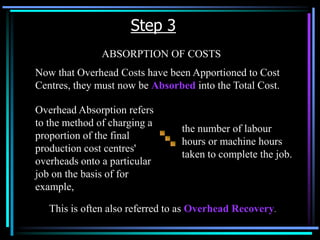
Step 3the number of labour hours or machine hours taken to complete the job.  ABSORPTION OF COSTSNow that Overhead Costs have been Apportioned to Cost Centres, they must now be Absorbed into the Total Cost.Overhead Absorption refers to the method of charging a proportion of the final production cost centres' overheads onto a particular job on the basis of for example,This is often also referred to as Overhead Recovery.
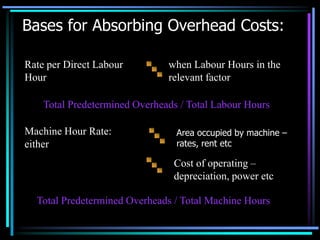
Bases for Absorbing Overhead Costs:when Labour Hours in the relevant factorArea occupied by machine – rates, rent etcCost of operating – depreciation, power etcRate per Direct Labour HourTotal Predetermined Overheads / Total Labour HoursMachine Hour Rate:  eitherTotal Predetermined Overheads / Total Machine Hours
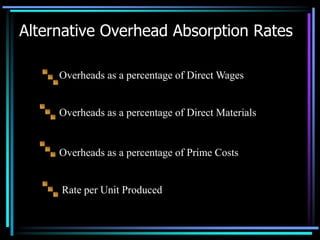
Overheads as a percentage of Direct WagesOverheads as a percentage of Direct MaterialsOverheads as a percentage of Prime CostsRate per Unit ProducedAlternative Overhead Absorption Rates
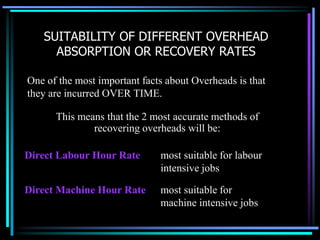
SUITABILITY OF DIFFERENT OVERHEAD ABSORPTION OR RECOVERY RATESOne of the most important facts about Overheads is that they are incurred OVER TIME. This means that the 2 most accurate methods of recovering overheads will be:most suitable for labour intensive jobsDirect Labour Hour Ratemost suitable for machine intensive jobsDirect Machine Hour Rate
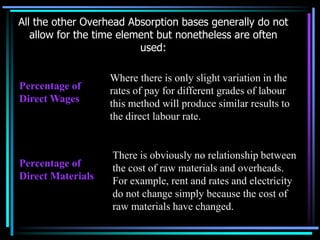
All the other Overhead Absorption bases generally do not allow for the time element but nonetheless are often used:Where there is only slight variation in the rates of pay for different grades of labour this method will produce similar results to the direct labour rate.  Percentage of Direct WagesThere is obviously no relationship between the cost of raw materials and overheads.  For example, rent and rates and electricity do not change simply because the cost of raw materials have changed.Percentage of Direct Materials
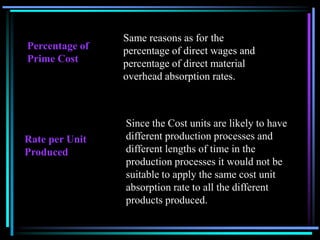
Same reasons as for the percentage of direct wages and percentage of direct material overhead absorption rates.Percentage of Prime CostSince the Cost units are likely to have different production processes and different lengths of time in the production processes it would not be suitable to apply the same cost unit absorption rate to all the different products produced.Rate per Unit Produced
ACTUAL OVERHEADS AND PREDETERMINED/BUDGETED OVERHEADSA difficulty in using overhead absorption or recovery rates in practice is that you will not know what the actual overheads are until after the accounting period is finished – for example, a month or year.But since you have to charge overheads onto the job when it is done or indeed even before it is done, particularly if the customer wants an estimate of how much the job will cost, then you will have to use some method of "guessing" what the overheads will be.
The way round this problem is to use PREDETERMINED or BUDGETED Overhead Costs.  This is simply an estimate of what overhead costs will be in the next financial year based on an extension of what they were in the past year after allowing for:any anticipated price increases.any anticipated increases or decreases in production, and
What this means is that when we come to the end of the accounting period the actual overhead costs incurred will in all probability differ from the overheads absorbed into the cost units.On the other hand, if the actual overheads for the accounting period are less than the overheads absorbed then we will have overabsorbed costs and so we will have to make an adjustment by crediting the gain to the Costing Profit and Loss Account.If the actual overheads for the accounting period are greater than the overheads absorbed then we will have underabsorbed costs and so we will have to make an additional charge for the difference to the Costing Profit and Loss Account.
Cost Centre AActual DataBudgeted Data	£52,000£50,000Overheads5,050 hours5,000 hoursDirect Labour Hours EXAMPLE – OVERHEAD UNDERABSORBEDCalculate the underabsorption of overheadsOverhead absorbed	=budgeted overhead rateactual direct labour hours xOverhead over / under absorbed   =overheads absorbedactual overheads incurred –
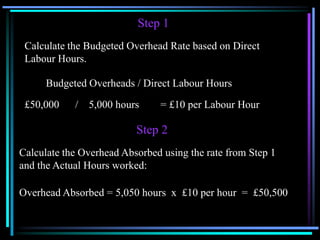
Step 1Calculate the Budgeted Overhead Rate based on Direct Labour Hours.Budgeted Overheads / Direct Labour Hours£50,000      /    5,000 hours        = £10 per Labour HourStep 2Calculate the Overhead Absorbed using the rate from Step 1 and the Actual Hours worked:Overhead Absorbed = 5,050 hours  x  £10 per hour  =  £50,500
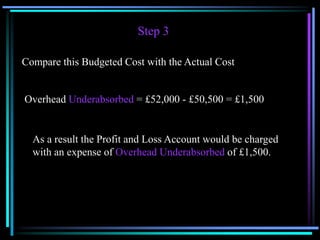
Step 3Compare this Budgeted Cost with the Actual CostOverhead Underabsorbed = £52,000 - £50,500 = £1,500As a result the Profit and Loss Account would be charged with an expense of Overhead Underabsorbed of £1,500.
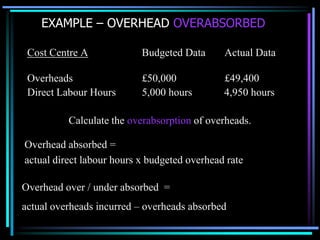
EXAMPLE – OVERHEAD OVERABSORBED Cost Centre A		       Budgeted Data	  Actual DataOverheads		       £50,000		  £49,400Direct Labour Hours	       5,000 hours            4,950 hours Calculate the overabsorption of overheads. Overhead absorbed = actual direct labour hours x budgeted overhead rateOverhead over / under absorbed  = actual overheads incurred – overheads absorbed
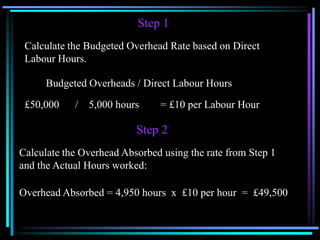
Step 1Calculate the Budgeted Overhead Rate based on Direct Labour Hours.Budgeted Overheads / Direct Labour Hours£50,000      /    5,000 hours        = £10 per Labour HourStep 2Calculate the Overhead Absorbed using the rate from Step 1 and the Actual Hours worked:Overhead Absorbed = 4,950 hours  x  £10 per hour  =  £49,500
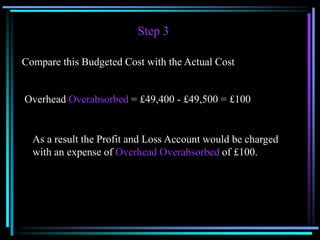
Step 3Compare this Budgeted Cost with the Actual CostOverhead Overabsorbed = £49,400 - £49,500 = £100As a result the Profit and Loss Account would be charged with an expense of Overhead Overabsorbed of £100.

Overhead analysis

  • 1.
    OVERHEAD ANALYSISTo estimatethe cost of each productTo calculate the cost of any work-in-progressTo attempt to control costs by comparing actual with estimatedObjectives of Cost Accounting:
  • 2.
    Three elements ofCostDirect MaterialsDirect Labour Other expenses– raw materials, stationery, stores from all departments.– wages, salaries, commission paid to employees.– admin, selling, distribution and financial expenses.
  • 3.
    ‘Other Expenses'DIRECTThese ‘OtherExpenses’ can be DIRECT or INDIRECT:– traceable to a particular product or job. They vary in proportion to production.Direct Materials + Direct Labour + Direct Expenses =PRIME COST
  • 4.
    INDIRECTIndirect Expenses– theseare expenses which cannot be traceable to a particular job or product.They are essentialto therunning of the business.Normally known as OverheadsThey fall into 3 groups –ManufacturingSelling and DistributionAdministration and Financial
  • 5.
    Prime Cost +Manufacturing Overheads =PRODUCTION COSTSProduction Costs + Selling and Distribution + Administration and Financial =TOTAL COST
  • 6.
    COST CENTRES Inorder to control costs it is necessary to trace them to the area responsible for the costs. These areas are known as COST CENTRESA Cost Centre can be a location, person or equipmentThe Cost Centre acts as a collecting place for costs eg a manufacturing department, a machine, an operating theatre in a hospital.
  • 7.
    2 types ofCost Centre– these are involved in the manufacturing process such as machining and assembly Cost Centres.Production Cost CentresService Cost Centres– these are not involved in the actual manufacturing process but provide services to the production Cost Centres such as the maintenance and stores departments.
  • 8.
    a television setmanufactureda ball-bearing made on a machinea bus journey in terms of operating cost per passenger mile travelleda heart transplant operationCost UnitsA Cost Unit is the final product or service being costedExamples of Cost Units might be:
  • 9.
    HOW TO TRACECOSTS TO COST CENTRES Power, Lighting and Heating (when separately metered), Repairs and Maintenance to a machineStep 1Direct Costs– are ALLOCATED to a Cost Centre.
  • 10.
    Cost Allocation refersto the allotment of whole items of overhead costs to cost centres; that is, overhead costs can be allocated directly to a Cost Centre.For example, if the canteen is treated as a separate cost centre, then the wages of the canteen manager are allocated to that cost centre.Allocation of Costs to Cost Centres
  • 11.
    Indirect CostsDepreciation, Rent,Rates, Heating and Lighting (not separately metered), Canteen costs, Supervision etc– are APPORTIONED to Cost Centres on a suitable basis.Cost Apportionmentoverhead costs are shared out among various Cost Centres on some fair and equitable basis since the overhead cannot be directly allocated to any one particular cost centre.A suitable basis could be:Floor space for Heating and LightingNumber of Employees for Canteen Costs.
  • 12.
    Apportionment of Costsfloorarea, size of departmentbook value of the fixed assetsnumber of employees  horse power of machines Overhead Cost Basis of ApportionmentRent, rates, heating and lightingDepreciation and insurance of plant and machineryCanteen, factory administration costs Power
  • 13.
    Step 2Maintenance orPersonnel Departments.So far we have dealt with Production Department Cost Centres. However, all businesses will incur Service Costs egThese departments exist for the whole business not just one department and therefore these Service Costs must be APPORTIONEDamong the other Production Departments, again using a suitable basis.
  • 14.
    Basis of ApportionmentCanteen,personnel and security guards' wagesCleaning  Maintenance Service Overhead Cost Basis of Apportionmentnumber of employeescost of materials used or material requisitionsmaintenance man hours or value of the capital equipment
  • 15.
    Step 3the numberof labour hours or machine hours taken to complete the job. ABSORPTION OF COSTSNow that Overhead Costs have been Apportioned to Cost Centres, they must now be Absorbed into the Total Cost.Overhead Absorption refers to the method of charging a proportion of the final production cost centres' overheads onto a particular job on the basis of for example,This is often also referred to as Overhead Recovery.
  • 16.
    Bases for AbsorbingOverhead Costs:when Labour Hours in the relevant factorArea occupied by machine – rates, rent etcCost of operating – depreciation, power etcRate per Direct Labour HourTotal Predetermined Overheads / Total Labour HoursMachine Hour Rate: eitherTotal Predetermined Overheads / Total Machine Hours
  • 17.
    Overheads as apercentage of Direct WagesOverheads as a percentage of Direct MaterialsOverheads as a percentage of Prime CostsRate per Unit ProducedAlternative Overhead Absorption Rates
  • 18.
    SUITABILITY OF DIFFERENTOVERHEAD ABSORPTION OR RECOVERY RATESOne of the most important facts about Overheads is that they are incurred OVER TIME. This means that the 2 most accurate methods of recovering overheads will be:most suitable for labour intensive jobsDirect Labour Hour Ratemost suitable for machine intensive jobsDirect Machine Hour Rate
  • 19.
    All the otherOverhead Absorption bases generally do not allow for the time element but nonetheless are often used:Where there is only slight variation in the rates of pay for different grades of labour this method will produce similar results to the direct labour rate. Percentage of Direct WagesThere is obviously no relationship between the cost of raw materials and overheads. For example, rent and rates and electricity do not change simply because the cost of raw materials have changed.Percentage of Direct Materials
  • 20.
    Same reasons asfor the percentage of direct wages and percentage of direct material overhead absorption rates.Percentage of Prime CostSince the Cost units are likely to have different production processes and different lengths of time in the production processes it would not be suitable to apply the same cost unit absorption rate to all the different products produced.Rate per Unit Produced
  • 21.
    ACTUAL OVERHEADS ANDPREDETERMINED/BUDGETED OVERHEADSA difficulty in using overhead absorption or recovery rates in practice is that you will not know what the actual overheads are until after the accounting period is finished – for example, a month or year.But since you have to charge overheads onto the job when it is done or indeed even before it is done, particularly if the customer wants an estimate of how much the job will cost, then you will have to use some method of "guessing" what the overheads will be.
  • 22.
    The way roundthis problem is to use PREDETERMINED or BUDGETED Overhead Costs. This is simply an estimate of what overhead costs will be in the next financial year based on an extension of what they were in the past year after allowing for:any anticipated price increases.any anticipated increases or decreases in production, and
  • 23.
    What this meansis that when we come to the end of the accounting period the actual overhead costs incurred will in all probability differ from the overheads absorbed into the cost units.On the other hand, if the actual overheads for the accounting period are less than the overheads absorbed then we will have overabsorbed costs and so we will have to make an adjustment by crediting the gain to the Costing Profit and Loss Account.If the actual overheads for the accounting period are greater than the overheads absorbed then we will have underabsorbed costs and so we will have to make an additional charge for the difference to the Costing Profit and Loss Account.
  • 24.
    Cost Centre AActualDataBudgeted Data £52,000£50,000Overheads5,050 hours5,000 hoursDirect Labour Hours EXAMPLE – OVERHEAD UNDERABSORBEDCalculate the underabsorption of overheadsOverhead absorbed =budgeted overhead rateactual direct labour hours xOverhead over / under absorbed =overheads absorbedactual overheads incurred –
  • 25.
    Step 1Calculate theBudgeted Overhead Rate based on Direct Labour Hours.Budgeted Overheads / Direct Labour Hours£50,000 / 5,000 hours = £10 per Labour HourStep 2Calculate the Overhead Absorbed using the rate from Step 1 and the Actual Hours worked:Overhead Absorbed = 5,050 hours x £10 per hour = £50,500
  • 26.
    Step 3Compare thisBudgeted Cost with the Actual CostOverhead Underabsorbed = £52,000 - £50,500 = £1,500As a result the Profit and Loss Account would be charged with an expense of Overhead Underabsorbed of £1,500.
  • 27.
    EXAMPLE – OVERHEADOVERABSORBED Cost Centre A Budgeted Data Actual DataOverheads £50,000 £49,400Direct Labour Hours 5,000 hours 4,950 hours Calculate the overabsorption of overheads. Overhead absorbed = actual direct labour hours x budgeted overhead rateOverhead over / under absorbed = actual overheads incurred – overheads absorbed
  • 28.
    Step 1Calculate theBudgeted Overhead Rate based on Direct Labour Hours.Budgeted Overheads / Direct Labour Hours£50,000 / 5,000 hours = £10 per Labour HourStep 2Calculate the Overhead Absorbed using the rate from Step 1 and the Actual Hours worked:Overhead Absorbed = 4,950 hours x £10 per hour = £49,500
  • 29.
    Step 3Compare thisBudgeted Cost with the Actual CostOverhead Overabsorbed = £49,400 - £49,500 = £100As a result the Profit and Loss Account would be charged with an expense of Overhead Overabsorbed of £100.