OVERHEADSPOWERPOINT
PRESENTATION BY:
PARAS MAHENDRU
MOHIT SINGHAL
KUNAL GUPTA
PASHUPATI
MADHOGARIA
SHIVAM BANSAL
In a modern day manufacturing unit there are certain
expenses incurred on general services & facilitieswhich are
essential for the manufacturing process but which can’t be
directly identified with articles produced or services rendered
All those expenses which can not be identified or traced with
a particular unit of production is termed as overheads.
With the automation of the production process the cost of
the facility and ancillary services have increased
drastically and are forming a major portion of the total cost
of production. It has overtaken material and/or labour cost
. Hence controlling of overheads has assumed a greater
significance than ever before
Overheads are generally and
predominantly period costs and
associated with a facility or a department
in an organization.
We shall take up comparative study of Overhead cost
control and Activity Based Costing at a later stage
In fact, overheads have assumed such a significance that
in some of the developed countries the study of overhead
has become a subject in itself and is known as Activity
Based Costing or ABC
Based on this overheads are classified as follows
Factory
overheads
Administrative
overheads
Selling &
Distribution
overheads
Research &
Development
overheads
One of the earliest and most often used Organisational Structure is
Functional Departmentalisation.
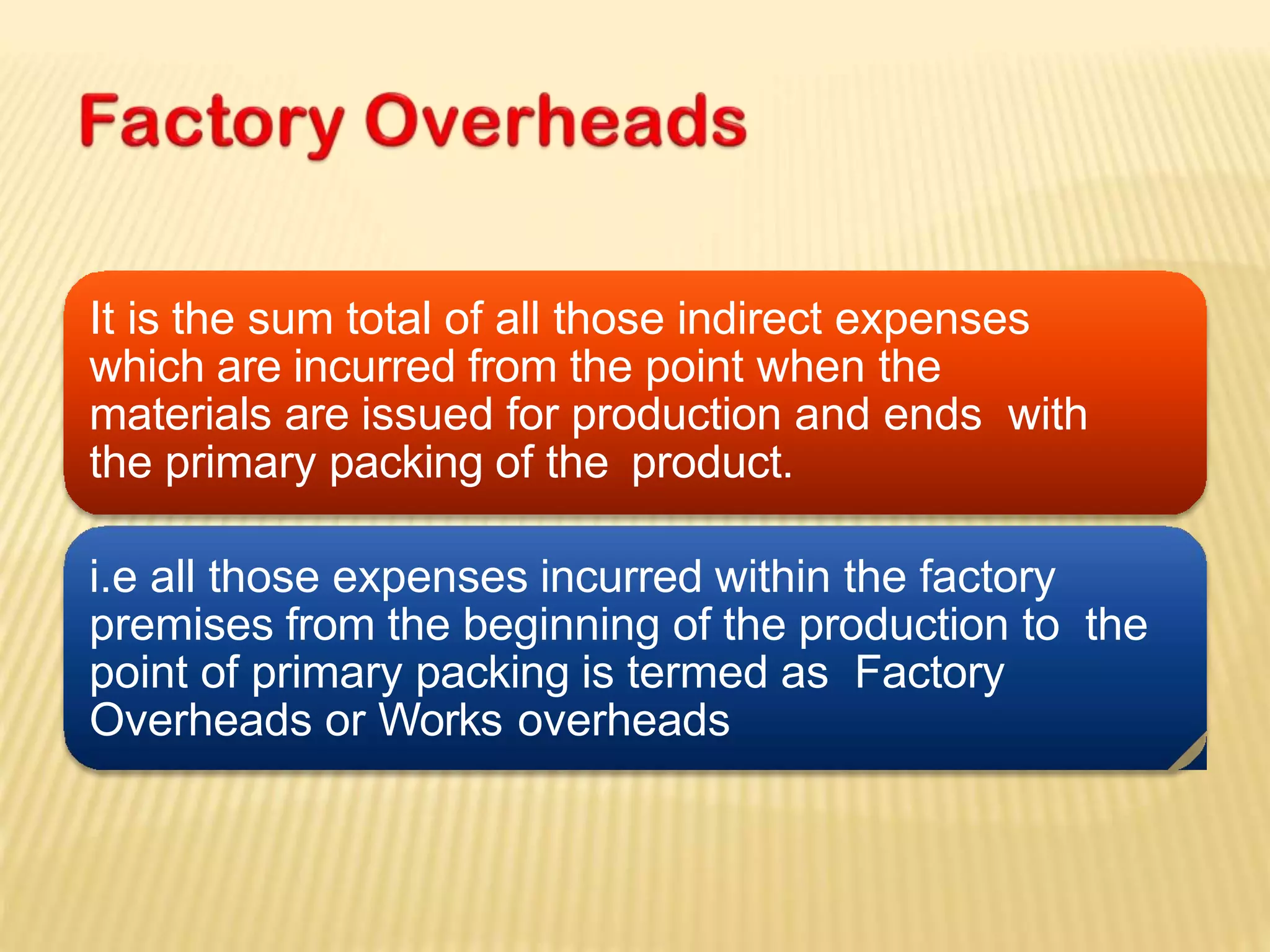
It is the sum total of all those indirect expenses
which are incurred from the point when the
materials are issued for production and ends with
the primary packing of the product.
i.e all those expenses incurred within the factory
premises from the beginning of the production to the
point of primary packing is termed as Factory
Overheads or Works overheads
It is the sum total of all indirect cost
incurred in managing an organisation. By
definition
The cost of formulating the policy, directing the
organisation and controlling the functions of an
organisation and which can’t be attributed to
manufacturing, selling & distributing or research &
development activity or function
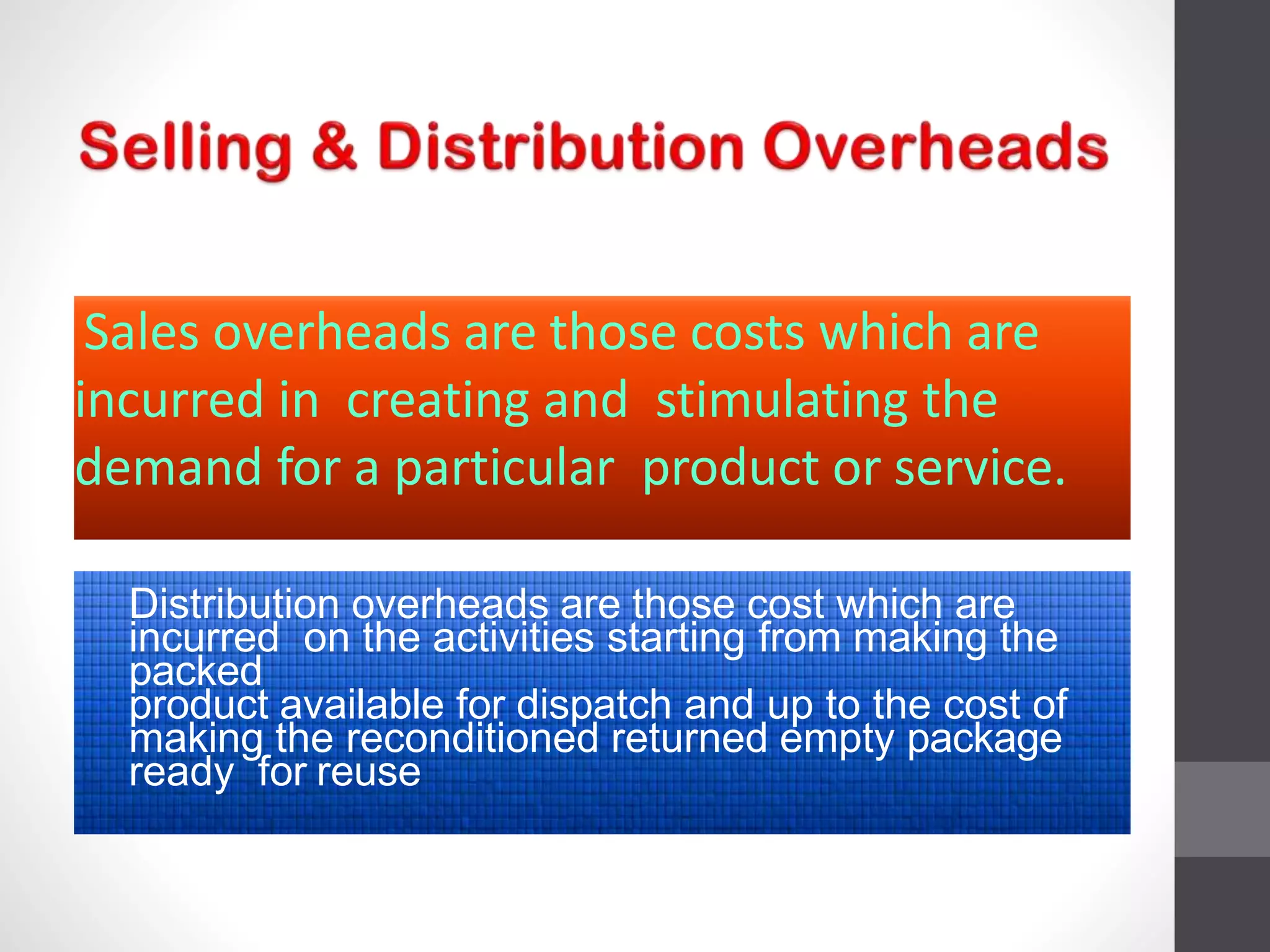
Sales overheads are those costs which are
incurred in creating and stimulating the
demand for a particular product or service.
Distribution overheads are those cost which are
incurred on the activities starting from making the
packed
product available for dispatch and up to the cost of
making the reconditioned returned empty package
ready for reuse
Research overheads are those costs which are
incurred to search for new or improved
products , new application for the materials,
new or improved methods
Development overheads are those costs which
are incurred to implement the decision to
produce new or improved products
If the research & development is towards an existing
product or improving the process of production, then
the same will be added to Factory or works overheads and
absorbed into the cost of production.
If it is incurred on developing a new product it is treated as
a separate overhead and charged to costing profit & loss
account.
Semi-variable
Changes with level of activity but not proportionately
Variable
Changes in direct proportion to level of activity
Fixed
Does not change with the level of activity
Based on the nature of the overheads are classified into
Controllability
Controllable & Uncontrollable
Element-wise
Indirect Materials Indirect Labour Indirect Expenses
One of the main objectives for
development of cost accounting is to
design a system which would furnish the
management with an estimate whichis
accurate and close to reality.
This involves estimation of various costs
involved because only direct costs like
Materials, labour and direct expensesare
the ones which are readily available, all
other indirect expenses will have to be
estimated. Based on such estimates
recovery rates have to be arrivedat
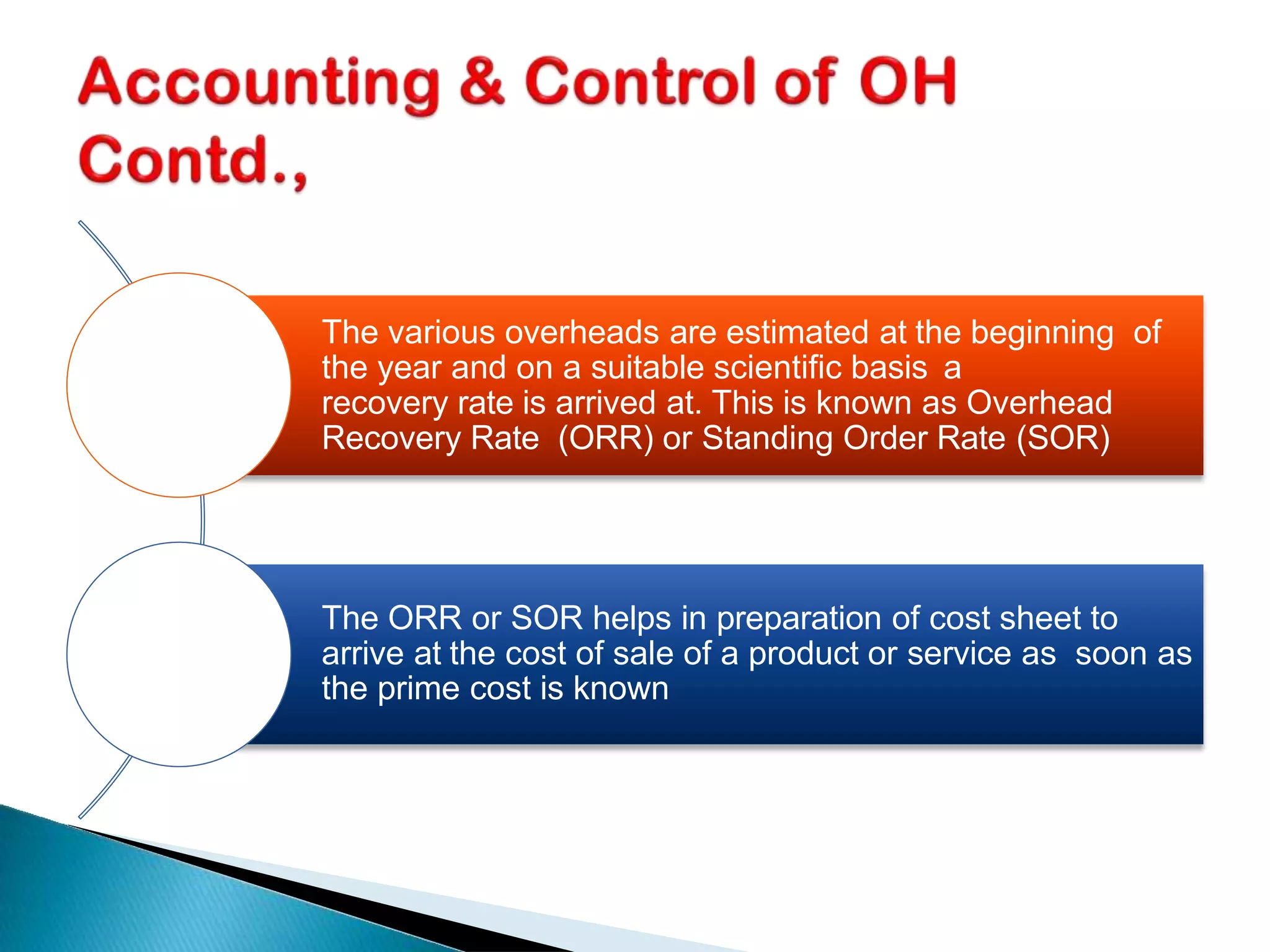
The various overheads are estimated at the beginning of
the year and on a suitable scientific basis a
recovery rate is arrived at. This is known as Overhead
Recovery Rate (ORR) or Standing Order Rate (SOR)
The ORR or SOR helps in preparation of cost sheet to
arrive at the cost of sale of a product or service as soon as
the prime cost is known
Allocation
• It means assigning or allotment or identifying of an
entire item of cost with a particular cost centre or cost
unit
Apportionment
• There are some items of cost which can’t be directly
identified with any particular cost centre or cost unit.
These have to distributed to all those departments or cost
centres which are utilising the benefits on a rational
basis, this is termed as apportionment
Re-apportionment
• Once the overheads are allocated and
apportioned to all the departments, the cost
of service departments will have to be re-
apportioned to the production departments
• It is the process of applying & recovering the
overheads to the cost of production of a product
Absorption
It is to be noted that Allocation
and Apportionment are facility or
department or cost centre level
activities, whereas Absorption is a
product level activity i.e
absorption is the process of
recovering the overheads from all
the products which have passed
through a particular department or
a cost centre.
Activity-Based Costing System 18
No. of
Setup
Hours
Product A Product B Product C
Cost
Allocation
Base
Cost
Objects
No. of
Shipments
No. of
employees
SetupDesign ShippingActivity
Overheads Cost
Pool
D e p a r t m e n t s
Activity-Based Costing System
19
Activity Cost
Pools
Activity Cost Drivers
 Production
a) Number of units
b) Number of set-ups
c) Number electricity units consumed
 Marketing
a) Number of sales personnel
b) Number of sales orders
 Research &
Development
a) Number of research projects
b) Personnel hours spend on projects
c) Technical complexities of the projects
 Customer Service
a) Number of service calls
b) Number of products serviced
c) Hours spend on servicing products
 Purchasing a) Number of purchase orders
 Material Handling a) Number of material requisitions
Estimation & Collection of Overheads
Determining Recovery /Standing Order Rates
Departmentalisation / Allocation of overheads
Apportioning of the Overheads to variousDeptt
Re-apportionment of Service Department overheads to
Production Departments
Absorbing overheads over cost units/products
Direct re-
distributio
n Method
Step Method or
Non Reciprocal
Method
Reciprocal
Service Method
Simultaneous
Equation
Method
Repeated
Distribution
Method
Trial & Error
Method
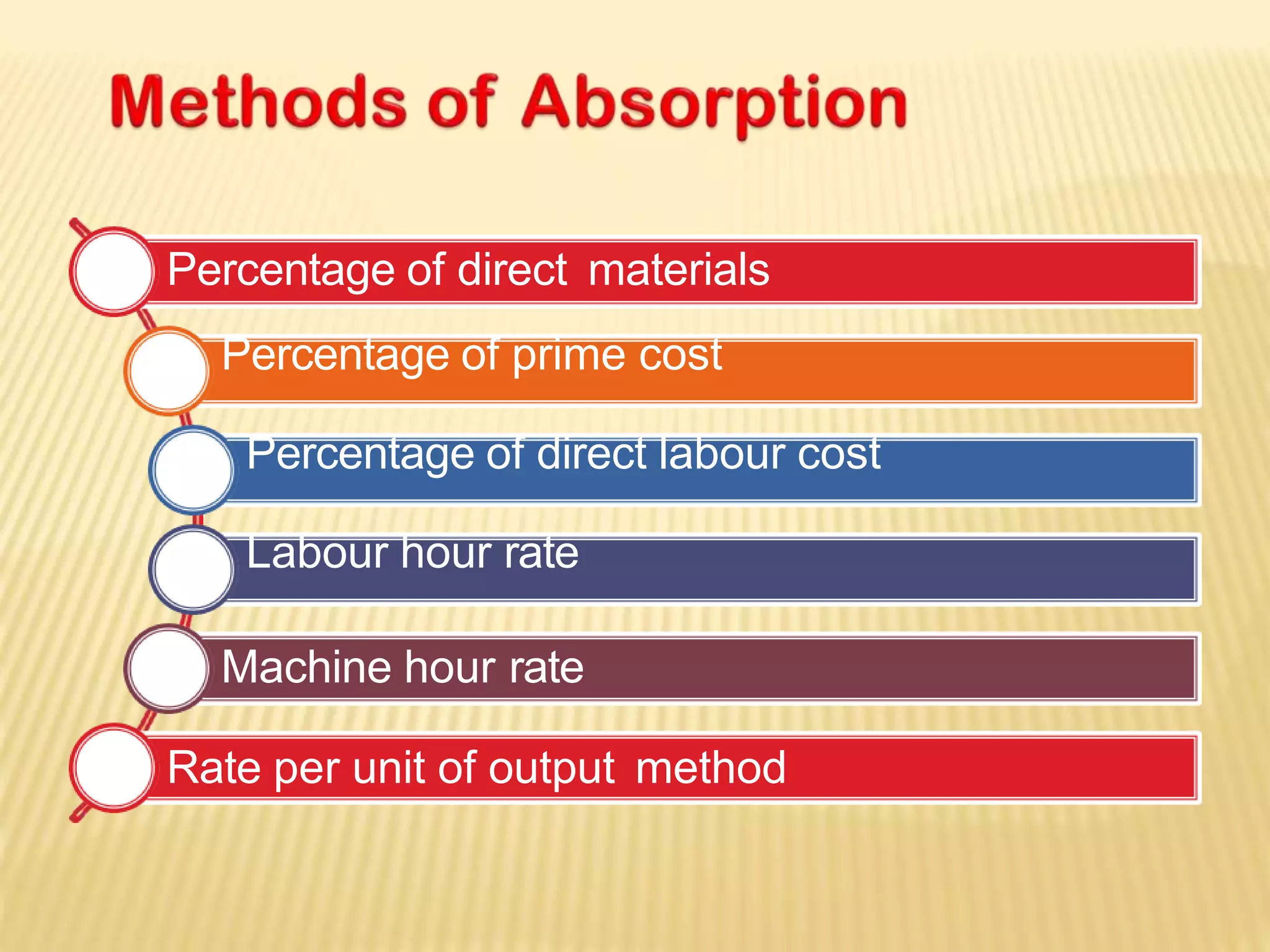
Percentage of direct materials
Percentage of prime cost
Percentage of direct labour cost
Labour hour rate
Machine hour rate
Rate per unit of output method
Normal Rate
Predetermined overhead rate
Blanket overhead rate
Departmental Overhead rate
Overheads are applied to production on a pre-
determined overhead recovery rate.
The actual overheads incurred during a period will
vary from the overheads applied or absorbed into
production.
The difference between overheads applied or
absorbed and actual overheads incurred results in
under or over recovery of overheads
Both overhead and production changing but not in the
same proportion
Under or over recovery of overheads
may result due to
Actual Overhead being higher or
lower than budgeted overheads
Actual production being higher or
lower than the budgeted
production
The difference in overheads incurred and absorbed is
also called as overheads variance
If the under or over absorption is not material it is
transferred to Costing Profit & Loss A/c and the cost
of individual products is not affected.
If the under or over absorption is materail then the
same is applied to the cost of individual products by
using a supplementary overhead recovery rate
That portion of under or over absorbed
overheads which is attributable to goods
manufactured and sold, will have to be
added to cost of sales.
That portion of under or over absorbed
overheads which is attributable to Stockof
Finished Goods and WIP will have to be
adjusted in their carrying values
Any under or over absorption resultingout of
abnormal reasons will have to be transferred
to Costing Profit & Loss Account
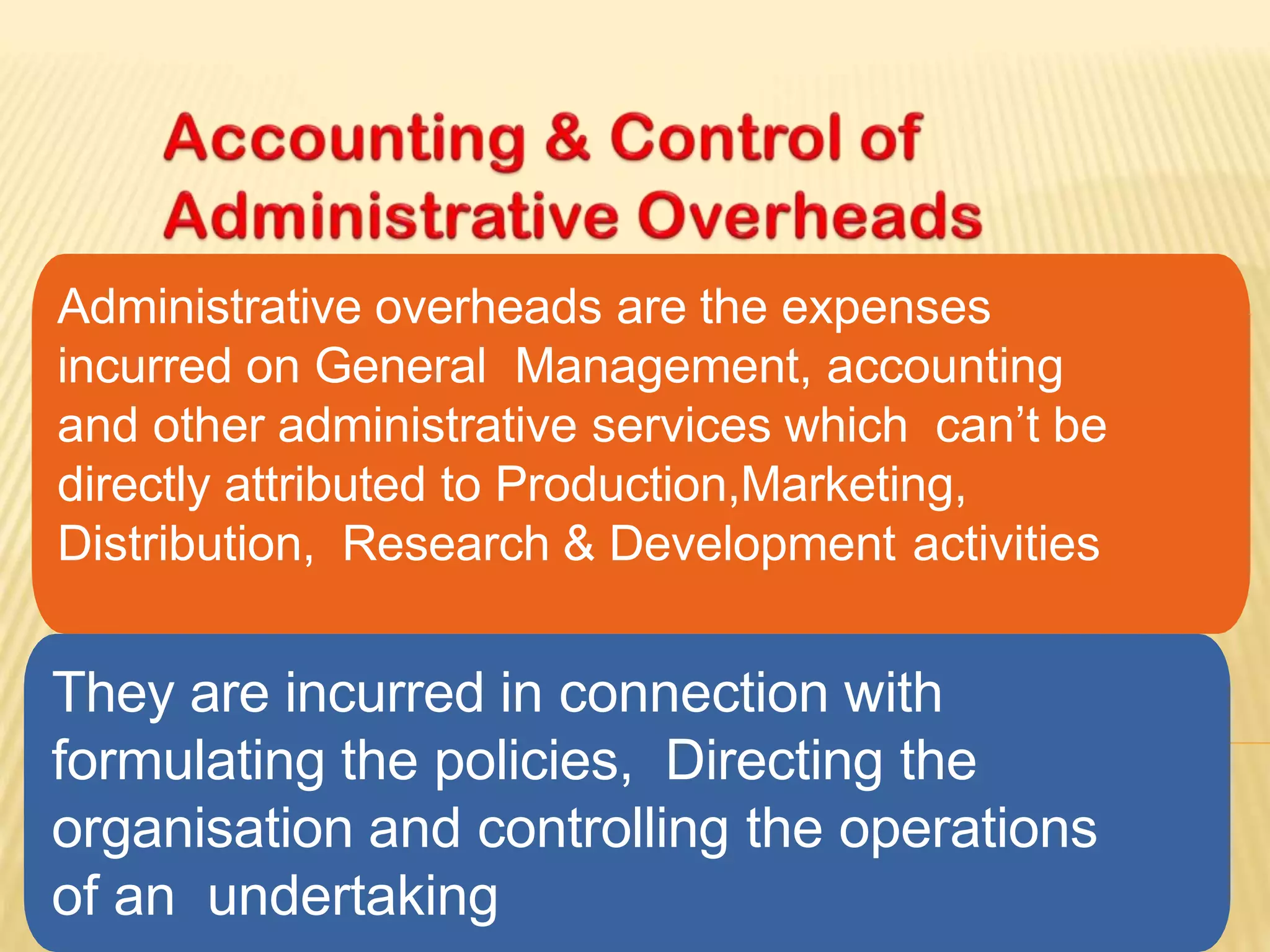
Administrative overheads are the expenses
incurred on General Management, accounting
and other administrative services which can’t be
directly attributed to Production,Marketing,
Distribution, Research & Development activities
They are incurred in connection with
formulating the policies, Directing the
organisation and controlling the operations
of an undertaking
Administrative overheads are dealt with as follows
• Apportioning them to Production & Sales
Departments
• Charging it to Costing Profit & Loss Account
• Recovering Administration overheads separately to cost
of production / Sales on the basis of Works Cost, Sales
Value or Quantity, Gross profit,Quantity
Produced or Conversion cost
Classification and Analysis of Overheads by departments
according to their functions
Control through Budgets Control through standard
It is the sum total of the expenses
incurred from the point of secondary
packing and ending with making the
reconditioned returned empty package
ready for reuse
We have discussed the
meaning at length earlier in
this chapter, let us look at the
aspects of accounting &
control over S&D OH
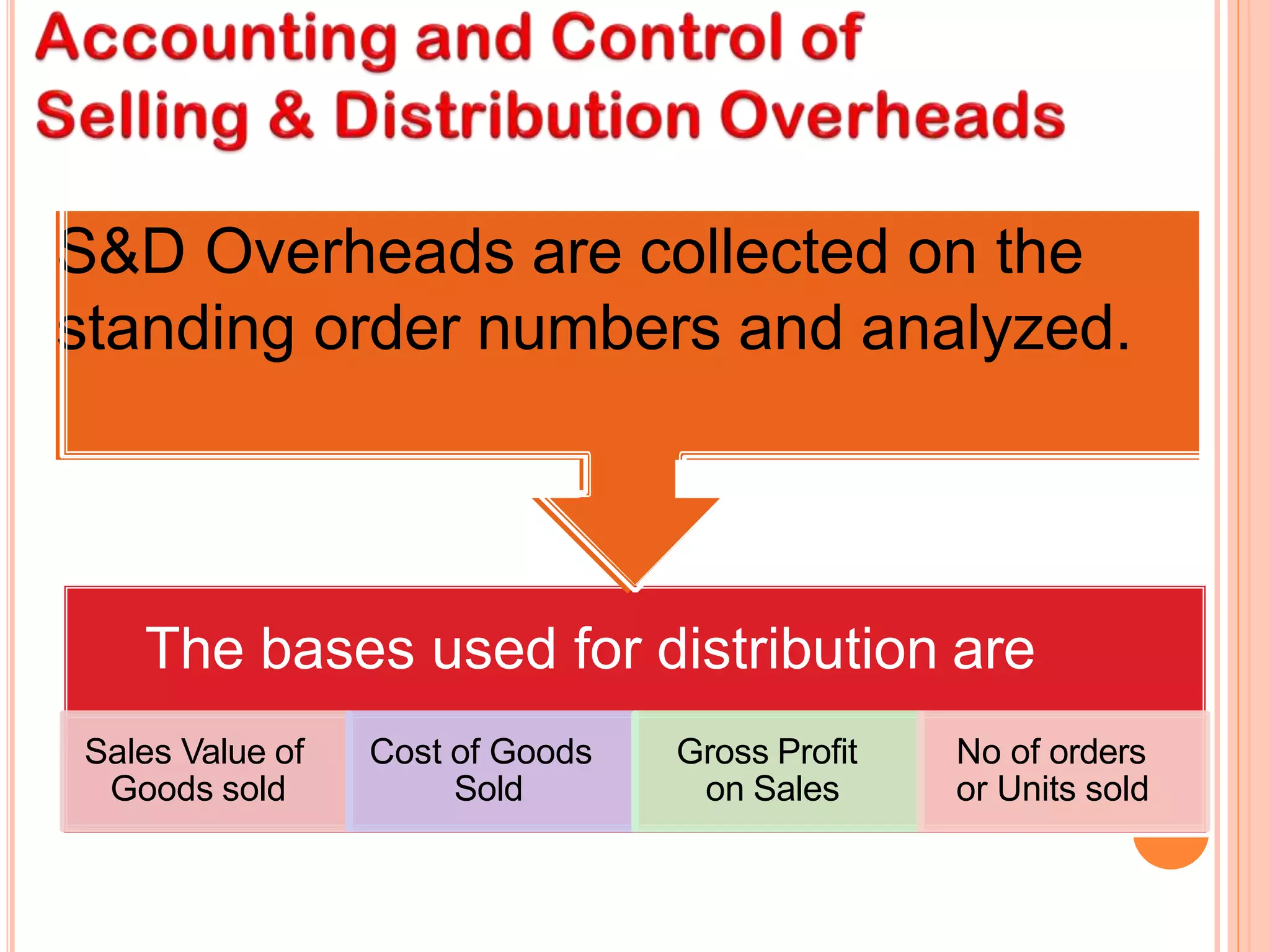
The bases used for distribution are
Sales Value of
Goods sold
Cost of Goods
Sold
Gross Profit
on Sales
No of orders
or Units sold
S&D Overheads are collected on the
standing order numbers and analyzed.
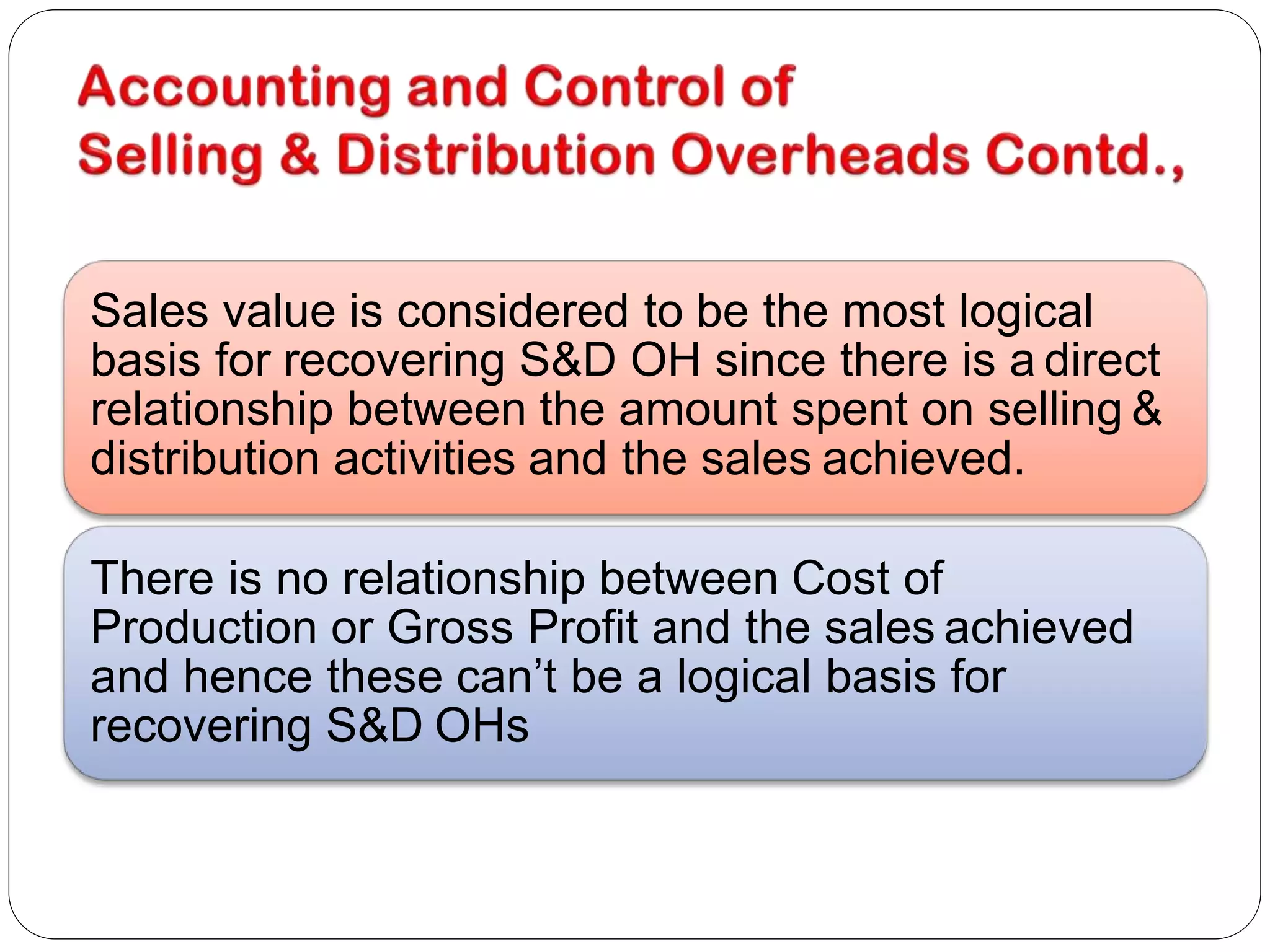
Sales value is considered to be the most logical
basis for recovering S&D OH since there is a direct
relationship between the amount spent on selling &
distribution activities and the sales achieved.
There is no relationship between Cost of
Production or Gross Profit and the sales achieved
and hence these can’t be a logical basis for
recovering S&D OHs
The most widely used basis for Recovering S&D OHs is an estimated
amount per unit.
The S&D expenses are categorised into fixed and variableportion.
The fixed expenses are apportioned on the basis of the benefit
derived
The variable S&D expenses are packaging, freight outwards,
commission payable to sales man etc, these are ascertained unitwise
and added to the fixed S&D expenses to arrive at total S&D OH /unit
Even though it is very difficult to control the S&D OHs the
following are some of the methods to control S&D OHs
Comparison with past performance
Budgetary Control
Standard Costing
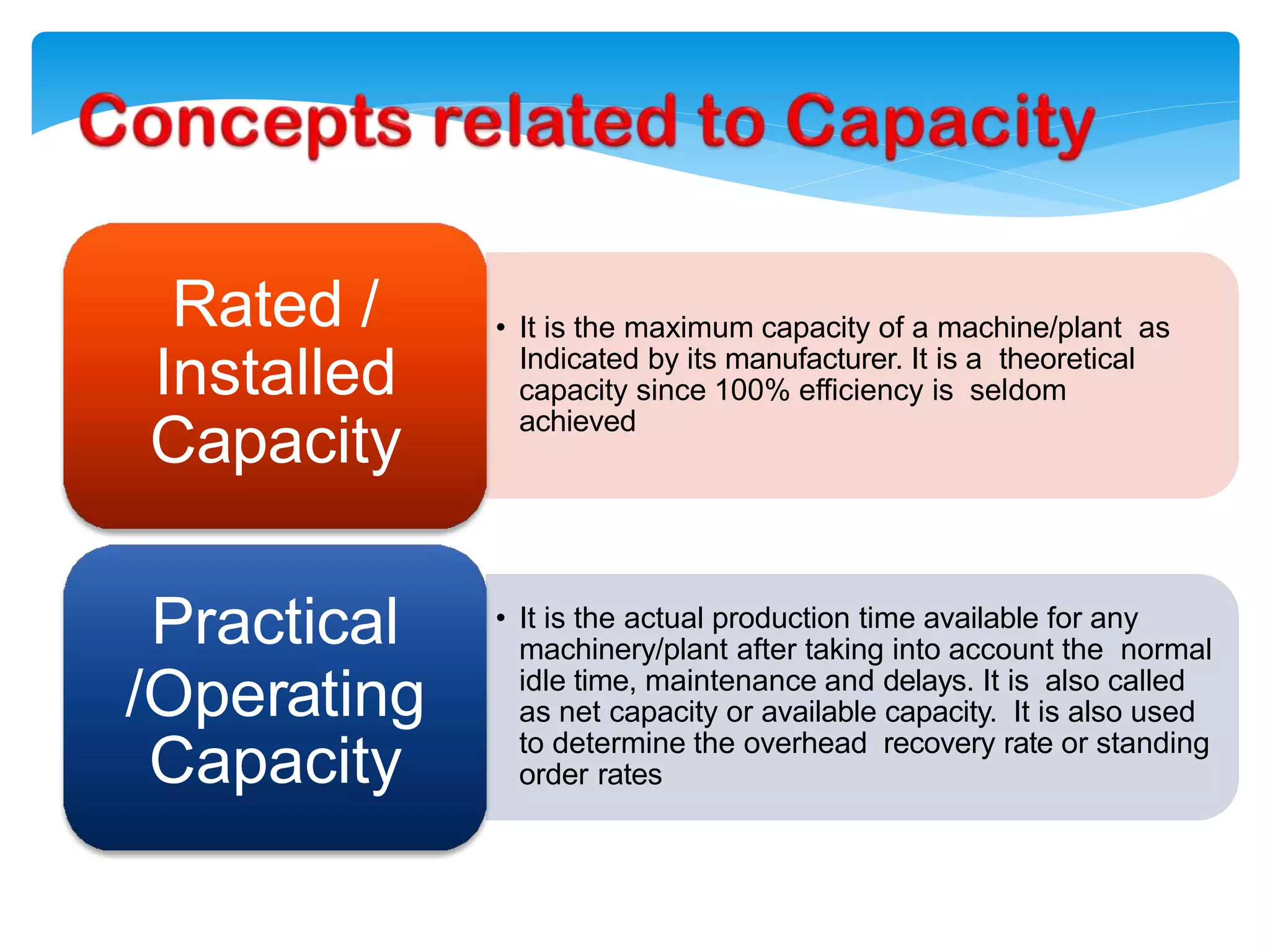
• It is the maximum capacity of a machine/plant as
Indicated by its manufacturer. It is a theoretical
capacity since 100% efficiency is seldom
achieved
Rated /
Installed
Capacity
• It is the actual production time available for any
machinery/plant after taking into account the normal
idle time, maintenance and delays. It is also called
as net capacity or available capacity. It is also used
to determine the overhead recovery rate or standing
order rates
Practical
/Operating
Capacity
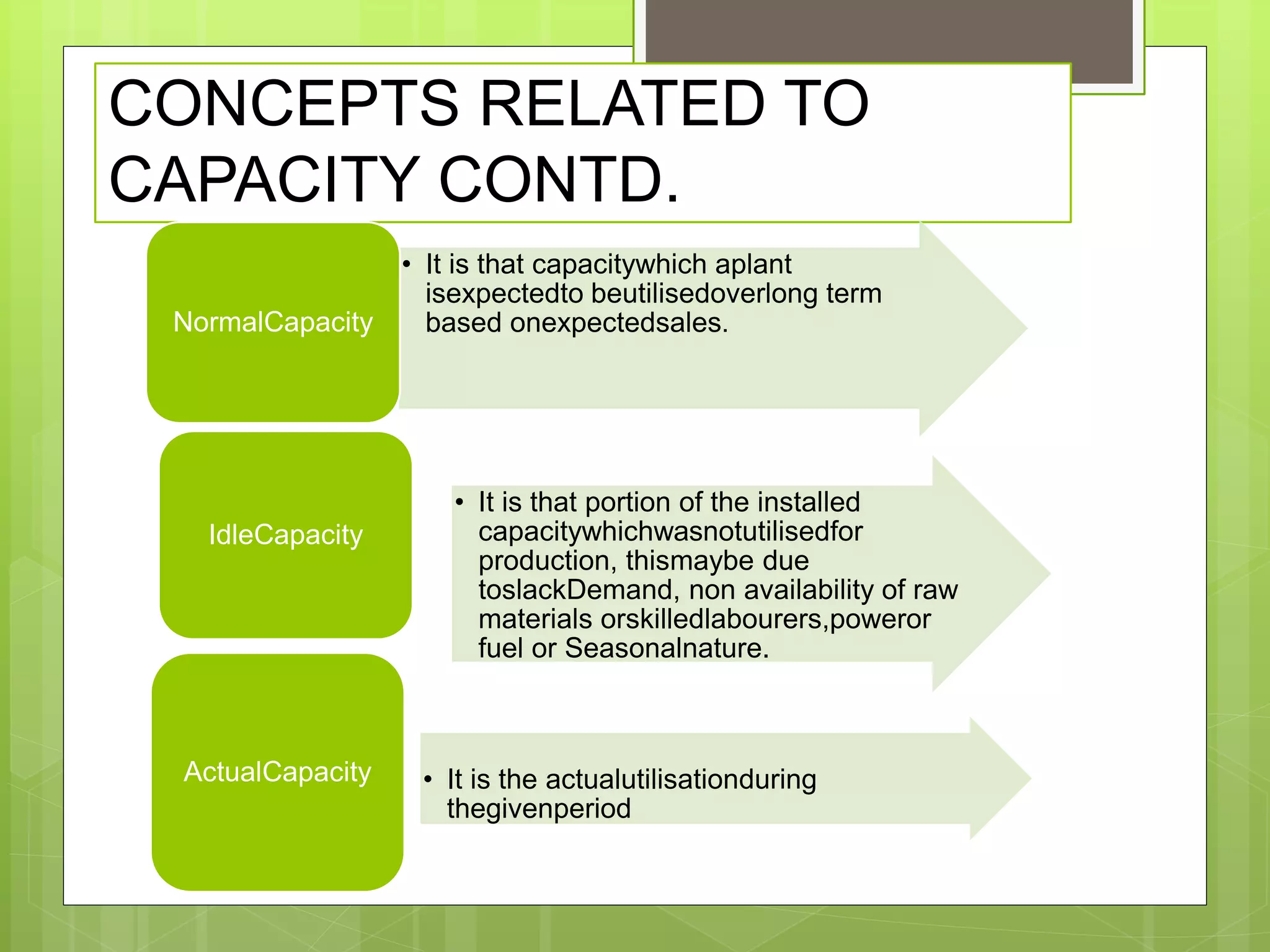
CONCEPTS RELATED TO
CAPACITY CONTD.
• It is that capacitywhich aplant
isexpectedto beutilisedoverlong term
based onexpectedsales.NormalCapacity
• It is that portion of the installed
capacitywhichwasnotutilisedfor
production, thismaybe due
toslackDemand, non availability of raw
materials orskilledlabourers,poweror
fuel or Seasonalnature.
IdleCapacity
• It is the actualutilisationduring
thegivenperiod
ActualCapacity
The idle capacity cost is treated asfollows
If it is due to
unavoidable
reasons then the
cost is recovered
by applying a
supplementary
overhead recovery
rate and added to
cost
If it is due to
avoidable
reasons then the
cost is
transferred to
costing P&LA/c
If it is due to
seasonal factors,
then it is charged
to the product as
a part of ORR
Cost overhead

Cost overhead

  • 1.
    OVERHEADSPOWERPOINT PRESENTATION BY: PARAS MAHENDRU MOHITSINGHAL KUNAL GUPTA PASHUPATI MADHOGARIA SHIVAM BANSAL
  • 2.
    In a modernday manufacturing unit there are certain expenses incurred on general services & facilitieswhich are essential for the manufacturing process but which can’t be directly identified with articles produced or services rendered All those expenses which can not be identified or traced with a particular unit of production is termed as overheads.
  • 3.
    With the automationof the production process the cost of the facility and ancillary services have increased drastically and are forming a major portion of the total cost of production. It has overtaken material and/or labour cost . Hence controlling of overheads has assumed a greater significance than ever before Overheads are generally and predominantly period costs and associated with a facility or a department in an organization.
  • 4.
    We shall takeup comparative study of Overhead cost control and Activity Based Costing at a later stage In fact, overheads have assumed such a significance that in some of the developed countries the study of overhead has become a subject in itself and is known as Activity Based Costing or ABC
  • 5.
    Based on thisoverheads are classified as follows Factory overheads Administrative overheads Selling & Distribution overheads Research & Development overheads One of the earliest and most often used Organisational Structure is Functional Departmentalisation.
  • 6.
    It is thesum total of all those indirect expenses which are incurred from the point when the materials are issued for production and ends with the primary packing of the product. i.e all those expenses incurred within the factory premises from the beginning of the production to the point of primary packing is termed as Factory Overheads or Works overheads
  • 7.
    It is thesum total of all indirect cost incurred in managing an organisation. By definition The cost of formulating the policy, directing the organisation and controlling the functions of an organisation and which can’t be attributed to manufacturing, selling & distributing or research & development activity or function
  • 8.
    Sales overheads arethose costs which are incurred in creating and stimulating the demand for a particular product or service. Distribution overheads are those cost which are incurred on the activities starting from making the packed product available for dispatch and up to the cost of making the reconditioned returned empty package ready for reuse
  • 9.
    Research overheads arethose costs which are incurred to search for new or improved products , new application for the materials, new or improved methods Development overheads are those costs which are incurred to implement the decision to produce new or improved products
  • 10.
    If the research& development is towards an existing product or improving the process of production, then the same will be added to Factory or works overheads and absorbed into the cost of production. If it is incurred on developing a new product it is treated as a separate overhead and charged to costing profit & loss account.
  • 11.
    Semi-variable Changes with levelof activity but not proportionately Variable Changes in direct proportion to level of activity Fixed Does not change with the level of activity Based on the nature of the overheads are classified into
  • 12.
  • 13.
    One of themain objectives for development of cost accounting is to design a system which would furnish the management with an estimate whichis accurate and close to reality. This involves estimation of various costs involved because only direct costs like Materials, labour and direct expensesare the ones which are readily available, all other indirect expenses will have to be estimated. Based on such estimates recovery rates have to be arrivedat
  • 14.
    The various overheadsare estimated at the beginning of the year and on a suitable scientific basis a recovery rate is arrived at. This is known as Overhead Recovery Rate (ORR) or Standing Order Rate (SOR) The ORR or SOR helps in preparation of cost sheet to arrive at the cost of sale of a product or service as soon as the prime cost is known
  • 15.
    Allocation • It meansassigning or allotment or identifying of an entire item of cost with a particular cost centre or cost unit Apportionment • There are some items of cost which can’t be directly identified with any particular cost centre or cost unit. These have to distributed to all those departments or cost centres which are utilising the benefits on a rational basis, this is termed as apportionment
  • 16.
    Re-apportionment • Once theoverheads are allocated and apportioned to all the departments, the cost of service departments will have to be re- apportioned to the production departments • It is the process of applying & recovering the overheads to the cost of production of a product Absorption
  • 17.
    It is tobe noted that Allocation and Apportionment are facility or department or cost centre level activities, whereas Absorption is a product level activity i.e absorption is the process of recovering the overheads from all the products which have passed through a particular department or a cost centre.
  • 18.
    Activity-Based Costing System18 No. of Setup Hours Product A Product B Product C Cost Allocation Base Cost Objects No. of Shipments No. of employees SetupDesign ShippingActivity Overheads Cost Pool D e p a r t m e n t s
  • 19.
    Activity-Based Costing System 19 ActivityCost Pools Activity Cost Drivers  Production a) Number of units b) Number of set-ups c) Number electricity units consumed  Marketing a) Number of sales personnel b) Number of sales orders  Research & Development a) Number of research projects b) Personnel hours spend on projects c) Technical complexities of the projects  Customer Service a) Number of service calls b) Number of products serviced c) Hours spend on servicing products  Purchasing a) Number of purchase orders  Material Handling a) Number of material requisitions
  • 20.
    Estimation & Collectionof Overheads Determining Recovery /Standing Order Rates Departmentalisation / Allocation of overheads Apportioning of the Overheads to variousDeptt Re-apportionment of Service Department overheads to Production Departments Absorbing overheads over cost units/products
  • 21.
    Direct re- distributio n Method StepMethod or Non Reciprocal Method Reciprocal Service Method Simultaneous Equation Method Repeated Distribution Method Trial & Error Method
  • 22.
    Percentage of directmaterials Percentage of prime cost Percentage of direct labour cost Labour hour rate Machine hour rate Rate per unit of output method
  • 23.
    Normal Rate Predetermined overheadrate Blanket overhead rate Departmental Overhead rate
  • 24.
    Overheads are appliedto production on a pre- determined overhead recovery rate. The actual overheads incurred during a period will vary from the overheads applied or absorbed into production. The difference between overheads applied or absorbed and actual overheads incurred results in under or over recovery of overheads
  • 25.
    Both overhead andproduction changing but not in the same proportion Under or over recovery of overheads may result due to Actual Overhead being higher or lower than budgeted overheads Actual production being higher or lower than the budgeted production
  • 26.
    The difference inoverheads incurred and absorbed is also called as overheads variance If the under or over absorption is not material it is transferred to Costing Profit & Loss A/c and the cost of individual products is not affected. If the under or over absorption is materail then the same is applied to the cost of individual products by using a supplementary overhead recovery rate
  • 27.
    That portion ofunder or over absorbed overheads which is attributable to goods manufactured and sold, will have to be added to cost of sales. That portion of under or over absorbed overheads which is attributable to Stockof Finished Goods and WIP will have to be adjusted in their carrying values Any under or over absorption resultingout of abnormal reasons will have to be transferred to Costing Profit & Loss Account
  • 28.
    Administrative overheads arethe expenses incurred on General Management, accounting and other administrative services which can’t be directly attributed to Production,Marketing, Distribution, Research & Development activities They are incurred in connection with formulating the policies, Directing the organisation and controlling the operations of an undertaking
  • 29.
    Administrative overheads aredealt with as follows • Apportioning them to Production & Sales Departments • Charging it to Costing Profit & Loss Account • Recovering Administration overheads separately to cost of production / Sales on the basis of Works Cost, Sales Value or Quantity, Gross profit,Quantity Produced or Conversion cost
  • 30.
    Classification and Analysisof Overheads by departments according to their functions Control through Budgets Control through standard
  • 31.
    It is thesum total of the expenses incurred from the point of secondary packing and ending with making the reconditioned returned empty package ready for reuse We have discussed the meaning at length earlier in this chapter, let us look at the aspects of accounting & control over S&D OH
  • 32.
    The bases usedfor distribution are Sales Value of Goods sold Cost of Goods Sold Gross Profit on Sales No of orders or Units sold S&D Overheads are collected on the standing order numbers and analyzed.
  • 33.
    Sales value isconsidered to be the most logical basis for recovering S&D OH since there is a direct relationship between the amount spent on selling & distribution activities and the sales achieved. There is no relationship between Cost of Production or Gross Profit and the sales achieved and hence these can’t be a logical basis for recovering S&D OHs
  • 34.
    The most widelyused basis for Recovering S&D OHs is an estimated amount per unit. The S&D expenses are categorised into fixed and variableportion. The fixed expenses are apportioned on the basis of the benefit derived The variable S&D expenses are packaging, freight outwards, commission payable to sales man etc, these are ascertained unitwise and added to the fixed S&D expenses to arrive at total S&D OH /unit
  • 35.
    Even though itis very difficult to control the S&D OHs the following are some of the methods to control S&D OHs Comparison with past performance Budgetary Control Standard Costing
  • 36.
    • It isthe maximum capacity of a machine/plant as Indicated by its manufacturer. It is a theoretical capacity since 100% efficiency is seldom achieved Rated / Installed Capacity • It is the actual production time available for any machinery/plant after taking into account the normal idle time, maintenance and delays. It is also called as net capacity or available capacity. It is also used to determine the overhead recovery rate or standing order rates Practical /Operating Capacity
  • 37.
    CONCEPTS RELATED TO CAPACITYCONTD. • It is that capacitywhich aplant isexpectedto beutilisedoverlong term based onexpectedsales.NormalCapacity • It is that portion of the installed capacitywhichwasnotutilisedfor production, thismaybe due toslackDemand, non availability of raw materials orskilledlabourers,poweror fuel or Seasonalnature. IdleCapacity • It is the actualutilisationduring thegivenperiod ActualCapacity
  • 38.
    The idle capacitycost is treated asfollows If it is due to unavoidable reasons then the cost is recovered by applying a supplementary overhead recovery rate and added to cost If it is due to avoidable reasons then the cost is transferred to costing P&LA/c If it is due to seasonal factors, then it is charged to the product as a part of ORR