Outsourcing: What’s the Theory?


                                      1


Gordon M. Groat
PhD (abd), MSc, BGS, ASc
Predominant Theory
                                   2


 Resource Based View (RBV)
 Transaction Cost Economics (TCE)
 Total Cost of Outsourcing (TCO)
 Agency Theory
 Negative Curvilinear Model        (Adjusting Outsourcing on the X and Y axis)


  Theory   Lit +   Lit -
Lit Review: Outsourcing Advantages
                                3


 Strategic Focus / Reduction of Assets
 Complimentary Capabilities / Lower Production Costs
 Strategic Flexibility
 Avoiding Bureaucratic Costs
 Relational Rent


  Theory    Lit +   Lit -
Lit Review: Outsourcing Disadvantages
                             4


 Interfaces / Economies of Scope
 Hollowing Out
 Opportunistic Behaviour
 Rising Transaction & Coordination Costs
 Limited Learning & Innovation


  Theory   Lit +   Lit -
Strategic Focus & Reduction of Assets
                                         5


 Shifting cost of production leveraging an outsourcing
 model frees up assets that the outsourcer now
 provides… i.e. the infrastructure costs, etc.

    Why is this a good thing?
          It allows the organization to redeploy freed up assets to other
           strategic areas or the organization can redistribute savings to
           shareholders – in either event, a win with the investing
           community (share price)


  Theory     Lit +   Lit -
Complimentary Capabilities & Lower Production Costs
                               6


 Outsourcing can remove a fixed cost from production
  thus raising profitability

 Outsourcers often have more efficient production
  processes – allowing them to produce at a cost
  savings compared to internal production… enhanced
  profitability PLUS core competency… i.e. it’s what
  the Outsourcer does best.


  Theory   Lit +   Lit -
Strategic Flexibility
                                     7


 By using outsourcers – it’s easier to switch from one
 outsourcer to another
    Organization can increase or decrease supplies from various
     outsourcers (supply channels) in response to “external shock”
    Reduces the need to “retool” or “restructure” due to economic
     changes and market changes
       European – flexibility reservoir
       Japanese – Inimitable supply chain where there is an obligation to
        the well being of the supplier


  Theory   Lit +   Lit -
Avoiding Bureaucratic Costs
                                   8


 There is no competitive incentive associated with
 internal production and thus – rising price base is
 associated with internal production

    Lack of Price Mechanism
    Lack of Economic Incentives


  Theory   Lit +    Lit -
Relational Rent
                                  9


 Building Idiosyncratic and valuable relationships
 with suppliers enables Innovation and Learning,
 which in turn, produces efficiencies that reduce
 transaction costs

    SEE TOYOTA PRODUCTION


  Theory   Lit +   Lit -
Toyota Supplier Relations
                               10


 Toyota Supplier Relations are widely studied as a
 model with a sustainable advantage where the
 relationship is deep and extensive… often including
 the following ties:

    Historical
    Social
    Interpersonal


  Theory   Lit +   Lit -
Interfaces / Economies of Scope
                                 11


 Sometimes there is a point in the value chain that
 manifests at key strategic intersections, for example
 R&D, Manufacturing, and Marketing

    If there are important interfaces adding to the Value Chain –
     then splitting up these processes to Outsourcing may not be
     the best course of action


  Theory   Lit +   Lit -
Hollowing Out
                                 12


 Firms that outsource many activities can sometimes
 give up their competitive edge.

 Firms can loose bargaining power vis-à-vis suppliers
 because the capabilities of suppliers increase relative
 to those of the firm


  Theory   Lit +   Lit -
Opportunistic Behaviour
                                13


 Opportunistic behaviour allows suppliers to extract
 greater rents from a relationship than they would
 normally do

    i.e. Gaming the Contract


  Theory   Lit +   Lit -
Rising Transaction & Coordination Costs
                                14


 External Span of Control issues
   Managers have a limited amount of time to dedicate to
    managing relationships with outsourcers
   Too much outsourcing throws this issue into a TCE/TCO
    discussion as the value of outsourcing is chipped away by
    managerial costs to run the business


  Theory   Lit +   Lit -
Limited Learning & Innovation
                             15


 If the firm itself is not able to do the business
 process, how is it able to derive learning from the
 process?


  Theory   Lit +   Lit -
Transaction Cost Economics (TCE)
                           16


 Production costs are lower in “markets” than in
 organizations because of allocative efficiencies – this
 leads to inter-firm division of labour

 Transaction Costs are the costs of “running” the
 economy… in the case of BPO, the cost of monitoring
 mechanisms to prevent opportunistic behaviour


  Theory   Lit +   Lit -
Total Cost of Outsourcing
                               17


 Extrapolates TCE to include the perspective of
 Williamson and then captures the costs of managing
 the economy… this elevates the “Make or Buy”
 decision to a different level apart from the basic
 contractual “cost” of service items.


  Theory   Lit +   Lit -
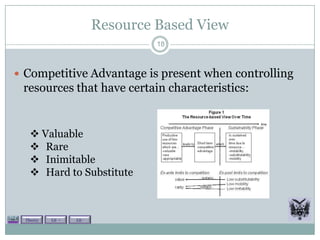
Resource Based View
                                    18


 Competitive Advantage is present when controlling
 resources that have certain characteristics:


     Valuable
     Rare
     Inimitable
     Hard to Substitute


  Theory   Lit +   Lit -
Agency Theory
                                 19


 Outsourcer commissions work from the supplier
 (agent)

    Works well when there is strong alignment between both
     parties
    Where alignment is not possible, Vertical Integration is
     preferred


  Theory   Lit +   Lit -
Negative Curvilinear Model
                                                                              20


        Activity                                   A        B          C            D          E        F   G    H   I
Performance Gain
                                                   -4       -3         -2          -1          0        1   2    3   4
  from Outsourcing

                                                        Negative Curvilinear xy Performance Graph


                                           6
                    Number of Outsourced


                                           5

                                           4
                         Activities


                                           3

                                           2

                                           1

                                           0
                                               0        2               4                  6        8       10
                                                                            Perform ance


   Theory   Lit +                     Lit -
Projections
                                               21


 BPO market posting continued growth
 Shifting regional patterns
 Increased competition proliferates alternatives
 Value add shift from simple BPO to more complex
 relationships             (i.e. BPO to BTO)


  Theory   Lit +   Lit -
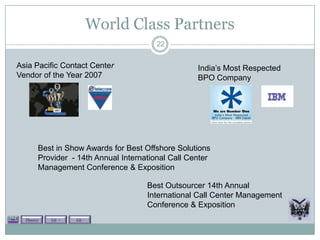
World Class Partners
                                        22


Asia Pacific Contact Center                        India’s Most Respected
Vendor of the Year 2007                            BPO Company


       Best in Show Awards for Best Offshore Solutions
       Provider - 14th Annual International Call Center
       Management Conference & Exposition

                                     Best Outsourcer 14th Annual
                                     International Call Center Management
                                     Conference & Exposition
  Theory   Lit +   Lit -
Outsoucing Costs // TCE
                                    23


 Call Center Employee Cost
 2006 Data Set (collected 2005)


 USA                             US$ 19,000 annually
 Australia                       US$ 17,000 annually
 Philippines                     US$ 9,050 annually
 India                           US$ 7,500 annually


  Theory    Lit +     Lit -
What does it mean for ME?
                               24


 By enabling internal Core Competencies to shine we
  set ourselves up to deliver a better product to market
  more efficiently
 By managing our Outsourcing arrangements well, we
  are able to enhance our profitability
 The more money the enterprise earns- the more
  money there is to grow the business


  Theory   Lit +   Lit -
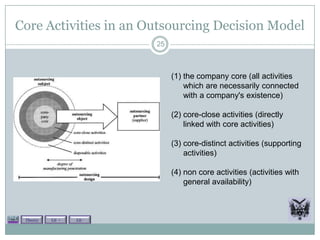
Core Activities in an Outsourcing Decision Model
                          25


                               (1) the company core (all activities
                                   which are necessarily connected
                                   with a company's existence)

                               (2) core-close activities (directly
                                   linked with core activities)

                               (3) core-distinct activities (supporting
                                   activities)

                               (4) non core activities (activities with
                                   general availability)


 Theory   Lit +   Lit -
Questions
                             26


Theory   Lit +   Lit -
27


Theory   Lit +   Lit -

Outsourcing Theory

  • 1.
    Outsourcing: What’s theTheory? 1 Gordon M. Groat PhD (abd), MSc, BGS, ASc
  • 2.
    Predominant Theory 2  Resource Based View (RBV)  Transaction Cost Economics (TCE)  Total Cost of Outsourcing (TCO)  Agency Theory  Negative Curvilinear Model (Adjusting Outsourcing on the X and Y axis) Theory Lit + Lit -
  • 3.
    Lit Review: OutsourcingAdvantages 3  Strategic Focus / Reduction of Assets  Complimentary Capabilities / Lower Production Costs  Strategic Flexibility  Avoiding Bureaucratic Costs  Relational Rent Theory Lit + Lit -
  • 4.
    Lit Review: OutsourcingDisadvantages 4  Interfaces / Economies of Scope  Hollowing Out  Opportunistic Behaviour  Rising Transaction & Coordination Costs  Limited Learning & Innovation Theory Lit + Lit -
  • 5.
    Strategic Focus &Reduction of Assets 5  Shifting cost of production leveraging an outsourcing model frees up assets that the outsourcer now provides… i.e. the infrastructure costs, etc.  Why is this a good thing?  It allows the organization to redeploy freed up assets to other strategic areas or the organization can redistribute savings to shareholders – in either event, a win with the investing community (share price) Theory Lit + Lit -
  • 6.
    Complimentary Capabilities &Lower Production Costs 6  Outsourcing can remove a fixed cost from production thus raising profitability  Outsourcers often have more efficient production processes – allowing them to produce at a cost savings compared to internal production… enhanced profitability PLUS core competency… i.e. it’s what the Outsourcer does best. Theory Lit + Lit -
  • 7.
    Strategic Flexibility 7  By using outsourcers – it’s easier to switch from one outsourcer to another  Organization can increase or decrease supplies from various outsourcers (supply channels) in response to “external shock”  Reduces the need to “retool” or “restructure” due to economic changes and market changes  European – flexibility reservoir  Japanese – Inimitable supply chain where there is an obligation to the well being of the supplier Theory Lit + Lit -
  • 8.
    Avoiding Bureaucratic Costs 8  There is no competitive incentive associated with internal production and thus – rising price base is associated with internal production  Lack of Price Mechanism  Lack of Economic Incentives Theory Lit + Lit -
  • 9.
    Relational Rent 9  Building Idiosyncratic and valuable relationships with suppliers enables Innovation and Learning, which in turn, produces efficiencies that reduce transaction costs  SEE TOYOTA PRODUCTION Theory Lit + Lit -
  • 10.
    Toyota Supplier Relations 10  Toyota Supplier Relations are widely studied as a model with a sustainable advantage where the relationship is deep and extensive… often including the following ties:  Historical  Social  Interpersonal Theory Lit + Lit -
  • 11.
    Interfaces / Economiesof Scope 11  Sometimes there is a point in the value chain that manifests at key strategic intersections, for example R&D, Manufacturing, and Marketing  If there are important interfaces adding to the Value Chain – then splitting up these processes to Outsourcing may not be the best course of action Theory Lit + Lit -
  • 12.
    Hollowing Out 12  Firms that outsource many activities can sometimes give up their competitive edge.  Firms can loose bargaining power vis-à-vis suppliers because the capabilities of suppliers increase relative to those of the firm Theory Lit + Lit -
  • 13.
    Opportunistic Behaviour 13  Opportunistic behaviour allows suppliers to extract greater rents from a relationship than they would normally do  i.e. Gaming the Contract Theory Lit + Lit -
  • 14.
    Rising Transaction &Coordination Costs 14  External Span of Control issues  Managers have a limited amount of time to dedicate to managing relationships with outsourcers  Too much outsourcing throws this issue into a TCE/TCO discussion as the value of outsourcing is chipped away by managerial costs to run the business Theory Lit + Lit -
  • 15.
    Limited Learning &Innovation 15  If the firm itself is not able to do the business process, how is it able to derive learning from the process? Theory Lit + Lit -
  • 16.
    Transaction Cost Economics(TCE) 16  Production costs are lower in “markets” than in organizations because of allocative efficiencies – this leads to inter-firm division of labour  Transaction Costs are the costs of “running” the economy… in the case of BPO, the cost of monitoring mechanisms to prevent opportunistic behaviour Theory Lit + Lit -
  • 17.
    Total Cost ofOutsourcing 17  Extrapolates TCE to include the perspective of Williamson and then captures the costs of managing the economy… this elevates the “Make or Buy” decision to a different level apart from the basic contractual “cost” of service items. Theory Lit + Lit -
  • 18.
    Resource Based View 18  Competitive Advantage is present when controlling resources that have certain characteristics:  Valuable  Rare  Inimitable  Hard to Substitute Theory Lit + Lit -
  • 19.
    Agency Theory 19  Outsourcer commissions work from the supplier (agent)  Works well when there is strong alignment between both parties  Where alignment is not possible, Vertical Integration is preferred Theory Lit + Lit -
  • 20.
    Negative Curvilinear Model 20 Activity A B C D E F G H I Performance Gain -4 -3 -2 -1 0 1 2 3 4 from Outsourcing Negative Curvilinear xy Performance Graph 6 Number of Outsourced 5 4 Activities 3 2 1 0 0 2 4 6 8 10 Perform ance Theory Lit + Lit -
  • 21.
    Projections 21  BPO market posting continued growth  Shifting regional patterns  Increased competition proliferates alternatives  Value add shift from simple BPO to more complex relationships (i.e. BPO to BTO) Theory Lit + Lit -
  • 22.
    World Class Partners 22 Asia Pacific Contact Center India’s Most Respected Vendor of the Year 2007 BPO Company Best in Show Awards for Best Offshore Solutions Provider - 14th Annual International Call Center Management Conference & Exposition Best Outsourcer 14th Annual International Call Center Management Conference & Exposition Theory Lit + Lit -
  • 23.
    Outsoucing Costs //TCE 23  Call Center Employee Cost 2006 Data Set (collected 2005)  USA US$ 19,000 annually  Australia US$ 17,000 annually  Philippines US$ 9,050 annually  India US$ 7,500 annually Theory Lit + Lit -
  • 24.
    What does itmean for ME? 24  By enabling internal Core Competencies to shine we set ourselves up to deliver a better product to market more efficiently  By managing our Outsourcing arrangements well, we are able to enhance our profitability  The more money the enterprise earns- the more money there is to grow the business Theory Lit + Lit -
  • 25.
    Core Activities inan Outsourcing Decision Model 25 (1) the company core (all activities which are necessarily connected with a company's existence) (2) core-close activities (directly linked with core activities) (3) core-distinct activities (supporting activities) (4) non core activities (activities with general availability) Theory Lit + Lit -
  • 26.
    Questions 26 Theory Lit + Lit -
  • 27.
    27 Theory Lit + Lit -