Purchasing and Supply Chain Management
                         by W.C. Benton


   Chapter Nine
     Strategic Outsourcing
Learning Objectives
1. To learn the precise definition of outsourcing.
2. To learn why organizations outsource manufacturing
   and services business processes.
3. To learn the outsourcing process is not considered
   contracting or joint venturing.
4. To learn about the benefits and pitfalls of
   outsourcing.


                                                        9-2
Learning Objectives
5. To about the hidden cost of outsourcing.
6. To learn about core and non-core competencies.
7. To learn about the elements of strategic outsourcing
8. To learn about the role of the outsourcing
   relationship manager.


                                                          9-3
Outsourcing
• Defined as the complete transfer of a business process that
  has been traditionally operated and managed internally to an
  independently-owned external service provider.

   – A complete transfer of all associated internal business process
     activities
   – Once outsourced, the people, facilities, equipment, technology and
     other assets are no longer maintained internally


                                                                          9-4
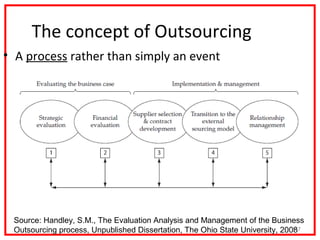
Outsourcing

• Not the same as subcontracting, joint venturing or contract
  manufacturing


                                                                9-5
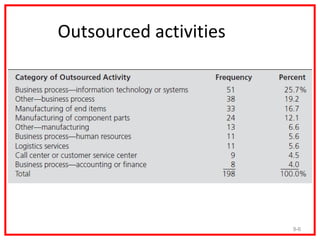
Outsourced activities


Source: Handley, S.M., The Evaluation Analysis and Management of
the Business Outsourcing process, Unpublished Dissertation, The
Ohio State University, 2008                                        9-6
The concept of Outsourcing
• A process rather than simply an event


 Source: Handley, S.M., The Evaluation Analysis and Management of the Business
 Outsourcing process, Unpublished Dissertation, The Ohio State University, 2008
                                                                              9-7
Reasons for
 Outsourcing Business Processes
The generic strategic benefits of outsourcing are:
  1.   Cost Minimization
  2.   Refocus Organization to Core
  3.   Improvement in Operating
  4.   Increased Market Share and Revenue


                                                     9-8
Outsourcing Business Processes

• The usual primary driver for outsourcing :
   • A reduction in direct operating costs which must be
     significantly lower than the current direct operating
     costs


                                                             9-9
Specific Purposes & Benefits of
            Outsourcing
1.    To reduce and control operating costs
2.    To improve quality
3.    To change company focus
4.    To acquire external capabilities
5.    To refocus scarce resources for alternative uses
6.    To reduce cycle time
7.    To obtain cash infusion
8.    To reduce risks
9.    To gain flexibility
10.   To turn fixed costs into variable costs

                                                         9-10
The Following are Important for Realizing
     Expected Outsourcing Benefits

•An extensive strategic assessment

•A true commitment to a cooperative relationship with


                                                        9-11
The Hidden Cost of Outsourcing
1. Quality Costs

 –   Preventative
 –   Appraisal
 –   Internal failure
 –   External failure


                                   9-12
Detecting Quality Failures

The buying firm will need a proper mechanisms that are
capable of detecting quality failures by an external source.

   This may be more difficult than with internal sourcing


                                                               9-13
The Hidden Cost of Outsourcing
2. Supplier or Vendor Relationship Management
       The most effective external sourcing relationships involve
       considerable management time and coordination


External Sourcing which involve:

   –      Commodity products or services may not require extensive
          relationship building and coordination.
   –      Strategic products and services require extensive relationship
          building and coordination activities.


                                                                           9-14
The Hidden Cost of Outsourcing

•       Relationship Management Costs
    –     Labor expense of purchasing personnel
    –     Travel
    –     IT infrastructure and management
    –     Supplier development programs (e.g. training and
          performance evaluation systems)


                                                             9-15
The Hidden Cost of Outsourcing
3.     Internal Coordination
•      Contrasted against the internal coordination and overhead
       costs associated with internally sourcing (Vertically
       integrate or Make)

•      The costs of bureaucracy
     –   Payroll, benefits management
     –   Utility expenses, IT expenses, etc.


                                                                   9-16
Understanding Overhead Costs

Firms need to have a thorough understanding of these
marginal overhead expenses and how they would be
incrementally impacted by outsourcing


                                                       9-17
The Hidden Cost of Outsourcing
4. Implementation of External Sourcing Model

•   Costs associated with the transition resulting from switching
    sources
       –     supplier search, evaluation and contracting
       –     the transfer of physical assets
       –     domestic and international travel during start-up
       –     training of the new source


                                                                    9-18
Additional Hidden Costs Associated
   with the Internal Workforce
  •   relationship manager training for internal
      employees
  •   retention bonuses, severance packages,
      employee turnover
  •   management time required to thwart labor
      disputes


                                                   9-19
The Hidden Cost of Outsourcing

 5. Coordination of Product / Service Design and
    Development
   –   There appears to be a significant interplay between the architecture
       of the product or service and the cost of coordination.


   –   Cost of coordination: the number of engineering hours
       required to bring a new product to market
   –   Tightly coupled or integrated product designs require
       higher levels of coordination


                                                                   9-20
A Need to Coordinate Sourcing
                 Alternatives
•   Firms need to develop a deep understanding of the
    coordination cost implications of various sourcing
    alternatives


                                                         9-21
The Hidden Cost of Outsourcing

6. Governmental and Political Related Expenses

•       Costs involved with ensuring compliance with governmental
        laws, regulations, and even local business customs
    –     legal expenses incurred to learn about a foreign location’s laws and
          regulations, travel
    –     taxation, local content obligations, lobbying efforts
    –     tariffs, quota systems, etc.


                                                                                 9-22
The Hidden Cost of Outsourcing
7. Supply Chain Risk Management
•   Risk can be defined as a measure of the probability and
    severity of adverse effects.

•   Four iterative phases
    1.     Risk assessment
    2.     Risk mitigation
    3.     Risk monitoring
    4.     Contingency planning.


                                                     9-23
Supply Chain Risk Management

•   A comprehensive risk management approach will introduce
    costs that are different for various sourcing alternatives.

•   Different options will carry with them different types and
    sizes of risks.

•   Some specific costs includes
     – insurance, dedicated risk management personnel,
       financial hedging, and operations hedging.


                                                                  9-24
The Hidden Cost of Outsourcing
8.   Miscellaneous Financial Considerations
     Sources of financial benefit from outsourcing
         Vendor’s better economies of scale
         External suppliers’ capability to aggregate the demands
          of their multiple customers


                                                                9-25
Miscellaneous Financial
             Considerations
•   The size of the buying firm’s portion of cost
    improvement is determined by competitive
    conditions in the supply market, power structures,
    and the overall threat of opportunistic behavior by
    the external supplier.

•   If a firm’ internal efforts can generate nearly equal
    financial improvement as outsourcing, the
    outsourcing decision is called into question.

                                                            9-26
Core Competencies
• Core Competencies are:
     • The collective learning in an organization
     • Unique combinations of thought, focus and
       implementation methodologies
     • Achieved over the long term

• Outsourcing can provide short-term competitive
  benefits, but does not significantly improve Core
  Competencies

                                                      9-27
Keys to Outsourcing Success in Today's
              Economy
1. Understanding and avoiding the pitfalls of cost-focused
   outsourcing and apply a total business-outcome-focus

2. Continuously re-evaluate contracts to improve efficiency and
   costs. The drivers of efficiency and costs are:
      • Provider selection and retention,
      • Services delivery policies, contract pricing and etc.

3. Ensure a certain level of flexibility in contract terms in order
   to be response to corporate changes
                                                                      9-28
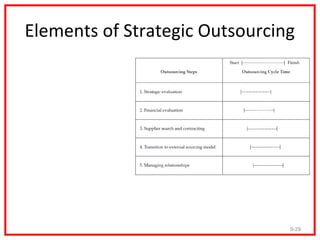
Elements of Strategic Outsourcing
• The steps are highly
  interrelated.
• Modification to the
  steps are required to
  fit each specific
  organization and
  outsourcing
  objectives.
• Concurrent
  relationships between
  steps reduce the
  implementation cycle
  time.
                                  9-29
Elements of Strategic Outsourcing
 1. STRATEGIC EVALUATION
     • Outsourcing is the act of reversing a previous decision to
       “make” or perform a particular function internally.

    • The first step is to understand the strategic importance
      (value) of the activity or system.

        • Standardized processes, commoditized products, etc.: extremely
          low strategic value.

    • Buying firms must make decisions as part of a
      comprehensive sourcing strategy.

                                                                   9-30
Elements of Strategic Outsourcing

2. FINANCIAL EVALUATION

   • Outsourcing decisions are required to make short and
     long-term financial sense.

   • However outsourcing benefits are not mutually exclusive
     and independent constructs, but rather significantly
     interrelated.


                                                               9-31
Elements of Strategic Outsourcing
3. SUPPLIER SELECTION AND CONTRACT DEVELOPMENT
• Supplier Selection
   – Supplier profiles
     •    Key management contacts, a company overview
     •    SWOT analysis, Porter’s five key financial figures
     •    Information on current contracts, “owners” of the
          relationship within the firm, and an organizational
          chart.
     •     Functional evaluation of the content

  –    Establish expectations, scope of work, pricing


                                                                9-32
Supplier Selection and
             Contract Development
•    Contract Development
    – a minimum for an enforceable contract include:

    1.   A clearly defined scope of work and elements of the
         processes to be supplied
    2.   An agreed upon approximate price for each aspect of
         what is being supplied.
    3.   An understanding of an acceptable level of operating
         flexibility as circumstances and requirements change.
    4.   Consider a short term contract with provisions for
         extensions and renegotiations
    5.   Ground rules that encourage relationship and alliance
         maintenance
    6.   Determination of a means for measuring performance
         for each aspect of the agreement.                       9-33
Element of Outsourcing
4. TRANSITION TO EXTERNAL SOURCING MODEL

 Begins with the contract execution to the transfer of the
 agreed upon activities and resources
   • The buying and selling organizations must both follow the
     specific roles outlined in the contract
   • The buying organization must also appoint a relationship
     manager
   • The relationship manager and the supplier must merge their
     independent plans into one consensus plan


                                                                  9-34
Elements of Outsourcing
TRANSITION TO EXTERNAL SOURCING MODEL (continued)

• Consensus transition plan must include at a minimum
   – Communication Criteria
   – Personnel Criteria
   – Transition Criteria


                                                        9-35
Elements of Outsourcing
 TRANSITION TO EXTERNAL SOURCING MODEL (continued)
• Communication Criteria
   – About the process of communicating external initiatives to
      the affected and unaffected employees

  –     The following actions should included in the process
      •   Announce that the contract has been signed and awarded
          to the supplying firm
      •   Discuss how severance packages will be offered to
          affected employees
      •   Conduct extensive question and answer session
                                                           9-36
Elements of Outsourcing
TRANSITION TO EXTERNAL SOURCING MODEL (continued)
• Personnel Criteria
  – About the overall message itself that will be
      communicated to the affected and non-affected
      employees
  – Create the perception of procedural and interpersonal
      justice
          1. Communicate early and clearly why the decision was made
          2. All stakeholders need to feel as though their interests were
             represented
          3. Retained employees need to be trained to enhance their
             “lateral” skills such as relationship management, negotiation
             and consensus building.

                                                                             9-37
Elements of Outsourcing
TRANSITION TO EXTERNAL SOURCING MODEL (continued)
Transition Criteria
   1. The schedule involving the transfer of activities and
        resources to the supplying organization
   2. The list of activities to implement outlined in the project
        management schedule should include:
         –      An organization meeting for employees being transferred to
                the supplier’s organization.
         –      A meeting with the buying firm’s manager whose activities are
                being outsourced conducted on-site at the new location.
     •       A creation of a plan to address the issues involved in
             transferring significant physical assets
         –      a specific third-party agreement in the contract
                                                                                9-38
Relationship Management
• In order to effectively cultivate the relationship, the
  buying firm must actively monitor and evaluate
  performance. The buying firm must also solve
  outsourcing related problems.

• The original contract establishes
     • the performance measures
     • deliverables, due dates
     • the expected supplier requirements

                                                      9-39
Relationship Management
1. Performance measurement is the cornerstone of the buyer-
   supplier relationship.
   • It establishes control which provides the ability to manage
     the relationship

1. The buyer and supplier relationship managers should
   develop and execute the reporting system established in the
   contract.
      • A performance report is also needed. See the
        following slide.


                                                                   9-40
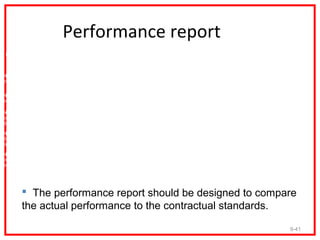
Performance report
 Performance   Performance   2009      2009      2008      2008      2007      2007
  Measures      Standard     Actual   Variance   Actual   Variance   Actual   Variance


Number of
outputs

Number of
errors

Number of
on-time
deliveries

Number of
day-cycle
time

Number of
outputs per
employee


         The performance report should be designed to compare
        the actual performance to the contractual standards.

                                                                                         9-41
Risk
• Outsourcing risks include:
  – Breaches in intellectual property
  – Provider shirking
  – Opportunistic renegotiation

• The combination of contractual incompleteness,
  asset specificity, and uncertainty gives rise to these
  risks when firms pursue external sourcing


                                                           9-42
Performance Report
• Risk is the difference between risk and uncertainty
• Risk as defined By Knight:
   – Risk is measurable, but uncertainty cannot be
     measured
   – Buyers outsourcing risks (BOR) = PA x NC
   – PA = the probability that an adverse event will
     occur
   – NC = negative consequences if the adverse event
     occurs, assuming that each of the adverse events
     is independent

                                                        9-43
Forms of Governance
• Traditional theory
   – Hierarchy (i.e. internal sourcing) v. Market (i.e. external
     sources)
   – Market: arm’s-length relationship between the customer and
     supplier organization


                                                              9-44
Forms of Governance
• Hybrid governance theory
  – From the observation of Japanese- style supply chain
    relationships
  – Neither purely hierarchical nor a purely arms- length
    market mechanism.
  – Seeks to realize the control, goal alignment, and improved
    coordination associated with retaining an activity
    internally, while also benefiting from the potentially
    superior skills and cost position of specialized, external
    organizations.
  – The relationship is more of a long-term, collaborative
    partnership
                                                                 9-45
Long Term Relationships
• Benefits
   – A reduction in transaction costs
   – Improve learning and control opportunism
   – Greater social capital
     • Improved dissemination of information and reduced
       motivation for opportunistic behavior

     • Social capital: the sum of the actual and potential
       resources embedded within, available through, and
       derived from the network of relationships possessed by
       an individual or social unit.
                                                                9-46
Long-term relationships with service providers can
mitigate many of the traditional concerns with
external sourcing


                                                     9-47
Requirements for
           Long Term Relationships
• Strong commitment from both parties
   1. The sharing of timely, rich, and often proprietary
      information including:
         – demand forecasts, detailed cost information
         – new product plans, strategic change
   1. For building trust between the organizations
   2. For more effective planning and execution


                                                           9-48
Requirements for
       Long Term Relationships
• Joint effort by the organizations.

• Equitable distribution of pain and gain (tying their destinies
  together)

• A contract that defines performance incentives by means of
  penalty and reward structures

• A constructive and flexible change management and dispute
  resolution process

• A formalized procedure for communicating the buyer’s
  expectations and evaluating the supplier’s performance
                                                                   9-49

STRATEGIC OUTSOURCING

  • 1.
    Purchasing and SupplyChain Management by W.C. Benton Chapter Nine Strategic Outsourcing
  • 2.
    Learning Objectives 1. Tolearn the precise definition of outsourcing. 2. To learn why organizations outsource manufacturing and services business processes. 3. To learn the outsourcing process is not considered contracting or joint venturing. 4. To learn about the benefits and pitfalls of outsourcing. 9-2
  • 3.
    Learning Objectives 5. Toabout the hidden cost of outsourcing. 6. To learn about core and non-core competencies. 7. To learn about the elements of strategic outsourcing 8. To learn about the role of the outsourcing relationship manager. 9-3
  • 4.
    Outsourcing • Defined asthe complete transfer of a business process that has been traditionally operated and managed internally to an independently-owned external service provider. – A complete transfer of all associated internal business process activities – Once outsourced, the people, facilities, equipment, technology and other assets are no longer maintained internally 9-4
  • 5.
    Outsourcing • Not thesame as subcontracting, joint venturing or contract manufacturing 9-5
  • 6.
    Outsourced activities Source: Handley,S.M., The Evaluation Analysis and Management of the Business Outsourcing process, Unpublished Dissertation, The Ohio State University, 2008 9-6
  • 7.
    The concept ofOutsourcing • A process rather than simply an event Source: Handley, S.M., The Evaluation Analysis and Management of the Business Outsourcing process, Unpublished Dissertation, The Ohio State University, 2008 9-7
  • 8.
    Reasons for OutsourcingBusiness Processes The generic strategic benefits of outsourcing are: 1. Cost Minimization 2. Refocus Organization to Core 3. Improvement in Operating 4. Increased Market Share and Revenue 9-8
  • 9.
    Outsourcing Business Processes •The usual primary driver for outsourcing : • A reduction in direct operating costs which must be significantly lower than the current direct operating costs 9-9
  • 10.
    Specific Purposes &Benefits of Outsourcing 1. To reduce and control operating costs 2. To improve quality 3. To change company focus 4. To acquire external capabilities 5. To refocus scarce resources for alternative uses 6. To reduce cycle time 7. To obtain cash infusion 8. To reduce risks 9. To gain flexibility 10. To turn fixed costs into variable costs 9-10
  • 11.
    The Following areImportant for Realizing Expected Outsourcing Benefits •An extensive strategic assessment •A true commitment to a cooperative relationship with 9-11
  • 12.
    The Hidden Costof Outsourcing 1. Quality Costs – Preventative – Appraisal – Internal failure – External failure 9-12
  • 13.
    Detecting Quality Failures Thebuying firm will need a proper mechanisms that are capable of detecting quality failures by an external source. This may be more difficult than with internal sourcing 9-13
  • 14.
    The Hidden Costof Outsourcing 2. Supplier or Vendor Relationship Management The most effective external sourcing relationships involve considerable management time and coordination External Sourcing which involve: – Commodity products or services may not require extensive relationship building and coordination. – Strategic products and services require extensive relationship building and coordination activities. 9-14
  • 15.
    The Hidden Costof Outsourcing • Relationship Management Costs – Labor expense of purchasing personnel – Travel – IT infrastructure and management – Supplier development programs (e.g. training and performance evaluation systems) 9-15
  • 16.
    The Hidden Costof Outsourcing 3. Internal Coordination • Contrasted against the internal coordination and overhead costs associated with internally sourcing (Vertically integrate or Make) • The costs of bureaucracy – Payroll, benefits management – Utility expenses, IT expenses, etc. 9-16
  • 17.
    Understanding Overhead Costs Firmsneed to have a thorough understanding of these marginal overhead expenses and how they would be incrementally impacted by outsourcing 9-17
  • 18.
    The Hidden Costof Outsourcing 4. Implementation of External Sourcing Model • Costs associated with the transition resulting from switching sources – supplier search, evaluation and contracting – the transfer of physical assets – domestic and international travel during start-up – training of the new source 9-18
  • 19.
    Additional Hidden CostsAssociated with the Internal Workforce • relationship manager training for internal employees • retention bonuses, severance packages, employee turnover • management time required to thwart labor disputes 9-19
  • 20.
    The Hidden Costof Outsourcing 5. Coordination of Product / Service Design and Development – There appears to be a significant interplay between the architecture of the product or service and the cost of coordination. – Cost of coordination: the number of engineering hours required to bring a new product to market – Tightly coupled or integrated product designs require higher levels of coordination 9-20
  • 21.
    A Need toCoordinate Sourcing Alternatives • Firms need to develop a deep understanding of the coordination cost implications of various sourcing alternatives 9-21
  • 22.
    The Hidden Costof Outsourcing 6. Governmental and Political Related Expenses • Costs involved with ensuring compliance with governmental laws, regulations, and even local business customs – legal expenses incurred to learn about a foreign location’s laws and regulations, travel – taxation, local content obligations, lobbying efforts – tariffs, quota systems, etc. 9-22
  • 23.
    The Hidden Costof Outsourcing 7. Supply Chain Risk Management • Risk can be defined as a measure of the probability and severity of adverse effects. • Four iterative phases 1. Risk assessment 2. Risk mitigation 3. Risk monitoring 4. Contingency planning. 9-23
  • 24.
    Supply Chain RiskManagement • A comprehensive risk management approach will introduce costs that are different for various sourcing alternatives. • Different options will carry with them different types and sizes of risks. • Some specific costs includes – insurance, dedicated risk management personnel, financial hedging, and operations hedging. 9-24
  • 25.
    The Hidden Costof Outsourcing 8. Miscellaneous Financial Considerations Sources of financial benefit from outsourcing  Vendor’s better economies of scale  External suppliers’ capability to aggregate the demands of their multiple customers 9-25
  • 26.
    Miscellaneous Financial Considerations • The size of the buying firm’s portion of cost improvement is determined by competitive conditions in the supply market, power structures, and the overall threat of opportunistic behavior by the external supplier. • If a firm’ internal efforts can generate nearly equal financial improvement as outsourcing, the outsourcing decision is called into question. 9-26
  • 27.
    Core Competencies • CoreCompetencies are: • The collective learning in an organization • Unique combinations of thought, focus and implementation methodologies • Achieved over the long term • Outsourcing can provide short-term competitive benefits, but does not significantly improve Core Competencies 9-27
  • 28.
    Keys to OutsourcingSuccess in Today's Economy 1. Understanding and avoiding the pitfalls of cost-focused outsourcing and apply a total business-outcome-focus 2. Continuously re-evaluate contracts to improve efficiency and costs. The drivers of efficiency and costs are: • Provider selection and retention, • Services delivery policies, contract pricing and etc. 3. Ensure a certain level of flexibility in contract terms in order to be response to corporate changes 9-28
  • 29.
    Elements of StrategicOutsourcing • The steps are highly interrelated. • Modification to the steps are required to fit each specific organization and outsourcing objectives. • Concurrent relationships between steps reduce the implementation cycle time. 9-29
  • 30.
    Elements of StrategicOutsourcing 1. STRATEGIC EVALUATION • Outsourcing is the act of reversing a previous decision to “make” or perform a particular function internally. • The first step is to understand the strategic importance (value) of the activity or system. • Standardized processes, commoditized products, etc.: extremely low strategic value. • Buying firms must make decisions as part of a comprehensive sourcing strategy. 9-30
  • 31.
    Elements of StrategicOutsourcing 2. FINANCIAL EVALUATION • Outsourcing decisions are required to make short and long-term financial sense. • However outsourcing benefits are not mutually exclusive and independent constructs, but rather significantly interrelated. 9-31
  • 32.
    Elements of StrategicOutsourcing 3. SUPPLIER SELECTION AND CONTRACT DEVELOPMENT • Supplier Selection – Supplier profiles • Key management contacts, a company overview • SWOT analysis, Porter’s five key financial figures • Information on current contracts, “owners” of the relationship within the firm, and an organizational chart. • Functional evaluation of the content – Establish expectations, scope of work, pricing 9-32
  • 33.
    Supplier Selection and Contract Development • Contract Development – a minimum for an enforceable contract include: 1. A clearly defined scope of work and elements of the processes to be supplied 2. An agreed upon approximate price for each aspect of what is being supplied. 3. An understanding of an acceptable level of operating flexibility as circumstances and requirements change. 4. Consider a short term contract with provisions for extensions and renegotiations 5. Ground rules that encourage relationship and alliance maintenance 6. Determination of a means for measuring performance for each aspect of the agreement. 9-33
  • 34.
    Element of Outsourcing 4.TRANSITION TO EXTERNAL SOURCING MODEL Begins with the contract execution to the transfer of the agreed upon activities and resources • The buying and selling organizations must both follow the specific roles outlined in the contract • The buying organization must also appoint a relationship manager • The relationship manager and the supplier must merge their independent plans into one consensus plan 9-34
  • 35.
    Elements of Outsourcing TRANSITIONTO EXTERNAL SOURCING MODEL (continued) • Consensus transition plan must include at a minimum – Communication Criteria – Personnel Criteria – Transition Criteria 9-35
  • 36.
    Elements of Outsourcing TRANSITION TO EXTERNAL SOURCING MODEL (continued) • Communication Criteria – About the process of communicating external initiatives to the affected and unaffected employees – The following actions should included in the process • Announce that the contract has been signed and awarded to the supplying firm • Discuss how severance packages will be offered to affected employees • Conduct extensive question and answer session 9-36
  • 37.
    Elements of Outsourcing TRANSITIONTO EXTERNAL SOURCING MODEL (continued) • Personnel Criteria – About the overall message itself that will be communicated to the affected and non-affected employees – Create the perception of procedural and interpersonal justice 1. Communicate early and clearly why the decision was made 2. All stakeholders need to feel as though their interests were represented 3. Retained employees need to be trained to enhance their “lateral” skills such as relationship management, negotiation and consensus building. 9-37
  • 38.
    Elements of Outsourcing TRANSITIONTO EXTERNAL SOURCING MODEL (continued) Transition Criteria 1. The schedule involving the transfer of activities and resources to the supplying organization 2. The list of activities to implement outlined in the project management schedule should include: – An organization meeting for employees being transferred to the supplier’s organization. – A meeting with the buying firm’s manager whose activities are being outsourced conducted on-site at the new location. • A creation of a plan to address the issues involved in transferring significant physical assets – a specific third-party agreement in the contract 9-38
  • 39.
    Relationship Management • Inorder to effectively cultivate the relationship, the buying firm must actively monitor and evaluate performance. The buying firm must also solve outsourcing related problems. • The original contract establishes • the performance measures • deliverables, due dates • the expected supplier requirements 9-39
  • 40.
    Relationship Management 1. Performancemeasurement is the cornerstone of the buyer- supplier relationship. • It establishes control which provides the ability to manage the relationship 1. The buyer and supplier relationship managers should develop and execute the reporting system established in the contract. • A performance report is also needed. See the following slide. 9-40
  • 41.
    Performance report Performance Performance 2009 2009 2008 2008 2007 2007 Measures Standard Actual Variance Actual Variance Actual Variance Number of outputs Number of errors Number of on-time deliveries Number of day-cycle time Number of outputs per employee  The performance report should be designed to compare the actual performance to the contractual standards. 9-41
  • 42.
    Risk • Outsourcing risksinclude: – Breaches in intellectual property – Provider shirking – Opportunistic renegotiation • The combination of contractual incompleteness, asset specificity, and uncertainty gives rise to these risks when firms pursue external sourcing 9-42
  • 43.
    Performance Report • Riskis the difference between risk and uncertainty • Risk as defined By Knight: – Risk is measurable, but uncertainty cannot be measured – Buyers outsourcing risks (BOR) = PA x NC – PA = the probability that an adverse event will occur – NC = negative consequences if the adverse event occurs, assuming that each of the adverse events is independent 9-43
  • 44.
    Forms of Governance •Traditional theory – Hierarchy (i.e. internal sourcing) v. Market (i.e. external sources) – Market: arm’s-length relationship between the customer and supplier organization 9-44
  • 45.
    Forms of Governance •Hybrid governance theory – From the observation of Japanese- style supply chain relationships – Neither purely hierarchical nor a purely arms- length market mechanism. – Seeks to realize the control, goal alignment, and improved coordination associated with retaining an activity internally, while also benefiting from the potentially superior skills and cost position of specialized, external organizations. – The relationship is more of a long-term, collaborative partnership 9-45
  • 46.
    Long Term Relationships •Benefits – A reduction in transaction costs – Improve learning and control opportunism – Greater social capital • Improved dissemination of information and reduced motivation for opportunistic behavior • Social capital: the sum of the actual and potential resources embedded within, available through, and derived from the network of relationships possessed by an individual or social unit. 9-46
  • 47.
    Long-term relationships withservice providers can mitigate many of the traditional concerns with external sourcing 9-47
  • 48.
    Requirements for Long Term Relationships • Strong commitment from both parties 1. The sharing of timely, rich, and often proprietary information including: – demand forecasts, detailed cost information – new product plans, strategic change 1. For building trust between the organizations 2. For more effective planning and execution 9-48
  • 49.
    Requirements for Long Term Relationships • Joint effort by the organizations. • Equitable distribution of pain and gain (tying their destinies together) • A contract that defines performance incentives by means of penalty and reward structures • A constructive and flexible change management and dispute resolution process • A formalized procedure for communicating the buyer’s expectations and evaluating the supplier’s performance 9-49