
Gordon M. Groat
LEADERSHIP BY THE NUMBERS :A COMPILATION OF CF
BEST PRACTICES MODIFIED FOR CORPORATE
APPLICATION
Table of Contents
Effectiveness Framework..............................................................................................................................3
Organizational Success..............................................................................................................................3
Internal Integration...................................................................................................................................3
Member Well Being and Commitment.....................................................................................................3
Conduct (ethos).........................................................................................................................................3
The Importance of Trust ...............................................................................................................................4
Distributed Leadership..................................................................................................................................4
Professional...................................................................................................................................................5
Leaders Primary Responsibilities ..................................................................................................................5
Member Well-being and Commitment.....................................................................................................5
Enhance Situational Awareness – Explain Events and Decisions..............................................................5
Collective Leadership....................................................................................................................................6
Gordon M. Groat
Duty is about what we do, a leader’s duty is to serve the mission. Honour is about how we perform our
duty. Leaders must perform their duties in accordance with the civic, legal, and ethical values embraced
by our society.. Effective leaders get the job done, look after their people, think and act in terms of the
larger team, anticipate and adapt to change, and exemplify our ethos in all they do. This is what
organization expects and it is also what the people whom we serve expect. Altogether too often, the
public is sad to learn their leaders have not lived up to an ethos of high standards. Part of our ethos,
then, should be to say that we will stand up to be moral, effective, and genuine leaders. For it is only
through a strong commitment to an ethos our people can be proud of, that we will be able to provide the
characteristics of strong and capable leaders and give the people what they so rightfully expect.
~ General Rick Hillier – Chief of Defence Staff
(Taken in part and editorialized by the author)
Gordon M. Groat
Effectiveness Framework
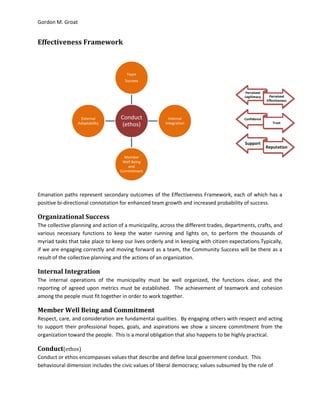
Emanation paths represent secondary outcomes of the Effectiveness Framework, each of which has a
positive bi-directional connotation for enhanced team growth and increased probability of success.
Organizational Success
The collective planning and action of a municipality, across the different trades, departments, crafts, and
various necessary functions to keep the water running and lights on, to perform the thousands of
myriad tasks that take place to keep our lives orderly and in keeping with citizen expectations.Typically,
if we are engaging correctly and moving forward as a team, the Community Success will be there as a
result of the collective planning and the actions of an organization.
Internal Integration
The internal operations of the municipality must be well organized, the functions clear, and the
reporting of agreed upon metrics must be established. The achievement of teamwork and cohesion
among the people must fit together in order to work together.
Member Well Being and Commitment
Respect, care, and consideration are fundamental qualities. By engaging others with respect and acting
to support their professional hopes, goals, and aspirations we show a sincere commitment from the
organization toward the people. This is a moral obligation that also happens to be highly practical.
Conduct(ethos)
Conduct or ethos encompasses values that describe and define local government conduct. This
behavioural dimension includes the civic values of liberal democracy; values subsumed by the rule of
Perceived
Legitimacy Perceived
Effectiveness
Confidence
Trust
Support
Reputation
Conduct
(ethos)
Team
Success
Internal
Integration
Member
Well Being
and
Commitment
External
Adaptability
Gordon M. Groat
law; ethical values governing our treatmentof others and the conduct of government operations; and
the traditional values of duty, loyalty, integrity, and courage. The ethos is the essence of your honour.
The Importance of Trust
Trust in leadership is positively related to individual and group performance, persistence in the face of
adversity, the ability to withstand stress, job satisfaction, and commitment to continued service. One of
the most important part of the leader’s job is to build and maintain healthy trust relationships with
subordinates, peers, and superiors. Leaders build and maintain trust through their decisions, actions,
and interactions.
Leaders build and maintain trust through their decisions, actions, and interactions. Leadership qualities
exhibited by each leader of the organization is reflected onto every leader of the organization. As such it
follows that the leaders should, at a minimum, always exhibit these traits:
Demonstrate high levels of proficiency in the performance of core functions and take advantage
of opportunities to enhance their professional expertise and competence
Exercise good judgment in decisions that affect others and do not expose people to unnecessary
physical or emotional risks
Show trust and confidence in their subordinates by giving them additional authority and
involving them in decisions where circumstances allow
Demonstrate concern for the well-being of their subordinates, represent their interests, and
ensure they are supported and taken care of by the organization
Show consideration and respect for others, treating subordinates fairly, without favor or
discrimination
Focus on the mission, maintaining high standards and honest and open communications
Lead by example, sharing risks and hardships and refusing to accept or take special privileges
Keep their word and can be counted on to honor their obligations
Distributed Leadership
Distributed leadership is about sharing the responsibilities of leadership, vertically and horizontally
within teams and the organization as a whole. Leadership is an essential role requirement for managers
but is not the same thing as command or management.
Leaders are involved in planning, problem-solving, decision making, organizing, informing, directing,
allocating and managing resources while developing, co-ordinating, monitoring, and controlling the
course of those efforts. The expectation is simple; leaders will not only lead but that they will lead well.
They will always seek to develop the team around them; they will never seek to be the smartest person
in the room, but rather, surround themselves with strengths, leverage those strengths, and constantly
seek ways to share the leadership role through a distributed environment based upon a foundation of
trust.
Gordon M. Groat
Professional
A profession is essentially an exclusive group of people performing a service to society and unified by a
common body of expertise and code of conduct. They words of a professional cannot be just words on
paper or empty commitments. They must be publicly visible consistent patterns of behaviour. Leaders
make the difference.
Leaders Primary Responsibilities
Build Teamwork and Cohesion
Professional Competence and Self-Improvement
Clarify Objectives and Intent
Solve Problems with Timely Decisions
Mentor, Educate, and Develop Team Members
Treat Teammates Fairly
Respond to Their Concerns
Represent Teammates Interests
Maintain Situational Awareness
Learn From Those Who Have Experience
Learn From Experience
Exemplify the Ethos
Member Well-being and Commitment
The primary leader roles pertaining to the member well-being and commitment dimension of
effectiveness are those of sustainer and developer. In the sustainer role, the leadership team is
responsible for establishing a healthy unit climate, treating people fairly, and managing interpersonal
conflict. The leader must also sustain the individual and collective interests of their people from
administrative staffs to organization leadership, and they should build morale.
In the developer role, leaders foster and recognize achievement, and protect depth and continuity in
teams by cultivating potential replacement leaders. They mentor people in apprenticeship positions and
challenging assignments, and encourage and support subordinate participation in training, educational,
and professional activities over the career span.
Enhance Situational Awareness – Explain Events and Decisions
The routine and prompt passage of information contributes to teammates’ situational awareness and
their ability to respond appropriately to a changing situation. Situational awareness is critical to
anticipating future environmental conditions and identifying opportunities to secure organizational
advantage.Candidly explaining events and decisions often reduces tensions created by uncertainty, and
is critical to maintaining the trust relationship between leaders and led.
Gordon M. Groat
Collective Leadership
Collective leadership refers to the combined effects and synergies when leaders at different levels
synchronize their leadership actions to achieve a common purpose. High performing collective
leadership occurs when leadership processes are mutually reinforcing and the result is greater than the
sum of its parts. Leveraging collective intelligence to establish collective leadership shifts fine
organizations into high performing organizations with stellar performers.

Leadership By The Numbers

  • 1.
    Gordon M. Groat LEADERSHIPBY THE NUMBERS :A COMPILATION OF CF BEST PRACTICES MODIFIED FOR CORPORATE APPLICATION Table of Contents Effectiveness Framework..............................................................................................................................3 Organizational Success..............................................................................................................................3 Internal Integration...................................................................................................................................3 Member Well Being and Commitment.....................................................................................................3 Conduct (ethos).........................................................................................................................................3 The Importance of Trust ...............................................................................................................................4 Distributed Leadership..................................................................................................................................4 Professional...................................................................................................................................................5 Leaders Primary Responsibilities ..................................................................................................................5 Member Well-being and Commitment.....................................................................................................5 Enhance Situational Awareness – Explain Events and Decisions..............................................................5 Collective Leadership....................................................................................................................................6
  • 2.
    Gordon M. Groat Dutyis about what we do, a leader’s duty is to serve the mission. Honour is about how we perform our duty. Leaders must perform their duties in accordance with the civic, legal, and ethical values embraced by our society.. Effective leaders get the job done, look after their people, think and act in terms of the larger team, anticipate and adapt to change, and exemplify our ethos in all they do. This is what organization expects and it is also what the people whom we serve expect. Altogether too often, the public is sad to learn their leaders have not lived up to an ethos of high standards. Part of our ethos, then, should be to say that we will stand up to be moral, effective, and genuine leaders. For it is only through a strong commitment to an ethos our people can be proud of, that we will be able to provide the characteristics of strong and capable leaders and give the people what they so rightfully expect. ~ General Rick Hillier – Chief of Defence Staff (Taken in part and editorialized by the author)
  • 3.
    Gordon M. Groat EffectivenessFramework Emanation paths represent secondary outcomes of the Effectiveness Framework, each of which has a positive bi-directional connotation for enhanced team growth and increased probability of success. Organizational Success The collective planning and action of a municipality, across the different trades, departments, crafts, and various necessary functions to keep the water running and lights on, to perform the thousands of myriad tasks that take place to keep our lives orderly and in keeping with citizen expectations.Typically, if we are engaging correctly and moving forward as a team, the Community Success will be there as a result of the collective planning and the actions of an organization. Internal Integration The internal operations of the municipality must be well organized, the functions clear, and the reporting of agreed upon metrics must be established. The achievement of teamwork and cohesion among the people must fit together in order to work together. Member Well Being and Commitment Respect, care, and consideration are fundamental qualities. By engaging others with respect and acting to support their professional hopes, goals, and aspirations we show a sincere commitment from the organization toward the people. This is a moral obligation that also happens to be highly practical. Conduct(ethos) Conduct or ethos encompasses values that describe and define local government conduct. This behavioural dimension includes the civic values of liberal democracy; values subsumed by the rule of Perceived Legitimacy Perceived Effectiveness Confidence Trust Support Reputation Conduct (ethos) Team Success Internal Integration Member Well Being and Commitment External Adaptability
  • 4.
    Gordon M. Groat law;ethical values governing our treatmentof others and the conduct of government operations; and the traditional values of duty, loyalty, integrity, and courage. The ethos is the essence of your honour. The Importance of Trust Trust in leadership is positively related to individual and group performance, persistence in the face of adversity, the ability to withstand stress, job satisfaction, and commitment to continued service. One of the most important part of the leader’s job is to build and maintain healthy trust relationships with subordinates, peers, and superiors. Leaders build and maintain trust through their decisions, actions, and interactions. Leaders build and maintain trust through their decisions, actions, and interactions. Leadership qualities exhibited by each leader of the organization is reflected onto every leader of the organization. As such it follows that the leaders should, at a minimum, always exhibit these traits: Demonstrate high levels of proficiency in the performance of core functions and take advantage of opportunities to enhance their professional expertise and competence Exercise good judgment in decisions that affect others and do not expose people to unnecessary physical or emotional risks Show trust and confidence in their subordinates by giving them additional authority and involving them in decisions where circumstances allow Demonstrate concern for the well-being of their subordinates, represent their interests, and ensure they are supported and taken care of by the organization Show consideration and respect for others, treating subordinates fairly, without favor or discrimination Focus on the mission, maintaining high standards and honest and open communications Lead by example, sharing risks and hardships and refusing to accept or take special privileges Keep their word and can be counted on to honor their obligations Distributed Leadership Distributed leadership is about sharing the responsibilities of leadership, vertically and horizontally within teams and the organization as a whole. Leadership is an essential role requirement for managers but is not the same thing as command or management. Leaders are involved in planning, problem-solving, decision making, organizing, informing, directing, allocating and managing resources while developing, co-ordinating, monitoring, and controlling the course of those efforts. The expectation is simple; leaders will not only lead but that they will lead well. They will always seek to develop the team around them; they will never seek to be the smartest person in the room, but rather, surround themselves with strengths, leverage those strengths, and constantly seek ways to share the leadership role through a distributed environment based upon a foundation of trust.
  • 5.
    Gordon M. Groat Professional Aprofession is essentially an exclusive group of people performing a service to society and unified by a common body of expertise and code of conduct. They words of a professional cannot be just words on paper or empty commitments. They must be publicly visible consistent patterns of behaviour. Leaders make the difference. Leaders Primary Responsibilities Build Teamwork and Cohesion Professional Competence and Self-Improvement Clarify Objectives and Intent Solve Problems with Timely Decisions Mentor, Educate, and Develop Team Members Treat Teammates Fairly Respond to Their Concerns Represent Teammates Interests Maintain Situational Awareness Learn From Those Who Have Experience Learn From Experience Exemplify the Ethos Member Well-being and Commitment The primary leader roles pertaining to the member well-being and commitment dimension of effectiveness are those of sustainer and developer. In the sustainer role, the leadership team is responsible for establishing a healthy unit climate, treating people fairly, and managing interpersonal conflict. The leader must also sustain the individual and collective interests of their people from administrative staffs to organization leadership, and they should build morale. In the developer role, leaders foster and recognize achievement, and protect depth and continuity in teams by cultivating potential replacement leaders. They mentor people in apprenticeship positions and challenging assignments, and encourage and support subordinate participation in training, educational, and professional activities over the career span. Enhance Situational Awareness – Explain Events and Decisions The routine and prompt passage of information contributes to teammates’ situational awareness and their ability to respond appropriately to a changing situation. Situational awareness is critical to anticipating future environmental conditions and identifying opportunities to secure organizational advantage.Candidly explaining events and decisions often reduces tensions created by uncertainty, and is critical to maintaining the trust relationship between leaders and led.
  • 6.
    Gordon M. Groat CollectiveLeadership Collective leadership refers to the combined effects and synergies when leaders at different levels synchronize their leadership actions to achieve a common purpose. High performing collective leadership occurs when leadership processes are mutually reinforcing and the result is greater than the sum of its parts. Leveraging collective intelligence to establish collective leadership shifts fine organizations into high performing organizations with stellar performers.