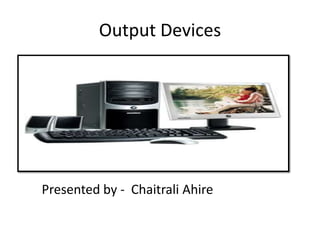

Output Devices
Presented by - Chaitrali Ahire
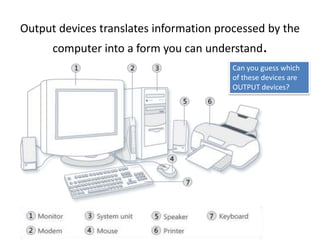
Output devices translates information processed by the
computer into a form you can understand.
Can you guess which
of these devices are
OUTPUT devices?
Output devices can be divided into two
categories: SOFTCOPY output devices and
HARDCOPY output devices.
SOFTCOPY HARDCOPY
Monitors (VDUs) Printers
Projectors
Speakers
Video Graphics Card
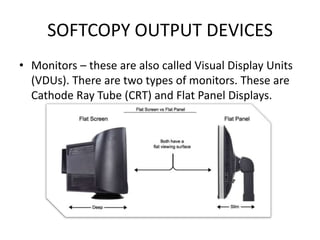
SOFTCOPY OUTPUT DEVICES
• Monitors – these are also called Visual Display Units
(VDUs). There are two types of monitors. These are
Cathode Ray Tube (CRT) and Flat Panel Displays.
visual display unit
• A VDU (Visual Displaying Unit) is the monitor
that is used to display the output of the
computer.
• It comprises the circuitry, display device and
an enclosure.
• The VDU in modern monitors is a thin film
transistor liquid crystal display thin panel, but
the older monitors use a cathode ray tube
that is as deep as the screen size.
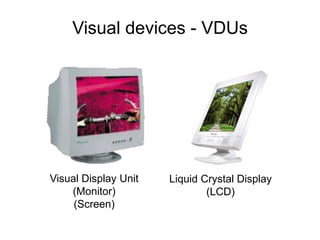
Visual devices - VDUs
Visual Display Unit
(Monitor)
(Screen)
Liquid Crystal Display
(LCD)
Types of Visual Display Unit
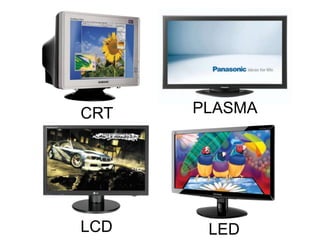
Mainly there are 4 types of VDU’s as follows :-
• (CRT) Cathode Ray Tube
• Plasma
• (LCD) Liquid Crystal Display
• (LED) Light Emitting Diode
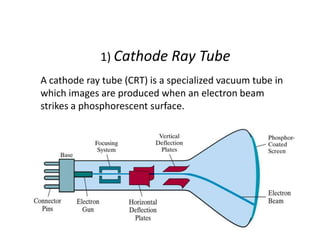
1) Cathode Ray Tube
A cathode ray tube (CRT) is a specialized vacuum tube in
which images are produced when an electron beam
strikes a phosphorescent surface.
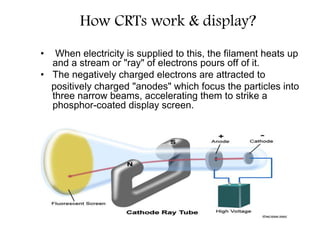
How CRTs work & display?
• When electricity is supplied to this, the filament heats up
and a stream or "ray" of electrons pours off of it.
• The negatively charged electrons are attracted to
positively charged "anodes" which focus the particles into
three narrow beams, accelerating them to strike a
phosphor-coated display screen.
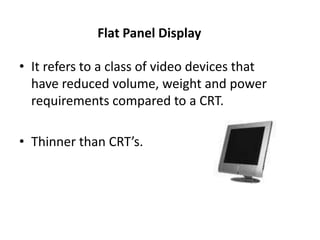
Flat Panel Display
• It refers to a class of video devices that
have reduced volume, weight and power
requirements compared to a CRT.
• Thinner than CRT’s.
1) PLASMA Display
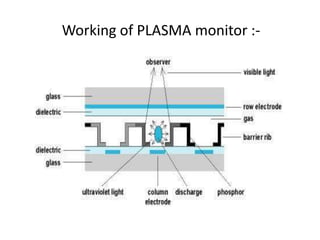
• The basic idea behind the plasma technology is
to illuminate tiny colored fluorescent lights to create
image pixels.
• Each pixel is made of three such fluorescent lights
red, green and blue lights.
• To create a wide range of colors, intensity of these
lights is varied accordingly.
Plasma displays are manufactured by companies
such as Panasonic, Fujitsu, and Pioneer.
Working of PLASMA monitor :-
2) LCD
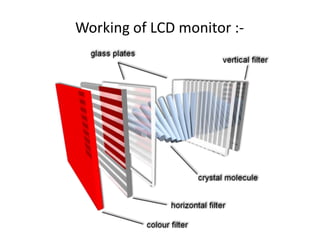
• A Liquid Crystal Display (LCD) is a flat panel display
that uses the light modulating properties of liquid crystals
which do not emit light directly.
• Each pixel of an LCD typically consists of a layer
of molecules aligned between two transparent electrodes,
and two polarizing filters, perpendicular to each other.
• With no actual liquid crystal between the polarizing
filters, light passing through the first filter would be blocked
by the second.
Working of LCD monitor :-
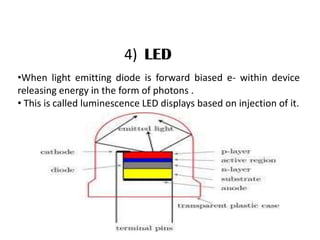
4) LED
•When light emitting diode is forward biased e- within device
releasing energy in the form of photons .
• This is called luminescence LED displays based on injection of it.
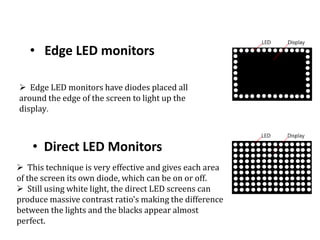
• Edge LED monitors
• Direct LED Monitors
 Edge LED monitors have diodes placed all
around the edge of the screen to light up the
display.
 This technique is very effective and gives each area
of the screen its own diode, which can be on or off.
 Still using white light, the direct LED screens can
produce massive contrast ratio's making the difference
between the lights and the blacks appear almost
perfect.
CRT
LEDLCD
PLASMA
Thank
You

Output devices of computer

  • 1.
    Output Devices Presented by- Chaitrali Ahire
  • 2.
    Output devices translatesinformation processed by the computer into a form you can understand. Can you guess which of these devices are OUTPUT devices?
  • 3.
    Output devices canbe divided into two categories: SOFTCOPY output devices and HARDCOPY output devices. SOFTCOPY HARDCOPY Monitors (VDUs) Printers Projectors Speakers Video Graphics Card
  • 4.
    SOFTCOPY OUTPUT DEVICES •Monitors – these are also called Visual Display Units (VDUs). There are two types of monitors. These are Cathode Ray Tube (CRT) and Flat Panel Displays.
  • 5.
    visual display unit •A VDU (Visual Displaying Unit) is the monitor that is used to display the output of the computer. • It comprises the circuitry, display device and an enclosure. • The VDU in modern monitors is a thin film transistor liquid crystal display thin panel, but the older monitors use a cathode ray tube that is as deep as the screen size.
  • 6.
    Visual devices -VDUs Visual Display Unit (Monitor) (Screen) Liquid Crystal Display (LCD)
  • 7.
    Types of VisualDisplay Unit Mainly there are 4 types of VDU’s as follows :- • (CRT) Cathode Ray Tube • Plasma • (LCD) Liquid Crystal Display • (LED) Light Emitting Diode
  • 8.
    1) Cathode RayTube A cathode ray tube (CRT) is a specialized vacuum tube in which images are produced when an electron beam strikes a phosphorescent surface.
  • 9.
    How CRTs work& display? • When electricity is supplied to this, the filament heats up and a stream or "ray" of electrons pours off of it. • The negatively charged electrons are attracted to positively charged "anodes" which focus the particles into three narrow beams, accelerating them to strike a phosphor-coated display screen.
  • 10.
    Flat Panel Display •It refers to a class of video devices that have reduced volume, weight and power requirements compared to a CRT. • Thinner than CRT’s.
  • 11.
    1) PLASMA Display •The basic idea behind the plasma technology is to illuminate tiny colored fluorescent lights to create image pixels. • Each pixel is made of three such fluorescent lights red, green and blue lights. • To create a wide range of colors, intensity of these lights is varied accordingly. Plasma displays are manufactured by companies such as Panasonic, Fujitsu, and Pioneer.
  • 12.
  • 13.
    2) LCD • ALiquid Crystal Display (LCD) is a flat panel display that uses the light modulating properties of liquid crystals which do not emit light directly. • Each pixel of an LCD typically consists of a layer of molecules aligned between two transparent electrodes, and two polarizing filters, perpendicular to each other. • With no actual liquid crystal between the polarizing filters, light passing through the first filter would be blocked by the second.
  • 14.
    Working of LCDmonitor :-
  • 15.
    4) LED •When lightemitting diode is forward biased e- within device releasing energy in the form of photons . • This is called luminescence LED displays based on injection of it.
  • 16.
    • Edge LEDmonitors • Direct LED Monitors  Edge LED monitors have diodes placed all around the edge of the screen to light up the display.  This technique is very effective and gives each area of the screen its own diode, which can be on or off.  Still using white light, the direct LED screens can produce massive contrast ratio's making the difference between the lights and the blacks appear almost perfect.
  • 17.
  • 18.