OUTPUT DEVICES
PRESENTATION BY
M.ZAIN KHALID
CONTENTS
• INTRODUTION
• MONITOR
• SPEAKER
• PRINTER
• PLOTTER
• HEADPHONE
• PROJECTOR
INTRODUCTION
• Output device receive information from the CPU and Present it to the user in user
understandable form.
• Output device can normally be produce in two ways:
• Either on display unit or
• In a paper
• Form of output on Computer Screen which is in Electronic form is softcopy output
.
• Output on paper which is in non-electronic form is called hardcopy.
What is a Monitor ?
• VDT and terminals monitors introduced in 1980’s.
• The monitors are display devices are most-used output device on computer.
• Monitors are very similar to televisions but usually display information at a
much higher resolution.
• Monitors are very important because without them you
wouldn't be able to do anything.
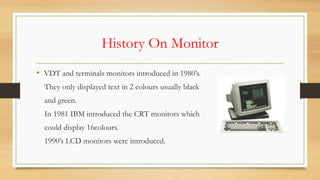
History On Monitor
• VDT and terminals monitors introduced in 1980’s.
They only displayed text in 2 colours usually black
and green.
In 1981 IBM introduced the CRT monitors which
could display 16colours.
1990’s LCD monitors were introduced.
MONITOR QUALITY AND RESOLUTION
• Quality:
• Manufacturers describe quality by dot pitch.
• The quality of the image on the screen depends upon many factors.
• Resolution:
• Resolution is one of the factor affecting the quality of the monitor.
• The resolution of a monitor refers to the number of pixels on the screen
expressed as a matrix.
• Most modern monitors can display 1024x768 pixels.
Speakers
• Speaker is a output device.
• A output device connected to a computer's sound card that outputs sounds
generated by the computer.
• Speakers can be used for various sounds meant to
alert the user, as well as music and spoken text.
Advantages & Disadvantages
• Advantages:
• They ‘re very simple to operate .
• Disadvantages :
• They can take up a fair amount desk-space compared to headphones.
Printer
• A printer is a device that produces hardcopy on the paper.
• Printers are commonly used in businesses to get the documents printed on
paper.
• Types of Printer:
• Printers can be categorized into:
• Impact Printer
• Non-Impact Printer
Types of Printer:
• Impact Printer:
• An impact printer produces images by striking an inked ribbon
with hammer or a set of pins, pressing ink from
the ribbon onto piece of paper.
• Impact printer are oldest technologies.
Advantage & Disadvantages
• Advantages:
• Less expensive
• Can make multiple copies with multipart paper
• Disadvantages:
• The impact printer is very Slow.
• Print quality lower in some types
Types of impact printer
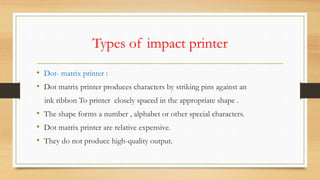
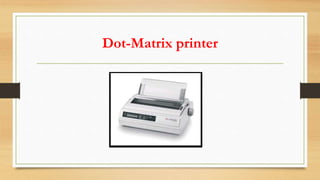
• Dot- matrix printer :
• Dot matrix printer produces characters by striking pins against an
ink ribbon To printer closely spaced in the appropriate shape .
• The shape forms a number , alphabet or other special characters.
• Dot matrix printer are relative expensive.
• They do not produce high-quality output.
Dot-Matrix printer
Type of impact printer
• Daisy wheel printer :
• These printer etched at the outer edge of a pedaled wheel which form
characters in the same way as a typewriter.
• Daisy wheel printer are loud and slow.
• They cannot printer graphics , and cannot changes fonts.
Daisy- wheel printer
Type impact printer
• Line printer:
• These printer is somewhat similar to the daisy wheel - printer is the line
printer.
• Line printer have a mechanism that allows multiple character to the
simultaneously printed on the same line.
• The printer speed ranging from 300 LPM ( lines per minute )to 2400 LPM.
Type of printer
• Non- impact printer:
• A non impact printer produces images on paper without striking the page on
the way.
• These printer are inexpensive to manufacture and silent .
• Very fast non-impact printer
• Printing more then 24 pages per minute.
Type non-impact printer
• LASER Printer :
• Laser stand for light amplification by stimulated emission of radiation.
• Laser printer are similar to copy machine.
• They use laser beams to burn special ink is called toner on page to create a
permanent images.
• The printer is vary fast and high quality provides.
• Laser printer have speeds of 4,8,12 or more page per minute.
Laser printer
Non-Impact Printer
• Ink jet printer:
• Ink jet printer is a type of printer that works by spraying ink on sheet a
paper.
• The printer are capable of producing
high quality of printer.
• In general, the price of ink jet printer is
lower then of laser printer.
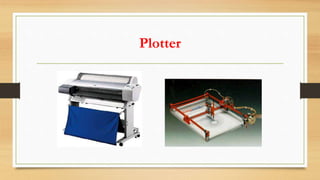
plotter
• Plotter:
• A plotter us a large scale printer that receives commands from a computer to
make drawing on paper with one or more automatic pens.
• Plotters are used in applications such as computer-aided design such as
diagrams, layouts, specification sheets and banners.
• The plotter is capable of producing color drawings in a matter of minutes.
• Plotters are considerably more expensive than printers.
Plotter
Headphones
• Headphone:
• Headphones give sound output from the computer.
• They are similar to speakers, except they are worn on
the ears so only one person can hear the output at a time.
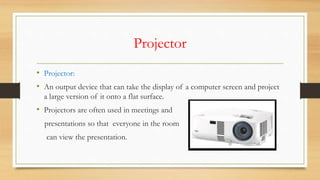
Projector
• Projector:
• An output device that can take the display of a computer screen and project
a large version of it onto a flat surface.
• Projectors are often used in meetings and
presentations so that everyone in the room
can view the presentation.
Projector
• Types of projector:
• Cathode Ray Tube (CRT) projector.
• Liquid Crystal Display (LCD) projector.
• Digital Light Processing (DLP) projector.
Type of Projector
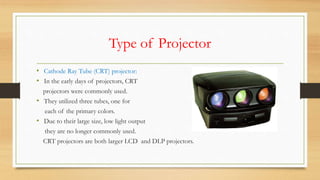
• Cathode Ray Tube (CRT) projector:
• In the early days of projectors, CRT
projectors were commonly used.
• They utilized three tubes, one for
each of the primary colors.
• Due to their large size, low light output
they are no longer commonly used.
CRT projectors are both larger LCD and DLP projectors.
Type of Projector
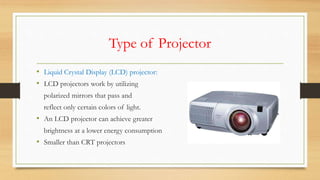
• Liquid Crystal Display (LCD) projector:
• LCD projectors work by utilizing
polarized mirrors that pass and
reflect only certain colors of light.
• An LCD projector can achieve greater
brightness at a lower energy consumption
• Smaller than CRT projectors
Type of projector
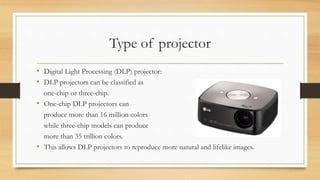
• Digital Light Processing (DLP) projector:
• DLP projectors can be classified as
one-chip or three-chip.
• One-chip DLP projectors can
produce more than 16 million colors
while three-chip models can produce
more than 35 trillion colors.
• This allows DLP projectors to reproduce more natural and lifelike images.

Output devices 6 things

  • 1.
  • 2.
    CONTENTS • INTRODUTION • MONITOR •SPEAKER • PRINTER • PLOTTER • HEADPHONE • PROJECTOR
  • 3.
    INTRODUCTION • Output devicereceive information from the CPU and Present it to the user in user understandable form. • Output device can normally be produce in two ways: • Either on display unit or • In a paper • Form of output on Computer Screen which is in Electronic form is softcopy output . • Output on paper which is in non-electronic form is called hardcopy.
  • 4.
    What is aMonitor ? • VDT and terminals monitors introduced in 1980’s. • The monitors are display devices are most-used output device on computer. • Monitors are very similar to televisions but usually display information at a much higher resolution. • Monitors are very important because without them you wouldn't be able to do anything.
  • 5.
    History On Monitor •VDT and terminals monitors introduced in 1980’s. They only displayed text in 2 colours usually black and green. In 1981 IBM introduced the CRT monitors which could display 16colours. 1990’s LCD monitors were introduced.
  • 6.
    MONITOR QUALITY ANDRESOLUTION • Quality: • Manufacturers describe quality by dot pitch. • The quality of the image on the screen depends upon many factors. • Resolution: • Resolution is one of the factor affecting the quality of the monitor. • The resolution of a monitor refers to the number of pixels on the screen expressed as a matrix. • Most modern monitors can display 1024x768 pixels.
  • 7.
    Speakers • Speaker isa output device. • A output device connected to a computer's sound card that outputs sounds generated by the computer. • Speakers can be used for various sounds meant to alert the user, as well as music and spoken text.
  • 8.
    Advantages & Disadvantages •Advantages: • They ‘re very simple to operate . • Disadvantages : • They can take up a fair amount desk-space compared to headphones.
  • 9.
    Printer • A printeris a device that produces hardcopy on the paper. • Printers are commonly used in businesses to get the documents printed on paper. • Types of Printer: • Printers can be categorized into: • Impact Printer • Non-Impact Printer
  • 10.
    Types of Printer: •Impact Printer: • An impact printer produces images by striking an inked ribbon with hammer or a set of pins, pressing ink from the ribbon onto piece of paper. • Impact printer are oldest technologies.
  • 11.
    Advantage & Disadvantages •Advantages: • Less expensive • Can make multiple copies with multipart paper • Disadvantages: • The impact printer is very Slow. • Print quality lower in some types
  • 12.
    Types of impactprinter • Dot- matrix printer : • Dot matrix printer produces characters by striking pins against an ink ribbon To printer closely spaced in the appropriate shape . • The shape forms a number , alphabet or other special characters. • Dot matrix printer are relative expensive. • They do not produce high-quality output.
  • 13.
  • 14.
    Type of impactprinter • Daisy wheel printer : • These printer etched at the outer edge of a pedaled wheel which form characters in the same way as a typewriter. • Daisy wheel printer are loud and slow. • They cannot printer graphics , and cannot changes fonts.
  • 15.
  • 16.
    Type impact printer •Line printer: • These printer is somewhat similar to the daisy wheel - printer is the line printer. • Line printer have a mechanism that allows multiple character to the simultaneously printed on the same line. • The printer speed ranging from 300 LPM ( lines per minute )to 2400 LPM.
  • 17.
    Type of printer •Non- impact printer: • A non impact printer produces images on paper without striking the page on the way. • These printer are inexpensive to manufacture and silent . • Very fast non-impact printer • Printing more then 24 pages per minute.
  • 18.
    Type non-impact printer •LASER Printer : • Laser stand for light amplification by stimulated emission of radiation. • Laser printer are similar to copy machine. • They use laser beams to burn special ink is called toner on page to create a permanent images. • The printer is vary fast and high quality provides. • Laser printer have speeds of 4,8,12 or more page per minute.
  • 19.
  • 20.
    Non-Impact Printer • Inkjet printer: • Ink jet printer is a type of printer that works by spraying ink on sheet a paper. • The printer are capable of producing high quality of printer. • In general, the price of ink jet printer is lower then of laser printer.
  • 21.
    plotter • Plotter: • Aplotter us a large scale printer that receives commands from a computer to make drawing on paper with one or more automatic pens. • Plotters are used in applications such as computer-aided design such as diagrams, layouts, specification sheets and banners. • The plotter is capable of producing color drawings in a matter of minutes. • Plotters are considerably more expensive than printers.
  • 22.
  • 23.
    Headphones • Headphone: • Headphonesgive sound output from the computer. • They are similar to speakers, except they are worn on the ears so only one person can hear the output at a time.
  • 24.
    Projector • Projector: • Anoutput device that can take the display of a computer screen and project a large version of it onto a flat surface. • Projectors are often used in meetings and presentations so that everyone in the room can view the presentation.
  • 25.
    Projector • Types ofprojector: • Cathode Ray Tube (CRT) projector. • Liquid Crystal Display (LCD) projector. • Digital Light Processing (DLP) projector.
  • 26.
    Type of Projector •Cathode Ray Tube (CRT) projector: • In the early days of projectors, CRT projectors were commonly used. • They utilized three tubes, one for each of the primary colors. • Due to their large size, low light output they are no longer commonly used. CRT projectors are both larger LCD and DLP projectors.
  • 27.
    Type of Projector •Liquid Crystal Display (LCD) projector: • LCD projectors work by utilizing polarized mirrors that pass and reflect only certain colors of light. • An LCD projector can achieve greater brightness at a lower energy consumption • Smaller than CRT projectors
  • 28.
    Type of projector •Digital Light Processing (DLP) projector: • DLP projectors can be classified as one-chip or three-chip. • One-chip DLP projectors can produce more than 16 million colors while three-chip models can produce more than 35 trillion colors. • This allows DLP projectors to reproduce more natural and lifelike images.