Computer - Output Devices
• Following are few of the important output devices which are used in a
computer.
• Monitors
• Graphic Plotter
• Printer
Monitors
• Monitors, commonly called as Visual Display Unit (VDU), are the main output
device of a computer. It forms images from tiny dots, called pixels that are arranged
in a rectangular form. The sharpness of the image depends upon the number of
pixels.
• There are two kinds of viewing screen used for monitors.
• Cathode-Ray Tube (CRT)
• Flat- Panel Display
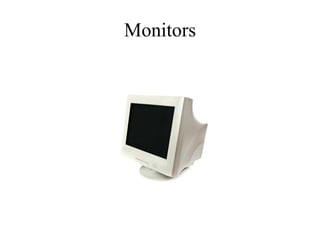
• Cathode-Ray Tube (CRT) Monitor
• The CRT display is made up of small picture elements called pixels. The smaller
the pixels, the better the image clarity, or resolution. It takes more than one
illuminated pixel to form whole character, such as the letter ‘e’ in the word help.
• A finite number of characters can be displayed on a screen at once. The screen can
be divided into a series of character boxes - fixed location on the screen where a
standard character can be placed. Most screens are capable of displaying 80
characters of data horizontally and 25 lines vertically. There are some
disadvantages of CRT:
• Large in Size
• High power consumption
Monitors
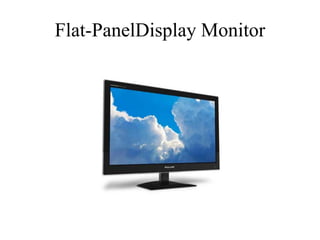
Flat-PanelDisplay Monitor
• The flat-panel display refers to a class of video devices that have reduced
volume, weight and power requirement in comparison to the CRT. You can
hang them on walls or wear them on your wrists. Current uses of flat-panel
displays include calculators, video games, monitors, laptop computer, graphics
display.
• The flat-panel display is divided into two categories:
• Emissive Displays - The emissive displays are devices that convert electrical
energy into light. Example are plasma panel and LED(Light-Emitting Diodes).
• Non-Emissive Displays - The Non-emissive displays use optical effects to
convert sunlight or light from some other source into graphics patterns.
Example is LCD(Liquid-Crystal Device)
Flat-PanelDisplay Monitor
Printers
• Printer is an output device, which is used to print information on paper.
• There are two types of printers:
• Impact Printers
• Non-Impact Printers
• Impact Printers
• The impact printers print the characters by striking them on the ribbon which is
then pressed on the paper.
• Characteristics of Impact Printers are the following:
• Very low consumable costs
• Very noisy
• Useful for bulk printing due to low cost
• There is physical contact with the paper to produce an image
• These printers are of two types
• Character printers
• Line printers
Printers
• Character Printers
• Character printers are the printers which print one character at a time.
• These are further divided into two types:
• Dot Matrix Printer(DMP)
• Daisy Wheel
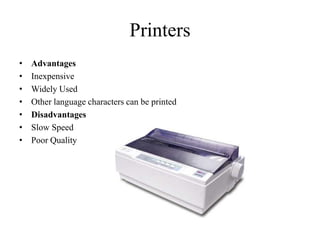
• DOT MATRIX PRINTER
• In the market one of the most popular printers is Dot Matrix Printer. These printers
are popular because of their ease of printing and economical price. Each character
printed is in form of pattern of dots and head consists of a Matrix of Pins of size
(5*7, 7*9, 9*7 or 9*9) which come out to form a character that is why it is called
Dot Matrix Printer.
Printers
• Advantages
• Inexpensive
• Widely Used
• Other language characters can be printed
• Disadvantages
• Slow Speed
• Poor Quality
Printers
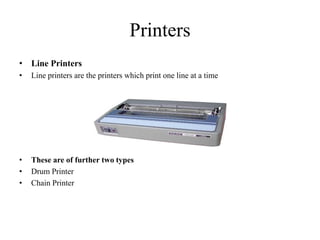
• Line Printers
• Line printers are the printers which print one line at a time
• These are of further two types
• Drum Printer
• Chain Printer
Printers
• DRUM PRINTER
• This printer is like a drum in shape so it is called drum printer. The surface
of drum is divided into number of tracks. Total tracks are equal to size of
paper i.e. for a paper width of 132 characters, drum will have 132 tracks. A
character set is embossed on track. The different character sets available in
the market are 48 character set, 64 and 96 characters set. One rotation of
drum prints one line. Drum printers are fast in speed and can print 300 to
2000 lines per minute.
• Advantages
• Very high speed
• Disadvantages
• Very expensive
• Characters fonts cannot be changed
• CHAIN PRINTER
• In this printer, chain of character sets are used so it is called Chain Printer.
A standard character set may have 48, 64, or 96 characters.
Printers
• Advantages
• Character fonts can easily be changed.
• Different languages can be used with the same printer.
• Disadvantages
• Noisy
Printers
• Non-impact Printers
• Non-impact printers print the characters without using ribbon. These printers print a
complete page at a time so they are also called as Page Printers.
• These printers are of two types
• Laser Printers
• Inkjet Printers
• Characteristics of Non-impact Printers
• Faster than impact printers.
• They are not noisy.
• High quality.
• Support many fonts and different character size.
Printers
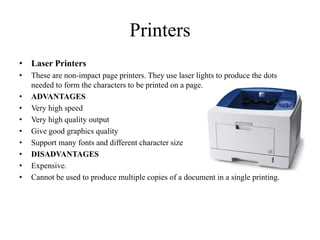
• Laser Printers
• These are non-impact page printers. They use laser lights to produce the dots
needed to form the characters to be printed on a page.
• ADVANTAGES
• Very high speed
• Very high quality output
• Give good graphics quality
• Support many fonts and different character size
• DISADVANTAGES
• Expensive.
• Cannot be used to produce multiple copies of a document in a single printing.
Printers
• Inkjet Printers
• Inkjet printers are non-impact character printers based on a relatively new
technology. They print characters by spraying small drops of ink onto paper. Inkjet
printers produce high quality output with presentable features.
• They make less noise because no hammering is done and these have many styles of
printing modes available. Colour printing is also possible. Some models of Inkjet
printers can produce multiple copies of printing also.
• ADVANTAGES
• High quality printing
• More reliable
• DISADVANTAGES
• Expensive as cost per page is high
• Slow as compared to laser printer

Computer Output Devices

  • 1.
  • 2.
    Computer - OutputDevices • Following are few of the important output devices which are used in a computer. • Monitors • Graphic Plotter • Printer
  • 3.
    Monitors • Monitors, commonlycalled as Visual Display Unit (VDU), are the main output device of a computer. It forms images from tiny dots, called pixels that are arranged in a rectangular form. The sharpness of the image depends upon the number of pixels. • There are two kinds of viewing screen used for monitors. • Cathode-Ray Tube (CRT) • Flat- Panel Display • Cathode-Ray Tube (CRT) Monitor • The CRT display is made up of small picture elements called pixels. The smaller the pixels, the better the image clarity, or resolution. It takes more than one illuminated pixel to form whole character, such as the letter ‘e’ in the word help. • A finite number of characters can be displayed on a screen at once. The screen can be divided into a series of character boxes - fixed location on the screen where a standard character can be placed. Most screens are capable of displaying 80 characters of data horizontally and 25 lines vertically. There are some disadvantages of CRT: • Large in Size • High power consumption
  • 4.
  • 5.
    Flat-PanelDisplay Monitor • Theflat-panel display refers to a class of video devices that have reduced volume, weight and power requirement in comparison to the CRT. You can hang them on walls or wear them on your wrists. Current uses of flat-panel displays include calculators, video games, monitors, laptop computer, graphics display. • The flat-panel display is divided into two categories: • Emissive Displays - The emissive displays are devices that convert electrical energy into light. Example are plasma panel and LED(Light-Emitting Diodes). • Non-Emissive Displays - The Non-emissive displays use optical effects to convert sunlight or light from some other source into graphics patterns. Example is LCD(Liquid-Crystal Device)
  • 6.
  • 7.
    Printers • Printer isan output device, which is used to print information on paper. • There are two types of printers: • Impact Printers • Non-Impact Printers • Impact Printers • The impact printers print the characters by striking them on the ribbon which is then pressed on the paper. • Characteristics of Impact Printers are the following: • Very low consumable costs • Very noisy • Useful for bulk printing due to low cost • There is physical contact with the paper to produce an image • These printers are of two types • Character printers • Line printers
  • 8.
    Printers • Character Printers •Character printers are the printers which print one character at a time. • These are further divided into two types: • Dot Matrix Printer(DMP) • Daisy Wheel • DOT MATRIX PRINTER • In the market one of the most popular printers is Dot Matrix Printer. These printers are popular because of their ease of printing and economical price. Each character printed is in form of pattern of dots and head consists of a Matrix of Pins of size (5*7, 7*9, 9*7 or 9*9) which come out to form a character that is why it is called Dot Matrix Printer.
  • 9.
    Printers • Advantages • Inexpensive •Widely Used • Other language characters can be printed • Disadvantages • Slow Speed • Poor Quality
  • 10.
    Printers • Line Printers •Line printers are the printers which print one line at a time • These are of further two types • Drum Printer • Chain Printer
  • 11.
    Printers • DRUM PRINTER •This printer is like a drum in shape so it is called drum printer. The surface of drum is divided into number of tracks. Total tracks are equal to size of paper i.e. for a paper width of 132 characters, drum will have 132 tracks. A character set is embossed on track. The different character sets available in the market are 48 character set, 64 and 96 characters set. One rotation of drum prints one line. Drum printers are fast in speed and can print 300 to 2000 lines per minute. • Advantages • Very high speed • Disadvantages • Very expensive • Characters fonts cannot be changed • CHAIN PRINTER • In this printer, chain of character sets are used so it is called Chain Printer. A standard character set may have 48, 64, or 96 characters.
  • 12.
    Printers • Advantages • Characterfonts can easily be changed. • Different languages can be used with the same printer. • Disadvantages • Noisy
  • 13.
    Printers • Non-impact Printers •Non-impact printers print the characters without using ribbon. These printers print a complete page at a time so they are also called as Page Printers. • These printers are of two types • Laser Printers • Inkjet Printers • Characteristics of Non-impact Printers • Faster than impact printers. • They are not noisy. • High quality. • Support many fonts and different character size.
  • 14.
    Printers • Laser Printers •These are non-impact page printers. They use laser lights to produce the dots needed to form the characters to be printed on a page. • ADVANTAGES • Very high speed • Very high quality output • Give good graphics quality • Support many fonts and different character size • DISADVANTAGES • Expensive. • Cannot be used to produce multiple copies of a document in a single printing.
  • 15.
    Printers • Inkjet Printers •Inkjet printers are non-impact character printers based on a relatively new technology. They print characters by spraying small drops of ink onto paper. Inkjet printers produce high quality output with presentable features. • They make less noise because no hammering is done and these have many styles of printing modes available. Colour printing is also possible. Some models of Inkjet printers can produce multiple copies of printing also. • ADVANTAGES • High quality printing • More reliable • DISADVANTAGES • Expensive as cost per page is high • Slow as compared to laser printer