DAILY LESSON LOG
School Learning Area MATH 7
Teacher Quarter THIRD
Teaching Dates Week 5
Teaching Time Grade and Section 7
I. OBJECTIVES
A. Content Standards The learner demonstrates understanding of key concepts of geometry of shapes and sizes, and geometric relationships
B. Performance Standards The learner is able to create models of plane figures and formulate and solve accurately authentic problems involving sides and
angles of a polygon
C. Most Essential Learning
Competencies
illustrates polygons: (a) convexity; (b) angles; and (c)sides. M7GEIIIe-2
II. CONTENT Polygons
III. LEARNING RESOURCES
A. References
1. Teacher's Guide pages pp 305-306 (MELCs)
2. Learner's Materials pages Learning Activity Sheet Grade 7 Math Quarter 3 Week 5
3. Textbook pages
4. Additional Materials from
Learning Resource (LR)
portal
B. Other Learning Resources
A. PROCEDURES
A. Reviewing previous lesson or
presenting the new lesson
Ask the learners to write what they have learned about the uses of a compass and straightedge in bisecting line segments and
angles. Also, ask the learners how to construct perpendicular lines and parallel lines.
B. Establishing a purpose for the
lesson
Ask learners where they think they can use the polygons in real life situations.
C. Presenting examples/ instances
of new lesson
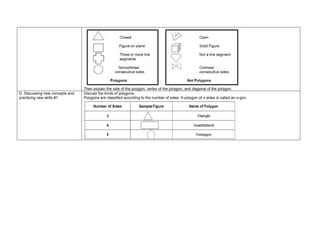
Present figures that will show what are polygons from not polygons.
Then explain the side of the polygon, vertex of the polygon, and diagonal of the polygon.
D. Discussing new concepts and
practicing new skills #1
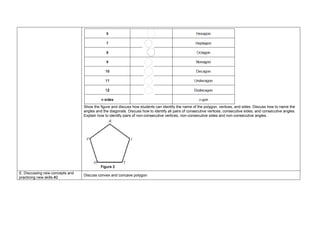
Discuss the kinds of polygons.
Polygons are classified according to the number of sides. A polygon of n sides is called an n-gon.
Show the figure and discuss how students can identify the name of the polygon, vertices, and sides. Discuss how to name the
angles and the diagonals. Discuss how to identify all pairs of consecutive vertices, consecutive sides, and consecutive angles.
Explain how to identify pairs of non-consecutive vertices, non-consecutive sides and non-consecutive angles.
E. Discussing new concepts and
practicing new skills #2
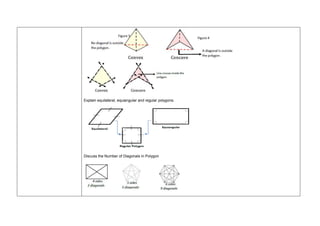
Discuss convex and concave polygon
Explain equilateral, equiangular and regular polygons.
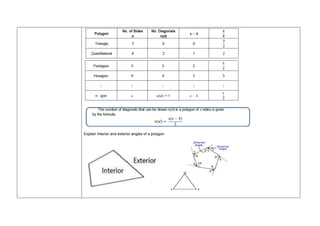
Discuss the Number of Diagonals in Polygon
Explain Interior and exterior angles of a polygon
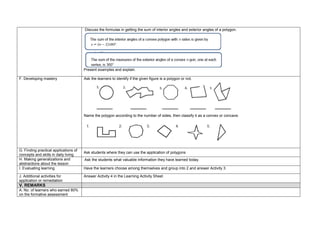
Discuss the formulas in getting the sum of interior angles and exterior angles of a polygon.
Present examples and explain.
F. Developing mastery Ask the learners to identify if the given figure is a polygon or not.
Name the polygon according to the number of sides, then classify it as a convex or concave.
G. Finding practical applications of
concepts and skills in daily living
Ask students where they can use the application of polygons
H. Making generalizations and
abstractions about the lesson
Ask the students what valuable information they have learned today.
I. Evaluating learning Have the learners choose among themselves and group into 2 and answer Activity 3
J. Additional activities for
application or remediation
Answer Activity 4 in the Learning Activity Sheet
V. REMARKS
A. No. of learners who earned 80%
on the formative assessment
B. No. of learners who require
additional activities for remediation
C. Did the remedial lessons work?
No. of learners who have caught up
with the lesson
D. No. of learners who continue to
require remediation
E. Which of my teaching strategies
worked well? Why did these works?
F. What difficulties did I encounter
which my principal or supervisor
can help me solve?
G. What innovation or localized
materials did I use/ discover which I
wish to share with other teacher?
Prepared by: Checked by:
Teacher I School Head

MATH-7-Q3-WEEK-5 4th quarter.doc

  • 1.
    DAILY LESSON LOG SchoolLearning Area MATH 7 Teacher Quarter THIRD Teaching Dates Week 5 Teaching Time Grade and Section 7 I. OBJECTIVES A. Content Standards The learner demonstrates understanding of key concepts of geometry of shapes and sizes, and geometric relationships B. Performance Standards The learner is able to create models of plane figures and formulate and solve accurately authentic problems involving sides and angles of a polygon C. Most Essential Learning Competencies illustrates polygons: (a) convexity; (b) angles; and (c)sides. M7GEIIIe-2 II. CONTENT Polygons III. LEARNING RESOURCES A. References 1. Teacher's Guide pages pp 305-306 (MELCs) 2. Learner's Materials pages Learning Activity Sheet Grade 7 Math Quarter 3 Week 5 3. Textbook pages 4. Additional Materials from Learning Resource (LR) portal B. Other Learning Resources A. PROCEDURES A. Reviewing previous lesson or presenting the new lesson Ask the learners to write what they have learned about the uses of a compass and straightedge in bisecting line segments and angles. Also, ask the learners how to construct perpendicular lines and parallel lines. B. Establishing a purpose for the lesson Ask learners where they think they can use the polygons in real life situations. C. Presenting examples/ instances of new lesson Present figures that will show what are polygons from not polygons.
  • 2.
    Then explain theside of the polygon, vertex of the polygon, and diagonal of the polygon. D. Discussing new concepts and practicing new skills #1 Discuss the kinds of polygons. Polygons are classified according to the number of sides. A polygon of n sides is called an n-gon.
  • 3.
    Show the figureand discuss how students can identify the name of the polygon, vertices, and sides. Discuss how to name the angles and the diagonals. Discuss how to identify all pairs of consecutive vertices, consecutive sides, and consecutive angles. Explain how to identify pairs of non-consecutive vertices, non-consecutive sides and non-consecutive angles. E. Discussing new concepts and practicing new skills #2 Discuss convex and concave polygon
  • 4.
    Explain equilateral, equiangularand regular polygons. Discuss the Number of Diagonals in Polygon
  • 5.
    Explain Interior andexterior angles of a polygon
  • 6.
    Discuss the formulasin getting the sum of interior angles and exterior angles of a polygon. Present examples and explain. F. Developing mastery Ask the learners to identify if the given figure is a polygon or not. Name the polygon according to the number of sides, then classify it as a convex or concave. G. Finding practical applications of concepts and skills in daily living Ask students where they can use the application of polygons H. Making generalizations and abstractions about the lesson Ask the students what valuable information they have learned today. I. Evaluating learning Have the learners choose among themselves and group into 2 and answer Activity 3 J. Additional activities for application or remediation Answer Activity 4 in the Learning Activity Sheet V. REMARKS A. No. of learners who earned 80% on the formative assessment
  • 7.
    B. No. oflearners who require additional activities for remediation C. Did the remedial lessons work? No. of learners who have caught up with the lesson D. No. of learners who continue to require remediation E. Which of my teaching strategies worked well? Why did these works? F. What difficulties did I encounter which my principal or supervisor can help me solve? G. What innovation or localized materials did I use/ discover which I wish to share with other teacher? Prepared by: Checked by: Teacher I School Head