7E INQUIRY-BASED APPROACH LESSON STUDY
Topic / Title QUADRILATERALS
Grade Level VII
Time Allotment 1 hour
Teacher/s ELTON JOHN EMBODO
Learning Competencies and Objectives
COMPETENCY: Demonstrate understanding ofthe key concepts ofgeometry of shapes and sizes.
OBJECTIVES: 1. Define quadrilaterals;
2. Construct and define the different types of quadrilaterals;
3. Recognize the importance of quadrilaterals in construction ofdifferent establishment.
4. Make a conjecture about special kinds of quadrilaterals.
ELICIT (5 minutes) MATERIALS
KWL CHART
Fill in the first and second column below about what you know and what you want to know about
angles.
K-now W-ant to know L-earned
*
*
*
*
*
*
*
*
*
Key questions:
1. What you know about quadrilaterals?
2. What you want to know about quadrilaterals?
CHART
ENGAGE ( 10 minutes)
*The class will be divided into four groups.
*The teacher will provide each group materials needed such illustration board, pencil and ruler.
*Each group will do the activity by following the steps to be given.
Steps:
a. In illustration board, plot four non-collinear points and name them as point A, B, C, D
b. Using a ruler, connect the four non-collinear points consecutively.
Key Questions:
1. How many sides are there in the figure?
2. What do you think is the name of the figure being formed?
3. How would you define a quadrilateral?
Illustration board
Pencil
Rule
EXPLORE (10 minutes)
Hands on activity No.1
Before giving the next activity, the teacher will introduce first the terms parallelogram, rectangle,
rhombus, and trapezoid.
1. Play the game “Meeting the deadline”.
a. Divide the students into two groups.Give each group a box containing 20 sticks: four 10
cm, thirteen 6 cm, one 8 cm, 7 cm, and 12 cm in length.
b. using the 20 sticks, have each group construct quadrilaterals with the following properties:
 Quadrilateral with two pairs of parallel sides
 Quadrilateral with four right angles
 Quadrilateral with four congruent sides
 Quadrilateral with exactly one pair of parallel sides
sticks
illustration board
glue
EXPLAIN (5 minutes)
Key questions:
1. What are common to all quadrilaterals?
2. What are the different types of quadrilaterals?
3. Based on the constructed figures, how will you define each type of quadrilateral?
ELABORATE (10 minutes)
HANDS-ON ACTIVITY No.2
Material: sticks, protractor
1. using the same sticks, ask the students to construct a rhombus with congruent angles. Tell the
students that the resulting figure is a special kind of rhombus.
GUIDE QUESTIONS:
1. What do you call that special kind of rhombus?
2. Based on the illustration, define a square in your own words.
Illustration board
Sticks
Glue
EXTEND (15 minutes)s
QUADRILATERALS AROUND US
Students will be working in the same group in the previous activities. Provided the materials needed,
students will construct their own desired structures such as houses,schools and churches applying the
idea of quadrilaterals around the world. The students output will be graded using a constructed
rubrics.
Sticks
Cartons
Glue
Scissors
EVALUATE ( 5 minutes)
KWL CHART
Fill in the third column indicating what you have learned from the lesson about angles.
K-now W-ant to know L-earned
*
*
*
*
*
*
*
*
*
CHART
Assignment (optional)
1. Measure the consecutive and opposite angles of each special of quadrilateral.
References
1. G7 Mathematics Learner’s Material and Teacher’s Guide
2. Next Century Mathematics: Geometry by Fernando B. Orines, et al.
Prepared by:
1. Elton John B. Embodo
2.

Lesson plan on quadrilateral using inquiry based method

  • 1.
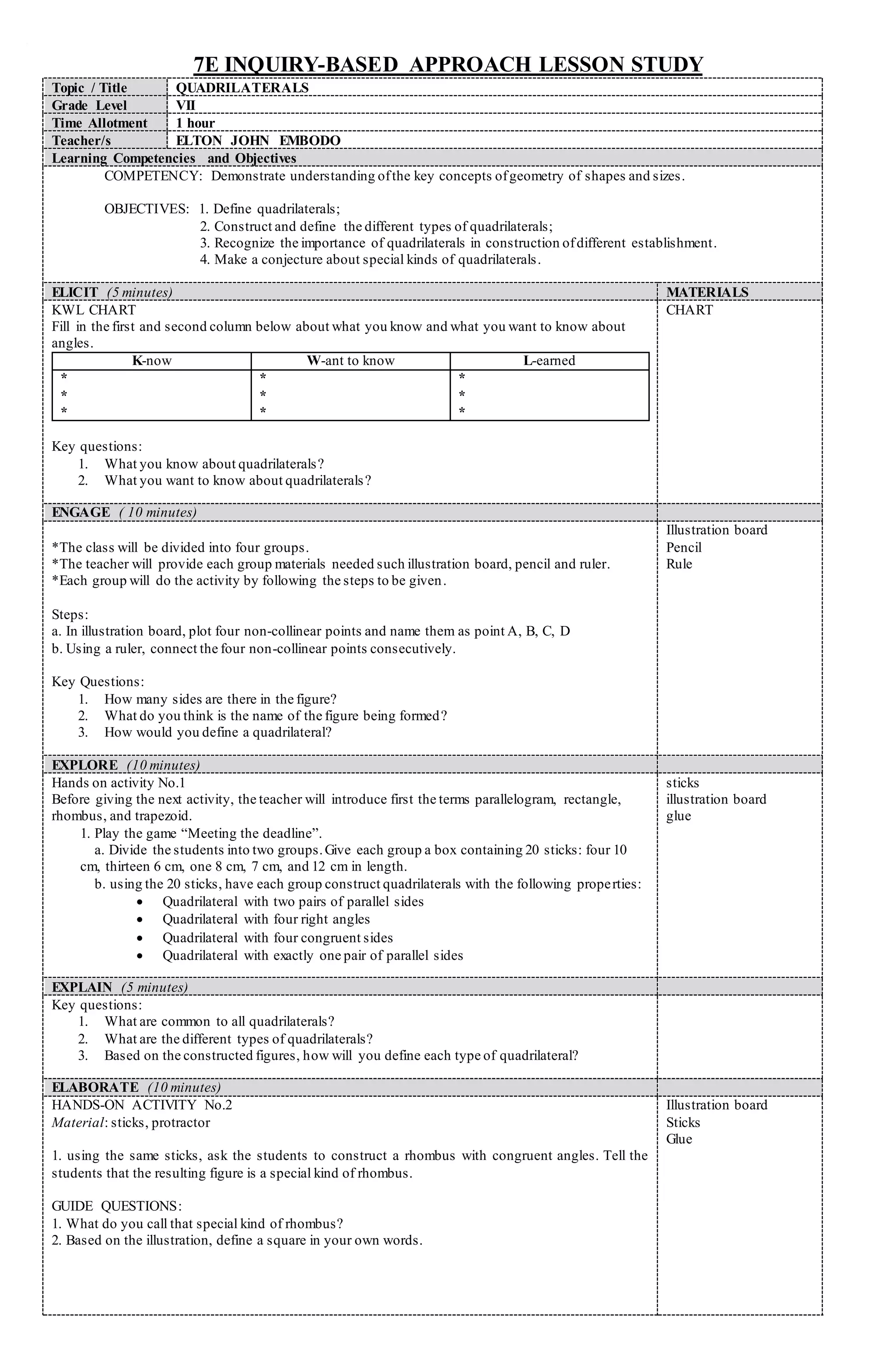
    7E INQUIRY-BASED APPROACHLESSON STUDY Topic / Title QUADRILATERALS Grade Level VII Time Allotment 1 hour Teacher/s ELTON JOHN EMBODO Learning Competencies and Objectives COMPETENCY: Demonstrate understanding ofthe key concepts ofgeometry of shapes and sizes. OBJECTIVES: 1. Define quadrilaterals; 2. Construct and define the different types of quadrilaterals; 3. Recognize the importance of quadrilaterals in construction ofdifferent establishment. 4. Make a conjecture about special kinds of quadrilaterals. ELICIT (5 minutes) MATERIALS KWL CHART Fill in the first and second column below about what you know and what you want to know about angles. K-now W-ant to know L-earned * * * * * * * * * Key questions: 1. What you know about quadrilaterals? 2. What you want to know about quadrilaterals? CHART ENGAGE ( 10 minutes) *The class will be divided into four groups. *The teacher will provide each group materials needed such illustration board, pencil and ruler. *Each group will do the activity by following the steps to be given. Steps: a. In illustration board, plot four non-collinear points and name them as point A, B, C, D b. Using a ruler, connect the four non-collinear points consecutively. Key Questions: 1. How many sides are there in the figure? 2. What do you think is the name of the figure being formed? 3. How would you define a quadrilateral? Illustration board Pencil Rule EXPLORE (10 minutes) Hands on activity No.1 Before giving the next activity, the teacher will introduce first the terms parallelogram, rectangle, rhombus, and trapezoid. 1. Play the game “Meeting the deadline”. a. Divide the students into two groups.Give each group a box containing 20 sticks: four 10 cm, thirteen 6 cm, one 8 cm, 7 cm, and 12 cm in length. b. using the 20 sticks, have each group construct quadrilaterals with the following properties:  Quadrilateral with two pairs of parallel sides  Quadrilateral with four right angles  Quadrilateral with four congruent sides  Quadrilateral with exactly one pair of parallel sides sticks illustration board glue EXPLAIN (5 minutes) Key questions: 1. What are common to all quadrilaterals? 2. What are the different types of quadrilaterals? 3. Based on the constructed figures, how will you define each type of quadrilateral? ELABORATE (10 minutes) HANDS-ON ACTIVITY No.2 Material: sticks, protractor 1. using the same sticks, ask the students to construct a rhombus with congruent angles. Tell the students that the resulting figure is a special kind of rhombus. GUIDE QUESTIONS: 1. What do you call that special kind of rhombus? 2. Based on the illustration, define a square in your own words. Illustration board Sticks Glue
  • 2.
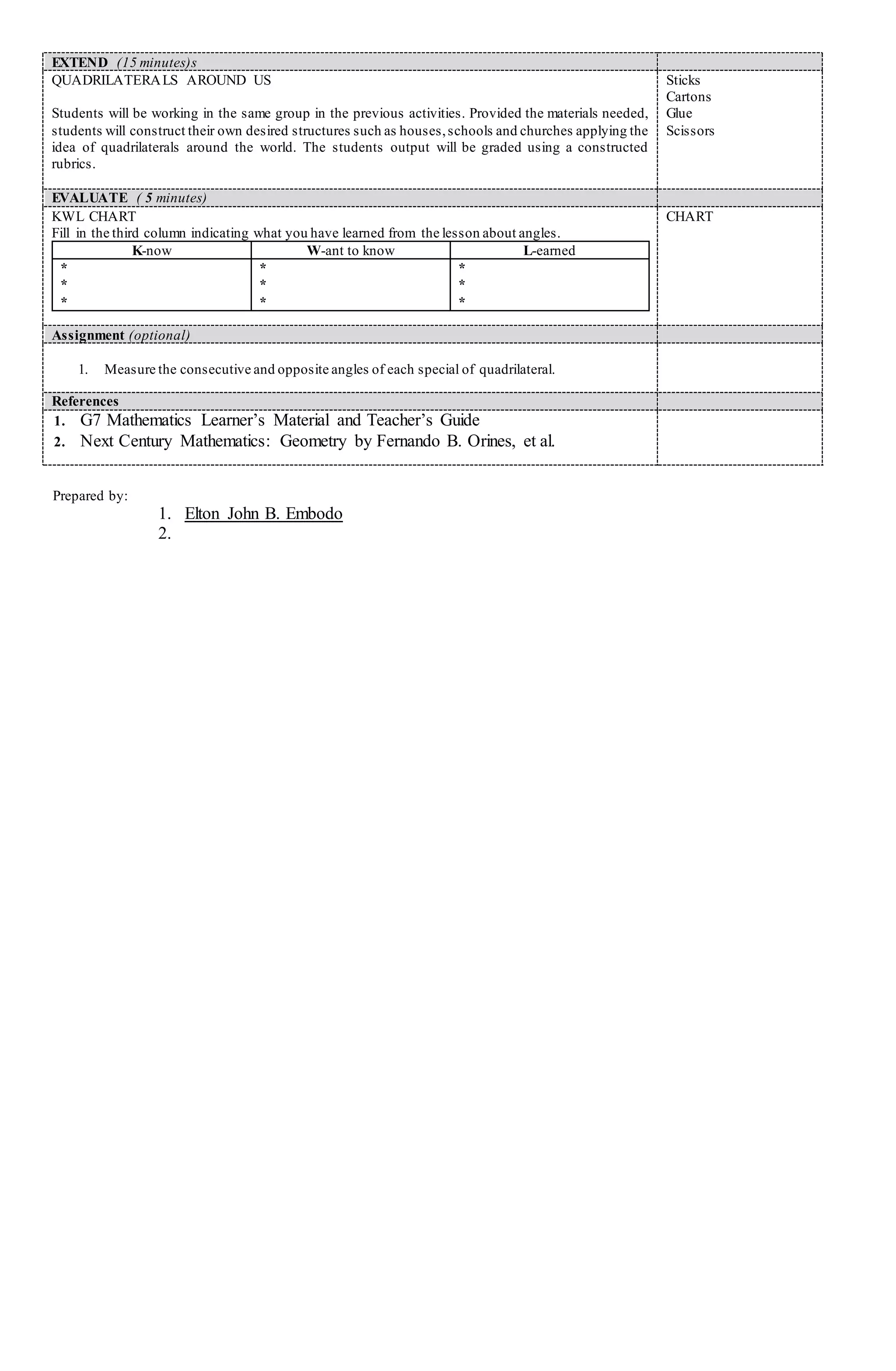
    EXTEND (15 minutes)s QUADRILATERALSAROUND US Students will be working in the same group in the previous activities. Provided the materials needed, students will construct their own desired structures such as houses,schools and churches applying the idea of quadrilaterals around the world. The students output will be graded using a constructed rubrics. Sticks Cartons Glue Scissors EVALUATE ( 5 minutes) KWL CHART Fill in the third column indicating what you have learned from the lesson about angles. K-now W-ant to know L-earned * * * * * * * * * CHART Assignment (optional) 1. Measure the consecutive and opposite angles of each special of quadrilateral. References 1. G7 Mathematics Learner’s Material and Teacher’s Guide 2. Next Century Mathematics: Geometry by Fernando B. Orines, et al. Prepared by: 1. Elton John B. Embodo 2.