Instructional Design ROBERT GAGNE Presented by Dawn Jeffries, Liberty Joy and Ann Yates
1916 to 2002, American Doctorate-level psychologist, professor, learning theorist/researcher, and author  Focused on the “…practical application of learning theory to real world skills” in order to provide instruction for specific tasks and outcomes (Dick, 2003, p. 77) (Dick, 2003; Robert Mills , 2006) The Man Behind the Theory
(Robert Mills, 2006)
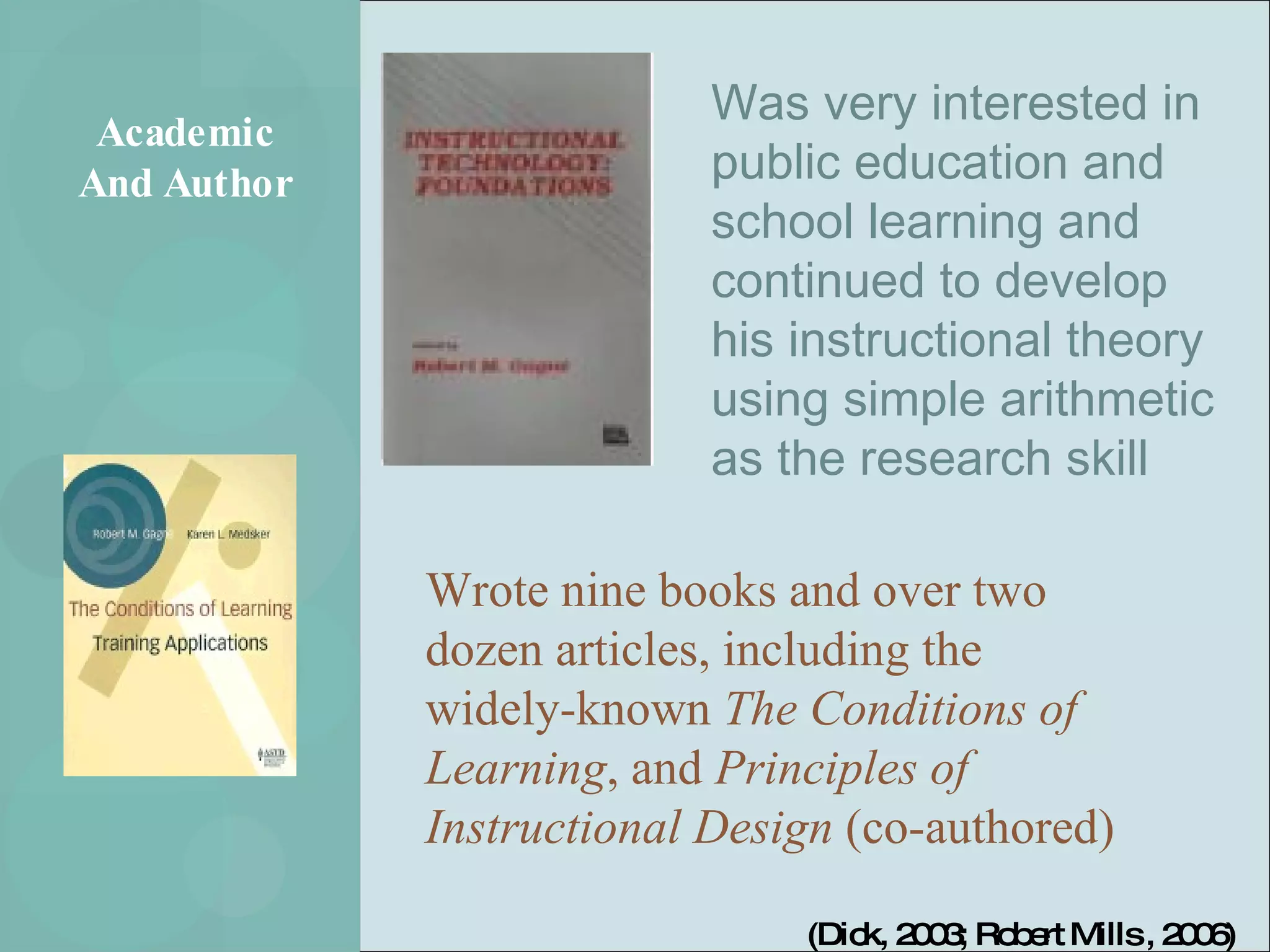
Academic And Author Was very interested in public education and school learning and continued to develop his instructional theory using simple arithmetic as the research skill Wrote nine books and over two dozen articles, including the widely-known  The Conditions of Learning , and  Principles of Instructional Design  (co-authored)  (Dick, 2003; Robert Mills , 2006)
Instructional Learning:  The Concept  and Definition Behind Gagne’s Theory The concept: 1. A task analysis is done for the specific skill to be learned; this analysis details each component of the skill 2. The components can then be assembled to create a plan for instruction, which Gagne called a “learning hierarchy” 3. Therefore, a teacher creating an instructional plan would identify the skill to be learned as a specific behavior, then ask and answer the question "What would you have to know how to do in order to perform this task, after being given only a set of instructions"    A definition  An instructional theory which seeks to describe the conditions under which one can intentionally arrange for the learning of specific performance outcomes (Driscoll, 2000)   (Driscoll, 2000; Theory into Practice, 1994-2009)
Gagne’s Theory of Instruction is made up of  three  components A Taxonomy of  Learning Outcomes Conditions of Learning Nine Events of  Instruction Gaining attention Informing learners of  objectives Stimulating recall of prior learning Presenting the stimulus Providing learning guidance Eliciting performance Providing feedback Assessing performance Enhancing retention and transfer Cognitive Domain: Cognitive strategies, Intellectual skills, Verbal information Affective Domain: Attitudes Psychomotor Domain : Motor Skills (Driscoll, 2000)
Taxonomy of Learning (“Gagne’s five learned,” n.d.) Five major categories of learning outcomes
Cognitive Domain Cognitive strategies:  opportunities allowing practice for problem solving  Demonstrate or describe the strategy Allow for a variety of situations to practice Impart informative feedback toward originality or creativity of the strategy or outcome (Driscoll, 1991)
Cognitive Domain continued Intellectual skills:  identified in sequence of hierarchy allowing prerequisites to be completed enhancing learning at each level: Direct attention of learner to distinctive features (Recognize stimulus) Reside within working memory limits (present new skills in increments) Inspire recall of skills learned previously  Provide verbal cues for organizing component skill combinations Provide for spaced review and practices Allow for a variety of milieu to promote transfer  (Driscoll, 1991)
Cognitive Domain Continued Verbal Information:  an example may consist of building a large vocabulary Promote attention to distinctive features by variations in speech or print Provide information to be presented in chunks Provide a context full of meaning for effective information encoding Provide effective recall cues and information generalization (Driscoll, 1991)
Affective Domain Attitudes:  the learner is exposed to persuasive arguments or reliable role models Establish success expectancy associated with attitude desired Promote student identification with a human model one admires Arrange for demonstration or communication of choice for personal action Provide feedback of successful performance; or allow surveillance of feedback of the human model (Driscoll, 1991)
Psychomotor Domain  Motor skills: executing performances Provide verbal or added guidance to cue the exclusive subroutine Allow for repeated practices Provide feedback immediately regarding performance accuracy Encourage the use of practicing mentally (imagining their presentation or performance) (Driscoll, 1991)
Conditions of Learning (Driscoll, 2000) Learning goals need to be categorized according to the type of outcome they represent (from the taxonomy). Careful consideration needs to be given to what end result is desired. Therefore, the conditions of learning go along with the type of outcome desired: Verbal information Intellectual skills Cognitive strategies Attitudes Motor skills Described by Gagne as the building blocks for instruction
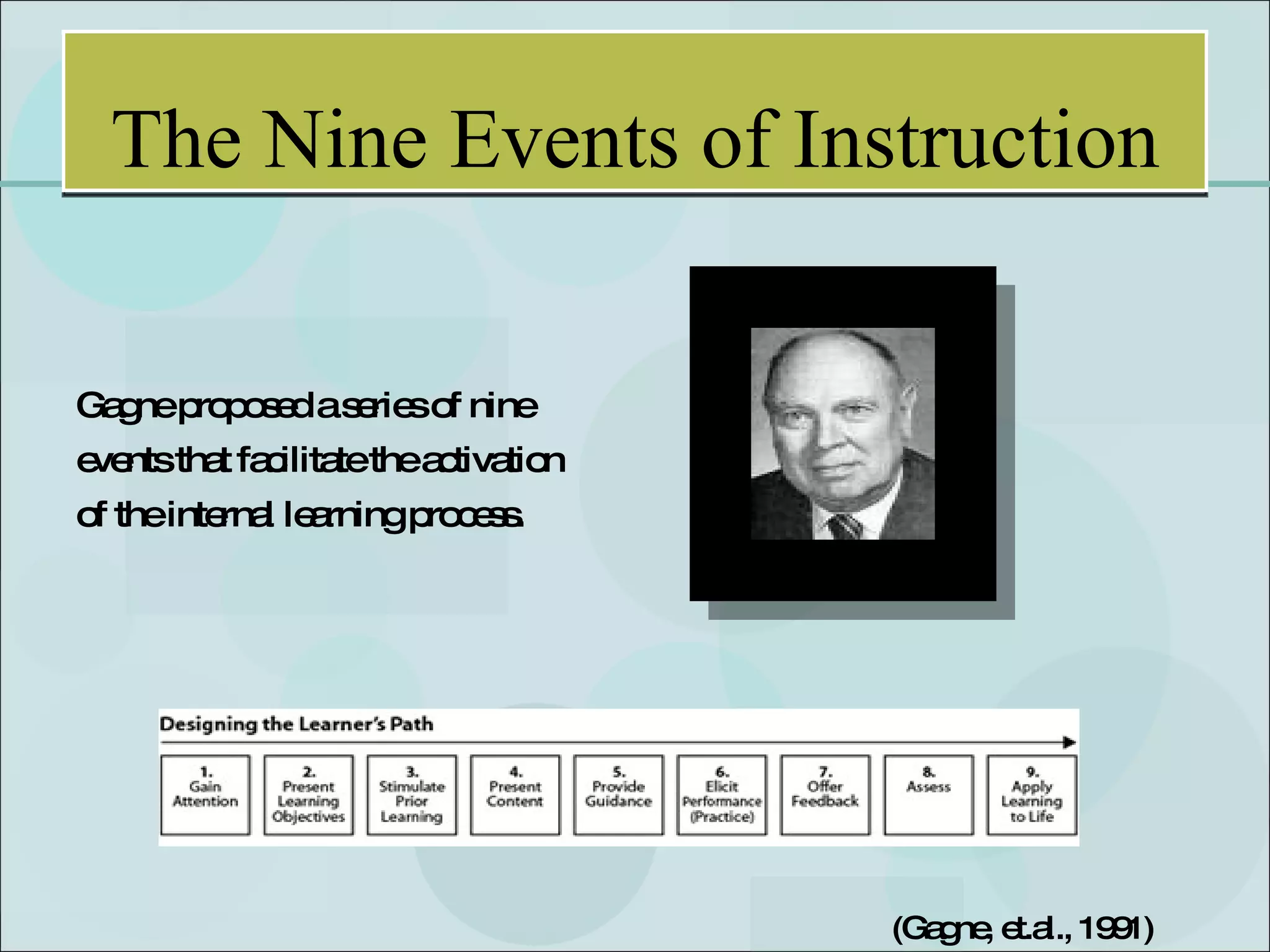
The Nine Events of Instruction Gagne proposed a series of nine  events that facilitate the activation  of the internal learning process. (Gagne, et.al., 1991)
ELEMENTARY GEOMETRY Square vs. Cube
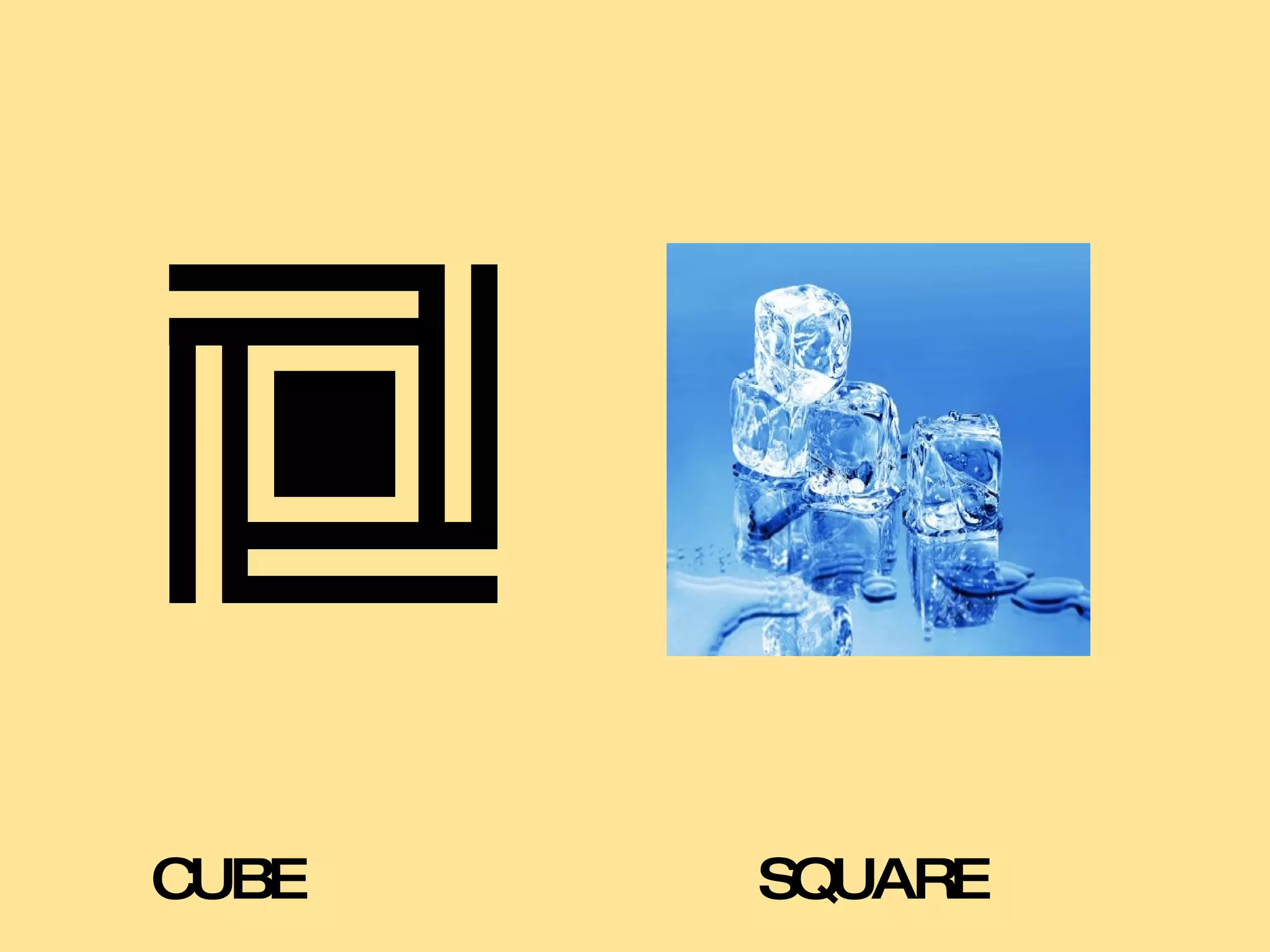
What is this? Square or Cube?
After this lesson you will be able to correctly identify and distinguish between a square and a cube Lesson Objective
Fourth Grade  Math
A  cube  is a three-dimensional figure having six matching square sides squares (Retrieved January 27, 2009 from  http://www.associatedcontent.com ) (http://www.gifandgif.eu/animated_gif/Geometric_Figures/index.php ) CUBE
A square is part of a cube.  It is a one-dimensional polygon with four equal sides and four equal ninety degree angles (Retrieved January 27, 2009 from  http://www.mathopenref.com ) SQUARE
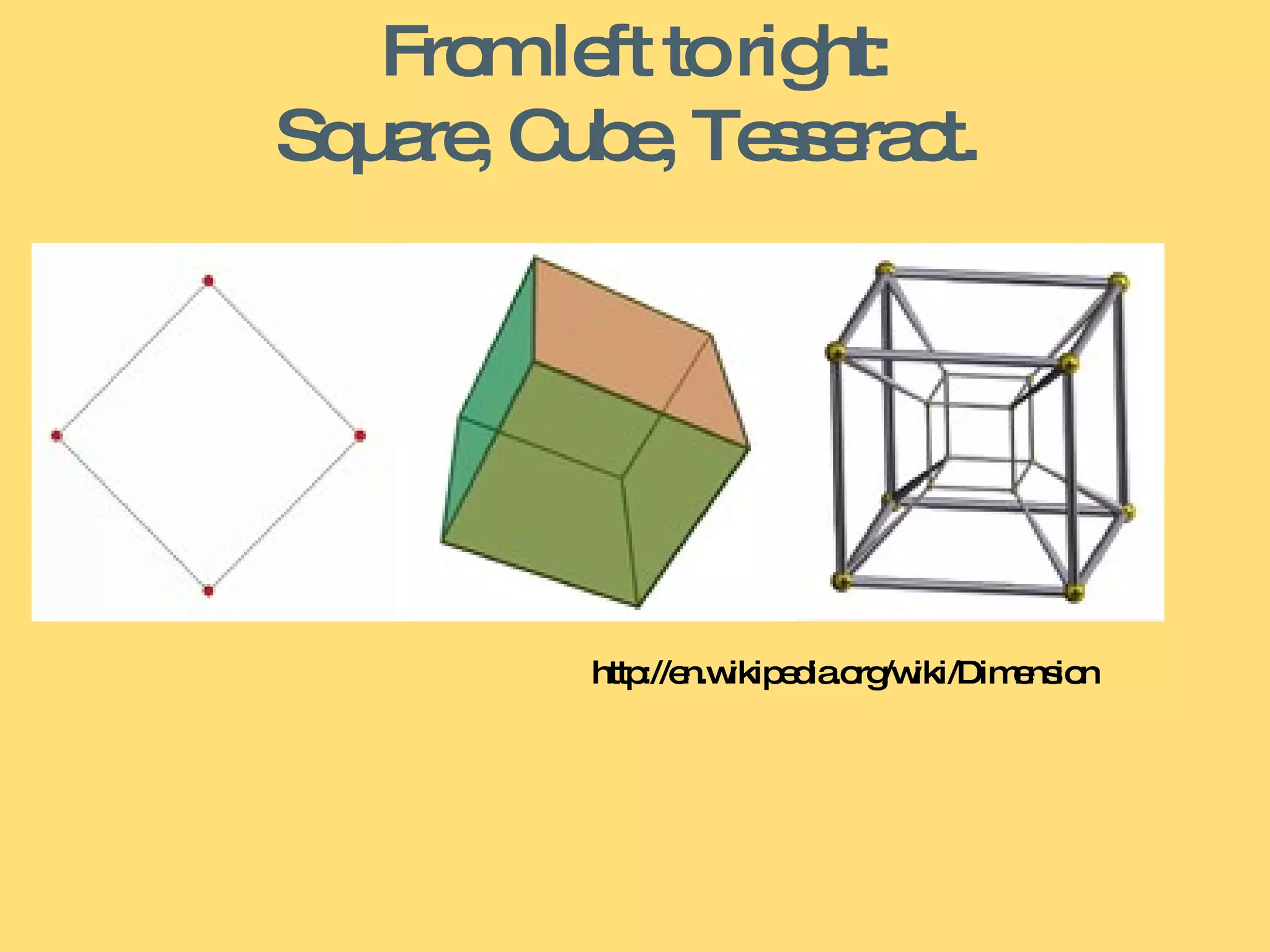
From left to right: Square, Cube, Tesseract.  http://en.wikipedia.org/wiki/Dimension
How to draw the shapes http://en.wikipedia.org/wiki/Dimension
Check your knowledge A. Square B. Cube
A. Square B. Cube
CUBE   SQUARE
Gagne’s Nine Steps for Instructional Design
STEP 1  Gain Attention  To ensure the learners are ready to learn and participate in activities, it's critical to present a stimulus to gain their attention Arouse learner with novelty Pose questions to learner In e-learning it is vital to engage students and ensure their attention is captured.
STEP 3  Recall Prior Knowledge Remembering fourth grade geometry Bringing long-term memory knowledge to forefront to encourage present short-term memory In e-learning existing knowledge must be acknowledged and incorporated into the new learning situation.
STEP 2  Inform Learner of Objective  In order to motivate the learners to participate actively in the lesson, it is important to relate instructional goals to the learner.  Explain purpose Present goals Encourage learner to set individual goals In e-learning objectives must be clear and upfront. Visible agenda.
STEP 4 Presents information about the new stimulus  Defines square  Defines cube Defines difference between square and cube E-learning and the internet give students easy and wide access to more information as needed about the stimulus or about skills related to the stimulus
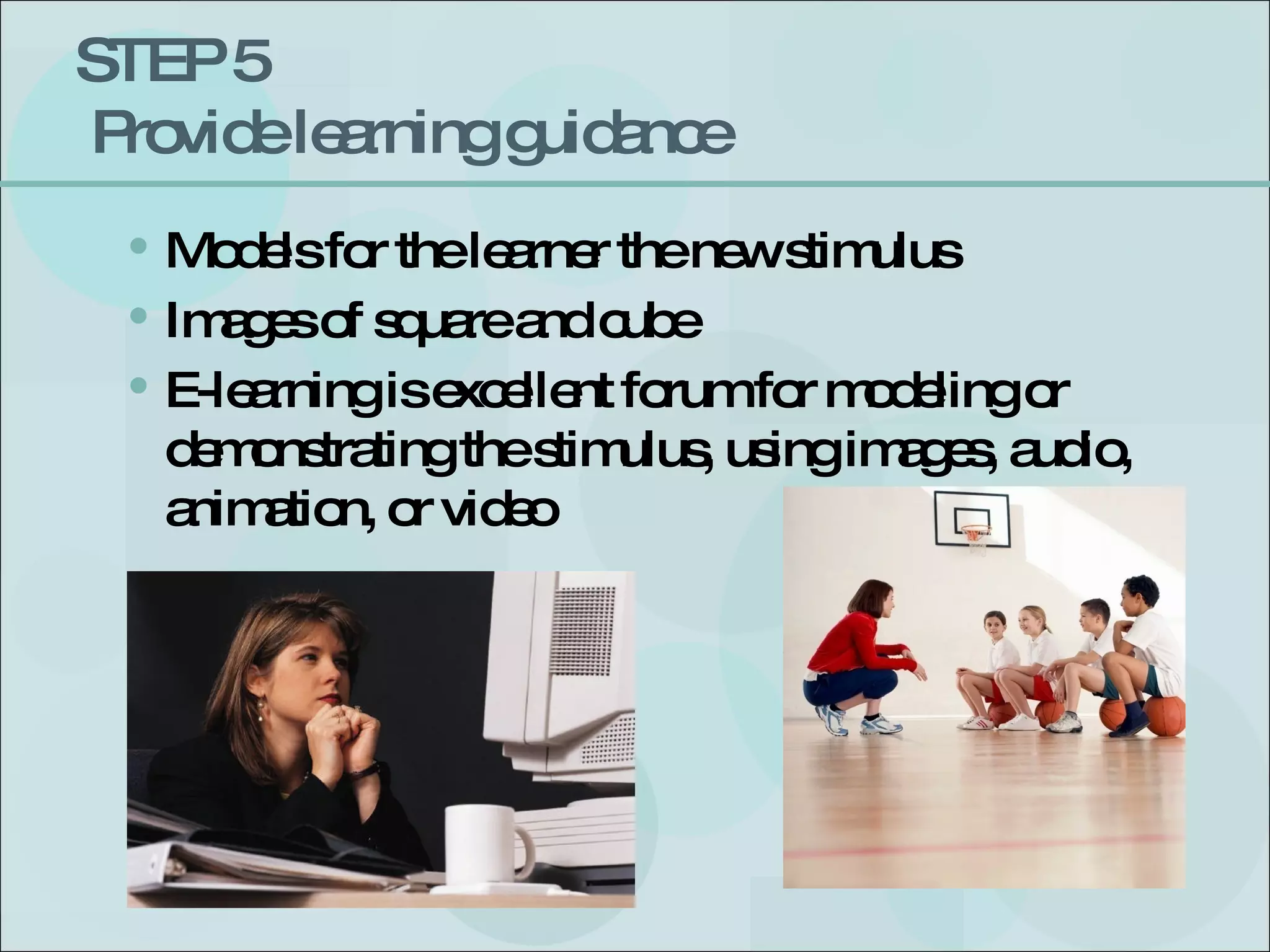
STEP 5  Provide learning guidance Models for the learner the new stimulus Images of square and cube E-learning is excellent forum for modeling or demonstrating the stimulus, using images, audio, animation, or video
STEP 6  Elicit performance Students are asked to choose between a cube and a square Given three opportunities to show what they have learned E-learning tools allow for creative testing and lots of practice. Assessment is important.
STEP 7  Provide Feedback Assessing and reinforcing the correct performance  In e-learning providing feedback is at times a challenge, but remains a critical….. Need info Well done!!
STEP 8  Assess Performance  Retrieval of the content and reinforcement as a final evaluation  In e-learning…..need info
STEP 9  Enhancing retention and transfer Retrieval and simplification of the learned skill  In e-learning …. Need info
Gagné's ID is based on different types of learning outcome needing different learning activities and therefore different instructional conditions.  Developing instruction involves analyzing requirements, selecting media and designing the instructional events (Killpatrick, L., 2001 ). Concluding Thoughts
References Critchlow, R. (n.d.)  Robert Gagne’s nine events of instruction.  Retrieved January 27, 2009, from hungary.usembassy.gov /uploads/images/94KMTTRtqw2d0Ii-AmOyeA/ gagnes_nine_events_of_instruction.ppt  Dick, W. (2003).  The legacy of Robert Gagne . Educational Technology, Research and Development , 51 (2), 77. Driscoll, M. (1991).  Psychology of learning for instruction.  Retrieved January 28, 2009 from  http://my-ecoach.com/idtimeline/theory/gagne.html Driscoll, M. (2000).  Psychology of learning for instruction.  New York: Allyn & Bacon. Gagne, R. M. (1965).  The conditions of learning.  New York: Holt, Rinehart & Winston. Gagne, R. M., (1985).  The conditions of learning and theory of instruction.  Retrieved January 28, 2009 from  http://www.csulb.edu/~dkumrow/conference/learning_theory.html Gagne. R. M., Briggs L. J., & Wager W. W. (1992).  Principles of instructional design.  New York: Holt, Rinehart & Winston. Gagne’s five learned capabilities.  (n.d.) Retrieved January 22, 2009 from http://classweb.gmu.edu/ndabbagh/Resources/Resources2/gagnetax.htm Killpatrick, L. (2001). Gagne's nine events of instruction.  Encyclopedia of Educational Technology.  Retrieved January 30, 2009, from http://coe.sdsu.edu/eet/ Articles/gagnesevents/index.htm Kruse, K. (n.d.)  Gagne’s nine events of instruction: an introduction.  Retrieved January 21, 2009 from http://www.e-learningguru.com /articles/art3_3.htm Robert Mills Gagne Biography (2006).  Retrieved January 27, 2009, from  http://www.bookrags.com/biography/robert-mills-gagne/ Theory Into Practice database (1994-2009). Conditions of learning (R. Gagne). Retrieved January 27, 2009 from  http://tip.psychology.org/gagne-html .
Now it’s your turn: Draw a plane on the whiteboard. Draw a solid shape on the whiteboard.

Robertgagne Ppt

  • 1.
    Instructional Design ROBERTGAGNE Presented by Dawn Jeffries, Liberty Joy and Ann Yates
  • 2.
    1916 to 2002,American Doctorate-level psychologist, professor, learning theorist/researcher, and author Focused on the “…practical application of learning theory to real world skills” in order to provide instruction for specific tasks and outcomes (Dick, 2003, p. 77) (Dick, 2003; Robert Mills , 2006) The Man Behind the Theory
  • 3.
  • 4.
    Academic And AuthorWas very interested in public education and school learning and continued to develop his instructional theory using simple arithmetic as the research skill Wrote nine books and over two dozen articles, including the widely-known The Conditions of Learning , and Principles of Instructional Design (co-authored) (Dick, 2003; Robert Mills , 2006)
  • 5.
    Instructional Learning: The Concept and Definition Behind Gagne’s Theory The concept: 1. A task analysis is done for the specific skill to be learned; this analysis details each component of the skill 2. The components can then be assembled to create a plan for instruction, which Gagne called a “learning hierarchy” 3. Therefore, a teacher creating an instructional plan would identify the skill to be learned as a specific behavior, then ask and answer the question "What would you have to know how to do in order to perform this task, after being given only a set of instructions"   A definition An instructional theory which seeks to describe the conditions under which one can intentionally arrange for the learning of specific performance outcomes (Driscoll, 2000)   (Driscoll, 2000; Theory into Practice, 1994-2009)
  • 6.
    Gagne’s Theory ofInstruction is made up of three components A Taxonomy of Learning Outcomes Conditions of Learning Nine Events of Instruction Gaining attention Informing learners of objectives Stimulating recall of prior learning Presenting the stimulus Providing learning guidance Eliciting performance Providing feedback Assessing performance Enhancing retention and transfer Cognitive Domain: Cognitive strategies, Intellectual skills, Verbal information Affective Domain: Attitudes Psychomotor Domain : Motor Skills (Driscoll, 2000)
  • 7.
    Taxonomy of Learning(“Gagne’s five learned,” n.d.) Five major categories of learning outcomes
  • 8.
    Cognitive Domain Cognitivestrategies: opportunities allowing practice for problem solving Demonstrate or describe the strategy Allow for a variety of situations to practice Impart informative feedback toward originality or creativity of the strategy or outcome (Driscoll, 1991)
  • 9.
    Cognitive Domain continuedIntellectual skills: identified in sequence of hierarchy allowing prerequisites to be completed enhancing learning at each level: Direct attention of learner to distinctive features (Recognize stimulus) Reside within working memory limits (present new skills in increments) Inspire recall of skills learned previously Provide verbal cues for organizing component skill combinations Provide for spaced review and practices Allow for a variety of milieu to promote transfer (Driscoll, 1991)
  • 10.
    Cognitive Domain ContinuedVerbal Information: an example may consist of building a large vocabulary Promote attention to distinctive features by variations in speech or print Provide information to be presented in chunks Provide a context full of meaning for effective information encoding Provide effective recall cues and information generalization (Driscoll, 1991)
  • 11.
    Affective Domain Attitudes: the learner is exposed to persuasive arguments or reliable role models Establish success expectancy associated with attitude desired Promote student identification with a human model one admires Arrange for demonstration or communication of choice for personal action Provide feedback of successful performance; or allow surveillance of feedback of the human model (Driscoll, 1991)
  • 12.
    Psychomotor Domain Motor skills: executing performances Provide verbal or added guidance to cue the exclusive subroutine Allow for repeated practices Provide feedback immediately regarding performance accuracy Encourage the use of practicing mentally (imagining their presentation or performance) (Driscoll, 1991)
  • 13.
    Conditions of Learning(Driscoll, 2000) Learning goals need to be categorized according to the type of outcome they represent (from the taxonomy). Careful consideration needs to be given to what end result is desired. Therefore, the conditions of learning go along with the type of outcome desired: Verbal information Intellectual skills Cognitive strategies Attitudes Motor skills Described by Gagne as the building blocks for instruction
  • 14.
    The Nine Eventsof Instruction Gagne proposed a series of nine events that facilitate the activation of the internal learning process. (Gagne, et.al., 1991)
  • 15.
  • 16.
    What is this?Square or Cube?
  • 17.
    After this lessonyou will be able to correctly identify and distinguish between a square and a cube Lesson Objective
  • 18.
  • 19.
    A cube is a three-dimensional figure having six matching square sides squares (Retrieved January 27, 2009 from http://www.associatedcontent.com ) (http://www.gifandgif.eu/animated_gif/Geometric_Figures/index.php ) CUBE
  • 20.
    A square ispart of a cube. It is a one-dimensional polygon with four equal sides and four equal ninety degree angles (Retrieved January 27, 2009 from http://www.mathopenref.com ) SQUARE
  • 21.
    From left toright: Square, Cube, Tesseract. http://en.wikipedia.org/wiki/Dimension
  • 22.
    How to drawthe shapes http://en.wikipedia.org/wiki/Dimension
  • 23.
    Check your knowledgeA. Square B. Cube
  • 24.
  • 25.
    CUBE SQUARE
  • 26.
    Gagne’s Nine Stepsfor Instructional Design
  • 27.
    STEP 1 Gain Attention To ensure the learners are ready to learn and participate in activities, it's critical to present a stimulus to gain their attention Arouse learner with novelty Pose questions to learner In e-learning it is vital to engage students and ensure their attention is captured.
  • 28.
    STEP 3 Recall Prior Knowledge Remembering fourth grade geometry Bringing long-term memory knowledge to forefront to encourage present short-term memory In e-learning existing knowledge must be acknowledged and incorporated into the new learning situation.
  • 29.
    STEP 2 Inform Learner of Objective In order to motivate the learners to participate actively in the lesson, it is important to relate instructional goals to the learner. Explain purpose Present goals Encourage learner to set individual goals In e-learning objectives must be clear and upfront. Visible agenda.
  • 30.
    STEP 4 Presentsinformation about the new stimulus Defines square Defines cube Defines difference between square and cube E-learning and the internet give students easy and wide access to more information as needed about the stimulus or about skills related to the stimulus
  • 31.
    STEP 5 Provide learning guidance Models for the learner the new stimulus Images of square and cube E-learning is excellent forum for modeling or demonstrating the stimulus, using images, audio, animation, or video
  • 32.
    STEP 6 Elicit performance Students are asked to choose between a cube and a square Given three opportunities to show what they have learned E-learning tools allow for creative testing and lots of practice. Assessment is important.
  • 33.
    STEP 7 Provide Feedback Assessing and reinforcing the correct performance In e-learning providing feedback is at times a challenge, but remains a critical….. Need info Well done!!
  • 34.
    STEP 8 Assess Performance Retrieval of the content and reinforcement as a final evaluation In e-learning…..need info
  • 35.
    STEP 9 Enhancing retention and transfer Retrieval and simplification of the learned skill In e-learning …. Need info
  • 36.
    Gagné's ID isbased on different types of learning outcome needing different learning activities and therefore different instructional conditions. Developing instruction involves analyzing requirements, selecting media and designing the instructional events (Killpatrick, L., 2001 ). Concluding Thoughts
  • 37.
    References Critchlow, R.(n.d.) Robert Gagne’s nine events of instruction. Retrieved January 27, 2009, from hungary.usembassy.gov /uploads/images/94KMTTRtqw2d0Ii-AmOyeA/ gagnes_nine_events_of_instruction.ppt Dick, W. (2003). The legacy of Robert Gagne . Educational Technology, Research and Development , 51 (2), 77. Driscoll, M. (1991). Psychology of learning for instruction. Retrieved January 28, 2009 from http://my-ecoach.com/idtimeline/theory/gagne.html Driscoll, M. (2000). Psychology of learning for instruction. New York: Allyn & Bacon. Gagne, R. M. (1965). The conditions of learning. New York: Holt, Rinehart & Winston. Gagne, R. M., (1985). The conditions of learning and theory of instruction. Retrieved January 28, 2009 from http://www.csulb.edu/~dkumrow/conference/learning_theory.html Gagne. R. M., Briggs L. J., & Wager W. W. (1992). Principles of instructional design. New York: Holt, Rinehart & Winston. Gagne’s five learned capabilities. (n.d.) Retrieved January 22, 2009 from http://classweb.gmu.edu/ndabbagh/Resources/Resources2/gagnetax.htm Killpatrick, L. (2001). Gagne's nine events of instruction. Encyclopedia of Educational Technology. Retrieved January 30, 2009, from http://coe.sdsu.edu/eet/ Articles/gagnesevents/index.htm Kruse, K. (n.d.) Gagne’s nine events of instruction: an introduction. Retrieved January 21, 2009 from http://www.e-learningguru.com /articles/art3_3.htm Robert Mills Gagne Biography (2006). Retrieved January 27, 2009, from http://www.bookrags.com/biography/robert-mills-gagne/ Theory Into Practice database (1994-2009). Conditions of learning (R. Gagne). Retrieved January 27, 2009 from http://tip.psychology.org/gagne-html .
  • 38.
    Now it’s yourturn: Draw a plane on the whiteboard. Draw a solid shape on the whiteboard.