1
How many here …
… believe that you as a leader
can influence people by effective communication?
2
How many here …
3
… believe you are an effective communicator?
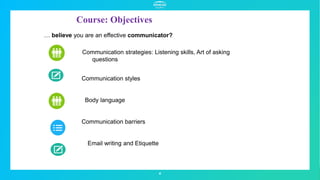
Course: Objectives
4
… believe you are an effective communicator?
Communication strategies: Listening skills, Art of asking
questions
Communication styles
Body language
Communication barriers
Email writing and Etiquette
5
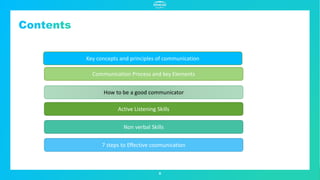
Key concepts and principles of communication
Communication Process and key Elements
How to be a good communicator
Active Listening Skills
Non verbal Skills
7 steps to Effective coomunication
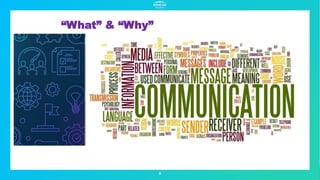
“What” & “Why”
6
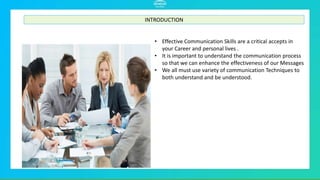
INTRODUCTION
Effective Communication Skills are a critical
accepts in your Career and personal lives .
It is important to understand the communication
process so that we can enhance the effectiveness
of our Messages .
We all must use variety of communication
Techniques to both understand and be
understood.
7
• Effective Communication Skills are a critical accepts in
your Career and personal lives .
• It is important to understand the communication process
so that we can enhance the effectiveness of our Messages
• We all must use variety of communication Techniques to
both understand and be understood.
INTRODUCTION
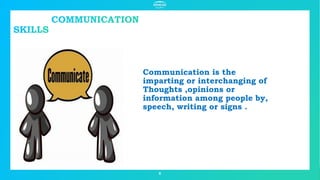
Communication is the
imparting or interchanging of
Thoughts ,opinions or
information among people by,
speech, writing or signs .
8
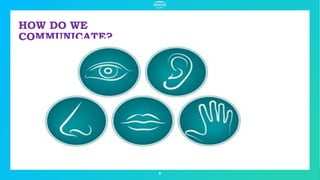
HOW DO WE
COMMUNICATE?
9
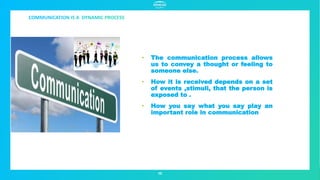
• The communication process allows
us to convey a thought or feeling to
someone else.
• How it is received depends on a set
of events ,stimuli, that the person is
exposed to .
• How you say what you say play an
important role in communication
10
11
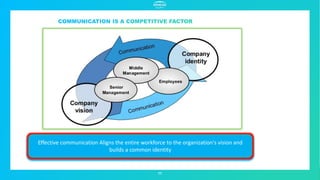
Effective communication Aligns the entire workforce to the organization's vision and
builds a common identity
1. Inspires confidence
2. Builds respects in Business and social life
3. Helps to build relation Develops a distant personality
4. Reveals your ability to others
12
What is good for effective communication?
13
Effective communication is based on a lot of factors but the major things that make your
communication effective are:
•Become an active and good listener
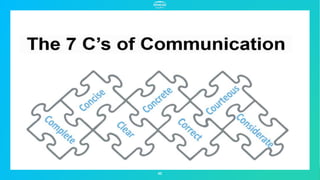
•Follow the 7 C's of effective communication
•Practice public speaking
•Focus on non-verbal communication
•Send and receive constructive feedback
14
15
Listening Tips
16
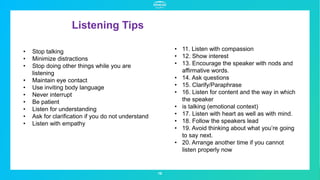
• Stop talking
• Minimize distractions
• Stop doing other things while you are
listening
• Maintain eye contact
• Use inviting body language
• Never interrupt
• Be patient
• Listen for understanding
• Ask for clarification if you do not understand
• Listen with empathy
• 11. Listen with compassion
• 12. Show interest
• 13. Encourage the speaker with nods and
affirmative words.
• 14. Ask questions
• 15. Clarify/Paraphrase
• 16. Listen for content and the way in which
the speaker
• is talking (emotional context)
• 17. Listen with heart as well as with mind.
• 18. Follow the speakers lead
• 19. Avoid thinking about what you’re going
to say next.
• 20. Arrange another time if you cannot
listen properly now
17
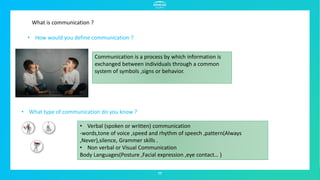
What is communication ?
• How would you define communication ?
Communication is a process by which information is
exchanged between individuals through a common
system of symbols ,signs or behavior.
• What type of communication do you know ?
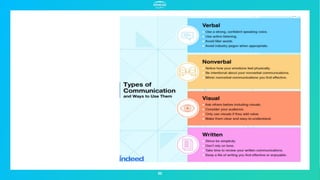
• Verbal (spoken or written) communication
-words,tone of voice ,speed and rhythm of speech ,pattern(Always
,Never),silence, Grammer skills .
• Non verbal or Visual Communication
Body Languages(Posture ,Facial expression ,eye contact… )
18
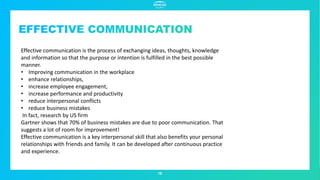
Effective communication is the process of exchanging ideas, thoughts, knowledge
and information so that the purpose or intention is fulfilled in the best possible
manner.
• Improving communication in the workplace
• enhance relationships,
• increase employee engagement,
• increase performance and productivity
• reduce interpersonal conflicts
• reduce business mistakes
In fact, research by US firm
Gartner shows that 70% of business mistakes are due to poor communication. That
suggests a lot of room for improvement!
Effective communication is a key interpersonal skill that also benefits your personal
relationships with friends and family. It can be developed after continuous practice
and experience.
19
The following are tips on how to communicate effectively:
o Listen attentively and be open to understand the speaker’s point of view.
Listening requires total focus to understand the totality of the message. Talk
less so that you can listen more. Ask questions to show you are interested
and paraphrase to demonstrate you understand the message being
conveyed.
o Keep your message simple and direct. Be clear on your message and what
you’re hoping to convey before you even start to communicate.
o Know your audience, whether it be an individual or a large group of people,
and tailor your message to be best received by them. Consider what the
audience needs in order to receive your message the way you intended it to
be including their different preferences and cultural norms. For example, to
appeal to analytical thinkers, you may provide your messaged supported by
facts, data and logic to support the message.
20
Be mindful of the timing of the message. As the saying goes, there is a time
and a place for everything, and communicating is not different.
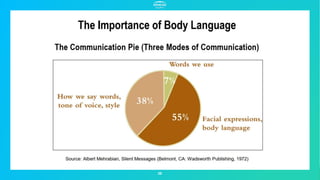
o Pay attention to your non-verbal communication. In person, your nonverbal communication such as facial
expressions, body movement and
gestures, eye contact, posture, tone of voice and even your muscle tension
and breathing can change how spoken words are received. Maintain steady
eye contact with your audience to engage their attention when you talk but
also be sure not to stare which can make others’ uncomfortable.
o Choose an appropriate mode of communication. Some communication such
as constructive feedback are best conducted through face to face
discussions. Accolades may achieve the best result if communicated in front
of the team. Other communication may be appropriate via a phone call, text
message, email or a social media platform such as Yammer/ intranet or a
webinar.
o Ask for honest feedback from those you communicate with on a regular
basis such as colleagues, managers and personal networks to find out if
there are any gaps in your communication that you may not have noticed so
that you can look at improvement opportunities.
If you have completed your DISC profile, you may also want to read your report
on Communication Tips for each of the DISC styles
21
Process of Effective Communication
22
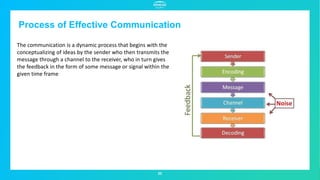
The communication is a dynamic process that begins with the
conceptualizing of ideas by the sender who then transmits the
message through a channel to the receiver, who in turn gives
the feedback in the form of some message or signal within the
given time frame
Process of Effective Communication
23
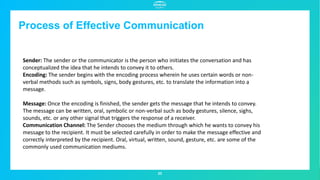
Sender: The sender or the communicator is the person who initiates the conversation and has
conceptualized the idea that he intends to convey it to others.
Encoding: The sender begins with the encoding process wherein he uses certain words or non-
verbal methods such as symbols, signs, body gestures, etc. to translate the information into a
message.
Message: Once the encoding is finished, the sender gets the message that he intends to convey.
The message can be written, oral, symbolic or non-verbal such as body gestures, silence, sighs,
sounds, etc. or any other signal that triggers the response of a receiver.
Communication Channel: The Sender chooses the medium through which he wants to convey his
message to the recipient. It must be selected carefully in order to make the message effective and
correctly interpreted by the recipient. Oral, virtual, written, sound, gesture, etc. are some of the
commonly used communication mediums.
Process of Effective Communication
24
Receiver: The receiver is the person for whom the message is intended or
targeted. He tries to comprehend it in the best possible manner such that the
communication objective is attained. The degree to which the receiver decodes
the message depends on his knowledge of the subject matter, experience, trust
and relationship with the sender.
Decoding: Here, the receiver interprets the sender’s message and tries to
understand it in the best possible manner. An effective communication occurs
only if the receiver understands the message in exactly the same way as it was
intended by the sender.
Feedback: The Feedback is the final step of the process that ensures the
receiver has received the message and interpreted it correctly as it was
intended by the sender. It increases the effectiveness of the communication as
it permits the sender to know the efficacy of his message. The response of the
receiver can be verbal or non-verbal.
25
Listening Tips
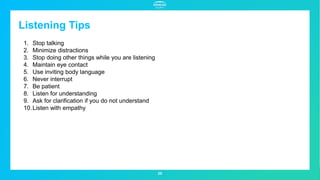
1. Stop talking
2. Minimize distractions
3. Stop doing other things while you are listening
4. Maintain eye contact
5. Use inviting body language
6. Never interrupt
7. Be patient
8. Listen for understanding
9. Ask for clarification if you do not understand
10.Listen with empathy
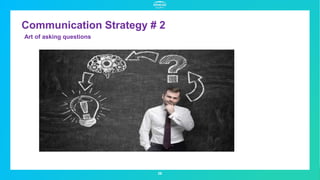
Communication Strategy # 2
26
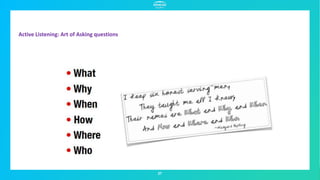
Art of asking questions
Active Listening: Art of Asking questions
27
Questioning Tips
28
1. Ask one question at a time.
2. Be confident in your questioning.
3. Keep your questions clear and simple
4. After you have asked the question keep quiet and wait for the
answer
5. After the answer appears to have finished, stay quiet for 1-2 more
seconds.
6. Use funneling technique (e.g. open/probing/closed questions)
7. Ask how they feel about an issue as well as factual questions
8. Use open questions for detailed answers
9. Use probing questions for more detailed in formation
10. Use specific probing questions (e.g. how many times did that
happen?)
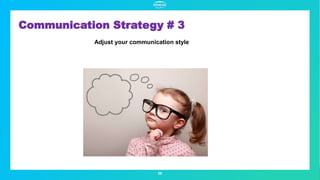
Communication Strategy # 3
29
Adjust your communication style
30
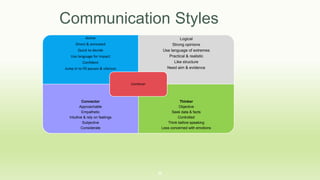
Communication Styles
Active
Direct & animated
Quick to decide
Use language for impact
Confident
Jump in to fill pauses & silences
Logical
Strong opinions
Use language of extremes
Practical & realistic
Like structure
Need aim & evidence
Connector
Approachable
Empathetic
Intuitive & rely on feelings
Subjective
Considerate
Thinker
Objective
Seek data & facts
Controlled
Think before speaking
Less concerned with emotions
Combiner
Active Communicators
31
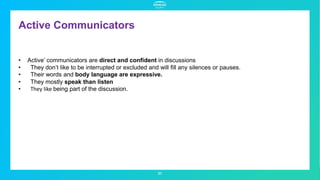
• Active’ communicators are direct and confident in discussions
• They don’t like to be interrupted or excluded and will fill any silences or pauses.
• Their words and body language are expressive.
• They mostly speak than listen
• They like being part of the discussion.
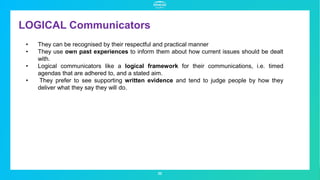
LOGICAL Communicators
32
• They can be recognised by their respectful and practical manner
• They use own past experiences to inform them about how current issues should be dealt
with.
• Logical communicators like a logical framework for their communications, i.e. timed
agendas that are adhered to, and a stated aim.
• They prefer to see supporting written evidence and tend to judge people by how they
deliver what they say they will do.
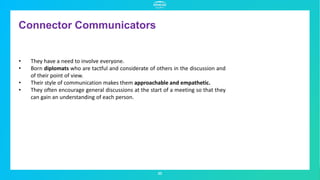
Connector Communicators
33
• They have a need to involve everyone.
• Born diplomats who are tactful and considerate of others in the discussion and
of their point of view.
• Their style of communication makes them approachable and empathetic.
• They often encourage general discussions at the start of a meeting so that they
can gain an understanding of each person.
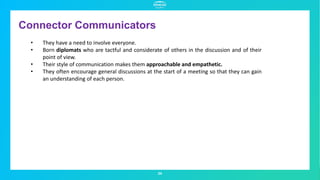
Connector Communicators
34
• They have a need to involve everyone.
• Born diplomats who are tactful and considerate of others in the discussion and of their
point of view.
• Their style of communication makes them approachable and empathetic.
• They often encourage general discussions at the start of a meeting so that they can gain
an understanding of each person.
THINKER Communicators
35
• They seek out facts and figures rather than feelings to support what they say.
• They will portray controlled body language throughout conversations whether they
are talking or listening.
• You can recognise the Thinkers in your team because they will be individuals who are
happy to talk about abstract ideas and strategies.
• Their communications are most effective in small rather than large groups.
Summary: Style
36
Most people have a preferred style, or combination of styles that they use when
they communicate.
Each person’s communication style is a unique combination of their own skills, as
well as those learnt from experience or from other people.
Effective communicators learn to adapt their style to suit the situation and will
also identify other people’s style, so that they can communicate more
successfully.
37
38
39
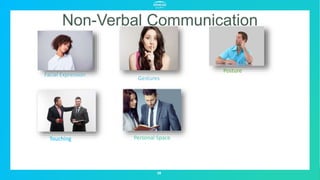
Facial Expression
Posture
Personal Space
Gestures
Non-Verbal Communication
Touching
40
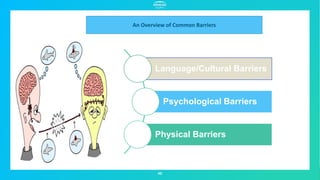
Language/Cultural Barriers
Psychological Barriers
Physical Barriers
An Overview of Common Barriers
41
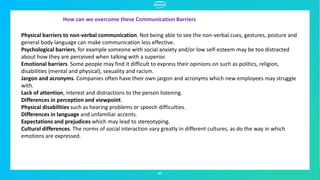
How can we overcome these Communication Barriers
Physical barriers to non-verbal communication. Not being able to see the non-verbal cues, gestures, posture and
general body language can make communication less effective.
Psychological barriers, for example someone with social anxiety and/or low self-esteem may be too distracted
about how they are perceived when talking with a superior.
Emotional barriers. Some people may find it difficult to express their opinions on such as politics, religion,
disabilities (mental and physical), sexuality and racism.
Jargon and acronyms. Companies often have their own jargon and acronyms which new employees may struggle
with.
Lack of attention, interest and distractions to the person listening.
Differences in perception and viewpoint.
Physical disabilities such as hearing problems or speech difficulties.
Differences in language and unfamiliar accents.
Expectations and prejudices which may lead to stereotyping.
Cultural differences. The norms of social interaction vary greatly in different cultures, as do the way in which
emotions are expressed.
42
43
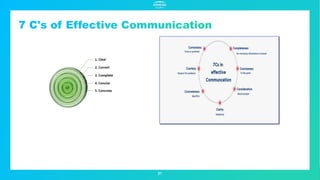
1. Clear
When writing or speaking to someone, be clear about your goal or message.
What is your purpose in communicating with this person?
- If you're not sure, then your audience won't be sure either.
- To be clear, try to minimize the number of ideas in each sentence.
- Make sure that it's easy for your reader to understand your meaning
- People shouldn't have to "read between the lines" and make assumptions on their own
to understand what you're trying to say.
44
2. Concise
When you're concise in your communication, you stick to the point and keep it brief. Instead of six sentences
you could communicate your message in three.
 Are there any adjectives or "filler words" that you can delete? You can often eliminate words like "for
instance," "you see," "definitely," "kind of," "literally," "basically," or "I mean."
 Are there any unnecessary sentences?
 Have you repeated the point several times, in different ways?
45
3. Concrete
• When your message is concrete, then your audience has a clear picture of what
you're telling them. There are details (but not too many!) and vivid facts, and there's
laser-like focus. Your message is solid.
46
4. Correct
When your communication is correct, it fits your audience. And correct communication is also error-free
communication.
 Do the technical terms you use fit your audience's level of education or knowledge?
 Have you checked your writing for grammatical errors? Remember, spell checkers won't catch
everything.
 Are all names and titles spelled correctly?
47
5. Coherent
• When your communication is coherent, it's logical.
• All points are connected and relevant to the main topic, and
the tone and flow of the text is consistent.
48
6. Complete
In a complete message, the audience has everything they need
to be informed and, if applicable, take action.
Does your message include a "call to action," so that your
audience clearly knows what you want them to do?
Have you included all relevant information – contact names,
dates, times, locations, and so on?
49
7. Courteous
• Courteous communication is friendly, open, and honest.
• There are no hidden insults or passive-aggressive tones.
• You keep your reader's viewpoint in mind, and you're
empathetic to their needs.
50

ppt rehna final.pptx

  • 1.
  • 2.
    How many here… … believe that you as a leader can influence people by effective communication? 2
  • 3.
    How many here… 3 … believe you are an effective communicator?
  • 4.
    Course: Objectives 4 … believeyou are an effective communicator? Communication strategies: Listening skills, Art of asking questions Communication styles Body language Communication barriers Email writing and Etiquette
  • 5.
    5 Key concepts andprinciples of communication Communication Process and key Elements How to be a good communicator Active Listening Skills Non verbal Skills 7 steps to Effective coomunication
  • 6.
  • 7.
    INTRODUCTION Effective Communication Skillsare a critical accepts in your Career and personal lives . It is important to understand the communication process so that we can enhance the effectiveness of our Messages . We all must use variety of communication Techniques to both understand and be understood. 7 • Effective Communication Skills are a critical accepts in your Career and personal lives . • It is important to understand the communication process so that we can enhance the effectiveness of our Messages • We all must use variety of communication Techniques to both understand and be understood. INTRODUCTION
  • 8.
    Communication is the impartingor interchanging of Thoughts ,opinions or information among people by, speech, writing or signs . 8
  • 9.
  • 10.
    • The communicationprocess allows us to convey a thought or feeling to someone else. • How it is received depends on a set of events ,stimuli, that the person is exposed to . • How you say what you say play an important role in communication 10
  • 11.
    11 Effective communication Alignsthe entire workforce to the organization's vision and builds a common identity
  • 12.
    1. Inspires confidence 2.Builds respects in Business and social life 3. Helps to build relation Develops a distant personality 4. Reveals your ability to others 12
  • 13.
    What is goodfor effective communication? 13 Effective communication is based on a lot of factors but the major things that make your communication effective are: •Become an active and good listener •Follow the 7 C's of effective communication •Practice public speaking •Focus on non-verbal communication •Send and receive constructive feedback
  • 14.
  • 15.
  • 16.
    Listening Tips 16 • Stoptalking • Minimize distractions • Stop doing other things while you are listening • Maintain eye contact • Use inviting body language • Never interrupt • Be patient • Listen for understanding • Ask for clarification if you do not understand • Listen with empathy • 11. Listen with compassion • 12. Show interest • 13. Encourage the speaker with nods and affirmative words. • 14. Ask questions • 15. Clarify/Paraphrase • 16. Listen for content and the way in which the speaker • is talking (emotional context) • 17. Listen with heart as well as with mind. • 18. Follow the speakers lead • 19. Avoid thinking about what you’re going to say next. • 20. Arrange another time if you cannot listen properly now
  • 17.
    17 What is communication? • How would you define communication ? Communication is a process by which information is exchanged between individuals through a common system of symbols ,signs or behavior. • What type of communication do you know ? • Verbal (spoken or written) communication -words,tone of voice ,speed and rhythm of speech ,pattern(Always ,Never),silence, Grammer skills . • Non verbal or Visual Communication Body Languages(Posture ,Facial expression ,eye contact… )
  • 18.
    18 Effective communication isthe process of exchanging ideas, thoughts, knowledge and information so that the purpose or intention is fulfilled in the best possible manner. • Improving communication in the workplace • enhance relationships, • increase employee engagement, • increase performance and productivity • reduce interpersonal conflicts • reduce business mistakes In fact, research by US firm Gartner shows that 70% of business mistakes are due to poor communication. That suggests a lot of room for improvement! Effective communication is a key interpersonal skill that also benefits your personal relationships with friends and family. It can be developed after continuous practice and experience.
  • 19.
    19 The following aretips on how to communicate effectively: o Listen attentively and be open to understand the speaker’s point of view. Listening requires total focus to understand the totality of the message. Talk less so that you can listen more. Ask questions to show you are interested and paraphrase to demonstrate you understand the message being conveyed. o Keep your message simple and direct. Be clear on your message and what you’re hoping to convey before you even start to communicate. o Know your audience, whether it be an individual or a large group of people, and tailor your message to be best received by them. Consider what the audience needs in order to receive your message the way you intended it to be including their different preferences and cultural norms. For example, to appeal to analytical thinkers, you may provide your messaged supported by facts, data and logic to support the message.
  • 20.
    20 Be mindful ofthe timing of the message. As the saying goes, there is a time and a place for everything, and communicating is not different. o Pay attention to your non-verbal communication. In person, your nonverbal communication such as facial expressions, body movement and gestures, eye contact, posture, tone of voice and even your muscle tension and breathing can change how spoken words are received. Maintain steady eye contact with your audience to engage their attention when you talk but also be sure not to stare which can make others’ uncomfortable. o Choose an appropriate mode of communication. Some communication such as constructive feedback are best conducted through face to face discussions. Accolades may achieve the best result if communicated in front of the team. Other communication may be appropriate via a phone call, text message, email or a social media platform such as Yammer/ intranet or a webinar. o Ask for honest feedback from those you communicate with on a regular basis such as colleagues, managers and personal networks to find out if there are any gaps in your communication that you may not have noticed so that you can look at improvement opportunities. If you have completed your DISC profile, you may also want to read your report on Communication Tips for each of the DISC styles
  • 21.
  • 22.
    Process of EffectiveCommunication 22 The communication is a dynamic process that begins with the conceptualizing of ideas by the sender who then transmits the message through a channel to the receiver, who in turn gives the feedback in the form of some message or signal within the given time frame
  • 23.
    Process of EffectiveCommunication 23 Sender: The sender or the communicator is the person who initiates the conversation and has conceptualized the idea that he intends to convey it to others. Encoding: The sender begins with the encoding process wherein he uses certain words or non- verbal methods such as symbols, signs, body gestures, etc. to translate the information into a message. Message: Once the encoding is finished, the sender gets the message that he intends to convey. The message can be written, oral, symbolic or non-verbal such as body gestures, silence, sighs, sounds, etc. or any other signal that triggers the response of a receiver. Communication Channel: The Sender chooses the medium through which he wants to convey his message to the recipient. It must be selected carefully in order to make the message effective and correctly interpreted by the recipient. Oral, virtual, written, sound, gesture, etc. are some of the commonly used communication mediums.
  • 24.
    Process of EffectiveCommunication 24 Receiver: The receiver is the person for whom the message is intended or targeted. He tries to comprehend it in the best possible manner such that the communication objective is attained. The degree to which the receiver decodes the message depends on his knowledge of the subject matter, experience, trust and relationship with the sender. Decoding: Here, the receiver interprets the sender’s message and tries to understand it in the best possible manner. An effective communication occurs only if the receiver understands the message in exactly the same way as it was intended by the sender. Feedback: The Feedback is the final step of the process that ensures the receiver has received the message and interpreted it correctly as it was intended by the sender. It increases the effectiveness of the communication as it permits the sender to know the efficacy of his message. The response of the receiver can be verbal or non-verbal.
  • 25.
    25 Listening Tips 1. Stoptalking 2. Minimize distractions 3. Stop doing other things while you are listening 4. Maintain eye contact 5. Use inviting body language 6. Never interrupt 7. Be patient 8. Listen for understanding 9. Ask for clarification if you do not understand 10.Listen with empathy
  • 26.
    Communication Strategy #2 26 Art of asking questions
  • 27.
    Active Listening: Artof Asking questions 27
  • 28.
    Questioning Tips 28 1. Askone question at a time. 2. Be confident in your questioning. 3. Keep your questions clear and simple 4. After you have asked the question keep quiet and wait for the answer 5. After the answer appears to have finished, stay quiet for 1-2 more seconds. 6. Use funneling technique (e.g. open/probing/closed questions) 7. Ask how they feel about an issue as well as factual questions 8. Use open questions for detailed answers 9. Use probing questions for more detailed in formation 10. Use specific probing questions (e.g. how many times did that happen?)
  • 29.
    Communication Strategy #3 29 Adjust your communication style
  • 30.
    30 Communication Styles Active Direct &animated Quick to decide Use language for impact Confident Jump in to fill pauses & silences Logical Strong opinions Use language of extremes Practical & realistic Like structure Need aim & evidence Connector Approachable Empathetic Intuitive & rely on feelings Subjective Considerate Thinker Objective Seek data & facts Controlled Think before speaking Less concerned with emotions Combiner
  • 31.
    Active Communicators 31 • Active’communicators are direct and confident in discussions • They don’t like to be interrupted or excluded and will fill any silences or pauses. • Their words and body language are expressive. • They mostly speak than listen • They like being part of the discussion.
  • 32.
    LOGICAL Communicators 32 • Theycan be recognised by their respectful and practical manner • They use own past experiences to inform them about how current issues should be dealt with. • Logical communicators like a logical framework for their communications, i.e. timed agendas that are adhered to, and a stated aim. • They prefer to see supporting written evidence and tend to judge people by how they deliver what they say they will do.
  • 33.
    Connector Communicators 33 • Theyhave a need to involve everyone. • Born diplomats who are tactful and considerate of others in the discussion and of their point of view. • Their style of communication makes them approachable and empathetic. • They often encourage general discussions at the start of a meeting so that they can gain an understanding of each person.
  • 34.
    Connector Communicators 34 • Theyhave a need to involve everyone. • Born diplomats who are tactful and considerate of others in the discussion and of their point of view. • Their style of communication makes them approachable and empathetic. • They often encourage general discussions at the start of a meeting so that they can gain an understanding of each person.
  • 35.
    THINKER Communicators 35 • Theyseek out facts and figures rather than feelings to support what they say. • They will portray controlled body language throughout conversations whether they are talking or listening. • You can recognise the Thinkers in your team because they will be individuals who are happy to talk about abstract ideas and strategies. • Their communications are most effective in small rather than large groups.
  • 36.
    Summary: Style 36 Most peoplehave a preferred style, or combination of styles that they use when they communicate. Each person’s communication style is a unique combination of their own skills, as well as those learnt from experience or from other people. Effective communicators learn to adapt their style to suit the situation and will also identify other people’s style, so that they can communicate more successfully.
  • 37.
  • 38.
  • 39.
  • 40.
  • 41.
    41 How can weovercome these Communication Barriers Physical barriers to non-verbal communication. Not being able to see the non-verbal cues, gestures, posture and general body language can make communication less effective. Psychological barriers, for example someone with social anxiety and/or low self-esteem may be too distracted about how they are perceived when talking with a superior. Emotional barriers. Some people may find it difficult to express their opinions on such as politics, religion, disabilities (mental and physical), sexuality and racism. Jargon and acronyms. Companies often have their own jargon and acronyms which new employees may struggle with. Lack of attention, interest and distractions to the person listening. Differences in perception and viewpoint. Physical disabilities such as hearing problems or speech difficulties. Differences in language and unfamiliar accents. Expectations and prejudices which may lead to stereotyping. Cultural differences. The norms of social interaction vary greatly in different cultures, as do the way in which emotions are expressed.
  • 42.
  • 43.
    43 1. Clear When writingor speaking to someone, be clear about your goal or message. What is your purpose in communicating with this person? - If you're not sure, then your audience won't be sure either. - To be clear, try to minimize the number of ideas in each sentence. - Make sure that it's easy for your reader to understand your meaning - People shouldn't have to "read between the lines" and make assumptions on their own to understand what you're trying to say.
  • 44.
    44 2. Concise When you'reconcise in your communication, you stick to the point and keep it brief. Instead of six sentences you could communicate your message in three.  Are there any adjectives or "filler words" that you can delete? You can often eliminate words like "for instance," "you see," "definitely," "kind of," "literally," "basically," or "I mean."  Are there any unnecessary sentences?  Have you repeated the point several times, in different ways?

  • 45.
    45 3. Concrete • Whenyour message is concrete, then your audience has a clear picture of what you're telling them. There are details (but not too many!) and vivid facts, and there's laser-like focus. Your message is solid.
  • 46.
    46 4. Correct When yourcommunication is correct, it fits your audience. And correct communication is also error-free communication.  Do the technical terms you use fit your audience's level of education or knowledge?  Have you checked your writing for grammatical errors? Remember, spell checkers won't catch everything.  Are all names and titles spelled correctly?
  • 47.
    47 5. Coherent • Whenyour communication is coherent, it's logical. • All points are connected and relevant to the main topic, and the tone and flow of the text is consistent.
  • 48.
    48 6. Complete In acomplete message, the audience has everything they need to be informed and, if applicable, take action. Does your message include a "call to action," so that your audience clearly knows what you want them to do? Have you included all relevant information – contact names, dates, times, locations, and so on?
  • 49.
    49 7. Courteous • Courteouscommunication is friendly, open, and honest. • There are no hidden insults or passive-aggressive tones. • You keep your reader's viewpoint in mind, and you're empathetic to their needs.
  • 50.