

Max MARTIN
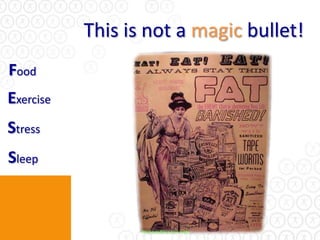
This is not a magic bullet!
Food
Exercise
Stress
Sleep
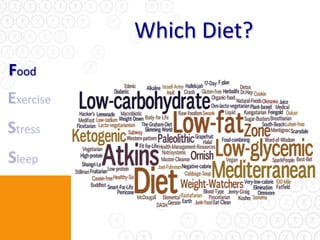
Which Diet?
Food
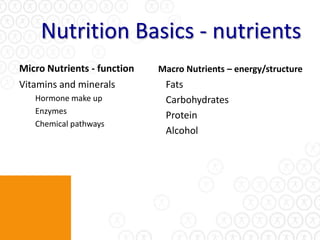
Nutrition Basics - nutrients
Micro Nutrients - function   Macro Nutrients – energy/structure
Vitamins and minerals         Fats
   Hormone make up            Carbohydrates
   Enzymes
                              Protein
   Chemical pathways
                              Alcohol
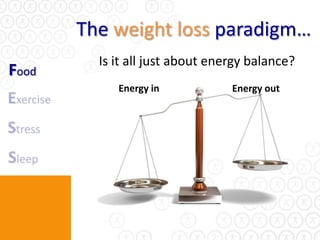
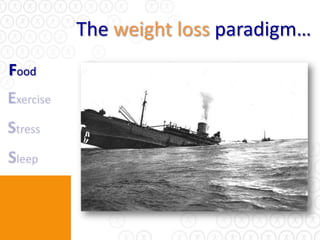
The weight loss paradigm…
         Is it all just about energy balance?
Food
            Energy in            Energy out
The weight loss paradigm…
Food
The weight loss paradigm…
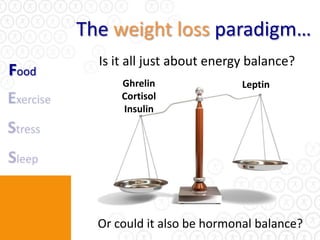
         Is it all just about energy balance?
Food
             Ghrelin               Leptin
             Cortisol
             Insulin


         Or could it also be hormonal balance?
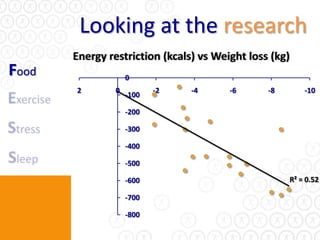
Looking at the research
       Energy restriction (kcals) vs Weight loss (kg)
Food                0
       2        0          -2   -4      -6      -8          -10
                    -100

                    -200

                    -300

                    -400

                    -500

                    -600                                R² = 0.52

                    -700

                    -800
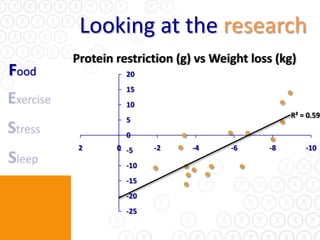
Looking at the research
       Protein restriction (g) vs Weight loss (kg)
Food             20
                 15
                 10
                                                 R² = 0.59
                 5
                 0
        2      0 -5    -2     -4     -6     -8       -10

                 -10
                 -15
                 -20
                 -25
Looking at the research
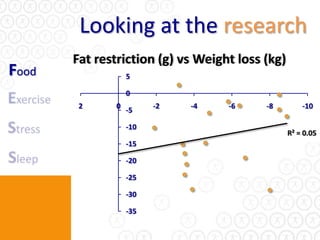
       Fat restriction (g) vs Weight loss (kg)
Food              5

                  0
        2     0         -2   -4    -6     -8         -10
                  -5

                  -10
                                                 R² = 0.05
                  -15

                  -20

                  -25

                  -30

                  -35
Looking at the research
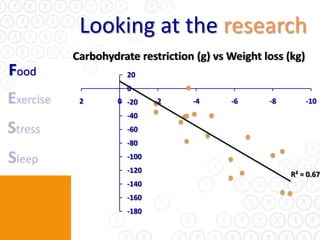
       Carbohydrate restriction (g) vs Weight loss (kg)
Food              20
                  0
        2       0 -20    -2    -4      -6      -8         -10
                  -40
                  -60
                  -80
                  -100
                  -120
                                                    R² = 0.67
                  -140
                  -160
                  -180
Can we stick to diets?
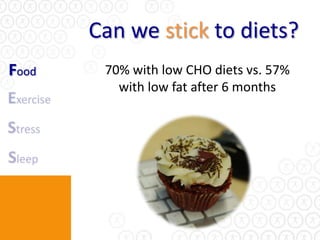
Food    70% with low CHO diets vs. 57%
          with low fat after 6 months
Shai et al. 2008, NEJM


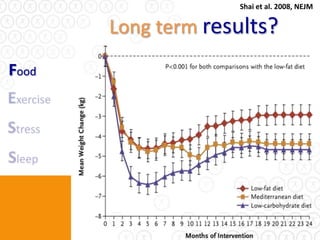
       Long term results?
Food
Food


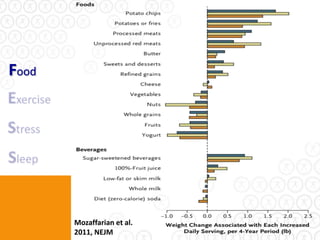
       Mozaffarian et al.
       2011, NEJM
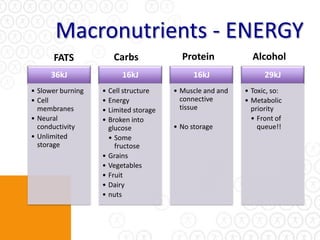
Macronutrients - ENERGY
      FATS            Carbs              Protein            Alcohol
      36kJ               16kJ                16kJ               29kJ
• Slower burning   • Cell structure    • Muscle and and   • Toxic, so:
• Cell             • Energy              connective       • Metabolic
  membranes        • Limited storage     tissue             priority
• Neural           • Broken into                            • Front of
  conductivity       glucose           • No storage           queue!!
• Unlimited          • Some
  storage              fructose
                   • Grains
                   • Vegetables
                   • Fruit
                   • Dairy
                   • nuts
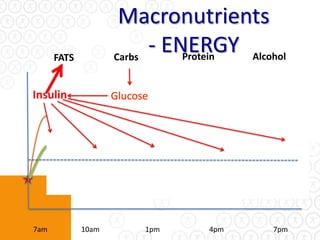
Macronutrients
      FATS          Carbs
                          - ENERGY Alcohol
                              Protein


Insulin


7am          10am       1pm     4pm     7pm

FESS weightloss food only

  • 1.
  • 2.
    This is nota magic bullet! Food Exercise Stress Sleep
  • 3.
  • 4.
    Nutrition Basics -nutrients Micro Nutrients - function Macro Nutrients – energy/structure Vitamins and minerals Fats Hormone make up Carbohydrates Enzymes Protein Chemical pathways Alcohol
  • 5.
    The weight lossparadigm… Is it all just about energy balance? Food Energy in Energy out
  • 6.
    The weight lossparadigm… Food
  • 7.
    The weight lossparadigm… Is it all just about energy balance? Food Ghrelin Leptin Cortisol Insulin Or could it also be hormonal balance?
  • 8.
    Looking at theresearch Energy restriction (kcals) vs Weight loss (kg) Food 0 2 0 -2 -4 -6 -8 -10 -100 -200 -300 -400 -500 -600 R² = 0.52 -700 -800
  • 9.
    Looking at theresearch Protein restriction (g) vs Weight loss (kg) Food 20 15 10 R² = 0.59 5 0 2 0 -5 -2 -4 -6 -8 -10 -10 -15 -20 -25
  • 10.
    Looking at theresearch Fat restriction (g) vs Weight loss (kg) Food 5 0 2 0 -2 -4 -6 -8 -10 -5 -10 R² = 0.05 -15 -20 -25 -30 -35
  • 11.
    Looking at theresearch Carbohydrate restriction (g) vs Weight loss (kg) Food 20 0 2 0 -20 -2 -4 -6 -8 -10 -40 -60 -80 -100 -120 R² = 0.67 -140 -160 -180
  • 12.
    Can we stickto diets? Food 70% with low CHO diets vs. 57% with low fat after 6 months
  • 13.
    Shai et al.2008, NEJM Long term results? Food
  • 14.
    Food Mozaffarian et al. 2011, NEJM
  • 15.
    Macronutrients - ENERGY FATS Carbs Protein Alcohol 36kJ 16kJ 16kJ 29kJ • Slower burning • Cell structure • Muscle and and • Toxic, so: • Cell • Energy connective • Metabolic membranes • Limited storage tissue priority • Neural • Broken into • Front of conductivity glucose • No storage queue!! • Unlimited • Some storage fructose • Grains • Vegetables • Fruit • Dairy • nuts
  • 16.
    Macronutrients FATS Carbs - ENERGY Alcohol Protein Insulin 7am 10am 1pm 4pm 7pm

Editor's Notes

  • #3 Advert from the early 1900’sExplain the FESS paradigm
  • #4 Who here get’s confused, wikipedia has over 100 different diets referenced
  • #6 Explain the energy in, energy out equation, the law of thermodynamics. How much control do we have over this?Why is it you can eat the same, not change your exercise and either put on or lose weight? Who does this with stress? Why is it that research studies show that if you don’t sleep enough you’re more likely to get fat? Shouldn’t this be the opposite given that you burn less energy asleep compared to being awake.
  • #7 The sinking ship….Why is it that we put on weight? Saying it is because you are in positive energy balance is like saying to the captain of the ship because we are filling up with water when he asks why are we sinking. Rather we should be looking for the root cause of the problem so that we can successfully fix the hole and stop it from happening again.
  • #8 Start framing insulin, ghrelin, cortisol and leptin here.Ghrelin is the hunger hormone, Leptin is a fullness indicator, these levels can increase drop or our bodies can become resistant to these hormones
  • #9 So lets look at what the research has to say about our food. Pretty much all reviews on weight loss up until recently have stated that weight loss is simply just reducing our energy intake to induce a negative energy balance. To look at this relationship what I did was delve into the last 10 years of the highest quality weight loss research called RCT’s. These trials have been performed on all sorts of diets, such as low CHO, low fat, mediterranean, atkins even weight watchers. Essentially what I did was break down these diets into how much it reduced energy intake, grams of protein, fat and carbohydrate to determine which has the greatest impact on weight loss. All overweight individuals with trials going for 6 months.This is what I found… Explain the r2 relationshipWhat I would like to know is what is the difference between the outliers why will one diet that restrict energy by 300 cals induce an 8kg weight loss over 6 months while the other only create a 2kg change
  • #10 Explain the impact protein has on satiety, increases thermogenesis and increases the likelihood of maintaining LBM – MAINTAIN PRO INTAKE WHEN REDUCING EICOUNTERINTUTITIVE IF WE JUST FOCUS ON EI COMPONENT
  • #11 Highlight that no diet increased the amounts of fat rather maintainedNo relationship, however this does not give the green light to increase fat as it is energy dense (remember all these studies induced a negative energy balance.However, what is more important is the type of fats. Reduction in most saturated fats, and trans fatty acids due to their inflammatory response in the body is important while poly/mono fats and omega 3’s should be maintained.
  • #12 The strongest relationship, even stronger than energy intake! Why is it if we reduce CHO by a gram it is associated with greater weight loss success than fat? After all one gram of fat has twice as much energy than one gram of CHO.Explain insulin here and what signals it sends the body.It is easiest to reduce these in sugary foods and starchy foods due to their density of CHO, and increase the CHO that are less dense such as vegetables, and to an certain extent wholegrains and fruit.Most people in these trials averaged around 250g of Cho per day
  • #13 Looking at the adherence rates. Why the greater drop out? Satiety (usually dropping fat means dropping pro) or lack of results?Nordmann et al Arch Intern Med. 2006;166:285-293 – reviewof RCTs on lowcarbvslowfat, thiseffect was still apparentat 12 monthshowever not significant
  • #14 Many people say that low CHO do not create long term changeShai et al 2008 shows an average difference of 2kg with low CHO to low fat diet and you can see the rebound weight gain post 6 months occurs with both types of diets.Mediterranean diet interesting… lean meats, fish, chicken legumes, nuts, seeds, eggs, olive oil lots of veg (little pasta)COASTAL REGIONS – LOCAL PRODUCE, UNPROCESSED & LOW GI -
  • #15 120,000 people from large studies such as the Nurses Health study by Mozaffarian 2011 in NEJM in June this yearThe effect of increasing a food by one serve per day