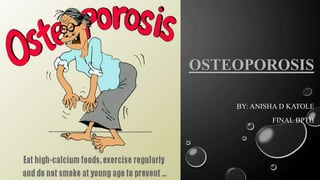
OSTEOPOROSIS
BY: ANISHA D KATOLE
FINAL BPTH
OUTLINE
• DEFINITION
• PATHOPHYSIOLOGY
• TYPES
• CAUSES
• CLINICAL FEATURES
• INVESTIGATIONS
• DIAGNOSTIC FEATURES
• ICF
DEFINITION
• The most common metabolic bone disease.
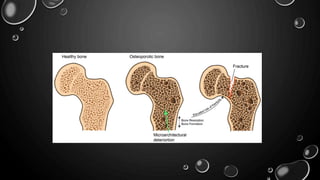
• Osteoporosis is characterised by a diffuse reduction in the bone density due to decrease
in the bone mass.
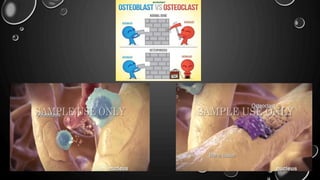
• It occurs when the rate of bone resorption exceeds the rate of bone formation.
• The reduction of bone mass results in fragile skeleton associated with increased risk of
fractures and consequent pain and deformity.
PATHOPHYSIOLOGY
• Bone loss due to normal age related changes in bone remodelling as well as extrinsic and intrinsic factor that
exaggerated this process.
• Bone remodelling has two primary functions
1. To repair micro damage within the skeleton to maintain the skeletal strength.
2. To supply calcium to maintain calcium supply.
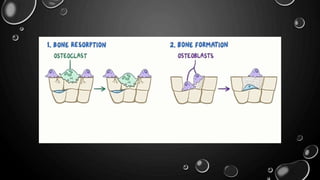
• After age 30- 40, the resorption and formation processes becomes imbalanced and resorption exceed
formation.
• Excessive bone loss can be loss due to an increase in osteoclastic activity and/or osteoblastic activity.
TYPES OF OSTEOPOROSIS
• PRIMARY OSTEOPOROSIS
• SECONDARY OSTEOPOROSIS
PRIMARY OSTEOPOROSIS
• Primary osteoporosis results without an underlying disease or medication
• It is further divided into 2 types: 1. Idiopathic type
2.Involutional type
• Idiopathic type is found in the young and juveniles and is less frequent.
• Involutional type is seen in postmenopausal women and ageing individuals and is more
common.
• In women, there is an accelerated phase of bone loss after the menopause due to
estrogen deficiency, which causes uncoupling of bone resorption and bone
formation, such that the amount of bone removed by osteoclasts exceeds the rate of
new bone formation by osteoblasts.
SECONDARY OSTEOPOROSIS
• It is attributed to number of factors and conditions.
• E.g : Immobilization, chronic anaemia, acromegaly, hepatic diseases,
hyperparathyroidism, hypogonadism and starvation.
• This can be an effect of medication.
• E.g : hypercortisonism, administration of anticonvulsants drugs and large dose of
heparin.
CAUSES
• Senility
• Post-immobilization e.g a bed ridden
patient
• Post-menopausal
• Protein deficiency
inadequate intake- old age, illness
malnutrition
excess protein loss (3rd degree burns)
mal-absorption
• Endocrinal :
Cushing’s disease
Hyperthyroid stage
• Drug induced:
Long term steroid therapy
phenobarbitone therapy
Chronic heparin therapy
• Rheumatological conditions :
RA
Ankylosing spondylosis
• Lack of calcium diet
• Lack of physical activity
• Family history
• Smoking
• Chronic obstructive pulmonary disorders
• Asthma
• Gastrointestinal diseases
CLINICAL FEATURES
• Asymptomatic until fracture occurs
• Fractures due to bone fragility are the most
common manifestations.
• Back pain
• Height loss
• Increased Kyphosis
• Decreased activity tolerance
• Osteoporotic fractures can affect any bone,
but the most common sites are the forearm
(Colle’s fracture), spine (vertebral fracture)
and hip. Of these, hip fractures are the most
serious.
• Immobility
• Loss of height
INVESTIGATIONS
1. X-RAY :
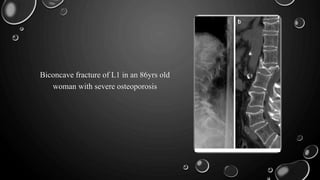
• In severe cases , a spine or hip x-ray may
show fracture or collapse of the spinal bones
• However , simple x-rays of bones are not
very accurate in predicting whether someone
is likely to have osteoporosis.
Biconcave fracture of L1 in an 86yrs old
woman with severe osteoporosis
2. CT-SCAN :
• A special type of spine CT that can show loss
of bone mineral density, quantitative
computed tomography (QCT) may be used in
rare cases.
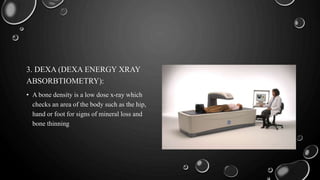
3. DEXA (DEXA ENERGY XRAY
ABSORBTIOMETRY):
• A bone density is a low dose x-ray which
checks an area of the body such as the hip,
hand or foot for signs of mineral loss and
bone thinning
4.NEUTRON ACTIVATION ANALYSIS:
In this method , calcium in the bone is activated
by neutron bombing , and its activity measured,
5. BONE BIOPSY
DIAGNOSTIC FEATURES
A medical evaluation to diagnose osteoporosis and estimate risk of breaking a bone may involve
one or more following steps:
1. Medical history
2. Physical examination
3. Bone density test
4. Laboratory test
ICF
1. Structures related to the nervous system
2. Structures related to eye, ear , voice and speech
3. Structures related to cardiovascular , immunological and respiratory systems.
4. Structures related to the digestive , metabolism and endocrine system.
5. Structures related to genito-urinal and reproductive system.
• STRUCTURAL INTEGRITY
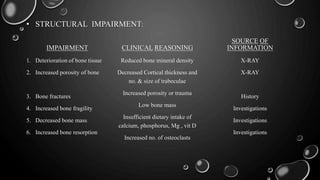
• STRUCTURAL IMPAIRMENT:
IMPAIRMENT
1. Deterioration of bone tissue
2. Increased porosity of bone
3. Bone fractures
4. Increased bone fragility
5. Decreased bone mass
6. Increased bone resorption
CLINICAL REASONING
Reduced bone mineral density
Decreased Cortical thickness and
no. & size of trabeculae
Increased porosity or trauma
Low bone mass
Insufficient dietary intake of
calcium, phosphorus, Mg , vit D
Increased no. of osteoclasts
SOURCE OF
INFORMATION
X-RAY
X-RAY
History
Investigations
Investigations
Investigations
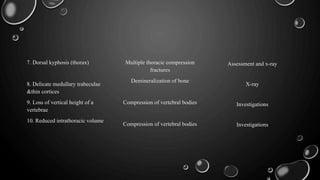
7. Dorsal kyphosis (thorax)
8. Delicate medullary trabeculae
&thin cortices
9. Loss of vertical height of a
vertebrae
10. Reduced intrathoracic volume
Multiple thoracic compression
fractures
Demineralization of bone
Compression of vertebral bodies
Assessment and x-ray
X-ray
Investigations
Investigations
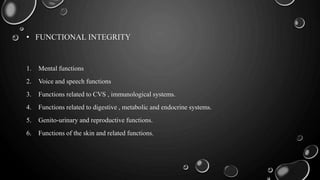
• FUNCTIONAL INTEGRITY
1. Mental functions
2. Voice and speech functions
3. Functions related to CVS , immunological systems.
4. Functions related to digestive , metabolic and endocrine systems.
5. Genito-urinary and reproductive functions.
6. Functions of the skin and related functions.
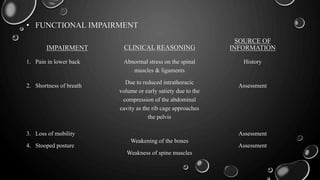
• FUNCTIONAL IMPAIRMENT
IMPAIRMENT
1. Pain in lower back
2. Shortness of breath
3. Loss of mobility
4. Stooped posture
CLINICAL REASONING
Abnormal stress on the spinal
muscles & ligaments
Due to reduced intrathoracic
volume or early satiety due to the
compression of the abdominal
cavity as the rib cage approaches
the pelvis
Weakening of the bones
Weakness of spine muscles
SOURCE OF
INFORMATION
History
Assessment
Assessment
Assessment
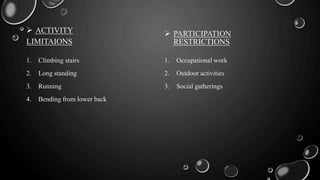
 ACTIVITY
LIMITAIONS
1. Climbing stairs
2. Long standing
3. Running
4. Bending from lower back
 PARTICIPATION
RESTRICTIONS
1. Occupational work
2. Outdoor activities
3. Social gatherings
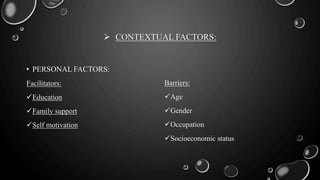
 CONTEXTUAL FACTORS:
• PERSONAL FACTORS:
Facilitators:
Education
Family support
Self motivation
Barriers:
Age
Gender
Occupation
Socioeconomic status
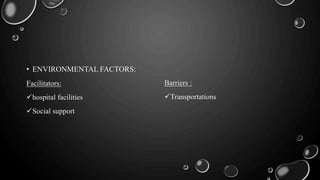
• ENVIRONMENTAL FACTORS:
Facilitators:
hospital facilities
Social support
Barriers :
Transportations
OSTEOPOROSIS.pptx

OSTEOPOROSIS.pptx

  • 1.
    OSTEOPOROSIS BY: ANISHA DKATOLE FINAL BPTH
  • 2.
    OUTLINE • DEFINITION • PATHOPHYSIOLOGY •TYPES • CAUSES • CLINICAL FEATURES • INVESTIGATIONS • DIAGNOSTIC FEATURES • ICF
  • 3.
    DEFINITION • The mostcommon metabolic bone disease. • Osteoporosis is characterised by a diffuse reduction in the bone density due to decrease in the bone mass. • It occurs when the rate of bone resorption exceeds the rate of bone formation. • The reduction of bone mass results in fragile skeleton associated with increased risk of fractures and consequent pain and deformity.
  • 6.
    PATHOPHYSIOLOGY • Bone lossdue to normal age related changes in bone remodelling as well as extrinsic and intrinsic factor that exaggerated this process. • Bone remodelling has two primary functions 1. To repair micro damage within the skeleton to maintain the skeletal strength. 2. To supply calcium to maintain calcium supply. • After age 30- 40, the resorption and formation processes becomes imbalanced and resorption exceed formation. • Excessive bone loss can be loss due to an increase in osteoclastic activity and/or osteoblastic activity.
  • 8.
    TYPES OF OSTEOPOROSIS •PRIMARY OSTEOPOROSIS • SECONDARY OSTEOPOROSIS
  • 9.
    PRIMARY OSTEOPOROSIS • Primaryosteoporosis results without an underlying disease or medication • It is further divided into 2 types: 1. Idiopathic type 2.Involutional type • Idiopathic type is found in the young and juveniles and is less frequent. • Involutional type is seen in postmenopausal women and ageing individuals and is more common. • In women, there is an accelerated phase of bone loss after the menopause due to estrogen deficiency, which causes uncoupling of bone resorption and bone formation, such that the amount of bone removed by osteoclasts exceeds the rate of new bone formation by osteoblasts.
  • 10.
    SECONDARY OSTEOPOROSIS • Itis attributed to number of factors and conditions. • E.g : Immobilization, chronic anaemia, acromegaly, hepatic diseases, hyperparathyroidism, hypogonadism and starvation. • This can be an effect of medication. • E.g : hypercortisonism, administration of anticonvulsants drugs and large dose of heparin.
  • 11.
    CAUSES • Senility • Post-immobilizatione.g a bed ridden patient • Post-menopausal • Protein deficiency inadequate intake- old age, illness malnutrition excess protein loss (3rd degree burns) mal-absorption • Endocrinal : Cushing’s disease Hyperthyroid stage • Drug induced: Long term steroid therapy phenobarbitone therapy Chronic heparin therapy • Rheumatological conditions : RA Ankylosing spondylosis
  • 12.
    • Lack ofcalcium diet • Lack of physical activity • Family history • Smoking • Chronic obstructive pulmonary disorders • Asthma • Gastrointestinal diseases
  • 13.
    CLINICAL FEATURES • Asymptomaticuntil fracture occurs • Fractures due to bone fragility are the most common manifestations. • Back pain • Height loss • Increased Kyphosis • Decreased activity tolerance • Osteoporotic fractures can affect any bone, but the most common sites are the forearm (Colle’s fracture), spine (vertebral fracture) and hip. Of these, hip fractures are the most serious. • Immobility • Loss of height
  • 14.
    INVESTIGATIONS 1. X-RAY : •In severe cases , a spine or hip x-ray may show fracture or collapse of the spinal bones • However , simple x-rays of bones are not very accurate in predicting whether someone is likely to have osteoporosis.
  • 15.
    Biconcave fracture ofL1 in an 86yrs old woman with severe osteoporosis
  • 16.
    2. CT-SCAN : •A special type of spine CT that can show loss of bone mineral density, quantitative computed tomography (QCT) may be used in rare cases.
  • 17.
    3. DEXA (DEXAENERGY XRAY ABSORBTIOMETRY): • A bone density is a low dose x-ray which checks an area of the body such as the hip, hand or foot for signs of mineral loss and bone thinning
  • 18.
    4.NEUTRON ACTIVATION ANALYSIS: Inthis method , calcium in the bone is activated by neutron bombing , and its activity measured, 5. BONE BIOPSY
  • 19.
    DIAGNOSTIC FEATURES A medicalevaluation to diagnose osteoporosis and estimate risk of breaking a bone may involve one or more following steps: 1. Medical history 2. Physical examination 3. Bone density test 4. Laboratory test
  • 20.
    ICF 1. Structures relatedto the nervous system 2. Structures related to eye, ear , voice and speech 3. Structures related to cardiovascular , immunological and respiratory systems. 4. Structures related to the digestive , metabolism and endocrine system. 5. Structures related to genito-urinal and reproductive system. • STRUCTURAL INTEGRITY
  • 21.
    • STRUCTURAL IMPAIRMENT: IMPAIRMENT 1.Deterioration of bone tissue 2. Increased porosity of bone 3. Bone fractures 4. Increased bone fragility 5. Decreased bone mass 6. Increased bone resorption CLINICAL REASONING Reduced bone mineral density Decreased Cortical thickness and no. & size of trabeculae Increased porosity or trauma Low bone mass Insufficient dietary intake of calcium, phosphorus, Mg , vit D Increased no. of osteoclasts SOURCE OF INFORMATION X-RAY X-RAY History Investigations Investigations Investigations
  • 22.
    7. Dorsal kyphosis(thorax) 8. Delicate medullary trabeculae &thin cortices 9. Loss of vertical height of a vertebrae 10. Reduced intrathoracic volume Multiple thoracic compression fractures Demineralization of bone Compression of vertebral bodies Compression of vertebral bodies Assessment and x-ray X-ray Investigations Investigations
  • 23.
    • FUNCTIONAL INTEGRITY 1.Mental functions 2. Voice and speech functions 3. Functions related to CVS , immunological systems. 4. Functions related to digestive , metabolic and endocrine systems. 5. Genito-urinary and reproductive functions. 6. Functions of the skin and related functions.
  • 24.
    • FUNCTIONAL IMPAIRMENT IMPAIRMENT 1.Pain in lower back 2. Shortness of breath 3. Loss of mobility 4. Stooped posture CLINICAL REASONING Abnormal stress on the spinal muscles & ligaments Due to reduced intrathoracic volume or early satiety due to the compression of the abdominal cavity as the rib cage approaches the pelvis Weakening of the bones Weakness of spine muscles SOURCE OF INFORMATION History Assessment Assessment Assessment
  • 25.
     ACTIVITY LIMITAIONS 1. Climbingstairs 2. Long standing 3. Running 4. Bending from lower back  PARTICIPATION RESTRICTIONS 1. Occupational work 2. Outdoor activities 3. Social gatherings
  • 26.
     CONTEXTUAL FACTORS: •PERSONAL FACTORS: Facilitators: Education Family support Self motivation Barriers: Age Gender Occupation Socioeconomic status
  • 27.
    • ENVIRONMENTAL FACTORS: Facilitators: hospitalfacilities Social support Barriers : Transportations