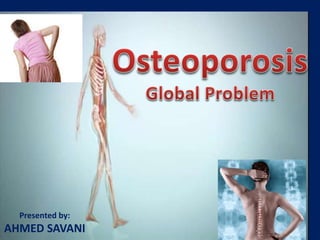
Presented by:
AHMED SAVANI
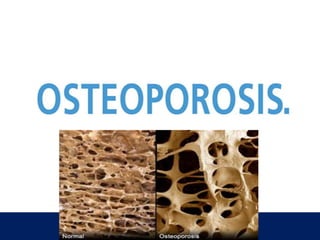
Osteoporosis is nothing but problem with ……
Your Bones
That have become Weak & Porous
4
Why Are Healthy Bones Important?
• Strong bones support us and
allow us to move
• Bones are a storehouse for
vital minerals
• Strong bones protect our
heart, lungs, brain and other
organs
10
• After mid-30’s, you begin to
slowly lose bone mass.
• Women lose bone mass
faster after menopause.
• Men lose bone mass too.
11
Generally breaks the
bones of the wrist,
spine and hip.
Vertebral Fracture Cascade
Somewhere in
the World
Studies were made,…In India what found
2003 studies by IOF
But
In 2013 studies were made again & what the Result
they got…were totally unimaginable
People suffered by Osteoporosis reached to ……
In most Western countries, the peak incidence of osteoporosis
occurs at about 70-80 years of age,
BUT
Osteoporotic Fractures:
Comparison with Other Diseases
1996 new cases,
all ages184 300
750 000
vertebral
250 000
other sites
250 000
forearm
250 000
hip
0
500
1000
1500
2000
Osteoporotic
Fractures
Heart
Attack
Stroke Breast
Cancer
Annualincidencex1000
1 500 000
Annual incidence
all ages
513 000
annual estimate
women 29+
228 000
annual estimate
women 30+
All fractures are Associated With
Morbidity
Cooper C, Am J Med, 1997;103(2A):12S-17S
40%
Unable to walk
independently
30%
Permanent
disability
20%
Death within
one year
80%
Unable to carry out at
least one independent
activity of daily living
 Age/ Getting older
 Having a family history of osteoporosis
 Estrogens & testosterone hormone deficiency
 Female sex
 After Menopause in Female
 Low Calcium /Vitamin D Intake
 Alcohol consumption
 Smoking
 Low body weight
 Long Use of Steroids medication
 Low sun exposure
 Poor or lack of exercise
 Sedentary lifestyle/ Prolonged immobilisation

NAGLI -RAGI
ફણગાવેલા કઠોળ (મગ, મઠ વવ....)
સ ૂકાાં મેવા (કાજુ, અખરોટ, બદામ, ખજૂર વવ..)
દૂધ અને દૂધની બનાવટો
IOM Report - 2010
Daily
vitamin D needs in International Units (IU)
Age
600 IU
200 IU
400 IU
0
100
200
300
400
500
600
up to 50 51-70 over 70
IU
Medications Available for
Post-Menopausal Osteoporosis
• Actonel® (risedronate sodium tablets)
• Didrocal® (etidronate sodium tablets)
• Fosamax® (alendronate sodium tablets)
• Aclasta ® (zolendronate IV)
• Estrogen (some use)
• Evista® (raloxifene HCl)
• Miacalcin® (calcitonin salmon) Nasal Spray
• Forteo (Teriparatide) (sc)
• Consult with your physician to determine what medication may be best for
you
Diagnostic criteria* Classification
T is above or equal to -1 Normal
T is between -1 and -2.5 Osteopenia (low
bone mass)
T is -2.5 or lower Osteoporosis
T is -2.5 or lower + fx = Severe or est.
osteoporosis
*Measured in "T scores." T score indicates the number of standard deviations
below or above the average peak bone mass in young adults.
WHO Criteria for Diagnosis of
Bone Status
48
Vitamin D from sunlight exposure
• Vitamin D is manufactured in your skin
following direct exposure to sun.
• Amount varies with time of day, season,
latitude and skin pigmentation.
• 10–15 minutes exposure of hands, arms and
face 2–3 times/week may be sufficient
(depending on skin sensitivity).
• Clothing, sunscreen, window glass and
pollution reduce amount produced.
Source: National Osteoporosis Foundation Web site; retrieved July 2005 at http://www.nof.org
49
Vitamin D necessary for calcium
absorption
• Choose a supplement with vitamin D
unless obtaining vitamin D from
other sources.
• Follow age group recommendation.
Avoid going
over a daily combined total of 2,000
IU or 50 mcg from food
and supplements.
• It’s not necessary to consume calcium
and vitamin D at the same time to get
the benefit of enhanced calcium
absorption.
Vitamin D is like a key
that unlocks the door
and lets calcium
into the body.
50
Limit calcium to 500 mg at a time
Our bodies can best handle
about 500 mg calcium at one
time from food and/or
supplements.
Spread your calcium sources
throughout
the day.
500
mg
51
Bone Health Building Blocks
Osteoporosis : Global Problem

Osteoporosis : Global Problem

  • 1.
  • 3.
    Osteoporosis is nothingbut problem with …… Your Bones That have become Weak & Porous
  • 4.
    4 Why Are HealthyBones Important? • Strong bones support us and allow us to move • Bones are a storehouse for vital minerals • Strong bones protect our heart, lungs, brain and other organs
  • 10.
    10 • After mid-30’s,you begin to slowly lose bone mass. • Women lose bone mass faster after menopause. • Men lose bone mass too.
  • 11.
    11 Generally breaks the bonesof the wrist, spine and hip.
  • 12.
  • 16.
  • 18.
    Studies were made,…InIndia what found
  • 19.
  • 20.
    But In 2013 studieswere made again & what the Result they got…were totally unimaginable People suffered by Osteoporosis reached to ……
  • 22.
    In most Westerncountries, the peak incidence of osteoporosis occurs at about 70-80 years of age, BUT
  • 23.
    Osteoporotic Fractures: Comparison withOther Diseases 1996 new cases, all ages184 300 750 000 vertebral 250 000 other sites 250 000 forearm 250 000 hip 0 500 1000 1500 2000 Osteoporotic Fractures Heart Attack Stroke Breast Cancer Annualincidencex1000 1 500 000 Annual incidence all ages 513 000 annual estimate women 29+ 228 000 annual estimate women 30+
  • 24.
    All fractures areAssociated With Morbidity Cooper C, Am J Med, 1997;103(2A):12S-17S 40% Unable to walk independently 30% Permanent disability 20% Death within one year 80% Unable to carry out at least one independent activity of daily living
  • 25.
     Age/ Gettingolder  Having a family history of osteoporosis  Estrogens & testosterone hormone deficiency  Female sex  After Menopause in Female  Low Calcium /Vitamin D Intake  Alcohol consumption  Smoking  Low body weight  Long Use of Steroids medication  Low sun exposure  Poor or lack of exercise  Sedentary lifestyle/ Prolonged immobilisation 
  • 37.
  • 41.
  • 42.
    સ ૂકાાં મેવા(કાજુ, અખરોટ, બદામ, ખજૂર વવ..)
  • 43.
  • 44.
  • 45.
    Daily vitamin D needsin International Units (IU) Age 600 IU 200 IU 400 IU 0 100 200 300 400 500 600 up to 50 51-70 over 70 IU
  • 46.
    Medications Available for Post-MenopausalOsteoporosis • Actonel® (risedronate sodium tablets) • Didrocal® (etidronate sodium tablets) • Fosamax® (alendronate sodium tablets) • Aclasta ® (zolendronate IV) • Estrogen (some use) • Evista® (raloxifene HCl) • Miacalcin® (calcitonin salmon) Nasal Spray • Forteo (Teriparatide) (sc) • Consult with your physician to determine what medication may be best for you
  • 47.
    Diagnostic criteria* Classification Tis above or equal to -1 Normal T is between -1 and -2.5 Osteopenia (low bone mass) T is -2.5 or lower Osteoporosis T is -2.5 or lower + fx = Severe or est. osteoporosis *Measured in "T scores." T score indicates the number of standard deviations below or above the average peak bone mass in young adults. WHO Criteria for Diagnosis of Bone Status
  • 48.
    48 Vitamin D fromsunlight exposure • Vitamin D is manufactured in your skin following direct exposure to sun. • Amount varies with time of day, season, latitude and skin pigmentation. • 10–15 minutes exposure of hands, arms and face 2–3 times/week may be sufficient (depending on skin sensitivity). • Clothing, sunscreen, window glass and pollution reduce amount produced. Source: National Osteoporosis Foundation Web site; retrieved July 2005 at http://www.nof.org
  • 49.
    49 Vitamin D necessaryfor calcium absorption • Choose a supplement with vitamin D unless obtaining vitamin D from other sources. • Follow age group recommendation. Avoid going over a daily combined total of 2,000 IU or 50 mcg from food and supplements. • It’s not necessary to consume calcium and vitamin D at the same time to get the benefit of enhanced calcium absorption. Vitamin D is like a key that unlocks the door and lets calcium into the body.
  • 50.
    50 Limit calcium to500 mg at a time Our bodies can best handle about 500 mg calcium at one time from food and/or supplements. Spread your calcium sources throughout the day. 500 mg
  • 51.