Osteoporosis
Osteoporosis
What
What You
You Should Know
Should Know
2
2
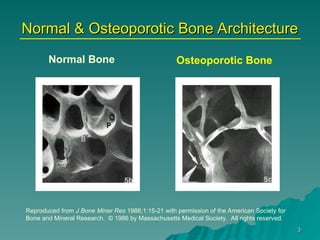
What is Osteoporosis?
A condition in which the infrastructure
of bone becomes thin and weakened.
Weakened bone is at higher risk for
fracture to occur from minimal
stresses.
stresses.
3
3
Normal & Osteoporotic Bone Architecture
Normal Bone Osteoporotic Bone
Reproduced from J Bone Miner Res 1986;1:15-21 with permission of the American Society for
Bone and Mineral Research. © 1986 by Massachusetts Medical Society. All rights reserved.
4
4
Who Gets Osteoporosis?
ANYONE could be at risk for Osteoporosis
 Most people are identified after age 50
Most people are identified after age 50
 Some diseases & conditions increase risk
Some diseases & conditions increase risk
 Even men & children are at risk
Even men & children are at risk
5
5
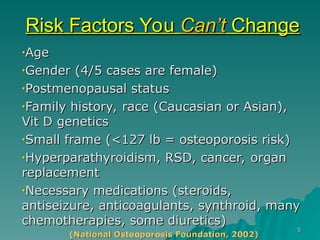
Risk Factors You
Risk Factors You Can’t
Can’t Change
Change
•
Age
Age
•
Gender (4/5 cases are female)
•
Postmenopausal status
•Family history, race (Caucasian or Asian),
Family history, race (Caucasian or Asian),
Vit D genetics
Vit D genetics
•Small frame (<127 lb = osteoporosis risk)
Small frame (<127 lb = osteoporosis risk)
•
Hyperparathyroidism, RSD, cancer, organ
replacement
replacement
•Necessary medications (steroids,
Necessary medications (steroids,
antiseizure, anticoagulants, synthroid, many
chemotherapies, some diuretics)
(National Osteoporosis Foundation, 2002)
6
6
Additional Risk Factors
Diseases that Are Often Treated with
Glucocorticoid Medications*
Asthma
Asthma
Bursitis
Bursitis
Crohn’s Disease
Crohn’s Disease
Chronic Active
Chronic Active
Hepatitis
Hepatitis
Dermatitis (Severe)
Dermatitis (Severe)
Glaucoma
Glaucoma
Lupus Erythematosus
Lupus Erythematosus
Multiple Sclerosis
Multiple Sclerosis
Osteoarthritis
Osteoarthritis
Psoriasis
Psoriasis
Rheumatoid Arthritis
*Partial List (National Osteoporosis Foundation, 2002)
7
7
Risk Factors You
Risk Factors You Can
Can Change
Change
• Diet – inadequate calcium and vitamin D,
Diet – inadequate calcium and vitamin D,
too much or too little protein
• Some bone-damaging medications
Some bone-damaging medications
• Unhealthy lifestyle choices
Unhealthy lifestyle choices
• Alcohol (more than 2 drinks/day)
Alcohol (more than 2 drinks/day)
• Smoking (any!)
Smoking (any!)
• Too little exercise
Too little exercise
• Under-eating (<127 lb = osteoporosis risk)
Under-eating (<127 lb = osteoporosis risk)
(National Osteoporosis Foundation, 2002)
8
8
Age in Years
10 20 30 40 50 60 70 80 90
Active
Growth
Slow
Loss
Rapid
Loss
Less Rapid
Loss
 Bones build mass beginning at birth and peak by
Bones build mass beginning at birth and peak by
age 20-30
age 20-30
 Peak bone mass is attained between 25 & 30 y/o
• 50% accrued during teen years
• Declines by 1 – 1.5%/ year after peak
• Declines by 3 – 5%/ year 1st
5 yr/ menopause
Bone Development
(National
Osteoporosis
Foundation, 2002)
9
9
Calcium and Bone
 Recommended daily calcium intake
Recommended daily calcium intake
• Children and Young Adults
Children and Young Adults
• 1-10 years
1-10 years 800 mgs
800 mgs
• 11-24 years
11-24 years 1,200 mgs
1,200 mgs
• Adults
Adults 1,000 mgs
1,000 mgs
• Pregnant and Lactating Women
Pregnant and Lactating Women 1,200 mgs
1,200 mgs
• Postmenopausal Women Not on ERT 1,500 mgs
Postmenopausal Women Not on ERT 1,500 mgs
• Men over the age of 65
Men over the age of 65 1,500 mgs
1,500 mgs
(National Osteoporosis Foundation, 2002)
 Excess
Excess salt displaces calcium
salt displaces calcium
– Is added to almost all
Is added to almost all canned foods
canned foods!
!
 High
High phosphates leach calcium
phosphates leach calcium from bone!
from bone!
– Soda
Soda – the worst culprit
– the worst culprit
10
10
Bone Nutrition - Beyond Calcium
 Vitamin D
Vitamin D
• At least 800 units daily
At least 800 units daily (Boonen S et al, 2006; Pfeifer M et al, 2002)
)
• 30 minutes of sun to hands & face daily sufficient in sub-tropical
30 minutes of sun to hands & face daily sufficient in sub-tropical
latitudes but only the “sunny” 6 months in temperate latitudes
 Magnesium
Magnesium
• 400-600/day
400-600/day – allows calcification as a natural calcium
– allows calcification as a natural calcium
chelator
chelator (Barzel US, 1998)
• Depleted by stress, physical exertion
Depleted by stress, physical exertion
 Protein Intake and Bone - moderation is the key
oderation is the key
• Women (35-59 y/o) w/ protein intake >95g/day (5 servings red
Women (35-59 y/o) w/ protein intake >95g/day (5 servings red
meat/wk) vs those <59 g/day had increased risk of forearm fractures
(Feskanich D et al, 1996)
• High amounts of protein intake (~200 g/day) associated with
High amounts of protein intake (~200 g/day) associated with
decreased bone density
decreased bone density (Barzel US 1998)
• Low protein diets (<50g/day) associated with decreased bone density
Low protein diets (<50g/day) associated with decreased bone density
(Chiu JF et al 1997)
11
11
Drug Options – FDA approved
 Anti-resorptives (slow bone resorption)
Anti-resorptives (slow bone resorption)
• Bisphosphonates (alendronate, risedronate,
Bisphosphonates (alendronate, risedronate,
ibandronate, pamidronate)
ibandronate, pamidronate) (Wasnich RD et al, 2004;
(Wasnich RD et al, 2004;
Chestnut III CH et al, 2004, Chan SS et al, 2004)
• Selective estrogen receptor modulators
Selective estrogen receptor modulators
(raloxifene)
(raloxifene)
• Calcitonin (Miacalcin)
Calcitonin (Miacalcin)
• Estrogen
Estrogen (Writing Group WHI, 2002; Nerhood RC 2001)
(Writing Group WHI, 2002; Nerhood RC 2001)
• Risks with long-term use may outweigh benefits,
Risks with long-term use may outweigh benefits,
may be safer with lower doses
• Always needs to be given with progesterone when
Always needs to be given with progesterone when
uterus present
uterus present
 Anabolic (bone forming)
Anabolic (bone forming)
• Parathyroid hormone (teraparatide)
Parathyroid hormone (teraparatide) (Heaney RP,
(Heaney RP,
2003)
2003)
12
12
Why Do Bones Weaken?
 Bones depend on calcium, other
Bones depend on calcium, other
chemicals, and vitamins to keep them
strong.
strong.
 Bones grow as a response to physical
Bones grow as a response to physical
stress being put on them.
 The density (hardness) of bones
The density (hardness) of bones
requires a good diet, some sunlight,
and exercise in order to stay strong
and not break.
and not break.
13
13
It’s a Big Problem
It’s a Big Problem
 Osteoporosis affects more than 10
Osteoporosis affects more than 10
million people in the US
8 million women
8 million women
2 million men (but they are catching up)
 24 million others have low bone
24 million others have low bone
mass, called osteopenia
 Osteopenia is a precursor to
Osteopenia is a precursor to
osteoporosis
osteoporosis
(National Osteoporosis Foundation, 2002)
14
14
Why is It a Problem?
 Osteoporosis, by itself, is not a
Osteoporosis, by itself, is not a
problem. It doesn’t cause pain and
you will not know you have it
you will not know you have it!
!
 The problem is that it makes bones
The problem is that it makes bones
very brittle and brittle bones can
break easily.
break easily.
 A broken bone is called a FRACTURE.
A broken bone is called a FRACTURE.
15
15
Fracture Numbers
Fracture Numbers
 Every year there are 1.5 million bone fractures in
Every year there are 1.5 million bone fractures in
this country
this country
300,000 hip fractures
700,000 vertebral fractures
250,000 wrist fractures
 Women have a greater lifetime risk of sustaining
Women have a greater lifetime risk of sustaining
a hip fracture than breast, ovarian , and uterine
cancer combined
cancer combined
 Fracture care costs
Fracture care costs $3 BILLION
$3 BILLION every year!
every year!
(National Osteoporosis Foundation, 2002)
16
16
Fractures HURT
Fractures HURT
Fractures cause:
Fractures cause:
 Pain
Pain
 Limited mobility
Limited mobility
• Prolonged bedrest causes:
Prolonged bedrest causes:
 Loss of strength
Loss of strength
 Pneumonia
Pneumonia
 Disability
Disability
 Death
Death
• 20% of those with hip fractures die within one year
20% of those with hip fractures die within one year
• Increased mortality with each vertebral fracture
Increased mortality with each vertebral fracture
(National Osteoporosis Foundation, 2002)
17
17
Determinants
Determinants of
of
Osteoporotic Fracture
 Number of
Number of
osteoporosis
osteoporosis
risk factors
risk factors
 Forward
Forward
bending
bending
(trunk flexion)
(trunk flexion)
 Poor balance,
Poor balance,
or accidents
or accidents
resulting in
resulting in
falls
falls
Vertebral Fracture Hip Fracture
18
18
Fracture Force Risks During
Bending and Lifting
 Compression loads imposed on
Compression loads imposed on
the L3 motion segment (lower
back) by
back) by 30º of trunk flexion
30º of trunk flexion
– 1800 N with
1800 N with arms at chest
arms at chest
– 2610 N with arms in front,
2610 N with arms in front, holding 2
holding 2
kg in each hand
kg in each hand (Schultz et al 1982
(Schultz et al 1982)
)
 300 to 1200 N enough to fracture
300 to 1200 N enough to fracture
an osteoporotic vertebra
an osteoporotic vertebra (Edmondston et
(Edmondston et
al 1997)
al 1997)
 Practical Application -
Practical Application - bend and
lift in everyday life with the trunk
in relative neutral!
19
19
Exercise and Vertebral Fractures
(for women with a previous fracture)
Type of Exercise
Type of Exercise
 Spinal Extension (Back
Spinal Extension (Back
arches/lifts)
arches/lifts)
 Spinal Flexion
Spinal Flexion
(Crunches)
(Crunches)
 Combined Flexion and
Combined Flexion and
Extension
Extension
 No exercise
No exercise
New Fractures
New Fractures
 16%
16%
 89%
89%
 53%
53%
 67%
67%
(Sinaki and Mikkelson, 1984)
20
20
How Do I Know if I Have It?
 There are many types of screening tests
There are many types of screening tests
available in the community. Many use a
finger or a foot to estimate possible risk.
 The gold standard (the absolute test) for
The gold standard (the absolute test) for
determining the amount of bone density
an individual has is a
an individual has is a DEXA test
DEXA test. It is like
. It is like
an X-ray without the radiation.
 You lie on a table and a scanner passes
You lie on a table and a scanner passes
over you. A computer determines how
much bone you have by the information
read by the scanner.
21
21
What’s a T-score?
What’s a T-score?
 The amount of bone you have is
The amount of bone you have is
determined by how much has been lost
since childhood, assuming you had lots of
calcium and activity at that time
 A T-score is a statistical number which
A T-score is a statistical number which
says whether you are above or below
“normal”
“normal”
 T-scores are such numbers as -1.4 or -3.0
T-scores are such numbers as -1.4 or -3.0
or even + 1.0 sometimes.
22
22
T-scores
T-scores
 Normal T-scores range from +1 to -1
Normal T-scores range from +1 to -1
 Osteopenia
Osteopenia T-scores
T-scores
-1.0 to -2.5
-1.0 to -2.5
 Osteoporosis
Osteoporosis T-score
T-score
less than -2.5
less than -2.5 (up to -6.0)
(up to -6.0)
23
23
What Should I Do First?
There are 3 major things you can do
1.
1. Talk to your
Talk to your doctor
doctor about a Bone Density
about a Bone Density
Test
Test
2.
2. Talk to a
Talk to a physical therapist
physical therapist about your
about your
activity level and an exercise program to
combat osteoporosis
combat osteoporosis
3.
3. Talk to a
Talk to a dietician
dietician to make sure your diet
to make sure your diet
is providing your bones with enough
calcium and is balanced correctly
24
24
What If I Already Have Osteoporosis?
 Talk to your physician and pharmacist
Talk to your physician and pharmacist
about
about medications
medications available to help you
available to help you
 Make sure your
Make sure your diet
diet includes enough
includes enough
calcium, not too much caffeine or alcohol,
and adequate, but not excessive, protein.
 Spend at least 30 minutes/day in sunlight
Spend at least 30 minutes/day in sunlight
and/or eat foods which are fortified with
Vitamin D
Vitamin D
 and………………..
and………………..
25
25
See a Physical Therapist
 PTs are able to develop an exercise
PTs are able to develop an exercise
program for you that will be appropriate
for your condition
for your condition
 PTs will evaluate your posture, your
PTs will evaluate your posture, your
strength, your range of motion, your
balance, and your general endurance
status
status
 PTs will develop a balanced program which
PTs will develop a balanced program which
should help keep you fit as well as safe
 PTs can answer your questions or refer
PTs can answer your questions or refer
you to others who will
26
26
Studies on Exercise
Studies on Exercise
 Appropriate exercise may slow the
Appropriate exercise may slow the
rate of bone loss
rate of bone loss
 Sedentary lifestyles and immobility
Sedentary lifestyles and immobility
lower bone density
lower bone density
 Effects of exercise are improved
Effects of exercise are improved
when combined with proper nutrition
and medication
and medication
27
27
Exercise Effect on Bone –
Works only when “Regular”
 Postmenopausal women exercised
Postmenopausal women exercised
3 times per week for 9 months
 Stair-climbing for ~ 30 minutes
Stair-climbing for ~ 30 minutes
each session
each session
 Spinal bone density
Spinal bone density 
 4% in
4% in
exercisers
exercisers
 Spinal bone density
Spinal bone density 
 to baseline
to baseline
within 9 months for those who
stopped exercising
stopped exercising
(Dalsky 1988)
28
28
Resistance Training
Increases Bone Density Best
 Landmark study (
Landmark study (Nelson & Fiaterone 1994)
Nelson & Fiaterone 1994)
– Sedentary 50-70 y/o postmenopausal women
Sedentary 50-70 y/o postmenopausal women
– Resistance training 2 X/wk on 5 machines for 1
Resistance training 2 X/wk on 5 machines for 1
year
year
– Significant bone density increases in spine, hip,
Significant bone density increases in spine, hip,
total body
total body
 Many other studies validate, including:
Many other studies validate, including:
– Cussler EC 2003
Cussler EC 2003
– Kerr D 2001
Kerr D 2001
– Kelley GA 2001
Kelley GA 2001
29
29
Principles of Exercise for
People with Lowered Bone Mass
 Posture
Posture is critical in all activities
is critical in all activities
 Weight bearing
Weight bearing is important
is important
Walking, Dancing, Stair climbing
 Resistance exercise
Resistance exercise is the best way
is the best way
to strengthen bone & muscle groups
 Balance exercise
Balance exercise to decrease fall risk
to decrease fall risk
 Avoid activities or positions that
Avoid activities or positions that
move the body into bent (flexed)
postures
postures
30
30
Exercise Intervention Works
 After Vertebral fracture
After Vertebral fracture
– 6 months of supervised exercise
6 months of supervised exercise 
 back strength
back strength
and psychological status
and psychological status (Gold et al:
(Gold et al: 2004)
2004)
 For kyphosis and balance
For kyphosis and balance
– 12 weeks of SAFE yoga (
12 weeks of SAFE yoga (no forward bending!!!
no forward bending!!!)
)
improves balance & posture
improves balance & posture (Greendale et al, 2002)
(Greendale et al, 2002)
 For osteoporosis and back pain
For osteoporosis and back pain
– 10 weeks of combination group and
10 weeks of combination group and
individual exercise increases height,
improves back posture and strength
improves back posture and strength (Lindsey
(Lindsey
et al, 1995)
et al, 1995)
31
31
Eclectic Treatment Focus Essential
 Frailty Injury Cooperative Interventions
Frailty Injury Cooperative Interventions
Trial Analysis revealed that a year after
the intervention:
the intervention:
– Fall rate decreased
Fall rate decreased 10%
10% in those who did
in those who did
strength
strength exercises only
exercises only
– Fall rate decreased by
Fall rate decreased by 17%
17% in those who
in those who
received
received “balance” exercises
“balance” exercises only
only
– Fall rate decreased by
Fall rate decreased by 31%
31% in those who did
in those who did
both plus the Tai Chi.
(Wolfson L et al: Balance and strength training in older adults:
intervention gains and Tai Chi maintenance. 1996)
– Those who increase
Those who increase all balance scores
all balance scores
show a
show a 60%
60% reduction in fall risk.
reduction in fall risk.
(Tinetti ME et al: A multifactorial intervention to reduce the risk of
falling among elderly people living in the community. 1994)
32
32
Prevention of Bone Loss and
Minimizing Fracture Risk
 Healthy lifestyle choices
Healthy lifestyle choices
– Exercise
Exercise
– Nutrition
Nutrition
 Early treatment
Early treatment
– Screening
Screening
– Individualized therapies
Individualized therapies
 Physical Therapy
Physical Therapy
– Resistive weight bearing exercise
Resistive weight bearing exercise
– Correct body mechanics
Correct body mechanics
– Balance interventions
Balance interventions
– Treat mechanical pain & dysfunction
Treat mechanical pain & dysfunction
See a Physical Therapist
for More Details!
for More Details!
http://www.apta.org
http://www.apta.org
Click the “Find a PT” button
34
34
Find Out More About Osteoporosis
Web sites for up to date information:
www.geriatricspt.org/clients/resources.cfm
www.nof.org
www.nof.org
www.surgeongeneral/library/bonehealth
www.osteo.org
www.osteo.org
www.fore.org
www.fore.org
35
35
References
References
1.
1. Barzel US, Massey LK. Excess dietary protein can adversely affect bone.
Barzel US, Massey LK. Excess dietary protein can adversely affect bone. J
J
Nutr.
Nutr. Jun 1998;128(6):1051-1053.
Jun 1998;128(6):1051-1053.
2.
2. Boonen S, Vanderschueren D, Haentjens P, Lips P. Calcium and vitamin D
Boonen S, Vanderschueren D, Haentjens P, Lips P. Calcium and vitamin D
in the prevention and treatment of osteoporosis - a clinical update.
in the prevention and treatment of osteoporosis - a clinical update. J Intern
J Intern
Med.
Med. Jun 2006;259(6):539-552.
Jun 2006;259(6):539-552.
3.
3. Chan SS, Nery LM, McElduff A, et al. Intravenous pamidronate in the
Chan SS, Nery LM, McElduff A, et al. Intravenous pamidronate in the
treatment and prevention of osteoporosis.
treatment and prevention of osteoporosis. Intern Med J.
Intern Med J. Apr
Apr
2004;34(4):162-166.
2004;34(4):162-166.
4.
4. Chesnut III CH, Skag A, Christiansen C, et al. Effects of oral ibandronate
Chesnut III CH, Skag A, Christiansen C, et al. Effects of oral ibandronate
administered daily or intermittently on fracture risk in postmenopausal
osteoporosis.
osteoporosis. J Bone Miner Res.
J Bone Miner Res. Aug 2004;19(8):1241-1249.
Aug 2004;19(8):1241-1249.
5.
5. Chiu JF, Lan SJ, Yang CY, et al. Long-term vegetarian diet and bone
Chiu JF, Lan SJ, Yang CY, et al. Long-term vegetarian diet and bone
mineral density in postmenopausal Taiwanese women.
mineral density in postmenopausal Taiwanese women. Calcif Tissue Int.
Calcif Tissue Int.
Mar 1997;60(3):245-249.
6.
6. Cussler EC, Lohman TG, Going SB, et al. Weight lifted in strength training
Cussler EC, Lohman TG, Going SB, et al. Weight lifted in strength training
predicts bone change in postmenopausal women.
predicts bone change in postmenopausal women. Med Sci Sports Exerc.
Med Sci Sports Exerc.
Jan 2003;35(1):10-17.
7.
7. Dalsky GP, Stocke KS, Ehsani AA, Slatopolsky E, Lee WC, Birge SJ Jr.
Dalsky GP, Stocke KS, Ehsani AA, Slatopolsky E, Lee WC, Birge SJ Jr.
Weight-bearing exercise training and lumbar bone mineral content in
postmenopausal women.
postmenopausal women. Ann Intern Med.
Ann Intern Med. Jun 1988;108(6):824-828.
Jun 1988;108(6):824-828.
8.
8. Edmondston SJ, Singer KP, Day RE, Price RI, Breidahl PD. Ex vivo
Edmondston SJ, Singer KP, Day RE, Price RI, Breidahl PD. Ex vivo
estimation of thoracolumbar vertebral body compressive strength: the
relative contributions of bone densitometry and vertebral morphometry.
Osteoporos Int.
Osteoporos Int. 1997;7(2):142-148.
1997;7(2):142-148.
9.
9. Feskanich D, Willett WC, Stampfer MJ, Colditz GA. Protein consumption and
Feskanich D, Willett WC, Stampfer MJ, Colditz GA. Protein consumption and
bone fractures in women.
bone fractures in women. Am J Epidemiol.
Am J Epidemiol. Mar 1 1996;143(5):472-479.
Mar 1 1996;143(5):472-479.
36
36
References (Cont)
References (Cont)
10.Gold DT, Shipp KM, Pieper CF, Duncan PW, Martinez S, Lyles KW. Group
treatment improves trunk strength and psychological status in older
women with vertebral fractures: results of a randomized, clinical trial.
women with vertebral fractures: results of a randomized, clinical trial. J Am
J Am
Geriatr Soc.
Geriatr Soc. Sep 2004;52(9):1471-1478.
Sep 2004;52(9):1471-1478.
11.Greendale GA, McDivit A, Carpenter A, Seeger L, Huang MH. Yoga for
women with hyperkyphosis: results of a pilot study.
women with hyperkyphosis: results of a pilot study. Am J Public Health.
Am J Public Health.
Oct 2002;92(10):1611-1614.
12.Heaney RP. Advances in therapy for osteoporosis.
12.Heaney RP. Advances in therapy for osteoporosis. Clin Med Res.
Clin Med Res. Apr
Apr
2003;1(2):93-99.
2003;1(2):93-99.
13.Herbold NH, Frates SE. Update of nutrition guidelines for the teen: trends
and concerns.
and concerns. Curr Opin Pediatr.
Curr Opin Pediatr. Aug 2000;12(4):303-309.
Aug 2000;12(4):303-309.
14.Kelley GA, Kelley KS, Tran ZV. Resistance training and bone mineral
density in women: a meta-analysis of controlled trials.
density in women: a meta-analysis of controlled trials. Am J Phys Med
Am J Phys Med
Rehabil.
Rehabil. Jan 2001;80(1):65-77.
Jan 2001;80(1):65-77.
15.Kelley GA, Kelley KS, Tran ZV. Exercise and lumbar spine bone mineral
density in postmenopausal women: a meta-analysis of individual patient
data.
data. J Gerontol A Biol Sci Med Sci.
J Gerontol A Biol Sci Med Sci. Sep 2002;57(9):M599-604.
Sep 2002;57(9):M599-604.
16.Kerr D, Ackland T, Maslen B, Morton A, Prince R. Resistance training over 2
years increases bone mass in calcium-replete postmenopausal women.
years increases bone mass in calcium-replete postmenopausal women. J
J
Bone Miner Res.
Bone Miner Res. Jan 2001;16(1):175-181.
Jan 2001;16(1):175-181.
17.Lindsey C, Reisine S, Fertig J. Evaluation for the effects of exercise on
posture, back strength, pain & mood in postmenopausal women with
osteoporosis & back pain. Paper presented at: WCPT, 1995; Washington,
DC.
DC.
18.National_Osteoporosis_Foundation.
18.National_Osteoporosis_Foundation. America's Bone Health: The
America's Bone Health: The
State of Osteoporosis and Low Bone Mass in Our Nation.
Washington, DC: National Osteoporosis Foundation; 2002.
37
37
References (cont)
References (cont)
19.
19.Nelson ME, Fiatarone MA, Morganti CM, Greenberg RA, Evans WJ. Effects of
Nelson ME, Fiatarone MA, Morganti CM, Greenberg RA, Evans WJ. Effects of
high-intensity strength training on multiple risk factors for osteoporotic
fractures: a randomized controlled trial.
fractures: a randomized controlled trial. JAMA.
JAMA. Dec 28 1994;272(24):1909-
Dec 28 1994;272(24):1909-
1914.
1914.
20.
20.Schultz AB, Andersson GBJ, Haderspeck K, et. al.
Schultz AB, Andersson GBJ, Haderspeck K, et. al. Analysis and
Analysis and
measurement of lumbar trunk loads in tasks involving bends and twists.
measurement of lumbar trunk loads in tasks involving bends and twists. J
J
Biomechanics.
Biomechanics. 1982;15(9):669-675.
1982;15(9):669-675.
21.
21.Sinaki M, Itoi E, Wahner HW, et al. Stronger back muscles reduce the
Sinaki M, Itoi E, Wahner HW, et al. Stronger back muscles reduce the
incidence of vertebral fractures: a prospective 10 year follow-up of
postmenopausal women.
postmenopausal women. Bone.
Bone. Jun 2002;30(6):836-841.
Jun 2002;30(6):836-841.
22.
22.Sinaki M, Mikkelsen BA. Postmenopausal spinal osteoporosis: flexion versus
Sinaki M, Mikkelsen BA. Postmenopausal spinal osteoporosis: flexion versus
extension exercises.
extension exercises. Arch Phys Med Rehabil.
Arch Phys Med Rehabil. Oct 1984;65(10):593-596.
Oct 1984;65(10):593-596.
23.
23.Tinetti ME, Baker DI, McAvay G, et al. A multifactorial intervention to reduce
Tinetti ME, Baker DI, McAvay G, et al. A multifactorial intervention to reduce
the risk of falling among elderly people living in the community.
the risk of falling among elderly people living in the community. N Engl J
N Engl J
Med.
Med. Sep 29 1994;331(13):821-827.
Sep 29 1994;331(13):821-827.
24.
24.Wasnich RD, Bagger YZ, Hosking DJ, et al.
Wasnich RD, Bagger YZ, Hosking DJ, et al. Changes in bone density and
Changes in bone density and
turnover after alendronate or estrogen withdrawal.
turnover after alendronate or estrogen withdrawal. Menopause.
Menopause. Nov-Dec
Nov-Dec
2004;11((6 Pt 1)):622-630.
25.
25.Wolfson L, Whipple R, Derby C, et al. Balance and strength training in older
Wolfson L, Whipple R, Derby C, et al. Balance and strength training in older
adults: intervention gains and Tai Chi maintenance.
adults: intervention gains and Tai Chi maintenance. J Am Geriatr Soc.
J Am Geriatr Soc. May
May
1996;44(5):498-506.
1996;44(5):498-506.
26.
26.Writing Group for the Women's Health Initiative Investigators. Risks and
Writing Group for the Women's Health Initiative Investigators. Risks and
benefits of estrogen plus progestin in healthy postmenopausal women:
principal results From the Women's Health Initiative randomized controlled
trial.
trial. JAMA.
JAMA. Jul 17 2002;288(3):321-333.
Jul 17 2002;288(3):321-333.

osteorprosis power point presentation.ppt

  • 1.
  • 2.
    2 2 What is Osteoporosis? Whatis Osteoporosis? A condition in which the infrastructure A condition in which the infrastructure of bone becomes thin and weakened. of bone becomes thin and weakened. Weakened bone is at higher risk for Weakened bone is at higher risk for fracture to occur from minimal fracture to occur from minimal stresses. stresses.
  • 3.
    3 3 Normal & OsteoporoticBone Architecture Normal & Osteoporotic Bone Architecture Normal Bone Osteoporotic Bone Reproduced from J Bone Miner Res 1986;1:15-21 with permission of the American Society for Bone and Mineral Research. © 1986 by Massachusetts Medical Society. All rights reserved.
  • 4.
    4 4 Who Gets Osteoporosis? WhoGets Osteoporosis? ANYONE could be at risk for Osteoporosis ANYONE could be at risk for Osteoporosis  Most people are identified after age 50 Most people are identified after age 50  Some diseases & conditions increase risk Some diseases & conditions increase risk  Even men & children are at risk Even men & children are at risk
  • 5.
    5 5 Risk Factors You RiskFactors You Can’t Can’t Change Change • Age Age • Gender (4/5 cases are female) Gender (4/5 cases are female) • Postmenopausal status Postmenopausal status •Family history, race (Caucasian or Asian), Family history, race (Caucasian or Asian), Vit D genetics Vit D genetics •Small frame (<127 lb = osteoporosis risk) Small frame (<127 lb = osteoporosis risk) • Hyperparathyroidism, RSD, cancer, organ Hyperparathyroidism, RSD, cancer, organ replacement replacement •Necessary medications (steroids, Necessary medications (steroids, antiseizure, anticoagulants, synthroid, many antiseizure, anticoagulants, synthroid, many chemotherapies, some diuretics) chemotherapies, some diuretics) (National Osteoporosis Foundation, 2002)
  • 6.
    6 6 Additional Risk Factors AdditionalRisk Factors Diseases that Are Often Treated with Glucocorticoid Medications* Asthma Asthma Bursitis Bursitis Crohn’s Disease Crohn’s Disease Chronic Active Chronic Active Hepatitis Hepatitis Dermatitis (Severe) Dermatitis (Severe) Glaucoma Glaucoma Lupus Erythematosus Lupus Erythematosus Multiple Sclerosis Multiple Sclerosis Osteoarthritis Osteoarthritis Psoriasis Psoriasis Rheumatoid Arthritis Rheumatoid Arthritis *Partial List (National Osteoporosis Foundation, 2002)
  • 7.
    7 7 Risk Factors You RiskFactors You Can Can Change Change • Diet – inadequate calcium and vitamin D, Diet – inadequate calcium and vitamin D, too much or too little protein too much or too little protein • Some bone-damaging medications Some bone-damaging medications • Unhealthy lifestyle choices Unhealthy lifestyle choices • Alcohol (more than 2 drinks/day) Alcohol (more than 2 drinks/day) • Smoking (any!) Smoking (any!) • Too little exercise Too little exercise • Under-eating (<127 lb = osteoporosis risk) Under-eating (<127 lb = osteoporosis risk) (National Osteoporosis Foundation, 2002)
  • 8.
    8 8 Age in Years 1020 30 40 50 60 70 80 90 Active Growth Slow Loss Rapid Loss Less Rapid Loss  Bones build mass beginning at birth and peak by Bones build mass beginning at birth and peak by age 20-30 age 20-30  Peak bone mass is attained between 25 & 30 y/o • 50% accrued during teen years • Declines by 1 – 1.5%/ year after peak • Declines by 3 – 5%/ year 1st 5 yr/ menopause Bone Development (National Osteoporosis Foundation, 2002)
  • 9.
    9 9 Calcium and Bone Recommended daily calcium intake Recommended daily calcium intake • Children and Young Adults Children and Young Adults • 1-10 years 1-10 years 800 mgs 800 mgs • 11-24 years 11-24 years 1,200 mgs 1,200 mgs • Adults Adults 1,000 mgs 1,000 mgs • Pregnant and Lactating Women Pregnant and Lactating Women 1,200 mgs 1,200 mgs • Postmenopausal Women Not on ERT 1,500 mgs Postmenopausal Women Not on ERT 1,500 mgs • Men over the age of 65 Men over the age of 65 1,500 mgs 1,500 mgs (National Osteoporosis Foundation, 2002)  Excess Excess salt displaces calcium salt displaces calcium – Is added to almost all Is added to almost all canned foods canned foods! !  High High phosphates leach calcium phosphates leach calcium from bone! from bone! – Soda Soda – the worst culprit – the worst culprit
  • 10.
    10 10 Bone Nutrition -Beyond Calcium  Vitamin D Vitamin D • At least 800 units daily At least 800 units daily (Boonen S et al, 2006; Pfeifer M et al, 2002) ) • 30 minutes of sun to hands & face daily sufficient in sub-tropical 30 minutes of sun to hands & face daily sufficient in sub-tropical latitudes but only the “sunny” 6 months in temperate latitudes latitudes but only the “sunny” 6 months in temperate latitudes  Magnesium Magnesium • 400-600/day 400-600/day – allows calcification as a natural calcium – allows calcification as a natural calcium chelator chelator (Barzel US, 1998) • Depleted by stress, physical exertion Depleted by stress, physical exertion  Protein Intake and Bone - moderation is the key oderation is the key • Women (35-59 y/o) w/ protein intake >95g/day (5 servings red Women (35-59 y/o) w/ protein intake >95g/day (5 servings red meat/wk) vs those <59 g/day had increased risk of forearm fractures meat/wk) vs those <59 g/day had increased risk of forearm fractures (Feskanich D et al, 1996) • High amounts of protein intake (~200 g/day) associated with High amounts of protein intake (~200 g/day) associated with decreased bone density decreased bone density (Barzel US 1998) • Low protein diets (<50g/day) associated with decreased bone density Low protein diets (<50g/day) associated with decreased bone density (Chiu JF et al 1997)
  • 11.
    11 11 Drug Options –FDA approved  Anti-resorptives (slow bone resorption) Anti-resorptives (slow bone resorption) • Bisphosphonates (alendronate, risedronate, Bisphosphonates (alendronate, risedronate, ibandronate, pamidronate) ibandronate, pamidronate) (Wasnich RD et al, 2004; (Wasnich RD et al, 2004; Chestnut III CH et al, 2004, Chan SS et al, 2004) Chestnut III CH et al, 2004, Chan SS et al, 2004) • Selective estrogen receptor modulators Selective estrogen receptor modulators (raloxifene) (raloxifene) • Calcitonin (Miacalcin) Calcitonin (Miacalcin) • Estrogen Estrogen (Writing Group WHI, 2002; Nerhood RC 2001) (Writing Group WHI, 2002; Nerhood RC 2001) • Risks with long-term use may outweigh benefits, Risks with long-term use may outweigh benefits, may be safer with lower doses may be safer with lower doses • Always needs to be given with progesterone when Always needs to be given with progesterone when uterus present uterus present  Anabolic (bone forming) Anabolic (bone forming) • Parathyroid hormone (teraparatide) Parathyroid hormone (teraparatide) (Heaney RP, (Heaney RP, 2003) 2003)
  • 12.
    12 12 Why Do BonesWeaken? Why Do Bones Weaken?  Bones depend on calcium, other Bones depend on calcium, other chemicals, and vitamins to keep them chemicals, and vitamins to keep them strong. strong.  Bones grow as a response to physical Bones grow as a response to physical stress being put on them. stress being put on them.  The density (hardness) of bones The density (hardness) of bones requires a good diet, some sunlight, requires a good diet, some sunlight, and exercise in order to stay strong and exercise in order to stay strong and not break. and not break.
  • 13.
    13 13 It’s a BigProblem It’s a Big Problem  Osteoporosis affects more than 10 Osteoporosis affects more than 10 million people in the US million people in the US 8 million women 8 million women 2 million men (but they are catching up) 2 million men (but they are catching up)  24 million others have low bone 24 million others have low bone mass, called osteopenia mass, called osteopenia  Osteopenia is a precursor to Osteopenia is a precursor to osteoporosis osteoporosis (National Osteoporosis Foundation, 2002)
  • 14.
    14 14 Why is Ita Problem? Why is It a Problem?  Osteoporosis, by itself, is not a Osteoporosis, by itself, is not a problem. It doesn’t cause pain and problem. It doesn’t cause pain and you will not know you have it you will not know you have it! !  The problem is that it makes bones The problem is that it makes bones very brittle and brittle bones can very brittle and brittle bones can break easily. break easily.  A broken bone is called a FRACTURE. A broken bone is called a FRACTURE.
  • 15.
    15 15 Fracture Numbers Fracture Numbers Every year there are 1.5 million bone fractures in Every year there are 1.5 million bone fractures in this country this country 300,000 hip fractures 300,000 hip fractures 700,000 vertebral fractures 700,000 vertebral fractures 250,000 wrist fractures 250,000 wrist fractures  Women have a greater lifetime risk of sustaining Women have a greater lifetime risk of sustaining a hip fracture than breast, ovarian , and uterine a hip fracture than breast, ovarian , and uterine cancer combined cancer combined  Fracture care costs Fracture care costs $3 BILLION $3 BILLION every year! every year! (National Osteoporosis Foundation, 2002)
  • 16.
    16 16 Fractures HURT Fractures HURT Fracturescause: Fractures cause:  Pain Pain  Limited mobility Limited mobility • Prolonged bedrest causes: Prolonged bedrest causes:  Loss of strength Loss of strength  Pneumonia Pneumonia  Disability Disability  Death Death • 20% of those with hip fractures die within one year 20% of those with hip fractures die within one year • Increased mortality with each vertebral fracture Increased mortality with each vertebral fracture (National Osteoporosis Foundation, 2002)
  • 17.
    17 17 Determinants Determinants of of Osteoporotic Fracture OsteoporoticFracture  Number of Number of osteoporosis osteoporosis risk factors risk factors  Forward Forward bending bending (trunk flexion) (trunk flexion)  Poor balance, Poor balance, or accidents or accidents resulting in resulting in falls falls Vertebral Fracture Hip Fracture
  • 18.
    18 18 Fracture Force RisksDuring Bending and Lifting  Compression loads imposed on Compression loads imposed on the L3 motion segment (lower the L3 motion segment (lower back) by back) by 30º of trunk flexion 30º of trunk flexion – 1800 N with 1800 N with arms at chest arms at chest – 2610 N with arms in front, 2610 N with arms in front, holding 2 holding 2 kg in each hand kg in each hand (Schultz et al 1982 (Schultz et al 1982) )  300 to 1200 N enough to fracture 300 to 1200 N enough to fracture an osteoporotic vertebra an osteoporotic vertebra (Edmondston et (Edmondston et al 1997) al 1997)  Practical Application - Practical Application - bend and lift in everyday life with the trunk in relative neutral!
  • 19.
    19 19 Exercise and VertebralFractures Exercise and Vertebral Fractures (for women with a previous fracture) (for women with a previous fracture) Type of Exercise Type of Exercise  Spinal Extension (Back Spinal Extension (Back arches/lifts) arches/lifts)  Spinal Flexion Spinal Flexion (Crunches) (Crunches)  Combined Flexion and Combined Flexion and Extension Extension  No exercise No exercise New Fractures New Fractures  16% 16%  89% 89%  53% 53%  67% 67% (Sinaki and Mikkelson, 1984) (Sinaki and Mikkelson, 1984)
  • 20.
    20 20 How Do IKnow if I Have It? How Do I Know if I Have It?  There are many types of screening tests There are many types of screening tests available in the community. Many use a available in the community. Many use a finger or a foot to estimate possible risk. finger or a foot to estimate possible risk.  The gold standard (the absolute test) for The gold standard (the absolute test) for determining the amount of bone density determining the amount of bone density an individual has is a an individual has is a DEXA test DEXA test. It is like . It is like an X-ray without the radiation. an X-ray without the radiation.  You lie on a table and a scanner passes You lie on a table and a scanner passes over you. A computer determines how over you. A computer determines how much bone you have by the information much bone you have by the information read by the scanner. read by the scanner.
  • 21.
    21 21 What’s a T-score? What’sa T-score?  The amount of bone you have is The amount of bone you have is determined by how much has been lost determined by how much has been lost since childhood, assuming you had lots of since childhood, assuming you had lots of calcium and activity at that time calcium and activity at that time  A T-score is a statistical number which A T-score is a statistical number which says whether you are above or below says whether you are above or below “normal” “normal”  T-scores are such numbers as -1.4 or -3.0 T-scores are such numbers as -1.4 or -3.0 or even + 1.0 sometimes. or even + 1.0 sometimes.
  • 22.
    22 22 T-scores T-scores  Normal T-scoresrange from +1 to -1 Normal T-scores range from +1 to -1  Osteopenia Osteopenia T-scores T-scores -1.0 to -2.5 -1.0 to -2.5  Osteoporosis Osteoporosis T-score T-score less than -2.5 less than -2.5 (up to -6.0) (up to -6.0)
  • 23.
    23 23 What Should IDo First? What Should I Do First? There are 3 major things you can do There are 3 major things you can do 1. 1. Talk to your Talk to your doctor doctor about a Bone Density about a Bone Density Test Test 2. 2. Talk to a Talk to a physical therapist physical therapist about your about your activity level and an exercise program to activity level and an exercise program to combat osteoporosis combat osteoporosis 3. 3. Talk to a Talk to a dietician dietician to make sure your diet to make sure your diet is providing your bones with enough is providing your bones with enough calcium and is balanced correctly calcium and is balanced correctly
  • 24.
    24 24 What If IAlready Have Osteoporosis? What If I Already Have Osteoporosis?  Talk to your physician and pharmacist Talk to your physician and pharmacist about about medications medications available to help you available to help you  Make sure your Make sure your diet diet includes enough includes enough calcium, not too much caffeine or alcohol, calcium, not too much caffeine or alcohol, and adequate, but not excessive, protein. and adequate, but not excessive, protein.  Spend at least 30 minutes/day in sunlight Spend at least 30 minutes/day in sunlight and/or eat foods which are fortified with and/or eat foods which are fortified with Vitamin D Vitamin D  and……………….. and………………..
  • 25.
    25 25 See a PhysicalTherapist See a Physical Therapist  PTs are able to develop an exercise PTs are able to develop an exercise program for you that will be appropriate program for you that will be appropriate for your condition for your condition  PTs will evaluate your posture, your PTs will evaluate your posture, your strength, your range of motion, your strength, your range of motion, your balance, and your general endurance balance, and your general endurance status status  PTs will develop a balanced program which PTs will develop a balanced program which should help keep you fit as well as safe should help keep you fit as well as safe  PTs can answer your questions or refer PTs can answer your questions or refer you to others who will you to others who will
  • 26.
    26 26 Studies on Exercise Studieson Exercise  Appropriate exercise may slow the Appropriate exercise may slow the rate of bone loss rate of bone loss  Sedentary lifestyles and immobility Sedentary lifestyles and immobility lower bone density lower bone density  Effects of exercise are improved Effects of exercise are improved when combined with proper nutrition when combined with proper nutrition and medication and medication
  • 27.
    27 27 Exercise Effect onBone – Exercise Effect on Bone – Works only when “Regular” Works only when “Regular”  Postmenopausal women exercised Postmenopausal women exercised 3 times per week for 9 months 3 times per week for 9 months  Stair-climbing for ~ 30 minutes Stair-climbing for ~ 30 minutes each session each session  Spinal bone density Spinal bone density   4% in 4% in exercisers exercisers  Spinal bone density Spinal bone density   to baseline to baseline within 9 months for those who within 9 months for those who stopped exercising stopped exercising (Dalsky 1988)
  • 28.
    28 28 Resistance Training Increases BoneDensity Best  Landmark study ( Landmark study (Nelson & Fiaterone 1994) Nelson & Fiaterone 1994) – Sedentary 50-70 y/o postmenopausal women Sedentary 50-70 y/o postmenopausal women – Resistance training 2 X/wk on 5 machines for 1 Resistance training 2 X/wk on 5 machines for 1 year year – Significant bone density increases in spine, hip, Significant bone density increases in spine, hip, total body total body  Many other studies validate, including: Many other studies validate, including: – Cussler EC 2003 Cussler EC 2003 – Kerr D 2001 Kerr D 2001 – Kelley GA 2001 Kelley GA 2001
  • 29.
    29 29 Principles of Exercisefor Principles of Exercise for People with Lowered Bone Mass People with Lowered Bone Mass  Posture Posture is critical in all activities is critical in all activities  Weight bearing Weight bearing is important is important Walking, Dancing, Stair climbing Walking, Dancing, Stair climbing  Resistance exercise Resistance exercise is the best way is the best way to strengthen bone & muscle groups to strengthen bone & muscle groups  Balance exercise Balance exercise to decrease fall risk to decrease fall risk  Avoid activities or positions that Avoid activities or positions that move the body into bent (flexed) move the body into bent (flexed) postures postures
  • 30.
    30 30 Exercise Intervention Works ExerciseIntervention Works  After Vertebral fracture After Vertebral fracture – 6 months of supervised exercise 6 months of supervised exercise   back strength back strength and psychological status and psychological status (Gold et al: (Gold et al: 2004) 2004)  For kyphosis and balance For kyphosis and balance – 12 weeks of SAFE yoga ( 12 weeks of SAFE yoga (no forward bending!!! no forward bending!!!) ) improves balance & posture improves balance & posture (Greendale et al, 2002) (Greendale et al, 2002)  For osteoporosis and back pain For osteoporosis and back pain – 10 weeks of combination group and 10 weeks of combination group and individual exercise increases height, individual exercise increases height, improves back posture and strength improves back posture and strength (Lindsey (Lindsey et al, 1995) et al, 1995)
  • 31.
    31 31 Eclectic Treatment FocusEssential Eclectic Treatment Focus Essential  Frailty Injury Cooperative Interventions Frailty Injury Cooperative Interventions Trial Analysis revealed that a year after Trial Analysis revealed that a year after the intervention: the intervention: – Fall rate decreased Fall rate decreased 10% 10% in those who did in those who did strength strength exercises only exercises only – Fall rate decreased by Fall rate decreased by 17% 17% in those who in those who received received “balance” exercises “balance” exercises only only – Fall rate decreased by Fall rate decreased by 31% 31% in those who did in those who did both plus the Tai Chi. both plus the Tai Chi. (Wolfson L et al: Balance and strength training in older adults: (Wolfson L et al: Balance and strength training in older adults: intervention gains and Tai Chi maintenance. 1996) intervention gains and Tai Chi maintenance. 1996) – Those who increase Those who increase all balance scores all balance scores show a show a 60% 60% reduction in fall risk. reduction in fall risk. (Tinetti ME et al: A multifactorial intervention to reduce the risk of (Tinetti ME et al: A multifactorial intervention to reduce the risk of falling among elderly people living in the community. 1994) falling among elderly people living in the community. 1994)
  • 32.
    32 32 Prevention of BoneLoss and Minimizing Fracture Risk  Healthy lifestyle choices Healthy lifestyle choices – Exercise Exercise – Nutrition Nutrition  Early treatment Early treatment – Screening Screening – Individualized therapies Individualized therapies  Physical Therapy Physical Therapy – Resistive weight bearing exercise Resistive weight bearing exercise – Correct body mechanics Correct body mechanics – Balance interventions Balance interventions – Treat mechanical pain & dysfunction Treat mechanical pain & dysfunction
  • 33.
    See a PhysicalTherapist See a Physical Therapist for More Details! for More Details! http://www.apta.org http://www.apta.org Click the “Find a PT” button Click the “Find a PT” button
  • 34.
    34 34 Find Out MoreAbout Osteoporosis Find Out More About Osteoporosis Web sites for up to date information: Web sites for up to date information: www.geriatricspt.org/clients/resources.cfm www.geriatricspt.org/clients/resources.cfm www.nof.org www.nof.org www.surgeongeneral/library/bonehealth www.surgeongeneral/library/bonehealth www.osteo.org www.osteo.org www.fore.org www.fore.org
  • 35.
    35 35 References References 1. 1. Barzel US,Massey LK. Excess dietary protein can adversely affect bone. Barzel US, Massey LK. Excess dietary protein can adversely affect bone. J J Nutr. Nutr. Jun 1998;128(6):1051-1053. Jun 1998;128(6):1051-1053. 2. 2. Boonen S, Vanderschueren D, Haentjens P, Lips P. Calcium and vitamin D Boonen S, Vanderschueren D, Haentjens P, Lips P. Calcium and vitamin D in the prevention and treatment of osteoporosis - a clinical update. in the prevention and treatment of osteoporosis - a clinical update. J Intern J Intern Med. Med. Jun 2006;259(6):539-552. Jun 2006;259(6):539-552. 3. 3. Chan SS, Nery LM, McElduff A, et al. Intravenous pamidronate in the Chan SS, Nery LM, McElduff A, et al. Intravenous pamidronate in the treatment and prevention of osteoporosis. treatment and prevention of osteoporosis. Intern Med J. Intern Med J. Apr Apr 2004;34(4):162-166. 2004;34(4):162-166. 4. 4. Chesnut III CH, Skag A, Christiansen C, et al. Effects of oral ibandronate Chesnut III CH, Skag A, Christiansen C, et al. Effects of oral ibandronate administered daily or intermittently on fracture risk in postmenopausal administered daily or intermittently on fracture risk in postmenopausal osteoporosis. osteoporosis. J Bone Miner Res. J Bone Miner Res. Aug 2004;19(8):1241-1249. Aug 2004;19(8):1241-1249. 5. 5. Chiu JF, Lan SJ, Yang CY, et al. Long-term vegetarian diet and bone Chiu JF, Lan SJ, Yang CY, et al. Long-term vegetarian diet and bone mineral density in postmenopausal Taiwanese women. mineral density in postmenopausal Taiwanese women. Calcif Tissue Int. Calcif Tissue Int. Mar 1997;60(3):245-249. Mar 1997;60(3):245-249. 6. 6. Cussler EC, Lohman TG, Going SB, et al. Weight lifted in strength training Cussler EC, Lohman TG, Going SB, et al. Weight lifted in strength training predicts bone change in postmenopausal women. predicts bone change in postmenopausal women. Med Sci Sports Exerc. Med Sci Sports Exerc. Jan 2003;35(1):10-17. Jan 2003;35(1):10-17. 7. 7. Dalsky GP, Stocke KS, Ehsani AA, Slatopolsky E, Lee WC, Birge SJ Jr. Dalsky GP, Stocke KS, Ehsani AA, Slatopolsky E, Lee WC, Birge SJ Jr. Weight-bearing exercise training and lumbar bone mineral content in Weight-bearing exercise training and lumbar bone mineral content in postmenopausal women. postmenopausal women. Ann Intern Med. Ann Intern Med. Jun 1988;108(6):824-828. Jun 1988;108(6):824-828. 8. 8. Edmondston SJ, Singer KP, Day RE, Price RI, Breidahl PD. Ex vivo Edmondston SJ, Singer KP, Day RE, Price RI, Breidahl PD. Ex vivo estimation of thoracolumbar vertebral body compressive strength: the estimation of thoracolumbar vertebral body compressive strength: the relative contributions of bone densitometry and vertebral morphometry. relative contributions of bone densitometry and vertebral morphometry. Osteoporos Int. Osteoporos Int. 1997;7(2):142-148. 1997;7(2):142-148. 9. 9. Feskanich D, Willett WC, Stampfer MJ, Colditz GA. Protein consumption and Feskanich D, Willett WC, Stampfer MJ, Colditz GA. Protein consumption and bone fractures in women. bone fractures in women. Am J Epidemiol. Am J Epidemiol. Mar 1 1996;143(5):472-479. Mar 1 1996;143(5):472-479.
  • 36.
    36 36 References (Cont) References (Cont) 10.GoldDT, Shipp KM, Pieper CF, Duncan PW, Martinez S, Lyles KW. Group 10.Gold DT, Shipp KM, Pieper CF, Duncan PW, Martinez S, Lyles KW. Group treatment improves trunk strength and psychological status in older treatment improves trunk strength and psychological status in older women with vertebral fractures: results of a randomized, clinical trial. women with vertebral fractures: results of a randomized, clinical trial. J Am J Am Geriatr Soc. Geriatr Soc. Sep 2004;52(9):1471-1478. Sep 2004;52(9):1471-1478. 11.Greendale GA, McDivit A, Carpenter A, Seeger L, Huang MH. Yoga for 11.Greendale GA, McDivit A, Carpenter A, Seeger L, Huang MH. Yoga for women with hyperkyphosis: results of a pilot study. women with hyperkyphosis: results of a pilot study. Am J Public Health. Am J Public Health. Oct 2002;92(10):1611-1614. Oct 2002;92(10):1611-1614. 12.Heaney RP. Advances in therapy for osteoporosis. 12.Heaney RP. Advances in therapy for osteoporosis. Clin Med Res. Clin Med Res. Apr Apr 2003;1(2):93-99. 2003;1(2):93-99. 13.Herbold NH, Frates SE. Update of nutrition guidelines for the teen: trends 13.Herbold NH, Frates SE. Update of nutrition guidelines for the teen: trends and concerns. and concerns. Curr Opin Pediatr. Curr Opin Pediatr. Aug 2000;12(4):303-309. Aug 2000;12(4):303-309. 14.Kelley GA, Kelley KS, Tran ZV. Resistance training and bone mineral 14.Kelley GA, Kelley KS, Tran ZV. Resistance training and bone mineral density in women: a meta-analysis of controlled trials. density in women: a meta-analysis of controlled trials. Am J Phys Med Am J Phys Med Rehabil. Rehabil. Jan 2001;80(1):65-77. Jan 2001;80(1):65-77. 15.Kelley GA, Kelley KS, Tran ZV. Exercise and lumbar spine bone mineral 15.Kelley GA, Kelley KS, Tran ZV. Exercise and lumbar spine bone mineral density in postmenopausal women: a meta-analysis of individual patient density in postmenopausal women: a meta-analysis of individual patient data. data. J Gerontol A Biol Sci Med Sci. J Gerontol A Biol Sci Med Sci. Sep 2002;57(9):M599-604. Sep 2002;57(9):M599-604. 16.Kerr D, Ackland T, Maslen B, Morton A, Prince R. Resistance training over 2 16.Kerr D, Ackland T, Maslen B, Morton A, Prince R. Resistance training over 2 years increases bone mass in calcium-replete postmenopausal women. years increases bone mass in calcium-replete postmenopausal women. J J Bone Miner Res. Bone Miner Res. Jan 2001;16(1):175-181. Jan 2001;16(1):175-181. 17.Lindsey C, Reisine S, Fertig J. Evaluation for the effects of exercise on 17.Lindsey C, Reisine S, Fertig J. Evaluation for the effects of exercise on posture, back strength, pain & mood in postmenopausal women with posture, back strength, pain & mood in postmenopausal women with osteoporosis & back pain. Paper presented at: WCPT, 1995; Washington, osteoporosis & back pain. Paper presented at: WCPT, 1995; Washington, DC. DC. 18.National_Osteoporosis_Foundation. 18.National_Osteoporosis_Foundation. America's Bone Health: The America's Bone Health: The State of Osteoporosis and Low Bone Mass in Our Nation. State of Osteoporosis and Low Bone Mass in Our Nation. Washington, DC: National Osteoporosis Foundation; 2002. Washington, DC: National Osteoporosis Foundation; 2002.
  • 37.
    37 37 References (cont) References (cont) 19. 19.NelsonME, Fiatarone MA, Morganti CM, Greenberg RA, Evans WJ. Effects of Nelson ME, Fiatarone MA, Morganti CM, Greenberg RA, Evans WJ. Effects of high-intensity strength training on multiple risk factors for osteoporotic high-intensity strength training on multiple risk factors for osteoporotic fractures: a randomized controlled trial. fractures: a randomized controlled trial. JAMA. JAMA. Dec 28 1994;272(24):1909- Dec 28 1994;272(24):1909- 1914. 1914. 20. 20.Schultz AB, Andersson GBJ, Haderspeck K, et. al. Schultz AB, Andersson GBJ, Haderspeck K, et. al. Analysis and Analysis and measurement of lumbar trunk loads in tasks involving bends and twists. measurement of lumbar trunk loads in tasks involving bends and twists. J J Biomechanics. Biomechanics. 1982;15(9):669-675. 1982;15(9):669-675. 21. 21.Sinaki M, Itoi E, Wahner HW, et al. Stronger back muscles reduce the Sinaki M, Itoi E, Wahner HW, et al. Stronger back muscles reduce the incidence of vertebral fractures: a prospective 10 year follow-up of incidence of vertebral fractures: a prospective 10 year follow-up of postmenopausal women. postmenopausal women. Bone. Bone. Jun 2002;30(6):836-841. Jun 2002;30(6):836-841. 22. 22.Sinaki M, Mikkelsen BA. Postmenopausal spinal osteoporosis: flexion versus Sinaki M, Mikkelsen BA. Postmenopausal spinal osteoporosis: flexion versus extension exercises. extension exercises. Arch Phys Med Rehabil. Arch Phys Med Rehabil. Oct 1984;65(10):593-596. Oct 1984;65(10):593-596. 23. 23.Tinetti ME, Baker DI, McAvay G, et al. A multifactorial intervention to reduce Tinetti ME, Baker DI, McAvay G, et al. A multifactorial intervention to reduce the risk of falling among elderly people living in the community. the risk of falling among elderly people living in the community. N Engl J N Engl J Med. Med. Sep 29 1994;331(13):821-827. Sep 29 1994;331(13):821-827. 24. 24.Wasnich RD, Bagger YZ, Hosking DJ, et al. Wasnich RD, Bagger YZ, Hosking DJ, et al. Changes in bone density and Changes in bone density and turnover after alendronate or estrogen withdrawal. turnover after alendronate or estrogen withdrawal. Menopause. Menopause. Nov-Dec Nov-Dec 2004;11((6 Pt 1)):622-630. 2004;11((6 Pt 1)):622-630. 25. 25.Wolfson L, Whipple R, Derby C, et al. Balance and strength training in older Wolfson L, Whipple R, Derby C, et al. Balance and strength training in older adults: intervention gains and Tai Chi maintenance. adults: intervention gains and Tai Chi maintenance. J Am Geriatr Soc. J Am Geriatr Soc. May May 1996;44(5):498-506. 1996;44(5):498-506. 26. 26.Writing Group for the Women's Health Initiative Investigators. Risks and Writing Group for the Women's Health Initiative Investigators. Risks and benefits of estrogen plus progestin in healthy postmenopausal women: benefits of estrogen plus progestin in healthy postmenopausal women: principal results From the Women's Health Initiative randomized controlled principal results From the Women's Health Initiative randomized controlled trial. trial. JAMA. JAMA. Jul 17 2002;288(3):321-333. Jul 17 2002;288(3):321-333.

Editor's Notes

  • #8 Bone growth is promoted by adequate intake of calcium, vitamin D, protein and exercise