What Is Osteoporosis?
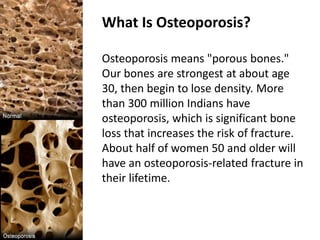
Osteoporosis means "porous bones."
Our bones are strongest at about age
30, then begin to lose density. More
than 300 million Indians have
osteoporosis, which is significant bone
loss that increases the risk of fracture.
About half of women 50 and older will
have an osteoporosis-related fracture in
their lifetime.
Symptoms of Osteoporosis
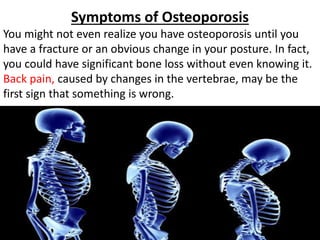
You might not even realize you have osteoporosis until you
have a fracture or an obvious change in your posture. In fact,
you could have significant bone loss without even knowing it.
Back pain, caused by changes in the vertebrae, may be the
first sign that something is wrong.
Osteoporosis and
Fractures
1. Osteoporosis is the underlying
cause of 1.5 million fractures every
year.
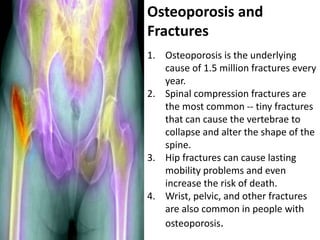
2. Spinal compression fractures are
the most common -- tiny fractures
that can cause the vertebrae to
collapse and alter the shape of the
spine.
3. Hip fractures can cause lasting
mobility problems and even
increase the risk of death.
4. Wrist, pelvic, and other fractures
are also common in people with
osteoporosis.
What Causes
Osteoporosis?
Our bones are constantly being
rebuilt throughout our lifetime.
Bones are made up of collagen, a
protein that provides the basic
framework, and calcium
phosphate, a mineral that hardens
the bone. As we age, we lose more
bone than we replace. The greatest
change in a woman's bone density
comes in the five to seven years
after menopause.
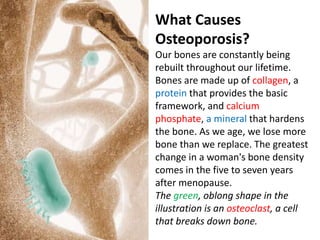
The green, oblong shape in the
illustration is an osteoclast, a cell
that breaks down bone.
Does Everyone Get
Osteoporosis?
1. Bone loss is a natural part of aging,
but not everyone will lose enough
bone density to develop osteoporosis.
However, the older you are, the
greater your chance of having
osteoporosis.
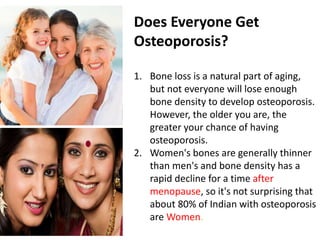
2. Women's bones are generally thinner
than men's and bone density has a
rapid decline for a time after
menopause, so it's not surprising that
about 80% of Indian with osteoporosis
are Women.
Risk Factors You Can't
Control
1. Women who are thin and have a
small frame are more likely to
develop osteoporosis.
2. Heredity plays a role, and so does
ethnicity.
3. It is more common among Whites
and Asians.
4. Some conditions, such as type 1
diabetes, rheumatoid arthritis,
inflammatory bowel disease, and
hormonal disorders are also linked
to bone loss.
Risk Factors You Can
Control
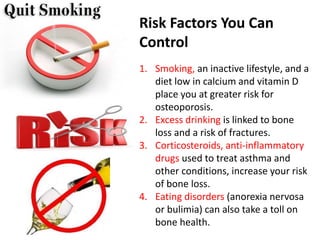
1. Smoking, an inactive lifestyle, and a
diet low in calcium and vitamin D
place you at greater risk for
osteoporosis.
2. Excess drinking is linked to bone
loss and a risk of fractures.
3. Corticosteroids, anti-inflammatory
drugs used to treat asthma and
other conditions, increase your risk
of bone loss.
4. Eating disorders (anorexia nervosa
or bulimia) can also take a toll on
bone health.
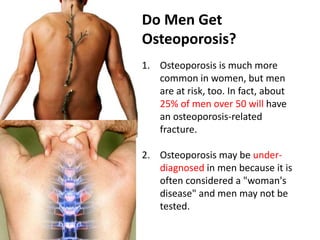
Do Men Get
Osteoporosis?
1. Osteoporosis is much more
common in women, but men
are at risk, too. In fact, about
25% of men over 50 will have
an osteoporosis-related
fracture.
2. Osteoporosis may be under-
diagnosed in men because it is
often considered a "woman's
disease" and men may not be
tested.
Testing: DXA Bone
Density Scan
Your doctor may recommend a bone
mineral density test if:
1. You're over 50 and have broken a
bone
2. You are a woman over 65, or a man
over 70
3. You are in menopause or past
menopause and have risk factors
4. You are a man age 50-69 with risk
factors
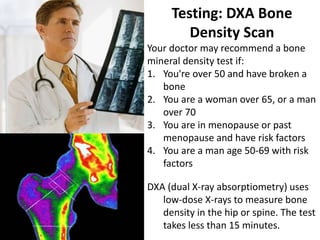
DXA (dual X-ray absorptiometry) uses
low-dose X-rays to measure bone
density in the hip or spine. The test
takes less than 15 minutes.
Testing: What Your
T-Score Means
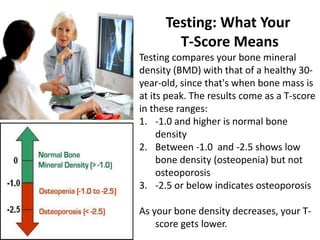
Testing compares your bone mineral
density (BMD) with that of a healthy 30-
year-old, since that's when bone mass is
at its peak. The results come as a T-score
in these ranges:
1. -1.0 and higher is normal bone
density
2. Between -1.0 and -2.5 shows low
bone density (osteopenia) but not
osteoporosis
3. -2.5 or below indicates osteoporosis
As your bone density decreases, your T-
score gets lower.
Treatment: Bone-Boosting
Drugs
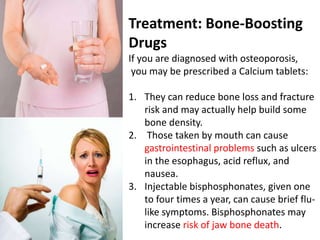
If you are diagnosed with osteoporosis,
you may be prescribed a Calcium tablets:
1. They can reduce bone loss and fracture
risk and may actually help build some
bone density.
2. Those taken by mouth can cause
gastrointestinal problems such as ulcers
in the esophagus, acid reflux, and
nausea.
3. Injectable bisphosphonates, given one
to four times a year, can cause brief flu-
like symptoms. Bisphosphonates may
increase risk of jaw bone death.
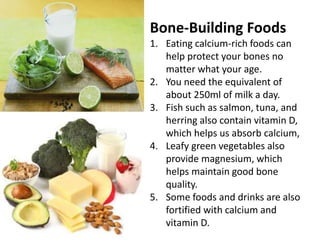
Bone-Building Foods
1. Eating calcium-rich foods can
help protect your bones no
matter what your age.
2. You need the equivalent of
about 250ml of milk a day.
3. Fish such as salmon, tuna, and
herring also contain vitamin D,
which helps us absorb calcium,
4. Leafy green vegetables also
provide magnesium, which
helps maintain good bone
quality.
5. Some foods and drinks are also
fortified with calcium and
vitamin D.
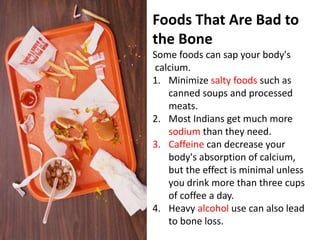
Foods That Are Bad to
the Bone
Some foods can sap your body's
calcium.
1. Minimize salty foods such as
canned soups and processed
meats.
2. Most Indians get much more
sodium than they need.
3. Caffeine can decrease your
body's absorption of calcium,
but the effect is minimal unless
you drink more than three cups
of coffee a day.
4. Heavy alcohol use can also lead
to bone loss.
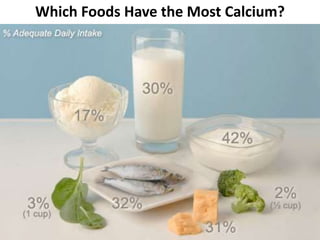
Which Foods Have the Most Calcium?
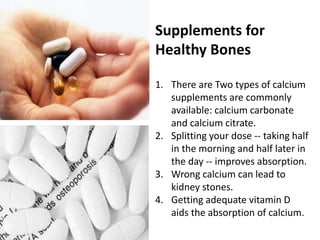
Supplements for
Healthy Bones
1. There are Two types of calcium
supplements are commonly
available: calcium carbonate
and calcium citrate.
2. Splitting your dose -- taking half
in the morning and half later in
the day -- improves absorption.
3. Wrong calcium can lead to
kidney stones.
4. Getting adequate vitamin D
aids the absorption of calcium.
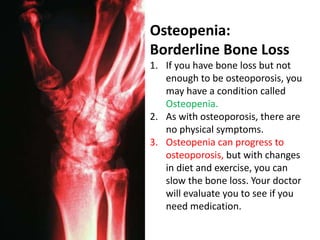
Osteopenia:
Borderline Bone Loss
1. If you have bone loss but not
enough to be osteoporosis, you
may have a condition called
Osteopenia.
2. As with osteoporosis, there are
no physical symptoms.
3. Osteopenia can progress to
osteoporosis, but with changes
in diet and exercise, you can
slow the bone loss. Your doctor
will evaluate you to see if you
need medication.
Here are the recommended daily
intakes for calcium by age:
Under 1 year: 200-260 mg
1-3 years: 700 mg
4-8 years: 1,000 mg
9-18 years: 1,300 mg
19-50 years : 1,000 mg
51-70 men: 1,000 mg
51+ women: 1,200 mg
71+ years: 1,200 mg
By age 30, the average woman
has built 98% of her peak bone
mass.
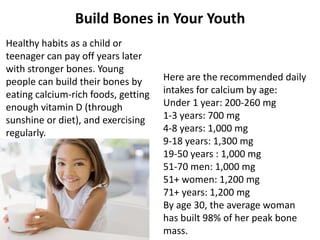
Healthy habits as a child or
teenager can pay off years later
with stronger bones. Young
people can build their bones by
eating calcium-rich foods, getting
enough vitamin D (through
sunshine or diet), and exercising
regularly.
Build Bones in Your Youth
It's Never Too Late for
Bone Health
1. Many people don't find out
about their bone loss until
they are in their 60s or older.
2. But you can still benefit from
boosting a low calcium intake
to recommended levels and
exercising regularly.
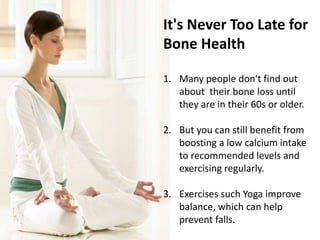
3. Exercises such Yoga improve
balance, which can help
prevent falls.
 Since it’s difficult to get the Recommended Daily
Allowance (RDA) from food alone,
Supplements are required.
(Currently, the RDA states that adult men and women up to
age 50 should consume 1,000 milligrams (mg) of calcium daily.
After age 50, women need 1,200 mg daily, while men remain
at 1,000 mg. After age 71, both men and women should aim
for 1,200 mg each day.)
Clearly, we need calcium to maintain
GOOD BONE HEALTH.
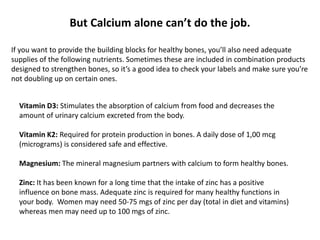
Vitamin D3: Stimulates the absorption of calcium from food and decreases the
amount of urinary calcium excreted from the body.
Vitamin K2: Required for protein production in bones. A daily dose of 1,00 mcg
(micrograms) is considered safe and effective.
Magnesium: The mineral magnesium partners with calcium to form healthy bones.
Zinc: It has been known for a long time that the intake of zinc has a positive
influence on bone mass. Adequate zinc is required for many healthy functions in
your body. Women may need 50-75 mgs of zinc per day (total in diet and vitamins)
whereas men may need up to 100 mgs of zinc.
But Calcium alone can’t do the job.
If you want to provide the building blocks for healthy bones, you’ll also need adequate
supplies of the following nutrients. Sometimes these are included in combination products
designed to strengthen bones, so it’s a good idea to check your labels and make sure you’re
not doubling up on certain ones.
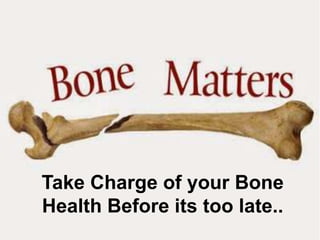
Take Charge of your Bone
Health Before its too late..
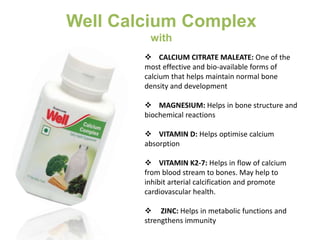
 CALCIUM CITRATE MALEATE: One of the
most effective and bio-available forms of
calcium that helps maintain normal bone
density and development
 MAGNESIUM: Helps in bone structure and
biochemical reactions
 VITAMIN D: Helps optimise calcium
absorption
 VITAMIN K2-7: Helps in flow of calcium
from blood stream to bones. May help to
inhibit arterial calcification and promote
cardiovascular health.
 ZINC: Helps in metabolic functions and
strengthens immunity
Well Calcium Complex
with
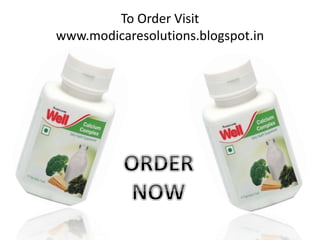
To Order Visit
www.modicaresolutions.blogspot.in

Prevent and Treat Osteoporosis 9769352147

  • 2.
    What Is Osteoporosis? Osteoporosismeans "porous bones." Our bones are strongest at about age 30, then begin to lose density. More than 300 million Indians have osteoporosis, which is significant bone loss that increases the risk of fracture. About half of women 50 and older will have an osteoporosis-related fracture in their lifetime.
  • 3.
    Symptoms of Osteoporosis Youmight not even realize you have osteoporosis until you have a fracture or an obvious change in your posture. In fact, you could have significant bone loss without even knowing it. Back pain, caused by changes in the vertebrae, may be the first sign that something is wrong.
  • 4.
    Osteoporosis and Fractures 1. Osteoporosisis the underlying cause of 1.5 million fractures every year. 2. Spinal compression fractures are the most common -- tiny fractures that can cause the vertebrae to collapse and alter the shape of the spine. 3. Hip fractures can cause lasting mobility problems and even increase the risk of death. 4. Wrist, pelvic, and other fractures are also common in people with osteoporosis.
  • 5.
    What Causes Osteoporosis? Our bonesare constantly being rebuilt throughout our lifetime. Bones are made up of collagen, a protein that provides the basic framework, and calcium phosphate, a mineral that hardens the bone. As we age, we lose more bone than we replace. The greatest change in a woman's bone density comes in the five to seven years after menopause. The green, oblong shape in the illustration is an osteoclast, a cell that breaks down bone.
  • 6.
    Does Everyone Get Osteoporosis? 1.Bone loss is a natural part of aging, but not everyone will lose enough bone density to develop osteoporosis. However, the older you are, the greater your chance of having osteoporosis. 2. Women's bones are generally thinner than men's and bone density has a rapid decline for a time after menopause, so it's not surprising that about 80% of Indian with osteoporosis are Women.
  • 7.
    Risk Factors YouCan't Control 1. Women who are thin and have a small frame are more likely to develop osteoporosis. 2. Heredity plays a role, and so does ethnicity. 3. It is more common among Whites and Asians. 4. Some conditions, such as type 1 diabetes, rheumatoid arthritis, inflammatory bowel disease, and hormonal disorders are also linked to bone loss.
  • 8.
    Risk Factors YouCan Control 1. Smoking, an inactive lifestyle, and a diet low in calcium and vitamin D place you at greater risk for osteoporosis. 2. Excess drinking is linked to bone loss and a risk of fractures. 3. Corticosteroids, anti-inflammatory drugs used to treat asthma and other conditions, increase your risk of bone loss. 4. Eating disorders (anorexia nervosa or bulimia) can also take a toll on bone health.
  • 9.
    Do Men Get Osteoporosis? 1.Osteoporosis is much more common in women, but men are at risk, too. In fact, about 25% of men over 50 will have an osteoporosis-related fracture. 2. Osteoporosis may be under- diagnosed in men because it is often considered a "woman's disease" and men may not be tested.
  • 10.
    Testing: DXA Bone DensityScan Your doctor may recommend a bone mineral density test if: 1. You're over 50 and have broken a bone 2. You are a woman over 65, or a man over 70 3. You are in menopause or past menopause and have risk factors 4. You are a man age 50-69 with risk factors DXA (dual X-ray absorptiometry) uses low-dose X-rays to measure bone density in the hip or spine. The test takes less than 15 minutes.
  • 11.
    Testing: What Your T-ScoreMeans Testing compares your bone mineral density (BMD) with that of a healthy 30- year-old, since that's when bone mass is at its peak. The results come as a T-score in these ranges: 1. -1.0 and higher is normal bone density 2. Between -1.0 and -2.5 shows low bone density (osteopenia) but not osteoporosis 3. -2.5 or below indicates osteoporosis As your bone density decreases, your T- score gets lower.
  • 12.
    Treatment: Bone-Boosting Drugs If youare diagnosed with osteoporosis, you may be prescribed a Calcium tablets: 1. They can reduce bone loss and fracture risk and may actually help build some bone density. 2. Those taken by mouth can cause gastrointestinal problems such as ulcers in the esophagus, acid reflux, and nausea. 3. Injectable bisphosphonates, given one to four times a year, can cause brief flu- like symptoms. Bisphosphonates may increase risk of jaw bone death.
  • 13.
    Bone-Building Foods 1. Eatingcalcium-rich foods can help protect your bones no matter what your age. 2. You need the equivalent of about 250ml of milk a day. 3. Fish such as salmon, tuna, and herring also contain vitamin D, which helps us absorb calcium, 4. Leafy green vegetables also provide magnesium, which helps maintain good bone quality. 5. Some foods and drinks are also fortified with calcium and vitamin D.
  • 14.
    Foods That AreBad to the Bone Some foods can sap your body's calcium. 1. Minimize salty foods such as canned soups and processed meats. 2. Most Indians get much more sodium than they need. 3. Caffeine can decrease your body's absorption of calcium, but the effect is minimal unless you drink more than three cups of coffee a day. 4. Heavy alcohol use can also lead to bone loss.
  • 15.
    Which Foods Havethe Most Calcium?
  • 16.
    Supplements for Healthy Bones 1.There are Two types of calcium supplements are commonly available: calcium carbonate and calcium citrate. 2. Splitting your dose -- taking half in the morning and half later in the day -- improves absorption. 3. Wrong calcium can lead to kidney stones. 4. Getting adequate vitamin D aids the absorption of calcium.
  • 17.
    Osteopenia: Borderline Bone Loss 1.If you have bone loss but not enough to be osteoporosis, you may have a condition called Osteopenia. 2. As with osteoporosis, there are no physical symptoms. 3. Osteopenia can progress to osteoporosis, but with changes in diet and exercise, you can slow the bone loss. Your doctor will evaluate you to see if you need medication.
  • 18.
    Here are therecommended daily intakes for calcium by age: Under 1 year: 200-260 mg 1-3 years: 700 mg 4-8 years: 1,000 mg 9-18 years: 1,300 mg 19-50 years : 1,000 mg 51-70 men: 1,000 mg 51+ women: 1,200 mg 71+ years: 1,200 mg By age 30, the average woman has built 98% of her peak bone mass. Healthy habits as a child or teenager can pay off years later with stronger bones. Young people can build their bones by eating calcium-rich foods, getting enough vitamin D (through sunshine or diet), and exercising regularly. Build Bones in Your Youth
  • 19.
    It's Never TooLate for Bone Health 1. Many people don't find out about their bone loss until they are in their 60s or older. 2. But you can still benefit from boosting a low calcium intake to recommended levels and exercising regularly. 3. Exercises such Yoga improve balance, which can help prevent falls.
  • 20.
     Since it’sdifficult to get the Recommended Daily Allowance (RDA) from food alone, Supplements are required. (Currently, the RDA states that adult men and women up to age 50 should consume 1,000 milligrams (mg) of calcium daily. After age 50, women need 1,200 mg daily, while men remain at 1,000 mg. After age 71, both men and women should aim for 1,200 mg each day.) Clearly, we need calcium to maintain GOOD BONE HEALTH.
  • 21.
    Vitamin D3: Stimulatesthe absorption of calcium from food and decreases the amount of urinary calcium excreted from the body. Vitamin K2: Required for protein production in bones. A daily dose of 1,00 mcg (micrograms) is considered safe and effective. Magnesium: The mineral magnesium partners with calcium to form healthy bones. Zinc: It has been known for a long time that the intake of zinc has a positive influence on bone mass. Adequate zinc is required for many healthy functions in your body. Women may need 50-75 mgs of zinc per day (total in diet and vitamins) whereas men may need up to 100 mgs of zinc. But Calcium alone can’t do the job. If you want to provide the building blocks for healthy bones, you’ll also need adequate supplies of the following nutrients. Sometimes these are included in combination products designed to strengthen bones, so it’s a good idea to check your labels and make sure you’re not doubling up on certain ones.
  • 22.
    Take Charge ofyour Bone Health Before its too late..
  • 23.
     CALCIUM CITRATEMALEATE: One of the most effective and bio-available forms of calcium that helps maintain normal bone density and development  MAGNESIUM: Helps in bone structure and biochemical reactions  VITAMIN D: Helps optimise calcium absorption  VITAMIN K2-7: Helps in flow of calcium from blood stream to bones. May help to inhibit arterial calcification and promote cardiovascular health.  ZINC: Helps in metabolic functions and strengthens immunity Well Calcium Complex with
  • 24.