Osteoporosis
Julie Zacharias Simpson DO
Touro University Nevada
Assistant Professor
January 20, 2018
Disclosure
• I have nothing to disclose.
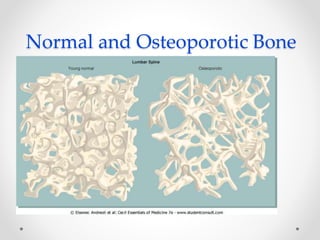
Normal and Osteoporotic Bone
Osteoporosis
Most common bone disorder
Compromised bone strength with
increased risk of fracture
40 million people world wide
33% of postmenopausal women have
osteoporosis and additional 54% of
postmenopausal women have low bone
density in hip, spine or wrist.
Osteoporosis
Affects 1 in 2 Caucasian ♀, 1 in 5 ♂
Female to male ratio is
 7:1 for vertebral fx
 1.5: 1 for distal forearm fx
 2:1 for hip fx
Greatest risk in white and Asian women
 Less risk in African American
 Not the same as risk for fracture
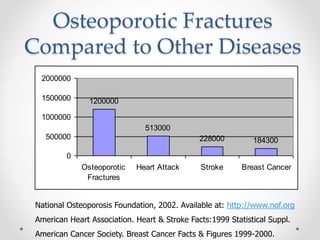
Osteoporotic Fractures
Compared to Other Diseases
1200000
513000
228000 184300
0
500000
1000000
1500000
2000000
Osteoporotic
Fractures
Heart Attack Stroke Breast Cancer
National Osteoporosis Foundation, 2002. Available at: http://www.nof.org
American Heart Association. Heart & Stroke Facts:1999 Statistical Suppl.
American Cancer Society. Breast Cancer Facts & Figures 1999-2000.
Definition
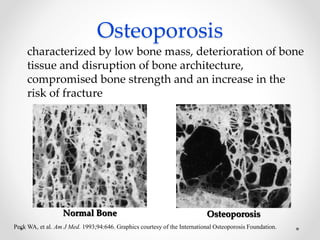
characterized by low bone mass, deterioration of bone
tissue and disruption of bone architecture,
compromised bone strength and an increase in the
risk of fracture
Osteoporosis
Normal Bone Osteoporosis
Peck WA, et al. Am J Med. 1993;94:646. Graphics courtesy of the International Osteoporosis Foundation.
Osteoporosis -
Pathophysiology
 Bone remodeling is a coupled process between
osteoclast and osteoblast.
 Function of bone remodeling is to:
1) repair microdamage within the skeleton to maintain skeletal
strength and ensure the relative youth of the skeleton
(2) to supply calcium from the skeleton to maintain serum calcium.
Osteoporosis -
Pathophysiology
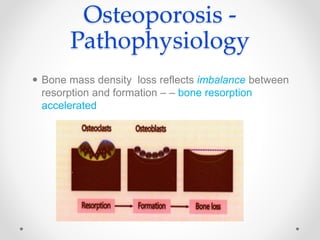
 Bone mass density loss reflects imbalance between
resorption and formation – – bone resorption
accelerated
Osteoporosis
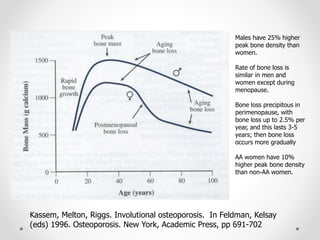
• The biggest culprit for osteoporosis is the accelerated
bone loss during menopausal period (mid 50-70’s) and
to lesser extent poor bone mass acquisition during
adolescence.
Kassem, Melton, Riggs. Involutional osteoporosis. In Feldman, Kelsay
(eds) 1996. Osteoporosis. New York, Academic Press, pp 691-702
Males have 25% higher
peak bone density than
women.
Rate of bone loss is
similar in men and
women except during
menopause.
Bone loss precipitous in
perimenopause, with
bone loss up to 2.5% per
year, and this lasts 3-5
years; then bone loss
occurs more gradually
AA women have 10%
higher peak bone density
than non-AA women.
Question
The gold standard to evaluate for osteoporosis is?
A. DEXA: Dual energy x-ray absorptometry
B. X-ray:
C. QCT: quantitative computer tomography
D. ultrasound of heel or finger
How to predict bone
fragility
Bone mineral density
• DEXA: Dual energy x-ray absorptometry
• X-ray: Evident when ≥ 30% of bone has been lost
o Affected by over/underpenetration of film
• QCT: quantitative computer tomography
• QUS: quantitative ultrasound of heel or finger
DEXA correlates the best with future fracture risk of all
predictive measures.
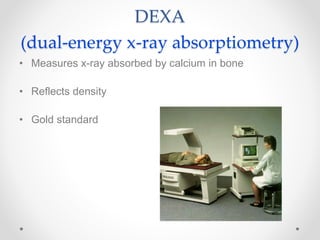
DEXA
(dual-energy x-ray absorptiometry)
• Measures x-ray absorbed by calcium in bone
• Reflects density
• Gold standard
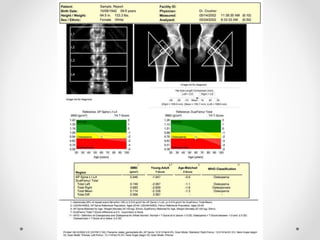
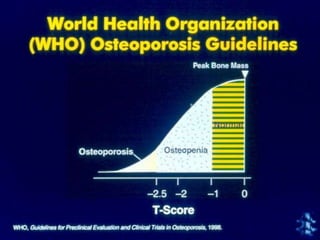
T-scores vs. Z-scores
 T-score: calculated by comparing current BMD to the
mean peak BMD of normal young adult of same gender
(white)
 applied to postmenopausal women
 Z-score: based on difference between the individual’s
BMD and mean of a reference population of same
gender, age, ethnicity
 Used for premenopausal women under age 50
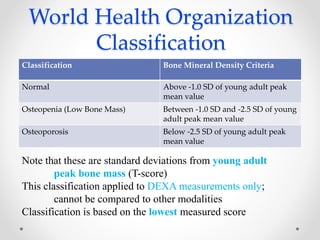
World Health Organization
Classification
Classification Bone Mineral Density Criteria
Normal Above -1.0 SD of young adult peak
mean value
Osteopenia (Low Bone Mass) Between -1.0 SD and -2.5 SD of young
adult peak mean value
Osteoporosis Below -2.5 SD of young adult peak
mean value
Note that these are standard deviations from young adult
peak bone mass (T-score)
This classification applied to DEXA measurements only;
cannot be compared to other modalities
Classification is based on the lowest measured score
Who Should Be Screened?
Screening: Who should have
DEXA evaluation?
• Women over age 65, men over age 70, regardless of
clinical risk factors
• Younger postmenopausal women, women in
menopausal transition, and men age 50-69 year with
one or more additional risk factor
• Adults who have fractures after age 50
• Adults with condition (Rheumatoid arthritis) or taking
medication (ie. steroid doses > 3 mos)
According to National Osteoporosis Foundation
Question
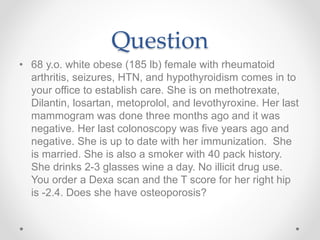
• 68 y.o. white obese (185 lb) female with rheumatoid
arthritis, seizures, HTN, and hypothyroidism comes in to
your office to establish care. She is on methotrexate,
Dilantin, losartan, metoprolol, and levothyroxine. Her last
mammogram was done three months ago and it was
negative. Her last colonoscopy was five years ago and
negative. She is up to date with her immunization. She
is married. She is also a smoker with 40 pack history.
She drinks 2-3 glasses wine a day. No illicit drug use.
You order a Dexa scan and the T score for her right hip
is -2.4. Does she have osteoporosis?
Question
• So ---she technically has osteopenia
• Do you treat?
Question
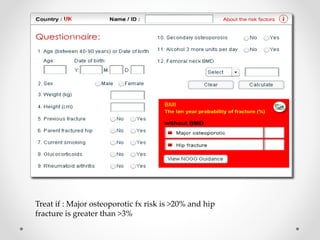
• Calculate her FRAX score
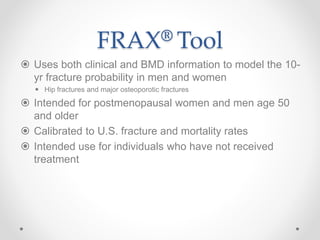
FRAX® Tool
 Uses both clinical and BMD information to model the 10-
yr fracture probability in men and women
 Hip fractures and major osteoporotic fractures
 Intended for postmenopausal women and men age 50
and older
 Calibrated to U.S. fracture and mortality rates
 Intended use for individuals who have not received
treatment
Treat if : Major osteoporotic fx risk is >20% and hip
fracture is greater than >3%
Question
• Her Ten year probability of fracture is
o Major osteoporotic fracture is 21%
o Hip fracture is 9.5%
• Do you treat?
So whom should be
considered for treatment?
 Those with hip or vertebral fractures
 Those with T-scores > or = - 2.5 (spine or hip)
 Those with other fractures, age > 50 years
 Secondary causes with high fracture risk
 Glucocorticoid exposure
 Complete immobilization
 FRAX score: 10-year probability of hip fracture ≥ 3%,
or probability of all major fractures ≥ 20% based on
total T-score
Labs
• Serum calcium: typically normal
• Phosphate and PTH normal.
• Alkaline phosphatase is usually normal but may be
slightly elevated, especially following a fracture.
• Vitamin D deficiency is very common
• Consider checking TSH, celiac disease, and
hypogonadism
Risk factors for secondary
osteoporosis
• Diseases
o Rheumatoid or other
inflammatory arthritis
o Multiple myeloma, lymphoma
o Hyperthyroidism
o Hyperparathyroidism
o Cushing’s syndrome
o Marfans and Ehlers – Danlos
o Renal disease
o Osteogenesis imperfecta
o Liver disease
• Tobacco
• Excess alcohol
• Medications
o Anticonvulsants - ( Dilantin)
o Steroids >5mg/d for
>6 months
o Depo-provera
o Heparin/warfarin
o Immunosuppressants
o GnRH agonist
• Hypogonadism
• Vitamin D deficiency
Evaluation for Secondary
Causes
• Serum calcium, phosphorous
• 25-OH vitamin D
• PTH
• Thyroid function
• Complete blood count/serum protein
electrophoresis
• Creatinine, albumin
• Urinary calcium excretion
• Tissue transglutaminase antibody (celiac sprue)
Treatment
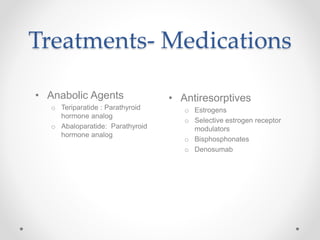
Treatments- Medications
• Anabolic Agents
o Teriparatide : Parathyroid
hormone analog
o Abaloparatide: Parathyroid
hormone analog
• Antiresorptives
o Estrogens
o Selective estrogen receptor
modulators
o Bisphosphonates
o Denosumab
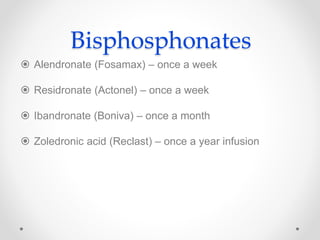
Bisphosphonates
 Alendronate (Fosamax) – once a week
 Residronate (Actonel) – once a week
 Ibandronate (Boniva) – once a month
 Zoledronic acid (Reclast) – once a year infusion
Bisphosphonates
• Inhibit activity of osteoclasts and shorten their lifespan
• Bind to bone. No known effect anywhere but bone
• Prevent cytokine release form osteoblast that activates
osteoclasts
• Activates osteoblast substance that inhibits osteoclasts
• Supports osteoblast bone formation
Bisphosphonates
Most common side effect:
 esophageal/gastric irritation
 osteonecrosis of jaw: rare 1/100,000
pts in year
Atypical fracture of long bone after long
term use
With discontinuation, BMD remains stable
or declines slowly
Bisphosphonates
• Poor absorption
o Has to be taken on empty stomach
o With water only, minimum 8 oz
o Stay upright for 30 minutes
• Caution in patients with renal dysfunction
o Alendronate ClCr <35 ml/min
o Risendronate ClCr <30 ml/min
o Ibandronate ClCr <30 ml/min
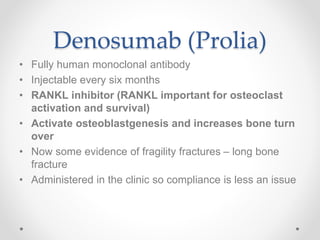
Denosumab (Prolia)
• Fully human monoclonal antibody
• Injectable every six months
• RANKL inhibitor (RANKL important for osteoclast
activation and survival)
• Activate osteoblastgenesis and increases bone turn
over
• Now some evidence of fragility fractures – long bone
fracture
• Administered in the clinic so compliance is less an issue
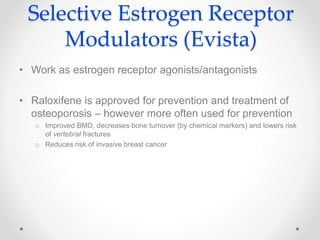
Selective Estrogen Receptor
Modulators (Evista)
• Work as estrogen receptor agonists/antagonists
• Raloxifene is approved for prevention and treatment of
osteoporosis – however more often used for prevention
o Improved BMD, decreases bone turnover (by chemical markers) and lowers risk
of vertebral fractures
o Reduces risk of invasive breast cancer
(salmon) Calcitonin
 Approved for treatment but not for prevention of
osteoporosis
 Nasal spray/ injection
 Mainly used to treat bone pain from vertebral
compression fractures
 Alternative for patients who cannot tolerate/ are
unwilling to take other agents
 No documented efficacy in early postmenopausal
women
Estrogen/Progestin
• Only slows resorption of bone
o Not anabolic (does not stimulate formation)
o Not as effective as bisphosphonates
• Not first choice therapy for osteoporosis but may be
appropriate in some patients – persistent
menopausal symptoms
• Not recommend to treat just osteoporosis
• Keep in mind the risks
o Vascular events
o Increased risk of breast cancer (and of uterine cancer if given alone to female
with uterus)
Teriparatide (Forteo)
 20 ug daily injectable. Has to be refrigerated.
 Recombinant human PTH 1-34
 Draws Ca out of cortical bone
 Daily, subcutaneous injection administered for two years
 Bone loss after discontinuation mitigated by bisphosphonate
 Prior therapy with bisphosphonate delays improvements in BMD
Teriparatide (Forteo)
 Contraindicated in patients with bone metastases,
hypercalcemia, prior skeletal radiation
 Risk of osteosarcoma in animal trial
Abaloparatide (Tymlos)
• Approved by FDA on April 28, 2017.
• 80ug daily injectable. Does not have be refrigerated
(working on transdermal)
• Black box warning is the same as teriparatide.
• Treat for 2 years.
Trials
• ACTIVE trial and ACTIVExtend
o ACTIVE trial: Effect of Albaloparatide Major Osteoporotic Fracture Incidence in
Postmenopausal Women with Osteoporosis
o ACTIVExtend: Eighteen Months of Treatment with Abaloparatide Followed by Six
Months of Treatment with Alendronate in Postmenopausal Women with
Osteoporosis
Summary ACTIVE Trial
• In postmenopausal women with osteoporosis, 18 months
of subcutaneous abaloparatide compared with placebo
significantly
–Increased BMD at the lumbar spine, total hip and
femoral neck
–Reduced the risk of vertebral and nonvertebral
fractures
-Reduced the risk of clinical and major
osteoporotic fractures
Summary ACTIVE Trial
• Abaloparatide-SC had an acceptable safety profile
–No differences were evident between the
placebo, abaloparatide and teriparatide groups in
treatment-emergent adverse events, serious adverse
events, or deaths
–The incidence of hypercalcemia was higher with
abaloparatide-SC as compared to placebo.
- A lower incidence of hypercalcemia was
observed with abaloparatide-SC compared with
teriparatide
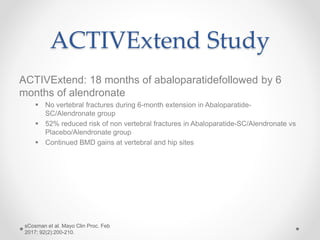
ACTIVExtend Study
ACTIVExtend: 18 months of abaloparatidefollowed by 6
months of alendronate
 No vertebral fractures during 6-month extension in Abaloparatide-
SC/Alendronate group
 52% reduced risk of non vertebral fractures in Abaloparatide-SC/Alendronate vs
Placebo/Alendronate group
 Continued BMD gains at vertebral and hip sites
sCosman et al. Mayo Clin Proc. Feb
2017; 92(2):200-210.
Treatment
• First line is bisphosphonates if not contraindicated
(renal failure or unable to tolerate b/c of GI). Consider
denusamab as alternative
• Severe osteoporosis (T score -3.5) consider teriparatide
or abaloparatide
• Duration of treatment is uncertain. Risk of
subtrochanteric or femoral shaft fracture increases with
tx beyond five years.
Emerging Therapies
• Sclerostin Inhibitors
• Romosozumab is a monoclonal antibody that binds
sclerostin which increases bone formation and
decreases bone resorption.
• The N. Eng J Med 2016;375: 1532-1543 (October 20,
2016) published “Romosozumab treatment in
postmenopausal women with osteoporosis.”
Cosman F, Crittenden B, Adachi JD et al. Romosozumab Treatment in Postmenopausal Women with
Osteoporosis. N Eng J Med 2016;375: 1532-1543 (October 20, 2016)
Trial: The Fracture Study in Postmenopausal
Women with Osteoporosis (FRAME)
• Design: Double-blinded, placebo-controlled,
multinational study
• Number: 7180 pts
• Inclusion: T-score, -2.5 to -3.5 – total hip or femoral neck
• Drug:
o Romo 210 mg sc or placebo monthly x 12 months;
o Followed by denosumab 60 mg sc x 12 months
Cosman F et al. N Engl J Med
2016;375:1532-1543.
Trial: The Fracture Study in Postmenopausal
Women with Osteoporosis (FRAME)
• Co-primary endpoints: cumulative incidence of new
vertebral fractures at 12 and 24 months
• Secondary endpoints: clinical (nonvertebral and
symptomatic vertebral fractures) and nonvertebral
fractures
Cosman F et al. N Engl J Med
2016;375:1532-1543.
Trial: The Fracture Study in Postmenopausal
Women with Osteoporosis (FRAME)
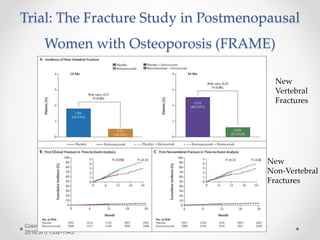
Cosman F et al. N Engl J Med
2016;375:1532-1543.
New
Vertebral
Fractures
New
Non-Vertebral
Fractures
Trial: The Fracture Study in Postmenopausal
Women with Osteoporosis (FRAME)
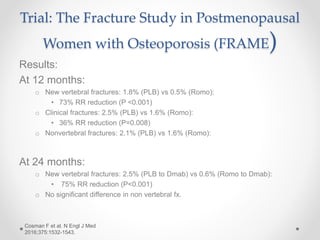
Results:
At 12 months:
o New vertebral fractures: 1.8% (PLB) vs 0.5% (Romo):
• 73% RR reduction (P <0.001)
o Clinical fractures: 2.5% (PLB) vs 1.6% (Romo):
• 36% RR reduction (P=0.008)
o Nonvertebral fractures: 2.1% (PLB) vs 1.6% (Romo):
At 24 months:
o New vertebral fractures: 2.5% (PLB to Dmab) vs 0.6% (Romo to Dmab):
• 75% RR reduction (P<0.001)
o No significant difference in non vertebral fx.
Cosman F et al. N Engl J Med
2016;375:1532-1543.
Trial: The Fracture Study in Postmenopausal
Women with Osteoporosis (FRAME)
• Adverse rxn:
o Osteoarthritis
o Atypical femoral fracture
o Injection site reactions
o ill-fitting dentures
o Osteonecrosis of jaw following tooth extraction and osteomyelitis of the jaw.
Cosman F et al. N Engl J Med
2016;375:1532-1543.
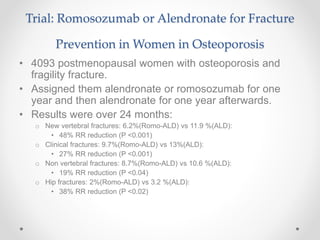
Trial: Romosozumab or Alendronate for Fracture
Prevention in Women in Osteoporosis
• 4093 postmenopausal women with osteoporosis and
fragility fracture.
• Assigned them alendronate or romosozumab for one
year and then alendronate for one year afterwards.
• Results were over 24 months:
o New vertebral fractures: 6.2%(Romo-ALD) vs 11.9 %(ALD):
• 48% RR reduction (P <0.001)
o Clinical fractures: 9.7%(Romo-ALD) vs 13%(ALD):
• 27% RR reduction (P <0.001)
o Non vertebral fractures: 8.7%(Romo-ALD) vs 10.6 %(ALD):
• 19% RR reduction (P <0.04)
o Hip fractures: 2%(Romo-ALD) vs 3.2 %(ALD):
• 38% RR reduction (P <0.02)
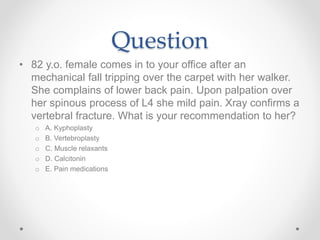
Question
• 82 y.o. female comes in to your office after an
mechanical fall tripping over the carpet with her walker.
She complains of lower back pain. Upon palpation over
her spinous process of L4 she mild pain. Xray confirms a
vertebral fracture. What is your recommendation to her?
o A. Kyphoplasty
o B. Vertebroplasty
o C. Muscle relaxants
o D. Calcitonin
o E. Pain medications
Fractures
Fractures
• > 1.5 million annually
• Cost of $19 billion annually (2005)
• First evidence of osteoporosis in absence of screening
• Most common is vertebral fracture, with hip fractures the
most morbid and deadly
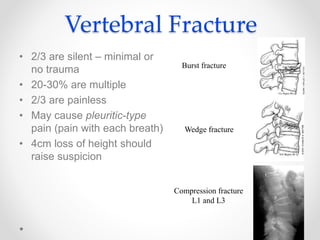
Vertebral Fracture
• 2/3 are silent – minimal or
no trauma
• 20-30% are multiple
• 2/3 are painless
• May cause pleuritic-type
pain (pain with each breath)
• 4cm loss of height should
raise suspicion
Wedge fracture
Compression fracture
L1 and L3
Burst fracture
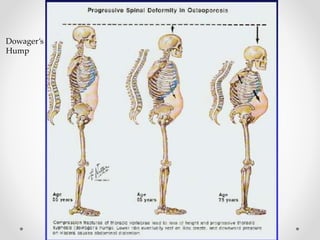
Dowager’s
Hump
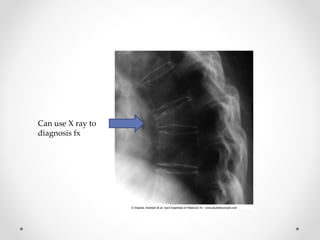
Can use X ray to
diagnosis fx
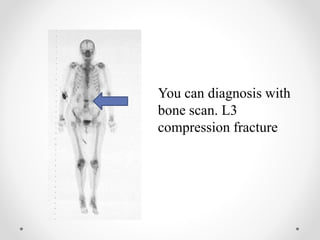
You can diagnosis with
bone scan. L3
compression fracture
Hip fracture
• 20% mortality within 1 year of hip fracture
• 50% do not regain pre-fracture functioning
• 25% nursing home placement
• 1/3 will fracture the opposite hip
National Osteoporosis Foundation. Physician’s Guide to
Prevention and Treatment of Osteoporosis. Washington,
DC. 2003
Hip Fractures
• 90% occur following a fall (very important to establish
circumstances of fall)
• Hip fracture rate 2-3x higher in women
o 1-year mortality higher in men
• suspect if pain in the hip, groin, low back or suprapubic
pain, and external rotation of one leg (log roll)
Treating pain for vertebral
fractures
• Recommended for pain
 NSAIDs vs. opiates
 Calcitonin as adjunct
• Not recommended for pain:
 Vertebroplasty – injection of cement (polymethylmethacrylate) into compressed
vertebra to prevent further collapse
 Kyphoplasty – introduction of balloon into vertebral body, then injection of cement
 Muscle relaxants
Non Pharmacologic
treatment
• Quit smoking
• Exercise – no evidence high intensity more effective
• Weight bearing exercises –resistance
• Calcium and Vitamin D - Ca (500mg – 600mg two times
daily) and vitamin D (1000 IU daily)
Non Pharmacologic
treatment
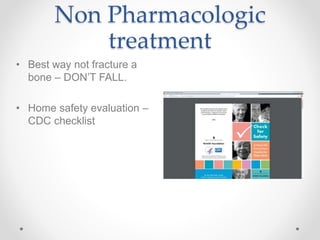
• Best way not fracture a
bone – DON’T FALL.
• Home safety evaluation –
CDC checklist
Questions

2018: Osteoporosis.interprofessional2

  • 1.
    Osteoporosis Julie Zacharias SimpsonDO Touro University Nevada Assistant Professor January 20, 2018
  • 2.
    Disclosure • I havenothing to disclose.
  • 3.
  • 4.
    Osteoporosis Most common bonedisorder Compromised bone strength with increased risk of fracture 40 million people world wide 33% of postmenopausal women have osteoporosis and additional 54% of postmenopausal women have low bone density in hip, spine or wrist.
  • 5.
    Osteoporosis Affects 1 in2 Caucasian ♀, 1 in 5 ♂ Female to male ratio is  7:1 for vertebral fx  1.5: 1 for distal forearm fx  2:1 for hip fx Greatest risk in white and Asian women  Less risk in African American  Not the same as risk for fracture
  • 6.
    Osteoporotic Fractures Compared toOther Diseases 1200000 513000 228000 184300 0 500000 1000000 1500000 2000000 Osteoporotic Fractures Heart Attack Stroke Breast Cancer National Osteoporosis Foundation, 2002. Available at: http://www.nof.org American Heart Association. Heart & Stroke Facts:1999 Statistical Suppl. American Cancer Society. Breast Cancer Facts & Figures 1999-2000.
  • 7.
  • 8.
    characterized by lowbone mass, deterioration of bone tissue and disruption of bone architecture, compromised bone strength and an increase in the risk of fracture Osteoporosis Normal Bone Osteoporosis Peck WA, et al. Am J Med. 1993;94:646. Graphics courtesy of the International Osteoporosis Foundation.
  • 9.
    Osteoporosis - Pathophysiology  Boneremodeling is a coupled process between osteoclast and osteoblast.  Function of bone remodeling is to: 1) repair microdamage within the skeleton to maintain skeletal strength and ensure the relative youth of the skeleton (2) to supply calcium from the skeleton to maintain serum calcium.
  • 10.
    Osteoporosis - Pathophysiology  Bonemass density loss reflects imbalance between resorption and formation – – bone resorption accelerated
  • 11.
    Osteoporosis • The biggestculprit for osteoporosis is the accelerated bone loss during menopausal period (mid 50-70’s) and to lesser extent poor bone mass acquisition during adolescence.
  • 13.
    Kassem, Melton, Riggs.Involutional osteoporosis. In Feldman, Kelsay (eds) 1996. Osteoporosis. New York, Academic Press, pp 691-702 Males have 25% higher peak bone density than women. Rate of bone loss is similar in men and women except during menopause. Bone loss precipitous in perimenopause, with bone loss up to 2.5% per year, and this lasts 3-5 years; then bone loss occurs more gradually AA women have 10% higher peak bone density than non-AA women.
  • 14.
    Question The gold standardto evaluate for osteoporosis is? A. DEXA: Dual energy x-ray absorptometry B. X-ray: C. QCT: quantitative computer tomography D. ultrasound of heel or finger
  • 15.
    How to predictbone fragility Bone mineral density • DEXA: Dual energy x-ray absorptometry • X-ray: Evident when ≥ 30% of bone has been lost o Affected by over/underpenetration of film • QCT: quantitative computer tomography • QUS: quantitative ultrasound of heel or finger DEXA correlates the best with future fracture risk of all predictive measures.
  • 16.
    DEXA (dual-energy x-ray absorptiometry) •Measures x-ray absorbed by calcium in bone • Reflects density • Gold standard
  • 17.
    T-scores vs. Z-scores T-score: calculated by comparing current BMD to the mean peak BMD of normal young adult of same gender (white)  applied to postmenopausal women  Z-score: based on difference between the individual’s BMD and mean of a reference population of same gender, age, ethnicity  Used for premenopausal women under age 50
  • 19.
    World Health Organization Classification ClassificationBone Mineral Density Criteria Normal Above -1.0 SD of young adult peak mean value Osteopenia (Low Bone Mass) Between -1.0 SD and -2.5 SD of young adult peak mean value Osteoporosis Below -2.5 SD of young adult peak mean value Note that these are standard deviations from young adult peak bone mass (T-score) This classification applied to DEXA measurements only; cannot be compared to other modalities Classification is based on the lowest measured score
  • 21.
    Who Should BeScreened?
  • 22.
    Screening: Who shouldhave DEXA evaluation? • Women over age 65, men over age 70, regardless of clinical risk factors • Younger postmenopausal women, women in menopausal transition, and men age 50-69 year with one or more additional risk factor • Adults who have fractures after age 50 • Adults with condition (Rheumatoid arthritis) or taking medication (ie. steroid doses > 3 mos) According to National Osteoporosis Foundation
  • 23.
    Question • 68 y.o.white obese (185 lb) female with rheumatoid arthritis, seizures, HTN, and hypothyroidism comes in to your office to establish care. She is on methotrexate, Dilantin, losartan, metoprolol, and levothyroxine. Her last mammogram was done three months ago and it was negative. Her last colonoscopy was five years ago and negative. She is up to date with her immunization. She is married. She is also a smoker with 40 pack history. She drinks 2-3 glasses wine a day. No illicit drug use. You order a Dexa scan and the T score for her right hip is -2.4. Does she have osteoporosis?
  • 24.
    Question • So ---shetechnically has osteopenia • Do you treat?
  • 25.
  • 26.
    FRAX® Tool  Usesboth clinical and BMD information to model the 10- yr fracture probability in men and women  Hip fractures and major osteoporotic fractures  Intended for postmenopausal women and men age 50 and older  Calibrated to U.S. fracture and mortality rates  Intended use for individuals who have not received treatment
  • 27.
    Treat if :Major osteoporotic fx risk is >20% and hip fracture is greater than >3%
  • 28.
    Question • Her Tenyear probability of fracture is o Major osteoporotic fracture is 21% o Hip fracture is 9.5% • Do you treat?
  • 29.
    So whom shouldbe considered for treatment?  Those with hip or vertebral fractures  Those with T-scores > or = - 2.5 (spine or hip)  Those with other fractures, age > 50 years  Secondary causes with high fracture risk  Glucocorticoid exposure  Complete immobilization  FRAX score: 10-year probability of hip fracture ≥ 3%, or probability of all major fractures ≥ 20% based on total T-score
  • 30.
    Labs • Serum calcium:typically normal • Phosphate and PTH normal. • Alkaline phosphatase is usually normal but may be slightly elevated, especially following a fracture. • Vitamin D deficiency is very common • Consider checking TSH, celiac disease, and hypogonadism
  • 31.
    Risk factors forsecondary osteoporosis • Diseases o Rheumatoid or other inflammatory arthritis o Multiple myeloma, lymphoma o Hyperthyroidism o Hyperparathyroidism o Cushing’s syndrome o Marfans and Ehlers – Danlos o Renal disease o Osteogenesis imperfecta o Liver disease • Tobacco • Excess alcohol • Medications o Anticonvulsants - ( Dilantin) o Steroids >5mg/d for >6 months o Depo-provera o Heparin/warfarin o Immunosuppressants o GnRH agonist • Hypogonadism • Vitamin D deficiency
  • 32.
    Evaluation for Secondary Causes •Serum calcium, phosphorous • 25-OH vitamin D • PTH • Thyroid function • Complete blood count/serum protein electrophoresis • Creatinine, albumin • Urinary calcium excretion • Tissue transglutaminase antibody (celiac sprue)
  • 33.
  • 34.
    Treatments- Medications • AnabolicAgents o Teriparatide : Parathyroid hormone analog o Abaloparatide: Parathyroid hormone analog • Antiresorptives o Estrogens o Selective estrogen receptor modulators o Bisphosphonates o Denosumab
  • 35.
    Bisphosphonates  Alendronate (Fosamax)– once a week  Residronate (Actonel) – once a week  Ibandronate (Boniva) – once a month  Zoledronic acid (Reclast) – once a year infusion
  • 36.
    Bisphosphonates • Inhibit activityof osteoclasts and shorten their lifespan • Bind to bone. No known effect anywhere but bone • Prevent cytokine release form osteoblast that activates osteoclasts • Activates osteoblast substance that inhibits osteoclasts • Supports osteoblast bone formation
  • 37.
    Bisphosphonates Most common sideeffect:  esophageal/gastric irritation  osteonecrosis of jaw: rare 1/100,000 pts in year Atypical fracture of long bone after long term use With discontinuation, BMD remains stable or declines slowly
  • 38.
    Bisphosphonates • Poor absorption oHas to be taken on empty stomach o With water only, minimum 8 oz o Stay upright for 30 minutes • Caution in patients with renal dysfunction o Alendronate ClCr <35 ml/min o Risendronate ClCr <30 ml/min o Ibandronate ClCr <30 ml/min
  • 39.
    Denosumab (Prolia) • Fullyhuman monoclonal antibody • Injectable every six months • RANKL inhibitor (RANKL important for osteoclast activation and survival) • Activate osteoblastgenesis and increases bone turn over • Now some evidence of fragility fractures – long bone fracture • Administered in the clinic so compliance is less an issue
  • 40.
    Selective Estrogen Receptor Modulators(Evista) • Work as estrogen receptor agonists/antagonists • Raloxifene is approved for prevention and treatment of osteoporosis – however more often used for prevention o Improved BMD, decreases bone turnover (by chemical markers) and lowers risk of vertebral fractures o Reduces risk of invasive breast cancer
  • 41.
    (salmon) Calcitonin  Approvedfor treatment but not for prevention of osteoporosis  Nasal spray/ injection  Mainly used to treat bone pain from vertebral compression fractures  Alternative for patients who cannot tolerate/ are unwilling to take other agents  No documented efficacy in early postmenopausal women
  • 42.
    Estrogen/Progestin • Only slowsresorption of bone o Not anabolic (does not stimulate formation) o Not as effective as bisphosphonates • Not first choice therapy for osteoporosis but may be appropriate in some patients – persistent menopausal symptoms • Not recommend to treat just osteoporosis • Keep in mind the risks o Vascular events o Increased risk of breast cancer (and of uterine cancer if given alone to female with uterus)
  • 43.
    Teriparatide (Forteo)  20ug daily injectable. Has to be refrigerated.  Recombinant human PTH 1-34  Draws Ca out of cortical bone  Daily, subcutaneous injection administered for two years  Bone loss after discontinuation mitigated by bisphosphonate  Prior therapy with bisphosphonate delays improvements in BMD
  • 44.
    Teriparatide (Forteo)  Contraindicatedin patients with bone metastases, hypercalcemia, prior skeletal radiation  Risk of osteosarcoma in animal trial
  • 45.
    Abaloparatide (Tymlos) • Approvedby FDA on April 28, 2017. • 80ug daily injectable. Does not have be refrigerated (working on transdermal) • Black box warning is the same as teriparatide. • Treat for 2 years.
  • 46.
    Trials • ACTIVE trialand ACTIVExtend o ACTIVE trial: Effect of Albaloparatide Major Osteoporotic Fracture Incidence in Postmenopausal Women with Osteoporosis o ACTIVExtend: Eighteen Months of Treatment with Abaloparatide Followed by Six Months of Treatment with Alendronate in Postmenopausal Women with Osteoporosis
  • 47.
    Summary ACTIVE Trial •In postmenopausal women with osteoporosis, 18 months of subcutaneous abaloparatide compared with placebo significantly –Increased BMD at the lumbar spine, total hip and femoral neck –Reduced the risk of vertebral and nonvertebral fractures -Reduced the risk of clinical and major osteoporotic fractures
  • 48.
    Summary ACTIVE Trial •Abaloparatide-SC had an acceptable safety profile –No differences were evident between the placebo, abaloparatide and teriparatide groups in treatment-emergent adverse events, serious adverse events, or deaths –The incidence of hypercalcemia was higher with abaloparatide-SC as compared to placebo. - A lower incidence of hypercalcemia was observed with abaloparatide-SC compared with teriparatide
  • 49.
    ACTIVExtend Study ACTIVExtend: 18months of abaloparatidefollowed by 6 months of alendronate  No vertebral fractures during 6-month extension in Abaloparatide- SC/Alendronate group  52% reduced risk of non vertebral fractures in Abaloparatide-SC/Alendronate vs Placebo/Alendronate group  Continued BMD gains at vertebral and hip sites sCosman et al. Mayo Clin Proc. Feb 2017; 92(2):200-210.
  • 50.
    Treatment • First lineis bisphosphonates if not contraindicated (renal failure or unable to tolerate b/c of GI). Consider denusamab as alternative • Severe osteoporosis (T score -3.5) consider teriparatide or abaloparatide • Duration of treatment is uncertain. Risk of subtrochanteric or femoral shaft fracture increases with tx beyond five years.
  • 51.
    Emerging Therapies • SclerostinInhibitors • Romosozumab is a monoclonal antibody that binds sclerostin which increases bone formation and decreases bone resorption. • The N. Eng J Med 2016;375: 1532-1543 (October 20, 2016) published “Romosozumab treatment in postmenopausal women with osteoporosis.” Cosman F, Crittenden B, Adachi JD et al. Romosozumab Treatment in Postmenopausal Women with Osteoporosis. N Eng J Med 2016;375: 1532-1543 (October 20, 2016)
  • 52.
    Trial: The FractureStudy in Postmenopausal Women with Osteoporosis (FRAME) • Design: Double-blinded, placebo-controlled, multinational study • Number: 7180 pts • Inclusion: T-score, -2.5 to -3.5 – total hip or femoral neck • Drug: o Romo 210 mg sc or placebo monthly x 12 months; o Followed by denosumab 60 mg sc x 12 months Cosman F et al. N Engl J Med 2016;375:1532-1543.
  • 53.
    Trial: The FractureStudy in Postmenopausal Women with Osteoporosis (FRAME) • Co-primary endpoints: cumulative incidence of new vertebral fractures at 12 and 24 months • Secondary endpoints: clinical (nonvertebral and symptomatic vertebral fractures) and nonvertebral fractures Cosman F et al. N Engl J Med 2016;375:1532-1543.
  • 54.
    Trial: The FractureStudy in Postmenopausal Women with Osteoporosis (FRAME) Cosman F et al. N Engl J Med 2016;375:1532-1543. New Vertebral Fractures New Non-Vertebral Fractures
  • 55.
    Trial: The FractureStudy in Postmenopausal Women with Osteoporosis (FRAME) Results: At 12 months: o New vertebral fractures: 1.8% (PLB) vs 0.5% (Romo): • 73% RR reduction (P <0.001) o Clinical fractures: 2.5% (PLB) vs 1.6% (Romo): • 36% RR reduction (P=0.008) o Nonvertebral fractures: 2.1% (PLB) vs 1.6% (Romo): At 24 months: o New vertebral fractures: 2.5% (PLB to Dmab) vs 0.6% (Romo to Dmab): • 75% RR reduction (P<0.001) o No significant difference in non vertebral fx. Cosman F et al. N Engl J Med 2016;375:1532-1543.
  • 56.
    Trial: The FractureStudy in Postmenopausal Women with Osteoporosis (FRAME) • Adverse rxn: o Osteoarthritis o Atypical femoral fracture o Injection site reactions o ill-fitting dentures o Osteonecrosis of jaw following tooth extraction and osteomyelitis of the jaw. Cosman F et al. N Engl J Med 2016;375:1532-1543.
  • 57.
    Trial: Romosozumab orAlendronate for Fracture Prevention in Women in Osteoporosis • 4093 postmenopausal women with osteoporosis and fragility fracture. • Assigned them alendronate or romosozumab for one year and then alendronate for one year afterwards. • Results were over 24 months: o New vertebral fractures: 6.2%(Romo-ALD) vs 11.9 %(ALD): • 48% RR reduction (P <0.001) o Clinical fractures: 9.7%(Romo-ALD) vs 13%(ALD): • 27% RR reduction (P <0.001) o Non vertebral fractures: 8.7%(Romo-ALD) vs 10.6 %(ALD): • 19% RR reduction (P <0.04) o Hip fractures: 2%(Romo-ALD) vs 3.2 %(ALD): • 38% RR reduction (P <0.02)
  • 58.
    Question • 82 y.o.female comes in to your office after an mechanical fall tripping over the carpet with her walker. She complains of lower back pain. Upon palpation over her spinous process of L4 she mild pain. Xray confirms a vertebral fracture. What is your recommendation to her? o A. Kyphoplasty o B. Vertebroplasty o C. Muscle relaxants o D. Calcitonin o E. Pain medications
  • 59.
  • 60.
    Fractures • > 1.5million annually • Cost of $19 billion annually (2005) • First evidence of osteoporosis in absence of screening • Most common is vertebral fracture, with hip fractures the most morbid and deadly
  • 61.
    Vertebral Fracture • 2/3are silent – minimal or no trauma • 20-30% are multiple • 2/3 are painless • May cause pleuritic-type pain (pain with each breath) • 4cm loss of height should raise suspicion Wedge fracture Compression fracture L1 and L3 Burst fracture
  • 62.
  • 63.
    Can use Xray to diagnosis fx
  • 64.
    You can diagnosiswith bone scan. L3 compression fracture
  • 65.
    Hip fracture • 20%mortality within 1 year of hip fracture • 50% do not regain pre-fracture functioning • 25% nursing home placement • 1/3 will fracture the opposite hip National Osteoporosis Foundation. Physician’s Guide to Prevention and Treatment of Osteoporosis. Washington, DC. 2003
  • 66.
    Hip Fractures • 90%occur following a fall (very important to establish circumstances of fall) • Hip fracture rate 2-3x higher in women o 1-year mortality higher in men • suspect if pain in the hip, groin, low back or suprapubic pain, and external rotation of one leg (log roll)
  • 67.
    Treating pain forvertebral fractures • Recommended for pain  NSAIDs vs. opiates  Calcitonin as adjunct • Not recommended for pain:  Vertebroplasty – injection of cement (polymethylmethacrylate) into compressed vertebra to prevent further collapse  Kyphoplasty – introduction of balloon into vertebral body, then injection of cement  Muscle relaxants
  • 68.
    Non Pharmacologic treatment • Quitsmoking • Exercise – no evidence high intensity more effective • Weight bearing exercises –resistance • Calcium and Vitamin D - Ca (500mg – 600mg two times daily) and vitamin D (1000 IU daily)
  • 69.
    Non Pharmacologic treatment • Bestway not fracture a bone – DON’T FALL. • Home safety evaluation – CDC checklist
  • 70.

Editor's Notes

  • #5 72% of cost is directly related to HIP fracture cost
  • #7 Each year, more osteoporotic fractures occur more than heart attacks, strokes, and breast cancers combined. Despite being so common, osteoporosis screening and treatment are commonly overlooked in caring for the elderly.
  • #9 8
  • #14 Physiology of bone growth and bone loss.
  • #18 T-scores are NOT adjust for race
  • #46 Approved April 25, 2017
  • #62 Deformity may take days to weeks to develop so serial plain films may be necessary An incident vertebral fracture increases risk of subsequent fracture 5-7x Thoracic fractures can restrict lung function and cause problems with digestion
  • #63 Cervical lordosis, thoracic kyphosis