OSTEOMYELITIS 
DR. GAJANAN PANDIT
DEFINITION 
Osteomyelitis is defined as an inflammation of the 
bone caused by an infecting organism. 
The infection may be limited to a single portion of 
the bone or may involve numerous regions such as 
the marrow, cortex, periosteum, and the surrounding 
soft tissue. 
10/29/14 
2 
OSTEOMYELITIS
CLASSIFICATION 
Classification of osteomyelitis is based on numerous 
criteria, such as 
Based on duration of symptoms. 
Based on mechanism of infection. 
Based on the host response to disease. 
10/29/14 
3 
OSTEOMYELITIS
CLASSIFICATION 
Based on duration of symptoms. 
Acute 
Subacute 
Chronic 
The time limits defining these classes are arbitrary. 
10/29/14 
4 
OSTEOMYELITIS
CLASSIFICATION 
Based on mechanism of infection. 
Exogenous 
Hematogenous 
Exogenous osteomyelitis is caused by open fractures, 
surgery (iatrogenic), or contiguous spread from 
infected local tissue. 
The hematogenous form results from bacteremia. 
10/29/14 
5 
OSTEOMYELITIS
CLASSIFICATION 
Based on the host response to disease. 
Pyogenic 
Nonpyogenic 
10/29/14 
6 
OSTEOMYELITIS
Bacterial Associations 
7 
Hematogenous osteomyelitis is most commonly 
caused by S. aureus. 
In the past, Haemophilus influenzae type B (HiB) 
was a common organism in children, but the advent 
of HiB vaccine has made it a rare cause. 
Causes of osteomyelitis due to direct inoculation, 
such as into an open fracture, will be influenced by 
the environment in which the injury occurred. For 
example, injuries occurring in water may lead to 
infection with Aeromonas or Plesiomonas. 
OSTEOMYELITIS 10/29/14
Bacterial Associations 
8 
Nail puncture wounds of the foot, particularly 
through a tennis shoe, are associated with infection 
with Pseudomonas aeruginosa 
Underlying medical conditions of the host also 
influence the expected microbiology. Intravenous 
drug users may have P. aeruginosa and other 
gram-negative bacilli as causes of their 
osteomyelitis 
Patients with sickle cell disease are prone to 
the development of Salmonella osteomyelitis. 
OSTEOMYELITIS 10/29/14
Bacterial Associations 
9 
Osteomyelitis caused by fungal infections is more 
likely to be seen in immunocompromised hosts. 
Diabetic foot infections leading to osteomyelitis 
often are polymicrobial, often involving anaerobes 
and gram-positive and gram-negative aerobic bacilli. 
Patients infected with the human immunodeficiency 
virus (HIV) are at risk for a variety of unusual 
infections, including atypical mycobacteria. 
OSTEOMYELITIS 10/29/14
ACUTE HEMATOGENOUS OSTEOMYELITIS 
This is the most common type of bone infection and 
usually is seen in children. 
It is more common in males in all age groups. 
It is caused by a bacteremia which is common 
occurrence in children. 
Bacteriological seeding of bone is generally 
associated with other factors such as localized 
trauma, chronic illness, malnutrition, or an 
inadequate immune system. 
10/29/14 
10 
OSTEOMYELITIS
ACUTE HEMATOGENOUS OSTEOMYELITIS 
In children, the infection generally involves the 
metaphysis of rapidly growing bone. 
10/29/14 
11 
OSTEOMYELITIS
CAUSES FOR MORE INCIDENCE OF 
METAPHYSEAL OSTEOMYELITIS 
1. Hair pin bend vessels in metaphysis. 
2. Increased vascularity to metaphysis causing 
pooling of blood. It has been aptly called ‘a lake of 
blood’. 
3. Immature cells of metaphysis due to high turnover. 
4. Relative lack of phagocytosis. 
10/29/14 
12 
OSTEOMYELITIS
CAUSES FOR MORE INCIDENCE OF 
METAPHYSEAL OSTEOMYELITIS 
5. Presence of degenerating cartilage cells which act 
as a good culture media. 
6. Presence of end arteries in metaphysis. 
7. More prone to trauma. 
8. Presence of single endothelial lining in 
metaphyseal arteries. 
10/29/14 
13 
OSTEOMYELITIS
Pathogenesis 
14 
Introduction of bacteria. 
Infective embolus enters the nutrient artery. 
Trapped in small calibre vessels. 
Active hyperemia. 
Exudate and debris. 
Increased pressure in bone. 
Exudate travels along the paths of least resistence. 
Subperiosteal abscess. 
Sequestrum. 
OSTEOMYELITIS 10/29/14
10/29/14 
15 
OSTEOMYELITIS
DIAGNOSIS 
A diagnosis of acute osteomyelitis should be considered an 
emergency. 
The presenting signs and symptoms may vary with the 
severity of the infection. 
Symptoms include fever and chills, general malaise, 
irritability, pain, and swelling. 
With lower extremity involvement, there is either a 
limp or an inability to bear weight. 
10/29/14 
16 
OSTEOMYELITIS
DIAGNOSIS 
An infant with upper extremity involvement may exhibit 
pseudoparalysis; older children and adults with upper 
extremity involvement complain of pain on movement or 
use of the extremity. 
It is important to localize the point of maximum 
tenderness, which is usually warm and swollen. In children 
it is generally in the metaphyseal region. 
10/29/14 
17 
OSTEOMYELITIS
DIAGNOSIS 
It is also important to evaluate the adjoining joint for 
evidence of septic arthritis, which can occur as an 
extension of the adjoining osteomyelitis. 
Osteomyelitis involving the 
 neck of the femur, 
 talus, and 
 humeral head often leads to sepsis of the joint because 
these foci are located within the joint capsule. 
10/29/14 
18 
OSTEOMYELITIS
DIAGNOSIS 
Once the point of maximum tenderness is localized, 
aspirate the area, and send the pus or fluid obtained for 
Gram stain, culture, and sensitivity studies. 
If tuberculosis or a fungal infection is suspected, obtain an 
acid-fast stain and tuberculosis and fungal cultures. 
10/29/14 
19 
OSTEOMYELITIS
DIAGNOSIS 
When a joint effusion is present or joint involvement is 
suspected, aspirate the joint and confirm with an 
arthrogram. 
The arthrogram helps document the location of the 
aspiration and is useful for positive as well as for negative 
aspirations, since it may also identify joint capsule rupture. 
Aspiration of the hip joint under ultrasound guidance is 
very helpful in children and adults. 
10/29/14 
20 
OSTEOMYELITIS
DIAGNOSIS 
The white blood cell count is generally elevated, 
depending on the severity of the infection, with an increase 
in immature or band cells. 
The erythrocyte sedimentation rate and the C-reactive 
protein are usually elevated. 
Obtain blood cultures in all cases of acute hematogenous 
osteomyelitis and in chronic osteomyelitis exacerbated by 
fever and bacteremia. 
10/29/14 
21 
OSTEOMYELITIS
DIAGNOSIS 
Roentgenograms taken early in the disease process 
generally show soft-tissue swelling. Bony changes are not 
present until 7–10 days after the onset of infection. 
Radionuclide bone scanning using radioactive-labeled 
isotopes, such as technetium-99m and, more specifically, 
gallium citrate-67 and indium-111-labeled white blood 
cells, is helpful in localizing the area of involvement and in 
helping diagnose the condition. 
Aspiration is used for the diagnosis, especially when there 
is no drainage or sinuses, and in some cases bone biopsy 
may be necessary. 
10/29/14 
22 
OSTEOMYELITIS
DIAGNOSIS 
Magnetic resonance imaging (MRI) has added a new 
dimension to the diagnosis, localization, and 
characterization of the extent of infection. 
T1- and T2-weighted images are the initial screening 
techniques for diagnosing osteomyelitis. 
The MR finding in osteomyelitis on T1-weighted image 
sequences is a low signal intensity due to a dark marrow 
signal and an increased signal intensity due to a bright 
marrow signal on the T2-weighted image sequences. MRI 
has decreased the need for bone scanning and provides 
more useful information. 
10/29/14 
23 
OSTEOMYELITIS
DIAGNOSIS 
Sinograms are done whenever there is a sinus tract or 
open draining area from which the depth and extent of the 
infection can be determined. 
Abscessograms are done whenever an abscess is present 
and frank pus is aspirated. The abscessogram will help 
outline the extent of the abscess cavity. 
MRI, computed tomographic scanning, and radiographic 
tomogram are all useful tools in evaluating osteomyelitis. 
10/29/14 
24 
OSTEOMYELITIS
Radiographic Pathogenesis 
The earliest signs of bone infection are soft-tissue 
edema and loss of fascial planes. (seen within 24 to 
48 hours of the onset of infection) 
The earliest changes in the bone are evidence of a 
destructive lytic lesion. (seen within 7 to 10 days after 
the onset of infection), and a positive radionuclide 
bone scan. 
Within 2 to 6 weeks, there is progressive destruction 
of cortical and medullary bone, an increased 
endosteal sclerosis indicating reactive new bone 
formation, and a periosteal reaction. 
10/29/14 
25 
OSTEOMYELITIS
Radiographic Pathogenesis 
26 
In 6 to 8 weeks, sequestra indicating areas of 
necrotic bone usually become apparent; they are 
surrounded by a dense involucrum, representing a 
sheath of periosteal new bone. 
OSTEOMYELITIS 10/29/14
DIFFERENTIAL DIAGNOSIS 
27 
Acute Rheumatism: 
onset- gradual, pain- less acute, articular, swelling 
confined to joint, affects more than one joint at the 
same time and is ‘flitting’ in nature. 
Erysipelas: 
Less pain and general toxemia. 
Haemophilia: 
Bleeding diathesis should be looked for. 
OSTEOMYELITIS 10/29/14
DIFFERENTIAL DIAGNOSIS 
28 
Cellulitis: 
No intense pain and general malaise is less. 
Acute Pyogenic Arthritis: 
Features related to joint. 
Ewing’s tumour or Osteosarcoma: 
Much less intense general illness. 
OSTEOMYELITIS 10/29/14
PRINCIPLES OF TREATMENT OF ACUTE 
OSTEOMYELITIS (Proposed by NADE) 
1. An appropriate antibiotic is effective before pus 
formation. 
2. Antibiotics do not sterilize avascular tissues or abscesses, 
and such areas require surgical drainage. 
3. If such removal is effective, antibiotics should prevent 
their reformation, and primary wound closure should be 
safe. 
4. Surgery should not damage further already ischemic bone 
and soft tissue; and 
5. Antibiotics should be continued after surgery. 
10/29/14 
29 
OSTEOMYELITIS
INDICATIONS FOR SURGERY IN ACUTE 
HEMATOGENOUS OSTEOMYELITIS 
1. Presence of an abscess requiring drainage. 
2. Failure of the patient to improve despite appropriate 
intravenous antibiotics. 
10/29/14 
30 
OSTEOMYELITIS
Subacute Hematogenous Osteomyelitis 
31 
More insidous onset. 
Lacks severity of symptoms. 
Diagnosis usually delayed. 
Temperature is only mildly elevated. 
Mild to moderate pain. 
Usually positive radiographs and bone scan. 
Often confused with malignancy. 
OSTEOMYELITIS 10/29/14
Subacute Hematogenous Osteomyelitis 
32 
The indolent course is related to 
Increased host resistence. 
Decreased bacterial virulence. 
Administration of antibiotics before onset of 
symptoms. 
OSTEOMYELITIS 10/29/14
Subacute Hematogenous Osteomyelitis 
Classification: 
Gledhill and modified by 
Roberts et. al. 
Type I 
Central metaphyseal 
lesion. 
DD: Langerhans’ cell 
histiocytosis, Brodie 
abscess. 
33 
OSTEOMYELITIS 10/29/14
Subacute Hematogenous Osteomyelitis 
Classification: 
Gledhill and modified by 
Roberts et. al. 
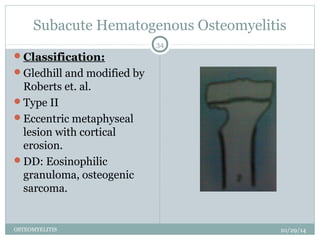
Type II 
Eccentric metaphyseal 
lesion with cortical 
erosion. 
DD: Eosinophilic 
granuloma, osteogenic 
sarcoma. 
34 
OSTEOMYELITIS 10/29/14
Subacute Hematogenous Osteomyelitis 
Classification: 
Gledhill and modified by 
Roberts et. al. 
Type III 
Diaphyseal cortical 
lesion. 
DD: Osteiod osteoma 
35 
OSTEOMYELITIS 10/29/14
Subacute Hematogenous Osteomyelitis 
Classification: 
Gledhill and modified by 
Roberts et. al. 
Type IV: 
Diaphyseal lesion with 
periosteal new bone 
formation, but without 
bony lesion. 
DD: Ewings sarcoma. 
36 
OSTEOMYELITIS 10/29/14
Subacute Hematogenous Osteomyelitis 
Classification: 
Gledhill and modified by 
Roberts et. al. 
Type V: 
Primary subacute 
epiphyseal osteomyelitis 
DD: Chondroblastoma. 
37 
OSTEOMYELITIS 10/29/14
Subacute Hematogenous Osteomyelitis 
Classification: 
Gledhill and modified by 
Roberts et. al. 
Type VI: 
Subacute osteomyelitis 
crossing physis to involve 
metaphysis and 
epiphysis. 
DD: Tuberculosis, 
osteogenic sarcoma 
38 
OSTEOMYELITIS 10/29/14
Subacute Hematogenous Osteomyelitis 
39 
Diagnosis must be established by an open biopsy and 
culture. 
Treatment consists of biopsy and curretage followed 
by treatment with appropriate antibiotics. 
OSTEOMYELITIS 10/29/14
Brodie Abscess 
40 
Localized form of subacute osteomyelitis. 
Involves long bones of lower extremity. 
C/f: intermittent pain of long duration, local 
tenderness. 
X-rays:- lytic lesion with a rim of sclerotic bone. 
T/t: open biopsy with curettage. 
OSTEOMYELITIS 10/29/14
CHRONIC OSTEOMYELITIS 
The hallmark of chronic osteomyelitis is infected 
dead bone within a compromised soft-tissue 
envelope. 
The infected foci within the bone is surrounded by 
sclerotic, relatively avascular bone covered by a 
thickened periosteum and scarred muscle and 
subcutaneous tissue. 
This avascular envelope of scar issue leaves systemic 
antibiotics essentially ineffective. 
10/29/14 
41 
OSTEOMYELITIS
CHRONIC OSTEOMYELITIS 
CLASSIFICATION: 
Cierny and Mader classification based on 
Physiological criteria and, 
Anatomical criteria 
10/29/14 
42 
OSTEOMYELITIS
CHRONIC OSTEOMYELITIS 
Physiological criteria: are divided into 3 classes 
based on three types of host: 
Class A hosts have a normal response to infection 
and surgery. 
Class B hosts are compromised and have deficient 
wound healing capabilities. 
Class C hosts, the results of treatment are 
potentially more damaging than the present 
condition. 
10/29/14 
43 
OSTEOMYELITIS
CHRONIC OSTEOMYELITIS 
Anatomical criteria: 
Type I: Medullary 
Is characterised by 
endosteal disease. 
10/29/14 
44 
OSTEOMYELITIS
CHRONIC OSTEOMYELITIS 
Anatomical criteria: 
Type II: Superficial 
Limited to surface of the 
bone. 
Infection is secondary to 
a coverage defect. 
10/29/14 
45 
OSTEOMYELITIS
CHRONIC OSTEOMYELITIS 
Anatomical criteria: 
Type III: Localized 
Stable, well demarcated 
lesion characterised by 
full thickness cortical 
sequestration and 
cavitation. 
10/29/14 
46 
OSTEOMYELITIS
CHRONIC OSTEOMYELITIS 
Anatomical criteria: 
Type IV: Diffuse 
Lesion creates 
mechanical instability, 
either at presentation or 
after appropriate 
treatment. 
10/29/14 
47 
OSTEOMYELITIS
Radiographic Findings 
48 
Early stages- Moth – eaten appearance. 
Elevation of periosteum with subperiosteal 
laminations of new bone. 
Sharply delineated areas of dense bone with 
surrounding decalcification. 
Gradually, necrotic dense area is sorrounded by 
white ring of involucrum. 
OSTEOMYELITIS 10/29/14
Sclerosing Osteomyelitis of Garre 
49 
Chronic form of disease in which the bone is 
thickened and distended. 
Abscesses and sequestra are absent. 
Intermittent pain of moderate intensity and usually 
long duration. 
Swelling and tenderness. 
X-ray: expanded bone with generalized sclerosis. 
T/t: Fenestration of sclerotic bone and antibiotics. 
OSTEOMYELITIS 10/29/14
CHRONIC OSTEOMYELITIS 
TREATMENT: 
Surgery for chronic osteomyelitis consists of 
sequestrectomy and resection of scarred and infected 
bone and soft tissue. 
The goal of surgery is eradication of the infection by 
achieving a viable and vascular environment. 
10/29/14 
50 
OSTEOMYELITIS
SEQUESTRECTOMY AND CURETTAGE 
10/29/14 
51 
OSTEOMYELITIS
SEQUESTRECTOMY AND CURETTAGE 
10/29/14 
52 
OSTEOMYELITIS
SEQUESTRECTOMY AND CURETTAGE 
10/29/14 
53 
OSTEOMYELITIS
SEQUESTRECTOMY AND CURETTAGE 
AFTERTREATMENT: 
Protection of limb 
Antibiotics 
Management of dead space. 
10/29/14 
54 
OSTEOMYELITIS
METHODS OF DEAD SPACE MANAGEMENT 
PAPINEAU CANCELLOUS GRAFT 
10/29/14 
55 
OSTEOMYELITIS
METHODS OF DEAD SPACE MANAGEMENT 
LOCAL CLOSURE 
10/29/14 
56 
OSTEOMYELITIS
METHODS OF DEAD SPACE MANAGEMENT 
MYOPLASTY 
10/29/14 
57 
OSTEOMYELITIS
METHODS OF DEAD SPACE MANAGEMENT 
FREE BONE TRANSFER 
10/29/14 
58 
OSTEOMYELITIS
METHODS OF DEAD SPACE MANAGEMENT 
USE OF BONE TRANSPORT 
ILIZAROV TECHNIQUE 
10/29/14 
59 
OSTEOMYELITIS
OPEN BONE GRAFTING 
Papineau et. al. described an open bone grafting 
technique for the treatment of chronic osteomyelitis. 
Based on following principles: 
1. Granulation tissue markedly resists infection. 
2.Autogenous cancellous bone grafts are rapidly 
revascularized and are resistant to infection. 
3.The infected area is completely excised. 
4.Adequate drainage is provided. 
5.Adequate immobilization is provided and 
6.Antibiotics are used for prolonged periods. 
10/29/14 
60 
OSTEOMYELITIS
Papineau technique 
The surgery is divided into three stages: 
1. DEBRIDEMENT 
2.CANCELLOUS AUTOGRAFTING:- posterior iliac 
crest, 3 to 4 cm long. 
3.SKIN CLOSURE 
10/29/14 
61 
OSTEOMYELITIS
Papineau technique 
10/29/14 
62 
OSTEOMYELITIS
Polymethylmethacrylate Antibiotic Bead Chains 
Commonly used. 
Rationale 
Bead pouch technique when primary closure not 
possible. 
Aminoglycosides most commonly employed. 
Short term(10 days), long term(80 days) or 
permanent implantation. 
Rationale for removal. 
Technique. 
10/29/14 
63 
OSTEOMYELITIS
Biodegradable Antibiotic Delivery System 
Advantage over PMMA:- no second procedure, 
osteoinductive and osteoconductive property. 
E.g. of carriers: BMP+ cancellous bone, 
Demineralised bone matrix(DBM) + CaSo4, CaPO4, 
Hydroxyappetite. 
Problem with calcium based carriers. 
10/29/14 
64 
OSTEOMYELITIS
Other modalities 
Soft tissue transfer. 
Ilizarov technique. 
Hyperbaric Oxygen Transfer. 
10/29/14 
65 
OSTEOMYELITIS
Complications 
Growth disturbances. 
Pathological fracture. 
Muscle contractures. 
Secondary septicemia. 
Epithelioma. 
Joint stiffness. 
Amyloidosis. 
66 
OSTEOMYELITIS 10/29/14
SURGICAL CONSIDERATIONS 
TOURNIQUETS 
Apply a tourniquet whenever possible except in patients 
with sickle cell disease or significant peripheral vascular 
disease. 
The tourniquet improves hemostasis and thus facilitates 
identification of the infection process. 
In acute cases with swelling, cellulitis, or abscess 
formation, elevate the extremity for several minutes 
before inflating the tourniquet. 
In chronic osteomyelitis without significant cellulitis or 
abscess formation, use an elastic bandage to extravasate 
the extremity before inflating the tourniquet 
10/29/14 
67 
OSTEOMYELITIS
SURGICAL CONSIDERATIONS 
DEBRIDEMENT 
Thorough debridement of all sequestra and necrotic and 
desiccated bone is essential. 
Do not remove viable infected bone, so as not to create 
large bony defects. It is not necessary to debride viable 
infected bone. 
Clinically dried out, exposed, desiccated bone is darker 
than normal and should be debrided. Necrotic bone that 
has not been exposed may appear at surgery more 
yellowish than viable bone, which is whitish. The main 
finding is that viable bone bleeds, whereas necrotic bone 
does not. 
10/29/14 
68 
OSTEOMYELITIS
SURGICAL CONSIDERATIONS 
DEBRIDEMENT 
Use of an osteotome to superficially shave the outer 
cortex of the questionable bone results in small areas 
of punctate bleeding. 
Some bone that may have been exposed to air may 
be viable; in these cases, the exposed outer cortex 
should be debrided with an osteotome down to good 
bleeding bone. 
Evacuate all pus and abscess, and remove all necrotic 
and infected soft tissue. 
10/29/14 
69 
OSTEOMYELITIS
SURGICAL CONSIDERATIONS 
IRRIGATION 
Use copious amounts of irrigating fluid, which 
cleanses the area of purulent exudate, loose soft 
tissue, and bony fragments, and decreases the 
bacterial count. 
Recommended:- 2 L of antibiotic solution containing 
50,000 units of bacitracin and 1 million units of 
polymyxin per liter as the final irrigating solution. 
Other antibiotics can be used for topical irrigation as 
well. 
10/29/14 
70 
OSTEOMYELITIS
SURGICAL CONSIDERATIONS 
WOUND MANAGEMENT 
The decision to leave a wound open or to close it requires 
careful judgment. In the majority of acute infections, and in 
all cases in which there is associated abscess formation with 
cellulitis and swelling, the wound should be left open. 
In some cases of early postoperative infection, the wound may 
be closed over drainage tubes, as long as the wound is 
thoroughly clean and the infection is not anaerobic. 
In cases of chronic osteomyelitis in which there is no 
significant cellulitis or abscess formation and in which the 
wound has been adequately debrided and converted to a clean 
wound, the wound may be closed over drainage tubes. 
10/29/14 
71 
OSTEOMYELITIS
SURGICAL CONSIDERATIONS 
WOUND MANAGEMENT 
In some cases in which bone or metal will be exposed 
if the wound is left open, a partial closure over the 
bone or metal may be desirable, as long as an 
adequate pathway has been provided for drainage. 
When there is any doubt, it is safest to leave the 
wound open. 
If the wound is closed, the wound site must be 
examined daily for any signs of infection; if such 
signs appear, the wound must be opened. 
10/29/14 
72 
OSTEOMYELITIS
SURGICAL CONSIDERATIONS 
WOUND MANAGEMENT 
Many wounds heal nicely by secondary intention. In the case 
of large wounds or when delayed closure is preferable, do not 
attempt closure until two criteria are met. 
First, the wound should appear clinically healthy, with clean 
granulating tissue and without any purulent exudate or 
necrotic tissue. If infected necrotic tissues are present, 
redebride the wound until it appears healthy. 
Second, once the clinical appearance of the wound is clean, 
take quantitative tissue cultures and do Gram stains. Wounds 
with either a positive Gram stain or quantitative tissue 
cultures with a bacterial count greater than 10-5 organisms 
should never be closed. (A positive Gram stain implies a 
bacterial count of greater than 10-5 organisms.) 
10/29/14 
73 
OSTEOMYELITIS
SURGICAL CONSIDERATIONS 
WOUND MANAGEMENT 
These wounds should be considered infected and reassessed 
for further surgical debridement and the appropriateness of 
the systemic antibiotic therapy. 
In secondary closure of wounds, it is important to redebride 
the wound at the time of closure and to do en bloc resection of 
the granulating tissue for several reasons. 
First, although the bacterial count is low, these tissues should 
still be considered contaminated; debridement will further 
reduce the bacterial count and thereby diminish the chance of 
infection. 
Second, debridement allows for cleaner, healthier tissue to be 
approximated by wound closure or covered by muscle 
transfer. 
10/29/14 
74 
OSTEOMYELITIS
SURGICAL CONSIDERATIONS 
DRAINS 
When the wounds are closed, Silastic or polyethylene drains may be 
used. 
Remove the suction drain in 48–72 hours. The drain allows the 
removal of all hematoma and tissue fluid, and the collapse of the 
potential dead space. The drains should be removed under sterile 
conditions and the tip cut off and sent for culture and sensitivity 
tests. 
The drain tends to attract whatever bacteria are present because it is 
a foreign body and because tissue fluids are removed through it. 
In general, a positive culture of the drain tip is a bad prognostic 
sign: It means that bacteria remain behind. 
Monitor the clinical course and wound site closely; if any clinical 
signs of wound infection reappear, it may be necessary to consider 
redebridement and reassessment of antibiotic therapy. 
10/29/14 
75 
OSTEOMYELITIS
SURGICAL CONSIDERATIONS 
WOUND PACKING 
The purpose of leaving a wound open is to allow drainage. 
Make certain, therefore, when packing wounds with gauze or 
other materials, that packing does not obstruct drainage. If it 
does, the purulent exudate will be retained in the wound, 
possibly causing tissue breakdown and necrosis with 
secondary cellulitis or even abscess formation. 
It is best to put wicks perpendicular to the open wound to 
allow free drainage. Wicks can be either povidone-iodine 
(Betadine)-soaked gauze, plain gauze, or fine-mesh gauze. The 
size varies with the size of the wound. The ends of the wicks 
should always protrude through the skin edges to allow easy 
access and removal and to prevent retention. 
10/29/14 
76 
OSTEOMYELITIS
PRINCIPLES OF TREATMENT OF INFECTED 
UNUNITED FRACTURES AND NONUNIONS 
The principles of treatment are infection control, 
stabilization of the fracture, soft-tissue coverage, and 
bone graft of ununited fractures and large bone defects. 
Infection control includes irrigation and debridement, 
culture and sensitivities, and antibiotic therapy. In 
chronic osteomyelitis, obtain aerobic, anaerobic, and 
fungal cultures. Recent studies have advocated taking of 
multiple deep cultures from purulent material, soft 
tissue, and bone 
Stabilization of the ununited fracture or nonunion is 
essential. Soft-tissue coverage may require the use of 
local muscle flaps and free vascularized muscle flaps for 
soft-tissue defects or an inadequate soft-tissue envelope 
after control of the osteomyelitis. 
10/29/14 
77 
OSTEOMYELITIS
PRINCIPLES OF TREATMENT OF INFECTED 
UNUNITED FRACTURES AND NONUNIONS 
Local muscle flaps and free vascularized muscle transfers 
also help by bringing in a new blood supply, which is 
important in host defense mechanisms, antibiotic 
delivery, and osseous and soft-tissue healing. For the 
tibia, use the gastrocnemius muscle for proximal-third 
defects, the soleus for middle-third, and for the distal-third, 
free vascularized muscle transfers. 
For local muscle transfers, it is important to assess the 
muscle preoperatively and not to transfer damaged 
muscle. Also avoid using crushed or badly damaged 
muscle, as flap necrosis or flap complications may result. 
In these cases, use free vascularized tissue transfer. Do 
preoperative angiograms on patients whose vascular 
status has been altered from any cause. 
10/29/14 
78 
OSTEOMYELITIS
OSTEOMYELITIS 79 10/29/14

Osteomyelitis

  • 1.
  • 2.
    DEFINITION Osteomyelitis isdefined as an inflammation of the bone caused by an infecting organism. The infection may be limited to a single portion of the bone or may involve numerous regions such as the marrow, cortex, periosteum, and the surrounding soft tissue. 10/29/14 2 OSTEOMYELITIS
  • 3.
    CLASSIFICATION Classification ofosteomyelitis is based on numerous criteria, such as Based on duration of symptoms. Based on mechanism of infection. Based on the host response to disease. 10/29/14 3 OSTEOMYELITIS
  • 4.
    CLASSIFICATION Based onduration of symptoms. Acute Subacute Chronic The time limits defining these classes are arbitrary. 10/29/14 4 OSTEOMYELITIS
  • 5.
    CLASSIFICATION Based onmechanism of infection. Exogenous Hematogenous Exogenous osteomyelitis is caused by open fractures, surgery (iatrogenic), or contiguous spread from infected local tissue. The hematogenous form results from bacteremia. 10/29/14 5 OSTEOMYELITIS
  • 6.
    CLASSIFICATION Based onthe host response to disease. Pyogenic Nonpyogenic 10/29/14 6 OSTEOMYELITIS
  • 7.
    Bacterial Associations 7 Hematogenous osteomyelitis is most commonly caused by S. aureus. In the past, Haemophilus influenzae type B (HiB) was a common organism in children, but the advent of HiB vaccine has made it a rare cause. Causes of osteomyelitis due to direct inoculation, such as into an open fracture, will be influenced by the environment in which the injury occurred. For example, injuries occurring in water may lead to infection with Aeromonas or Plesiomonas. OSTEOMYELITIS 10/29/14
  • 8.
    Bacterial Associations 8 Nail puncture wounds of the foot, particularly through a tennis shoe, are associated with infection with Pseudomonas aeruginosa Underlying medical conditions of the host also influence the expected microbiology. Intravenous drug users may have P. aeruginosa and other gram-negative bacilli as causes of their osteomyelitis Patients with sickle cell disease are prone to the development of Salmonella osteomyelitis. OSTEOMYELITIS 10/29/14
  • 9.
    Bacterial Associations 9 Osteomyelitis caused by fungal infections is more likely to be seen in immunocompromised hosts. Diabetic foot infections leading to osteomyelitis often are polymicrobial, often involving anaerobes and gram-positive and gram-negative aerobic bacilli. Patients infected with the human immunodeficiency virus (HIV) are at risk for a variety of unusual infections, including atypical mycobacteria. OSTEOMYELITIS 10/29/14
  • 10.
    ACUTE HEMATOGENOUS OSTEOMYELITIS This is the most common type of bone infection and usually is seen in children. It is more common in males in all age groups. It is caused by a bacteremia which is common occurrence in children. Bacteriological seeding of bone is generally associated with other factors such as localized trauma, chronic illness, malnutrition, or an inadequate immune system. 10/29/14 10 OSTEOMYELITIS
  • 11.
    ACUTE HEMATOGENOUS OSTEOMYELITIS In children, the infection generally involves the metaphysis of rapidly growing bone. 10/29/14 11 OSTEOMYELITIS
  • 12.
    CAUSES FOR MOREINCIDENCE OF METAPHYSEAL OSTEOMYELITIS 1. Hair pin bend vessels in metaphysis. 2. Increased vascularity to metaphysis causing pooling of blood. It has been aptly called ‘a lake of blood’. 3. Immature cells of metaphysis due to high turnover. 4. Relative lack of phagocytosis. 10/29/14 12 OSTEOMYELITIS
  • 13.
    CAUSES FOR MOREINCIDENCE OF METAPHYSEAL OSTEOMYELITIS 5. Presence of degenerating cartilage cells which act as a good culture media. 6. Presence of end arteries in metaphysis. 7. More prone to trauma. 8. Presence of single endothelial lining in metaphyseal arteries. 10/29/14 13 OSTEOMYELITIS
  • 14.
    Pathogenesis 14 Introductionof bacteria. Infective embolus enters the nutrient artery. Trapped in small calibre vessels. Active hyperemia. Exudate and debris. Increased pressure in bone. Exudate travels along the paths of least resistence. Subperiosteal abscess. Sequestrum. OSTEOMYELITIS 10/29/14
  • 15.
  • 16.
    DIAGNOSIS A diagnosisof acute osteomyelitis should be considered an emergency. The presenting signs and symptoms may vary with the severity of the infection. Symptoms include fever and chills, general malaise, irritability, pain, and swelling. With lower extremity involvement, there is either a limp or an inability to bear weight. 10/29/14 16 OSTEOMYELITIS
  • 17.
    DIAGNOSIS An infantwith upper extremity involvement may exhibit pseudoparalysis; older children and adults with upper extremity involvement complain of pain on movement or use of the extremity. It is important to localize the point of maximum tenderness, which is usually warm and swollen. In children it is generally in the metaphyseal region. 10/29/14 17 OSTEOMYELITIS
  • 18.
    DIAGNOSIS It isalso important to evaluate the adjoining joint for evidence of septic arthritis, which can occur as an extension of the adjoining osteomyelitis. Osteomyelitis involving the  neck of the femur,  talus, and  humeral head often leads to sepsis of the joint because these foci are located within the joint capsule. 10/29/14 18 OSTEOMYELITIS
  • 19.
    DIAGNOSIS Once thepoint of maximum tenderness is localized, aspirate the area, and send the pus or fluid obtained for Gram stain, culture, and sensitivity studies. If tuberculosis or a fungal infection is suspected, obtain an acid-fast stain and tuberculosis and fungal cultures. 10/29/14 19 OSTEOMYELITIS
  • 20.
    DIAGNOSIS When ajoint effusion is present or joint involvement is suspected, aspirate the joint and confirm with an arthrogram. The arthrogram helps document the location of the aspiration and is useful for positive as well as for negative aspirations, since it may also identify joint capsule rupture. Aspiration of the hip joint under ultrasound guidance is very helpful in children and adults. 10/29/14 20 OSTEOMYELITIS
  • 21.
    DIAGNOSIS The whiteblood cell count is generally elevated, depending on the severity of the infection, with an increase in immature or band cells. The erythrocyte sedimentation rate and the C-reactive protein are usually elevated. Obtain blood cultures in all cases of acute hematogenous osteomyelitis and in chronic osteomyelitis exacerbated by fever and bacteremia. 10/29/14 21 OSTEOMYELITIS
  • 22.
    DIAGNOSIS Roentgenograms takenearly in the disease process generally show soft-tissue swelling. Bony changes are not present until 7–10 days after the onset of infection. Radionuclide bone scanning using radioactive-labeled isotopes, such as technetium-99m and, more specifically, gallium citrate-67 and indium-111-labeled white blood cells, is helpful in localizing the area of involvement and in helping diagnose the condition. Aspiration is used for the diagnosis, especially when there is no drainage or sinuses, and in some cases bone biopsy may be necessary. 10/29/14 22 OSTEOMYELITIS
  • 23.
    DIAGNOSIS Magnetic resonanceimaging (MRI) has added a new dimension to the diagnosis, localization, and characterization of the extent of infection. T1- and T2-weighted images are the initial screening techniques for diagnosing osteomyelitis. The MR finding in osteomyelitis on T1-weighted image sequences is a low signal intensity due to a dark marrow signal and an increased signal intensity due to a bright marrow signal on the T2-weighted image sequences. MRI has decreased the need for bone scanning and provides more useful information. 10/29/14 23 OSTEOMYELITIS
  • 24.
    DIAGNOSIS Sinograms aredone whenever there is a sinus tract or open draining area from which the depth and extent of the infection can be determined. Abscessograms are done whenever an abscess is present and frank pus is aspirated. The abscessogram will help outline the extent of the abscess cavity. MRI, computed tomographic scanning, and radiographic tomogram are all useful tools in evaluating osteomyelitis. 10/29/14 24 OSTEOMYELITIS
  • 25.
    Radiographic Pathogenesis Theearliest signs of bone infection are soft-tissue edema and loss of fascial planes. (seen within 24 to 48 hours of the onset of infection) The earliest changes in the bone are evidence of a destructive lytic lesion. (seen within 7 to 10 days after the onset of infection), and a positive radionuclide bone scan. Within 2 to 6 weeks, there is progressive destruction of cortical and medullary bone, an increased endosteal sclerosis indicating reactive new bone formation, and a periosteal reaction. 10/29/14 25 OSTEOMYELITIS
  • 26.
    Radiographic Pathogenesis 26 In 6 to 8 weeks, sequestra indicating areas of necrotic bone usually become apparent; they are surrounded by a dense involucrum, representing a sheath of periosteal new bone. OSTEOMYELITIS 10/29/14
  • 27.
    DIFFERENTIAL DIAGNOSIS 27 Acute Rheumatism: onset- gradual, pain- less acute, articular, swelling confined to joint, affects more than one joint at the same time and is ‘flitting’ in nature. Erysipelas: Less pain and general toxemia. Haemophilia: Bleeding diathesis should be looked for. OSTEOMYELITIS 10/29/14
  • 28.
    DIFFERENTIAL DIAGNOSIS 28 Cellulitis: No intense pain and general malaise is less. Acute Pyogenic Arthritis: Features related to joint. Ewing’s tumour or Osteosarcoma: Much less intense general illness. OSTEOMYELITIS 10/29/14
  • 29.
    PRINCIPLES OF TREATMENTOF ACUTE OSTEOMYELITIS (Proposed by NADE) 1. An appropriate antibiotic is effective before pus formation. 2. Antibiotics do not sterilize avascular tissues or abscesses, and such areas require surgical drainage. 3. If such removal is effective, antibiotics should prevent their reformation, and primary wound closure should be safe. 4. Surgery should not damage further already ischemic bone and soft tissue; and 5. Antibiotics should be continued after surgery. 10/29/14 29 OSTEOMYELITIS
  • 30.
    INDICATIONS FOR SURGERYIN ACUTE HEMATOGENOUS OSTEOMYELITIS 1. Presence of an abscess requiring drainage. 2. Failure of the patient to improve despite appropriate intravenous antibiotics. 10/29/14 30 OSTEOMYELITIS
  • 31.
    Subacute Hematogenous Osteomyelitis 31 More insidous onset. Lacks severity of symptoms. Diagnosis usually delayed. Temperature is only mildly elevated. Mild to moderate pain. Usually positive radiographs and bone scan. Often confused with malignancy. OSTEOMYELITIS 10/29/14
  • 32.
    Subacute Hematogenous Osteomyelitis 32 The indolent course is related to Increased host resistence. Decreased bacterial virulence. Administration of antibiotics before onset of symptoms. OSTEOMYELITIS 10/29/14
  • 33.
    Subacute Hematogenous Osteomyelitis Classification: Gledhill and modified by Roberts et. al. Type I Central metaphyseal lesion. DD: Langerhans’ cell histiocytosis, Brodie abscess. 33 OSTEOMYELITIS 10/29/14
  • 34.
    Subacute Hematogenous Osteomyelitis Classification: Gledhill and modified by Roberts et. al. Type II Eccentric metaphyseal lesion with cortical erosion. DD: Eosinophilic granuloma, osteogenic sarcoma. 34 OSTEOMYELITIS 10/29/14
  • 35.
    Subacute Hematogenous Osteomyelitis Classification: Gledhill and modified by Roberts et. al. Type III Diaphyseal cortical lesion. DD: Osteiod osteoma 35 OSTEOMYELITIS 10/29/14
  • 36.
    Subacute Hematogenous Osteomyelitis Classification: Gledhill and modified by Roberts et. al. Type IV: Diaphyseal lesion with periosteal new bone formation, but without bony lesion. DD: Ewings sarcoma. 36 OSTEOMYELITIS 10/29/14
  • 37.
    Subacute Hematogenous Osteomyelitis Classification: Gledhill and modified by Roberts et. al. Type V: Primary subacute epiphyseal osteomyelitis DD: Chondroblastoma. 37 OSTEOMYELITIS 10/29/14
  • 38.
    Subacute Hematogenous Osteomyelitis Classification: Gledhill and modified by Roberts et. al. Type VI: Subacute osteomyelitis crossing physis to involve metaphysis and epiphysis. DD: Tuberculosis, osteogenic sarcoma 38 OSTEOMYELITIS 10/29/14
  • 39.
    Subacute Hematogenous Osteomyelitis 39 Diagnosis must be established by an open biopsy and culture. Treatment consists of biopsy and curretage followed by treatment with appropriate antibiotics. OSTEOMYELITIS 10/29/14
  • 40.
    Brodie Abscess 40 Localized form of subacute osteomyelitis. Involves long bones of lower extremity. C/f: intermittent pain of long duration, local tenderness. X-rays:- lytic lesion with a rim of sclerotic bone. T/t: open biopsy with curettage. OSTEOMYELITIS 10/29/14
  • 41.
    CHRONIC OSTEOMYELITIS Thehallmark of chronic osteomyelitis is infected dead bone within a compromised soft-tissue envelope. The infected foci within the bone is surrounded by sclerotic, relatively avascular bone covered by a thickened periosteum and scarred muscle and subcutaneous tissue. This avascular envelope of scar issue leaves systemic antibiotics essentially ineffective. 10/29/14 41 OSTEOMYELITIS
  • 42.
    CHRONIC OSTEOMYELITIS CLASSIFICATION: Cierny and Mader classification based on Physiological criteria and, Anatomical criteria 10/29/14 42 OSTEOMYELITIS
  • 43.
    CHRONIC OSTEOMYELITIS Physiologicalcriteria: are divided into 3 classes based on three types of host: Class A hosts have a normal response to infection and surgery. Class B hosts are compromised and have deficient wound healing capabilities. Class C hosts, the results of treatment are potentially more damaging than the present condition. 10/29/14 43 OSTEOMYELITIS
  • 44.
    CHRONIC OSTEOMYELITIS Anatomicalcriteria: Type I: Medullary Is characterised by endosteal disease. 10/29/14 44 OSTEOMYELITIS
  • 45.
    CHRONIC OSTEOMYELITIS Anatomicalcriteria: Type II: Superficial Limited to surface of the bone. Infection is secondary to a coverage defect. 10/29/14 45 OSTEOMYELITIS
  • 46.
    CHRONIC OSTEOMYELITIS Anatomicalcriteria: Type III: Localized Stable, well demarcated lesion characterised by full thickness cortical sequestration and cavitation. 10/29/14 46 OSTEOMYELITIS
  • 47.
    CHRONIC OSTEOMYELITIS Anatomicalcriteria: Type IV: Diffuse Lesion creates mechanical instability, either at presentation or after appropriate treatment. 10/29/14 47 OSTEOMYELITIS
  • 48.
    Radiographic Findings 48 Early stages- Moth – eaten appearance. Elevation of periosteum with subperiosteal laminations of new bone. Sharply delineated areas of dense bone with surrounding decalcification. Gradually, necrotic dense area is sorrounded by white ring of involucrum. OSTEOMYELITIS 10/29/14
  • 49.
    Sclerosing Osteomyelitis ofGarre 49 Chronic form of disease in which the bone is thickened and distended. Abscesses and sequestra are absent. Intermittent pain of moderate intensity and usually long duration. Swelling and tenderness. X-ray: expanded bone with generalized sclerosis. T/t: Fenestration of sclerotic bone and antibiotics. OSTEOMYELITIS 10/29/14
  • 50.
    CHRONIC OSTEOMYELITIS TREATMENT: Surgery for chronic osteomyelitis consists of sequestrectomy and resection of scarred and infected bone and soft tissue. The goal of surgery is eradication of the infection by achieving a viable and vascular environment. 10/29/14 50 OSTEOMYELITIS
  • 51.
    SEQUESTRECTOMY AND CURETTAGE 10/29/14 51 OSTEOMYELITIS
  • 52.
    SEQUESTRECTOMY AND CURETTAGE 10/29/14 52 OSTEOMYELITIS
  • 53.
    SEQUESTRECTOMY AND CURETTAGE 10/29/14 53 OSTEOMYELITIS
  • 54.
    SEQUESTRECTOMY AND CURETTAGE AFTERTREATMENT: Protection of limb Antibiotics Management of dead space. 10/29/14 54 OSTEOMYELITIS
  • 55.
    METHODS OF DEADSPACE MANAGEMENT PAPINEAU CANCELLOUS GRAFT 10/29/14 55 OSTEOMYELITIS
  • 56.
    METHODS OF DEADSPACE MANAGEMENT LOCAL CLOSURE 10/29/14 56 OSTEOMYELITIS
  • 57.
    METHODS OF DEADSPACE MANAGEMENT MYOPLASTY 10/29/14 57 OSTEOMYELITIS
  • 58.
    METHODS OF DEADSPACE MANAGEMENT FREE BONE TRANSFER 10/29/14 58 OSTEOMYELITIS
  • 59.
    METHODS OF DEADSPACE MANAGEMENT USE OF BONE TRANSPORT ILIZAROV TECHNIQUE 10/29/14 59 OSTEOMYELITIS
  • 60.
    OPEN BONE GRAFTING Papineau et. al. described an open bone grafting technique for the treatment of chronic osteomyelitis. Based on following principles: 1. Granulation tissue markedly resists infection. 2.Autogenous cancellous bone grafts are rapidly revascularized and are resistant to infection. 3.The infected area is completely excised. 4.Adequate drainage is provided. 5.Adequate immobilization is provided and 6.Antibiotics are used for prolonged periods. 10/29/14 60 OSTEOMYELITIS
  • 61.
    Papineau technique Thesurgery is divided into three stages: 1. DEBRIDEMENT 2.CANCELLOUS AUTOGRAFTING:- posterior iliac crest, 3 to 4 cm long. 3.SKIN CLOSURE 10/29/14 61 OSTEOMYELITIS
  • 62.
    Papineau technique 10/29/14 62 OSTEOMYELITIS
  • 63.
    Polymethylmethacrylate Antibiotic BeadChains Commonly used. Rationale Bead pouch technique when primary closure not possible. Aminoglycosides most commonly employed. Short term(10 days), long term(80 days) or permanent implantation. Rationale for removal. Technique. 10/29/14 63 OSTEOMYELITIS
  • 64.
    Biodegradable Antibiotic DeliverySystem Advantage over PMMA:- no second procedure, osteoinductive and osteoconductive property. E.g. of carriers: BMP+ cancellous bone, Demineralised bone matrix(DBM) + CaSo4, CaPO4, Hydroxyappetite. Problem with calcium based carriers. 10/29/14 64 OSTEOMYELITIS
  • 65.
    Other modalities Softtissue transfer. Ilizarov technique. Hyperbaric Oxygen Transfer. 10/29/14 65 OSTEOMYELITIS
  • 66.
    Complications Growth disturbances. Pathological fracture. Muscle contractures. Secondary septicemia. Epithelioma. Joint stiffness. Amyloidosis. 66 OSTEOMYELITIS 10/29/14
  • 67.
    SURGICAL CONSIDERATIONS TOURNIQUETS Apply a tourniquet whenever possible except in patients with sickle cell disease or significant peripheral vascular disease. The tourniquet improves hemostasis and thus facilitates identification of the infection process. In acute cases with swelling, cellulitis, or abscess formation, elevate the extremity for several minutes before inflating the tourniquet. In chronic osteomyelitis without significant cellulitis or abscess formation, use an elastic bandage to extravasate the extremity before inflating the tourniquet 10/29/14 67 OSTEOMYELITIS
  • 68.
    SURGICAL CONSIDERATIONS DEBRIDEMENT Thorough debridement of all sequestra and necrotic and desiccated bone is essential. Do not remove viable infected bone, so as not to create large bony defects. It is not necessary to debride viable infected bone. Clinically dried out, exposed, desiccated bone is darker than normal and should be debrided. Necrotic bone that has not been exposed may appear at surgery more yellowish than viable bone, which is whitish. The main finding is that viable bone bleeds, whereas necrotic bone does not. 10/29/14 68 OSTEOMYELITIS
  • 69.
    SURGICAL CONSIDERATIONS DEBRIDEMENT Use of an osteotome to superficially shave the outer cortex of the questionable bone results in small areas of punctate bleeding. Some bone that may have been exposed to air may be viable; in these cases, the exposed outer cortex should be debrided with an osteotome down to good bleeding bone. Evacuate all pus and abscess, and remove all necrotic and infected soft tissue. 10/29/14 69 OSTEOMYELITIS
  • 70.
    SURGICAL CONSIDERATIONS IRRIGATION Use copious amounts of irrigating fluid, which cleanses the area of purulent exudate, loose soft tissue, and bony fragments, and decreases the bacterial count. Recommended:- 2 L of antibiotic solution containing 50,000 units of bacitracin and 1 million units of polymyxin per liter as the final irrigating solution. Other antibiotics can be used for topical irrigation as well. 10/29/14 70 OSTEOMYELITIS
  • 71.
    SURGICAL CONSIDERATIONS WOUNDMANAGEMENT The decision to leave a wound open or to close it requires careful judgment. In the majority of acute infections, and in all cases in which there is associated abscess formation with cellulitis and swelling, the wound should be left open. In some cases of early postoperative infection, the wound may be closed over drainage tubes, as long as the wound is thoroughly clean and the infection is not anaerobic. In cases of chronic osteomyelitis in which there is no significant cellulitis or abscess formation and in which the wound has been adequately debrided and converted to a clean wound, the wound may be closed over drainage tubes. 10/29/14 71 OSTEOMYELITIS
  • 72.
    SURGICAL CONSIDERATIONS WOUNDMANAGEMENT In some cases in which bone or metal will be exposed if the wound is left open, a partial closure over the bone or metal may be desirable, as long as an adequate pathway has been provided for drainage. When there is any doubt, it is safest to leave the wound open. If the wound is closed, the wound site must be examined daily for any signs of infection; if such signs appear, the wound must be opened. 10/29/14 72 OSTEOMYELITIS
  • 73.
    SURGICAL CONSIDERATIONS WOUNDMANAGEMENT Many wounds heal nicely by secondary intention. In the case of large wounds or when delayed closure is preferable, do not attempt closure until two criteria are met. First, the wound should appear clinically healthy, with clean granulating tissue and without any purulent exudate or necrotic tissue. If infected necrotic tissues are present, redebride the wound until it appears healthy. Second, once the clinical appearance of the wound is clean, take quantitative tissue cultures and do Gram stains. Wounds with either a positive Gram stain or quantitative tissue cultures with a bacterial count greater than 10-5 organisms should never be closed. (A positive Gram stain implies a bacterial count of greater than 10-5 organisms.) 10/29/14 73 OSTEOMYELITIS
  • 74.
    SURGICAL CONSIDERATIONS WOUNDMANAGEMENT These wounds should be considered infected and reassessed for further surgical debridement and the appropriateness of the systemic antibiotic therapy. In secondary closure of wounds, it is important to redebride the wound at the time of closure and to do en bloc resection of the granulating tissue for several reasons. First, although the bacterial count is low, these tissues should still be considered contaminated; debridement will further reduce the bacterial count and thereby diminish the chance of infection. Second, debridement allows for cleaner, healthier tissue to be approximated by wound closure or covered by muscle transfer. 10/29/14 74 OSTEOMYELITIS
  • 75.
    SURGICAL CONSIDERATIONS DRAINS When the wounds are closed, Silastic or polyethylene drains may be used. Remove the suction drain in 48–72 hours. The drain allows the removal of all hematoma and tissue fluid, and the collapse of the potential dead space. The drains should be removed under sterile conditions and the tip cut off and sent for culture and sensitivity tests. The drain tends to attract whatever bacteria are present because it is a foreign body and because tissue fluids are removed through it. In general, a positive culture of the drain tip is a bad prognostic sign: It means that bacteria remain behind. Monitor the clinical course and wound site closely; if any clinical signs of wound infection reappear, it may be necessary to consider redebridement and reassessment of antibiotic therapy. 10/29/14 75 OSTEOMYELITIS
  • 76.
    SURGICAL CONSIDERATIONS WOUNDPACKING The purpose of leaving a wound open is to allow drainage. Make certain, therefore, when packing wounds with gauze or other materials, that packing does not obstruct drainage. If it does, the purulent exudate will be retained in the wound, possibly causing tissue breakdown and necrosis with secondary cellulitis or even abscess formation. It is best to put wicks perpendicular to the open wound to allow free drainage. Wicks can be either povidone-iodine (Betadine)-soaked gauze, plain gauze, or fine-mesh gauze. The size varies with the size of the wound. The ends of the wicks should always protrude through the skin edges to allow easy access and removal and to prevent retention. 10/29/14 76 OSTEOMYELITIS
  • 77.
    PRINCIPLES OF TREATMENTOF INFECTED UNUNITED FRACTURES AND NONUNIONS The principles of treatment are infection control, stabilization of the fracture, soft-tissue coverage, and bone graft of ununited fractures and large bone defects. Infection control includes irrigation and debridement, culture and sensitivities, and antibiotic therapy. In chronic osteomyelitis, obtain aerobic, anaerobic, and fungal cultures. Recent studies have advocated taking of multiple deep cultures from purulent material, soft tissue, and bone Stabilization of the ununited fracture or nonunion is essential. Soft-tissue coverage may require the use of local muscle flaps and free vascularized muscle flaps for soft-tissue defects or an inadequate soft-tissue envelope after control of the osteomyelitis. 10/29/14 77 OSTEOMYELITIS
  • 78.
    PRINCIPLES OF TREATMENTOF INFECTED UNUNITED FRACTURES AND NONUNIONS Local muscle flaps and free vascularized muscle transfers also help by bringing in a new blood supply, which is important in host defense mechanisms, antibiotic delivery, and osseous and soft-tissue healing. For the tibia, use the gastrocnemius muscle for proximal-third defects, the soleus for middle-third, and for the distal-third, free vascularized muscle transfers. For local muscle transfers, it is important to assess the muscle preoperatively and not to transfer damaged muscle. Also avoid using crushed or badly damaged muscle, as flap necrosis or flap complications may result. In these cases, use free vascularized tissue transfer. Do preoperative angiograms on patients whose vascular status has been altered from any cause. 10/29/14 78 OSTEOMYELITIS
  • 79.