– Layered Architecture  By: Abid Shahzad Aslam
Lecture–Roadmap   Need of a Layered Architecture OSI Model 7 Layers of OSI Model Functional Details of OSI Layers   Physical Layer Data Link Layer Network Layer Transport Layer Session Layer Presentation Layer Application Layer
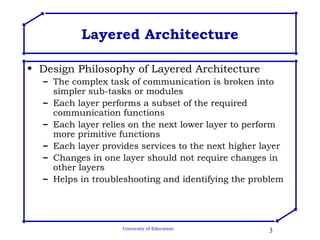
Layered Architecture Design Philosophy of Layered Architecture The complex task of communication is broken into simpler sub-tasks or modules Each layer performs a subset of the required communication functions Each layer relies on the next lower layer to perform more primitive functions Each layer provides services to the next higher layer Changes in one layer should not require changes in other layers Helps in troubleshooting and identifying the problem
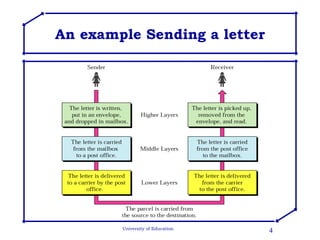
An example Sending a letter
OSI Model To standardize the design of communication system, the ISO created the OSI model. Open Systems Interconnection Developed by the International Organization for Standardization (ISO) Contains Seven layers It describes the functions to be performed at each layer
OSI Model ISO Established in 1947 ISO standard that covers all aspects of network communications is the Open Systems Interconnection ( OSI ) model.  First introduced in the late 1970s. A layer model Each layer performs a subset of the required communication functions Each layer relies on the next lower layer to perform more primitive functions Each layer provides services to the next higher layer Changes in one layer should not require changes in other layers
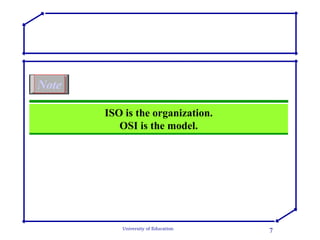
ISO is the organization. OSI is the model. Note
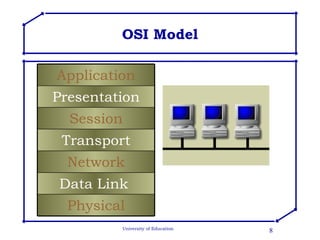
OSI Model Physical Data Link  Network Transport Session Presentation Application
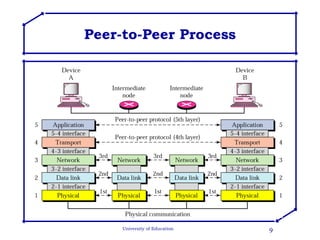
Peer-to-Peer Process
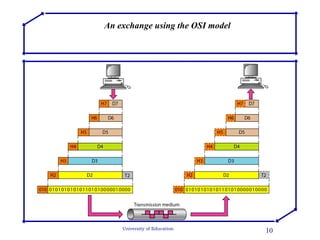
An exchange using the OSI model
OSI Model – Physical Layer Physical Physical interface between devices handles the transmission of bits over a communications channel Choice of Wired / wireless medium Data is converted into signals Includes voltage levels, connectors, media choice modulation techniques EIA/TIA-232, RJ45, NRZ.
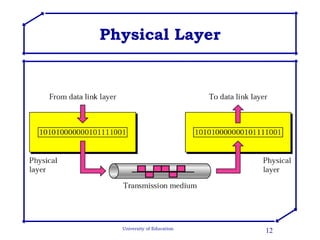
Physical Layer
The physical layer is responsible for movements of individual bits from one hop (node) to the next. Note
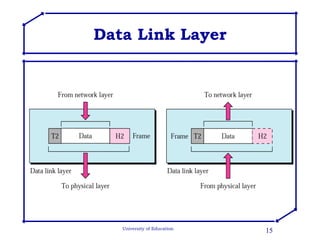
OSI Model – Data Link Layer •  Data Link –  Transforms data into a frame –  Means of activating, maintaining and   deactivating a reliable link –  Error detection and control –  Flow Control –  Higher layers may assume error free transmission Examples :- Ethernet, Frame Relay, FDDI.
Data Link Layer
The data link layer is responsible for moving  frames from one hop (node) to the next. Note
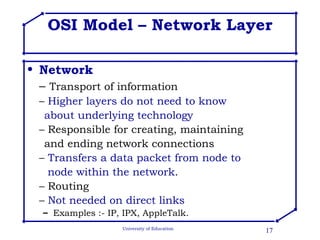
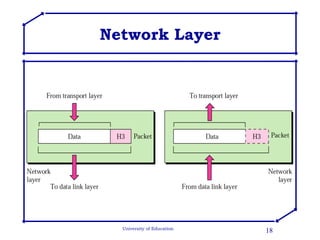
OSI Model – Network Layer Network –  Transport of information –  Higher layers do not need to know about underlying technology –  Responsible for creating, maintaining and ending network connections –  Transfers a data packet from node to node within the network . –  Routing –  Not needed on direct links Examples :- IP, IPX, AppleTalk.
Network Layer
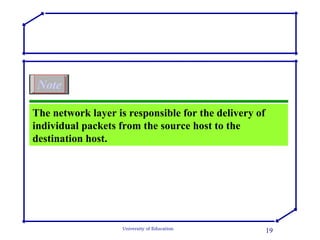
The network layer is responsible for the delivery of individual packets from the source host to the destination host. Note
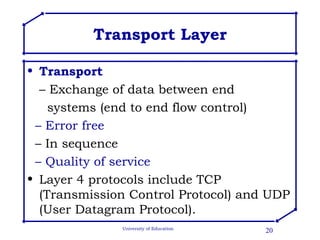
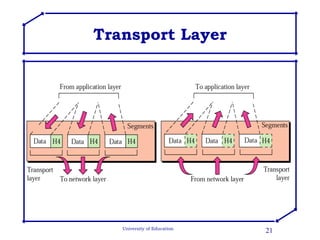
Transport Layer Transport –   Exchange of data between end systems (end to end flow control) –  Error free –   In sequence –  Quality of service Layer 4 protocols include TCP (Transmission Control Protocol) and UDP (User Datagram Protocol).
Transport Layer
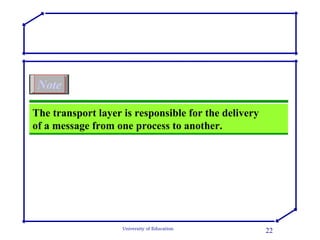
The transport layer is responsible for the delivery  of a message from one process to another. Note
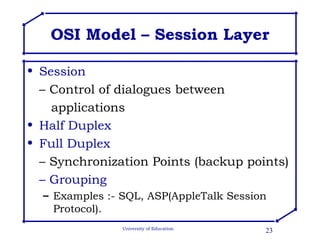
OSI Model – Session Layer Session –   Control of dialogues between   applications Half Duplex Full Duplex –   Synchronization Points (backup points) –  Grouping Examples :- SQL, ASP(AppleTalk Session Protocol).
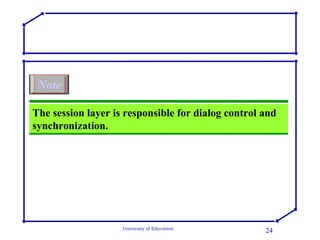
The session layer is responsible for dialog control and synchronization. Note
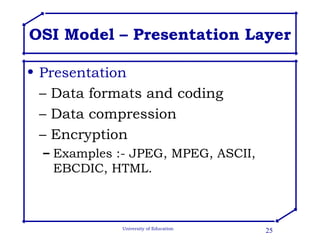
OSI Model – Presentation Layer Presentation – Data formats and coding – Data compression – Encryption Examples :- JPEG, MPEG, ASCII, EBCDIC, HTML.
The presentation layer is responsible for translation, compression, and encryption. Note
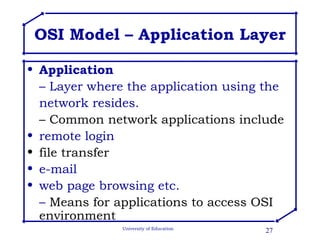
OSI Model – Application Layer Application –  Layer where the application using the network resides. –  Common network applications include remote login file transfer e-mail web page browsing etc. –  Means for applications to access OSI environment
The application layer is responsible for providing services to the user. Note
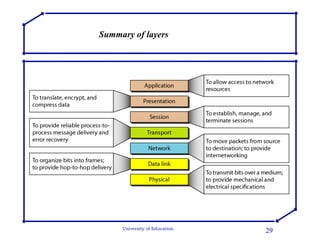
Summary of layers
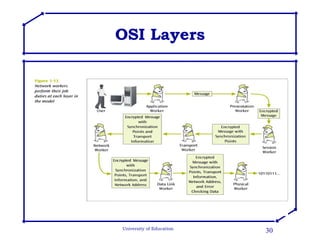
OSI Layers
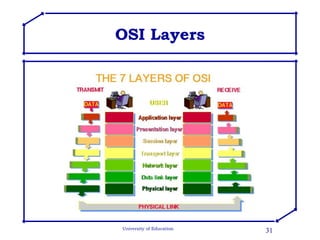
OSI Layers
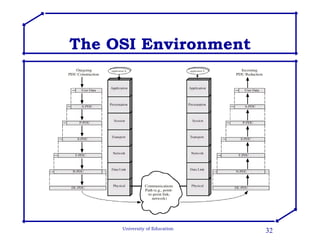
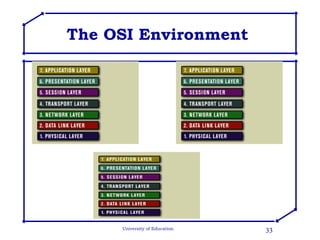
The OSI Environment
The OSI Environment

Osi Model

  • 1.
    – Layered Architecture By: Abid Shahzad Aslam
  • 2.
    Lecture–Roadmap Need of a Layered Architecture OSI Model 7 Layers of OSI Model Functional Details of OSI Layers Physical Layer Data Link Layer Network Layer Transport Layer Session Layer Presentation Layer Application Layer
  • 3.
    Layered Architecture DesignPhilosophy of Layered Architecture The complex task of communication is broken into simpler sub-tasks or modules Each layer performs a subset of the required communication functions Each layer relies on the next lower layer to perform more primitive functions Each layer provides services to the next higher layer Changes in one layer should not require changes in other layers Helps in troubleshooting and identifying the problem
  • 4.
  • 5.
    OSI Model Tostandardize the design of communication system, the ISO created the OSI model. Open Systems Interconnection Developed by the International Organization for Standardization (ISO) Contains Seven layers It describes the functions to be performed at each layer
  • 6.
    OSI Model ISOEstablished in 1947 ISO standard that covers all aspects of network communications is the Open Systems Interconnection ( OSI ) model. First introduced in the late 1970s. A layer model Each layer performs a subset of the required communication functions Each layer relies on the next lower layer to perform more primitive functions Each layer provides services to the next higher layer Changes in one layer should not require changes in other layers
  • 7.
    ISO is theorganization. OSI is the model. Note
  • 8.
    OSI Model PhysicalData Link Network Transport Session Presentation Application
  • 9.
  • 10.
    An exchange usingthe OSI model
  • 11.
    OSI Model –Physical Layer Physical Physical interface between devices handles the transmission of bits over a communications channel Choice of Wired / wireless medium Data is converted into signals Includes voltage levels, connectors, media choice modulation techniques EIA/TIA-232, RJ45, NRZ.
  • 12.
  • 13.
    The physical layeris responsible for movements of individual bits from one hop (node) to the next. Note
  • 14.
    OSI Model –Data Link Layer • Data Link – Transforms data into a frame – Means of activating, maintaining and deactivating a reliable link – Error detection and control – Flow Control – Higher layers may assume error free transmission Examples :- Ethernet, Frame Relay, FDDI.
  • 15.
  • 16.
    The data linklayer is responsible for moving frames from one hop (node) to the next. Note
  • 17.
    OSI Model –Network Layer Network – Transport of information – Higher layers do not need to know about underlying technology – Responsible for creating, maintaining and ending network connections – Transfers a data packet from node to node within the network . – Routing – Not needed on direct links Examples :- IP, IPX, AppleTalk.
  • 18.
  • 19.
    The network layeris responsible for the delivery of individual packets from the source host to the destination host. Note
  • 20.
    Transport Layer Transport– Exchange of data between end systems (end to end flow control) – Error free – In sequence – Quality of service Layer 4 protocols include TCP (Transmission Control Protocol) and UDP (User Datagram Protocol).
  • 21.
  • 22.
    The transport layeris responsible for the delivery of a message from one process to another. Note
  • 23.
    OSI Model –Session Layer Session – Control of dialogues between applications Half Duplex Full Duplex – Synchronization Points (backup points) – Grouping Examples :- SQL, ASP(AppleTalk Session Protocol).
  • 24.
    The session layeris responsible for dialog control and synchronization. Note
  • 25.
    OSI Model –Presentation Layer Presentation – Data formats and coding – Data compression – Encryption Examples :- JPEG, MPEG, ASCII, EBCDIC, HTML.
  • 26.
    The presentation layeris responsible for translation, compression, and encryption. Note
  • 27.
    OSI Model –Application Layer Application – Layer where the application using the network resides. – Common network applications include remote login file transfer e-mail web page browsing etc. – Means for applications to access OSI environment
  • 28.
    The application layeris responsible for providing services to the user. Note
  • 29.
  • 30.
  • 31.
  • 32.
  • 33.