OSI REFERENCE
LAYERS
Mrs. Vasanthi Muniasamy
CONTENTS
 INTRODUCTION
 WHAT IS OSI?
 OSI MODEL
 TYPES OF LAYERS
 PHYSICAL LAYER
 DATA LINK LAYER
 NETWORK LAYER
 TRANSPORT LAYER
 SESSION LAYER
 PRESENTATION LAYER
 APPLICATION LAYER
 CONCLUSION
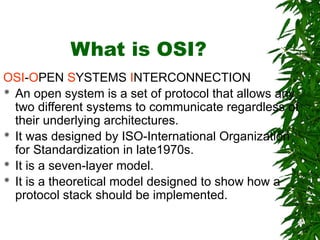
What is OSI?
OSI-OPEN SYSTEMS INTERCONNECTION
 An open system is a set of protocol that allows any
two different systems to communicate regardless of
their underlying architectures.
 It was designed by ISO-International Organization
for Standardization in late1970s.
 It is a seven-layer model.
 It is a theoretical model designed to show how a
protocol stack should be implemented.
OSI MODEL
Physical layer
Data link layer
Network layer
Transport layer
1
2
3
5
6
7
4
Application layer
Session layer
Presentation layer
TYPES OF LAYERS
 Physical layer
 Data link layer
 Network layer
 Transport layer
 Session layer
 Presentation layer
 Application layer
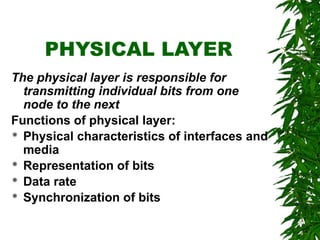
PHYSICAL LAYER
The physical layer is responsible for
transmitting individual bits from one
node to the next
Functions of physical layer:
 Physical characteristics of interfaces and
media
 Representation of bits
 Data rate
 Synchronization of bits
PHYSICAL LAYER
101010000000101111001 101010000000101111001
Physical
layer
Physical
layer
Transmission
medium
From data
link layer
To data
link layer
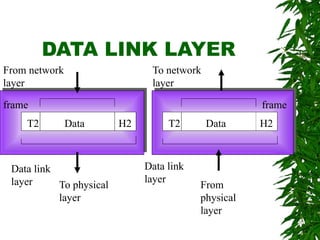
DATA LINK LAYER
The data link layer is responsible for
transmitting frames from one node to the
next
FUNCTIONS OF DATA LINK LAYER:
 Framing
 Physical addressing
 Flow control
 Error control
 Access control
DATA LINK LAYER
T2 Data H2 T2 Data H2
To physical
layer
From
physical
layer
Data link
layer
Data link
layer
From network
layer
To network
layer
frame
frame
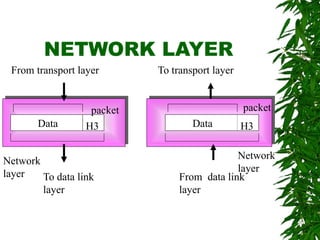
NETWORK LAYER
The network layer is responsible for
the delivery of packets from the
original source to the final
destination
FUNCTIONS OF NETWORK LAYER:
 Logical addressing
 Routing
NETWORK LAYER
Data H3 Data H3
To data link
layer
From data link
layer
Network
layer
Network
layer
From transport layer To transport layer
packet packet
TRANSPORT LAYER
The transport layer is responsible for
delivery of a message from one process
to another(process-to-process delivery)
FUNCTIONS OF TRANSPORT LAYER:
 Port addressing
 Segmentation and reassembly
 Connection control
 Flow control
 Error control
TRANSPORT LAYER
Data H4 Data H4 Data H4 Data H4 Data H4 Data H4
To network
layer
From network
layer
Transport
layer
Transport
layer
From session layer To session layer
segments segments
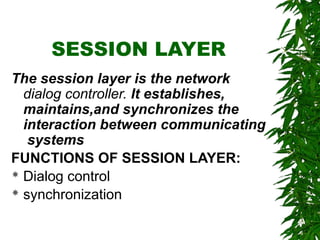
SESSION LAYER
The session layer is the network
dialog controller. It establishes,
maintains,and synchronizes the
interaction between communicating
systems
FUNCTIONS OF SESSION LAYER:
 Dialog control
 synchronization
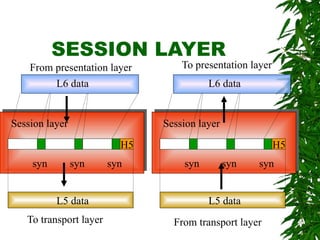
SESSION LAYER
H5
L5 data
syn syn syn
Session layer
L6 data
H5
L5 data
syn syn syn
Session layer
L6 data
To transport layer From transport layer
From presentation layer To presentation layer
PRESENTATION LAYER
The presentation layer is concerned with
the syntax and semantics of the
information exchanged between two
systems
FUNCTONS OF PRESENTATION LAYER:
 Translation
 Encryption
 Compression
PRESENTATION LAYER
L6 data
L7 data
H6
Presentation layer
Encoded ,encrypted
& compressed data
L6 data
L7 data
H6
Decoded ,decrypted
& decompressed data
Presentation layer
To session layer From session layer
From application layer To application layer
APPLICATION LAYER
The application layer enables the
user,whether human or software, to
access the network. It provides user
interfaces and support for services.
FUNCTIONS OF APPLICATION LAYER:
 Network virtual terminal
 File transfer,access,and
management(FTAM)
 Mail services
 Directory services
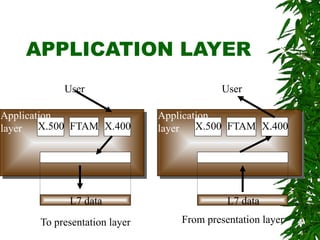
APPLICATION LAYER
X.500 FTAM X.400
Application
layer
L7 data
User
X.500 FTAM X.400
Application
layer
L7 data
User
To presentation layer From presentation layer
OSI LAYERS MODEL
THANK YOU

OSI LAYER (phyiscal,datalink layer,session layer)

  • 1.
  • 2.
    CONTENTS  INTRODUCTION  WHATIS OSI?  OSI MODEL  TYPES OF LAYERS  PHYSICAL LAYER  DATA LINK LAYER  NETWORK LAYER  TRANSPORT LAYER  SESSION LAYER  PRESENTATION LAYER  APPLICATION LAYER  CONCLUSION
  • 3.
    What is OSI? OSI-OPENSYSTEMS INTERCONNECTION  An open system is a set of protocol that allows any two different systems to communicate regardless of their underlying architectures.  It was designed by ISO-International Organization for Standardization in late1970s.  It is a seven-layer model.  It is a theoretical model designed to show how a protocol stack should be implemented.
  • 4.
    OSI MODEL Physical layer Datalink layer Network layer Transport layer 1 2 3 5 6 7 4 Application layer Session layer Presentation layer
  • 5.
    TYPES OF LAYERS Physical layer  Data link layer  Network layer  Transport layer  Session layer  Presentation layer  Application layer
  • 6.
    PHYSICAL LAYER The physicallayer is responsible for transmitting individual bits from one node to the next Functions of physical layer:  Physical characteristics of interfaces and media  Representation of bits  Data rate  Synchronization of bits
  • 7.
  • 8.
    DATA LINK LAYER Thedata link layer is responsible for transmitting frames from one node to the next FUNCTIONS OF DATA LINK LAYER:  Framing  Physical addressing  Flow control  Error control  Access control
  • 9.
    DATA LINK LAYER T2Data H2 T2 Data H2 To physical layer From physical layer Data link layer Data link layer From network layer To network layer frame frame
  • 10.
    NETWORK LAYER The networklayer is responsible for the delivery of packets from the original source to the final destination FUNCTIONS OF NETWORK LAYER:  Logical addressing  Routing
  • 11.
    NETWORK LAYER Data H3Data H3 To data link layer From data link layer Network layer Network layer From transport layer To transport layer packet packet
  • 12.
    TRANSPORT LAYER The transportlayer is responsible for delivery of a message from one process to another(process-to-process delivery) FUNCTIONS OF TRANSPORT LAYER:  Port addressing  Segmentation and reassembly  Connection control  Flow control  Error control
  • 13.
    TRANSPORT LAYER Data H4Data H4 Data H4 Data H4 Data H4 Data H4 To network layer From network layer Transport layer Transport layer From session layer To session layer segments segments
  • 14.
    SESSION LAYER The sessionlayer is the network dialog controller. It establishes, maintains,and synchronizes the interaction between communicating systems FUNCTIONS OF SESSION LAYER:  Dialog control  synchronization
  • 15.
    SESSION LAYER H5 L5 data synsyn syn Session layer L6 data H5 L5 data syn syn syn Session layer L6 data To transport layer From transport layer From presentation layer To presentation layer
  • 16.
    PRESENTATION LAYER The presentationlayer is concerned with the syntax and semantics of the information exchanged between two systems FUNCTONS OF PRESENTATION LAYER:  Translation  Encryption  Compression
  • 17.
    PRESENTATION LAYER L6 data L7data H6 Presentation layer Encoded ,encrypted & compressed data L6 data L7 data H6 Decoded ,decrypted & decompressed data Presentation layer To session layer From session layer From application layer To application layer
  • 18.
    APPLICATION LAYER The applicationlayer enables the user,whether human or software, to access the network. It provides user interfaces and support for services. FUNCTIONS OF APPLICATION LAYER:  Network virtual terminal  File transfer,access,and management(FTAM)  Mail services  Directory services
  • 19.
    APPLICATION LAYER X.500 FTAMX.400 Application layer L7 data User X.500 FTAM X.400 Application layer L7 data User To presentation layer From presentation layer
  • 20.
  • 21.