OSI Model BySyedMunawer Hassan
IntroductionISO International Standard Organization Established in 1947 Multinational body dedicated to worldwide agreement Standard of international level Covers all aspects of network communications It is Open System Interconnection MODELAllow two different Machines to connect without change in hardware and softwareIt is model for understanding and designing a network architecture 
The ModelLayered framework Designed for communication across all types of computer system 7 separate but related layer Each defines segment of process of moving information across network.
Why we need OSI ModelTo allow different types of network hardware and software to communicate with each otherAvoidable duplication of equipment resourcesTo breaks network communication into smaller, simpler parts that are easy to developTo facilitates standardization of network components to allow multiple – vendor development and support
1. Physical LayerPhysical characteristics of interfaces and medium.Representation of bits.Physical topology.Line configuration.Data rate.Synchronization of bits.Transmission mode.
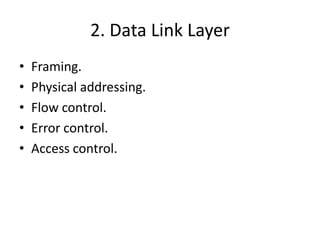
2. Data Link LayerFraming.Physical addressing.Flow control.Error control.Access control.
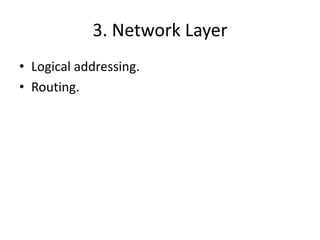
3. Network LayerLogical addressing.Routing.
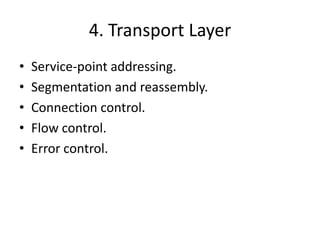
4. Transport LayerService-point addressing.Segmentation and reassembly.Connection control.Flow control.Error control.
5. Session LayerDialog control.Synchronization.
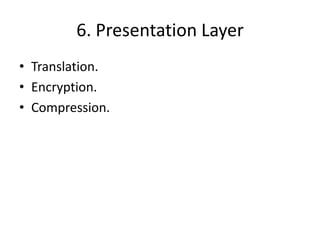
6. Presentation LayerTranslation.Encryption.Compression.
7. Application LayerNetwork virtual terminal.File transfer, access, and management.Mail services.Directory services.
SummaryThe International Standards Organization created a model called the Open Systems Interconnection, which allows diverse systems to communicate. The seven-layer OSI model provides guidelines for the development of universally compatible networking protocols. The physical layer coordinates the functions required to transmit a bit stream over a physical medium. The data link layer is responsible for delivering data units from one station to the next without errors. The network layer is responsible for the source-to-destination delivery of a packet across multiple network links. The transport layer is responsible for the process-to-process delivery of the entire message. The session layer establishes, maintains, and synchronizes the interactions between communicating devices. The presentation layer ensures interoperability between communicating devices through transformation of data into a mutually agreed upon format. The Application Layer Enable user, (human or software) to access the network and Provides user interface and support for services (email, Remote file access, shared database management system).

Osi Model

  • 1.
  • 2.
    IntroductionISO International StandardOrganization Established in 1947 Multinational body dedicated to worldwide agreement Standard of international level Covers all aspects of network communications It is Open System Interconnection MODELAllow two different Machines to connect without change in hardware and softwareIt is model for understanding and designing a network architecture 
  • 3.
    The ModelLayered frameworkDesigned for communication across all types of computer system 7 separate but related layer Each defines segment of process of moving information across network.
  • 4.
    Why we needOSI ModelTo allow different types of network hardware and software to communicate with each otherAvoidable duplication of equipment resourcesTo breaks network communication into smaller, simpler parts that are easy to developTo facilitates standardization of network components to allow multiple – vendor development and support
  • 5.
    1. Physical LayerPhysicalcharacteristics of interfaces and medium.Representation of bits.Physical topology.Line configuration.Data rate.Synchronization of bits.Transmission mode.
  • 6.
    2. Data LinkLayerFraming.Physical addressing.Flow control.Error control.Access control.
  • 7.
    3. Network LayerLogicaladdressing.Routing.
  • 8.
    4. Transport LayerService-pointaddressing.Segmentation and reassembly.Connection control.Flow control.Error control.
  • 9.
    5. Session LayerDialogcontrol.Synchronization.
  • 10.
  • 11.
    7. Application LayerNetworkvirtual terminal.File transfer, access, and management.Mail services.Directory services.
  • 12.
    SummaryThe International StandardsOrganization created a model called the Open Systems Interconnection, which allows diverse systems to communicate. The seven-layer OSI model provides guidelines for the development of universally compatible networking protocols. The physical layer coordinates the functions required to transmit a bit stream over a physical medium. The data link layer is responsible for delivering data units from one station to the next without errors. The network layer is responsible for the source-to-destination delivery of a packet across multiple network links. The transport layer is responsible for the process-to-process delivery of the entire message. The session layer establishes, maintains, and synchronizes the interactions between communicating devices. The presentation layer ensures interoperability between communicating devices through transformation of data into a mutually agreed upon format. The Application Layer Enable user, (human or software) to access the network and Provides user interface and support for services (email, Remote file access, shared database management system).