Computer Network
OSI Model
Reference Model
The ARPANET
Advanced Research Projects Agency. ARPA had no scientists or
laboratories; It is office and a small budget.
It did its work by issuing grants and contracts to universities and
companies whose ideas looked promising to it.
ARPANET was the network that became the basis for the Internet.
Based on a concept first published in 1967, ARPANET was
developed under the direction of the U.S. Advanced Research
Projects Agency (ARPA).
In 1969, the idea became a modest reality with the interconnection of
four university computers. The initial purpose was to communicate
with and share computer resources among mainly scientific users at
The ARPANET
ARPANET took advantage of the new idea of sending information
in small units called packets that could be routed on different paths
and reconstructed at their destination.
The development of the TCP/IP protocols in the 1970s made it
possible to expand the size of the network, which now had become
a network of networks, in an orderly way.
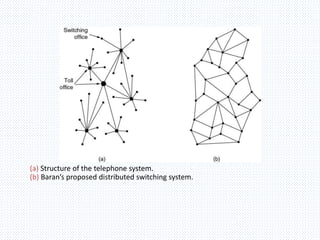
(a) Structure of the telephone system.
(b) Baran’s proposed distributed switching system.
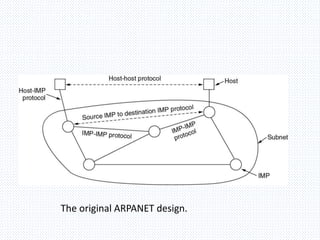
The original ARPANET design.
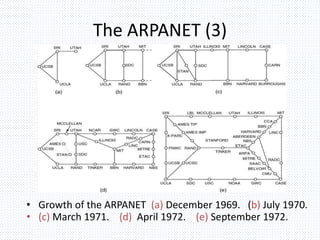
The ARPANET (3)
• Growth of the ARPANET (a) December 1969. (b) July 1970.
• (c) March 1971. (d) April 1972. (e) September 1972.
Layer Architecture
Network layers follow a set of rules, called protocol.
Layer architecture simplifies the network design.
It is easy to debug network applications in a layered
architecture network.
The network management is easier due to the layered
architecture.
The protocol defines the format of the data being
exchanged, and the control and timing for the handshake
between layers.
OSI Model
TCP/IP Model
TCP/IP MODEL
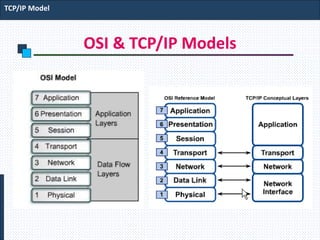
OSI & TCP/IP Models
TCP/IP Model
TCP/IP Model
TCP/IP Model
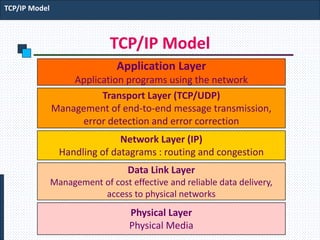
Application Layer
Application programs using the network
Transport Layer (TCP/UDP)
Management of end-to-end message transmission,
error detection and error correction
Network Layer (IP)
Handling of datagrams : routing and congestion
Data Link Layer
Management of cost effective and reliable data delivery,
access to physical networks
Physical Layer
Physical Media
Open Systems Interconnection (OSI) Model
International standard organization (ISO) established a
committee in 1977 to develop an architecture for computer
communication.
Open Systems Interconnection (OSI) reference model is the
result of this effort.
In 1984, the Open Systems Interconnection (OSI) reference
model was approved as an international standard for
communications architecture.
Term “open” denotes the ability to connect any two
systems which conform to the reference model and
associated standards.
OSI Model
OSI Reference Model
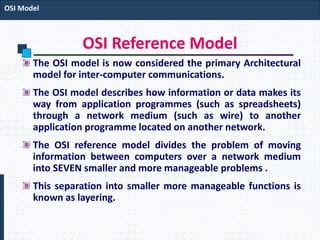
The OSI model is now considered the primary Architectural
model for inter-computer communications.
The OSI model describes how information or data makes its
way from application programmes (such as spreadsheets)
through a network medium (such as wire) to another
application programme located on another network.
The OSI reference model divides the problem of moving
information between computers over a network medium
into SEVEN smaller and more manageable problems .
This separation into smaller more manageable functions is
known as layering.
OSI Model
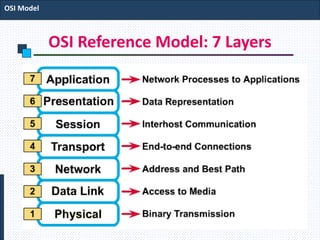
OSI Reference Model: 7 Layers
OSI Model
OSI Reference Model: 7 Layers
OSI Model
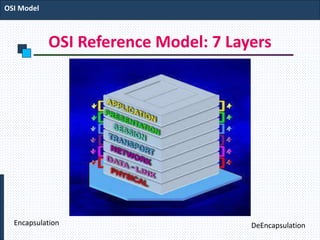
Encapsulation DeEncapsulation
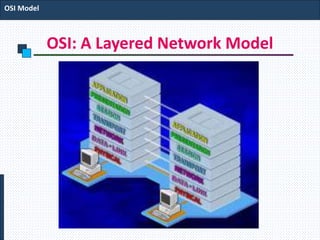
OSI: A Layered Network Model
OSI Model
Physical Layer
Provides physical interface for transmission of information.
Defines rules by which bits are passed from one system to
another on a physical communication medium.
• The design issues have to do with making sure that when one
side sends a 1 bit, it is received by the other side as a 1 bit, not
as a 0 bit.
Covers all - mechanical, electrical, functional and procedural -
aspects for physical communication.
Such characteristics as voltage levels, timing of voltage
changes, physical data rates, maximum transmission distances,
physical connectors, and other similar attributes are defined by
physical layer specifications.
OSI Model
Data Link Layer
Data link layer attempts to provide reliable communication
over the physical layer interface.
Breaks the outgoing data into frames and reassemble the
received frames.
Create and detect frame boundaries.
Handle errors by implementing an acknowledgement and
retransmission scheme.
Supports points-to-point as well as broadcast
communication.
Trailer, Header
OSI Model
Network Layer
Implements routing of frames (packets) through the
network.
Defines the most optimum path the packet should take from
the source to the destination
Defines logical addressing so that any endpoint can be
identified.
Handles congestion (routing) in the network.
Facilitates interconnection between heterogeneous
networks (Internetworking).
OSI Model
Transport Layer
Purpose of this layer is to provide a reliable mechanism for
the exchange of data between two processes in different
computers.
Ensures that data units are delivered in sequence
Ensures that the data units are delivered error free.
Ensures that there is no loss or duplication of data units.
Provides connectionless or connection oriented service.
Provides connection management.
Multiplex multiple connection over a single channel.
OSI Model
Session Layer
The session layer allows users on different machines to establish
sessions between them.
Session layer provides mechanism for controlling the dialogue
between the two end systems. It defines how to start, control and
end conversations (called sessions) between applications.
This layer requests for a logical connection to be established on
an end-user’s request.
Any necessary log-on or password validation is also handled by
this layer.
Session layer is also responsible for terminating the connection.
• This layer provides services like dialogue discipline.
OSI Model
Presentation Layer
Presentation layer defines the format in which the data is to
be exchanged between the two communicating entities.
Also handles data compression and data encryption
(cryptography). coding
OSI Model
Application Layer
Application layer interacts with application programs and is
the highest level of OSI model.
Application layer contains management functions to
support distributed applications.
Examples of application layer are applications such as file
transfer, electronic mail, remote login etc.
OSI Model
OSI in Action
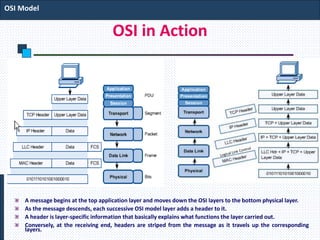
A message begins at the top application layer and moves down the OSI layers to the bottom physical layer.
As the message descends, each successive OSI model layer adds a header to it.
A header is layer-specific information that basically explains what functions the layer carried out.
Conversely, at the receiving end, headers are striped from the message as it travels up the corresponding
layers.
OSI Model
Comparing OSI and TCP/IP Models
Concepts central to the OSI
model
Services
Interfaces
Protocols
Comparing OSI and TCP/IP Models
The service definition tells what the layer does, not how
entities above it access it or how the layer works. It defines
the layer's semantics
A layer's interface tells the processes above it how to access
it. It specifies what the parameters are and what results to
expect. It, too, says nothing about how the layer works inside
the peer
Protocols used in a layer are the layer's own business. It can
use any protocols it wants to, as long as it gets the job done
(i.e., provides the offered services). It can also change them
at will without affecting software in higher layers.
The TCP/IP model did not originally clearly distinguish
between service, interface, and protocol,
Ethernet
• Architecture of the original Ethernet.
Ethernet is the most widely installed local area network (LAN)
technology.
Ethernet is a link layer protocol in the TCP/IP stack,
Describing how networked devices can format data for transmission to
other network devices on the same network segment, and how to put
that data out on the network connection.
It commercially in 1980 and first standardized in 1983 as IEEE 802.3.
support higher bit rates and longer link distances
The first Ethernet was developed at Xerox in 1976 by Metcalfe and Boggs, based on a
3Mbps serial cable bus, called the Ether, and used 1-persistent CSMA/CD for medium
access
Hub, Switch,
HUB: Also called a network hub, is a common connection point for devices in a
network.
The hub contains multiple ports. When a packet arrives at one port, it is copied to the
other ports so that all segments of the LAN can see all packets.
SWITCH: High-speed device that receives incoming data packets and redirects
them to their destination on a local area network (LAN). A LAN switch operates at
the data link layer (Layer 2) or the network layer of the OSI Model
1. It always broadcasts all kinds of packets, no matter whether packets are ARP or
ICMP
2. It does not have a MAC table
3. Collision will happen if multiple hosts try to send packets to the same destination
at the same time. It does not have facility for store-and-forward packets.
1. It has a MAC table
2. It only broadcasts an ARP packet, if MAC table does not have MAC address of destination
3. ICMP packets are unicast type
4. No collision will happen when multiple hosts try to send packet to the same destination.
Packets will be queued.
Router, Routing Algorithm, Bridge, FDDI
A router is a networking device that forwards data packets betwe
computer networks.
 Routers perform the "traffic directing" functions on the Internet.
 Wireless Routers have Access Point built in.
A routing algorithm is a set of step-by-step operations used to direct Internet traffic
efficiently. When a packet of data leaves its source, there are many different paths it
can take to its destination. The routing algorithm is used to determine
mathematically the best path to take.
 Distance vector algorithms
 Link-state algorithms
 Optimized Link State Routing algorithm
 Path vector protocol
Router, Routing Algorithm,Bridge,FDDI
Fiber Distributed Data Interface (FDDI) is a standard for data transmission in a local area
network. It uses optical fiber as its standard underlying physical medium, although it was also
later specified to use copper cable, in which case it may be called CDDI (Copper Distributed
Data Interface),
Repeater:
A repeater is an electronic device that receives a signal and retransmits it.
Repeaters are used to extend transmissions so that the signal can cover longer distances
or be received on the other side of an obstruction.
There are several different types of repeaters; a telephone repeater is an amplifier in
a telephone line, an optical repeater is an optoelectronic circuit that amplifies the light
beam in an optical fiber cable; and a radio repeater is a radio receiver
and transmitter that retransmits a radio signal.
BRIDGE: A bridge is a type of computer network device that provides interconnection with
other bridge networks that use the same protocol.
Bridge devices work at the data link layer of the Open System Interconnect (OSI) model,
connecting two different networks together and providing communication between them.
It is possible that some sentences or some information were
included in these slides without mentioning exact references. I am
sorry for violating rules of intellectual property. When I will have a
bit more time, I will try my best to avoid such things.
These slides are only for students in order to give them very basic
concepts about the giant, “Networking”, not for experts.
Since I am not a network expert, these slides could have
wrong/inconsistent information…I am sorry for that.
Students are requested to check references and Books, or to talk
to Network engineers.
Confession

Chapter 1.2 osi model

  • 1.
  • 2.
    The ARPANET Advanced ResearchProjects Agency. ARPA had no scientists or laboratories; It is office and a small budget. It did its work by issuing grants and contracts to universities and companies whose ideas looked promising to it. ARPANET was the network that became the basis for the Internet. Based on a concept first published in 1967, ARPANET was developed under the direction of the U.S. Advanced Research Projects Agency (ARPA). In 1969, the idea became a modest reality with the interconnection of four university computers. The initial purpose was to communicate with and share computer resources among mainly scientific users at
  • 3.
    The ARPANET ARPANET tookadvantage of the new idea of sending information in small units called packets that could be routed on different paths and reconstructed at their destination. The development of the TCP/IP protocols in the 1970s made it possible to expand the size of the network, which now had become a network of networks, in an orderly way.
  • 4.
    (a) Structure ofthe telephone system. (b) Baran’s proposed distributed switching system.
  • 5.
  • 6.
    The ARPANET (3) •Growth of the ARPANET (a) December 1969. (b) July 1970. • (c) March 1971. (d) April 1972. (e) September 1972.
  • 7.
    Layer Architecture Network layersfollow a set of rules, called protocol. Layer architecture simplifies the network design. It is easy to debug network applications in a layered architecture network. The network management is easier due to the layered architecture. The protocol defines the format of the data being exchanged, and the control and timing for the handshake between layers. OSI Model
  • 8.
  • 9.
    OSI & TCP/IPModels TCP/IP Model
  • 10.
    TCP/IP Model TCP/IP Model ApplicationLayer Application programs using the network Transport Layer (TCP/UDP) Management of end-to-end message transmission, error detection and error correction Network Layer (IP) Handling of datagrams : routing and congestion Data Link Layer Management of cost effective and reliable data delivery, access to physical networks Physical Layer Physical Media
  • 11.
    Open Systems Interconnection(OSI) Model International standard organization (ISO) established a committee in 1977 to develop an architecture for computer communication. Open Systems Interconnection (OSI) reference model is the result of this effort. In 1984, the Open Systems Interconnection (OSI) reference model was approved as an international standard for communications architecture. Term “open” denotes the ability to connect any two systems which conform to the reference model and associated standards. OSI Model
  • 12.
    OSI Reference Model TheOSI model is now considered the primary Architectural model for inter-computer communications. The OSI model describes how information or data makes its way from application programmes (such as spreadsheets) through a network medium (such as wire) to another application programme located on another network. The OSI reference model divides the problem of moving information between computers over a network medium into SEVEN smaller and more manageable problems . This separation into smaller more manageable functions is known as layering. OSI Model
  • 13.
    OSI Reference Model:7 Layers OSI Model
  • 14.
    OSI Reference Model:7 Layers OSI Model Encapsulation DeEncapsulation
  • 15.
    OSI: A LayeredNetwork Model OSI Model
  • 16.
    Physical Layer Provides physicalinterface for transmission of information. Defines rules by which bits are passed from one system to another on a physical communication medium. • The design issues have to do with making sure that when one side sends a 1 bit, it is received by the other side as a 1 bit, not as a 0 bit. Covers all - mechanical, electrical, functional and procedural - aspects for physical communication. Such characteristics as voltage levels, timing of voltage changes, physical data rates, maximum transmission distances, physical connectors, and other similar attributes are defined by physical layer specifications. OSI Model
  • 17.
    Data Link Layer Datalink layer attempts to provide reliable communication over the physical layer interface. Breaks the outgoing data into frames and reassemble the received frames. Create and detect frame boundaries. Handle errors by implementing an acknowledgement and retransmission scheme. Supports points-to-point as well as broadcast communication. Trailer, Header OSI Model
  • 18.
    Network Layer Implements routingof frames (packets) through the network. Defines the most optimum path the packet should take from the source to the destination Defines logical addressing so that any endpoint can be identified. Handles congestion (routing) in the network. Facilitates interconnection between heterogeneous networks (Internetworking). OSI Model
  • 19.
    Transport Layer Purpose ofthis layer is to provide a reliable mechanism for the exchange of data between two processes in different computers. Ensures that data units are delivered in sequence Ensures that the data units are delivered error free. Ensures that there is no loss or duplication of data units. Provides connectionless or connection oriented service. Provides connection management. Multiplex multiple connection over a single channel. OSI Model
  • 20.
    Session Layer The sessionlayer allows users on different machines to establish sessions between them. Session layer provides mechanism for controlling the dialogue between the two end systems. It defines how to start, control and end conversations (called sessions) between applications. This layer requests for a logical connection to be established on an end-user’s request. Any necessary log-on or password validation is also handled by this layer. Session layer is also responsible for terminating the connection. • This layer provides services like dialogue discipline. OSI Model
  • 21.
    Presentation Layer Presentation layerdefines the format in which the data is to be exchanged between the two communicating entities. Also handles data compression and data encryption (cryptography). coding OSI Model
  • 22.
    Application Layer Application layerinteracts with application programs and is the highest level of OSI model. Application layer contains management functions to support distributed applications. Examples of application layer are applications such as file transfer, electronic mail, remote login etc. OSI Model
  • 23.
    OSI in Action Amessage begins at the top application layer and moves down the OSI layers to the bottom physical layer. As the message descends, each successive OSI model layer adds a header to it. A header is layer-specific information that basically explains what functions the layer carried out. Conversely, at the receiving end, headers are striped from the message as it travels up the corresponding layers. OSI Model
  • 24.
    Comparing OSI andTCP/IP Models Concepts central to the OSI model Services Interfaces Protocols
  • 25.
    Comparing OSI andTCP/IP Models The service definition tells what the layer does, not how entities above it access it or how the layer works. It defines the layer's semantics A layer's interface tells the processes above it how to access it. It specifies what the parameters are and what results to expect. It, too, says nothing about how the layer works inside the peer Protocols used in a layer are the layer's own business. It can use any protocols it wants to, as long as it gets the job done (i.e., provides the offered services). It can also change them at will without affecting software in higher layers. The TCP/IP model did not originally clearly distinguish between service, interface, and protocol,
  • 26.
    Ethernet • Architecture ofthe original Ethernet. Ethernet is the most widely installed local area network (LAN) technology. Ethernet is a link layer protocol in the TCP/IP stack, Describing how networked devices can format data for transmission to other network devices on the same network segment, and how to put that data out on the network connection. It commercially in 1980 and first standardized in 1983 as IEEE 802.3. support higher bit rates and longer link distances The first Ethernet was developed at Xerox in 1976 by Metcalfe and Boggs, based on a 3Mbps serial cable bus, called the Ether, and used 1-persistent CSMA/CD for medium access
  • 27.
    Hub, Switch, HUB: Alsocalled a network hub, is a common connection point for devices in a network. The hub contains multiple ports. When a packet arrives at one port, it is copied to the other ports so that all segments of the LAN can see all packets. SWITCH: High-speed device that receives incoming data packets and redirects them to their destination on a local area network (LAN). A LAN switch operates at the data link layer (Layer 2) or the network layer of the OSI Model 1. It always broadcasts all kinds of packets, no matter whether packets are ARP or ICMP 2. It does not have a MAC table 3. Collision will happen if multiple hosts try to send packets to the same destination at the same time. It does not have facility for store-and-forward packets. 1. It has a MAC table 2. It only broadcasts an ARP packet, if MAC table does not have MAC address of destination 3. ICMP packets are unicast type 4. No collision will happen when multiple hosts try to send packet to the same destination. Packets will be queued.
  • 28.
    Router, Routing Algorithm,Bridge, FDDI A router is a networking device that forwards data packets betwe computer networks.  Routers perform the "traffic directing" functions on the Internet.  Wireless Routers have Access Point built in. A routing algorithm is a set of step-by-step operations used to direct Internet traffic efficiently. When a packet of data leaves its source, there are many different paths it can take to its destination. The routing algorithm is used to determine mathematically the best path to take.  Distance vector algorithms  Link-state algorithms  Optimized Link State Routing algorithm  Path vector protocol
  • 29.
    Router, Routing Algorithm,Bridge,FDDI FiberDistributed Data Interface (FDDI) is a standard for data transmission in a local area network. It uses optical fiber as its standard underlying physical medium, although it was also later specified to use copper cable, in which case it may be called CDDI (Copper Distributed Data Interface), Repeater: A repeater is an electronic device that receives a signal and retransmits it. Repeaters are used to extend transmissions so that the signal can cover longer distances or be received on the other side of an obstruction. There are several different types of repeaters; a telephone repeater is an amplifier in a telephone line, an optical repeater is an optoelectronic circuit that amplifies the light beam in an optical fiber cable; and a radio repeater is a radio receiver and transmitter that retransmits a radio signal. BRIDGE: A bridge is a type of computer network device that provides interconnection with other bridge networks that use the same protocol. Bridge devices work at the data link layer of the Open System Interconnect (OSI) model, connecting two different networks together and providing communication between them.
  • 30.
    It is possiblethat some sentences or some information were included in these slides without mentioning exact references. I am sorry for violating rules of intellectual property. When I will have a bit more time, I will try my best to avoid such things. These slides are only for students in order to give them very basic concepts about the giant, “Networking”, not for experts. Since I am not a network expert, these slides could have wrong/inconsistent information…I am sorry for that. Students are requested to check references and Books, or to talk to Network engineers. Confession