OSI & TCP/IP MODEL
…Different layers of OSI Model….
ABSTRACT
This is a notes about basic introduction of OSI
Model & TCP/IP Model. It contain details about
the seven layers of the OSI Model which are
Application layer, Presentation Layer, Session
Layer, Transport Layer, Network Layer, Data
Link Layer, Physical Layer.
Supervised By
Pranab Bandhu Nath
(Senior Lecturer)
CSE Department
City University, Dhaka
Submitted By
Shamima Akther| ID - 1834902616
CSE 317 : Computer Networks
Protocols Switches (TCP/IP, OSI): A protocol is a set of rules for communication between
computers within a layer on a network. Layers provide a division of the work done by a
network. These rules include guidelines that regulate the following characteristics of a network:
access method, allowed physical topologies, types of cabling and speed of data transfer.
As we know, In computer science, Computers communicate using a layered set of protocols.
There are two models that are widely referenced today : OSI and TCP/IP. The concepts are
similar, but the layers themselves differ between the two models.
• OSI: OSI Model referred to the Open Systems Interconnection Model (OSI). It is a
conceptual framework used to describe the functions of a networking system. This is a
model that was proposed as a set of standard layers and protocols for communication
between different computers around the world and has been in use since 1983. Although
not universally adopted, much of this model is considered the standard and in heavy use
layers provide a division of the work done by a network. In OSI model, communications
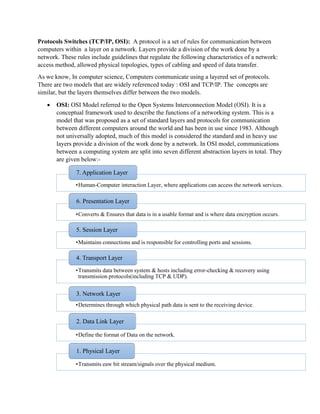
between a computing system are split into seven different abstraction layers in total. They
are given below:-
•Human-Computer interaction Layer, where applications can access the network services.
7. Application Layer
•Converts & Ensures that data is in a usable format and is where data encryption occurs.
6. Presentation Layer
•Maintains connections and is responsible for controlling ports and sessions.
5. Session Layer
•Transmits data between system & hosts including error-checking & recovery using
transmission protocols(including TCP & UDP).
4. Transport Layer
•Determines through which physical path data is sent to the receiving device.
3. Network Layer
•Define the format of Data on the network.
2. Data Link Layer
•Transmits eaw bit stream/signals over the physical medium.
1. Physical Layer
Necessity of OSI Model:
Although the modern internet doesn’t strictly follow the OSI Model (it more closely follows the
simpler internet protocol suite), the OSI Model is still very useful for troubleshooting network
problems. Whether its one person who can’t get their lapotop on the internet or a web site being
down for thousands of users, the OSI Model can help to break down the problem and isolate the
source of the trouble. If the problem can be narrowed down to one specific layer of the model, a
lot of unnecessary work can be avoided.
Seven Layers Of OSI Model:
The seven abstraction layers of the OSI Model can be defined as follows, from top to bottom:
Layer 7 (Application Layer):
Most of what the user actually interacts with is at this layer. Software Applications like web
browsers (Office 365, Google Chrome, Firefox, Safari etc) and other internet-connected
applications (like Skype or Outlook) rely on the application layer protocols to initiate
communications. But it should be clear that client software applications are not part of the
application layer; rather the application layer is responsible for the protocols and data
manipulation that the software relies on to present meaningful data to the user. So, applications
themselves do not reside at the application layer. It just interacts with software applications to
implement a communicating component. Example of the application layer is an application such
as file transfer, email, remote login etc.
Functions Of Application Layer:
• This layer helps to identifies communication partners, determining resource availability
and synchronizes communication.
• It allows users to log on to a remote host.
• This layer provides various E-mail services.
• It offers distributed database sources and access for global information about various
objects and services.
Layer 6 (Presentation Layer):
The Presentation Layer prepares data for the application layer.It takes any data transmitted by the
application layer and prepares it for transmission over the session layer. So, In general , it
represtents the preparation or translations of application format to network format or from
network formatting to application format. It formats or translates data based on the syntax or
semantics that the application accepts. Because of this, it at times also called the syntax layer.
Functions Of Presentation Layer:
• Data Compression: Allows to reduce the number of bits needs to be transmitted on the
network.
• Data Encryption: Helps to encrypt data for security purposes- For example, password
encryption.
• Character code translation from ASCII to EBCDIC.
• It provides a user interface and support for services like email and file transfer.
Layer 5 (Session Layer):
Session layer responsible for opening and closing communication between the two devices. The
time between when the communication is opened and closed is known as the session. The
session layer ensures that the session stays open long enough to transfer all the data being
exchanged. It also determines which packets belong to which text and image files.
Functions Of Session Layer:
• It establishes, maintains and terminates a session.
• Session layer enables two systems to enter into a dialog.
• It also allows a process to add a checkpoint to steam of data.
• It handles all the important log-on or password validation & reconnections.
Layer 4 (Transport Layer):
This layer coordinates data transfer between system and hosts, including error-checking and data
recovery. How much data to send, at what rate, where it goes etc. It regulates the size of the data,
Sequencing and ultimately the transfer of data betweem system & hosts. The best known
example of the transport layer is the Transmission control protocol(TCP), which is built on top of
the Internet Protocol(IP), commonly known as TCP/IP. TCP and UDP port numbers work at this
layer 4, while IP addresses work at Layer 3, the network layer.
Functions Of Transport Layer:
• Transport layer makes sure that the message is delivered to the correct process on the
destination machine.
• It also makes sure that the entire message arrives without any error else it should be
retransmitted.
• It divides the message received from the session layer into segments and numbers them to
make a sequence.
• It is responsible for flow control & error control.
Layer 3 (Network Layer):
This layer determines how data is sent to the receiving device. So,The network layer is
responsible for receiving frames from the data link layer and delivering them to their intended
destinations among based on the addresses contained inside the frame.The network layer finds
the destination by using logical addresses, such as IP(Internet Protocol). At this layer, routers are
a crucial component used to quite literally route information where it needs to go between
networks. Message delivery at the network layer does not give any guarenteed to be reliable
network layer protocol.
Functions Of Network Layer:
• It's responsible for packet forwarding.
• Routing protocols.
• Network layer addressing.
• Multicast group management.
Layer 2 (Data Link Layer):
The data link layer establishes and terminates a connection between two physically connected
nodes on a network. Like the network layer, It breaks up packets into frames and sends them
from source to destination. This layer is composed of two parts - Logical Link Control (LLC)
which identifies network protocols, performs error checking and synchronizes frames and Media
Access Control (MAC) which uses MAC addresses to connect devices and define permissions to
transmit and receive data. So, It is IP address understandble layer, which helps to define logical
addressing so that any end point should be identified. It translates binary (or BITs) into signals
and allows upper layers to access media.
Functions Of Data Link Layer:
• Framing which divides the data from Network layer into frames.
• Allows to add header to the frame to define the physical address of the source and
destination machine.
• Adds logical addresses of the sender and receivers.
• It is also responsible for the sourcing process to the destination process delivery of the
entire message.
• It also offers a system for error control in which it detects retransmits damage or lost
frames.
• Data link layer also provides a mechanism to transmit data over independent networks
which are linked together.
Layer 1 (Physical Layer):
The physical layer helps to define the electrical and physical specifications of the data
connection. This level establishes the relationship between a device and a physical transmission
medium such as cables and switches. This is also the layer where the data gets converted into a
bit stream, which is a string of 1s and 0s. The physical layer of both devices must also agree on a
signal convention so that the 1s can be distinguished from the 0s on both devices.The physical
layer is not concerned with protocols or other such higher-layer items.
Examples of hardware in the physical layer are network adapters, ethernet, repeaters,
networking hub's etc.
Functions Of Physical Layer:
• Actual hardware sits at this layer. It transmits signals over media.
• TCP: The TCP (Transmission Control Protocol)/IP (Internet Protocol) model, sometimes
referred to as a protocol stack, can be considered a condensed version of the OSI model.
As we know, This model does not cover the three layers of the OSI model. This means
that TCP/IP is hardware independent. Since TCP/IP does not include lower level
protocols, we'll start with the middle level protocols. TCP/IP has four layers. Such as:-
▪ Layer 1 (Network Access/Interface): Also called the Link or Network Interface
layer. This layer combines the OSI model’s L1 and L2..
▪ Layer 2 (Network): This layer is similar to the OSI model’s L3.
▪ Layer 3 (Transport): Also called the Host-to-Host layer. This layer is similar to
the OSI model’s L4.
▪ Layer 4 (Application): Also called the Process Layer, this layer combines the OSI
model’s L5, L6 and L7.

OSI &TCP/IP Model

  • 1.
    OSI & TCP/IPMODEL …Different layers of OSI Model…. ABSTRACT This is a notes about basic introduction of OSI Model & TCP/IP Model. It contain details about the seven layers of the OSI Model which are Application layer, Presentation Layer, Session Layer, Transport Layer, Network Layer, Data Link Layer, Physical Layer. Supervised By Pranab Bandhu Nath (Senior Lecturer) CSE Department City University, Dhaka Submitted By Shamima Akther| ID - 1834902616 CSE 317 : Computer Networks
  • 2.
    Protocols Switches (TCP/IP,OSI): A protocol is a set of rules for communication between computers within a layer on a network. Layers provide a division of the work done by a network. These rules include guidelines that regulate the following characteristics of a network: access method, allowed physical topologies, types of cabling and speed of data transfer. As we know, In computer science, Computers communicate using a layered set of protocols. There are two models that are widely referenced today : OSI and TCP/IP. The concepts are similar, but the layers themselves differ between the two models. • OSI: OSI Model referred to the Open Systems Interconnection Model (OSI). It is a conceptual framework used to describe the functions of a networking system. This is a model that was proposed as a set of standard layers and protocols for communication between different computers around the world and has been in use since 1983. Although not universally adopted, much of this model is considered the standard and in heavy use layers provide a division of the work done by a network. In OSI model, communications between a computing system are split into seven different abstraction layers in total. They are given below:- •Human-Computer interaction Layer, where applications can access the network services. 7. Application Layer •Converts & Ensures that data is in a usable format and is where data encryption occurs. 6. Presentation Layer •Maintains connections and is responsible for controlling ports and sessions. 5. Session Layer •Transmits data between system & hosts including error-checking & recovery using transmission protocols(including TCP & UDP). 4. Transport Layer •Determines through which physical path data is sent to the receiving device. 3. Network Layer •Define the format of Data on the network. 2. Data Link Layer •Transmits eaw bit stream/signals over the physical medium. 1. Physical Layer
  • 3.
    Necessity of OSIModel: Although the modern internet doesn’t strictly follow the OSI Model (it more closely follows the simpler internet protocol suite), the OSI Model is still very useful for troubleshooting network problems. Whether its one person who can’t get their lapotop on the internet or a web site being down for thousands of users, the OSI Model can help to break down the problem and isolate the source of the trouble. If the problem can be narrowed down to one specific layer of the model, a lot of unnecessary work can be avoided. Seven Layers Of OSI Model: The seven abstraction layers of the OSI Model can be defined as follows, from top to bottom: Layer 7 (Application Layer): Most of what the user actually interacts with is at this layer. Software Applications like web browsers (Office 365, Google Chrome, Firefox, Safari etc) and other internet-connected applications (like Skype or Outlook) rely on the application layer protocols to initiate communications. But it should be clear that client software applications are not part of the application layer; rather the application layer is responsible for the protocols and data manipulation that the software relies on to present meaningful data to the user. So, applications themselves do not reside at the application layer. It just interacts with software applications to implement a communicating component. Example of the application layer is an application such as file transfer, email, remote login etc. Functions Of Application Layer: • This layer helps to identifies communication partners, determining resource availability and synchronizes communication. • It allows users to log on to a remote host. • This layer provides various E-mail services. • It offers distributed database sources and access for global information about various objects and services. Layer 6 (Presentation Layer): The Presentation Layer prepares data for the application layer.It takes any data transmitted by the application layer and prepares it for transmission over the session layer. So, In general , it represtents the preparation or translations of application format to network format or from network formatting to application format. It formats or translates data based on the syntax or semantics that the application accepts. Because of this, it at times also called the syntax layer. Functions Of Presentation Layer: • Data Compression: Allows to reduce the number of bits needs to be transmitted on the network. • Data Encryption: Helps to encrypt data for security purposes- For example, password encryption.
  • 4.
    • Character codetranslation from ASCII to EBCDIC. • It provides a user interface and support for services like email and file transfer. Layer 5 (Session Layer): Session layer responsible for opening and closing communication between the two devices. The time between when the communication is opened and closed is known as the session. The session layer ensures that the session stays open long enough to transfer all the data being exchanged. It also determines which packets belong to which text and image files. Functions Of Session Layer: • It establishes, maintains and terminates a session. • Session layer enables two systems to enter into a dialog. • It also allows a process to add a checkpoint to steam of data. • It handles all the important log-on or password validation & reconnections. Layer 4 (Transport Layer): This layer coordinates data transfer between system and hosts, including error-checking and data recovery. How much data to send, at what rate, where it goes etc. It regulates the size of the data, Sequencing and ultimately the transfer of data betweem system & hosts. The best known example of the transport layer is the Transmission control protocol(TCP), which is built on top of the Internet Protocol(IP), commonly known as TCP/IP. TCP and UDP port numbers work at this layer 4, while IP addresses work at Layer 3, the network layer. Functions Of Transport Layer: • Transport layer makes sure that the message is delivered to the correct process on the destination machine. • It also makes sure that the entire message arrives without any error else it should be retransmitted. • It divides the message received from the session layer into segments and numbers them to make a sequence. • It is responsible for flow control & error control. Layer 3 (Network Layer): This layer determines how data is sent to the receiving device. So,The network layer is responsible for receiving frames from the data link layer and delivering them to their intended destinations among based on the addresses contained inside the frame.The network layer finds the destination by using logical addresses, such as IP(Internet Protocol). At this layer, routers are a crucial component used to quite literally route information where it needs to go between networks. Message delivery at the network layer does not give any guarenteed to be reliable network layer protocol.
  • 5.
    Functions Of NetworkLayer: • It's responsible for packet forwarding. • Routing protocols. • Network layer addressing. • Multicast group management. Layer 2 (Data Link Layer): The data link layer establishes and terminates a connection between two physically connected nodes on a network. Like the network layer, It breaks up packets into frames and sends them from source to destination. This layer is composed of two parts - Logical Link Control (LLC) which identifies network protocols, performs error checking and synchronizes frames and Media Access Control (MAC) which uses MAC addresses to connect devices and define permissions to transmit and receive data. So, It is IP address understandble layer, which helps to define logical addressing so that any end point should be identified. It translates binary (or BITs) into signals and allows upper layers to access media. Functions Of Data Link Layer: • Framing which divides the data from Network layer into frames. • Allows to add header to the frame to define the physical address of the source and destination machine. • Adds logical addresses of the sender and receivers. • It is also responsible for the sourcing process to the destination process delivery of the entire message. • It also offers a system for error control in which it detects retransmits damage or lost frames. • Data link layer also provides a mechanism to transmit data over independent networks which are linked together. Layer 1 (Physical Layer): The physical layer helps to define the electrical and physical specifications of the data connection. This level establishes the relationship between a device and a physical transmission medium such as cables and switches. This is also the layer where the data gets converted into a bit stream, which is a string of 1s and 0s. The physical layer of both devices must also agree on a signal convention so that the 1s can be distinguished from the 0s on both devices.The physical layer is not concerned with protocols or other such higher-layer items. Examples of hardware in the physical layer are network adapters, ethernet, repeaters, networking hub's etc. Functions Of Physical Layer: • Actual hardware sits at this layer. It transmits signals over media.
  • 6.
    • TCP: TheTCP (Transmission Control Protocol)/IP (Internet Protocol) model, sometimes referred to as a protocol stack, can be considered a condensed version of the OSI model. As we know, This model does not cover the three layers of the OSI model. This means that TCP/IP is hardware independent. Since TCP/IP does not include lower level protocols, we'll start with the middle level protocols. TCP/IP has four layers. Such as:- ▪ Layer 1 (Network Access/Interface): Also called the Link or Network Interface layer. This layer combines the OSI model’s L1 and L2.. ▪ Layer 2 (Network): This layer is similar to the OSI model’s L3. ▪ Layer 3 (Transport): Also called the Host-to-Host layer. This layer is similar to the OSI model’s L4. ▪ Layer 4 (Application): Also called the Process Layer, this layer combines the OSI model’s L5, L6 and L7.