Semaphores and
Bounded Buffer
Semaphores
• Semaphore is a type of generalized lock
• Defined by Dijkstra in the last 60s
• Main synchronization primitives used in UNIX
• Consist of a positive integer value
• Two operations
• P(): an atomic operation that waits for semaphore to
become positive, then decrement it by 1
• V(): an atomic operation that increments semaphore
by 1 and wakes up a waiting thread at P(), if any.
Semaphores vs. Integers
• No negative values
• Only operations are P() and V()
• Cannot read or write semaphore values
• Except at the initialization times
• Operations are atomic
• Two P() calls cannot decrement the value below
zero
• A sleeping thread at P() cannot miss a wakeup
from V()
Binary Semaphores
• A binary semaphore is initialized to 1
• P() waits until the value is 1
• Then set it to 0
• V() sets the value to 1
• Wakes up a thread waiting at P(), if any
Two Uses of Semaphores
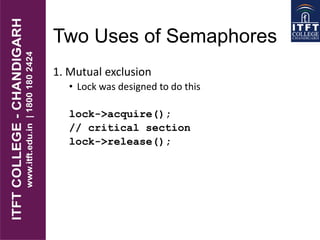
1. Mutual exclusion
• Lock was designed to do this
lock->acquire();
// critical section
lock->release();
Two Uses of Semaphores
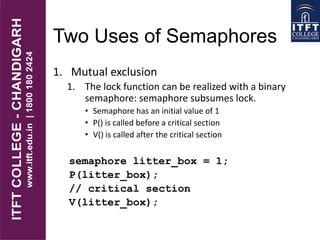
1. Mutual exclusion
1. The lock function can be realized with a binary
semaphore: semaphore subsumes lock.
• Semaphore has an initial value of 1
• P() is called before a critical section
• V() is called after the critical section
semaphore litter_box = 1;
P(litter_box);
// critical section
V(litter_box);
Two Uses of Semaphores
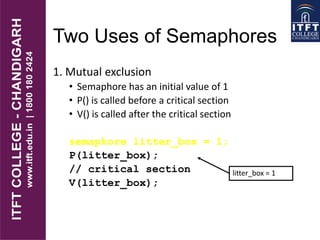
1. Mutual exclusion
• Semaphore has an initial value of 1
• P() is called before a critical section
• V() is called after the critical section
semaphore litter_box = 1;
P(litter_box);
// critical section
V(litter_box);
litter_box = 1
Two Uses of Semaphores
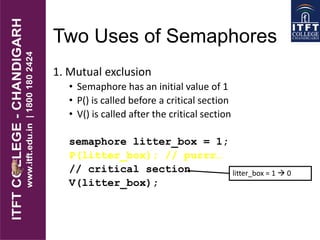
1. Mutual exclusion
• Semaphore has an initial value of 1
• P() is called before a critical section
• V() is called after the critical section
semaphore litter_box = 1;
P(litter_box); // purrr…
// critical section
V(litter_box);
litter_box = 1  0
Producer-Consumer with a
Bounded Buffer
• A classic problem
• A producer put things into a shared buffer
• A consumer takes them out
Problem Constraints
• The solution involves both synchronization
and mutual exclusion
• Constraints
• The consumer must wait if buffers are empty
(synchronization constraint)
• The producer must wait if buffers are full
(synchronization constraint)
• Only one thread can manipulate the buffer at a
time (mutual exclusion)
Implementing Semaphore
• How to implement semaphore?
• Almost exactly like lock.
• Using spinlock or queue
• What hardware support is needed?
• Interrupt disable
• Test-and-set
Implementing Semaphore
class semaphore {
int value;
}
semaphore::semaphore(int i) {
value = i;
}
semaphore::p() {
// disable interrupts
while (value == 0) {
// enable interrupts
// disable interrupts
}
value --;
// enable interrupts
}
semaphore::v() {
// disable interrupts
value ++;
// enable interrupts
}
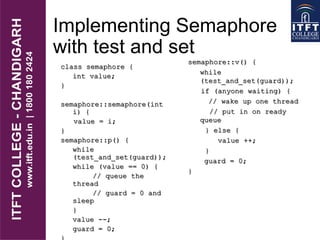
Implementing Semaphore
with test and set
class semaphore {
int value;
}
semaphore::semaphore(int
i) {
value = i;
}
semaphore::p() {
while
(test_and_set(guard));
while (value == 0) {
// queue the
thread
// guard = 0 and
sleep
}
value --;
guard = 0;
semaphore::v() {
while
(test_and_set(guard));
if (anyone waiting) {
// wake up one thread
// put in on ready
queue
} else {
value ++;
}
guard = 0;
}
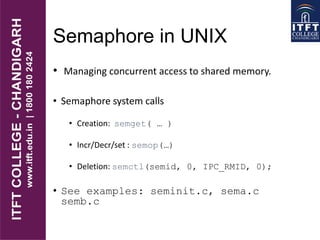
Semaphore in UNIX
• Managing concurrent access to shared memory.
• Semaphore system calls
• Creation: semget( … )
• Incr/Decr/set : semop(…)
• Deletion: semctl(semid, 0, IPC_RMID, 0);
• See examples: seminit.c, sema.c
semb.c

ITFT_Semaphores and bounded buffer

  • 1.
  • 2.
    Semaphores • Semaphore isa type of generalized lock • Defined by Dijkstra in the last 60s • Main synchronization primitives used in UNIX • Consist of a positive integer value • Two operations • P(): an atomic operation that waits for semaphore to become positive, then decrement it by 1 • V(): an atomic operation that increments semaphore by 1 and wakes up a waiting thread at P(), if any.
  • 3.
    Semaphores vs. Integers •No negative values • Only operations are P() and V() • Cannot read or write semaphore values • Except at the initialization times • Operations are atomic • Two P() calls cannot decrement the value below zero • A sleeping thread at P() cannot miss a wakeup from V()
  • 4.
    Binary Semaphores • Abinary semaphore is initialized to 1 • P() waits until the value is 1 • Then set it to 0 • V() sets the value to 1 • Wakes up a thread waiting at P(), if any
  • 5.
    Two Uses ofSemaphores 1. Mutual exclusion • Lock was designed to do this lock->acquire(); // critical section lock->release();
  • 6.
    Two Uses ofSemaphores 1. Mutual exclusion 1. The lock function can be realized with a binary semaphore: semaphore subsumes lock. • Semaphore has an initial value of 1 • P() is called before a critical section • V() is called after the critical section semaphore litter_box = 1; P(litter_box); // critical section V(litter_box);
  • 7.
    Two Uses ofSemaphores 1. Mutual exclusion • Semaphore has an initial value of 1 • P() is called before a critical section • V() is called after the critical section semaphore litter_box = 1; P(litter_box); // critical section V(litter_box); litter_box = 1
  • 8.
    Two Uses ofSemaphores 1. Mutual exclusion • Semaphore has an initial value of 1 • P() is called before a critical section • V() is called after the critical section semaphore litter_box = 1; P(litter_box); // purrr… // critical section V(litter_box); litter_box = 1  0
  • 9.
    Producer-Consumer with a BoundedBuffer • A classic problem • A producer put things into a shared buffer • A consumer takes them out
  • 10.
    Problem Constraints • Thesolution involves both synchronization and mutual exclusion • Constraints • The consumer must wait if buffers are empty (synchronization constraint) • The producer must wait if buffers are full (synchronization constraint) • Only one thread can manipulate the buffer at a time (mutual exclusion)
  • 11.
    Implementing Semaphore • Howto implement semaphore? • Almost exactly like lock. • Using spinlock or queue • What hardware support is needed? • Interrupt disable • Test-and-set
  • 12.
    Implementing Semaphore class semaphore{ int value; } semaphore::semaphore(int i) { value = i; } semaphore::p() { // disable interrupts while (value == 0) { // enable interrupts // disable interrupts } value --; // enable interrupts } semaphore::v() { // disable interrupts value ++; // enable interrupts }
  • 13.
    Implementing Semaphore with testand set class semaphore { int value; } semaphore::semaphore(int i) { value = i; } semaphore::p() { while (test_and_set(guard)); while (value == 0) { // queue the thread // guard = 0 and sleep } value --; guard = 0; semaphore::v() { while (test_and_set(guard)); if (anyone waiting) { // wake up one thread // put in on ready queue } else { value ++; } guard = 0; }
  • 14.
    Semaphore in UNIX •Managing concurrent access to shared memory. • Semaphore system calls • Creation: semget( … ) • Incr/Decr/set : semop(…) • Deletion: semctl(semid, 0, IPC_RMID, 0); • See examples: seminit.c, sema.c semb.c