WEL-COME
APPLICATION OF OZONE IN FOOD
PROCESSING
Presented by
Aniket More
(M. Tech.) Food Process Engineering
DEPARTMENT OF AGRICULTURAL AND FOOD
ENGINEERING
IIT KHARAGPUR
POINTS TO BE COVERED
1) Introduction
2) History of ozone in food processing
3) What is ozone?
4) How it is produced?
5) Principle and working
6) Different applications in food processing
7) Advantages and disadvantages
8) Cost analysis
9) Conclusions
10)References
INTRODUCTION
 Food industries are currently in need of different
innovative technologies to meet the consumer demand.
 There are some of the technologies like HPP, pulsed
electric field, high intensity pulsed light etc.
 But attention is now focused on the ozone as a powerful
sanitizer.
 Currently – more than 3000 water treatment
installations and more than 300 potable water treatment
plants all over the world.
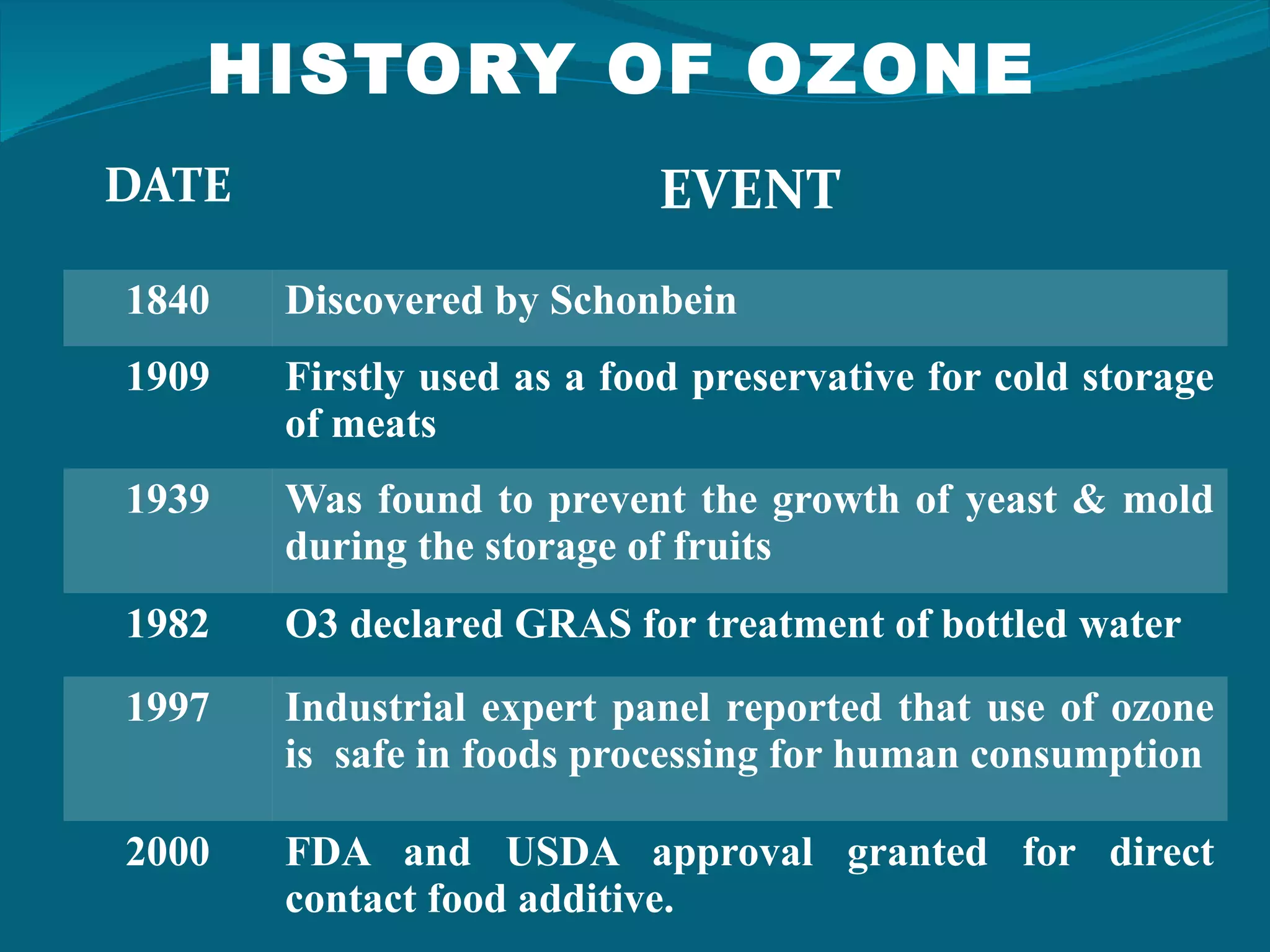
HISTORY OF OZONE
DATE EVENT
1840 Discovered by Schonbein
1909 Firstly used as a food preservative for cold storage
of meats
1939 Was found to prevent the growth of yeast & mold
during the storage of fruits
1982 O3 declared GRAS for treatment of bottled water
1997 Industrial expert panel reported that use of ozone
is safe in foods processing for human consumption
2000 FDA and USDA approval granted for direct
contact food additive.
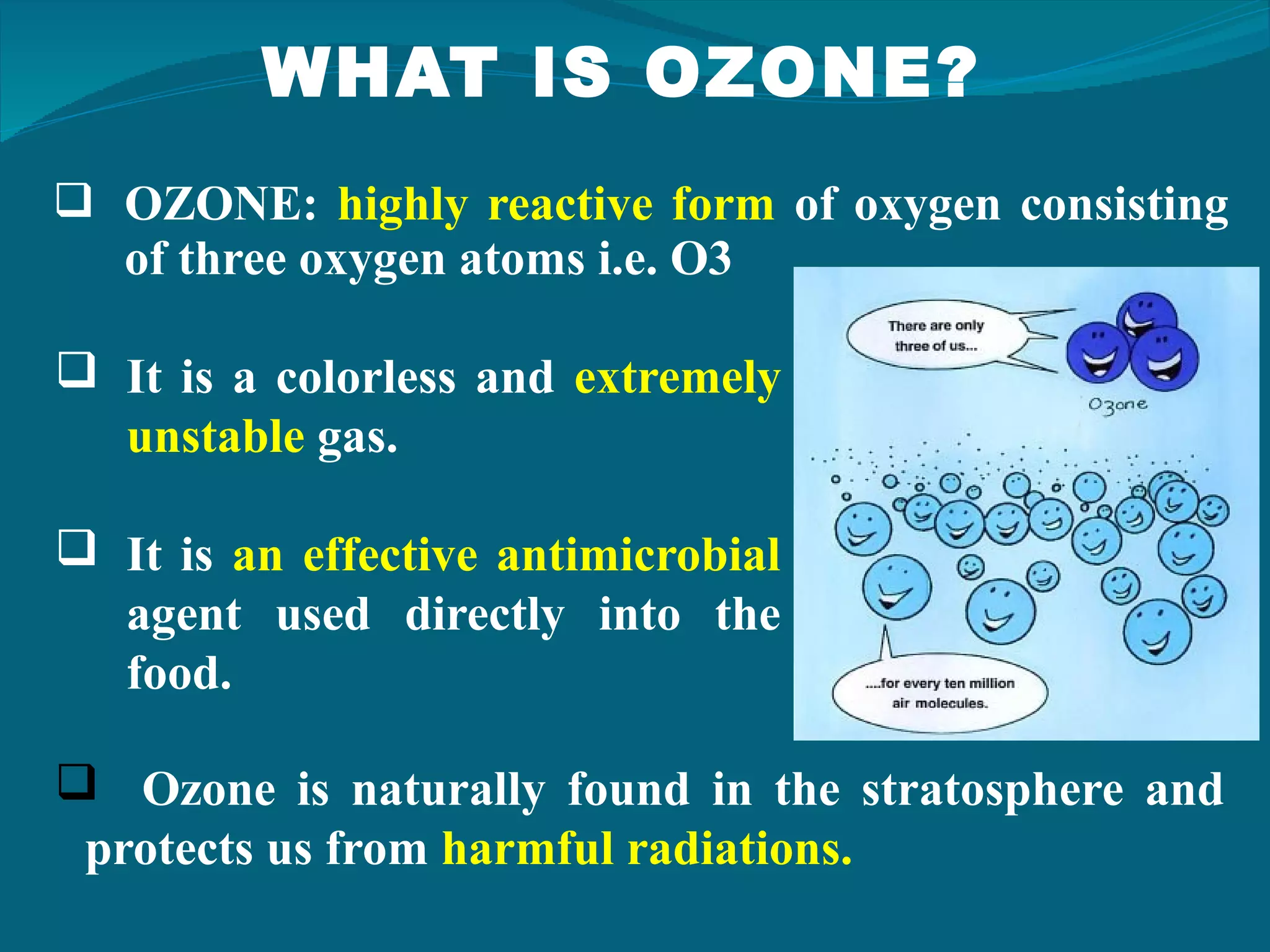
WHAT IS OZONE?
 OZONE: highly reactive form of oxygen consisting
of three oxygen atoms i.e. O3
 It is a colorless and extremely
unstable gas.
 It is an effective antimicrobial
agent used directly into the
food.
 Ozone is naturally found in the stratosphere and
protects us from harmful radiations.
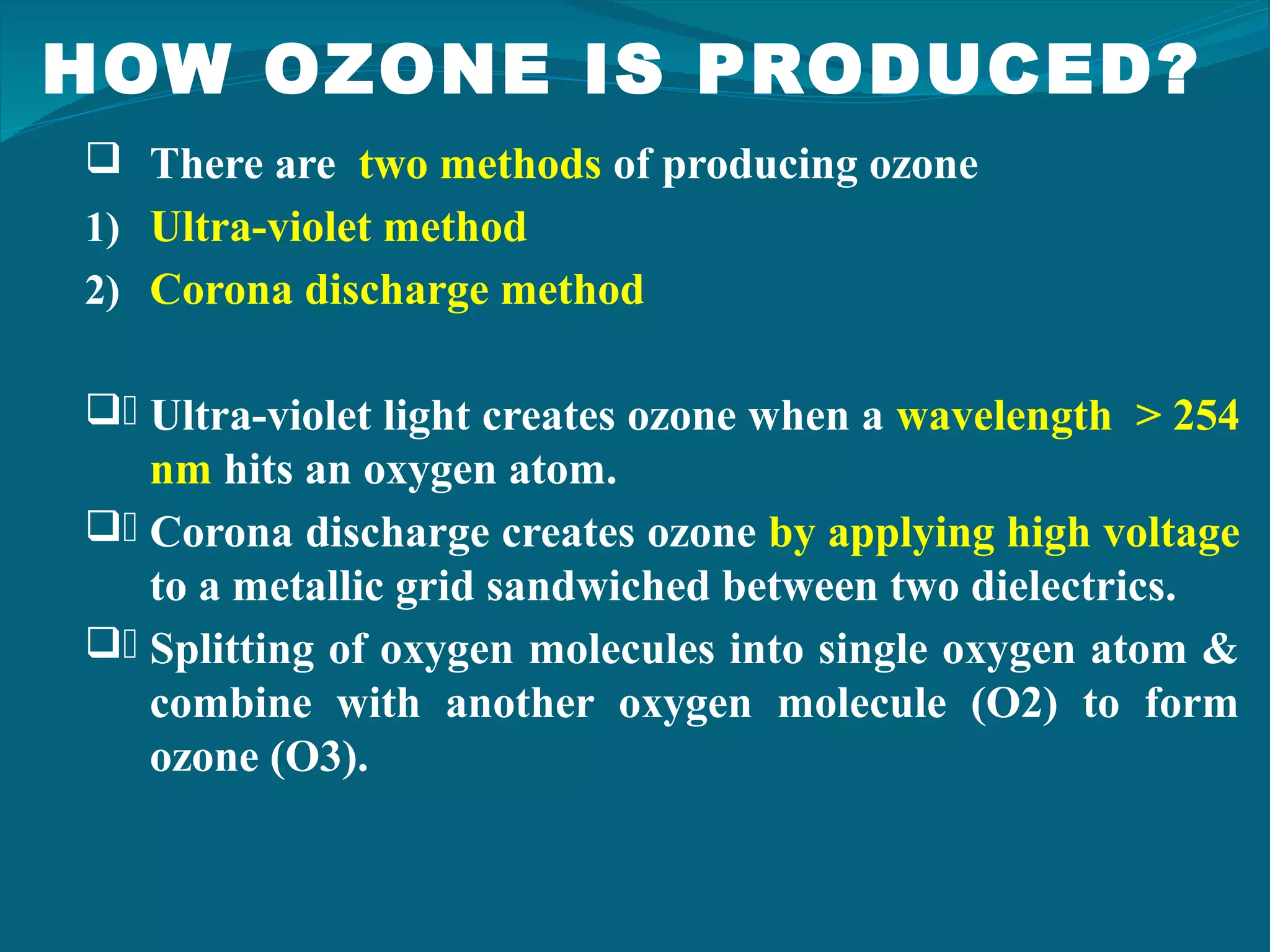
HOW OZONE IS PRODUCED?
 There are two methods of producing ozone
1) Ultra-violet method
2) Corona discharge method
) Ultra-violet light creates ozone when a wavelength > 254
nm hits an oxygen atom.
) Corona discharge creates ozone by applying high voltage
to a metallic grid sandwiched between two dielectrics.
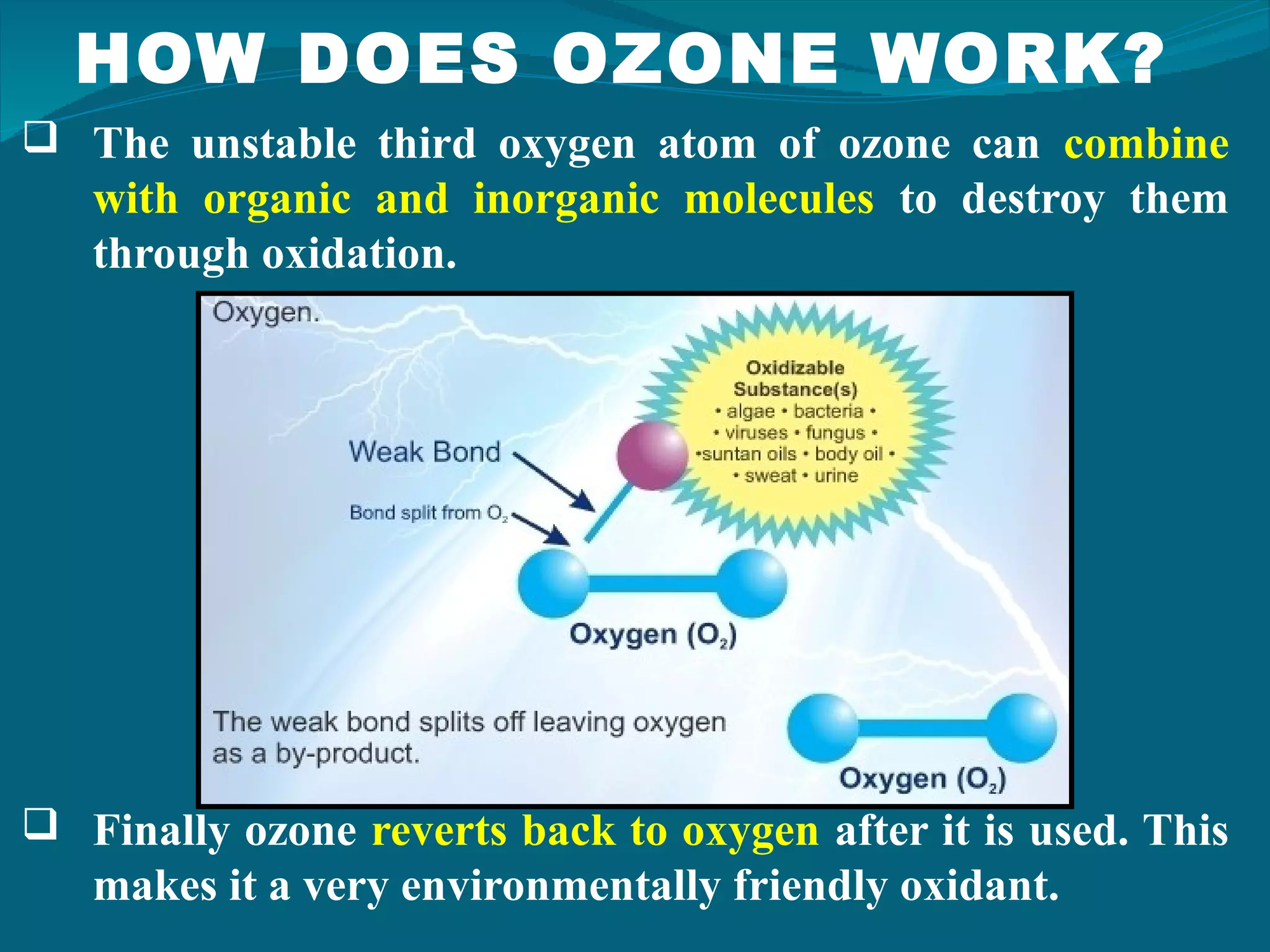
) Splitting of oxygen molecules into single oxygen atom &
combine with another oxygen molecule (O2) to form
ozone (O3).
HOW DOES OZONE WORK?
 The unstable third oxygen atom of ozone can combine
with organic and inorganic molecules to destroy them
through oxidation.
 Finally ozone reverts back to oxygen after it is used. This
makes it a very environmentally friendly oxidant.
COMPARATIVE STUDY
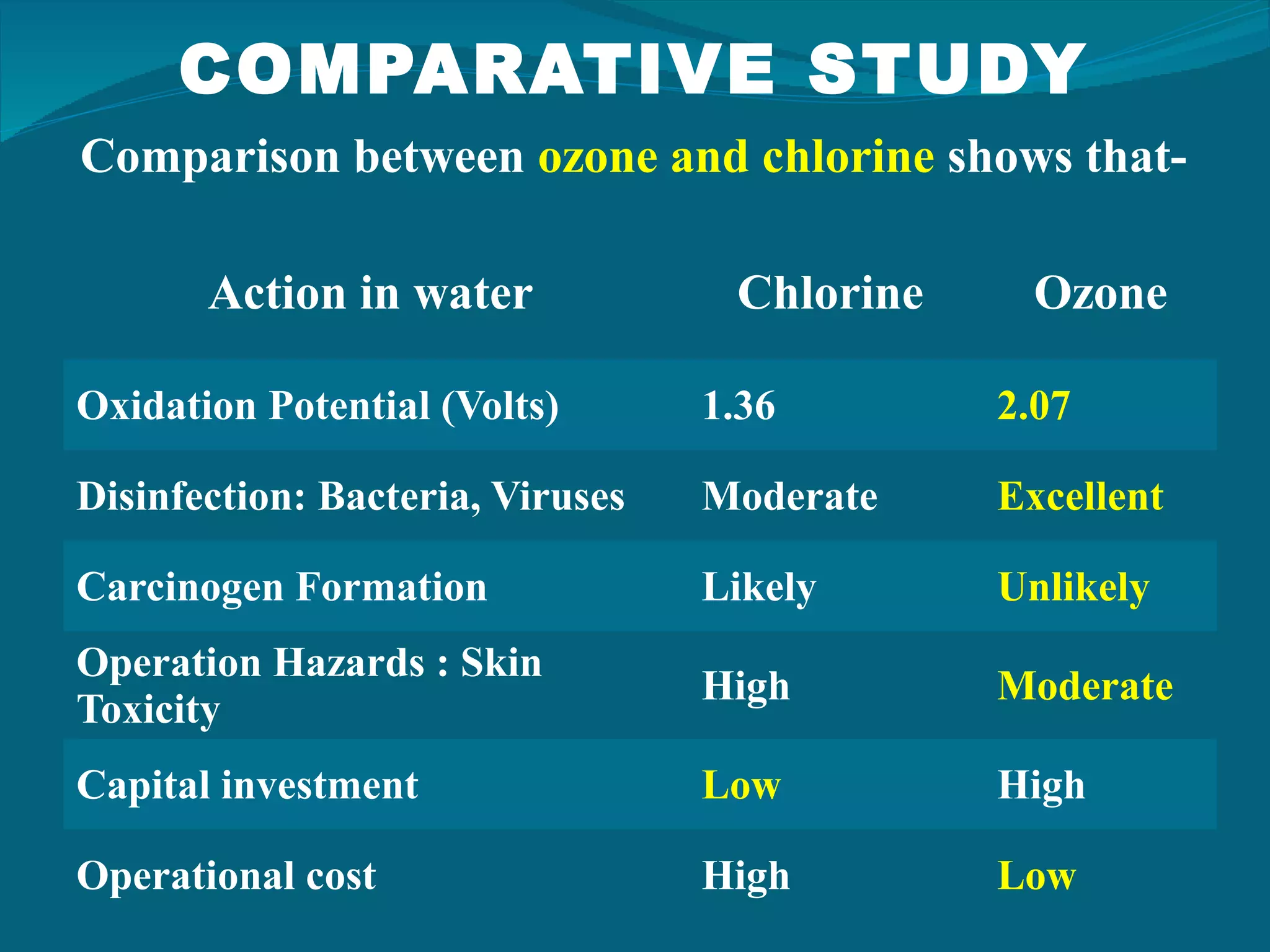
Comparison between ozone and chlorine shows that-
Action in water Chlorine Ozone
Oxidation Potential (Volts) 1.36 2.07
Disinfection: Bacteria, Viruses Moderate Excellent
Carcinogen Formation Likely Unlikely
Operation Hazards : Skin
Toxicity
High Moderate
Capital investment Low High
Operational cost High Low
DIFFERENT APPLICATIONS
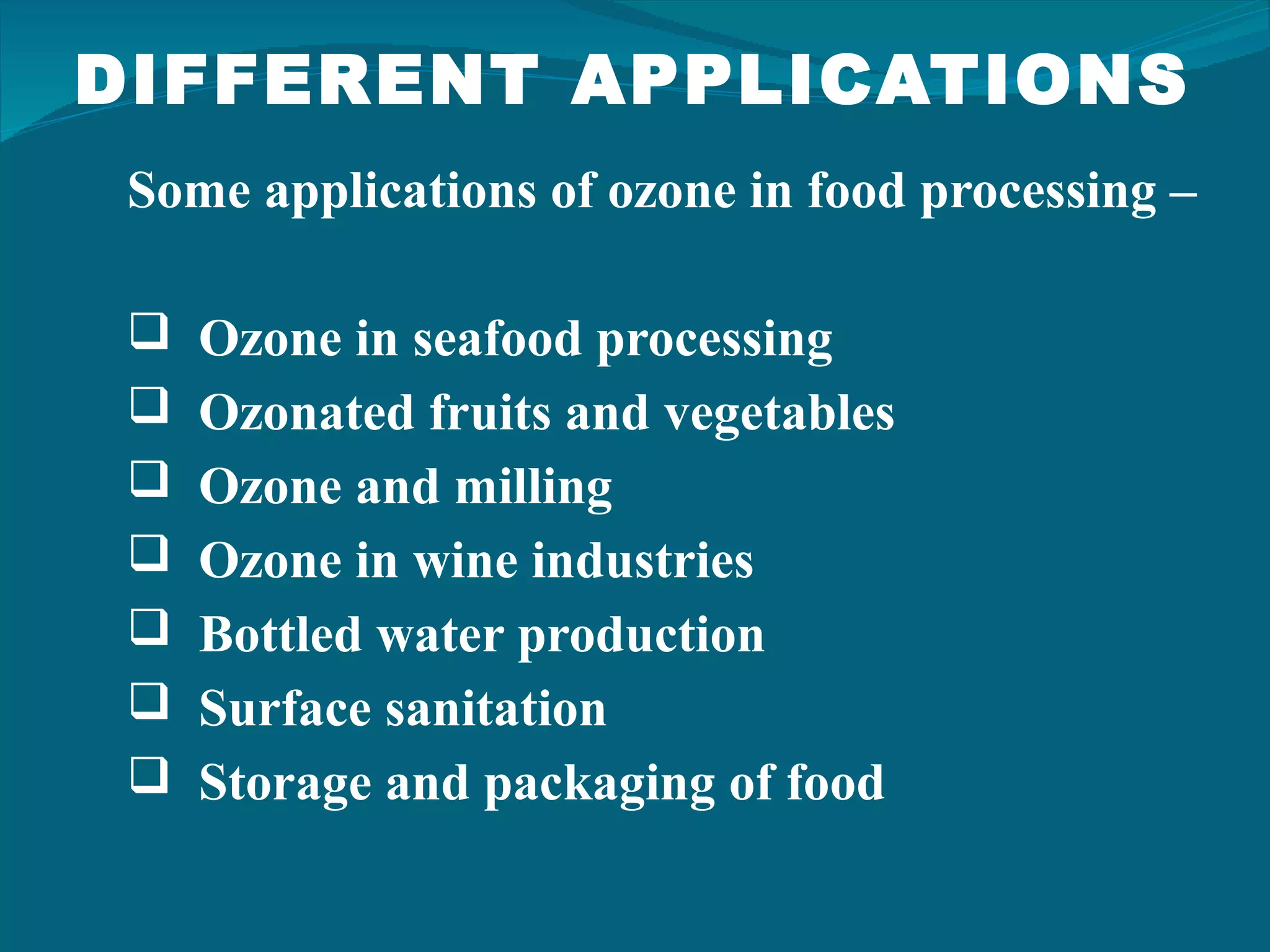
Some applications of ozone in food processing –
 Ozone in seafood processing
 Ozonated fruits and vegetables
 Ozone and milling
 Ozone in wine industries
 Bottled water production
 Surface sanitation
 Storage and packaging of food
OZONE IN SEAFOOD PROCESSING
 Effective at lowering water consumption by increasing
water re-use.
 Lowers diseases and maintains clean water in fish
growing ponds.
 Odor control in offal rooms and other processing area.
 Storage of live seafood.
 Improved antimicrobial
intervention in processing
of whole fish.
OZONE IN FRUITS & VEGETABLES
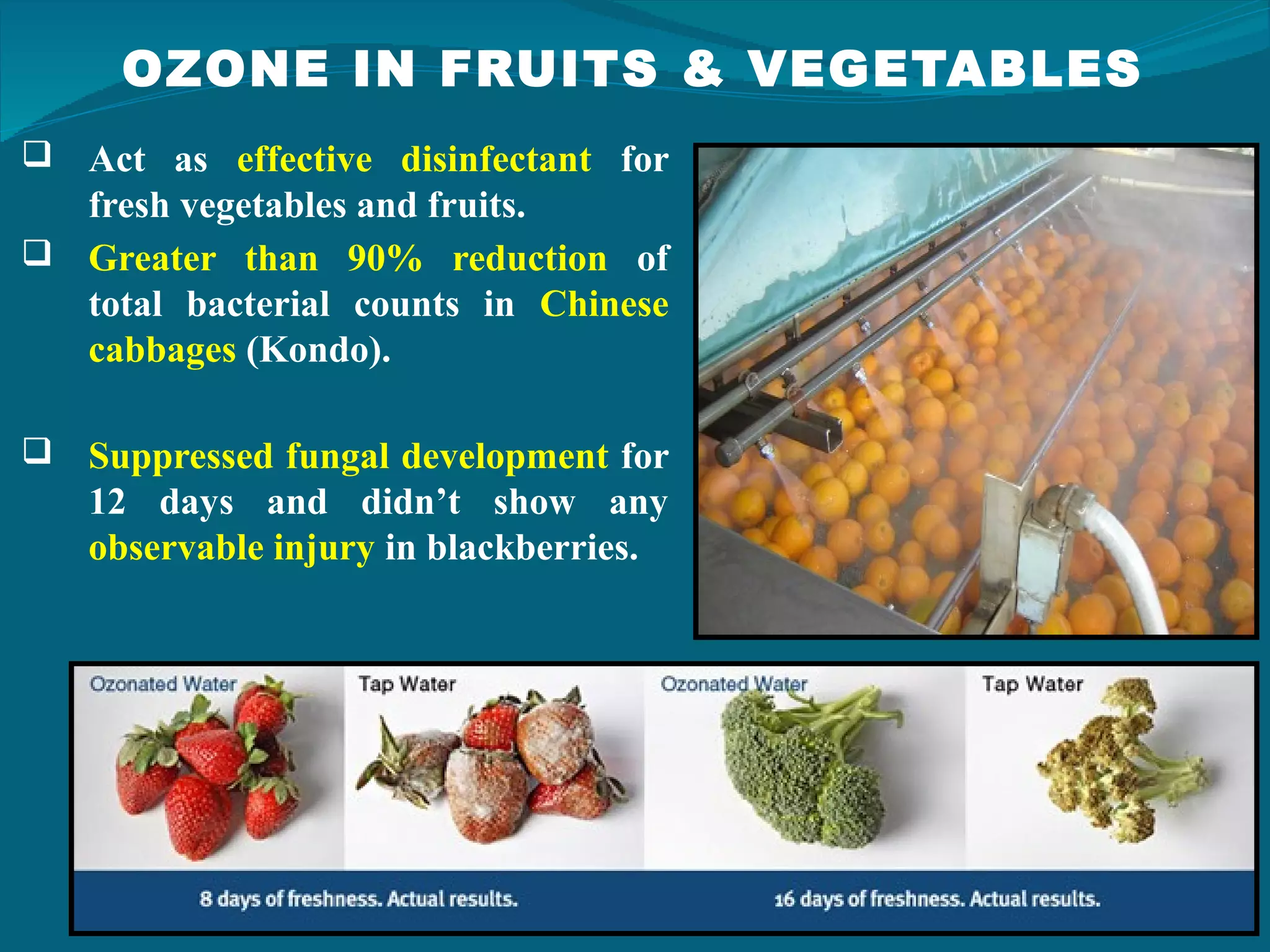
 Act as effective disinfectant for
fresh vegetables and fruits.
 Greater than 90% reduction of
total bacterial counts in Chinese
cabbages (Kondo).
 Suppressed fungal development for
12 days and didn’t show any
observable injury in blackberries.
OZONE AND MILLING
 Aqueous ozone - grain tempering process to inactivate mold and
bacteria.
 Ozone gas - surface sanitation of enclosed equipment and
conveyors and transport equipment as an antimicrobial
intervention.
 About 45-55% reduction in bacteria and mold using ozone in
tempering process as compared to normal water use.
 Resulting into increase in shelf life of milled product.
Particular
Reduction in
bacteria (%)
Reduction in
mold (%)
Soft wheat water
tempered
13 6.2
Soft wheat ozone
tempered
45.65 49.42
Hard wheat water
tempered
7.27 5.4
Hard wheat ozone
tempered
42.27 47.39
Effect of ozone on bacterial attack in wheat tempering
process
WINE PROCESSING
 Direct Contact – on grapes as the first point of
antimicrobial intervention.
 Barrel and Tank Washing – Wooden or SS barrels and
tanks (inside and outside).
 Surface Sanitation – on any wettable surface.
 CIP for Filler – as an additional point of intervention
 Drains, Transfer Lines, Valves, Conveyors are also
sanitize.
BOTTLED WATER PRODUCTION
 Ozone - Initially used in the US for water treatment.
 In 1982 – approval (GRAS) for use in bottled water.
 Today, the majority of bottled water companies use
ozone to ensure pure water.
 Removes most of the bacteria from water without any
residue.
 Oxidizes iron, manganese and sulpher based
compounds in water.
 Removes color and odor of water.
 The International Bottled Water Association (IBWA)
suggests that, a residual ozone level of 0.2 to 0.4 ppm
which also disinfects both the water and the bottle.
Bottled water production with ozonation
SURFACE SANITIZATION
 In food processing - important to provide pathogen free
food.
 So, for that, reducing the contamination of potentially
deadly pathogens is very crucial.
 Equipment, walls, floors, drains, tanks, tubes, racks,
knives and tables can all be sprayed with aqueous
ozone.
 Enclosed piping – sanitized with ozone spraying.
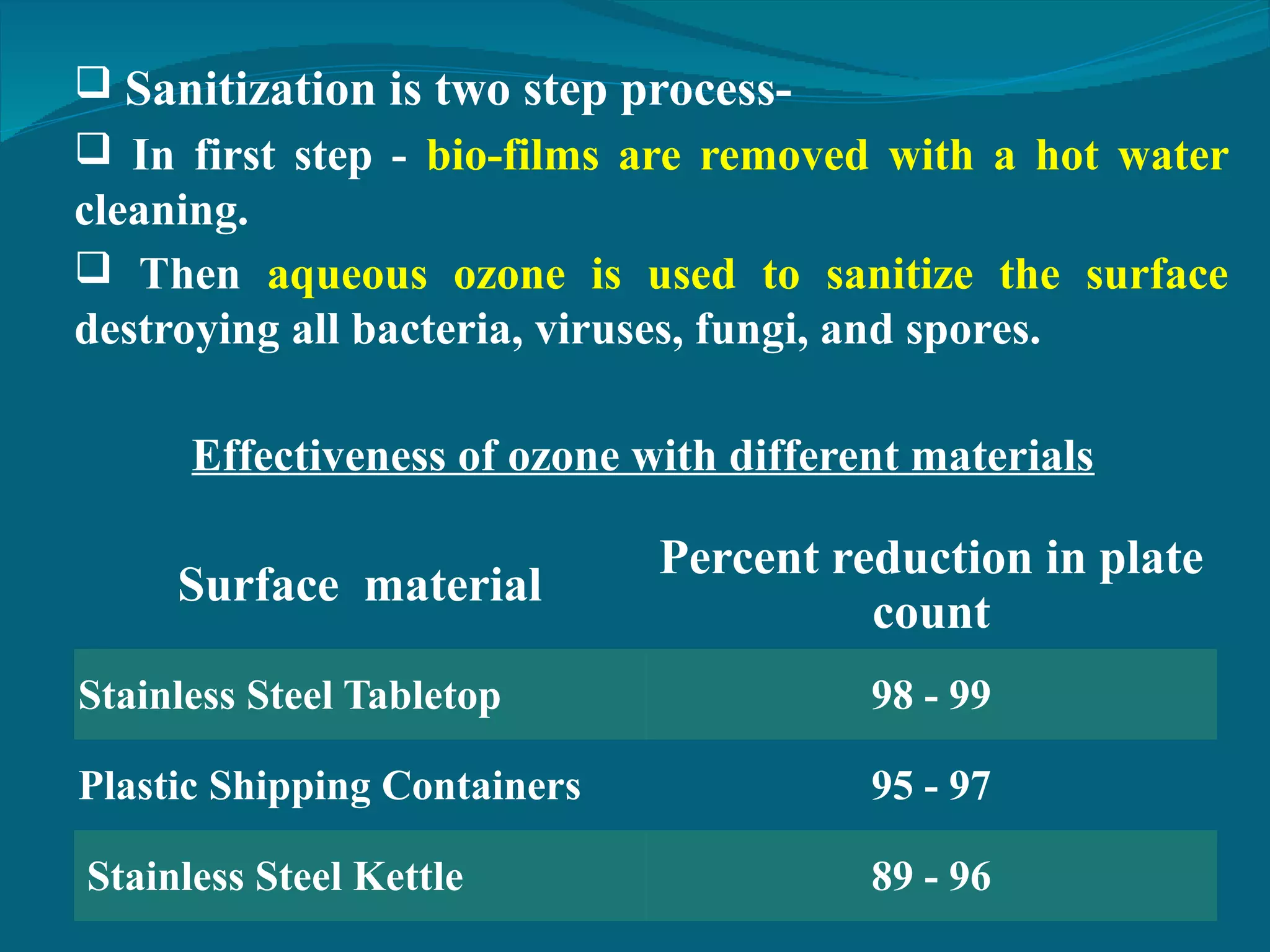
 Sanitization is two step process-
 In first step - bio-films are removed with a hot water
cleaning.
 Then aqueous ozone is used to sanitize the surface
destroying all bacteria, viruses, fungi, and spores.
Surface material
Percent reduction in plate
count
Stainless Steel Tabletop 98 - 99
Plastic Shipping Containers 95 - 97
Stainless Steel Kettle 89 - 96
Effectiveness of ozone with different materials
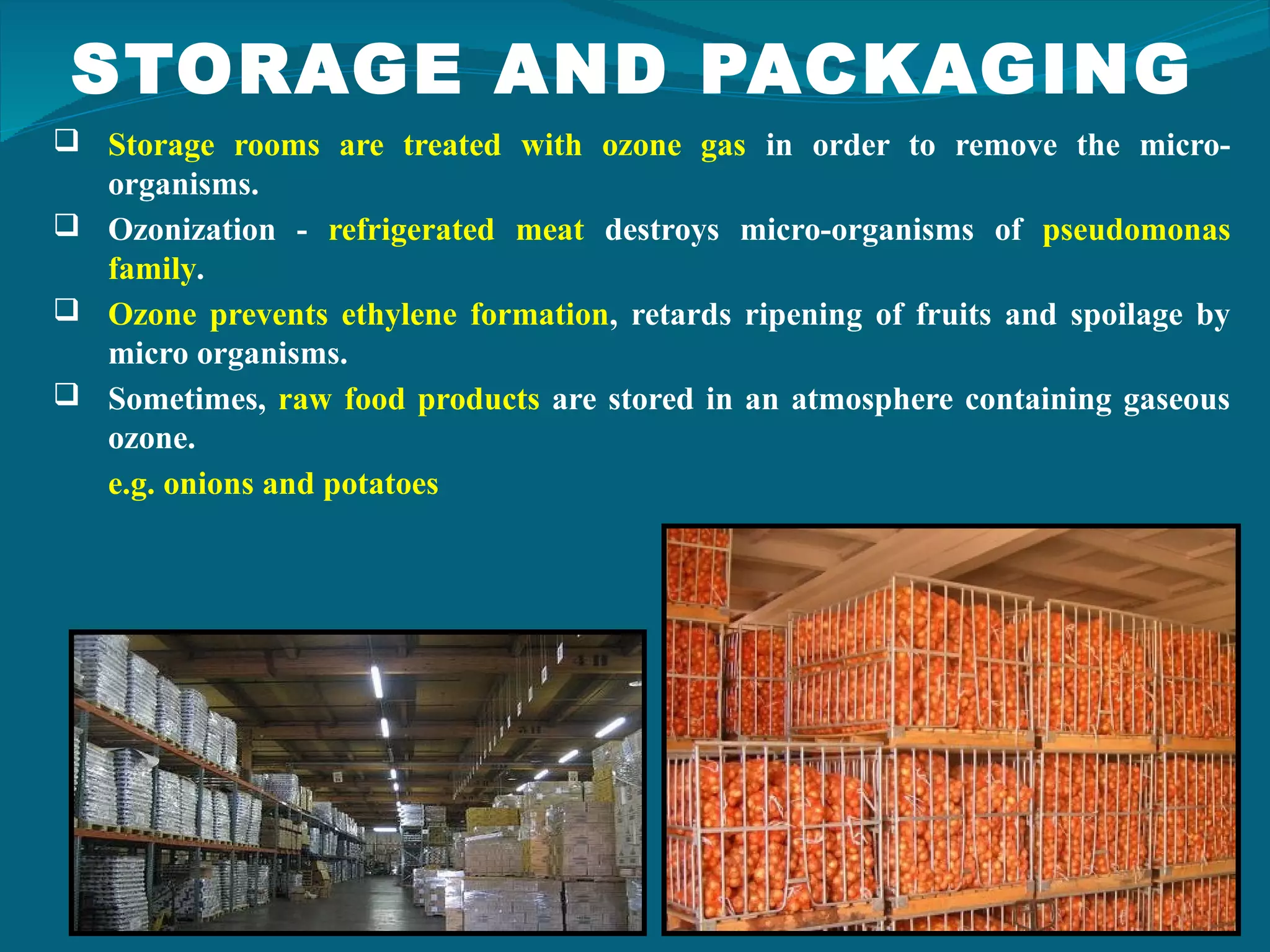
STORAGE AND PACKAGING
 Storage rooms are treated with ozone gas in order to remove the micro-
organisms.
 Ozonization - refrigerated meat destroys micro-organisms of pseudomonas
family.
 Ozone prevents ethylene formation, retards ripening of fruits and spoilage by
micro organisms.
 Sometimes, raw food products are stored in an atmosphere containing gaseous
ozone.
e.g. onions and potatoes
 Packaging materials are also disinfected using ozone and UV
radiation.
 In air-tight sealed plastic bags, ozone treatment is followed by
carbon dioxide or nitrogen.
 Since ozone will not leave any toxic residue, ozone surface
disinfection can apply for products and packing materials
like container, bottles, pouches etc.
Extension of Storage Life With Ozone
Food type
Extension
of life
Storage Conditions
Fish 50-80% With ozone sterilized ice
Poultry 2.5 days
When soak in ozonated water (3.88
mg/L) 20 min.
Strawberries and
Grapes
Double
Spraying of (2-3 ppm) aqueous ozone
for 5 - 6 hours per day.
Potatoes 6 months 3 ppm O3 at 6-14°C and 93-97% RH
Eggs 8 months 0.6 ppm O3 at -0.5°C and 90% RH
ADVANTAGES OF OZONE
 Ozone oxidation is nature friendly process .
 Highly effective in cold water, which saves energy &
cost.
 Significant reduction in processing time.
 Effective against wide range of harmful microorganisms.
 Dissolves metallic substances like iron and manganese.
 Removes unwanted color, taste, and odor of product.
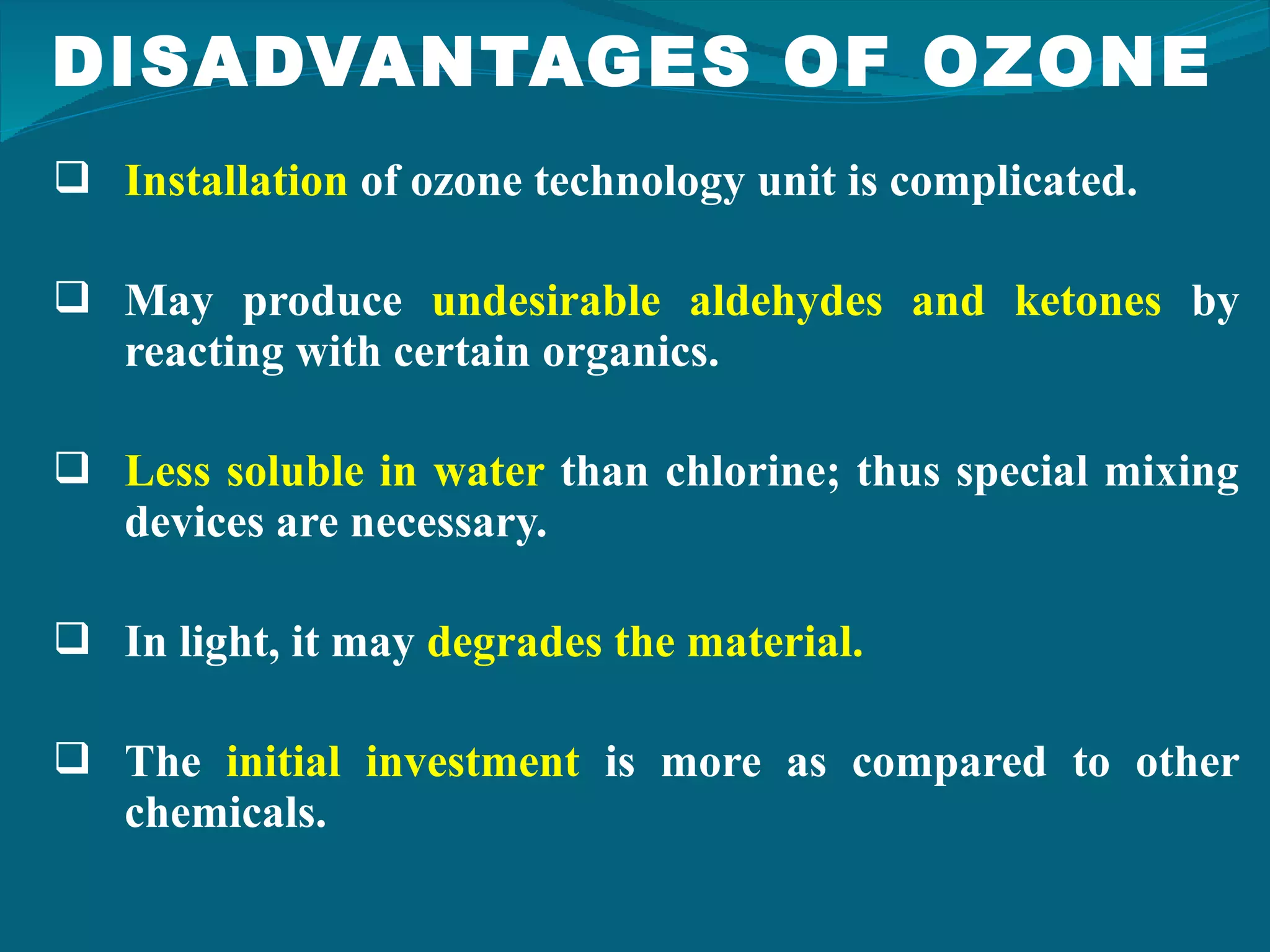
DISADVANTAGES OF OZONE
 Installation of ozone technology unit is complicated.
 May produce undesirable aldehydes and ketones by
reacting with certain organics.
 Less soluble in water than chlorine; thus special mixing
devices are necessary.
 In light, it may degrades the material.
 The initial investment is more as compared to other
chemicals.
COST ANALYSIS OF OZONE TECHNOLOGY
$ 15000
$ 1800
$ 18000
 Ozone is a potent sanitizer with promising applications in the
modern food industry
 It is environment-friendly disinfectant.
 There is a considerable difference (about 10 times less) in
operational cost with the use of ozone as compared to other
chemical sanitizers.
 It is the most likely alternative to chlorine and hydrogen
peroxide etc. in food applications.
CONCLUSIONS
From the above study it is concluded that,
REFERENCES
Khadre M. A., A. E. Yousef, and J. G. Kim. (2001). Microbiological aspects of
ozone, Applications in Food:- A Review, Journal of food science – Vol. no. 66,
no. 9 : 1242 – 1252.
Trevor Suslow. (1998). Basics of ozone applications for postharvest treatment of
fruits and vegetables, Perishables Handling Quarterly Issue No. 94, Department
of Vegetable Crops, UCD : 9-12.
Baratharaj V., Use of ozone in food processing & cold storage:7 -12.
http://www.ozonesolutions.com
http://www.worldfoodscience.com
THANK YOU
Bio-film formation
Attachment Colonization
Growth
 Bio-films - layers of microorganisms on the surface.
 Due to formation – surface become slimy.
 Generally found in cracks, crevices, and corners of food
processing equipment.
Application of ozone in food  processing

Application of ozone in food processing

  • 1.
  • 2.
    APPLICATION OF OZONEIN FOOD PROCESSING Presented by Aniket More (M. Tech.) Food Process Engineering DEPARTMENT OF AGRICULTURAL AND FOOD ENGINEERING IIT KHARAGPUR
  • 3.
    POINTS TO BECOVERED 1) Introduction 2) History of ozone in food processing 3) What is ozone? 4) How it is produced? 5) Principle and working 6) Different applications in food processing 7) Advantages and disadvantages 8) Cost analysis 9) Conclusions 10)References
  • 4.
    INTRODUCTION  Food industriesare currently in need of different innovative technologies to meet the consumer demand.  There are some of the technologies like HPP, pulsed electric field, high intensity pulsed light etc.  But attention is now focused on the ozone as a powerful sanitizer.  Currently – more than 3000 water treatment installations and more than 300 potable water treatment plants all over the world.
  • 5.
    HISTORY OF OZONE DATEEVENT 1840 Discovered by Schonbein 1909 Firstly used as a food preservative for cold storage of meats 1939 Was found to prevent the growth of yeast & mold during the storage of fruits 1982 O3 declared GRAS for treatment of bottled water 1997 Industrial expert panel reported that use of ozone is safe in foods processing for human consumption 2000 FDA and USDA approval granted for direct contact food additive.
  • 6.
    WHAT IS OZONE? OZONE: highly reactive form of oxygen consisting of three oxygen atoms i.e. O3  It is a colorless and extremely unstable gas.  It is an effective antimicrobial agent used directly into the food.  Ozone is naturally found in the stratosphere and protects us from harmful radiations.
  • 7.
    HOW OZONE ISPRODUCED?  There are two methods of producing ozone 1) Ultra-violet method 2) Corona discharge method ) Ultra-violet light creates ozone when a wavelength > 254 nm hits an oxygen atom. ) Corona discharge creates ozone by applying high voltage to a metallic grid sandwiched between two dielectrics. ) Splitting of oxygen molecules into single oxygen atom & combine with another oxygen molecule (O2) to form ozone (O3).
  • 8.
    HOW DOES OZONEWORK?  The unstable third oxygen atom of ozone can combine with organic and inorganic molecules to destroy them through oxidation.  Finally ozone reverts back to oxygen after it is used. This makes it a very environmentally friendly oxidant.
  • 9.
    COMPARATIVE STUDY Comparison betweenozone and chlorine shows that- Action in water Chlorine Ozone Oxidation Potential (Volts) 1.36 2.07 Disinfection: Bacteria, Viruses Moderate Excellent Carcinogen Formation Likely Unlikely Operation Hazards : Skin Toxicity High Moderate Capital investment Low High Operational cost High Low
  • 10.
    DIFFERENT APPLICATIONS Some applicationsof ozone in food processing –  Ozone in seafood processing  Ozonated fruits and vegetables  Ozone and milling  Ozone in wine industries  Bottled water production  Surface sanitation  Storage and packaging of food
  • 11.
    OZONE IN SEAFOODPROCESSING  Effective at lowering water consumption by increasing water re-use.  Lowers diseases and maintains clean water in fish growing ponds.  Odor control in offal rooms and other processing area.  Storage of live seafood.  Improved antimicrobial intervention in processing of whole fish.
  • 12.
    OZONE IN FRUITS& VEGETABLES  Act as effective disinfectant for fresh vegetables and fruits.  Greater than 90% reduction of total bacterial counts in Chinese cabbages (Kondo).  Suppressed fungal development for 12 days and didn’t show any observable injury in blackberries.
  • 13.
    OZONE AND MILLING Aqueous ozone - grain tempering process to inactivate mold and bacteria.  Ozone gas - surface sanitation of enclosed equipment and conveyors and transport equipment as an antimicrobial intervention.  About 45-55% reduction in bacteria and mold using ozone in tempering process as compared to normal water use.  Resulting into increase in shelf life of milled product.
  • 14.
    Particular Reduction in bacteria (%) Reductionin mold (%) Soft wheat water tempered 13 6.2 Soft wheat ozone tempered 45.65 49.42 Hard wheat water tempered 7.27 5.4 Hard wheat ozone tempered 42.27 47.39 Effect of ozone on bacterial attack in wheat tempering process
  • 15.
    WINE PROCESSING  DirectContact – on grapes as the first point of antimicrobial intervention.  Barrel and Tank Washing – Wooden or SS barrels and tanks (inside and outside).  Surface Sanitation – on any wettable surface.  CIP for Filler – as an additional point of intervention  Drains, Transfer Lines, Valves, Conveyors are also sanitize.
  • 16.
    BOTTLED WATER PRODUCTION Ozone - Initially used in the US for water treatment.  In 1982 – approval (GRAS) for use in bottled water.  Today, the majority of bottled water companies use ozone to ensure pure water.  Removes most of the bacteria from water without any residue.  Oxidizes iron, manganese and sulpher based compounds in water.  Removes color and odor of water.  The International Bottled Water Association (IBWA) suggests that, a residual ozone level of 0.2 to 0.4 ppm which also disinfects both the water and the bottle.
  • 17.
  • 18.
    SURFACE SANITIZATION  Infood processing - important to provide pathogen free food.  So, for that, reducing the contamination of potentially deadly pathogens is very crucial.  Equipment, walls, floors, drains, tanks, tubes, racks, knives and tables can all be sprayed with aqueous ozone.  Enclosed piping – sanitized with ozone spraying.
  • 19.
     Sanitization istwo step process-  In first step - bio-films are removed with a hot water cleaning.  Then aqueous ozone is used to sanitize the surface destroying all bacteria, viruses, fungi, and spores. Surface material Percent reduction in plate count Stainless Steel Tabletop 98 - 99 Plastic Shipping Containers 95 - 97 Stainless Steel Kettle 89 - 96 Effectiveness of ozone with different materials
  • 20.
    STORAGE AND PACKAGING Storage rooms are treated with ozone gas in order to remove the micro- organisms.  Ozonization - refrigerated meat destroys micro-organisms of pseudomonas family.  Ozone prevents ethylene formation, retards ripening of fruits and spoilage by micro organisms.  Sometimes, raw food products are stored in an atmosphere containing gaseous ozone. e.g. onions and potatoes
  • 21.
     Packaging materialsare also disinfected using ozone and UV radiation.  In air-tight sealed plastic bags, ozone treatment is followed by carbon dioxide or nitrogen.  Since ozone will not leave any toxic residue, ozone surface disinfection can apply for products and packing materials like container, bottles, pouches etc.
  • 22.
    Extension of StorageLife With Ozone Food type Extension of life Storage Conditions Fish 50-80% With ozone sterilized ice Poultry 2.5 days When soak in ozonated water (3.88 mg/L) 20 min. Strawberries and Grapes Double Spraying of (2-3 ppm) aqueous ozone for 5 - 6 hours per day. Potatoes 6 months 3 ppm O3 at 6-14°C and 93-97% RH Eggs 8 months 0.6 ppm O3 at -0.5°C and 90% RH
  • 23.
    ADVANTAGES OF OZONE Ozone oxidation is nature friendly process .  Highly effective in cold water, which saves energy & cost.  Significant reduction in processing time.  Effective against wide range of harmful microorganisms.  Dissolves metallic substances like iron and manganese.  Removes unwanted color, taste, and odor of product.
  • 24.
    DISADVANTAGES OF OZONE Installation of ozone technology unit is complicated.  May produce undesirable aldehydes and ketones by reacting with certain organics.  Less soluble in water than chlorine; thus special mixing devices are necessary.  In light, it may degrades the material.  The initial investment is more as compared to other chemicals.
  • 25.
    COST ANALYSIS OFOZONE TECHNOLOGY $ 15000 $ 1800 $ 18000
  • 26.
     Ozone isa potent sanitizer with promising applications in the modern food industry  It is environment-friendly disinfectant.  There is a considerable difference (about 10 times less) in operational cost with the use of ozone as compared to other chemical sanitizers.  It is the most likely alternative to chlorine and hydrogen peroxide etc. in food applications. CONCLUSIONS From the above study it is concluded that,
  • 27.
    REFERENCES Khadre M. A.,A. E. Yousef, and J. G. Kim. (2001). Microbiological aspects of ozone, Applications in Food:- A Review, Journal of food science – Vol. no. 66, no. 9 : 1242 – 1252. Trevor Suslow. (1998). Basics of ozone applications for postharvest treatment of fruits and vegetables, Perishables Handling Quarterly Issue No. 94, Department of Vegetable Crops, UCD : 9-12. Baratharaj V., Use of ozone in food processing & cold storage:7 -12. http://www.ozonesolutions.com http://www.worldfoodscience.com
  • 28.
  • 31.
    Bio-film formation Attachment Colonization Growth Bio-films - layers of microorganisms on the surface.  Due to formation – surface become slimy.  Generally found in cracks, crevices, and corners of food processing equipment.

Editor's Notes

  • #15 <number>