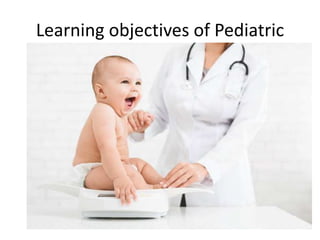
Learning objectives of Pediatric
1st week. (Day 1 )
1. Ensure medical and surgical Hand washing with
5 golden moments and its principle
1. Ward article orientation- weighing machine,
infantometer, steriometer , medicine
preparation room, pediatric stetho, B.P.
1. Pediatric history taking including morning
report with clinical significance .
Day -2
1. Core and peripheral temperature (difference,
clinical significance), - Review .
2. different methods of checking temperature ,
fever and its gradation and management.
3. . Hypothermia , causes, management.
4. Structure , function and general principals of
radiant warmer.
Day 3: Circulation assessment-
1. Age wise site of checking pulse, with clinical
significance.
2. Normal and alteration of heart rate according
to age and its clinical significance.
1. Measurement of BP.
2. Normal and alteration of blood pressure
according to age and its clinical significance.
pallor, mottled, cyanosis, its clinical significance
Normal urine output according to age. When to tell
oliguria .
Pulse:
BP.
Skin colour
Urine output
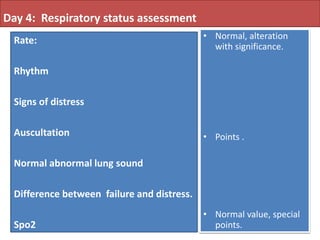
Day 4: Respiratory status assessment
• Normal, alteration
with significance.
• Points .
• Normal value, special
points.
Rate:
Rhythm
Signs of distress
Auscultation
Normal abnormal lung sound
Difference between failure and distress.
Spo2
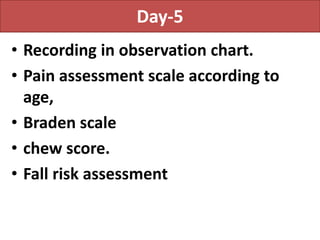
Day-5
• Recording in observation chart.
• Pain assessment scale according to
age,
• Braden scale
• chew score.
• Fall risk assessment
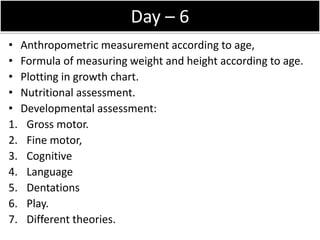
Day – 6
• Anthropometric measurement according to age,
• Formula of measuring weight and height according to age.
• Plotting in growth chart.
• Nutritional assessment.
• Developmental assessment:
1. Gross motor.
2. Fine motor,
3. Cognitive
4. Language
5. Dentations
6. Play.
7. Different theories.
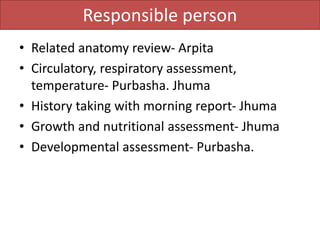
Responsible person
• Related anatomy review- Arpita
• Circulatory, respiratory assessment,
temperature- Purbasha. Jhuma
• History taking with morning report- Jhuma
• Growth and nutritional assessment- Jhuma
• Developmental assessment- Purbasha.
2 nd week.
• File orientation. (all papers)
• Intake – types, amount , fluid calculation,
checking hydration status, restriction and clinical
significance.
• output- type, amount, characteristics and its
alteration with clinical significance .
• Recording I/O.
Responsible person
• File orientation. (all papers)-Jhuma
• Intake – types, amount , fluid calculation,
checking hydration status, restriction and
clinical significance- Purbasha
• output- type, amount, characteristics and its
alteration with clinical significance -
Debasmita
• Recording I/O-Purbasha
3rd week
• Drug dose calculation,
• Oral medication administration with indication,
special precaution
• Medication administration through central line and
infection control.
• IM, intradermal (Skin test)
• Nasal, eye, ear drop,
• Observe pediatric IV canulation. ( review common
site of canulation in pediatric )
• Iv injection, infusion in drip set, syringe pump, (
preparation, drop calculation, Max calculation,
infection control, VIP score {review} .
4th week
• Observe pediatric IV canulation. ( review
common site of canulation in pediatric )
• Iv injection, infusion in drip set, syringe pump,
( preparation, drop calculation, Max
calculation, infection control, VIP score
{review} .
5th week
• O2 Administration ( review general principles
from 2nd sem)
• Nebulization, (review)
• Ryle’s tube feeding, ( review general principles
from 2nd sem)
• Catori spoon feeding ( special situations)
• assist in breast feeding,
• TPN, burping.
• Nappy changing
• Baby bath
6th week
• Catheterization
Anatomy of urinary system (upto bladder) review .
Types and parts with clinical significance
Size according to age
Indication with clinical significance
Insertion of catheter & fixation
Urine output (amount, colour, characteristics, clinical
significance)
Infection control (CAUTI)
Documentation
When to remove
Care after removal
• Catheter care.
Special for surgery ward
• Drainage site care, drainage amount, infection
control, documentation. .
• Dressing (steps, infection control for surgery
ward)
1. Colostomy care, colostomy irrigation.
2. Suppositories
– Indication
– Types
– Contraindications
– precautions
– Documentation
7th week
• Hemodynamic monitoring
• Sample collection.( Review)
• GCS, reflex.
• CBG,( normal , alteration, clinical significance
management)
Continuation
• Newborn examination, new Ballard score
• Newborn reflex
• Phototherapy, (indication, procedure, )
• Exchange transfusion,( indication and
procedure.)
• Newborn Resuscitation
Unit specific teaching
• Congenital heart disease to be taught by subject teacher
before R.N Tagore posting.
• Symptoms & management of increase ICP
• CSF report with alteration in bacterial and tubercular
meningitis.
• Care of a child with VP Shunt…
• Types and First aid management of convulsion.
• Types of ARM with symptoms
• Thalassemia, ALL,
• Nephrotic syndrom definition and signs.
• Cleft lip palate types nursing management.
• Hypospedias types features.
• Hirsprung definition features.
• Colostomy types & home care
ANY SUGGESTION
clinical outcome ped.pptx

clinical outcome ped.pptx

  • 1.
  • 2.
    1st week. (Day1 ) 1. Ensure medical and surgical Hand washing with 5 golden moments and its principle 1. Ward article orientation- weighing machine, infantometer, steriometer , medicine preparation room, pediatric stetho, B.P. 1. Pediatric history taking including morning report with clinical significance .
  • 3.
    Day -2 1. Coreand peripheral temperature (difference, clinical significance), - Review . 2. different methods of checking temperature , fever and its gradation and management. 3. . Hypothermia , causes, management. 4. Structure , function and general principals of radiant warmer.
  • 4.
    Day 3: Circulationassessment- 1. Age wise site of checking pulse, with clinical significance. 2. Normal and alteration of heart rate according to age and its clinical significance. 1. Measurement of BP. 2. Normal and alteration of blood pressure according to age and its clinical significance. pallor, mottled, cyanosis, its clinical significance Normal urine output according to age. When to tell oliguria . Pulse: BP. Skin colour Urine output
  • 5.
    Day 4: Respiratorystatus assessment • Normal, alteration with significance. • Points . • Normal value, special points. Rate: Rhythm Signs of distress Auscultation Normal abnormal lung sound Difference between failure and distress. Spo2
  • 6.
    Day-5 • Recording inobservation chart. • Pain assessment scale according to age, • Braden scale • chew score. • Fall risk assessment
  • 7.
    Day – 6 •Anthropometric measurement according to age, • Formula of measuring weight and height according to age. • Plotting in growth chart. • Nutritional assessment. • Developmental assessment: 1. Gross motor. 2. Fine motor, 3. Cognitive 4. Language 5. Dentations 6. Play. 7. Different theories.
  • 8.
    Responsible person • Relatedanatomy review- Arpita • Circulatory, respiratory assessment, temperature- Purbasha. Jhuma • History taking with morning report- Jhuma • Growth and nutritional assessment- Jhuma • Developmental assessment- Purbasha.
  • 9.
    2 nd week. •File orientation. (all papers) • Intake – types, amount , fluid calculation, checking hydration status, restriction and clinical significance. • output- type, amount, characteristics and its alteration with clinical significance . • Recording I/O.
  • 10.
    Responsible person • Fileorientation. (all papers)-Jhuma • Intake – types, amount , fluid calculation, checking hydration status, restriction and clinical significance- Purbasha • output- type, amount, characteristics and its alteration with clinical significance - Debasmita • Recording I/O-Purbasha
  • 11.
    3rd week • Drugdose calculation, • Oral medication administration with indication, special precaution • Medication administration through central line and infection control. • IM, intradermal (Skin test) • Nasal, eye, ear drop, • Observe pediatric IV canulation. ( review common site of canulation in pediatric ) • Iv injection, infusion in drip set, syringe pump, ( preparation, drop calculation, Max calculation, infection control, VIP score {review} .
  • 12.
    4th week • Observepediatric IV canulation. ( review common site of canulation in pediatric ) • Iv injection, infusion in drip set, syringe pump, ( preparation, drop calculation, Max calculation, infection control, VIP score {review} .
  • 13.
    5th week • O2Administration ( review general principles from 2nd sem) • Nebulization, (review) • Ryle’s tube feeding, ( review general principles from 2nd sem) • Catori spoon feeding ( special situations) • assist in breast feeding, • TPN, burping. • Nappy changing • Baby bath
  • 14.
    6th week • Catheterization Anatomyof urinary system (upto bladder) review . Types and parts with clinical significance Size according to age Indication with clinical significance Insertion of catheter & fixation Urine output (amount, colour, characteristics, clinical significance) Infection control (CAUTI) Documentation When to remove Care after removal • Catheter care.
  • 15.
    Special for surgeryward • Drainage site care, drainage amount, infection control, documentation. . • Dressing (steps, infection control for surgery ward) 1. Colostomy care, colostomy irrigation. 2. Suppositories – Indication – Types – Contraindications – precautions – Documentation
  • 16.
    7th week • Hemodynamicmonitoring • Sample collection.( Review) • GCS, reflex. • CBG,( normal , alteration, clinical significance management)
  • 17.
    Continuation • Newborn examination,new Ballard score • Newborn reflex • Phototherapy, (indication, procedure, ) • Exchange transfusion,( indication and procedure.) • Newborn Resuscitation
  • 18.
    Unit specific teaching •Congenital heart disease to be taught by subject teacher before R.N Tagore posting. • Symptoms & management of increase ICP • CSF report with alteration in bacterial and tubercular meningitis. • Care of a child with VP Shunt… • Types and First aid management of convulsion. • Types of ARM with symptoms • Thalassemia, ALL, • Nephrotic syndrom definition and signs. • Cleft lip palate types nursing management. • Hypospedias types features. • Hirsprung definition features. • Colostomy types & home care
  • 19.