College of Medicine and Health Sciences
School of Nursing and Midwifery
General Nursing Department
Pediatric Physical Assessment
Student ID Number:โ€ฆโ€ฆโ€ฆโ€ฆโ€ฆโ€ฆโ€ฆโ€ฆโ€ฆโ€ฆโ€ฆโ€ฆโ€ฆโ€ฆ
Level:โ€ฆโ€ฆโ€ฆโ€ฆโ€ฆโ€ฆโ€ฆโ€ฆโ€ฆโ€ฆโ€ฆโ€ฆโ€ฆโ€ฆโ€ฆโ€ฆโ€ฆ
Department:โ€ฆโ€ฆโ€ฆโ€ฆโ€ฆโ€ฆโ€ฆโ€ฆโ€ฆโ€ฆโ€ฆ
Academic year:โ€ฆโ€ฆโ€ฆโ€ฆโ€ฆโ€ฆโ€ฆโ€ฆโ€ฆโ€ฆ
Facilitatorโ€™s name:โ€ฆโ€ฆโ€ฆโ€ฆโ€ฆโ€ฆโ€ฆโ€ฆโ€ฆโ€ฆโ€ฆโ€ฆโ€ฆ
Date:โ€ฆโ€ฆโ€ฆโ€ฆโ€ฆโ€ฆโ€ฆโ€ฆโ€ฆโ€ฆโ€ฆโ€ฆโ€ฆโ€ฆโ€ฆโ€ฆโ€ฆโ€ฆโ€ฆ
1
PERFORMANCE GUIDELINES FACILITATOR
COMMENTS
PREPARATION AND INTRODUCTION
1. Assemble and prepare needed equipment.
2. Wash hands.
3. Introduces self with name and title.
4. Identifies the correct patient by asking the name and date of birth while checking the name band.
5. Inform the parent of what you are going to do and what will be done with the findings: in this case it is to
perform a physical assessment and inform the physician of abnormal findings, plan care, and document
findings in the patient chart (state rationale to instructor).
6. Maintain an approach to the infant/child and parent that is appropriate for the childโ€™s growth and
development. Describe your choice of actions.
RAPID ASSESSMENT AND IMMEDIATE ACTION
7. Rapid initial assessment for life threatening problems:
๏‚ท Is the infant/child alert and interactive with the parent?
๏‚ท Is the child lethargic, restless, or irritable?
๏‚ท Is the infant/child demonstrating signs of seizure:
๏‚ท Is the infant/child demonstrating any signs of severe respiratory distress:
nasal flaring, accessory muscle use, grunting, tri-pod position, significant mucous, paroxysmal cough,
restlessness, fast respiratory rate, noisy breathing, hemoptysis?
๏‚ท Is the infant/child demonstrating any significant signs of cardiovascular/perfusion problems:
color, severe dry lips, altered mental status, lethargic, sunken eyes, sunken fontanel, cold extremities,
weak fast pulse, bleeding, severe pallor?
๏‚ท Are there visible signs of malnutrition?
wasting or edema of both feet?
๏‚ท Is the infant/child safe in the parent arms, the bed :
positioning, side rails up, bed locked?
๏‚ท Is equipment connected to the infant/child operating correctly, per orders, and patient needs?
oxygen, pulse oximeter, heart monitor, IV site, IV pump, Foley, drains, NG tube, dressings.
8. Hand rubbing and wear proper gloves
9.Acquire and interpret vital signs using appropriate equipment and developmental approach. If asleep, or
quiet and cooperative assess respiratory rate/lung sounds and heart rate/sounds first.
๏‚ท Respiratory rate: identify if fast or slow based on age-appropriate norms
๏‚ท Heart rate: identify if fast or slow based on age-appropriate norms
๏‚ท Pulse oximeter: ensure equipment is functioning, adjust as needed, identify if normal or low
๏‚ท Temperature: identify method and interpret high, normal, low
๏‚ท Blood pressure: state or demonstrate proper cuff size and technique
2
๏‚ท Pain: assess using the appropriate scale (FlACC, numerical scale, Wong Backerโ€ฆ..
10. State any immediate actions that need to occur to protect the patient or improve their condition.
Demonstrate
if equipment is present.
11. Notify physician of abnormal findings and actions taken.
COMPLETE PHYSICAL ASSESSMENT
12. Determine an appropriate position for the condition and childโ€™s age to allow for optimal physical
assessment. Plan with the parent.
Warm hands , Inquire about pain before touching the infant or child,
13. General Appearance observe
๏‚ท๏€  Hygiene, clothing
๏‚ท๏€  Hydration
๏‚ท Parent-child interaction
๏‚ท๏€  Unusual behavior
14. Head Inspect and Palpate
๏‚ท Fontanels age appropriate: posterior closes between 1-2 months old and anterior closes between 7-19
months old; describe as full, flat, depressed, or closed
๏‚ท Head: symmetry, visible abnormalities, micro or macrocephaly, measure head circumference is < 2
years
๏‚ท Eyes: symmetry, relationship to ears, sclera and conjunctiva color, PERRLA ( Pupil, Equal, Round,
Reactive to, Light, Accommodation,) red reflex, strabismus >
6 months
๏‚ท Ears: symmetry, discharge, tenderness
๏‚ท Nose: patency, septum, nasal flaring, mucous color, thickness
๏‚ท Mouth: breath odor, lips fissures, dryness, color, tongue movement side to side, teeth number and
condition, color of gums, tonsil color, size, drainage, cleft lip and palate
๏‚ท Neck: lymph glands and thyroid enlarged include location, size, tenderness, consistency, neck
๏‚ท
Stiffness.
Assess primitive reflexes
15. Chest Inspect, auscultate
๏‚ท Inspect: accessory muscle use, respiratory pattern (abdominal breathing is normal < 6 years).
๏‚ท Auscultate: S1-S2 heart sounds, distinguish abnormal sounds, irregular rhythm, changes with
respirations.
๏‚ท Auscultate: auscultate lung sounds anterior, posterior and all lung fields, distinguish normal and
adventitious sounds.
16. Abdomen
๏‚ท Inspect: shape, visible swelling, hernia, umbilicus, veins, visible peristalsis
๏‚ท๏€  Auscultate: bowel sounds
๏‚ท Percuss: dull or tympanic
๏‚ท Palpate: liver, spleen, fluid movement, masses
17. Genitalia and anus
๏‚ท Rash: describe appearance and location๏€ 
cc
c
cc
3.
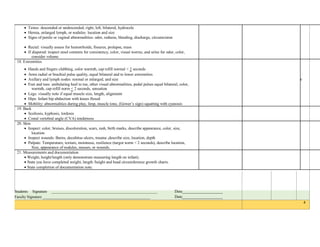
๏‚ท Testes: descended or undescended, right, left, bilateral, hydrocele
๏‚ท Hernia, enlarged lymph, or nodules: location and size
๏‚ท Signs of penile or vaginal abnormalities: odor, redness, bleeding, discharge, circumcision
๏‚ท Rectal: visually assess for hemorrhoids, fissures, prolapse, mass
๏‚ท If diapered: inspect stool contents for consistency, color, visual worms, and urine for odor, color,
consider volume
18. Extremities
๏‚ท Hands and fingers clubbing, color warmth, cap refill normal < 2 seconds
๏‚ท Arms radial or brachial pulse quality, equal bilateral and to lower extremities
๏‚ท Axillary and lymph nodes: normal or enlarged, and size c
๏‚ท Feet and toes: ambulating heel to toe, other visual abnormalities, pedal pulses equal bilateral, color,
warmth, cap refill norm < 2 seconds, sensation
๏‚ท Legs: visually note if equal muscle size, length, alignment
๏‚ท Hips: Infant hip abduction with knees flexed
๏‚ท Mobility: abnormalities during play, limp, muscle tone, (Gowerโ€™s sign) squatting with cyanosis
19. Back
๏‚ท Scoliosis, kyphosis, lordosis
๏‚ท Costal vertebral angle (CVA) tenderness
20. Skin
๏‚ท Inspect: color, bruises, discoloration, scars, rash, birth marks, describe appearance, color, size,
location
๏‚ท Inspect wounds: Burns, decubitus ulcers, trauma ,describe size, location, depth
๏‚ท Palpate: Temperature, texture, moistness, resilience (turgor norm < 2 seconds), describe location,
Size, appearance of nodules, masses, or wounds.
21. Measurements and documentation
๏‚ท Weight, height/length (only demonstrate measuring length on infant).
๏‚ท State you have completed weight, length /height and head circumference growth charts.
๏‚ท State completion of documentation note.
Students Signature _______________________________________________________
Faculty Signature ________________________________________________________
Date____________________
4
Pediatric Assessment new-1.pdf

Pediatric Assessment new-1.pdf

  • 1.
    College of Medicineand Health Sciences School of Nursing and Midwifery General Nursing Department Pediatric Physical Assessment Student ID Number:โ€ฆโ€ฆโ€ฆโ€ฆโ€ฆโ€ฆโ€ฆโ€ฆโ€ฆโ€ฆโ€ฆโ€ฆโ€ฆโ€ฆ Level:โ€ฆโ€ฆโ€ฆโ€ฆโ€ฆโ€ฆโ€ฆโ€ฆโ€ฆโ€ฆโ€ฆโ€ฆโ€ฆโ€ฆโ€ฆโ€ฆโ€ฆ Department:โ€ฆโ€ฆโ€ฆโ€ฆโ€ฆโ€ฆโ€ฆโ€ฆโ€ฆโ€ฆโ€ฆ Academic year:โ€ฆโ€ฆโ€ฆโ€ฆโ€ฆโ€ฆโ€ฆโ€ฆโ€ฆโ€ฆ Facilitatorโ€™s name:โ€ฆโ€ฆโ€ฆโ€ฆโ€ฆโ€ฆโ€ฆโ€ฆโ€ฆโ€ฆโ€ฆโ€ฆโ€ฆ Date:โ€ฆโ€ฆโ€ฆโ€ฆโ€ฆโ€ฆโ€ฆโ€ฆโ€ฆโ€ฆโ€ฆโ€ฆโ€ฆโ€ฆโ€ฆโ€ฆโ€ฆโ€ฆโ€ฆ 1
  • 2.
    PERFORMANCE GUIDELINES FACILITATOR COMMENTS PREPARATIONAND INTRODUCTION 1. Assemble and prepare needed equipment. 2. Wash hands. 3. Introduces self with name and title. 4. Identifies the correct patient by asking the name and date of birth while checking the name band. 5. Inform the parent of what you are going to do and what will be done with the findings: in this case it is to perform a physical assessment and inform the physician of abnormal findings, plan care, and document findings in the patient chart (state rationale to instructor). 6. Maintain an approach to the infant/child and parent that is appropriate for the childโ€™s growth and development. Describe your choice of actions. RAPID ASSESSMENT AND IMMEDIATE ACTION 7. Rapid initial assessment for life threatening problems: ๏‚ท Is the infant/child alert and interactive with the parent? ๏‚ท Is the child lethargic, restless, or irritable? ๏‚ท Is the infant/child demonstrating signs of seizure: ๏‚ท Is the infant/child demonstrating any signs of severe respiratory distress: nasal flaring, accessory muscle use, grunting, tri-pod position, significant mucous, paroxysmal cough, restlessness, fast respiratory rate, noisy breathing, hemoptysis? ๏‚ท Is the infant/child demonstrating any significant signs of cardiovascular/perfusion problems: color, severe dry lips, altered mental status, lethargic, sunken eyes, sunken fontanel, cold extremities, weak fast pulse, bleeding, severe pallor? ๏‚ท Are there visible signs of malnutrition? wasting or edema of both feet? ๏‚ท Is the infant/child safe in the parent arms, the bed : positioning, side rails up, bed locked? ๏‚ท Is equipment connected to the infant/child operating correctly, per orders, and patient needs? oxygen, pulse oximeter, heart monitor, IV site, IV pump, Foley, drains, NG tube, dressings. 8. Hand rubbing and wear proper gloves 9.Acquire and interpret vital signs using appropriate equipment and developmental approach. If asleep, or quiet and cooperative assess respiratory rate/lung sounds and heart rate/sounds first. ๏‚ท Respiratory rate: identify if fast or slow based on age-appropriate norms ๏‚ท Heart rate: identify if fast or slow based on age-appropriate norms ๏‚ท Pulse oximeter: ensure equipment is functioning, adjust as needed, identify if normal or low ๏‚ท Temperature: identify method and interpret high, normal, low ๏‚ท Blood pressure: state or demonstrate proper cuff size and technique 2
  • 3.
    ๏‚ท Pain: assessusing the appropriate scale (FlACC, numerical scale, Wong Backerโ€ฆ.. 10. State any immediate actions that need to occur to protect the patient or improve their condition. Demonstrate if equipment is present. 11. Notify physician of abnormal findings and actions taken. COMPLETE PHYSICAL ASSESSMENT 12. Determine an appropriate position for the condition and childโ€™s age to allow for optimal physical assessment. Plan with the parent. Warm hands , Inquire about pain before touching the infant or child, 13. General Appearance observe ๏‚ท๏€  Hygiene, clothing ๏‚ท๏€  Hydration ๏‚ท Parent-child interaction ๏‚ท๏€  Unusual behavior 14. Head Inspect and Palpate ๏‚ท Fontanels age appropriate: posterior closes between 1-2 months old and anterior closes between 7-19 months old; describe as full, flat, depressed, or closed ๏‚ท Head: symmetry, visible abnormalities, micro or macrocephaly, measure head circumference is < 2 years ๏‚ท Eyes: symmetry, relationship to ears, sclera and conjunctiva color, PERRLA ( Pupil, Equal, Round, Reactive to, Light, Accommodation,) red reflex, strabismus > 6 months ๏‚ท Ears: symmetry, discharge, tenderness ๏‚ท Nose: patency, septum, nasal flaring, mucous color, thickness ๏‚ท Mouth: breath odor, lips fissures, dryness, color, tongue movement side to side, teeth number and condition, color of gums, tonsil color, size, drainage, cleft lip and palate ๏‚ท Neck: lymph glands and thyroid enlarged include location, size, tenderness, consistency, neck ๏‚ท Stiffness. Assess primitive reflexes 15. Chest Inspect, auscultate ๏‚ท Inspect: accessory muscle use, respiratory pattern (abdominal breathing is normal < 6 years). ๏‚ท Auscultate: S1-S2 heart sounds, distinguish abnormal sounds, irregular rhythm, changes with respirations. ๏‚ท Auscultate: auscultate lung sounds anterior, posterior and all lung fields, distinguish normal and adventitious sounds. 16. Abdomen ๏‚ท Inspect: shape, visible swelling, hernia, umbilicus, veins, visible peristalsis ๏‚ท๏€  Auscultate: bowel sounds ๏‚ท Percuss: dull or tympanic ๏‚ท Palpate: liver, spleen, fluid movement, masses 17. Genitalia and anus ๏‚ท Rash: describe appearance and location๏€  cc c
  • 4.
  • 5.
    ๏‚ท Testes: descendedor undescended, right, left, bilateral, hydrocele ๏‚ท Hernia, enlarged lymph, or nodules: location and size ๏‚ท Signs of penile or vaginal abnormalities: odor, redness, bleeding, discharge, circumcision ๏‚ท Rectal: visually assess for hemorrhoids, fissures, prolapse, mass ๏‚ท If diapered: inspect stool contents for consistency, color, visual worms, and urine for odor, color, consider volume 18. Extremities ๏‚ท Hands and fingers clubbing, color warmth, cap refill normal < 2 seconds ๏‚ท Arms radial or brachial pulse quality, equal bilateral and to lower extremities ๏‚ท Axillary and lymph nodes: normal or enlarged, and size c ๏‚ท Feet and toes: ambulating heel to toe, other visual abnormalities, pedal pulses equal bilateral, color, warmth, cap refill norm < 2 seconds, sensation ๏‚ท Legs: visually note if equal muscle size, length, alignment ๏‚ท Hips: Infant hip abduction with knees flexed ๏‚ท Mobility: abnormalities during play, limp, muscle tone, (Gowerโ€™s sign) squatting with cyanosis 19. Back ๏‚ท Scoliosis, kyphosis, lordosis ๏‚ท Costal vertebral angle (CVA) tenderness 20. Skin ๏‚ท Inspect: color, bruises, discoloration, scars, rash, birth marks, describe appearance, color, size, location ๏‚ท Inspect wounds: Burns, decubitus ulcers, trauma ,describe size, location, depth ๏‚ท Palpate: Temperature, texture, moistness, resilience (turgor norm < 2 seconds), describe location, Size, appearance of nodules, masses, or wounds. 21. Measurements and documentation ๏‚ท Weight, height/length (only demonstrate measuring length on infant). ๏‚ท State you have completed weight, length /height and head circumference growth charts. ๏‚ท State completion of documentation note. Students Signature _______________________________________________________ Faculty Signature ________________________________________________________ Date____________________ Date____________________ 4