Property-based Testing
for Everyone
Dmitriy Morozov / Zoomdata Tech Lunch
Why is testing hard?
Example-based
Testing
• set up one input scenario
• run the code under test
• check the output

(and any other effects the code is supposed to have)
Imagine we needed to
implement a custom ADD
function
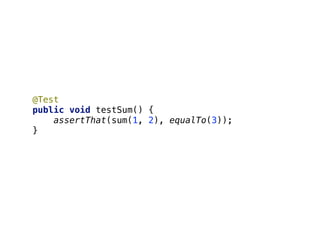
@Test

public void testSum() {

assertThat(sum(1, 2), equalTo(3));

}
private int sum(int a, int b) {

if (a == 1 && b == 2) {

return 3;

} else {

return 0;

}

}
@Test

public void testSum() {

assertThat(sum(2, 2), equalTo(4));

}
private int sum(int a, int b) {

if (a == 1 && b == 2) {

return 3;

} else if (a == 2 && b == 2) {

return 4;

} else {

return 0;

}

}
Enterprise Developer
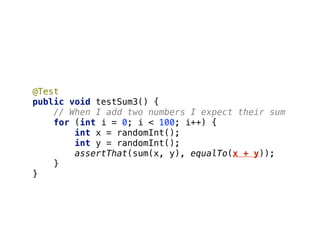
@Test

public void testSum3() {

// When I add two numbers I expect their sum

for (int i = 0; i < 100; i++) {

int x = randomInt();

int y = randomInt();

assertThat(sum(x, y), equalTo(x + y));

}

}
@Test

public void testSum3() {

// When I add two numbers I expect their sum

for (int i = 0; i < 100; i++) {

int x = randomInt();

int y = randomInt();

assertThat(sum(x, y), equalTo(x + y));

}

}
@Test

public void testSumUsingCommutativityProperty() {

// Changing the order of arguments
// shouldn’t change their sum 

for (int i = 0; i < 100; i++) {

int x = randomInt();

int y = randomInt();

assertThat(sum(x, y), equalTo(sum(y, x)));

}

}
// unfortunately that's not enough


private int sum(int a, int b) {

return a * b;

}
@Test

// `x + 2` is the same as `x + 1 + 1` 

public void testSumWithAdditiveProperty() {

for (int i = 0; i < 100; i++) {

int x = randomInt();

int result1 = sum(sum(x , 1), 1);

int result2 = sum(x, 2);

assertEquals(result1, result2);

}

}
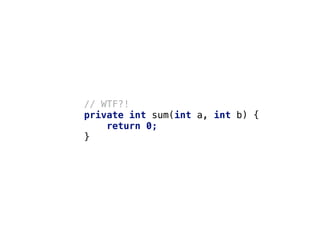
// WTF?!
private int sum(int a, int b) {

return 0;

}
@Test

// `x + 1` = `x`

public void testSumWithIdentityProperty() {

for (int i = 0; i < 100; i++) {

int x = randomInt();

assertEquals(x, sum(x, 0));

}

}
Testing Specification with properties
• Commutativity property
• Associativity property
• Identity property
Testing Specification with properties
By using specifications, we have understood the
requirements in a deeper way
QuickCheck
QuickCheck in a nutshell
John Hughes - Testing the Hard Stuff and Staying Sane
Benefits
• Less time spent writing test code

- One property replaces many tests
• Better testing

- Lots of combinations you’d never test by hand
• Less time spent on diagnosis

- Failures minimized automatically
3,000 pages of specifications
20,000 lines of QuickCheck
1,000,000 LoC from 6 suppliers
200 bugs
100 bugs in the standard
junit-quickcheck
@RunWith(JUnitQuickcheck.class)

public class AdditionPropertyTest {


@Property

public void commutativityProperty(int x, int y) {

assertThat(sum(x, y), equalTo(sum(y, x)));

}


@Property

public void additiveProperty(int x) {

int result1 = sum(sum(x , 1), 1);

int result2 = sum(x, 2);

assertEquals(result1, result2); }


@Property

public void identityProperty(int x) {

assertEquals(x, sum(x, 0));

}


}
java.lang.AssertionError: Property identityProperty
falsified via shrinking: expected:<1> but was:<0>
Shrunken args: [1]
Original failure message: [expected:<98> but was:<0>]
Original args: [98]
Seeds: [7329045779044418918]
@RunWith(JUnitQuickcheck.class)

public class MoneyChangerTest {


@Property

public void sumOfCoinsEqualsAmount(

@InRange(min = "0", max = "500") int amountToChange,

Set<@InRange(min = "1", max = "100") Integer> denominations) {


assumeThat(denominations.size(), greaterThan(0));

denominations.add(1);


MoneyChanger moneyChanger = new MoneyChanger();

List<Integer> coins = moneyChanger.change(amountToChange, denominations);


int sum = coins.stream().mapToInt(coin -> coin).sum();

assertThat(sum, equalTo(amountToChange));

}


}
JSVerify
npm install jsverify
describe("sort", function () {

jsc.property(

"idempotent", "array nat", function (arr) {

return _.isEqual(sort(sort(arr)), sort(arr));

});

});
How to handle state?
• Generate actions changing the state
• Apply each action to the state, if possible
• After each application, verify the model
Where can we benefit
from
property-based tests?
Spark Proxy on DataFrame
API
• Generate random DataReadRequest
• Execute request with RDD-based code
• Execute same request with DataFrame based code
• Compare the results
SDK
• Send START_VIS
• Generate random request, change metric, group-
by, filter, sort, etc
• Validate responses based on the test model
• Send STOP_VIS
• QuickCheck
• Testing Telecoms Software with Quviq QuickCheck
• Testing the hard stuff and staying sane
• The Mysteries of Dropbox
• Jepsen IV: Hope Springs Eternal
• Java Examples from this talk

Property-based testing

  • 1.
    Property-based Testing for Everyone DmitriyMorozov / Zoomdata Tech Lunch
  • 2.
  • 3.
    Example-based Testing • set upone input scenario • run the code under test • check the output
 (and any other effects the code is supposed to have)
  • 4.
    Imagine we neededto implement a custom ADD function
  • 5.
    @Test
 public void testSum(){
 assertThat(sum(1, 2), equalTo(3));
 }
  • 6.
    private int sum(inta, int b) {
 if (a == 1 && b == 2) {
 return 3;
 } else {
 return 0;
 }
 }
  • 7.
    @Test
 public void testSum(){
 assertThat(sum(2, 2), equalTo(4));
 }
  • 8.
    private int sum(inta, int b) {
 if (a == 1 && b == 2) {
 return 3;
 } else if (a == 2 && b == 2) {
 return 4;
 } else {
 return 0;
 }
 }
  • 9.
  • 10.
    @Test
 public void testSum3(){
 // When I add two numbers I expect their sum
 for (int i = 0; i < 100; i++) {
 int x = randomInt();
 int y = randomInt();
 assertThat(sum(x, y), equalTo(x + y));
 }
 }
  • 11.
    @Test
 public void testSum3(){
 // When I add two numbers I expect their sum
 for (int i = 0; i < 100; i++) {
 int x = randomInt();
 int y = randomInt();
 assertThat(sum(x, y), equalTo(x + y));
 }
 }
  • 12.
    @Test
 public void testSumUsingCommutativityProperty(){
 // Changing the order of arguments // shouldn’t change their sum 
 for (int i = 0; i < 100; i++) {
 int x = randomInt();
 int y = randomInt();
 assertThat(sum(x, y), equalTo(sum(y, x)));
 }
 }
  • 13.
    // unfortunately that'snot enough
 
 private int sum(int a, int b) {
 return a * b;
 }
  • 14.
    @Test
 // `x +2` is the same as `x + 1 + 1` 
 public void testSumWithAdditiveProperty() {
 for (int i = 0; i < 100; i++) {
 int x = randomInt();
 int result1 = sum(sum(x , 1), 1);
 int result2 = sum(x, 2);
 assertEquals(result1, result2);
 }
 }
  • 15.
    // WTF?! private intsum(int a, int b) {
 return 0;
 }
  • 16.
    @Test
 // `x +1` = `x`
 public void testSumWithIdentityProperty() {
 for (int i = 0; i < 100; i++) {
 int x = randomInt();
 assertEquals(x, sum(x, 0));
 }
 }
  • 17.
    Testing Specification withproperties • Commutativity property • Associativity property • Identity property
  • 18.
    Testing Specification withproperties By using specifications, we have understood the requirements in a deeper way
  • 19.
  • 21.
  • 22.
    John Hughes -Testing the Hard Stuff and Staying Sane
  • 24.
    Benefits • Less timespent writing test code
 - One property replaces many tests • Better testing
 - Lots of combinations you’d never test by hand • Less time spent on diagnosis
 - Failures minimized automatically
  • 25.
    3,000 pages ofspecifications 20,000 lines of QuickCheck 1,000,000 LoC from 6 suppliers 200 bugs 100 bugs in the standard
  • 26.
  • 27.
    @RunWith(JUnitQuickcheck.class)
 public class AdditionPropertyTest{
 
 @Property
 public void commutativityProperty(int x, int y) {
 assertThat(sum(x, y), equalTo(sum(y, x)));
 }
 
 @Property
 public void additiveProperty(int x) {
 int result1 = sum(sum(x , 1), 1);
 int result2 = sum(x, 2);
 assertEquals(result1, result2); }
 
 @Property
 public void identityProperty(int x) {
 assertEquals(x, sum(x, 0));
 } 
 }
  • 28.
    java.lang.AssertionError: Property identityProperty falsifiedvia shrinking: expected:<1> but was:<0> Shrunken args: [1] Original failure message: [expected:<98> but was:<0>] Original args: [98] Seeds: [7329045779044418918]
  • 29.
    @RunWith(JUnitQuickcheck.class)
 public class MoneyChangerTest{
 
 @Property
 public void sumOfCoinsEqualsAmount(
 @InRange(min = "0", max = "500") int amountToChange,
 Set<@InRange(min = "1", max = "100") Integer> denominations) {
 
 assumeThat(denominations.size(), greaterThan(0));
 denominations.add(1);
 
 MoneyChanger moneyChanger = new MoneyChanger();
 List<Integer> coins = moneyChanger.change(amountToChange, denominations); 
 int sum = coins.stream().mapToInt(coin -> coin).sum();
 assertThat(sum, equalTo(amountToChange));
 }
 
 }
  • 30.
  • 31.
    describe("sort", function (){
 jsc.property(
 "idempotent", "array nat", function (arr) {
 return _.isEqual(sort(sort(arr)), sort(arr));
 });
 });
  • 32.
  • 33.
    How to handlestate? • Generate actions changing the state • Apply each action to the state, if possible • After each application, verify the model
  • 34.
    Where can webenefit from property-based tests?
  • 35.
    Spark Proxy onDataFrame API • Generate random DataReadRequest • Execute request with RDD-based code • Execute same request with DataFrame based code • Compare the results
  • 36.
    SDK • Send START_VIS •Generate random request, change metric, group- by, filter, sort, etc • Validate responses based on the test model • Send STOP_VIS
  • 37.
    • QuickCheck • TestingTelecoms Software with Quviq QuickCheck • Testing the hard stuff and staying sane • The Mysteries of Dropbox • Jepsen IV: Hope Springs Eternal • Java Examples from this talk