DISTRIBUTED
               PATTERNS YOU
               SHOULD KNOW
                           Eric Redmond
                            @coderoshi

                       http://git.io/MYrjpQ

Monday, April 22, 13
h	
  =	
  NaiveHash.new(("A".."J").to_a)
                 tracknodes	
  =	
  Array.new(100000)

                 100000.times	
  do	
  |i|
                 	
  	
  tracknodes[i]	
  =	
  h.node(i)
                 end

                 h.add("K")

                 misses	
  =	
  0
                 100000.times	
  do	
  |i|
                 	
  	
  misses	
  +=	
  1	
  if	
  tracknodes[i]	
  !=	
  h.node(i)
                 end

                 puts	
  "misses:	
  #{(misses.to_f/100000)	
  *	
  100}%"


                 misses:	
  90.922%

Monday, April 22, 13
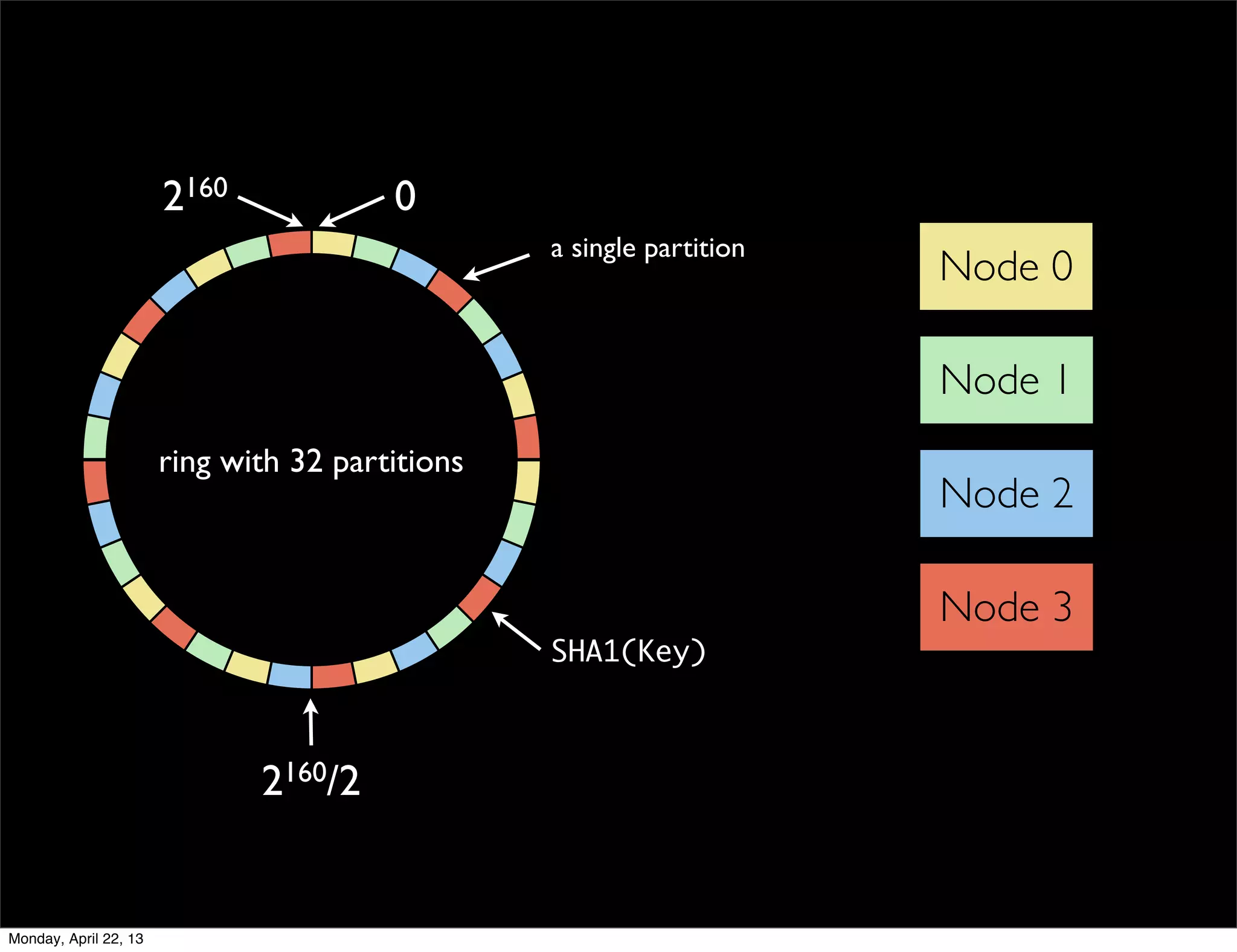
2160             0
                                                 a single partition
                                                                      Node 0

                                                                      Node 1
                       ring with 32 partitions
                                                                      Node 2


                                                 SHA1(Key)


                              2160/2


Monday, April 22, 13
2160             0
                                                 a single partition
                                                                      Node 0

                                                                      Node 1
                       ring with 32 partitions
                                                                      Node 2

                                                                      Node 3
                                                 SHA1(Key)


                              2160/2


Monday, April 22, 13
SHA1BITS	
  =	
  160
        class	
  PartitionedConsistentHash                                             h	
  =	
  PartitionedConsistentHash.new(("A".."J").to_a)
        	
  	
  def	
  initialize(nodes=[],	
  partitions=32)                          nodes	
  =	
  Array.new(100000)


  @partitions	
  =	
  partitions                                 100000.times	
  do	
  |i|


  @nodes,	
  @ring	
  =	
  nodes.clone.sort,	
  {}


  @power	
  =	
  SHA1BITS	
  -­‐	
  Math.log2(partitions).to_i
                                                                                       	
  	
  nodes[i]	
  =	
  h.node(i)


  @partitions.times	
  do	
  |i|                                 end


  @ring[range(i)]	
  =	
  @nodes[0]                      puts	
  "add	
  K"


  @nodes	
  <<	
  @nodes.shift


  end
                                                                                       h.add("K")


  @nodes.sort!                                                   misses	
  =	
  0
        	
  	
  end                                                                    100000.times	
  do	
  |i|
                                                                                       	
  	
  misses	
  +=	
  1	
  if	
  nodes[i]	
  !=	
  h.node(i)
        	
  	
  def	
  range(partition)


  (partition*(2**@power)..(partition+1)*(2**@power)-­‐1)         end
        	
  	
  end                                                                    puts	
  "misses:	
  #{(misses.to_f/100000)	
  *	
  100}%n"
        	
  	
  def	
  hash(key)


  Digest::SHA1.hexdigest(key.to_s).hex
        	
  	
  end                                                                    misses:	
  9.473%
        	
  	
  def	
  add(node)


  @nodes	
  <<	
  node


  partition_pow	
  =	
  Math.log2(@partitions)


  pow	
  =	
  SHA1BITS	
  -­‐	
  partition_pow.to_i


  (0..@partitions).step(@nodes.length)	
  do	
  |i|


  @ring[range(i,	
  pow)]	
  =	
  node


  end
        	
  	
  end


  def	
  node(keystr)


  return	
  nil	
  if	
  @ring.empty?


  key	
  =	
  hash(keystr)


  @ring.each	
  do	
  |range,	
  node|


  return	
  node	
  if	
  range.cover?(key)


  end
        	
  	
  end
        end


Monday, April 22, 13
class	
  Node


  def	
  initialize(name,	
  nodes=[],	
  partitions=32)


  @name	
  =	
  name


  @data	
  =	
  {}


  @ring	
  =	
  ConsistentHash.new(nodes,	
  partitions)
    	
  	
  end


  def	
  put(key,	
  value)


  if	
  @name	
  ==	
  @ring.node(key)


  puts	
  "put	
  #{key}	
  #{value}"


  @data[	
  @ring.hash(key)	
  ]	
  =	
  value


  end
    	
  	
  end


  def	
  get(key)


  if	
  @name	
  ==	
  @ring.node(key)


  puts	
  "get	
  #{key}"


  @data[@ring.hash(key)]


  end
    	
  	
  end

    end


Monday, April 22, 13
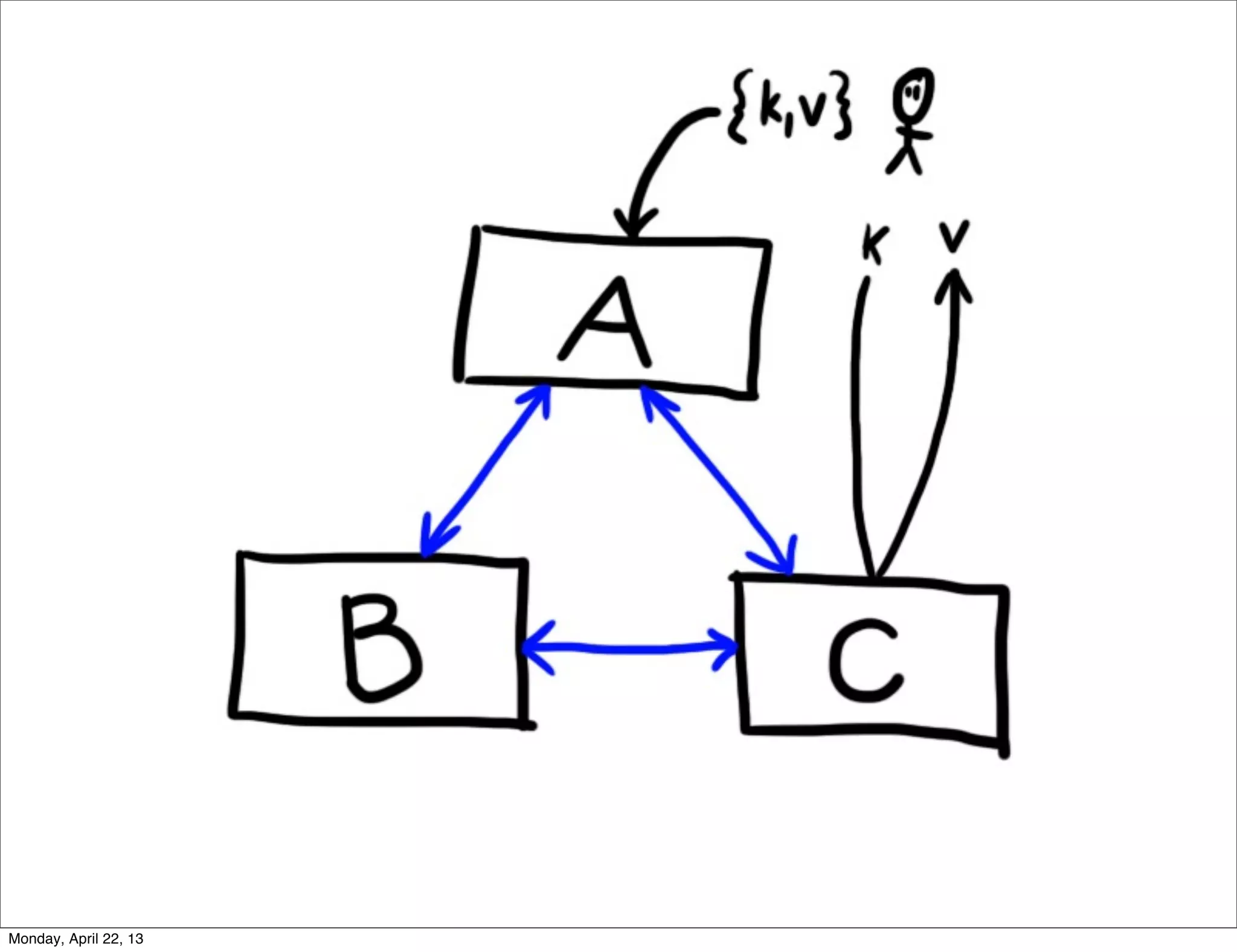
nodeA	
  =	
  Node.new(	
  'A',	
  ['A',	
  'B',	
  'C']	
  )
          nodeB	
  =	
  Node.new(	
  'B',	
  ['A',	
  'B',	
  'C']	
  )
          nodeC	
  =	
  Node.new(	
  'C',	
  ['A',	
  'B',	
  'C']	
  )


          nodeA.put(	
  "foo",	
  "bar"	
  )
          p	
  nodeA.get(	
  "foo"	
  )	
  	
  	
  #	
  nil


          nodeB.put(	
  "foo",	
  "bar"	
  )
          p	
  nodeB.get(	
  "foo"	
  )	
  	
  	
  #	
  "bar"


          nodeC.put(	
  "foo",	
  "bar"	
  )
          p	
  nodeC.get(	
  "foo"	
  )	
  	
  	
  #	
  nil


Monday, April 22, 13
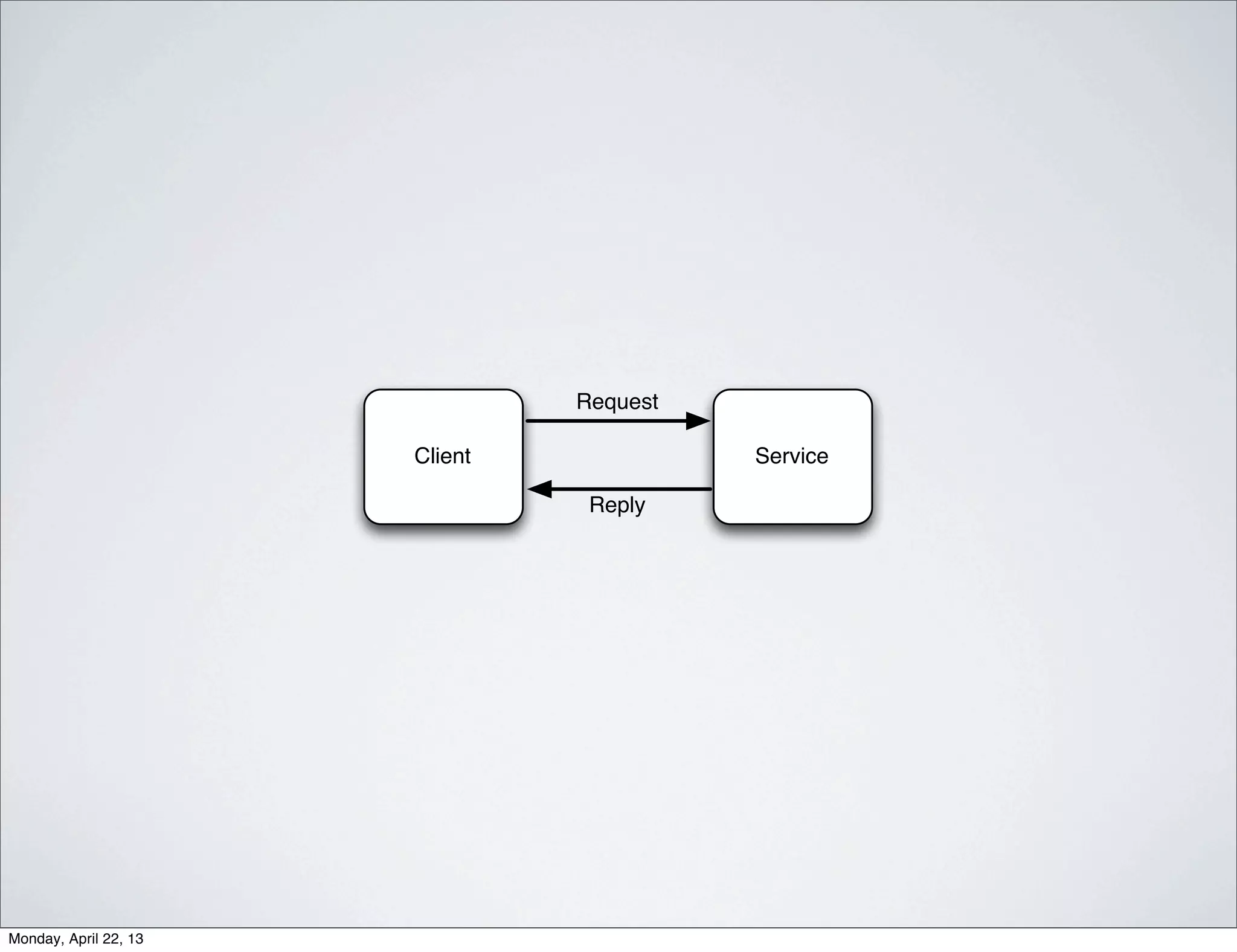
Request

                       Client             Service

                                 Reply


Monday, April 22, 13
module	
  Services
      	
  	
  def	
  connect(port=2200,	
  ip="127.0.0.1")


  ctx	
  =	
  ZMQ::Context.new


  sock	
  =	
  ctx.socket(	
  ZMQ::REQ	
  )


  sock.connect(	
  "tcp://#{ip}:#{port}"	
  )


  sock
      	
  	
  end


  def	
  service(port)


  thread	
  do


  ctx	
  =	
  ZMQ::Context.new


  rep	
  =	
  ctx.socket(	
  ZMQ::REP	
  )


  rep.bind(	
  "tcp://127.0.0.1:#{port}"	
  )


  while	
  line	
  =	
  rep.recv


  msg,	
  payload	
  =	
  line.split('	
  ',	
  2)


  send(	
  msg.to_sym,	
  rep,	
  payload	
  )	


  #	
  EVVVIILLLL!!!


  end


  end
      	
  	
  end


  def	
  method_missing(method,	
  *args,	
  &block)


  socket,	
  payload	
  =	
  args


  payload.send(	
  "bad	
  message"	
  )	
  if	
  payload
      	
  	
  end
      end

Monday, April 22, 13
class	
  Node
  	
  	
  include	
  Configuration
  	
  	
  include	
  Threads
  	
  	
  include	
  Services


  def	
  start()


  service(	
  config("port")	
  )


  puts	
  "#{@name}	
  started"


  join_threads()
  	
  	
  end


  def	
  remote_call(name,	
  message)


  puts	
  "#{name}	
  <=	
  #{message}"


  req	
  =	
  connect(config("port",	
  name),	
  config("ip",	
  name))


  resp	
  =	
  req.send(message)	
  &&	
  req.recv


  req.close


  resp
  	
  	
  end


  #	
  ...


Monday, April 22, 13
 	
  #	
  ...


  def	
  put(socket,	
  payload)


  key,	
  value	
  =	
  payload.split('	
  ',	
  2)


  socket.send(	
  do_put(key,	
  value).to_s	
  )
   	
  	
  end


  def	
  do_put(key,	
  value)


  node	
  =	
  @ring.node(key)


  if	
  node	
  ==	
  @name


  puts	
  "put	
  #{key}	
  #{value}"


  @data[@ring.hash(key)]	
  =	
  value


  else


  remote_call(node,	
  "put	
  #{key}	
  #{value}"	
  )


  end
   	
  	
  end


Monday, April 22, 13
Subscriber


                       Publisher   Subscriber


                                   Subscriber


Monday, April 22, 13
class	
  Node
    	
  	
  #	
  ...
    	
  	
  def	
  coordinate_cluster(pub_port,	
  rep_port)


  thread	
  do


  ctx	
  =	
  ZMQ::Context.new


  pub	
  =	
  ctx.socket(	
  ZMQ::PUB	
  )


  pub.bind(	
  "tcp://*:#{pub_port}"	
  )


  rep	
  =	
  ctx.socket(	
  ZMQ::REP	
  )


  rep.bind(	
  "tcp://*:#{rep_port}"	
  )


  while	
  line	
  =	
  rep.recv


  msg,	
  node	
  =	
  line.split('	
  ',	
  2)


  nodes	
  =	
  @ring.nodes


  case	
  msg


  when	
  'join'


  nodes	
  =	
  (nodes	
  <<	
  node).uniq.sort


  when	
  'down'


  nodes	
  -­‐=	
  [node]


  end


  @ring.cluster(nodes)


  pub.send(	
  "ring	
  "	
  +	
  nodes.join(','))


  rep.send(	
  "true"	
  )


  end


  end
    	
  	
  end
Monday, April 22, 13
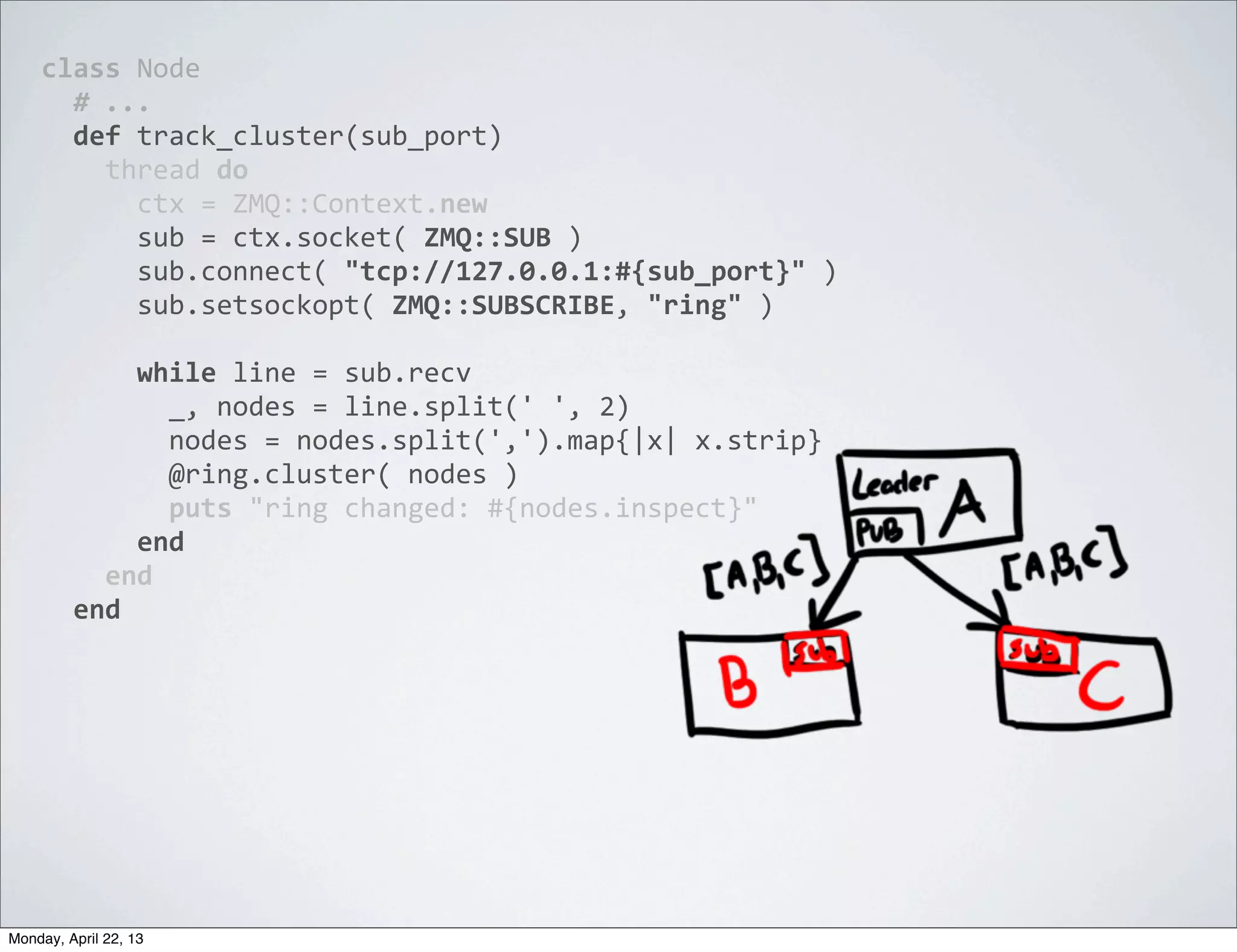
class	
  Node
    	
  	
  #	
  ...
    	
  	
  def	
  track_cluster(sub_port)


  thread	
  do


  ctx	
  =	
  ZMQ::Context.new


  sub	
  =	
  ctx.socket(	
  ZMQ::SUB	
  )


  sub.connect(	
  "tcp://127.0.0.1:#{sub_port}"	
  )


  sub.setsockopt(	
  ZMQ::SUBSCRIBE,	
  "ring"	
  )


  while	
  line	
  =	
  sub.recv


  _,	
  nodes	
  =	
  line.split('	
  ',	
  2)


  nodes	
  =	
  nodes.split(',').map{|x|	
  x.strip}


  @ring.cluster(	
  nodes	
  )


  puts	
  "ring	
  changed:	
  #{nodes.inspect}"


  end


  end
    	
  	
  end


Monday, April 22, 13
 	
  def	
  replicate(message,	
  n)


  list	
  =	
  @ring.pref_list(n)


  results	
  =	
  []


  while	
  replicate_node	
  =	
  list.shift


  results	
  <<	
  remote_call(replicate_node,	
  message)


  end


  results
       	
  	
  end


Monday, April 22, 13
WHAT TO EAT FOR DINNER?
   •   Adam wants Pizza

         {value:"pizza", vclock:{adam:1}}

   •   Barb wants Tacos

         {value:"tacos", vclock:{barb:1}}

   •   Adam gets the value, the system can’t resolve, so he gets bolth

         [{value:"pizza", vclock:{adam:1}},
          {value:"tacos", vclock:{barb:1}}]

   •   Adam resolves the value however he wants

         {value:"taco pizza", vclock:{adam:2, barb:1}}

Monday, April 22, 13
#	
  artificially	
  create	
  a	
  conflict	
  with	
  vclocks
          req.send('put	
  1	
  foo	
  {"B":1}	
  hello1')	
  &&	
  req.recv
          req.send('put	
  1	
  foo	
  {"C":1}	
  hello2')	
  &&	
  req.recv
          puts	
  req.send("get	
  2	
  foo")	
  &&	
  req.recv

          sleep	
  5

          #	
  resolve	
  the	
  conflict	
  by	
  decending	
  from	
  one	
  of	
  the	
  vclocks
          req.send('put	
  2	
  foo	
  {"B":3}	
  hello1')	
  &&	
  req.recv
          puts	
  req.send("get	
  2	
  foo")	
  &&	
  req.recv


Monday, April 22, 13
1.

                2.

                3.

                4.

Monday, April 22, 13
MERKEL TREE


    •A         tree of hashes

    • Periodicallypassed
        between nodes

    • Differences       are “repaired”


Monday, April 22, 13
array	
  	
  =	
  [{value:1},{value:3},{value:5}]

           mapped	
  =	
  array.map{|obj|	
  obj[:value]}
           #	
  [1,	
  3,	
  5]

           mapped.reduce(0){|sum,value|	
  sum	
  +	
  value}
           #	
  9


Monday, April 22, 13
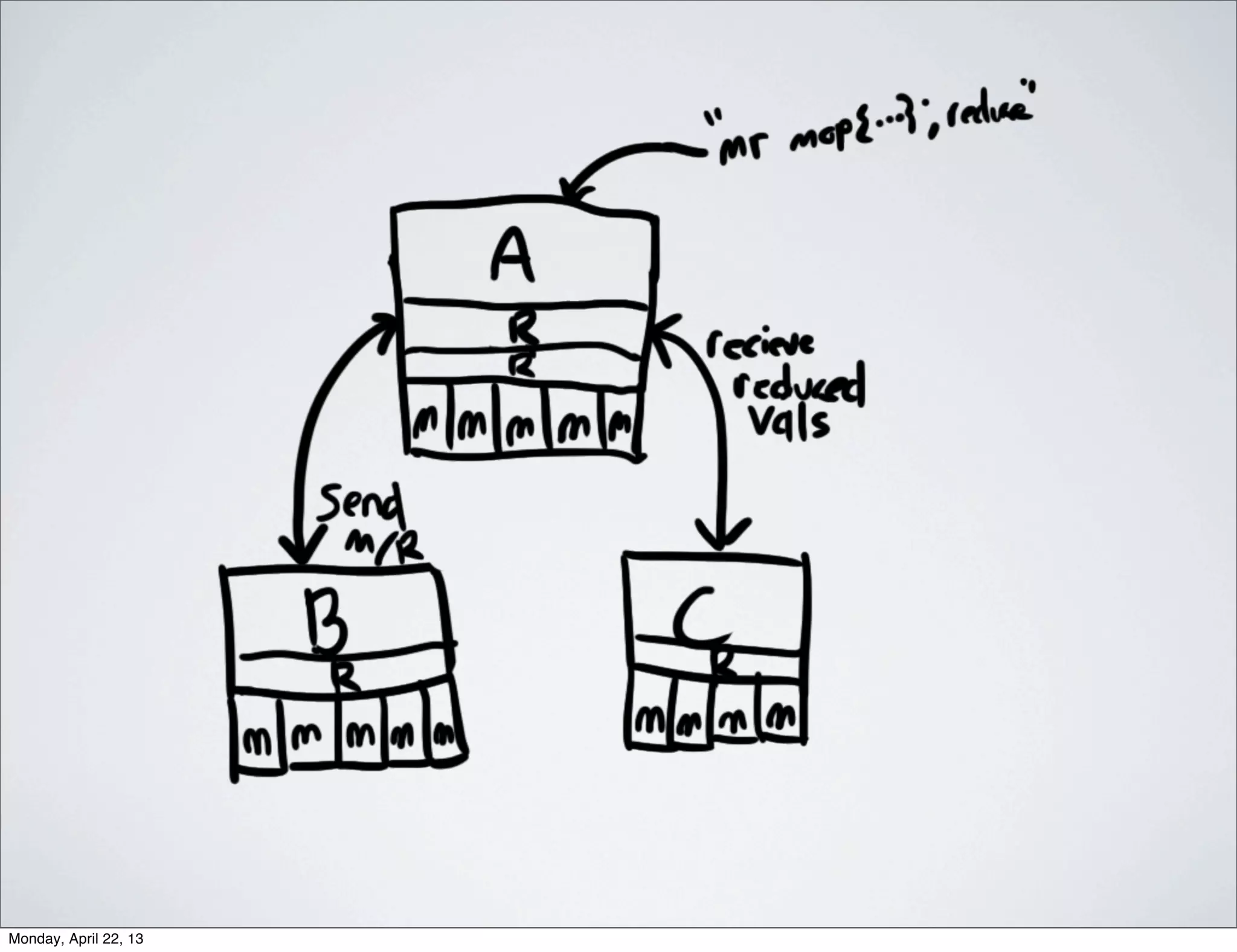
module	
  Mapreduce


  def	
  mr(socket,	
  payload)


  map_func,	
  reduce_func	
  =	
  payload.split(/;s+reduce/,	
  2)


  reduce_func	
  =	
  "reduce#{reduce_func}"


  socket.send(	
  Reduce.new(reduce_func,	
  call_maps(map_func)).call.to_s	
  )
   	
  	
  end


  def	
  map(socket,	
  payload)


  socket.send(	
  Map.new(payload,	
  @data).call.to_s	
  )
   	
  	
  end


  #	
  run	
  in	
  parallel,	
  then	
  join	
  results
   	
  	
  def	
  call_maps(map_func)


  results	
  =	
  []


  nodes	
  =	
  @ring.nodes	
  -­‐	
  [@name]


  nodes.map	
  {|node|


  Thread.new	
  do


  res	
  =	
  remote_call(node,	
  "map	
  #{map_func}")


  results	
  +=	
  eval(res)


  end


  }.each{|w|	
  w.join}


  results	
  +=	
  Map.new(map_func,	
  @data).call
   	
  	
  end
   end

Monday, April 22, 13
module	
  Mapreduce


  def	
  mr(socket,	
  payload)


  map_func,	
  reduce_func	
  =	
  payload.split(/;s+reduce/,	
  2)


  reduce_func	
  =	
  "reduce#{reduce_func}"


  socket.send(	
  Reduce.new(reduce_func,	
  call_maps(map_func)).call.to_s	
  )
   	
  	
  end


  def	
  map(socket,	
  payload)


  socket.send(	
  Map.new(payload,	
  @data).call.to_s	
  )
   	
  	
  end


  #	
  run	
  in	
  parallel,	
  then	
  join	
  results
   	
  	
  def	
  call_maps(map_func)


  results	
  =	
  []


  nodes	
  =	
  @ring.nodes	
  -­‐	
  [@name]


  nodes.map	
  {|node|


  Thread.new	
  do


  res	
  =	
  remote_call(node,	
  "map	
  #{map_func}")


  results	
  +=	
  eval(res)


  end


  }.each{|w|	
  w.join}


  results	
  +=	
  Map.new(map_func,	
  @data).call
   	
  	
  end
   end

Monday, April 22, 13
200.times	
  do	
  |i|
 	
  	
  req.send(	
  "put	
  2	
  key#{i}	
  {}	
  #{i}"	
  )	
  &&	
  req.recv
 end

 req.send(	
  "mr	
  map{|k,v|	
  [1]};	
  reduce{|vs|	
  vs.length}"	
  )
 puts	
  req.recv


Monday, April 22, 13
200.times	
  do	
  |i|
 	
  	
  req.send(	
  "put	
  2	
  key#{i}	
  {}	
  #{i}"	
  )	
  &&	
  req.recv
 end

 req.send(	
  "mr	
  map{|k,v|	
  [1]};	
  reduce{|vs|	
  vs.length}"	
  )
 puts	
  req.recv


Monday, April 22, 13
WHAT WE’VE DONE SO FAR
                       http://git.io/MYrjpQ


    • Distributed, Replicated, Self-healing, Conflict-resolving,
        Eventually Consistent Key/Value Datastore... with Mapreduce


Monday, April 22, 13
Key/Value
          Preference List
                                                   Vector Clocks
                           Distributed Hash Ring
        Request/
        Response


          Merkle Tree                     Node Gossip

                       CRDT (coming)               Read Repair

Monday, April 22, 13
basho
                                              @coderoshi


            http://pragprog.com/book/rwdata            http://github.com/coderoshi/little_riak_book


Monday, April 22, 13
I am the very model of a distributed database,
 I've information in my nodes residing out in cyber space,
 While other datastorers keep consistent values just in case,
 It's tolerant partitions and high uptime, that I embrace.


Monday, April 22, 13
I use a SHA-1algorithm, one-sixty bits of hashing space
 consistent hash ensures k/v's are never ever out of place,
 I replicate my data across more than one partition,
 In case a running node or two encounters decommission.


Monday, April 22, 13
My read repairs consistently, at least it does eventually,
  CAP demands you've only 2 to choose from preferentially,
  In short, you get consistency or high availability,
  To claim you can distribute and do both is pure futility.


Monday, April 22, 13
A system such as I is in a steady tiff with Entropy,
   since practically a quorum is consistent only sloppily,
   My favorite solutions are both read repair and AAE,
   My active anti-entropy trades deltas via Merkel Tree.


Monday, April 22, 13
After write, the clients choose their conflict resolution,
  With convergent replicated data types are a solution:
  I only take a change in state, and not results imperforate,
  And merge results to forge a final value that is proximate.


Monday, April 22, 13
How to know a sequence of events w/o employing locks,
 Well naturally, I use Lamport logic ordered vector-clocks.
 I have both sibling values when my v-clocks face a conflict,
 and keep successive values 'til a single one is picked.


Monday, April 22, 13
If values are your query goal then write some mapreduces.
 Invert-indexing values may reduce query obtuseness.
 Distributing a graph or a relation-style structure,
 though somewhat possible provides a weaker juncture.


Monday, April 22, 13
For data of the meta kind, my ring state is a toss up,
   To keep in sync my nodes will chat through protocol gossip.
   I am a mesh type network, not tree/star topological, their
   single points of failure make such choices most illogical.


Monday, April 22, 13
My network ring is just the thing, ensuring writes are quick,
  But know that CAP demands my choice give only 2 to pick.
  In short, I get consistency or high availability,
  To claim I could distribute and do both is just futility.


Monday, April 22, 13

DDS-20m

  • 1.
    DISTRIBUTED PATTERNS YOU SHOULD KNOW Eric Redmond @coderoshi http://git.io/MYrjpQ Monday, April 22, 13
  • 2.
  • 3.
  • 4.
  • 5.
    h  =  NaiveHash.new(("A".."J").to_a) tracknodes  =  Array.new(100000) 100000.times  do  |i|    tracknodes[i]  =  h.node(i) end h.add("K") misses  =  0 100000.times  do  |i|    misses  +=  1  if  tracknodes[i]  !=  h.node(i) end puts  "misses:  #{(misses.to_f/100000)  *  100}%" misses:  90.922% Monday, April 22, 13
  • 6.
    2160 0 a single partition Node 0 Node 1 ring with 32 partitions Node 2 SHA1(Key) 2160/2 Monday, April 22, 13
  • 7.
    2160 0 a single partition Node 0 Node 1 ring with 32 partitions Node 2 Node 3 SHA1(Key) 2160/2 Monday, April 22, 13
  • 8.
    SHA1BITS  =  160 class  PartitionedConsistentHash h  =  PartitionedConsistentHash.new(("A".."J").to_a)    def  initialize(nodes=[],  partitions=32) nodes  =  Array.new(100000)        @partitions  =  partitions 100000.times  do  |i|        @nodes,  @ring  =  nodes.clone.sort,  {}        @power  =  SHA1BITS  -­‐  Math.log2(partitions).to_i    nodes[i]  =  h.node(i)        @partitions.times  do  |i| end            @ring[range(i)]  =  @nodes[0] puts  "add  K"            @nodes  <<  @nodes.shift        end h.add("K")        @nodes.sort! misses  =  0    end 100000.times  do  |i|    misses  +=  1  if  nodes[i]  !=  h.node(i)    def  range(partition)        (partition*(2**@power)..(partition+1)*(2**@power)-­‐1) end    end puts  "misses:  #{(misses.to_f/100000)  *  100}%n"    def  hash(key)        Digest::SHA1.hexdigest(key.to_s).hex    end misses:  9.473%    def  add(node)        @nodes  <<  node        partition_pow  =  Math.log2(@partitions)        pow  =  SHA1BITS  -­‐  partition_pow.to_i        (0..@partitions).step(@nodes.length)  do  |i|            @ring[range(i,  pow)]  =  node        end    end    def  node(keystr)        return  nil  if  @ring.empty?        key  =  hash(keystr)        @ring.each  do  |range,  node|            return  node  if  range.cover?(key)        end    end end Monday, April 22, 13
  • 9.
    class  Node    def  initialize(name,  nodes=[],  partitions=32)        @name  =  name        @data  =  {}        @ring  =  ConsistentHash.new(nodes,  partitions)    end    def  put(key,  value)        if  @name  ==  @ring.node(key)            puts  "put  #{key}  #{value}"            @data[  @ring.hash(key)  ]  =  value        end    end    def  get(key)        if  @name  ==  @ring.node(key)            puts  "get  #{key}"            @data[@ring.hash(key)]        end    end end Monday, April 22, 13
  • 10.
    nodeA  =  Node.new(  'A',  ['A',  'B',  'C']  ) nodeB  =  Node.new(  'B',  ['A',  'B',  'C']  ) nodeC  =  Node.new(  'C',  ['A',  'B',  'C']  ) nodeA.put(  "foo",  "bar"  ) p  nodeA.get(  "foo"  )      #  nil nodeB.put(  "foo",  "bar"  ) p  nodeB.get(  "foo"  )      #  "bar" nodeC.put(  "foo",  "bar"  ) p  nodeC.get(  "foo"  )      #  nil Monday, April 22, 13
  • 11.
  • 12.
  • 13.
    Request Client Service Reply Monday, April 22, 13
  • 14.
    module  Services    def  connect(port=2200,  ip="127.0.0.1")        ctx  =  ZMQ::Context.new        sock  =  ctx.socket(  ZMQ::REQ  )        sock.connect(  "tcp://#{ip}:#{port}"  )        sock    end    def  service(port)        thread  do            ctx  =  ZMQ::Context.new            rep  =  ctx.socket(  ZMQ::REP  )            rep.bind(  "tcp://127.0.0.1:#{port}"  )            while  line  =  rep.recv                msg,  payload  =  line.split('  ',  2)                send(  msg.to_sym,  rep,  payload  )          #  EVVVIILLLL!!!            end        end    end    def  method_missing(method,  *args,  &block)        socket,  payload  =  args        payload.send(  "bad  message"  )  if  payload    end end Monday, April 22, 13
  • 15.
    class  Node    include  Configuration    include  Threads    include  Services    def  start()        service(  config("port")  )        puts  "#{@name}  started"        join_threads()    end    def  remote_call(name,  message)        puts  "#{name}  <=  #{message}"        req  =  connect(config("port",  name),  config("ip",  name))        resp  =  req.send(message)  &&  req.recv        req.close        resp    end    #  ... Monday, April 22, 13
  • 16.
       #  ...    def  put(socket,  payload)        key,  value  =  payload.split('  ',  2)        socket.send(  do_put(key,  value).to_s  )    end    def  do_put(key,  value)        node  =  @ring.node(key)        if  node  ==  @name            puts  "put  #{key}  #{value}"            @data[@ring.hash(key)]  =  value        else            remote_call(node,  "put  #{key}  #{value}"  )        end    end Monday, April 22, 13
  • 17.
  • 18.
  • 19.
    Subscriber Publisher Subscriber Subscriber Monday, April 22, 13
  • 20.
    class  Node    #  ...    def  coordinate_cluster(pub_port,  rep_port)        thread  do            ctx  =  ZMQ::Context.new            pub  =  ctx.socket(  ZMQ::PUB  )            pub.bind(  "tcp://*:#{pub_port}"  )            rep  =  ctx.socket(  ZMQ::REP  )            rep.bind(  "tcp://*:#{rep_port}"  )            while  line  =  rep.recv                msg,  node  =  line.split('  ',  2)                nodes  =  @ring.nodes                case  msg                when  'join'                    nodes  =  (nodes  <<  node).uniq.sort                when  'down'                    nodes  -­‐=  [node]                end                @ring.cluster(nodes)                pub.send(  "ring  "  +  nodes.join(','))                rep.send(  "true"  )            end        end    end Monday, April 22, 13
  • 21.
    class  Node    #  ...    def  track_cluster(sub_port)        thread  do            ctx  =  ZMQ::Context.new            sub  =  ctx.socket(  ZMQ::SUB  )            sub.connect(  "tcp://127.0.0.1:#{sub_port}"  )            sub.setsockopt(  ZMQ::SUBSCRIBE,  "ring"  )                        while  line  =  sub.recv                _,  nodes  =  line.split('  ',  2)                nodes  =  nodes.split(',').map{|x|  x.strip}                @ring.cluster(  nodes  )                puts  "ring  changed:  #{nodes.inspect}"            end        end    end Monday, April 22, 13
  • 22.
  • 23.
  • 24.
  • 25.
       def  replicate(message,  n)        list  =  @ring.pref_list(n)        results  =  []        while  replicate_node  =  list.shift            results  <<  remote_call(replicate_node,  message)        end        results    end Monday, April 22, 13
  • 26.
  • 27.
  • 28.
  • 29.
    WHAT TO EATFOR DINNER? • Adam wants Pizza {value:"pizza", vclock:{adam:1}} • Barb wants Tacos {value:"tacos", vclock:{barb:1}} • Adam gets the value, the system can’t resolve, so he gets bolth [{value:"pizza", vclock:{adam:1}}, {value:"tacos", vclock:{barb:1}}] • Adam resolves the value however he wants {value:"taco pizza", vclock:{adam:2, barb:1}} Monday, April 22, 13
  • 30.
    #  artificially  create  a  conflict  with  vclocks req.send('put  1  foo  {"B":1}  hello1')  &&  req.recv req.send('put  1  foo  {"C":1}  hello2')  &&  req.recv puts  req.send("get  2  foo")  &&  req.recv sleep  5 #  resolve  the  conflict  by  decending  from  one  of  the  vclocks req.send('put  2  foo  {"B":3}  hello1')  &&  req.recv puts  req.send("get  2  foo")  &&  req.recv Monday, April 22, 13
  • 31.
  • 32.
  • 33.
  • 34.
    1. 2. 3. 4. Monday, April 22, 13
  • 35.
  • 36.
    MERKEL TREE •A tree of hashes • Periodicallypassed between nodes • Differences are “repaired” Monday, April 22, 13
  • 37.
  • 38.
    array    =  [{value:1},{value:3},{value:5}] mapped  =  array.map{|obj|  obj[:value]} #  [1,  3,  5] mapped.reduce(0){|sum,value|  sum  +  value} #  9 Monday, April 22, 13
  • 39.
  • 40.
    module  Mapreduce    def  mr(socket,  payload)        map_func,  reduce_func  =  payload.split(/;s+reduce/,  2)        reduce_func  =  "reduce#{reduce_func}"        socket.send(  Reduce.new(reduce_func,  call_maps(map_func)).call.to_s  )    end    def  map(socket,  payload)        socket.send(  Map.new(payload,  @data).call.to_s  )    end    #  run  in  parallel,  then  join  results    def  call_maps(map_func)        results  =  []        nodes  =  @ring.nodes  -­‐  [@name]        nodes.map  {|node|            Thread.new  do                res  =  remote_call(node,  "map  #{map_func}")                results  +=  eval(res)            end        }.each{|w|  w.join}        results  +=  Map.new(map_func,  @data).call    end end Monday, April 22, 13
  • 41.
    module  Mapreduce    def  mr(socket,  payload)        map_func,  reduce_func  =  payload.split(/;s+reduce/,  2)        reduce_func  =  "reduce#{reduce_func}"        socket.send(  Reduce.new(reduce_func,  call_maps(map_func)).call.to_s  )    end    def  map(socket,  payload)        socket.send(  Map.new(payload,  @data).call.to_s  )    end    #  run  in  parallel,  then  join  results    def  call_maps(map_func)        results  =  []        nodes  =  @ring.nodes  -­‐  [@name]        nodes.map  {|node|            Thread.new  do                res  =  remote_call(node,  "map  #{map_func}")                results  +=  eval(res)            end        }.each{|w|  w.join}        results  +=  Map.new(map_func,  @data).call    end end Monday, April 22, 13
  • 42.
    200.times  do  |i|    req.send(  "put  2  key#{i}  {}  #{i}"  )  &&  req.recv end req.send(  "mr  map{|k,v|  [1]};  reduce{|vs|  vs.length}"  ) puts  req.recv Monday, April 22, 13
  • 43.
    200.times  do  |i|    req.send(  "put  2  key#{i}  {}  #{i}"  )  &&  req.recv end req.send(  "mr  map{|k,v|  [1]};  reduce{|vs|  vs.length}"  ) puts  req.recv Monday, April 22, 13
  • 44.
  • 45.
    WHAT WE’VE DONESO FAR http://git.io/MYrjpQ • Distributed, Replicated, Self-healing, Conflict-resolving, Eventually Consistent Key/Value Datastore... with Mapreduce Monday, April 22, 13
  • 46.
    Key/Value Preference List Vector Clocks Distributed Hash Ring Request/ Response Merkle Tree Node Gossip CRDT (coming) Read Repair Monday, April 22, 13
  • 47.
    basho @coderoshi http://pragprog.com/book/rwdata http://github.com/coderoshi/little_riak_book Monday, April 22, 13
  • 48.
    I am thevery model of a distributed database, I've information in my nodes residing out in cyber space, While other datastorers keep consistent values just in case, It's tolerant partitions and high uptime, that I embrace. Monday, April 22, 13
  • 49.
    I use aSHA-1algorithm, one-sixty bits of hashing space consistent hash ensures k/v's are never ever out of place, I replicate my data across more than one partition, In case a running node or two encounters decommission. Monday, April 22, 13
  • 50.
    My read repairsconsistently, at least it does eventually, CAP demands you've only 2 to choose from preferentially, In short, you get consistency or high availability, To claim you can distribute and do both is pure futility. Monday, April 22, 13
  • 51.
    A system suchas I is in a steady tiff with Entropy, since practically a quorum is consistent only sloppily, My favorite solutions are both read repair and AAE, My active anti-entropy trades deltas via Merkel Tree. Monday, April 22, 13
  • 52.
    After write, theclients choose their conflict resolution, With convergent replicated data types are a solution: I only take a change in state, and not results imperforate, And merge results to forge a final value that is proximate. Monday, April 22, 13
  • 53.
    How to knowa sequence of events w/o employing locks, Well naturally, I use Lamport logic ordered vector-clocks. I have both sibling values when my v-clocks face a conflict, and keep successive values 'til a single one is picked. Monday, April 22, 13
  • 54.
    If values areyour query goal then write some mapreduces. Invert-indexing values may reduce query obtuseness. Distributing a graph or a relation-style structure, though somewhat possible provides a weaker juncture. Monday, April 22, 13
  • 55.
    For data ofthe meta kind, my ring state is a toss up, To keep in sync my nodes will chat through protocol gossip. I am a mesh type network, not tree/star topological, their single points of failure make such choices most illogical. Monday, April 22, 13
  • 56.
    My network ringis just the thing, ensuring writes are quick, But know that CAP demands my choice give only 2 to pick. In short, I get consistency or high availability, To claim I could distribute and do both is just futility. Monday, April 22, 13