Names of group members
1. Syed Umar Rasheed (14093122-002)
2. Adnan Aslam (14093122-003)
3. Bilal Amjad (14093122-004)
4. Inzmam Tahir (14093122-005)
Orthogonal Trajectories
in rectangular coordinate
system
Definition
• An orthogonal trajectory of a family of curves is a curve
that intersects each curve of the family orthogonally—
that is, at right angles.
Suppose that we have a family of curves given by
and another family of curves
𝑔 𝑥, 𝑦 = 0
such that at any intersection of the curves of the first
family with a curve of the second family, the tangents of
the curves are perpendicular.
Orthogonal trajectories, therefore, are two families of
curves that always intersect perpendicularly.
𝑓 𝑥, 𝑦 = 0
Let us consider the example of the two families
𝑦 = 𝑚𝑥 𝑎𝑛𝑑 𝑦2 + 𝑥2 = 𝑐2
If we draw the two families together on the same graph
we get
METHOD
( , )
dy
f x y
dx

1
( , )
dy
dx f x y
 
Find the differential equation for the given family of
curves, by differentiating
Find the differential equation of the Orthogonal
Trajectory
Separating variables and integrating the above differential
equation we get the algebraic equation of the family of
orthogonal trajectories.
Given family of curve 𝑓 𝑥, 𝑦 = 0
STEP 1
STEP 2
STEP 3
𝑑𝑥
𝑑𝑦
= −𝑓( 𝑥, 𝑦)or
Orthogonal Curves
2
Consider the family of parabola . Find the family of curves
which intersect the above family of parabola perpendicularly.
y x C 
Example
Solution
Two curve intersect perpendicularly if the product of the slopes of
the tangents at the intersection point is -1.
The differential equation for the orthogonal family of curves.
𝑑𝑦
𝑑𝑥
= −
1
2𝑥
By differentiation we get
𝑑𝑦
𝑑𝑥
= 2𝑥 . Hence the family of
parabola in question satisfies the differential equation
𝑑𝑦
𝑑𝑥
= 2𝑥.
      
1 1 1
2 2
dy
dy dx
dx x x
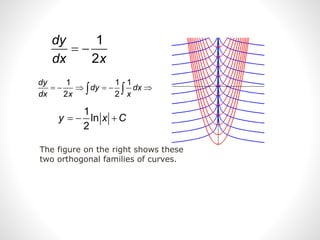
The figure on the right shows these
two orthogonal families of curves.
 
1
2
dy
dx x
  
1
ln
2
y x C
Example Find the orthogonal trajectories of all parabolas with vertices at
the origin and foci on the x-axis
𝒚 𝟐
= 𝟒𝒂𝒙
𝒚 𝟐
𝒙
= 𝟒𝒂
STEP 1: Differentiate Eq 1
Eq 1
𝒙
𝒅
𝒅𝒙
𝒚 𝟐
− 𝒚 𝟐 𝒅
𝒅𝒙
(𝒙)
𝒙 𝟐
= 𝟎
𝟐𝒙𝒚
𝒅𝒚
𝒅𝒙
− 𝒚 𝟐
= 𝟎
𝒅𝒚
𝒅𝒙
=
𝒚
𝟐𝒙
STEP 2: Differential equation of the orthogonal trajectories
𝒅𝒚
𝒅𝒙
= −
𝟐𝒙
𝒚
STEP 3: Solving the differential equation by method of separation of variables
𝒅𝒚
𝒅𝒙
= −
𝟐𝒙
𝒚
−𝒚𝒅𝒚 = 𝟐𝒙𝒅𝒙
∫ 𝟐𝒙 𝒅𝒙 + ∫ 𝒚𝒅𝒚 = ∫ 𝟎 ,integrating both sides
𝒙 𝟐 +
𝒚 𝟐
𝟐
= 𝑪
𝟐𝒙 𝟐 + 𝒚 𝟐 = 𝑪
𝟐𝒙 𝟐 + 𝒚 𝟐 = 𝒃 𝟐
Exercise 9.7
Find the orthogonal trajectories of each of the
following.
1) 𝑥2
− 𝑦2
= 𝑐
2) 𝑥 = 𝑐𝑦2
3) 𝑥2
+ 𝑦2
= 𝑐𝑥
4) 𝑦 = 𝑒 𝑐𝑥
5) 𝑦 = 𝑥 − 1 + 𝑐𝑒−𝑥
Applications
• Equipotential Lines and Electric Fields
• Electromagnetic waves consist of both electric and magnetic
field waves. These waves oscillate in perpendicular planes with
respect to each other.
• The light rays of sun that passes through the
orbits of the planets.
References
• www.slideshare.com
• www.quora.com
• www.mathcity.com
• www.wikipedia.com

Orthogonal trajectories

  • 1.
    Names of groupmembers 1. Syed Umar Rasheed (14093122-002) 2. Adnan Aslam (14093122-003) 3. Bilal Amjad (14093122-004) 4. Inzmam Tahir (14093122-005)
  • 2.
  • 3.
    Definition • An orthogonaltrajectory of a family of curves is a curve that intersects each curve of the family orthogonally— that is, at right angles.
  • 4.
    Suppose that wehave a family of curves given by and another family of curves 𝑔 𝑥, 𝑦 = 0 such that at any intersection of the curves of the first family with a curve of the second family, the tangents of the curves are perpendicular. Orthogonal trajectories, therefore, are two families of curves that always intersect perpendicularly. 𝑓 𝑥, 𝑦 = 0
  • 5.
    Let us considerthe example of the two families 𝑦 = 𝑚𝑥 𝑎𝑛𝑑 𝑦2 + 𝑥2 = 𝑐2 If we draw the two families together on the same graph we get
  • 6.
    METHOD ( , ) dy fx y dx  1 ( , ) dy dx f x y   Find the differential equation for the given family of curves, by differentiating Find the differential equation of the Orthogonal Trajectory Separating variables and integrating the above differential equation we get the algebraic equation of the family of orthogonal trajectories. Given family of curve 𝑓 𝑥, 𝑦 = 0 STEP 1 STEP 2 STEP 3 𝑑𝑥 𝑑𝑦 = −𝑓( 𝑥, 𝑦)or
  • 7.
    Orthogonal Curves 2 Consider thefamily of parabola . Find the family of curves which intersect the above family of parabola perpendicularly. y x C  Example Solution Two curve intersect perpendicularly if the product of the slopes of the tangents at the intersection point is -1. The differential equation for the orthogonal family of curves. 𝑑𝑦 𝑑𝑥 = − 1 2𝑥 By differentiation we get 𝑑𝑦 𝑑𝑥 = 2𝑥 . Hence the family of parabola in question satisfies the differential equation 𝑑𝑦 𝑑𝑥 = 2𝑥.
  • 8.
          1 1 1 2 2 dy dy dx dx x x The figure on the right shows these two orthogonal families of curves.   1 2 dy dx x    1 ln 2 y x C
  • 9.
    Example Find theorthogonal trajectories of all parabolas with vertices at the origin and foci on the x-axis 𝒚 𝟐 = 𝟒𝒂𝒙 𝒚 𝟐 𝒙 = 𝟒𝒂 STEP 1: Differentiate Eq 1 Eq 1 𝒙 𝒅 𝒅𝒙 𝒚 𝟐 − 𝒚 𝟐 𝒅 𝒅𝒙 (𝒙) 𝒙 𝟐 = 𝟎 𝟐𝒙𝒚 𝒅𝒚 𝒅𝒙 − 𝒚 𝟐 = 𝟎 𝒅𝒚 𝒅𝒙 = 𝒚 𝟐𝒙 STEP 2: Differential equation of the orthogonal trajectories 𝒅𝒚 𝒅𝒙 = − 𝟐𝒙 𝒚
  • 10.
    STEP 3: Solvingthe differential equation by method of separation of variables 𝒅𝒚 𝒅𝒙 = − 𝟐𝒙 𝒚 −𝒚𝒅𝒚 = 𝟐𝒙𝒅𝒙 ∫ 𝟐𝒙 𝒅𝒙 + ∫ 𝒚𝒅𝒚 = ∫ 𝟎 ,integrating both sides 𝒙 𝟐 + 𝒚 𝟐 𝟐 = 𝑪 𝟐𝒙 𝟐 + 𝒚 𝟐 = 𝑪 𝟐𝒙 𝟐 + 𝒚 𝟐 = 𝒃 𝟐
  • 11.
    Exercise 9.7 Find theorthogonal trajectories of each of the following. 1) 𝑥2 − 𝑦2 = 𝑐 2) 𝑥 = 𝑐𝑦2 3) 𝑥2 + 𝑦2 = 𝑐𝑥 4) 𝑦 = 𝑒 𝑐𝑥 5) 𝑦 = 𝑥 − 1 + 𝑐𝑒−𝑥
  • 12.
  • 13.
    • Electromagnetic wavesconsist of both electric and magnetic field waves. These waves oscillate in perpendicular planes with respect to each other.
  • 14.
    • The lightrays of sun that passes through the orbits of the planets.
  • 15.
    References • www.slideshare.com • www.quora.com •www.mathcity.com • www.wikipedia.com