What needs to change in curriculum design? 
Simon Cross, Alan Masson, Jim Everett, Paul Bartholomew, facilitated by Peter Bullen 
Innovating e-Learning 2011 
Learning in Transition
Facilitator 
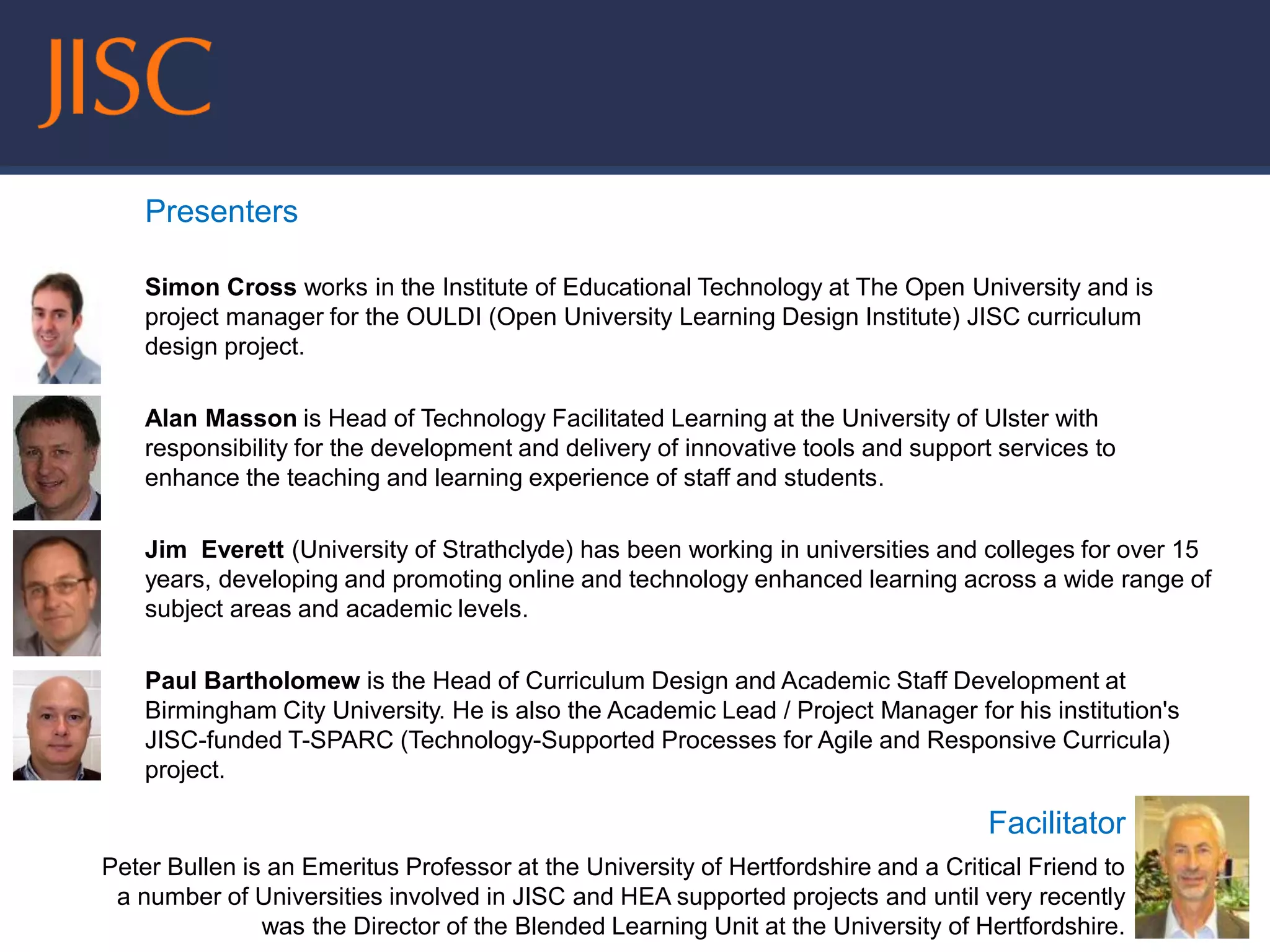
Peter Bullen is an Emeritus Professor at the University of Hertfordshire and a Critical Friend to a number of Universities involved in JISC and HEA supported projects and until very recently was the Director of the Blended Learning Unit at the University of Hertfordshire. 
Presenters 
Simon Cross works in the Institute of Educational Technology at The Open Universityand is project manager for the OULDI (Open University Learning Design Institute) JISC curriculum design project. 
Alan Masson is Head of Technology Facilitated Learning at the University of Ulster with responsibility for the development and delivery of innovative tools and support services to enhance the teaching and learning experience of staff and students. 
Jim Everett (University of Strathclyde) has been working in universities and colleges for over 15 years, developing and promoting online and technology enhanced learning across a wide range of subject areas and academic levels. 
Paul Bartholomew is the Head of Curriculum Design and Academic Staff Development at Birmingham City University. He is also the Academic Lead / Project Manager for his institution's JISC-funded T-SPARC (Technology-Supported Processes for Agile and Responsive Curricula) project.
Text-chatting 
Elluminate layout 
Audio 
Whiteboard 
Technical problems 
•Use the text-chat to engage with other delegates, presenter and moderators about the content of the session. 
•You can send private text-chat messages e.g. to moderators or to individuals. 
•You can change your Elluminate layout to “Wide layout” to make it easier to follow the text-chat (select “View … Layouts…Wide layout”). 
•If you are distracted by the text-chat, you can “unlock” the Elluminate layout to enable you to adjust the size and position of the text-chat sub-window (uncheck “View…Layouts …Layout locked”) 
•It is best to run the Audio Set-up Wizard to test your audio set-up each time you enter an Elluminate room (select “Tools…Audio… Audio setup wizard). 
•You must use a headset/microphone if you want to ask a question in audio. 
•Only use your microphone when guided by a moderator –click on the mic icon (bottom-left of screen) to turn it on and click on it again to turn it off. 
•Only draw on the whiteboard if guided by a moderator. 
•Send a private text-chat message to “moderators” and they will try to help. 
Session practice
What Needs to Change in Curriculum Design? 
Cluster C and B project teams from the 
Curriculum Design Programme: 
University of Ulster; Alan Masson & Catherine O’Donnell (Viewpoints) 
The Open University; Simon Cross & Rebecca Galley (OULDI) 
University of Strathclyde; Jim Everett & George Macgregor (PiP) 
Birmingham City University; Paul Bartholomew & Oliver Jenkins (T-SPARC) 
& 
Peter Bullen –Critical Friend
Objectives of this session 
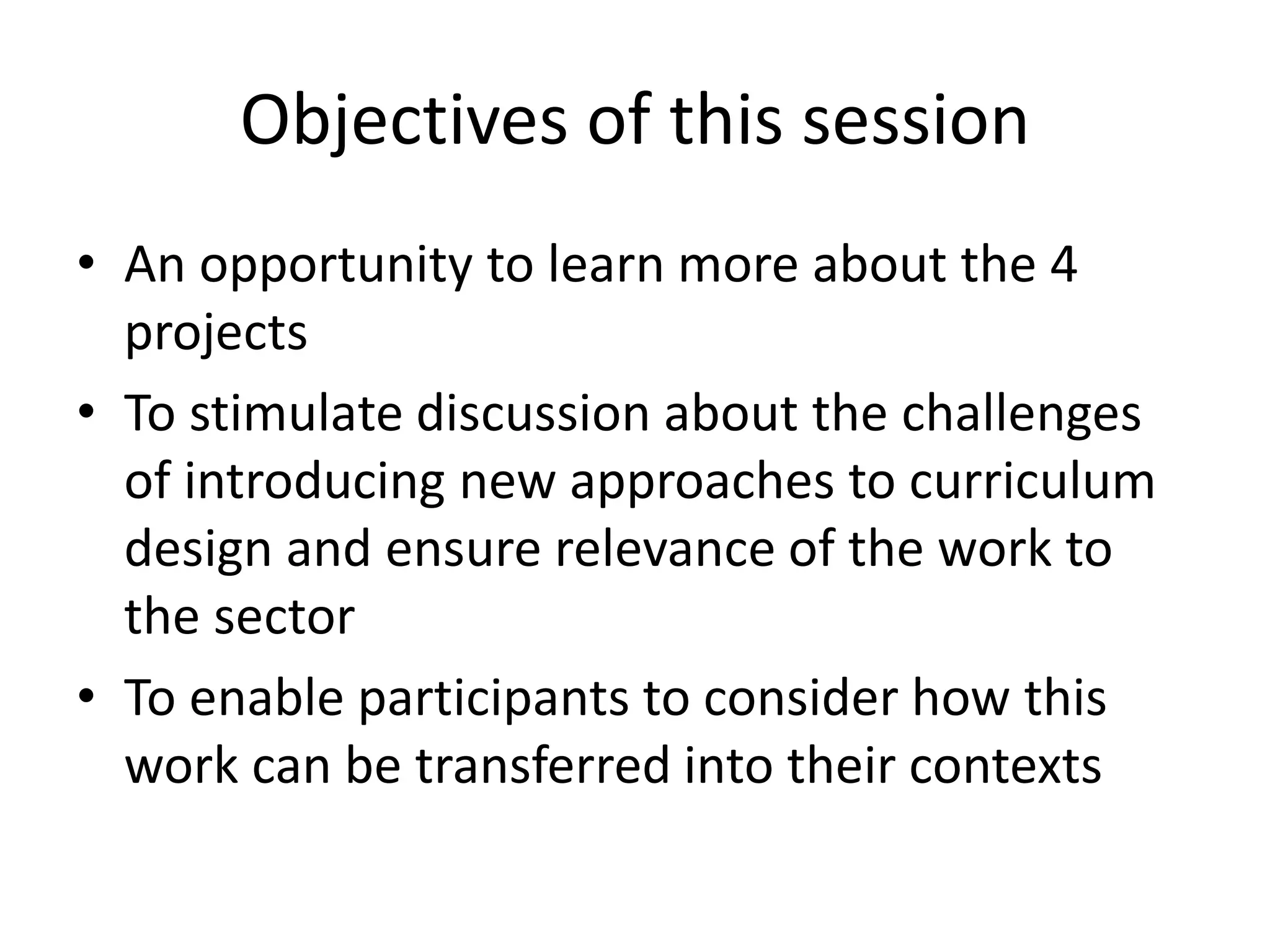
•An opportunity to learn more about the 4 projects 
•To stimulate discussion about the challenges of introducing new approaches to curriculum design and ensure relevance of the work to the sector 
•To enable participants to consider how this work can be transferred into their contexts
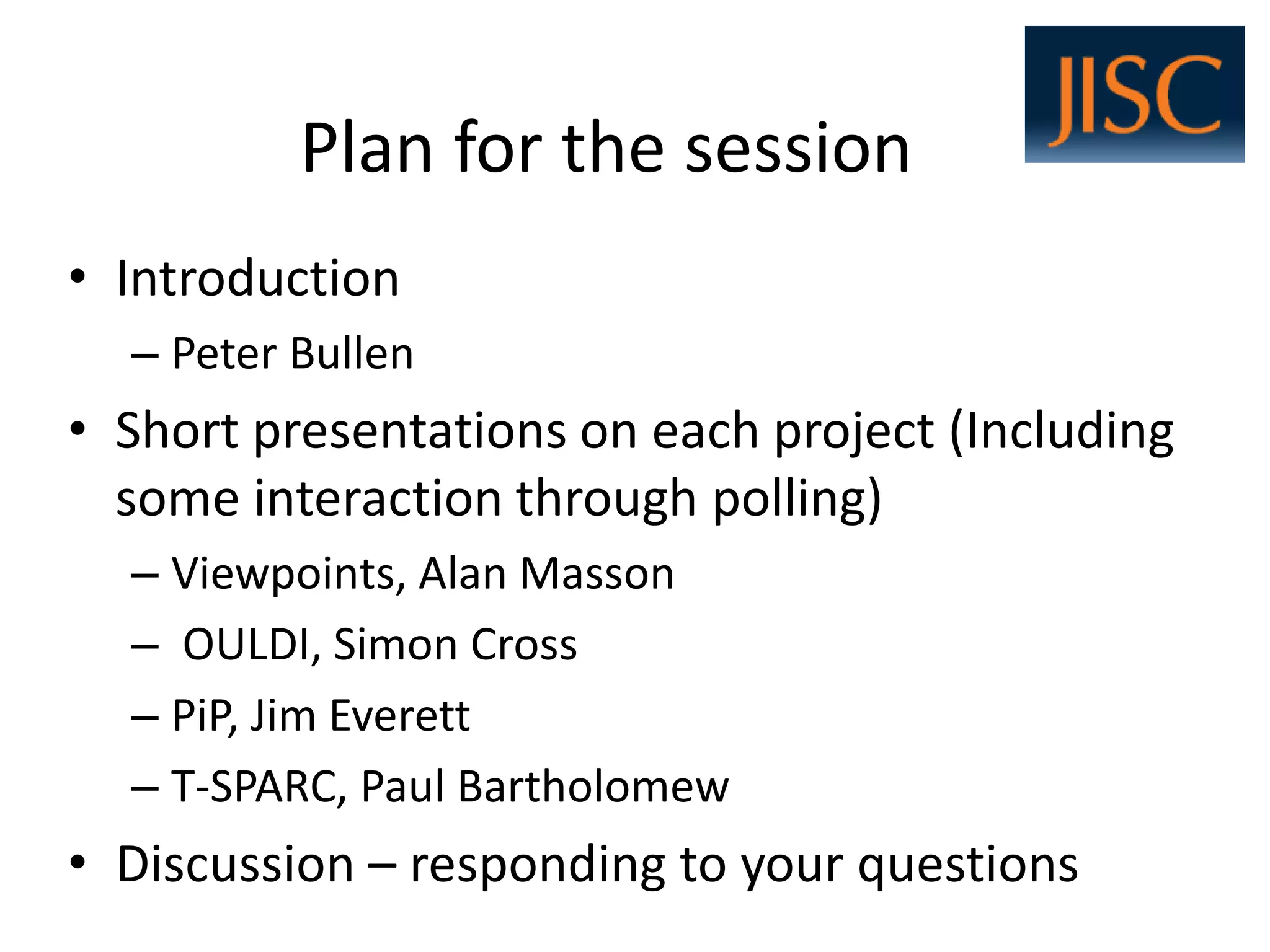
Plan for the session 
•Introduction 
–Peter Bullen 
•Short presentations on each project (Including some interaction through polling) 
–Viewpoints, Alan Masson 
–OULDI, Simon Cross 
–PiP, Jim Everett 
–T-SPARC, Paul Bartholomew 
•Discussion –responding to your questions
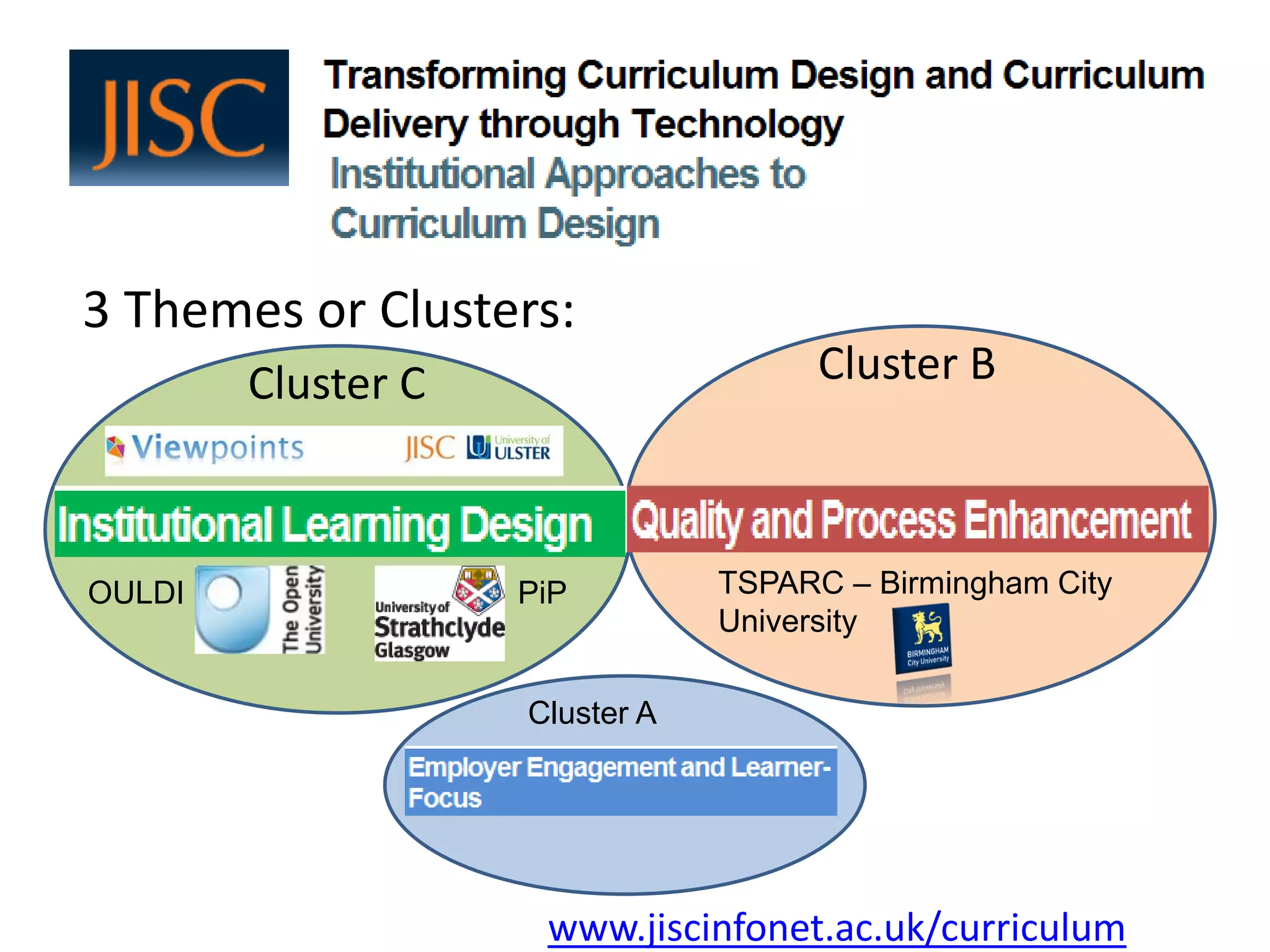
3 Themes or Clusters: 
c 
Cluster C 
www.jiscinfonet.ac.uk/curriculum 
Cluster B 
TSPARC –Birmingham City University 
OULDI 
PiP 
Cluster A
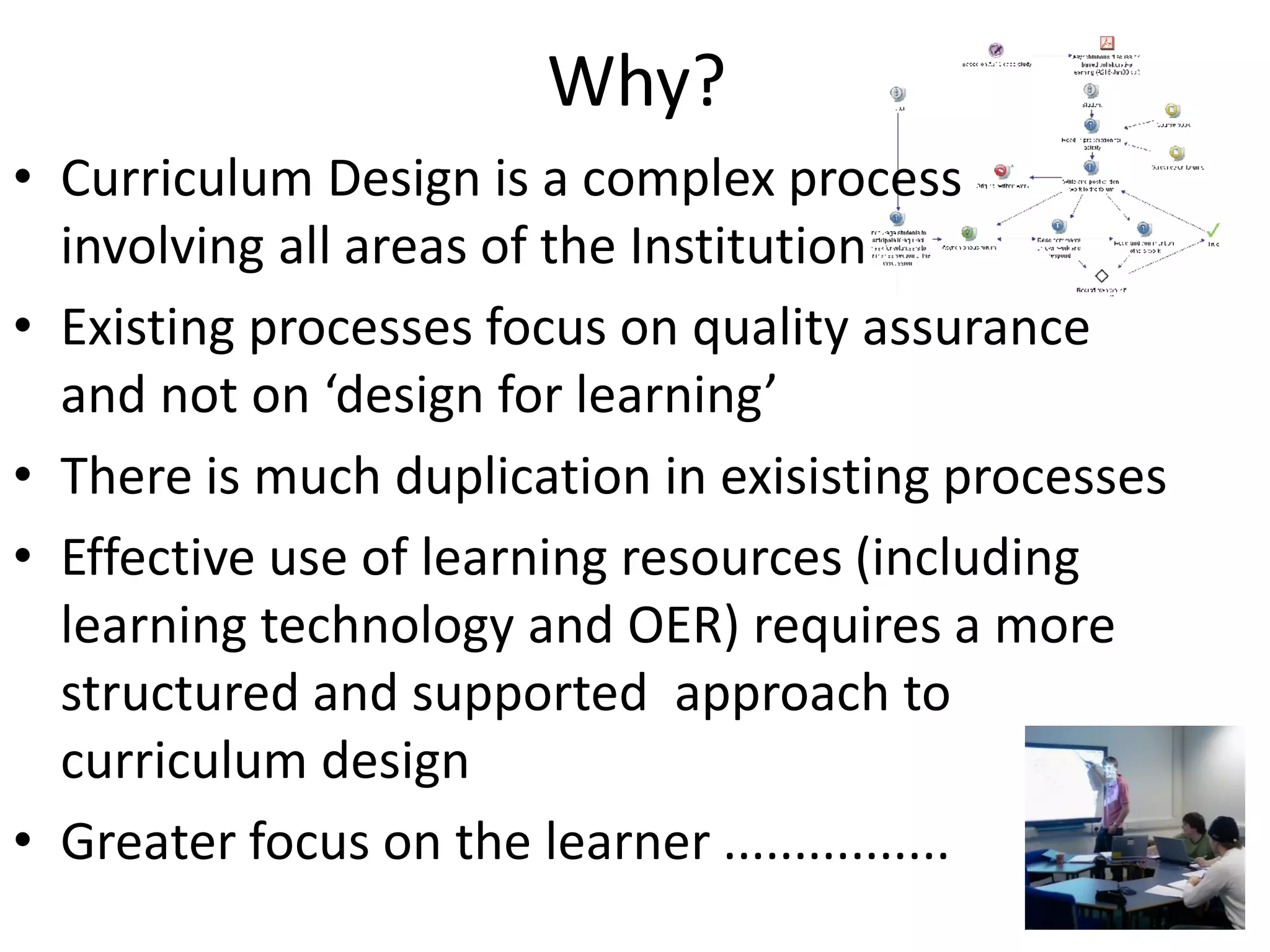
Why? 
•Curriculum Design is a complex process involving all areas of the Institution 
•Existing processes focus on quality assurance and not on ‘design for learning’ 
•There is much duplication in exisisting processes 
•Effective use of learning resources (including learning technology and OER) requires a more structured and supported approach to curriculum design 
•Greater focus on the learner ................
What is your primary interest in this session? 
A.Designing courses/programmes 
B.Teaching 
C.Quality Assurance 
D.Supporting learners 
E.Other –please enter details in the text chat box
Whatdo you think the greatest challenges of institutional approaches to Curriculum Design are? 
A.The lack of a common language of Curriculum Design 
B.Curriculum Design is currently ‘owned’ by the wrong people 
C.A fully integrated Curriculum Design process is too complex 
D.Limited opportunity to share useful curriculum designs 
E.Other –please enter details in the text chat box
The Viewpoints projectAlan Massonfacilitated by Catherine O’Donnell
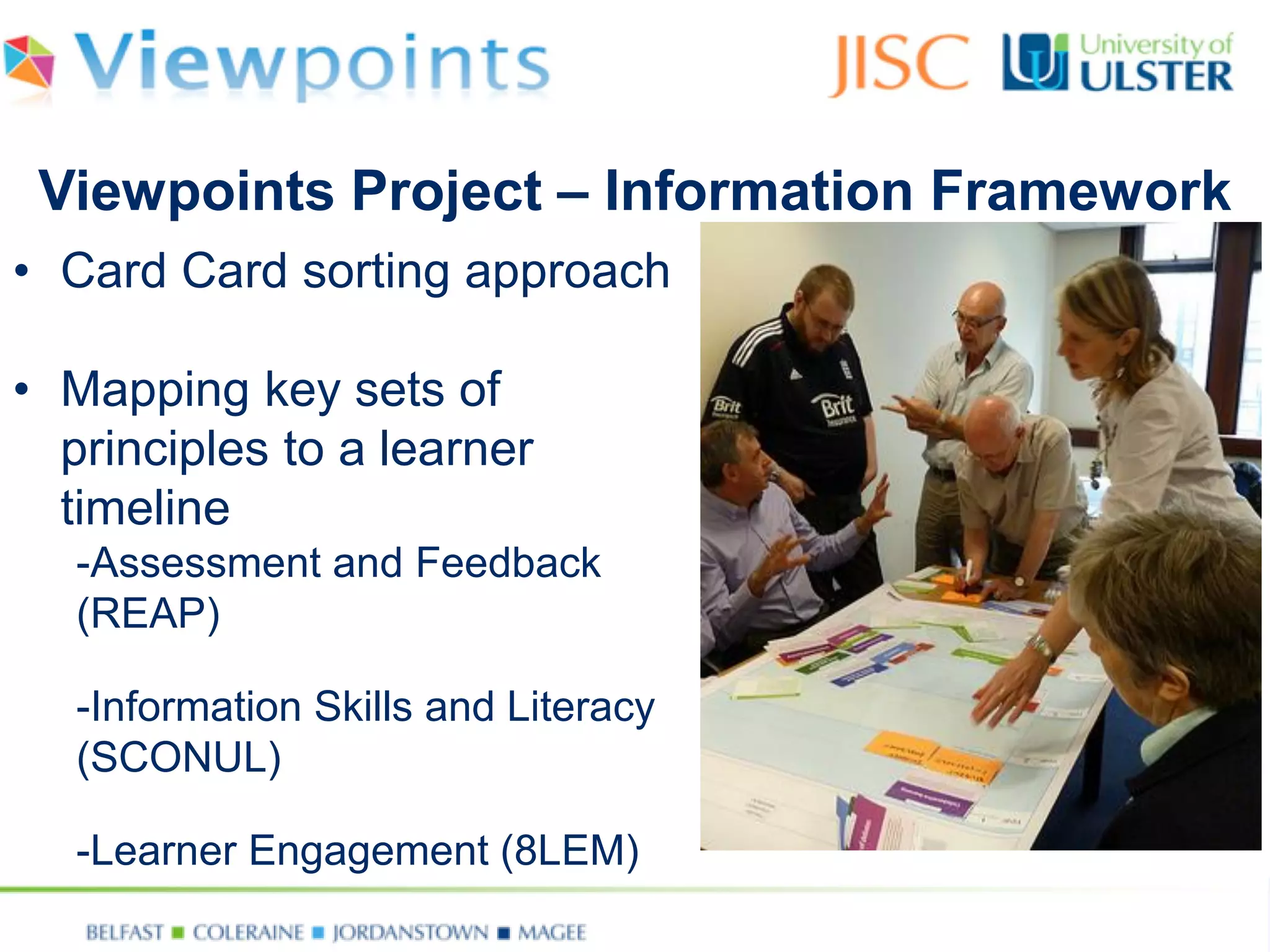
•Card Card sorting approach 
•Mapping key sets of principles to a learner timeline 
-Assessment and Feedback (REAP) 
-Information Skills and Literacy (SCONUL) 
-Learner Engagement (8LEM) 
Viewpoints Project –Information Framework
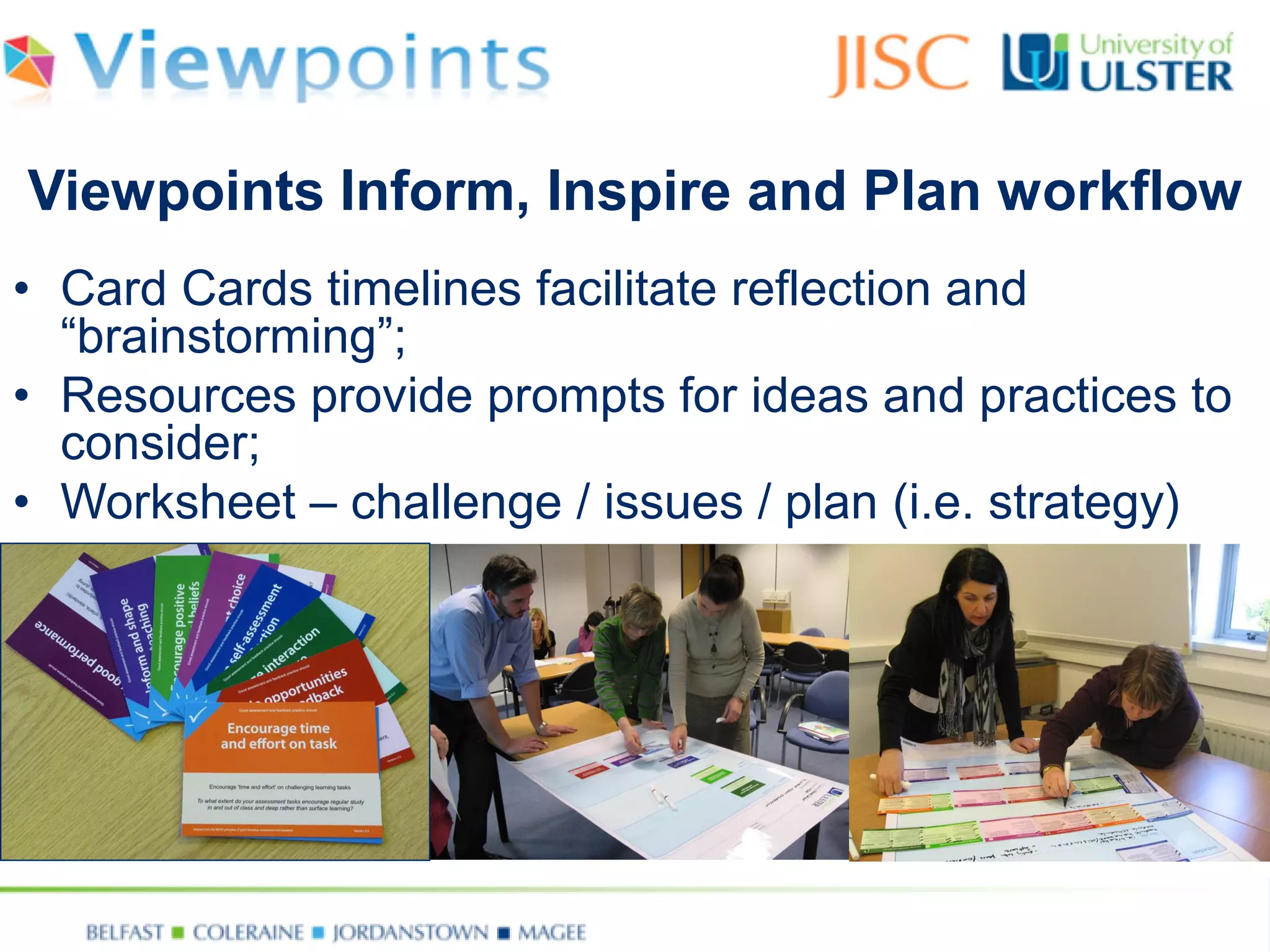
•Card Cards timelines facilitate reflection and “brainstorming”; 
•Resources provide prompts for ideas and practices to consider; 
•Worksheet –challenge / issues / plan (i.e. strategy) 
Viewpoints Inform, Inspire and Plan workflow
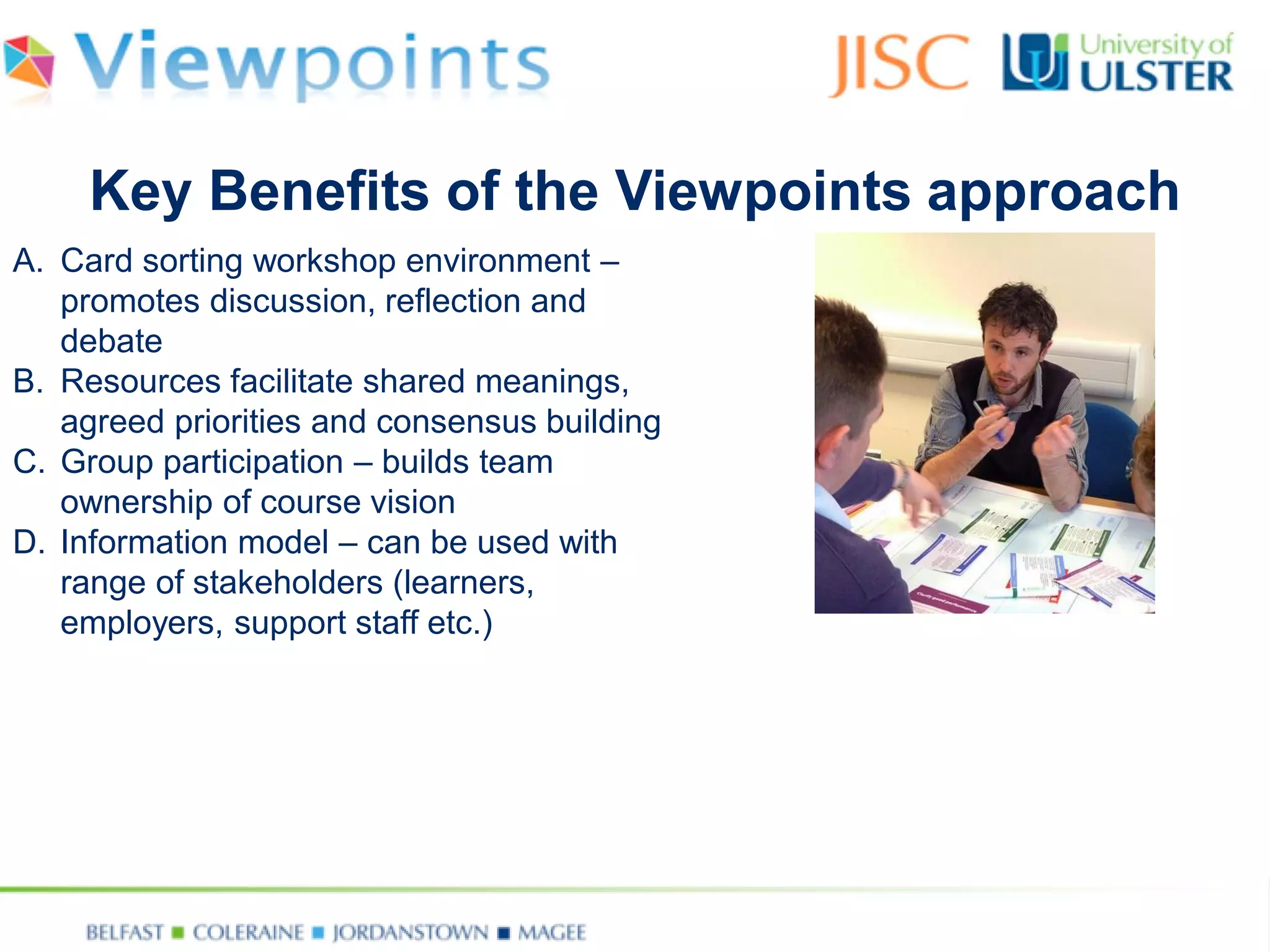
A.Card sorting workshop environment – promotes discussion, reflection and debate 
B.Resources facilitate shared meanings, agreed priorities and consensus building 
C.Group participation –builds team ownership of course vision 
D.Information model –can be used with range of stakeholders (learners, employers, support staff etc.) 
Key Benefits of the Viewpoints approach
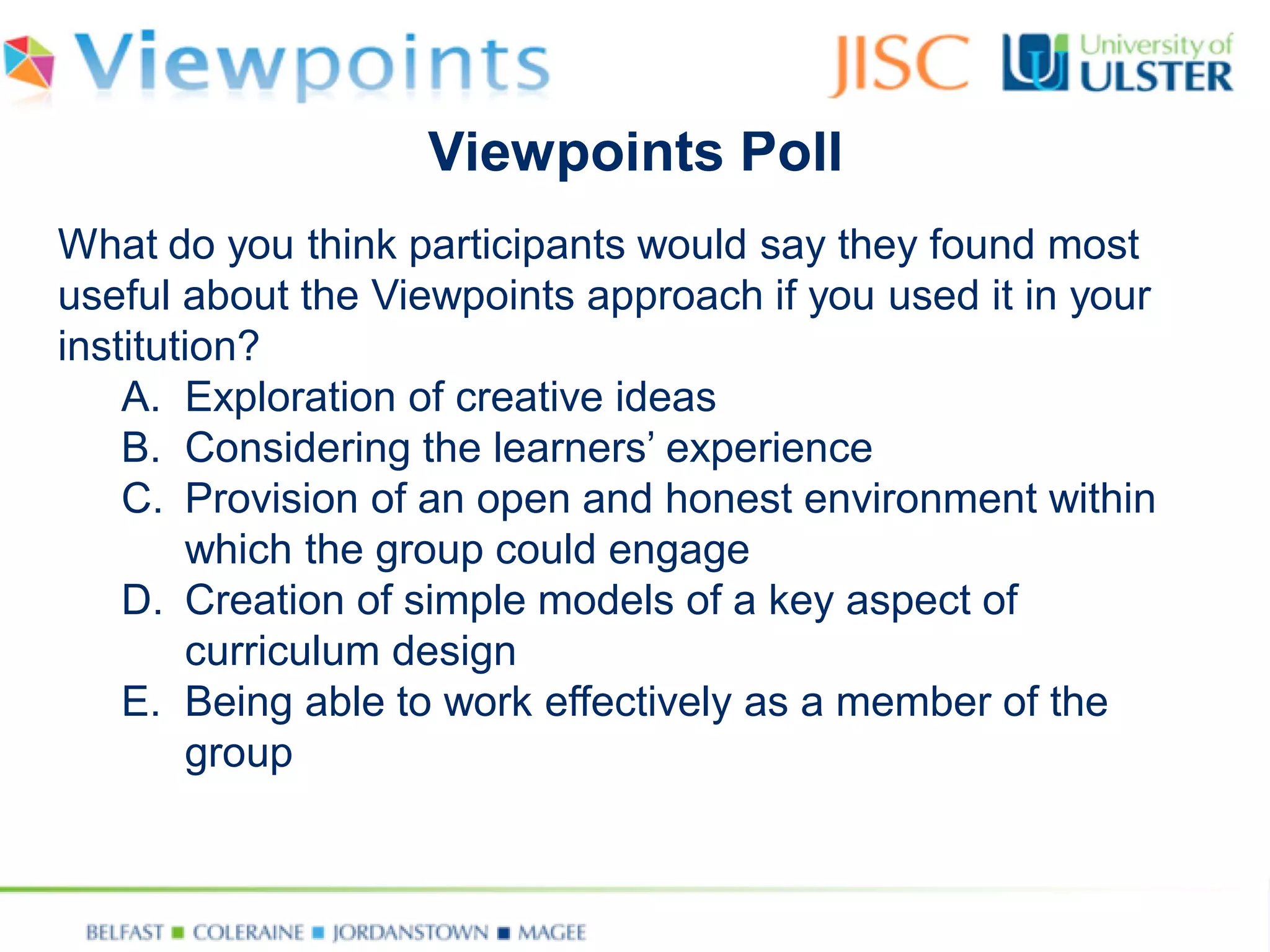
What do you think participants would say they found most useful about the Viewpoints approach if you used it in your institution? 
A.Exploration of creative ideas 
B.Considering the learners’ experience 
C.Provision of an open and honest environment within which the group could engage 
D.Creation of simple models of a key aspect of curriculum design 
E.Being able to work effectively as a member of the group 
Viewpoints Poll
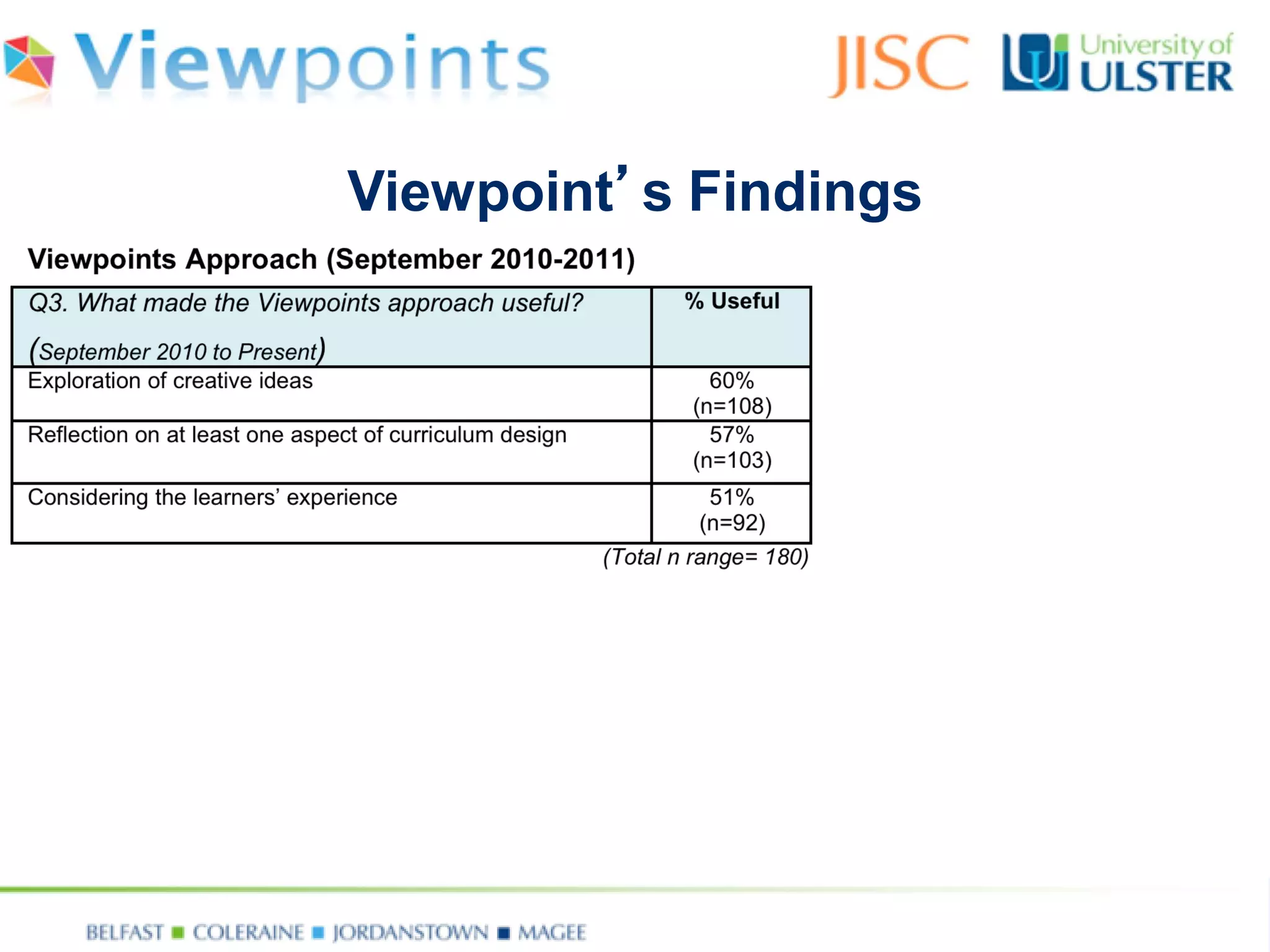
Viewpoint’s Findings
The OULDI projectSimon Crossfacilitated by Rebecca Galley
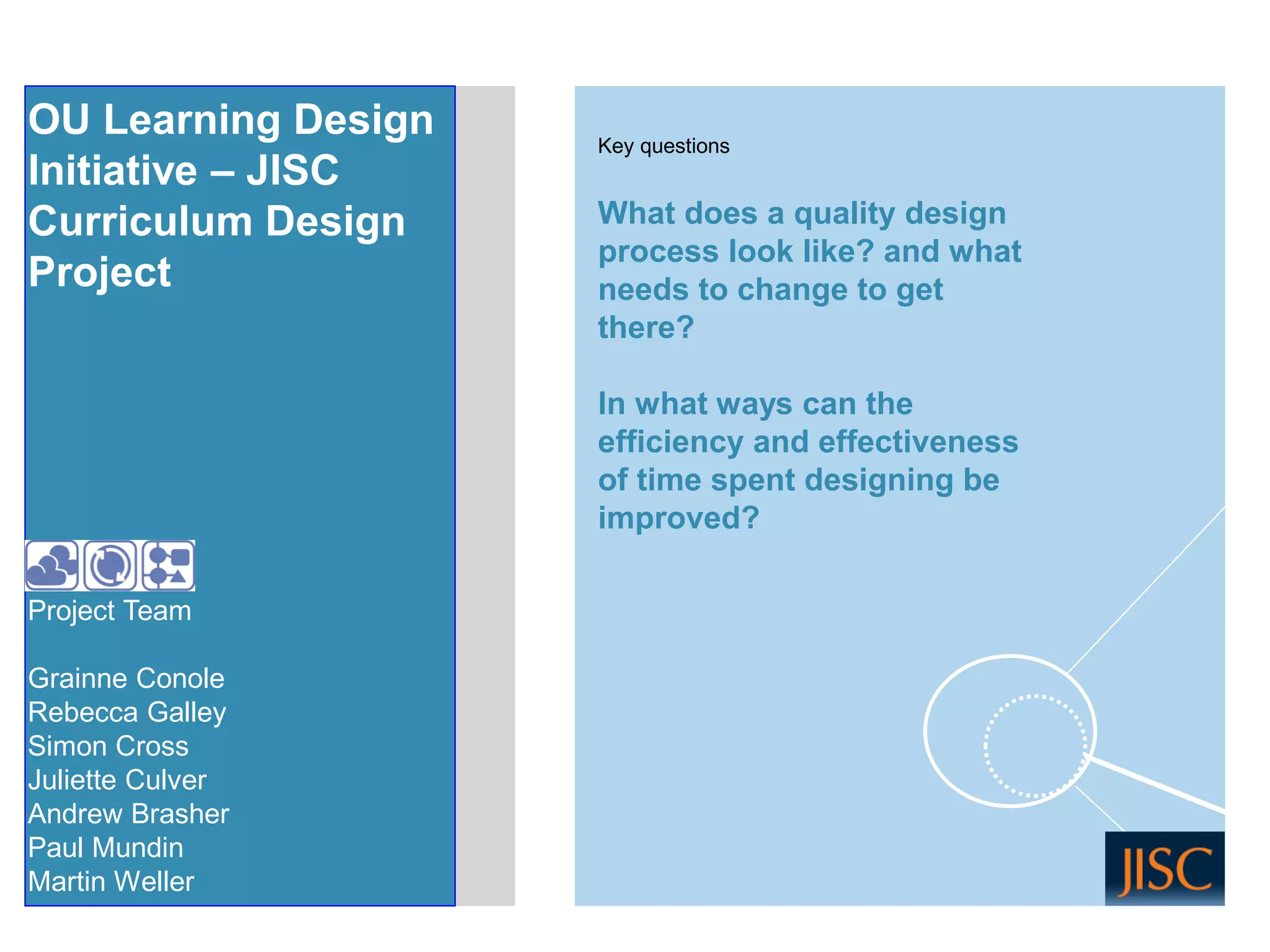
Project Team 
Grainne Conole 
Rebecca Galley 
Simon Cross 
Juliette Culver 
Andrew Brasher 
Paul Mundin 
Martin Weller 
What does a quality design process look like? and what needs to change to get there? 
In what ways can the efficiency and effectiveness of time spent designing be improved? 
OU Learning Design 
Initiative –JISC 
Curriculum Design Project 
Key questions
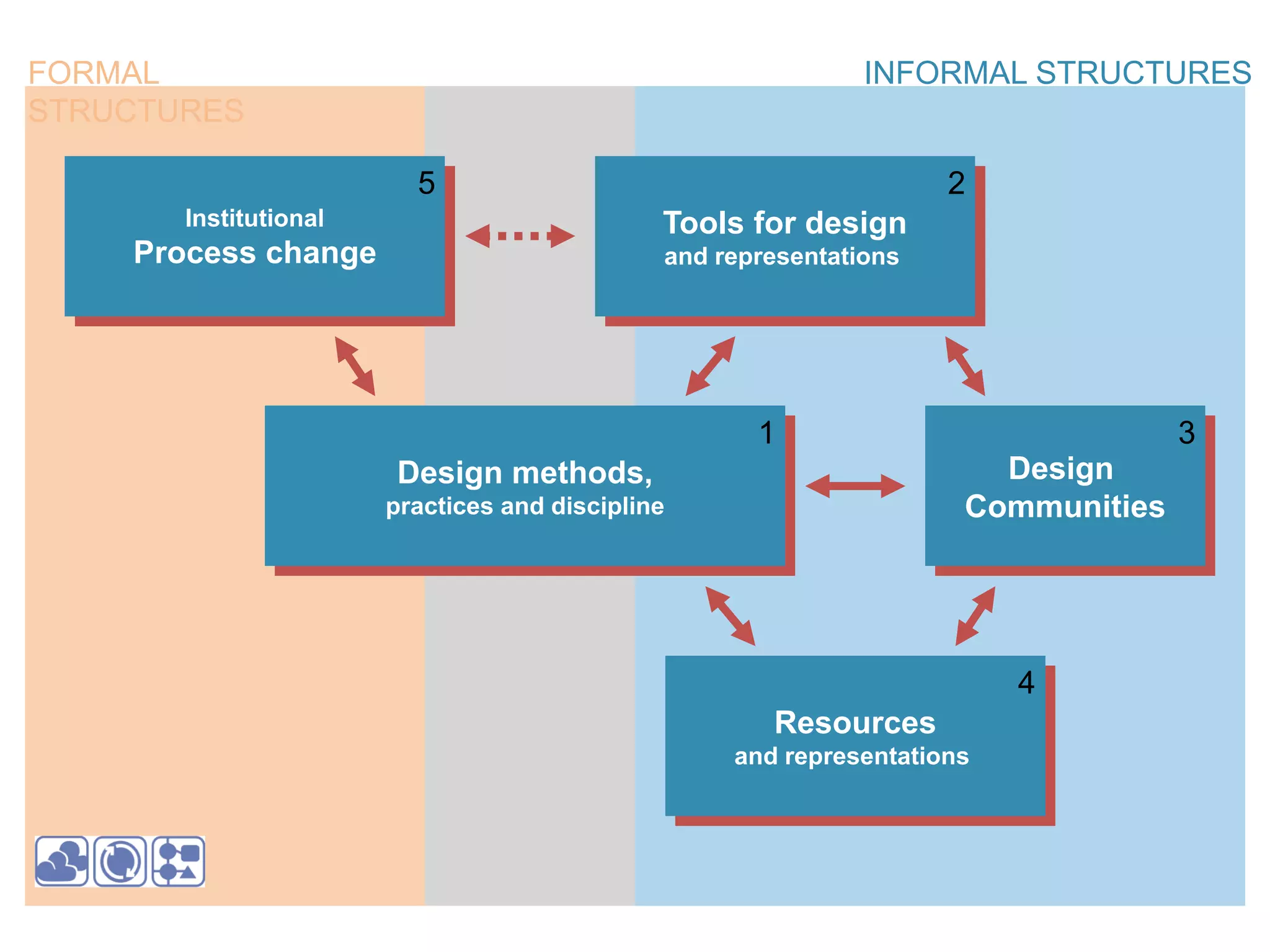
Design methods, 
practices and discipline 
Design 
Communities 
Resources 
and representations 
Tools for design 
and representations 
Institutional 
Process change 
FORMAL STRUCTURES 
INFORMAL STRUCTURES 
1 
2 
3 
4 
5
1 
2 
3 
4 
5 
6 
7 
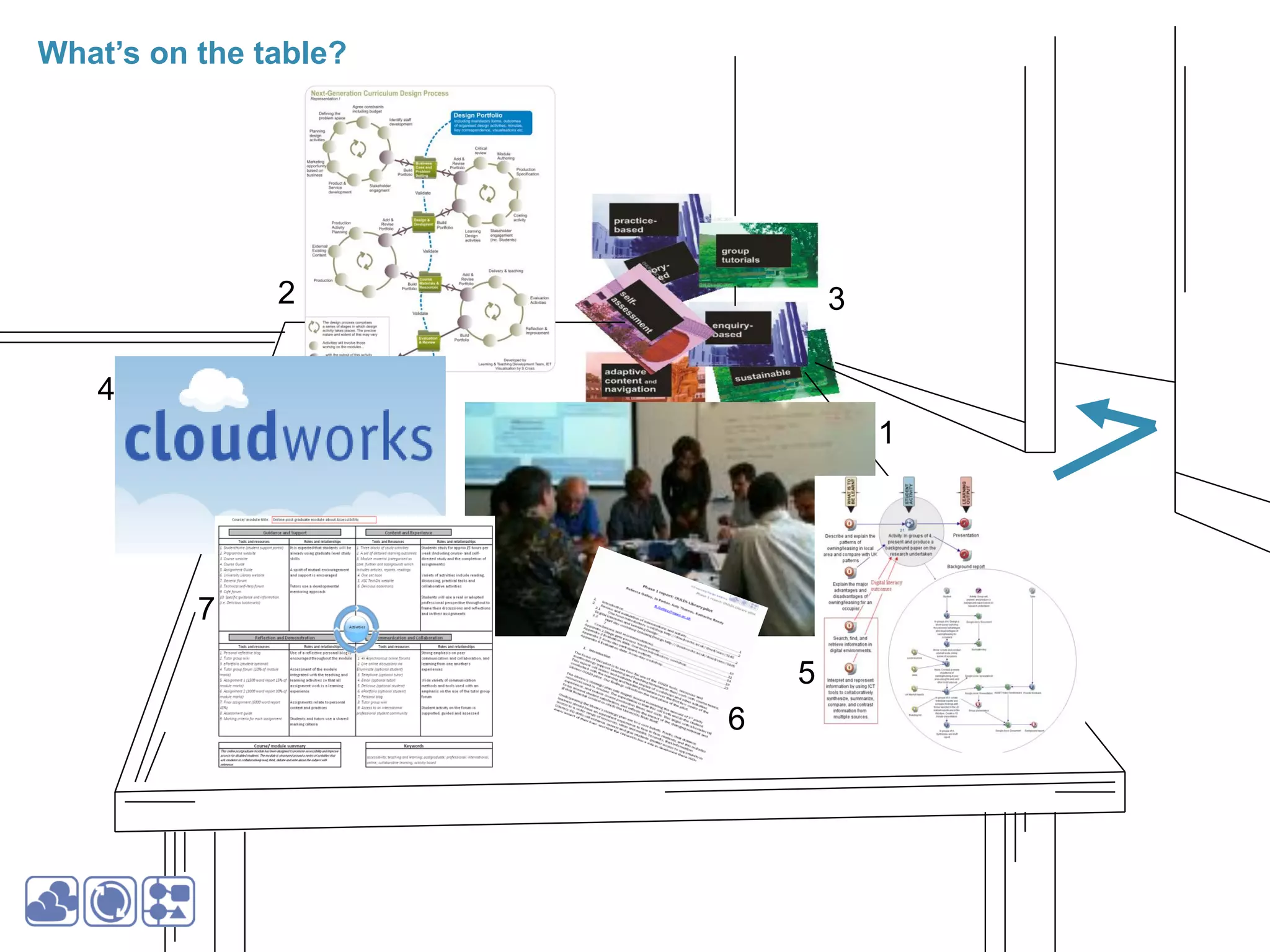
What’s on the table?
Where is there the most potential to make effective headway in changing practice in your institution? 
A.Defined institutional design processes 
B.Staff understanding and skills in relation to the designing of courses 
C.Tools, resources and representations for helping designers 
D.Design community to share experiences 
E.Other (please add in the chat box)
The PiP projectJim Everettfacilitated by George Macgregor
Principles in Patterns (PiP) 
Does your institution have a comprehensive online curriculum approval system? 
A.Yes 
B.No 
C.Don’t know
Principles in Patterns (PiP) 
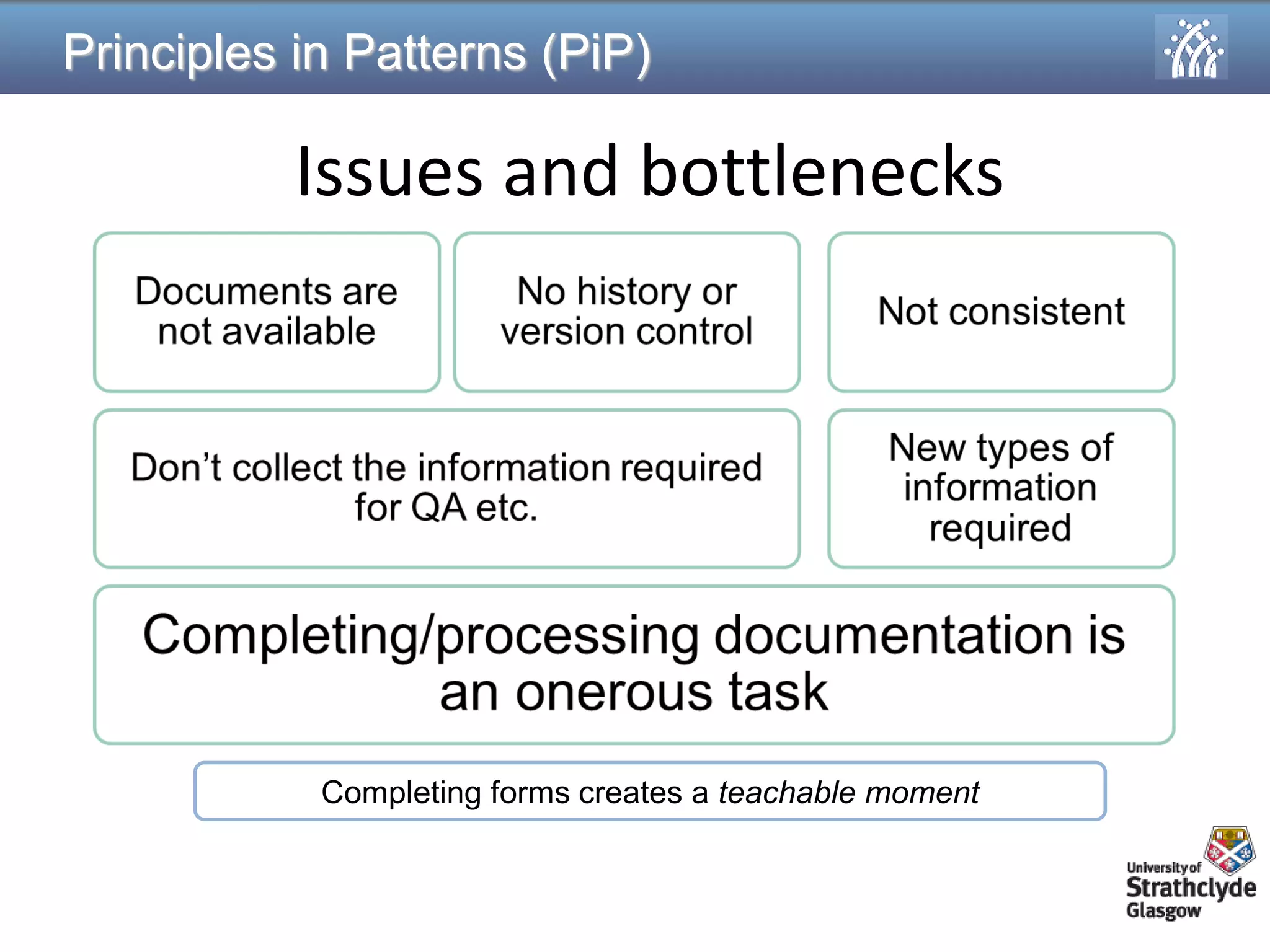
Issues and bottlenecks 
Completing forms creates a teachable moment
Principles in Patterns (PiP) 
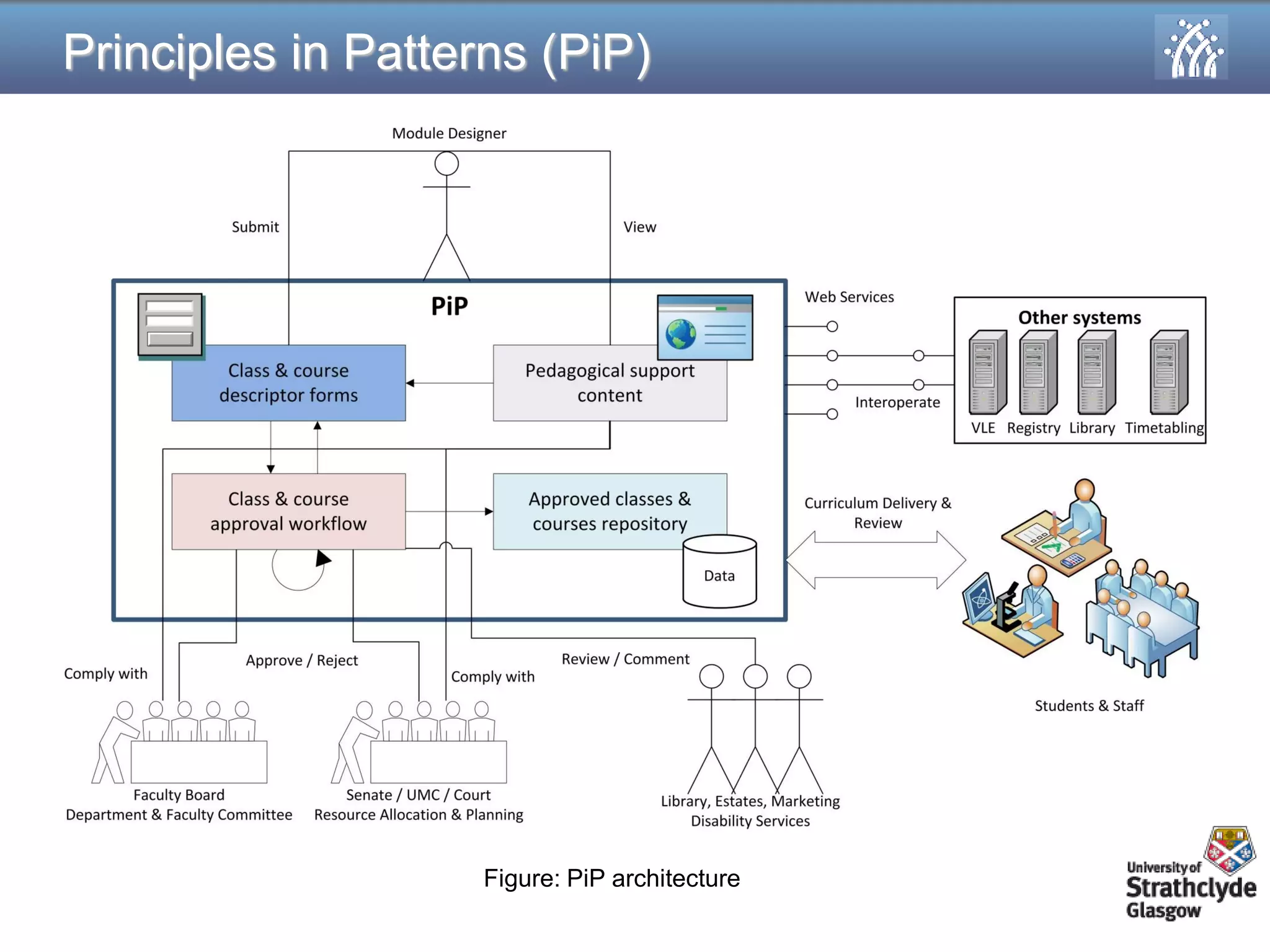
Figure: PiP architecture
Principles in Patterns (PiP) 
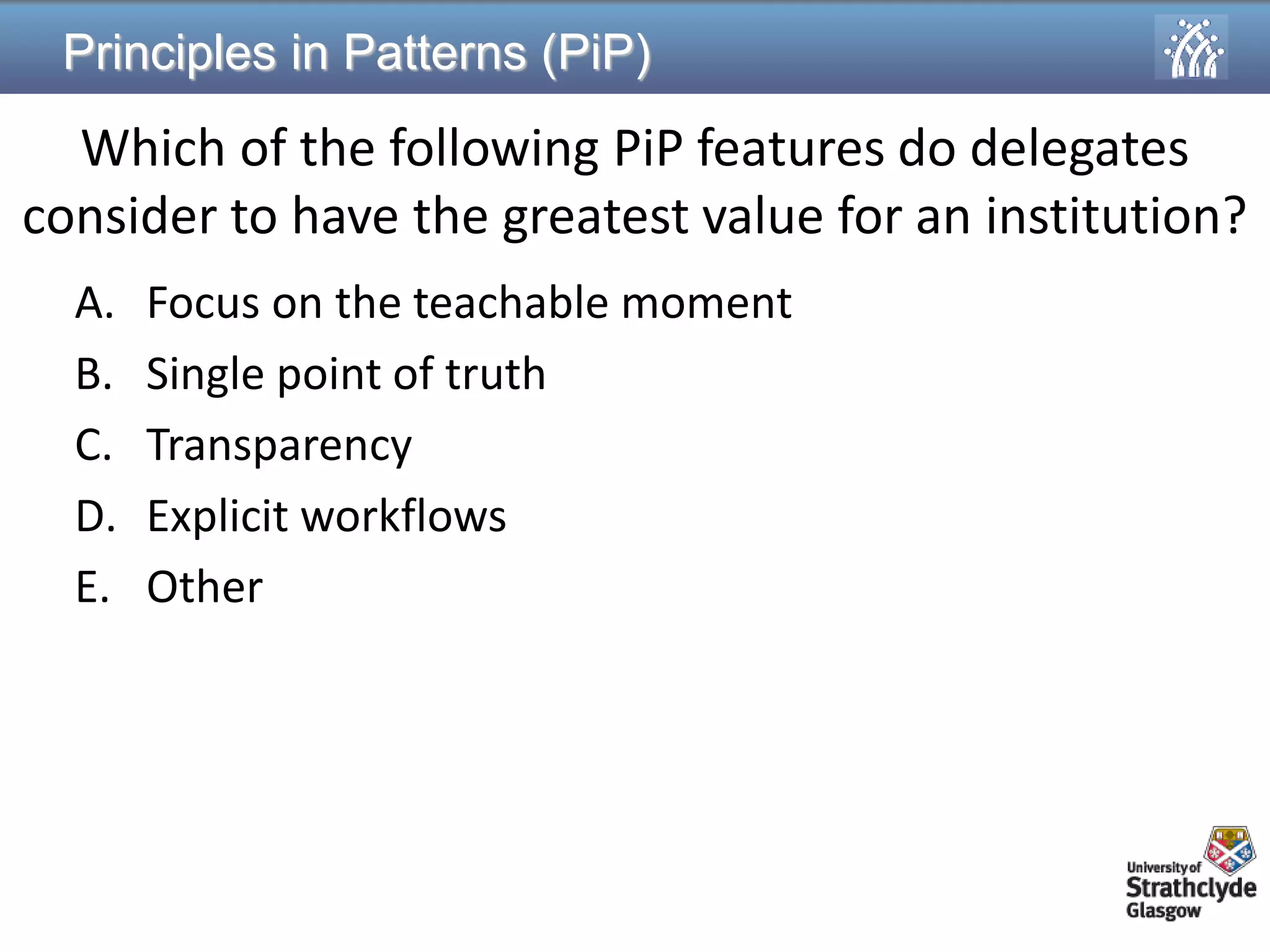
Which of the following PiP features do delegates consider to have the greatest value for an institution? 
A.Focus on the teachable moment 
B.Single point of truth 
C.Transparency 
D.Explicit workflows 
E.Other
The T-SPARC projectPaul Bartholomewfacilitated by Oliver Jenkins
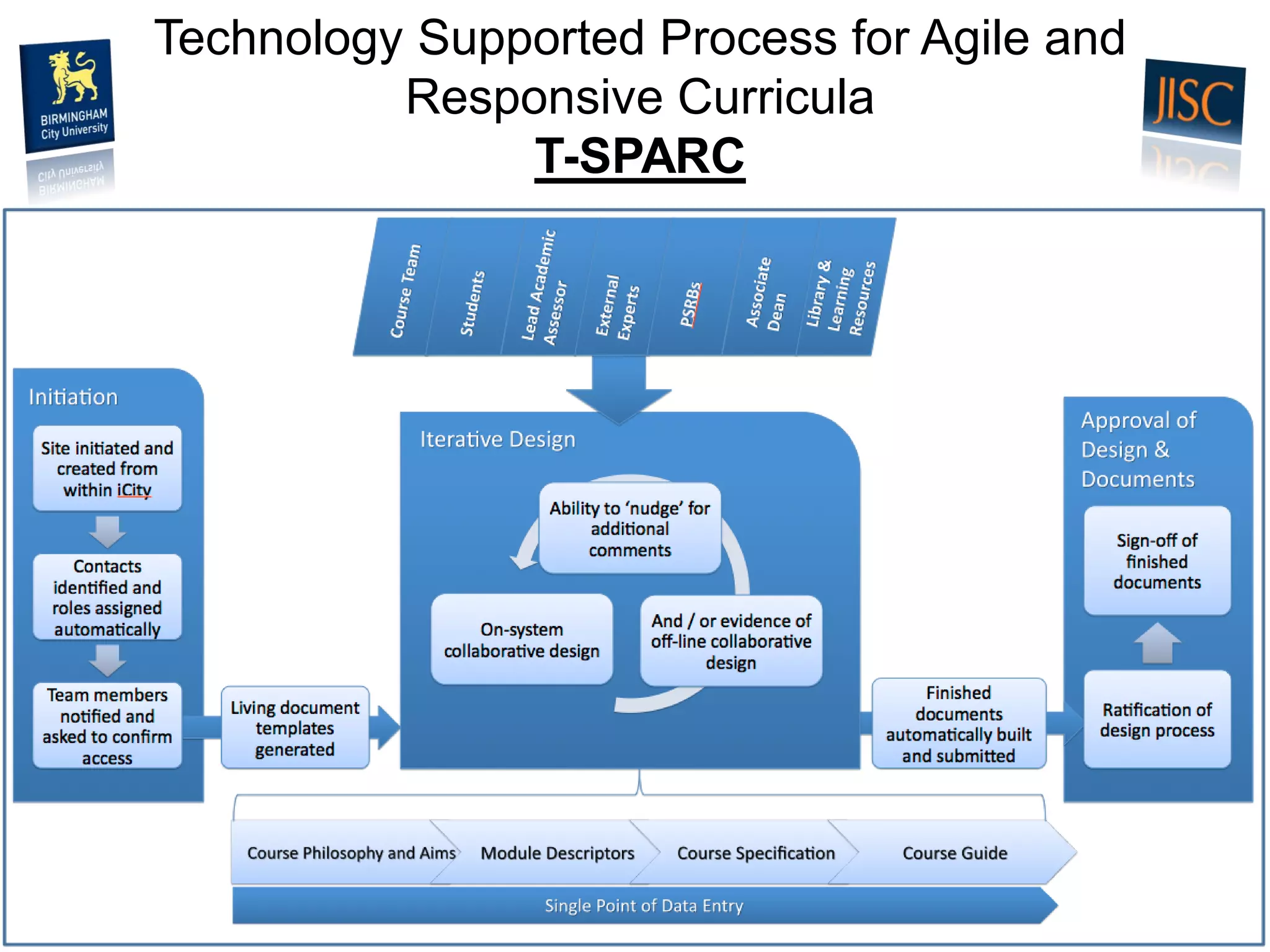
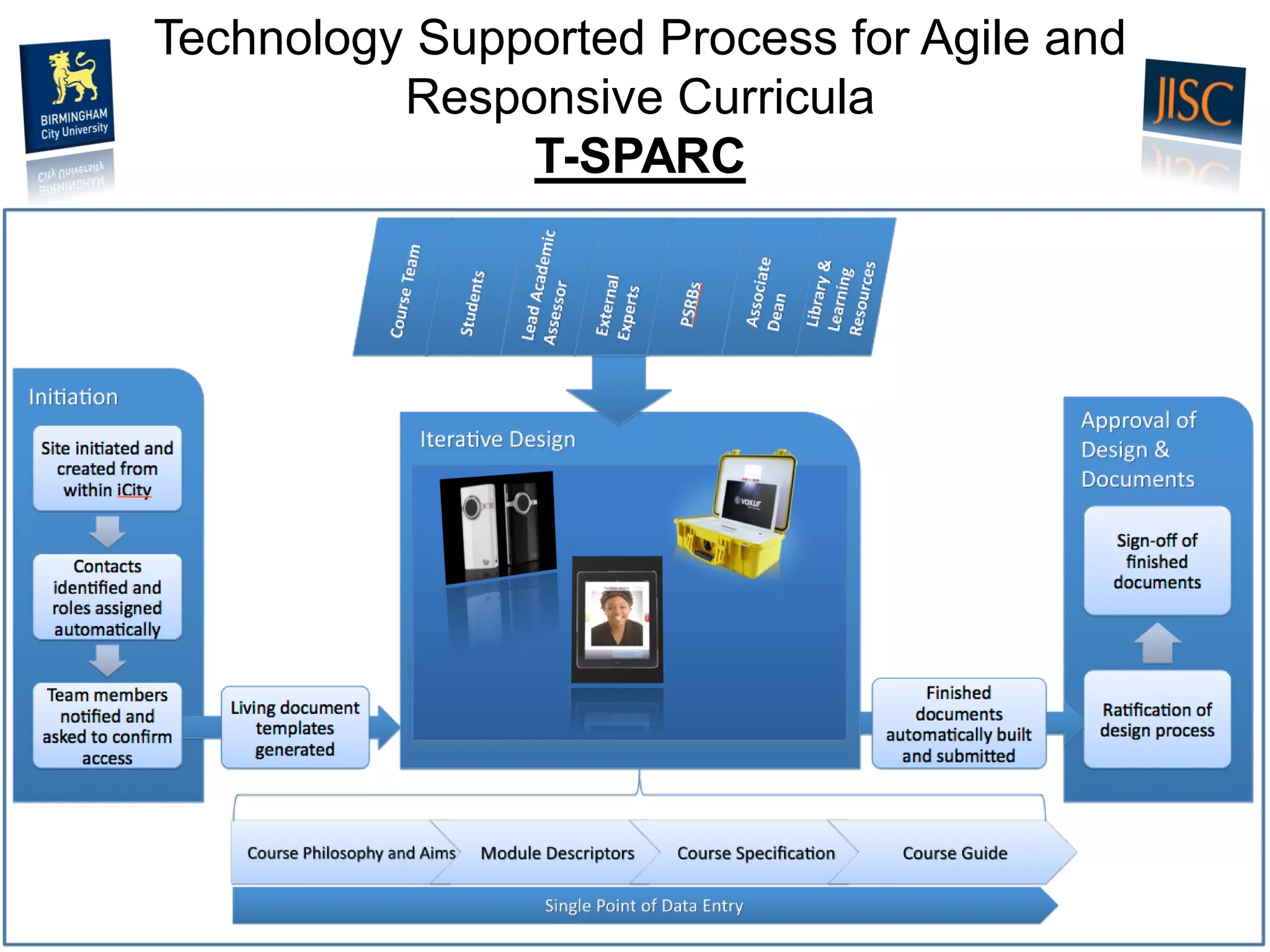
Technology Supported Process for Agile and Responsive CurriculaT-SPARC
Technology Supported Process for Agile and Responsive CurriculaT-SPARC 
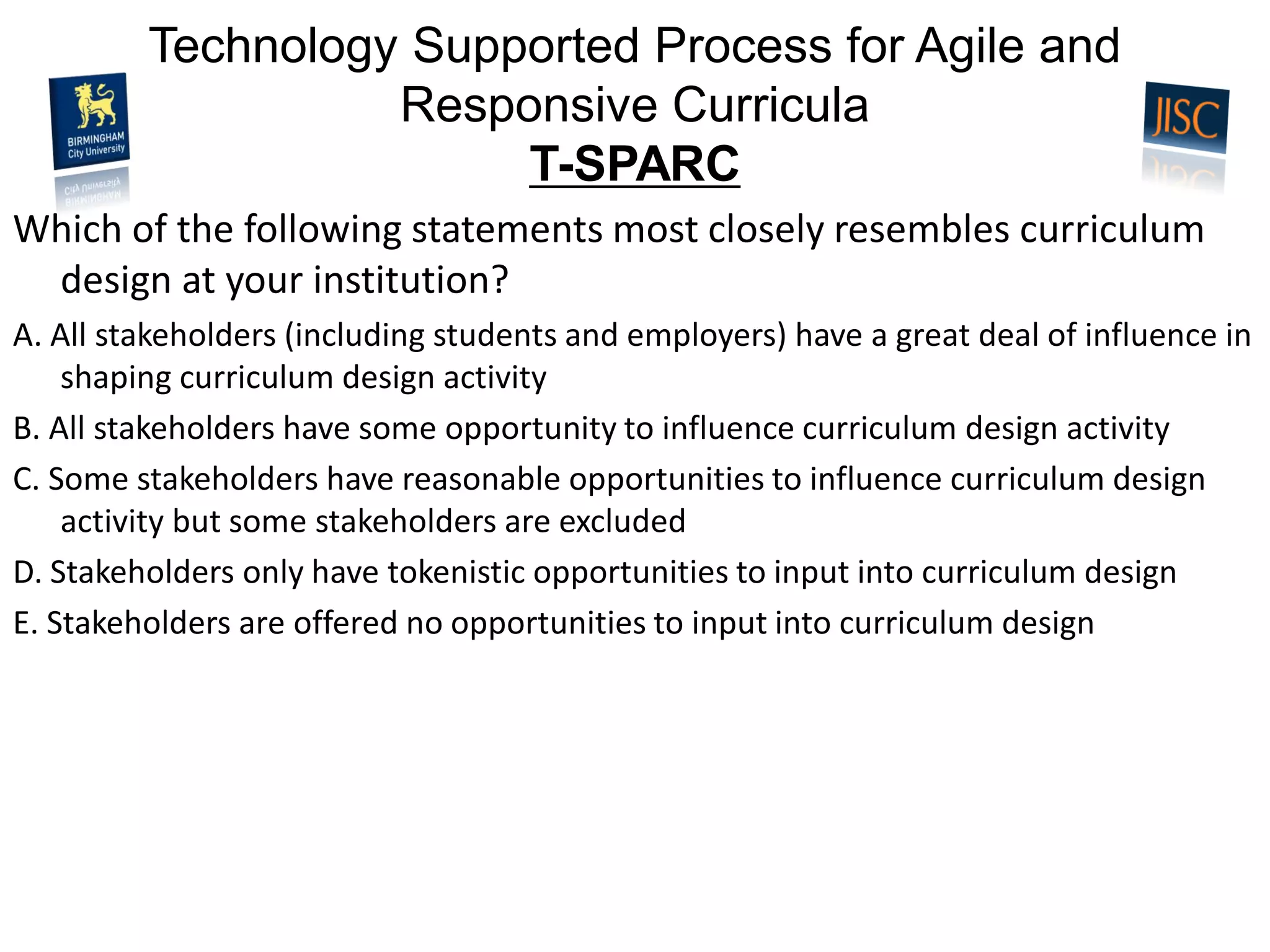
Which of the following statements most closely resembles curriculum design at your institution? 
A. All stakeholders (including students and employers) have a great deal of influence in shaping curriculum design activity 
B. All stakeholders have some opportunity to influence curriculum design activity 
C. Some stakeholders have reasonable opportunities to influence curriculum design activity but some stakeholders are excluded 
D. Stakeholders only have tokenistic opportunities to input into curriculum design 
E. Stakeholders are offered no opportunities to input into curriculum design
Discussion
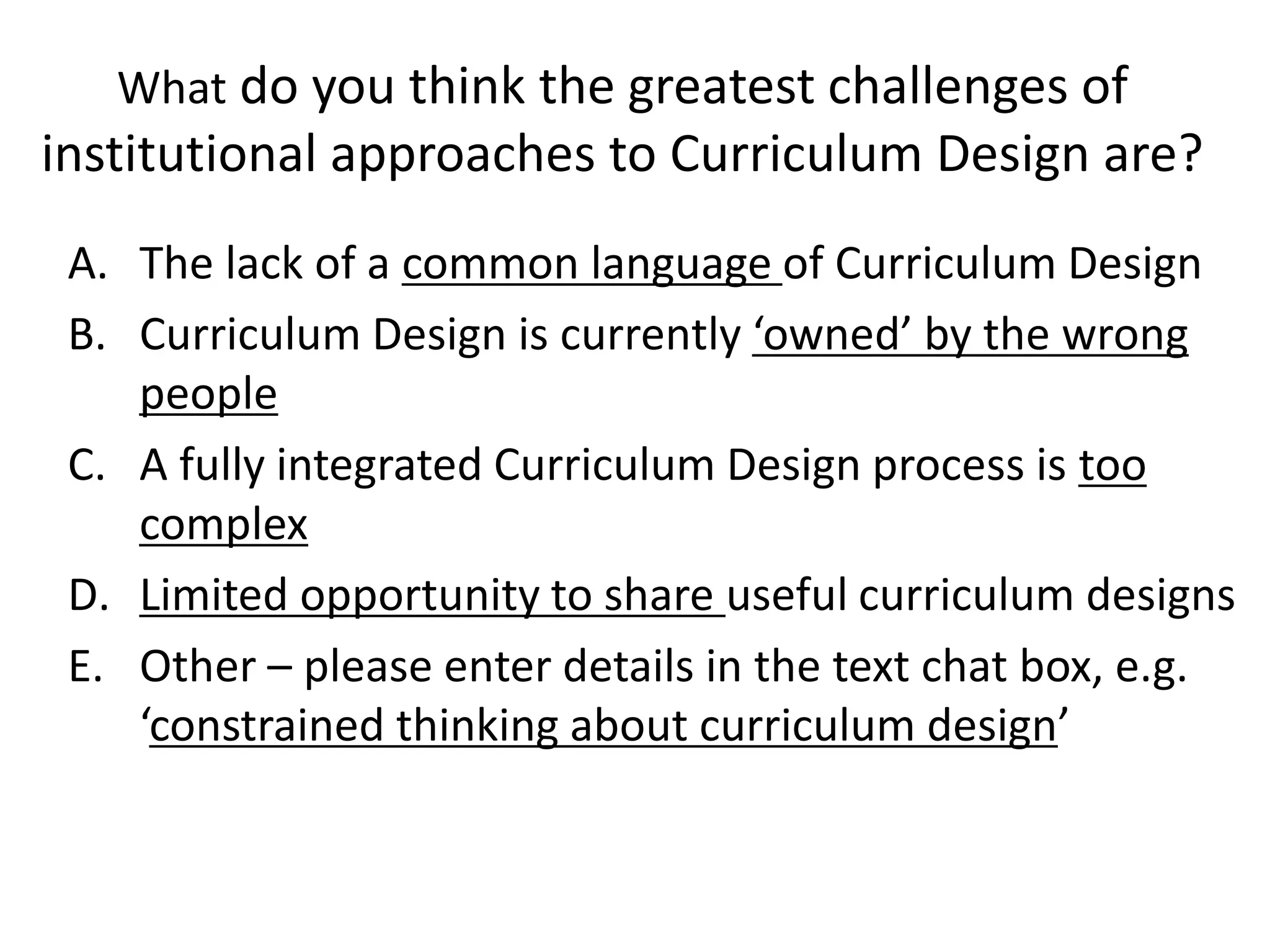
Whatdo you think the greatest challenges of institutional approaches to Curriculum Design are? 
A.The lack of a common language of Curriculum Design 
B.Curriculum Design is currently ‘owned’ by the wrong people 
C.A fully integrated Curriculum Design process is too complex 
D.Limited opportunity to share useful curriculum designs 
E.Other –please enter details in the text chat box, e.g. ‘constrained thinking about curriculum design’
Whatdo you think the greatest challenges of institutional approaches to Curriculum Design are? 
Please enter a shortphrase to describe the ‘greatest challenge’ in the text chat box → we will produce a WORDLE. 
To see the WORDLE and to continue the debate please join the asynchronous discussion.
Follow-on activities 
Asynchronous discussions 
You can continue the discussions in the asynchronous discussion area: http://www.online-conference.co.uk/WebX?230@@.eedd498 
Thinking Space 
Sally Graham and Joy Jarvis will chart the developing story of the conference, creating a virtual thinking space to visually present ideas, common themes, connections, views, issues and questions that arise from the conference. 
You can access the online Thinking Space at http://bit.ly/tieV01. 
As Sally and Joy develop the Thinking Space during each day of the conference, please contribute towards the Thinking Space by tweeting your ideas and feedback using the tag #jiscel11space. 
Sally Graham 
Joy Jarvis

What needs to change in curriculum design

  • 1.
    What needs tochange in curriculum design? Simon Cross, Alan Masson, Jim Everett, Paul Bartholomew, facilitated by Peter Bullen Innovating e-Learning 2011 Learning in Transition
  • 2.
    Facilitator Peter Bullenis an Emeritus Professor at the University of Hertfordshire and a Critical Friend to a number of Universities involved in JISC and HEA supported projects and until very recently was the Director of the Blended Learning Unit at the University of Hertfordshire. Presenters Simon Cross works in the Institute of Educational Technology at The Open Universityand is project manager for the OULDI (Open University Learning Design Institute) JISC curriculum design project. Alan Masson is Head of Technology Facilitated Learning at the University of Ulster with responsibility for the development and delivery of innovative tools and support services to enhance the teaching and learning experience of staff and students. Jim Everett (University of Strathclyde) has been working in universities and colleges for over 15 years, developing and promoting online and technology enhanced learning across a wide range of subject areas and academic levels. Paul Bartholomew is the Head of Curriculum Design and Academic Staff Development at Birmingham City University. He is also the Academic Lead / Project Manager for his institution's JISC-funded T-SPARC (Technology-Supported Processes for Agile and Responsive Curricula) project.
  • 3.
    Text-chatting Elluminate layout Audio Whiteboard Technical problems •Use the text-chat to engage with other delegates, presenter and moderators about the content of the session. •You can send private text-chat messages e.g. to moderators or to individuals. •You can change your Elluminate layout to “Wide layout” to make it easier to follow the text-chat (select “View … Layouts…Wide layout”). •If you are distracted by the text-chat, you can “unlock” the Elluminate layout to enable you to adjust the size and position of the text-chat sub-window (uncheck “View…Layouts …Layout locked”) •It is best to run the Audio Set-up Wizard to test your audio set-up each time you enter an Elluminate room (select “Tools…Audio… Audio setup wizard). •You must use a headset/microphone if you want to ask a question in audio. •Only use your microphone when guided by a moderator –click on the mic icon (bottom-left of screen) to turn it on and click on it again to turn it off. •Only draw on the whiteboard if guided by a moderator. •Send a private text-chat message to “moderators” and they will try to help. Session practice
  • 4.
    What Needs toChange in Curriculum Design? Cluster C and B project teams from the Curriculum Design Programme: University of Ulster; Alan Masson & Catherine O’Donnell (Viewpoints) The Open University; Simon Cross & Rebecca Galley (OULDI) University of Strathclyde; Jim Everett & George Macgregor (PiP) Birmingham City University; Paul Bartholomew & Oliver Jenkins (T-SPARC) & Peter Bullen –Critical Friend
  • 5.
    Objectives of thissession •An opportunity to learn more about the 4 projects •To stimulate discussion about the challenges of introducing new approaches to curriculum design and ensure relevance of the work to the sector •To enable participants to consider how this work can be transferred into their contexts
  • 6.
    Plan for thesession •Introduction –Peter Bullen •Short presentations on each project (Including some interaction through polling) –Viewpoints, Alan Masson –OULDI, Simon Cross –PiP, Jim Everett –T-SPARC, Paul Bartholomew •Discussion –responding to your questions
  • 7.
    3 Themes orClusters: c Cluster C www.jiscinfonet.ac.uk/curriculum Cluster B TSPARC –Birmingham City University OULDI PiP Cluster A
  • 8.
    Why? •Curriculum Designis a complex process involving all areas of the Institution •Existing processes focus on quality assurance and not on ‘design for learning’ •There is much duplication in exisisting processes •Effective use of learning resources (including learning technology and OER) requires a more structured and supported approach to curriculum design •Greater focus on the learner ................
  • 9.
    What is yourprimary interest in this session? A.Designing courses/programmes B.Teaching C.Quality Assurance D.Supporting learners E.Other –please enter details in the text chat box
  • 10.
    Whatdo you thinkthe greatest challenges of institutional approaches to Curriculum Design are? A.The lack of a common language of Curriculum Design B.Curriculum Design is currently ‘owned’ by the wrong people C.A fully integrated Curriculum Design process is too complex D.Limited opportunity to share useful curriculum designs E.Other –please enter details in the text chat box
  • 11.
    The Viewpoints projectAlanMassonfacilitated by Catherine O’Donnell
  • 12.
    •Card Card sortingapproach •Mapping key sets of principles to a learner timeline -Assessment and Feedback (REAP) -Information Skills and Literacy (SCONUL) -Learner Engagement (8LEM) Viewpoints Project –Information Framework
  • 13.
    •Card Cards timelinesfacilitate reflection and “brainstorming”; •Resources provide prompts for ideas and practices to consider; •Worksheet –challenge / issues / plan (i.e. strategy) Viewpoints Inform, Inspire and Plan workflow
  • 14.
    A.Card sorting workshopenvironment – promotes discussion, reflection and debate B.Resources facilitate shared meanings, agreed priorities and consensus building C.Group participation –builds team ownership of course vision D.Information model –can be used with range of stakeholders (learners, employers, support staff etc.) Key Benefits of the Viewpoints approach
  • 15.
    What do youthink participants would say they found most useful about the Viewpoints approach if you used it in your institution? A.Exploration of creative ideas B.Considering the learners’ experience C.Provision of an open and honest environment within which the group could engage D.Creation of simple models of a key aspect of curriculum design E.Being able to work effectively as a member of the group Viewpoints Poll
  • 16.
  • 17.
    The OULDI projectSimonCrossfacilitated by Rebecca Galley
  • 18.
    Project Team GrainneConole Rebecca Galley Simon Cross Juliette Culver Andrew Brasher Paul Mundin Martin Weller What does a quality design process look like? and what needs to change to get there? In what ways can the efficiency and effectiveness of time spent designing be improved? OU Learning Design Initiative –JISC Curriculum Design Project Key questions
  • 19.
    Design methods, practicesand discipline Design Communities Resources and representations Tools for design and representations Institutional Process change FORMAL STRUCTURES INFORMAL STRUCTURES 1 2 3 4 5
  • 20.
    1 2 3 4 5 6 7 What’s on the table?
  • 21.
    Where is therethe most potential to make effective headway in changing practice in your institution? A.Defined institutional design processes B.Staff understanding and skills in relation to the designing of courses C.Tools, resources and representations for helping designers D.Design community to share experiences E.Other (please add in the chat box)
  • 22.
    The PiP projectJimEverettfacilitated by George Macgregor
  • 23.
    Principles in Patterns(PiP) Does your institution have a comprehensive online curriculum approval system? A.Yes B.No C.Don’t know
  • 24.
    Principles in Patterns(PiP) Issues and bottlenecks Completing forms creates a teachable moment
  • 25.
    Principles in Patterns(PiP) Figure: PiP architecture
  • 26.
    Principles in Patterns(PiP) Which of the following PiP features do delegates consider to have the greatest value for an institution? A.Focus on the teachable moment B.Single point of truth C.Transparency D.Explicit workflows E.Other
  • 27.
    The T-SPARC projectPaulBartholomewfacilitated by Oliver Jenkins
  • 28.
    Technology Supported Processfor Agile and Responsive CurriculaT-SPARC
  • 29.
    Technology Supported Processfor Agile and Responsive CurriculaT-SPARC
  • 30.
    Technology Supported Processfor Agile and Responsive CurriculaT-SPARC Which of the following statements most closely resembles curriculum design at your institution? A. All stakeholders (including students and employers) have a great deal of influence in shaping curriculum design activity B. All stakeholders have some opportunity to influence curriculum design activity C. Some stakeholders have reasonable opportunities to influence curriculum design activity but some stakeholders are excluded D. Stakeholders only have tokenistic opportunities to input into curriculum design E. Stakeholders are offered no opportunities to input into curriculum design
  • 31.
  • 32.
    Whatdo you thinkthe greatest challenges of institutional approaches to Curriculum Design are? A.The lack of a common language of Curriculum Design B.Curriculum Design is currently ‘owned’ by the wrong people C.A fully integrated Curriculum Design process is too complex D.Limited opportunity to share useful curriculum designs E.Other –please enter details in the text chat box, e.g. ‘constrained thinking about curriculum design’
  • 33.
    Whatdo you thinkthe greatest challenges of institutional approaches to Curriculum Design are? Please enter a shortphrase to describe the ‘greatest challenge’ in the text chat box → we will produce a WORDLE. To see the WORDLE and to continue the debate please join the asynchronous discussion.
  • 34.
    Follow-on activities Asynchronousdiscussions You can continue the discussions in the asynchronous discussion area: http://www.online-conference.co.uk/WebX?230@@.eedd498 Thinking Space Sally Graham and Joy Jarvis will chart the developing story of the conference, creating a virtual thinking space to visually present ideas, common themes, connections, views, issues and questions that arise from the conference. You can access the online Thinking Space at http://bit.ly/tieV01. As Sally and Joy develop the Thinking Space during each day of the conference, please contribute towards the Thinking Space by tweeting your ideas and feedback using the tag #jiscel11space. Sally Graham Joy Jarvis