ORIC – Open Educational Resources for the
                         Inclusive Curriculum
                  http://www.oric.brad.ac.uk


1                 This work is licensed under a Creative Commons Attribution-NonCommercial-ShareAlike
                                 3.0 Unported License - http://creativecommons.org/licenses/by-nc-sa/3.0
   workshop activity 1;
       constructive alignment;
       workshop activity 2;
       aims & learning outcomes;
       levelness;
       workshop activity 3;
       review.


2                         This work is licensed under a Creative Commons Attribution-NonCommercial-ShareAlike
                                        3.0 Unported License - http://creativecommons.org/licenses/by-nc-sa/3.0/
Sir Ken Robinson on education and creativity:
    http://www.youtube.com/watch?v=zDZFcDGpL4U


3                       This work is licensed under a Creative Commons Attribution-NonCommercial-ShareAlike
                                      3.0 Unported License - http://creativecommons.org/licenses/by-nc-sa/3.0/
   individually – choose one teaching sequence,
        or individual session that you have helped to
        plan & design;
       in 2s & 3s – explain to each other & discuss
        the steps that you went through in the
        planning/design process (be honest!);
       be prepared to feed back.


4                          This work is licensed under a Creative Commons Attribution-NonCommercial-ShareAlike
                                         3.0 Unported License - http://creativecommons.org/licenses/by-nc-sa/3.0/
   theory/approach developed by John Biggs;
       all components in the learning/teaching
        system should support each other – should
        be aligned;
       “When there is alignment between what we
        want, how we teach and how we assess,
        teaching is likely to be much more effective
        than when there is not.” (Biggs, 1999: 26)


5                          This work is licensed under a Creative Commons Attribution-NonCommercial-ShareAlike
                                         3.0 Unported License - http://creativecommons.org/licenses/by-nc-sa/3.0/
In constructively aligned teaching:
       Devise & state intended learning outcomes;
       Learning & teaching methods are chosen to
        allow learners to construct meaning in a way
        which will realise these outcomes;
       Assessment tasks address the outcomes.


6                          This work is licensed under a Creative Commons Attribution-NonCommercial-ShareAlike
                                         3.0 Unported License - http://creativecommons.org/licenses/by-nc-sa/3.0/
“CA makes the students themselves do the real
    work; the teacher simply arranges things so that it
    is more likely that they will.”
                                                          (Biggs, 1999:27)


7                        This work is licensed under a Creative Commons Attribution-NonCommercial-ShareAlike
                                       3.0 Unported License - http://creativecommons.org/licenses/by-nc-sa/3.0/
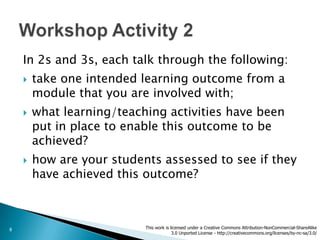
In 2s and 3s, each talk through the following:
       take one intended learning outcome from a
        module that you are involved with;
       what learning/teaching activities have been
        put in place to enable this outcome to be
        achieved?
       how are your students assessed to see if they
        have achieved this outcome?


8                          This work is licensed under a Creative Commons Attribution-NonCommercial-ShareAlike
                                         3.0 Unported License - http://creativecommons.org/licenses/by-nc-sa/3.0/
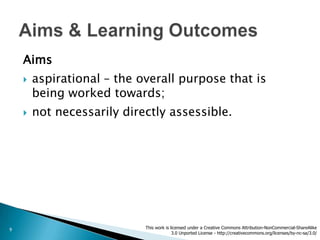
Aims
       aspirational – the overall purpose that is
        being worked towards;
       not necessarily directly assessible.


9                           This work is licensed under a Creative Commons Attribution-NonCommercial-ShareAlike
                                          3.0 Unported License - http://creativecommons.org/licenses/by-nc-sa/3.0/
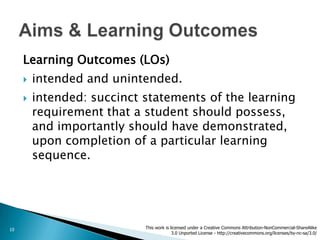
Learning Outcomes (LOs)
        intended and unintended.
        intended: succinct statements of the learning
         requirement that a student should possess,
         and importantly should have demonstrated,
         upon completion of a particular learning
         sequence.


10                          This work is licensed under a Creative Commons Attribution-NonCommercial-ShareAlike
                                          3.0 Unported License - http://creativecommons.org/licenses/by-nc-sa/3.0/
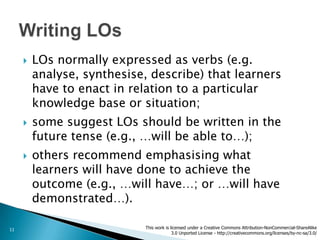
   LOs normally expressed as verbs (e.g.
         analyse, synthesise, describe) that learners
         have to enact in relation to a particular
         knowledge base or situation;
        some suggest LOs should be written in the
         future tense (e.g., …will be able to…);
        others recommend emphasising what
         learners will have done to achieve the
         outcome (e.g., …will have…; or …will have
         demonstrated…).

11                           This work is licensed under a Creative Commons Attribution-NonCommercial-ShareAlike
                                           3.0 Unported License - http://creativecommons.org/licenses/by-nc-sa/3.0/
Programme Aim: to instil in participants a
      reflective and innovative approach to their
      practice that they will take with them
      throughout their teaching careers.
     Programme LO: participants will be able to
      describe, interpret, evaluate, and reflect on
      their own teaching practice in a theoretically
      coherent manner.


12                        This work is licensed under a Creative Commons Attribution-NonCommercial-ShareAlike
                                        3.0 Unported License - http://creativecommons.org/licenses/by-nc-sa/3.0/
Scholarship Module LO: participants will be
      able to consider the implications of the
      evidence [of variation in student learning]
      gathered… in terms of developing a basis for
      reflective practice and personal actionable
      theory.
     Reflection Module LO: participants will be able
      to reflect on and document their own
      professional teaching practice …


13                        This work is licensed under a Creative Commons Attribution-NonCommercial-ShareAlike
                                        3.0 Unported License - http://creativecommons.org/licenses/by-nc-sa/3.0/
   From the Oxford Centre for Staff and
         Learning Development:
         http://www.brookes.ac.uk/services/ocsld/res
         ources/writing_learning_outcomes.html


14                         This work is licensed under a Creative Commons Attribution-NonCommercial-ShareAlike
                                         3.0 Unported License - http://creativecommons.org/licenses/by-nc-sa/3.0/
   thinking about LOs in a qualitative rather
         than a quantitative sense;
        can relate to level of study (e.g. QAA &
         institutional level descriptors);
        can relate to level of achievement (e.g. what
         is a 3rd or a 1st);
        two widely used taxonomies in HE: Bloom &
         SOLO.


15                           This work is licensed under a Creative Commons Attribution-NonCommercial-ShareAlike
                                           3.0 Unported License - http://creativecommons.org/licenses/by-nc-sa/3.0/
   Bloom organises educational objectives into
         three domains:
         ◦ Cognitive;
         ◦ Affective;
         ◦ Psychomotor.


16                          This work is licensed under a Creative Commons Attribution-NonCommercial-ShareAlike
                                          3.0 Unported License - http://creativecommons.org/licenses/by-nc-sa/3.0/
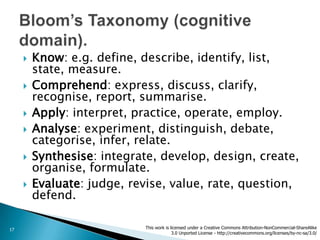
   Know: e.g. define, describe, identify, list,
         state, measure.
        Comprehend: express, discuss, clarify,
         recognise, report, summarise.
        Apply: interpret, practice, operate, employ.
        Analyse: experiment, distinguish, debate,
         categorise, infer, relate.
        Synthesise: integrate, develop, design, create,
         organise, formulate.
        Evaluate: judge, revise, value, rate, question,
         defend.

17                          This work is licensed under a Creative Commons Attribution-NonCommercial-ShareAlike
                                          3.0 Unported License - http://creativecommons.org/licenses/by-nc-sa/3.0/
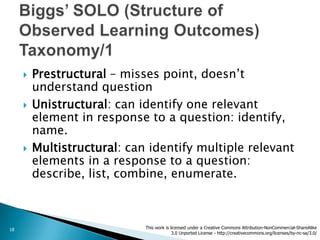
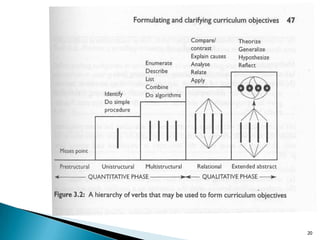
   Prestructural – misses point, doesn‟t
         understand question
        Unistructural: can identify one relevant
         element in response to a question: identify,
         name.
        Multistructural: can identify multiple relevant
         elements in a response to a question:
         describe, list, combine, enumerate.


18                           This work is licensed under a Creative Commons Attribution-NonCommercial-ShareAlike
                                           3.0 Unported License - http://creativecommons.org/licenses/by-nc-sa/3.0/
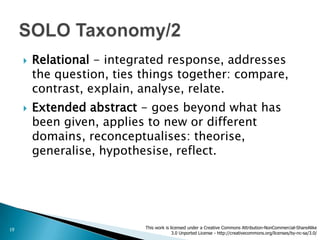
   Relational - integrated response, addresses
         the question, ties things together: compare,
         contrast, explain, analyse, relate.
        Extended abstract - goes beyond what has
         been given, applies to new or different
         domains, reconceptualises: theorise,
         generalise, hypothesise, reflect.


19                          This work is licensed under a Creative Commons Attribution-NonCommercial-ShareAlike
                                          3.0 Unported License - http://creativecommons.org/licenses/by-nc-sa/3.0/
20
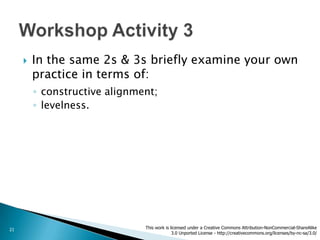
   In the same 2s & 3s briefly examine your own
         practice in terms of:
         ◦ constructive alignment;
         ◦ levelness.


21                             This work is licensed under a Creative Commons Attribution-NonCommercial-ShareAlike
                                             3.0 Unported License - http://creativecommons.org/licenses/by-nc-sa/3.0/
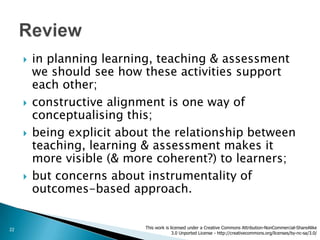
   in planning learning, teaching & assessment
         we should see how these activities support
         each other;
        constructive alignment is one way of
         conceptualising this;
        being explicit about the relationship between
         teaching, learning & assessment makes it
         more visible (& more coherent?) to learners;
        but concerns about instrumentality of
         outcomes-based approach.


22                          This work is licensed under a Creative Commons Attribution-NonCommercial-ShareAlike
                                          3.0 Unported License - http://creativecommons.org/licenses/by-nc-sa/3.0/
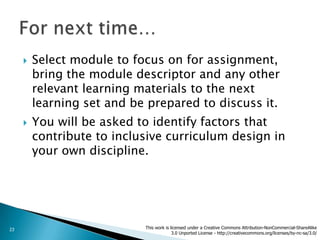
   Select module to focus on for assignment,
         bring the module descriptor and any other
         relevant learning materials to the next
         learning set and be prepared to discuss it.
        You will be asked to identify factors that
         contribute to inclusive curriculum design in
         your own discipline.


23                          This work is licensed under a Creative Commons Attribution-NonCommercial-ShareAlike
                                          3.0 Unported License - http://creativecommons.org/licenses/by-nc-sa/3.0/
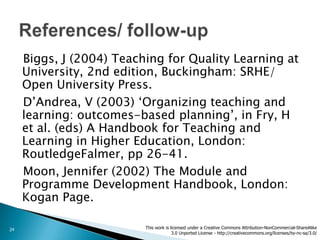
Biggs, J (2004) Teaching for Quality Learning at
     University, 2nd edition, Buckingham: SRHE/
     Open University Press.
     D‟Andrea, V (2003) „Organizing teaching and
     learning: outcomes-based planning‟, in Fry, H
     et al. (eds) A Handbook for Teaching and
     Learning in Higher Education, London:
     RoutledgeFalmer, pp 26-41.
     Moon, Jennifer (2002) The Module and
     Programme Development Handbook, London:
     Kogan Page.

24                        This work is licensed under a Creative Commons Attribution-NonCommercial-ShareAlike
                                        3.0 Unported License - http://creativecommons.org/licenses/by-nc-sa/3.0/

ORIC Module Design

  • 1.
    ORIC – OpenEducational Resources for the Inclusive Curriculum http://www.oric.brad.ac.uk 1 This work is licensed under a Creative Commons Attribution-NonCommercial-ShareAlike 3.0 Unported License - http://creativecommons.org/licenses/by-nc-sa/3.0
  • 2.
    workshop activity 1;  constructive alignment;  workshop activity 2;  aims & learning outcomes;  levelness;  workshop activity 3;  review. 2 This work is licensed under a Creative Commons Attribution-NonCommercial-ShareAlike 3.0 Unported License - http://creativecommons.org/licenses/by-nc-sa/3.0/
  • 3.
    Sir Ken Robinsonon education and creativity: http://www.youtube.com/watch?v=zDZFcDGpL4U 3 This work is licensed under a Creative Commons Attribution-NonCommercial-ShareAlike 3.0 Unported License - http://creativecommons.org/licenses/by-nc-sa/3.0/
  • 4.
    individually – choose one teaching sequence, or individual session that you have helped to plan & design;  in 2s & 3s – explain to each other & discuss the steps that you went through in the planning/design process (be honest!);  be prepared to feed back. 4 This work is licensed under a Creative Commons Attribution-NonCommercial-ShareAlike 3.0 Unported License - http://creativecommons.org/licenses/by-nc-sa/3.0/
  • 5.
    theory/approach developed by John Biggs;  all components in the learning/teaching system should support each other – should be aligned;  “When there is alignment between what we want, how we teach and how we assess, teaching is likely to be much more effective than when there is not.” (Biggs, 1999: 26) 5 This work is licensed under a Creative Commons Attribution-NonCommercial-ShareAlike 3.0 Unported License - http://creativecommons.org/licenses/by-nc-sa/3.0/
  • 6.
    In constructively alignedteaching:  Devise & state intended learning outcomes;  Learning & teaching methods are chosen to allow learners to construct meaning in a way which will realise these outcomes;  Assessment tasks address the outcomes. 6 This work is licensed under a Creative Commons Attribution-NonCommercial-ShareAlike 3.0 Unported License - http://creativecommons.org/licenses/by-nc-sa/3.0/
  • 7.
    “CA makes thestudents themselves do the real work; the teacher simply arranges things so that it is more likely that they will.” (Biggs, 1999:27) 7 This work is licensed under a Creative Commons Attribution-NonCommercial-ShareAlike 3.0 Unported License - http://creativecommons.org/licenses/by-nc-sa/3.0/
  • 8.
    In 2s and3s, each talk through the following:  take one intended learning outcome from a module that you are involved with;  what learning/teaching activities have been put in place to enable this outcome to be achieved?  how are your students assessed to see if they have achieved this outcome? 8 This work is licensed under a Creative Commons Attribution-NonCommercial-ShareAlike 3.0 Unported License - http://creativecommons.org/licenses/by-nc-sa/3.0/
  • 9.
    Aims  aspirational – the overall purpose that is being worked towards;  not necessarily directly assessible. 9 This work is licensed under a Creative Commons Attribution-NonCommercial-ShareAlike 3.0 Unported License - http://creativecommons.org/licenses/by-nc-sa/3.0/
  • 10.
    Learning Outcomes (LOs)  intended and unintended.  intended: succinct statements of the learning requirement that a student should possess, and importantly should have demonstrated, upon completion of a particular learning sequence. 10 This work is licensed under a Creative Commons Attribution-NonCommercial-ShareAlike 3.0 Unported License - http://creativecommons.org/licenses/by-nc-sa/3.0/
  • 11.
    LOs normally expressed as verbs (e.g. analyse, synthesise, describe) that learners have to enact in relation to a particular knowledge base or situation;  some suggest LOs should be written in the future tense (e.g., …will be able to…);  others recommend emphasising what learners will have done to achieve the outcome (e.g., …will have…; or …will have demonstrated…). 11 This work is licensed under a Creative Commons Attribution-NonCommercial-ShareAlike 3.0 Unported License - http://creativecommons.org/licenses/by-nc-sa/3.0/
  • 12.
    Programme Aim: toinstil in participants a reflective and innovative approach to their practice that they will take with them throughout their teaching careers. Programme LO: participants will be able to describe, interpret, evaluate, and reflect on their own teaching practice in a theoretically coherent manner. 12 This work is licensed under a Creative Commons Attribution-NonCommercial-ShareAlike 3.0 Unported License - http://creativecommons.org/licenses/by-nc-sa/3.0/
  • 13.
    Scholarship Module LO:participants will be able to consider the implications of the evidence [of variation in student learning] gathered… in terms of developing a basis for reflective practice and personal actionable theory. Reflection Module LO: participants will be able to reflect on and document their own professional teaching practice … 13 This work is licensed under a Creative Commons Attribution-NonCommercial-ShareAlike 3.0 Unported License - http://creativecommons.org/licenses/by-nc-sa/3.0/
  • 14.
    From the Oxford Centre for Staff and Learning Development: http://www.brookes.ac.uk/services/ocsld/res ources/writing_learning_outcomes.html 14 This work is licensed under a Creative Commons Attribution-NonCommercial-ShareAlike 3.0 Unported License - http://creativecommons.org/licenses/by-nc-sa/3.0/
  • 15.
    thinking about LOs in a qualitative rather than a quantitative sense;  can relate to level of study (e.g. QAA & institutional level descriptors);  can relate to level of achievement (e.g. what is a 3rd or a 1st);  two widely used taxonomies in HE: Bloom & SOLO. 15 This work is licensed under a Creative Commons Attribution-NonCommercial-ShareAlike 3.0 Unported License - http://creativecommons.org/licenses/by-nc-sa/3.0/
  • 16.
    Bloom organises educational objectives into three domains: ◦ Cognitive; ◦ Affective; ◦ Psychomotor. 16 This work is licensed under a Creative Commons Attribution-NonCommercial-ShareAlike 3.0 Unported License - http://creativecommons.org/licenses/by-nc-sa/3.0/
  • 17.
    Know: e.g. define, describe, identify, list, state, measure.  Comprehend: express, discuss, clarify, recognise, report, summarise.  Apply: interpret, practice, operate, employ.  Analyse: experiment, distinguish, debate, categorise, infer, relate.  Synthesise: integrate, develop, design, create, organise, formulate.  Evaluate: judge, revise, value, rate, question, defend. 17 This work is licensed under a Creative Commons Attribution-NonCommercial-ShareAlike 3.0 Unported License - http://creativecommons.org/licenses/by-nc-sa/3.0/
  • 18.
    Prestructural – misses point, doesn‟t understand question  Unistructural: can identify one relevant element in response to a question: identify, name.  Multistructural: can identify multiple relevant elements in a response to a question: describe, list, combine, enumerate. 18 This work is licensed under a Creative Commons Attribution-NonCommercial-ShareAlike 3.0 Unported License - http://creativecommons.org/licenses/by-nc-sa/3.0/
  • 19.
    Relational - integrated response, addresses the question, ties things together: compare, contrast, explain, analyse, relate.  Extended abstract - goes beyond what has been given, applies to new or different domains, reconceptualises: theorise, generalise, hypothesise, reflect. 19 This work is licensed under a Creative Commons Attribution-NonCommercial-ShareAlike 3.0 Unported License - http://creativecommons.org/licenses/by-nc-sa/3.0/
  • 20.
  • 21.
    In the same 2s & 3s briefly examine your own practice in terms of: ◦ constructive alignment; ◦ levelness. 21 This work is licensed under a Creative Commons Attribution-NonCommercial-ShareAlike 3.0 Unported License - http://creativecommons.org/licenses/by-nc-sa/3.0/
  • 22.
    in planning learning, teaching & assessment we should see how these activities support each other;  constructive alignment is one way of conceptualising this;  being explicit about the relationship between teaching, learning & assessment makes it more visible (& more coherent?) to learners;  but concerns about instrumentality of outcomes-based approach. 22 This work is licensed under a Creative Commons Attribution-NonCommercial-ShareAlike 3.0 Unported License - http://creativecommons.org/licenses/by-nc-sa/3.0/
  • 23.
    Select module to focus on for assignment, bring the module descriptor and any other relevant learning materials to the next learning set and be prepared to discuss it.  You will be asked to identify factors that contribute to inclusive curriculum design in your own discipline. 23 This work is licensed under a Creative Commons Attribution-NonCommercial-ShareAlike 3.0 Unported License - http://creativecommons.org/licenses/by-nc-sa/3.0/
  • 24.
    Biggs, J (2004)Teaching for Quality Learning at University, 2nd edition, Buckingham: SRHE/ Open University Press. D‟Andrea, V (2003) „Organizing teaching and learning: outcomes-based planning‟, in Fry, H et al. (eds) A Handbook for Teaching and Learning in Higher Education, London: RoutledgeFalmer, pp 26-41. Moon, Jennifer (2002) The Module and Programme Development Handbook, London: Kogan Page. 24 This work is licensed under a Creative Commons Attribution-NonCommercial-ShareAlike 3.0 Unported License - http://creativecommons.org/licenses/by-nc-sa/3.0/