Centre for Educational Development
                                                            Centre for Educational Development
                                                                                ORHEP Project
                                                                                ORHEP Project


Small-Group Teaching
Centre for Educational Development


                                                                                                   www.orhep.brad.ac.uk


    This work is licensed under a Creative Commons Attribution-ShareAlike 3.0 Unported License -
1   http://creativecommons.org/licenses/by-sa/3.0/                                                     www.orhep.brad.ac.uk
Centre for Educational Development
                                                                                ORHEP Project


Session learning outcomes
By the end of this session, you will have:
• identified and discussed characteristics of small
  group teaching, within your own subject
• identified some common problems associated
  with small-group teaching and evaluated some
  potential tutor interventions
                                                                                                   www.orhep.brad.ac.uk


    This work is licensed under a Creative Commons Attribution-ShareAlike 3.0 Unported License -
2   http://creativecommons.org/licenses/by-sa/3.0/                                                     www.orhep.brad.ac.uk
Centre for Educational Development
                                                                                ORHEP Project


Session overview
•   Introduction & Context
•   Disciplinary Contexts
•   Problems in small-group teaching
•   Teaching through discussion
•   Review
                                                                                                   www.orhep.brad.ac.uk


    This work is licensed under a Creative Commons Attribution-ShareAlike 3.0 Unported License -
3   http://creativecommons.org/licenses/by-sa/3.0/                                                     www.orhep.brad.ac.uk
Centre for Educational Development
                                                                                ORHEP Project

What we are specifically not
engaging with in this session…
• Issues of students working in groups
  together on assessed tasks, and theories
  of group formation, team roles etc.
• but see
  http://www.learnhighergroupwork.com/
                                                                                                   www.orhep.brad.ac.uk


    This work is licensed under a Creative Commons Attribution-ShareAlike 3.0 Unported License -
4   http://creativecommons.org/licenses/by-sa/3.0/                                                     www.orhep.brad.ac.uk
Centre for Educational Development
                                                                                ORHEP Project


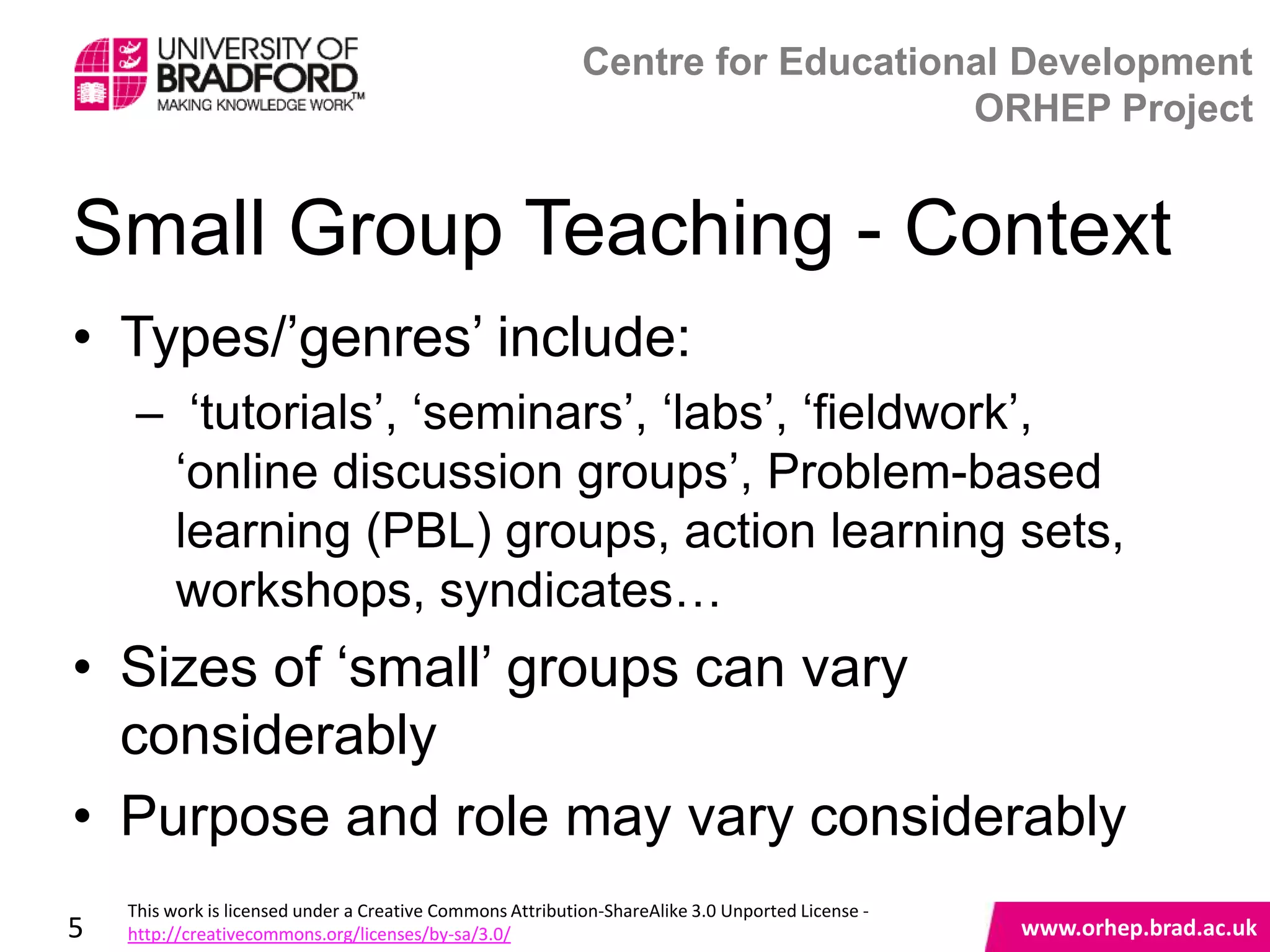
Small Group Teaching - Context
• Types/‟genres‟ include:
     – „tutorials‟, „seminars‟, „labs‟, „fieldwork‟,
      „online discussion groups‟, Problem-based
      learning (PBL) groups, action learning sets,
      workshops, syndicates…
• Sizes of „small‟ groups can vary
  considerably                     www.orhep.brad.ac.uk

• Purpose and role may vary considerably
    This work is licensed under a Creative Commons Attribution-ShareAlike 3.0 Unported License -
5   http://creativecommons.org/licenses/by-sa/3.0/                                                 www.orhep.brad.ac.uk
Centre for Educational Development
                                                                                ORHEP Project

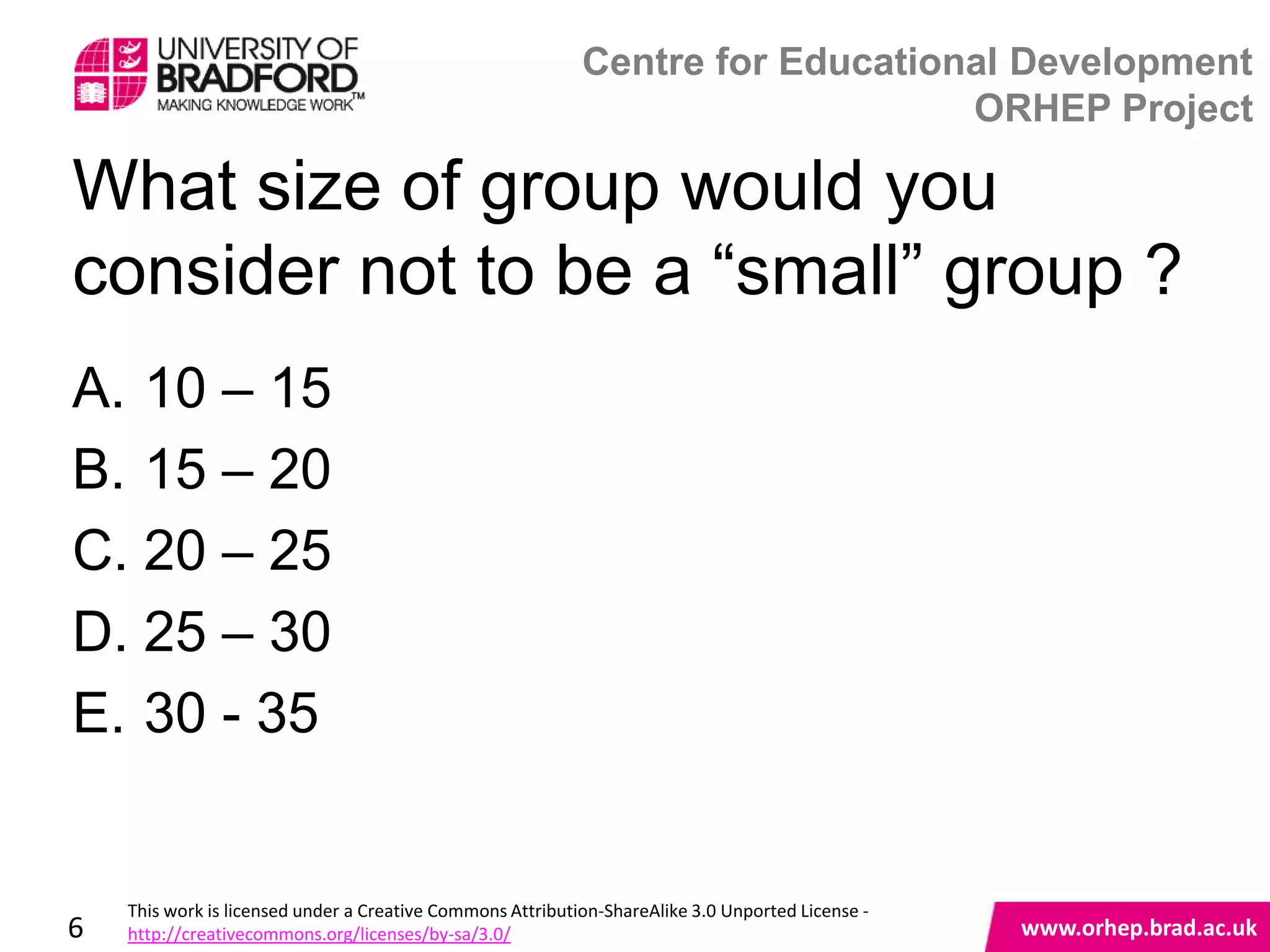
What size of group would you
consider not to be a “small” group ?
A. 10 – 15
B. 15 – 20
C. 20 – 25
D. 25 – 30
E. 30 - 35
                                                                                                   www.orhep.brad.ac.uk


    This work is licensed under a Creative Commons Attribution-ShareAlike 3.0 Unported License -
6   http://creativecommons.org/licenses/by-sa/3.0/                                                     www.orhep.brad.ac.uk
Centre for Educational Development
                                                                                ORHEP Project


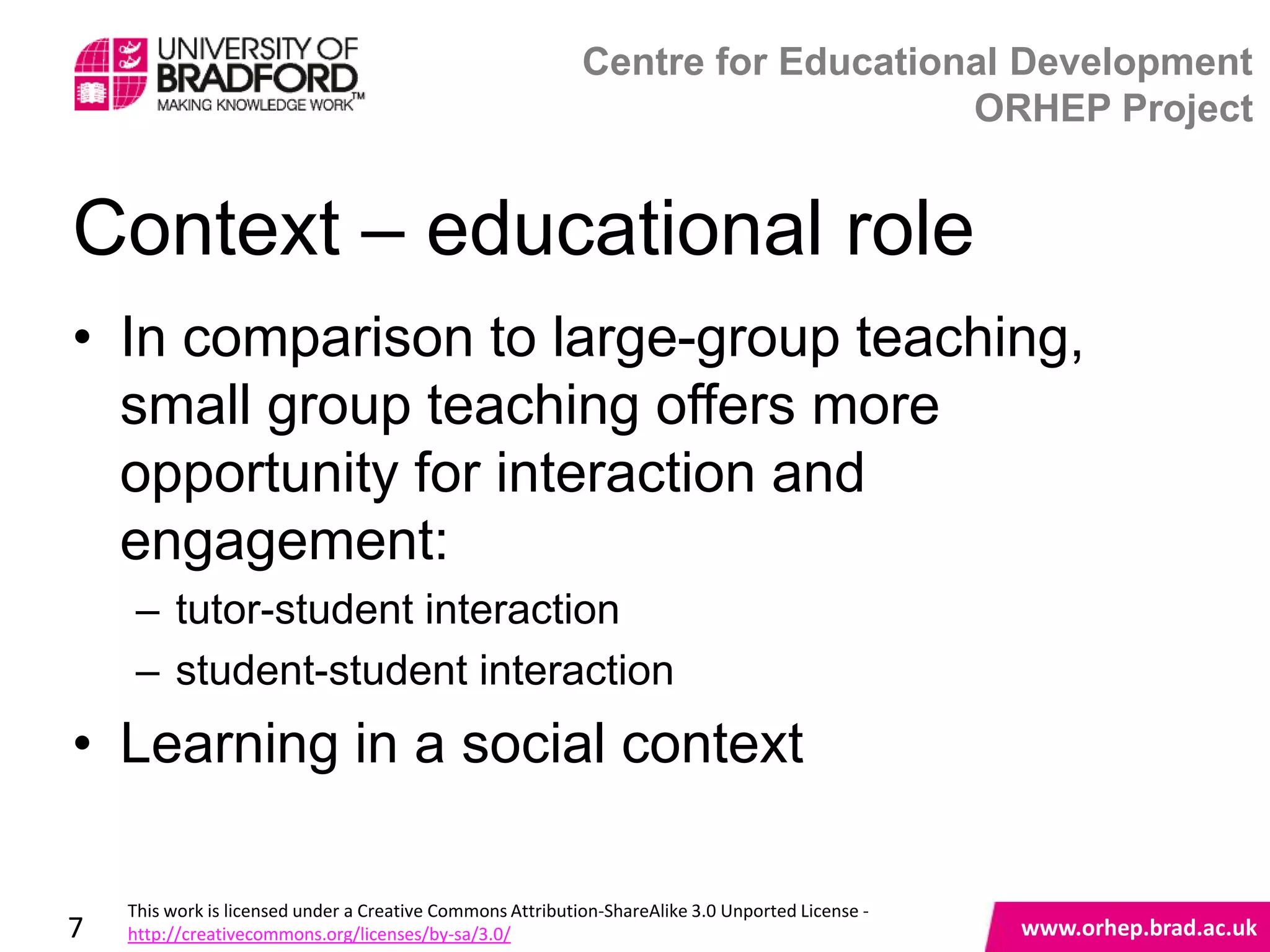
Context – educational role
• In comparison to large-group teaching,
  small group teaching offers more
  opportunity for interaction and
  engagement:
     – tutor-student interaction
     – student-student interaction
• Learning in a social context                                                                     www.orhep.brad.ac.uk


    This work is licensed under a Creative Commons Attribution-ShareAlike 3.0 Unported License -
7   http://creativecommons.org/licenses/by-sa/3.0/                                                     www.orhep.brad.ac.uk
Centre for Educational Development
                                                                                ORHEP Project


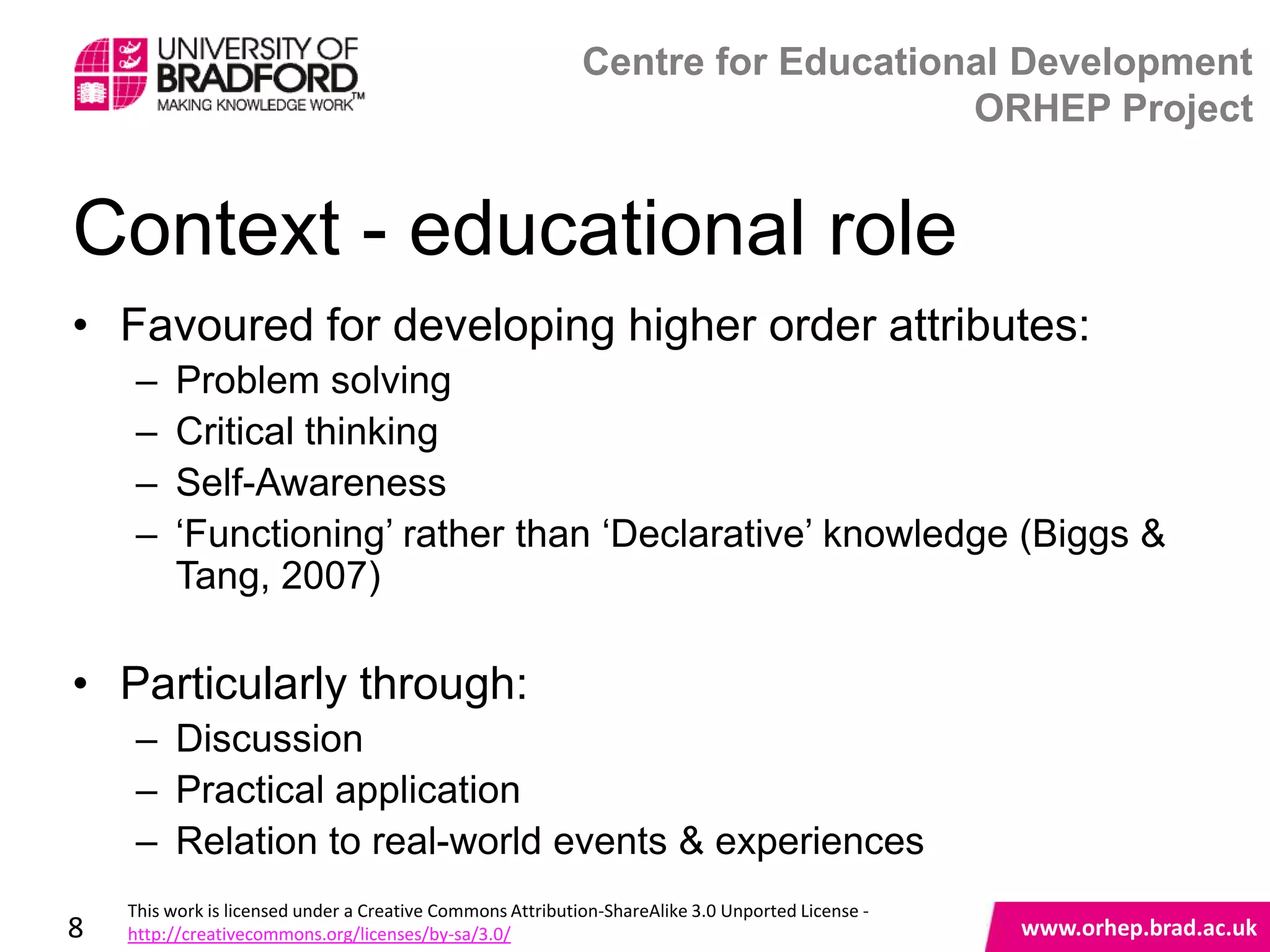
Context - educational role
• Favoured for developing higher order attributes:
     –   Problem solving
     –   Critical thinking
     –   Self-Awareness
     –   „Functioning‟ rather than „Declarative‟ knowledge (Biggs &
         Tang, 2007)

• Particularly through:
     – Discussion                                  www.orhep.brad.ac.uk
     – Practical application
     – Relation to real-world events & experiences
    This work is licensed under a Creative Commons Attribution-ShareAlike 3.0 Unported License -
8   http://creativecommons.org/licenses/by-sa/3.0/                                                 www.orhep.brad.ac.uk
Centre for Educational Development
                                                                                ORHEP Project


Contextual factors
• Size of group
• Location, room, layout, furniture,
  equipment
• Characteristics and diversity of group

• Resource & staffing issues to address
                                   www.orhep.brad.ac.uk


    This work is licensed under a Creative Commons Attribution-ShareAlike 3.0 Unported License -
9   http://creativecommons.org/licenses/by-sa/3.0/                                                 www.orhep.brad.ac.uk
Centre for Educational Development
                                                                                 ORHEP Project


Disciplinary contexts
What is the situation at your institution with
 regard to small group teaching?

Here are a few questions to consider.


                                                                                                    www.orhep.brad.ac.uk


     This work is licensed under a Creative Commons Attribution-ShareAlike 3.0 Unported License -
10   http://creativecommons.org/licenses/by-sa/3.0/                                                     www.orhep.brad.ac.uk
Centre for Educational Development
                                                                                 ORHEP Project


Disciplinary contexts
Individual questions

      – What types of small-group teaching are you involved
        in at your institution?

      – Are there typical „ways of practicing‟? If so, what are
        they?
                                                                                                    www.orhep.brad.ac.uk


     This work is licensed under a Creative Commons Attribution-ShareAlike 3.0 Unported License -
11   http://creativecommons.org/licenses/by-sa/3.0/                                                     www.orhep.brad.ac.uk
Centre for Educational Development
                                                                                 ORHEP Project


Disciplinary contexts

      – Are you aware of any examples of what you would
        consider to be innovative small-group teaching
        practice at your institution?

      – What are the typical issues or challenges associated
        with small-group teaching in your context?
                                                                                                    www.orhep.brad.ac.uk


     This work is licensed under a Creative Commons Attribution-ShareAlike 3.0 Unported License -
12   http://creativecommons.org/licenses/by-sa/3.0/                                                     www.orhep.brad.ac.uk
Centre for Educational Development
                                                                                 ORHEP Project

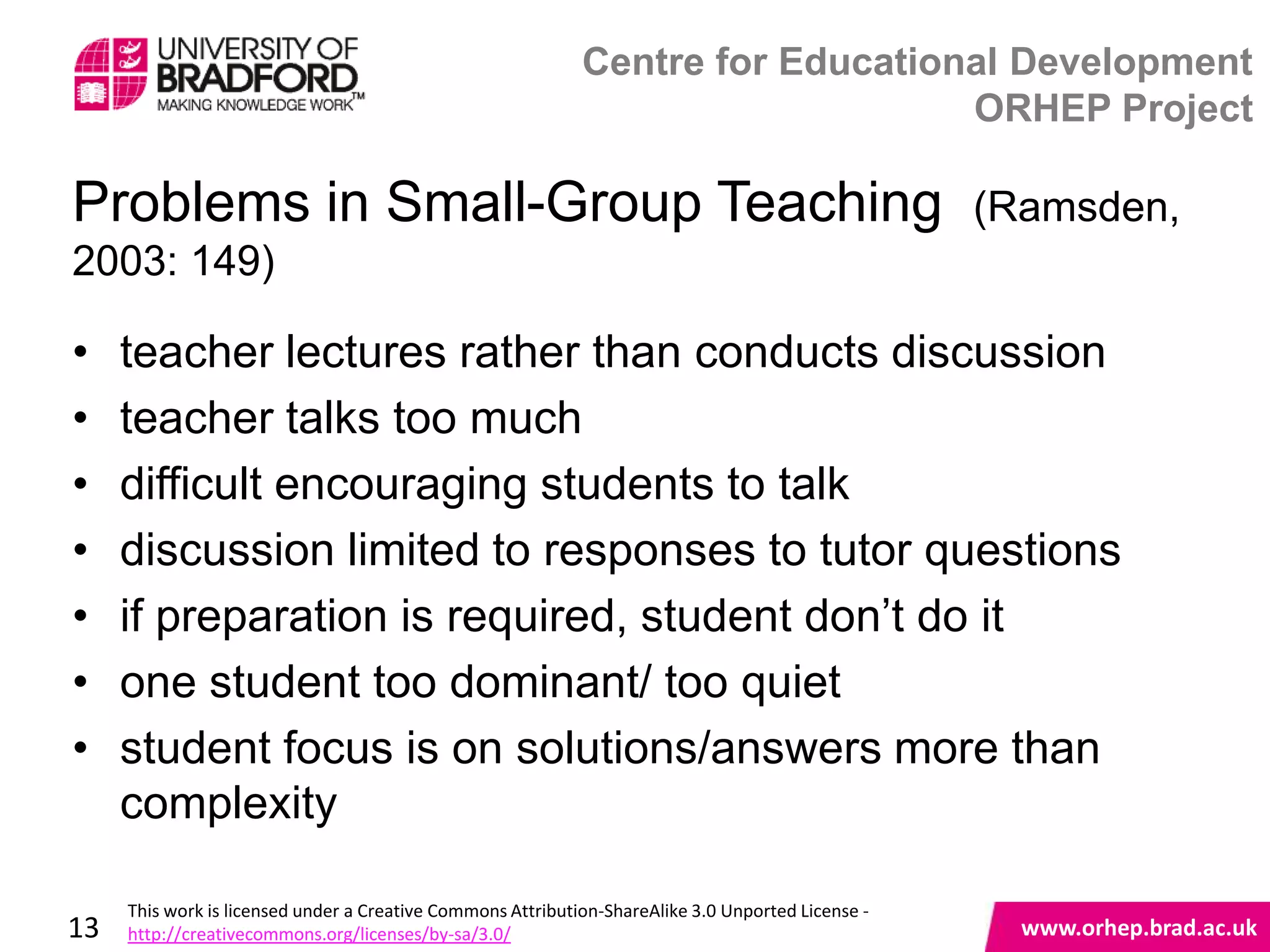
Problems in Small-Group Teaching                                                                    (Ramsden,
2003: 149)

•    teacher lectures rather than conducts discussion
•    teacher talks too much
•    difficult encouraging students to talk
•    discussion limited to responses to tutor questions
•    if preparation is required, student don‟t do it
•    one student too dominant/ too quiet
•    student focus is on solutions/answers more than
                                                www.orhep.brad.ac.uk
     complexity

     This work is licensed under a Creative Commons Attribution-ShareAlike 3.0 Unported License -
13   http://creativecommons.org/licenses/by-sa/3.0/                                                   www.orhep.brad.ac.uk
Centre for Educational Development
                                                                                 ORHEP Project

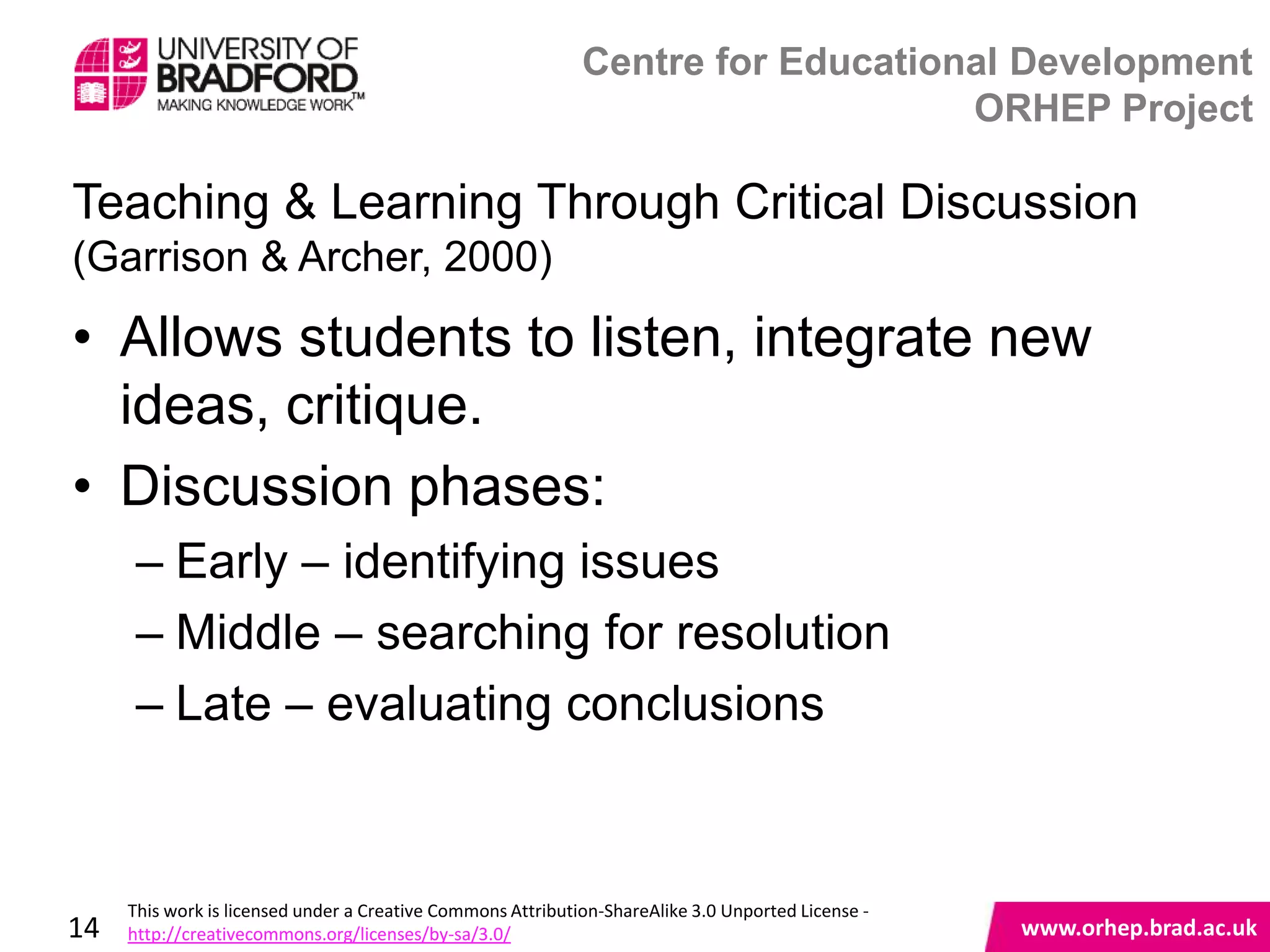
Teaching & Learning Through Critical Discussion
(Garrison & Archer, 2000)

• Allows students to listen, integrate new
  ideas, critique.
• Discussion phases:
      – Early – identifying issues
      – Middle – searching for resolution
      – Late – evaluating conclusions
                                                                                                    www.orhep.brad.ac.uk


     This work is licensed under a Creative Commons Attribution-ShareAlike 3.0 Unported License -
14   http://creativecommons.org/licenses/by-sa/3.0/                                                     www.orhep.brad.ac.uk
Centre for Educational Development
                                                                                 ORHEP Project


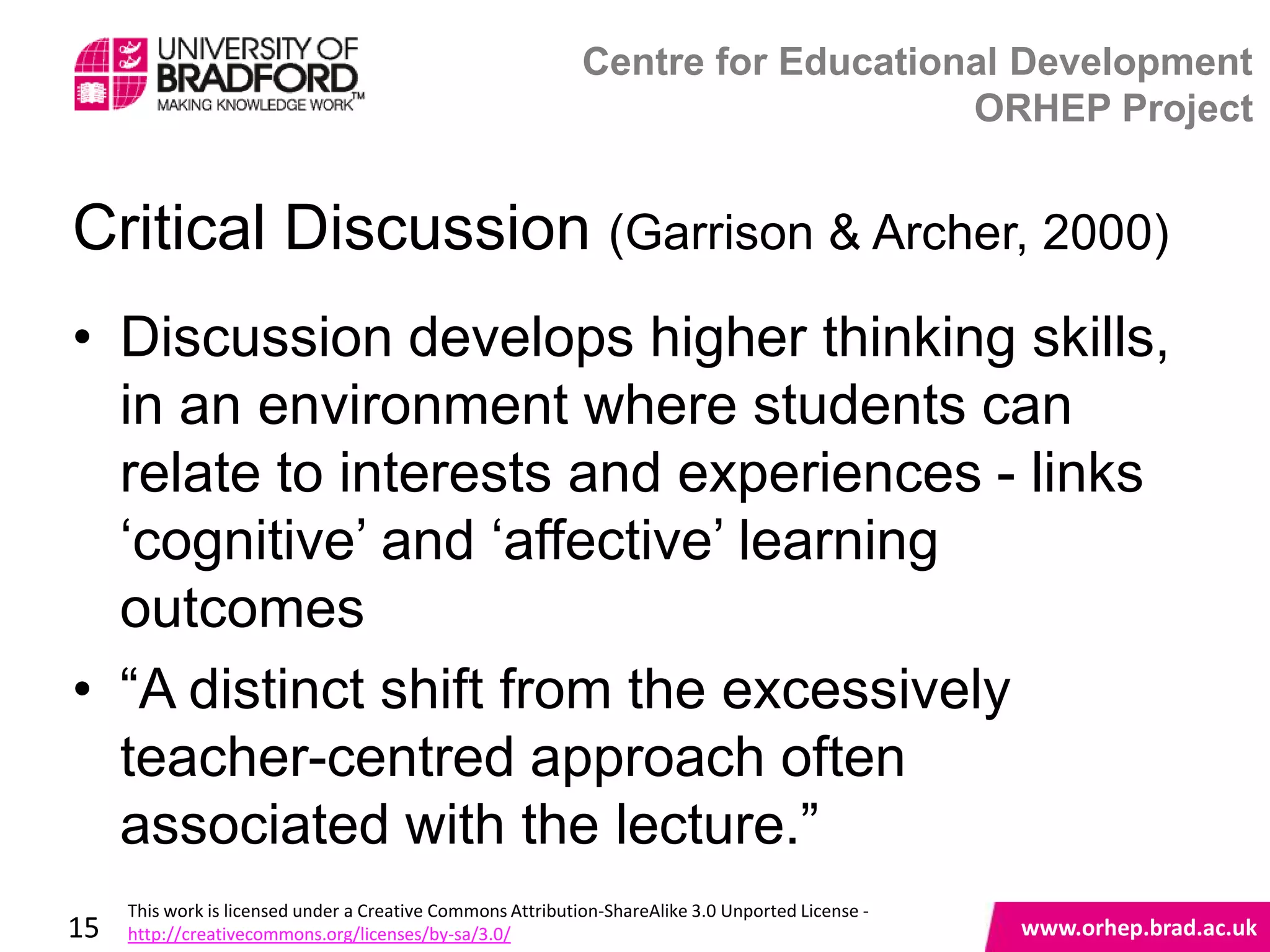
Critical Discussion (Garrison & Archer, 2000)
• Discussion develops higher thinking skills,
  in an environment where students can
  relate to interests and experiences - links
  „cognitive‟ and „affective‟ learning
  outcomes
• “A distinct shift from the excessively
  teacher-centred approach often www.orhep.brad.ac.uk
  associated with the lecture.”
     This work is licensed under a Creative Commons Attribution-ShareAlike 3.0 Unported License -
15   http://creativecommons.org/licenses/by-sa/3.0/                                                 www.orhep.brad.ac.uk
Centre for Educational Development
                                                                                 ORHEP Project


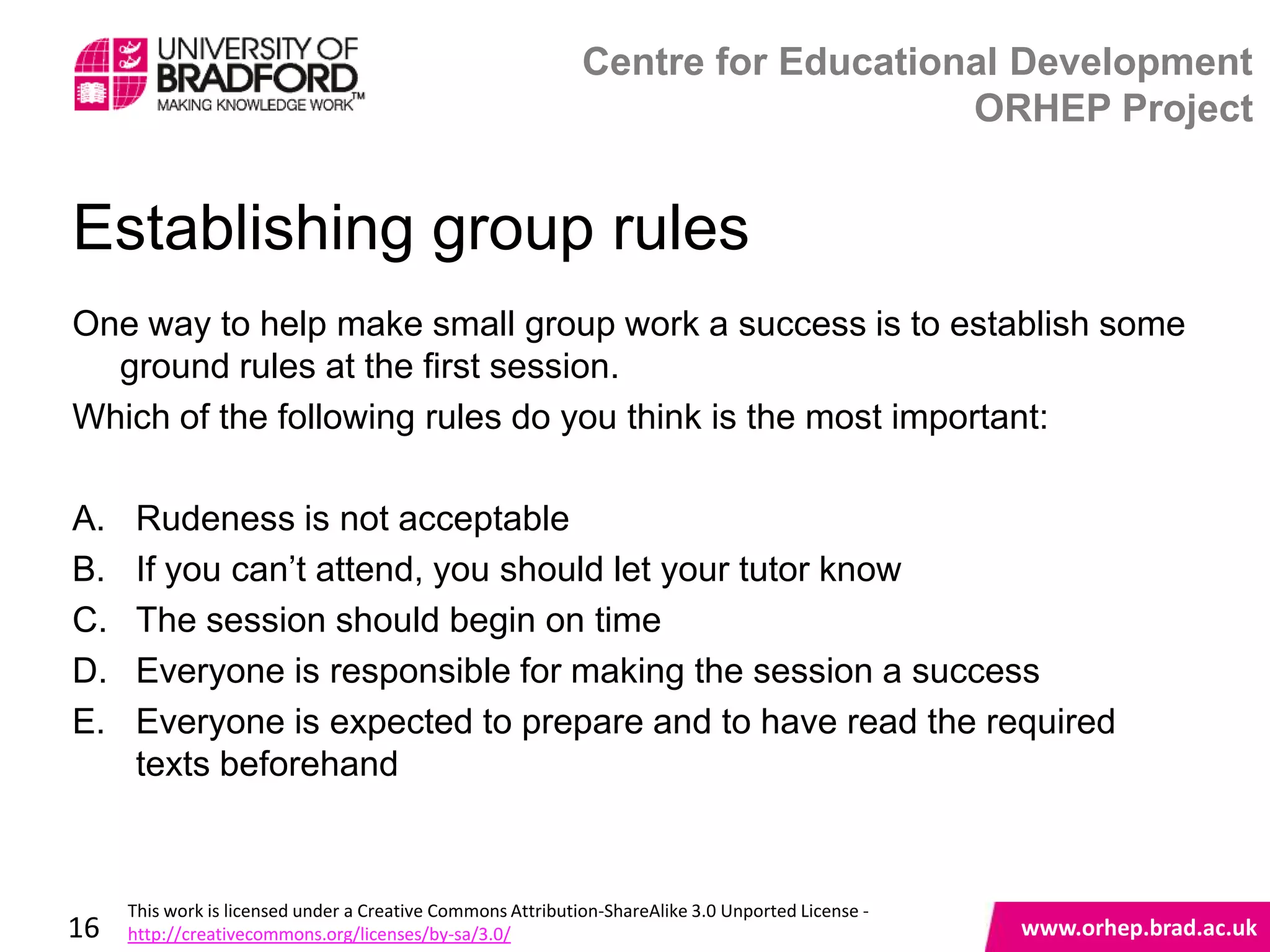
Establishing group rules
One way to help make small group work a success is to establish some
  ground rules at the first session.
Which of the following rules do you think is the most important:

A.    Rudeness is not acceptable
B.    If you can‟t attend, you should let your tutor know
C.    The session should begin on time
D.    Everyone is responsible for making the session a success
E.    Everyone is expected to prepare and to have read the required
      texts beforehand                                    www.orhep.brad.ac.uk


     This work is licensed under a Creative Commons Attribution-ShareAlike 3.0 Unported License -
16   http://creativecommons.org/licenses/by-sa/3.0/                                                 www.orhep.brad.ac.uk
Centre for Educational Development
                                                                                 ORHEP Project


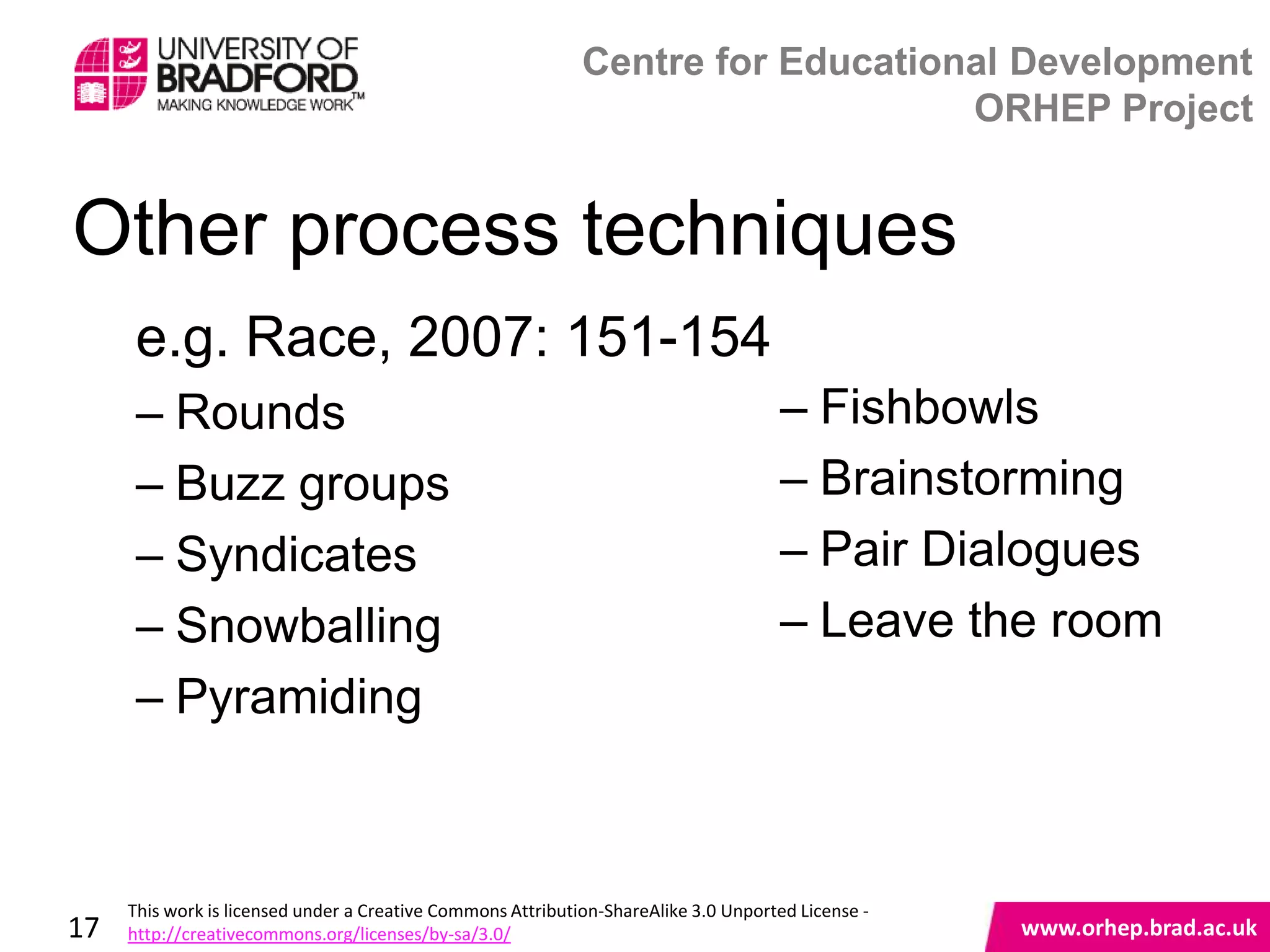
Other process techniques
      e.g. Race, 2007: 151-154
      – Rounds                                                                       – Fishbowls
      – Buzz groups                                                                  – Brainstorming
      – Syndicates                                                                   – Pair Dialogues
      – Snowballing                                                                  – Leave the room
      – Pyramiding
                                                                                                    www.orhep.brad.ac.uk


     This work is licensed under a Creative Commons Attribution-ShareAlike 3.0 Unported License -
17   http://creativecommons.org/licenses/by-sa/3.0/                                                     www.orhep.brad.ac.uk
Centre for Educational Development
                                                                                 ORHEP Project

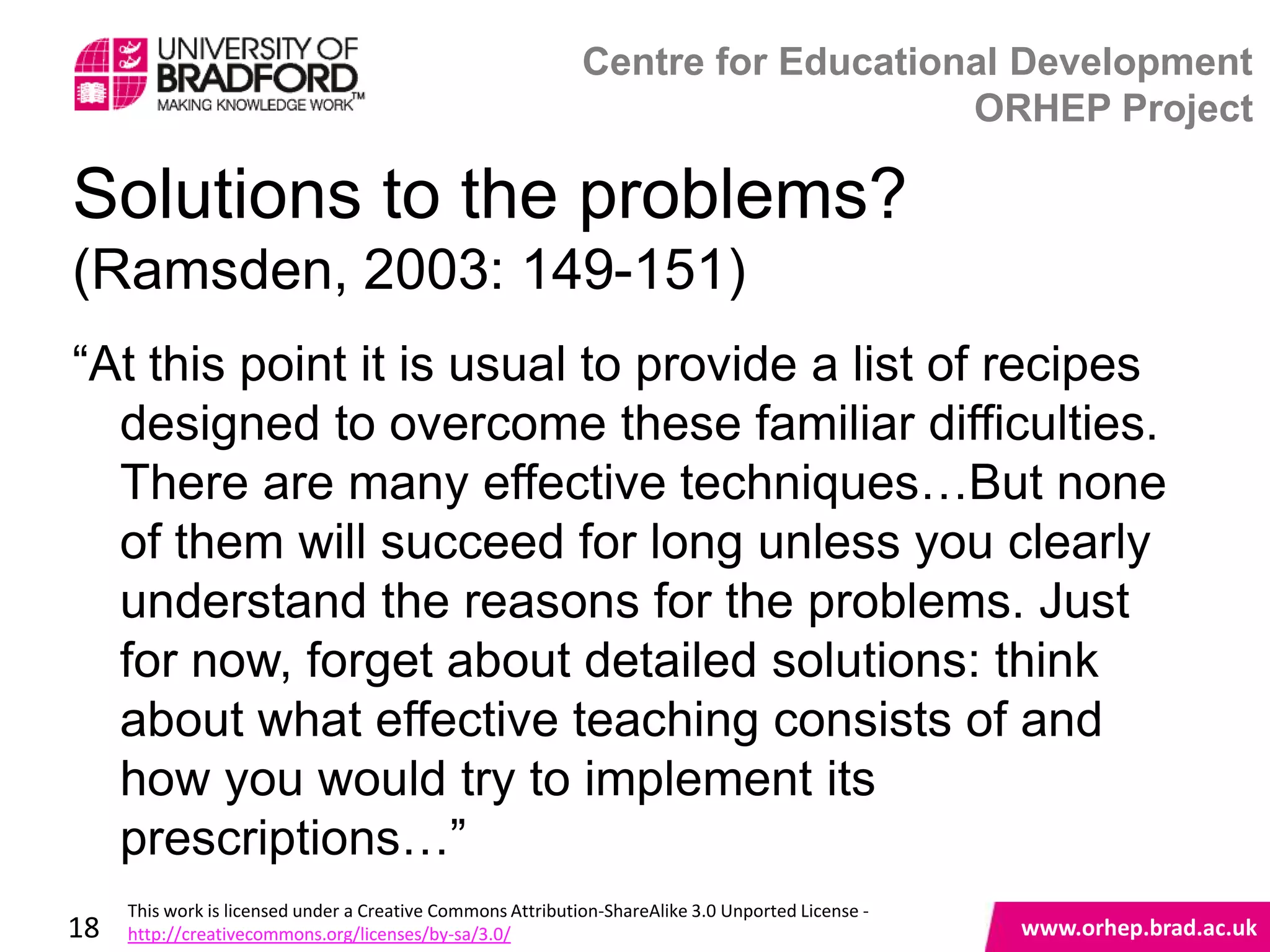
Solutions to the problems?
(Ramsden, 2003: 149-151)
“At this point it is usual to provide a list of recipes
  designed to overcome these familiar difficulties.
  There are many effective techniques…But none
  of them will succeed for long unless you clearly
  understand the reasons for the problems. Just
  for now, forget about detailed solutions: think
  about what effective teaching consists of and
                                              www.orhep.brad.ac.uk
  how you would try to implement its
  prescriptions…”
     This work is licensed under a Creative Commons Attribution-ShareAlike 3.0 Unported License -
18   http://creativecommons.org/licenses/by-sa/3.0/                                                 www.orhep.brad.ac.uk
Centre for Educational Development
                                                                                 ORHEP Project


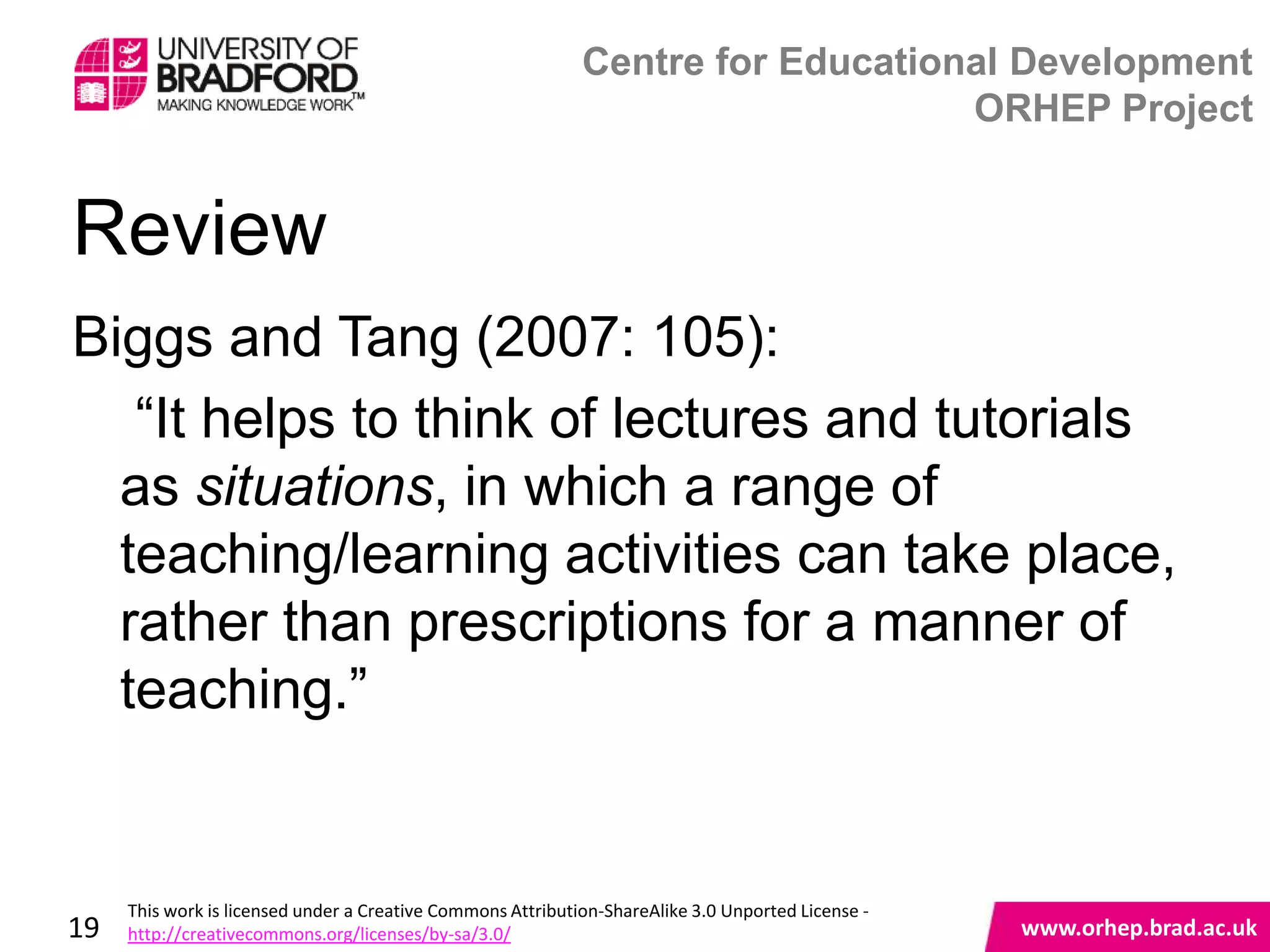
Review
Biggs and Tang (2007: 105):
   “It helps to think of lectures and tutorials
  as situations, in which a range of
  teaching/learning activities can take place,
  rather than prescriptions for a manner of
  teaching.”
                                                                                                    www.orhep.brad.ac.uk


     This work is licensed under a Creative Commons Attribution-ShareAlike 3.0 Unported License -
19   http://creativecommons.org/licenses/by-sa/3.0/                                                     www.orhep.brad.ac.uk
Centre for Educational Development
                                                                                 ORHEP Project


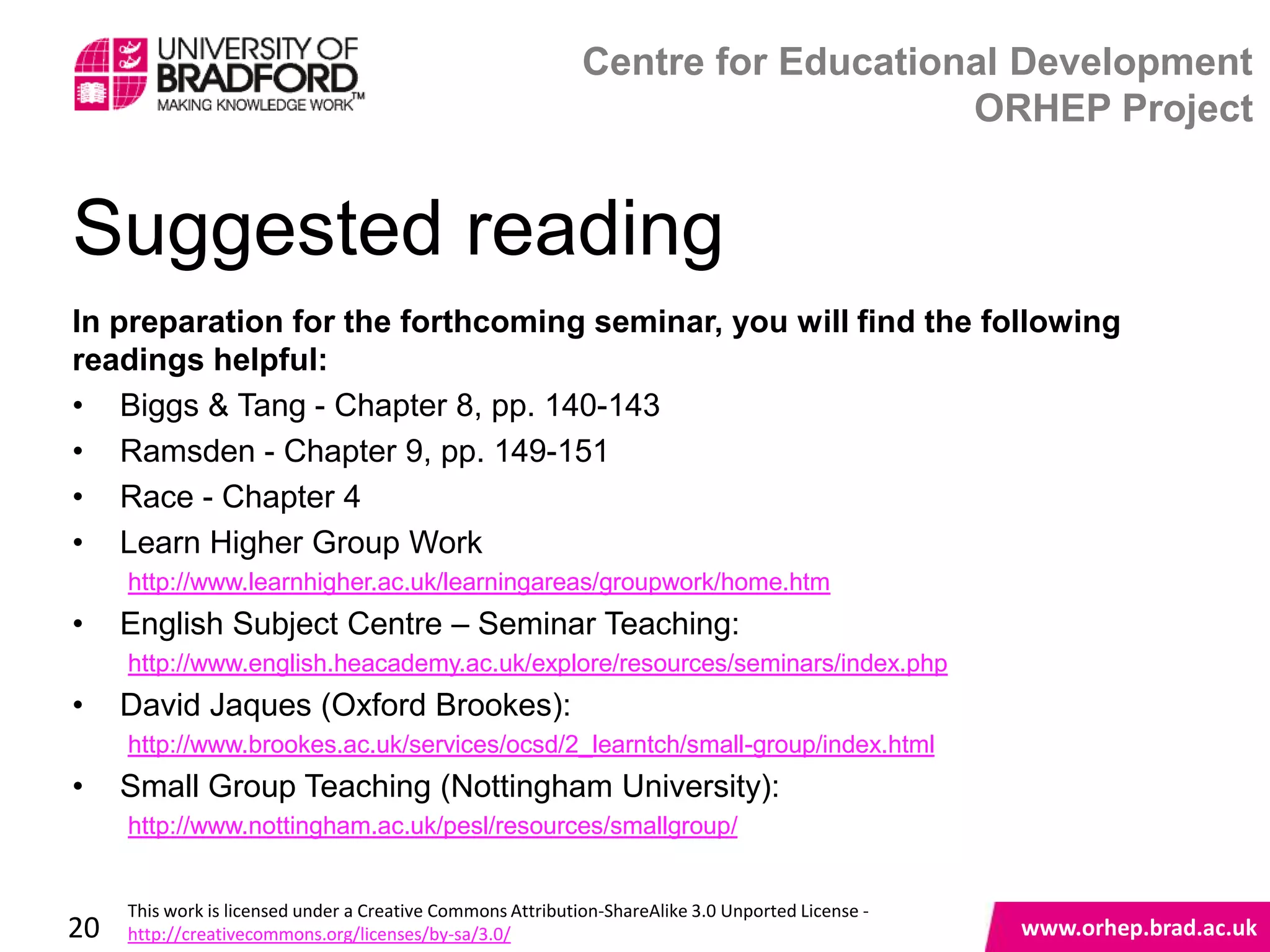
Suggested reading
In preparation for the forthcoming seminar, you will find the following
readings helpful:
• Biggs & Tang - Chapter 8, pp. 140-143
• Ramsden - Chapter 9, pp. 149-151
• Race - Chapter 4
• Learn Higher Group Work
     http://www.learnhigher.ac.uk/learningareas/groupwork/home.htm
•    English Subject Centre – Seminar Teaching:
     http://www.english.heacademy.ac.uk/explore/resources/seminars/index.php
•    David Jaques (Oxford Brookes):
     http://www.brookes.ac.uk/services/ocsd/2_learntch/small-group/index.html
                                                                                                    www.orhep.brad.ac.uk
•    Small Group Teaching (Nottingham University):
     http://www.nottingham.ac.uk/pesl/resources/smallgroup/


     This work is licensed under a Creative Commons Attribution-ShareAlike 3.0 Unported License -
20   http://creativecommons.org/licenses/by-sa/3.0/                                                     www.orhep.brad.ac.uk
Centre for Educational Development
                                                                                 ORHEP Project


References
• Biggs. J. and Tang, C (2007) Teaching for Quality
  Learning at University, Third Edition, Maidenhead, Open
  University Press.
• Garrison, D.R. & Archer, W. (2000) A Transactional
  Perspective on Teaching and Learning, Oxford,
  Pergamon.
• Race, P. (2007) The Lecturer’s Toolkit, Third Edition,
  London & New York, Routledge.
• Ramsden, P. (2003) Learning and Teaching in Higher
  Education, Second Edition, London & New York, www.orhep.brad.ac.uk
  Routledge Falmer.

     This work is licensed under a Creative Commons Attribution-ShareAlike 3.0 Unported License -
21   http://creativecommons.org/licenses/by-sa/3.0/                                                 www.orhep.brad.ac.uk

Small Group Teaching

  • 1.
    Centre for EducationalDevelopment Centre for Educational Development ORHEP Project ORHEP Project Small-Group Teaching Centre for Educational Development www.orhep.brad.ac.uk This work is licensed under a Creative Commons Attribution-ShareAlike 3.0 Unported License - 1 http://creativecommons.org/licenses/by-sa/3.0/ www.orhep.brad.ac.uk
  • 2.
    Centre for EducationalDevelopment ORHEP Project Session learning outcomes By the end of this session, you will have: • identified and discussed characteristics of small group teaching, within your own subject • identified some common problems associated with small-group teaching and evaluated some potential tutor interventions www.orhep.brad.ac.uk This work is licensed under a Creative Commons Attribution-ShareAlike 3.0 Unported License - 2 http://creativecommons.org/licenses/by-sa/3.0/ www.orhep.brad.ac.uk
  • 3.
    Centre for EducationalDevelopment ORHEP Project Session overview • Introduction & Context • Disciplinary Contexts • Problems in small-group teaching • Teaching through discussion • Review www.orhep.brad.ac.uk This work is licensed under a Creative Commons Attribution-ShareAlike 3.0 Unported License - 3 http://creativecommons.org/licenses/by-sa/3.0/ www.orhep.brad.ac.uk
  • 4.
    Centre for EducationalDevelopment ORHEP Project What we are specifically not engaging with in this session… • Issues of students working in groups together on assessed tasks, and theories of group formation, team roles etc. • but see http://www.learnhighergroupwork.com/ www.orhep.brad.ac.uk This work is licensed under a Creative Commons Attribution-ShareAlike 3.0 Unported License - 4 http://creativecommons.org/licenses/by-sa/3.0/ www.orhep.brad.ac.uk
  • 5.
    Centre for EducationalDevelopment ORHEP Project Small Group Teaching - Context • Types/‟genres‟ include: – „tutorials‟, „seminars‟, „labs‟, „fieldwork‟, „online discussion groups‟, Problem-based learning (PBL) groups, action learning sets, workshops, syndicates… • Sizes of „small‟ groups can vary considerably www.orhep.brad.ac.uk • Purpose and role may vary considerably This work is licensed under a Creative Commons Attribution-ShareAlike 3.0 Unported License - 5 http://creativecommons.org/licenses/by-sa/3.0/ www.orhep.brad.ac.uk
  • 6.
    Centre for EducationalDevelopment ORHEP Project What size of group would you consider not to be a “small” group ? A. 10 – 15 B. 15 – 20 C. 20 – 25 D. 25 – 30 E. 30 - 35 www.orhep.brad.ac.uk This work is licensed under a Creative Commons Attribution-ShareAlike 3.0 Unported License - 6 http://creativecommons.org/licenses/by-sa/3.0/ www.orhep.brad.ac.uk
  • 7.
    Centre for EducationalDevelopment ORHEP Project Context – educational role • In comparison to large-group teaching, small group teaching offers more opportunity for interaction and engagement: – tutor-student interaction – student-student interaction • Learning in a social context www.orhep.brad.ac.uk This work is licensed under a Creative Commons Attribution-ShareAlike 3.0 Unported License - 7 http://creativecommons.org/licenses/by-sa/3.0/ www.orhep.brad.ac.uk
  • 8.
    Centre for EducationalDevelopment ORHEP Project Context - educational role • Favoured for developing higher order attributes: – Problem solving – Critical thinking – Self-Awareness – „Functioning‟ rather than „Declarative‟ knowledge (Biggs & Tang, 2007) • Particularly through: – Discussion www.orhep.brad.ac.uk – Practical application – Relation to real-world events & experiences This work is licensed under a Creative Commons Attribution-ShareAlike 3.0 Unported License - 8 http://creativecommons.org/licenses/by-sa/3.0/ www.orhep.brad.ac.uk
  • 9.
    Centre for EducationalDevelopment ORHEP Project Contextual factors • Size of group • Location, room, layout, furniture, equipment • Characteristics and diversity of group • Resource & staffing issues to address www.orhep.brad.ac.uk This work is licensed under a Creative Commons Attribution-ShareAlike 3.0 Unported License - 9 http://creativecommons.org/licenses/by-sa/3.0/ www.orhep.brad.ac.uk
  • 10.
    Centre for EducationalDevelopment ORHEP Project Disciplinary contexts What is the situation at your institution with regard to small group teaching? Here are a few questions to consider. www.orhep.brad.ac.uk This work is licensed under a Creative Commons Attribution-ShareAlike 3.0 Unported License - 10 http://creativecommons.org/licenses/by-sa/3.0/ www.orhep.brad.ac.uk
  • 11.
    Centre for EducationalDevelopment ORHEP Project Disciplinary contexts Individual questions – What types of small-group teaching are you involved in at your institution? – Are there typical „ways of practicing‟? If so, what are they? www.orhep.brad.ac.uk This work is licensed under a Creative Commons Attribution-ShareAlike 3.0 Unported License - 11 http://creativecommons.org/licenses/by-sa/3.0/ www.orhep.brad.ac.uk
  • 12.
    Centre for EducationalDevelopment ORHEP Project Disciplinary contexts – Are you aware of any examples of what you would consider to be innovative small-group teaching practice at your institution? – What are the typical issues or challenges associated with small-group teaching in your context? www.orhep.brad.ac.uk This work is licensed under a Creative Commons Attribution-ShareAlike 3.0 Unported License - 12 http://creativecommons.org/licenses/by-sa/3.0/ www.orhep.brad.ac.uk
  • 13.
    Centre for EducationalDevelopment ORHEP Project Problems in Small-Group Teaching (Ramsden, 2003: 149) • teacher lectures rather than conducts discussion • teacher talks too much • difficult encouraging students to talk • discussion limited to responses to tutor questions • if preparation is required, student don‟t do it • one student too dominant/ too quiet • student focus is on solutions/answers more than www.orhep.brad.ac.uk complexity This work is licensed under a Creative Commons Attribution-ShareAlike 3.0 Unported License - 13 http://creativecommons.org/licenses/by-sa/3.0/ www.orhep.brad.ac.uk
  • 14.
    Centre for EducationalDevelopment ORHEP Project Teaching & Learning Through Critical Discussion (Garrison & Archer, 2000) • Allows students to listen, integrate new ideas, critique. • Discussion phases: – Early – identifying issues – Middle – searching for resolution – Late – evaluating conclusions www.orhep.brad.ac.uk This work is licensed under a Creative Commons Attribution-ShareAlike 3.0 Unported License - 14 http://creativecommons.org/licenses/by-sa/3.0/ www.orhep.brad.ac.uk
  • 15.
    Centre for EducationalDevelopment ORHEP Project Critical Discussion (Garrison & Archer, 2000) • Discussion develops higher thinking skills, in an environment where students can relate to interests and experiences - links „cognitive‟ and „affective‟ learning outcomes • “A distinct shift from the excessively teacher-centred approach often www.orhep.brad.ac.uk associated with the lecture.” This work is licensed under a Creative Commons Attribution-ShareAlike 3.0 Unported License - 15 http://creativecommons.org/licenses/by-sa/3.0/ www.orhep.brad.ac.uk
  • 16.
    Centre for EducationalDevelopment ORHEP Project Establishing group rules One way to help make small group work a success is to establish some ground rules at the first session. Which of the following rules do you think is the most important: A. Rudeness is not acceptable B. If you can‟t attend, you should let your tutor know C. The session should begin on time D. Everyone is responsible for making the session a success E. Everyone is expected to prepare and to have read the required texts beforehand www.orhep.brad.ac.uk This work is licensed under a Creative Commons Attribution-ShareAlike 3.0 Unported License - 16 http://creativecommons.org/licenses/by-sa/3.0/ www.orhep.brad.ac.uk
  • 17.
    Centre for EducationalDevelopment ORHEP Project Other process techniques e.g. Race, 2007: 151-154 – Rounds – Fishbowls – Buzz groups – Brainstorming – Syndicates – Pair Dialogues – Snowballing – Leave the room – Pyramiding www.orhep.brad.ac.uk This work is licensed under a Creative Commons Attribution-ShareAlike 3.0 Unported License - 17 http://creativecommons.org/licenses/by-sa/3.0/ www.orhep.brad.ac.uk
  • 18.
    Centre for EducationalDevelopment ORHEP Project Solutions to the problems? (Ramsden, 2003: 149-151) “At this point it is usual to provide a list of recipes designed to overcome these familiar difficulties. There are many effective techniques…But none of them will succeed for long unless you clearly understand the reasons for the problems. Just for now, forget about detailed solutions: think about what effective teaching consists of and www.orhep.brad.ac.uk how you would try to implement its prescriptions…” This work is licensed under a Creative Commons Attribution-ShareAlike 3.0 Unported License - 18 http://creativecommons.org/licenses/by-sa/3.0/ www.orhep.brad.ac.uk
  • 19.
    Centre for EducationalDevelopment ORHEP Project Review Biggs and Tang (2007: 105): “It helps to think of lectures and tutorials as situations, in which a range of teaching/learning activities can take place, rather than prescriptions for a manner of teaching.” www.orhep.brad.ac.uk This work is licensed under a Creative Commons Attribution-ShareAlike 3.0 Unported License - 19 http://creativecommons.org/licenses/by-sa/3.0/ www.orhep.brad.ac.uk
  • 20.
    Centre for EducationalDevelopment ORHEP Project Suggested reading In preparation for the forthcoming seminar, you will find the following readings helpful: • Biggs & Tang - Chapter 8, pp. 140-143 • Ramsden - Chapter 9, pp. 149-151 • Race - Chapter 4 • Learn Higher Group Work http://www.learnhigher.ac.uk/learningareas/groupwork/home.htm • English Subject Centre – Seminar Teaching: http://www.english.heacademy.ac.uk/explore/resources/seminars/index.php • David Jaques (Oxford Brookes): http://www.brookes.ac.uk/services/ocsd/2_learntch/small-group/index.html www.orhep.brad.ac.uk • Small Group Teaching (Nottingham University): http://www.nottingham.ac.uk/pesl/resources/smallgroup/ This work is licensed under a Creative Commons Attribution-ShareAlike 3.0 Unported License - 20 http://creativecommons.org/licenses/by-sa/3.0/ www.orhep.brad.ac.uk
  • 21.
    Centre for EducationalDevelopment ORHEP Project References • Biggs. J. and Tang, C (2007) Teaching for Quality Learning at University, Third Edition, Maidenhead, Open University Press. • Garrison, D.R. & Archer, W. (2000) A Transactional Perspective on Teaching and Learning, Oxford, Pergamon. • Race, P. (2007) The Lecturer’s Toolkit, Third Edition, London & New York, Routledge. • Ramsden, P. (2003) Learning and Teaching in Higher Education, Second Edition, London & New York, www.orhep.brad.ac.uk Routledge Falmer. This work is licensed under a Creative Commons Attribution-ShareAlike 3.0 Unported License - 21 http://creativecommons.org/licenses/by-sa/3.0/ www.orhep.brad.ac.uk

Editor's Notes

  • #12 Get students to raise hands and speak individually.