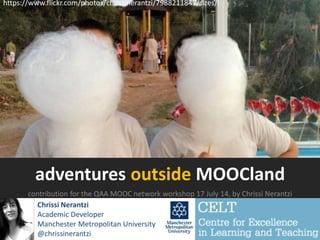
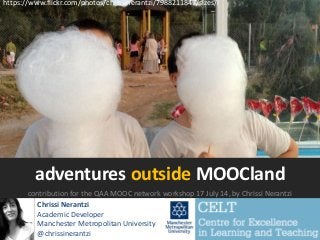
adventures outside MOOCland
contribution for the QAA MOOC network workshop 17 July 14, by Chrissi Nerantzi
Chrissi Nerantzi
Academic Developer
Manchester Metropolitan University
@chrissinerantzi
https://www.flickr.com/photos/chrissinerantzi/7988211847/sizes/l
http://www.timeshighereducation.co.uk/news/reputations-at-risk-as-platforms-fail-to-screen-moocs/2014381.article
10 July 2014
Open educational practices beyond
MOOCland? They do exist. But why do we
seem to ignore them?
“Bigger is better!” Is it really?
“Size matters!” If
it does, what do
we do about it?
One size
doesn’t fit all!
Remember?
debating
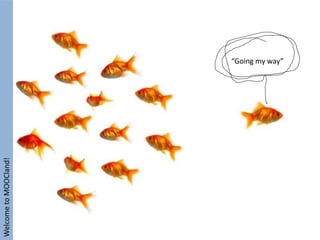
WelcometoMOOCland!
... going that way...
“Content is not education,
interaction is!”
Darco Jansen
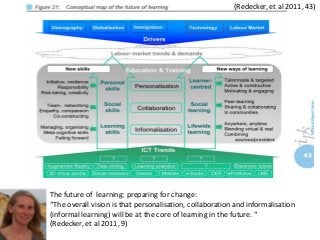
(Redecker, et al 2011, 43)
The future of learning: preparing for change:
“The overall vision is that personalisation, collaboration and informalisation
(informal learning) will be at the core of learning in the future. “
(Redecker, et al 2011, 9)
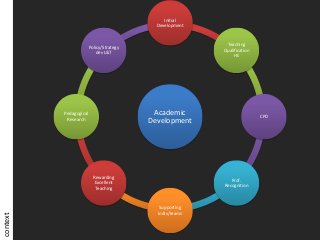
Academic
Development
Initial
Development
Teaching
Qualification
HE
CPD
Prof.
Recognition
Supporting
indiv/teams
Rewarding
Excellent
Teaching
Pedagogical
Research
Policy/Strategy
dev L&T
context
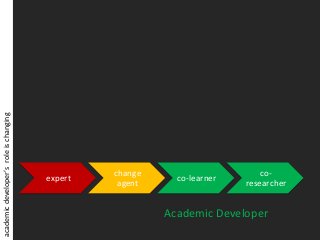
Academic Developer
expert
change
agent
co-learner
co-
researcher
academicdeveloper’sroleischanging
“Don’t replace one mono-
culture with another”
Weller (2014, online)
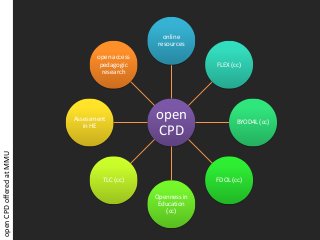
open
CPD
online
resources
FLEX (cc)
BYOD4L (cc)
FDOL (cc)
Openness in
Education
(cc)
TLC (cc)
Assessment
in HE
open access
pedagogic
research
openCPDofferedatMMU
open CPD: How we are dealing with quality...
• design -in open pathways to approved HE provision
• approved shell units to formalise informal practice-
based open CPD and gain academic credits
• peer review open provision internally/externally
• carry out ongoing evaluative collaborative
pedagogical research on learners’ & facilitators’
experience & approach/features used for further
enhancement, dissemination
• facilitate collaboratively, ongoing open peer review
process during facilitation
• learning analytics
quality assured & enhanced through peer review at all stages
examples of
open CPD that follow
• open course Flexible, Distance and Online Learning (FDOL)
fdol.wordpress.com
• FLEX, open CPD programme
http://www.celt.mmu.ac.uk/flex/
• Bring your own devices for learning (BYOD4L),
http://byod4learning.wordpress.com/
• Openness in Education (facilitated version of available
OER), http://northwestoer.org/introduction-to-openness-
in-education/
• Assessment in Higher Education,
http://aheo14.wordpress.com
• PgCert in Learning and Teaching in HE with open pathways
(under development)
open course Flexible, Distance and
Online Learning (FDOL)
Chrissi Nerantzi & Lars Uhlin (course developers)
approved PGCAP module since July 2011
designed as open collaborative module
FDOL131 - FDOL132 - FDOL141
2013, 2014
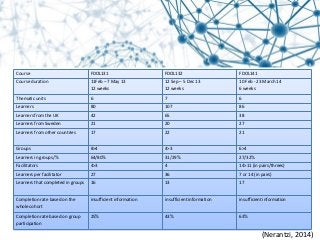
Course FDOL131 FDOL132 FDOL141
Course duration 11Feb – 7 May 13
12 weeks
12 Sep – 5 Dec 13
12 weeks
10 Feb - 23 March 14
6 weeks
Thematic units 6 7 6
Learners 80 107 86
Learners from the UK 42 65 38
Learners from Sweden 21 20 27
Learners from other countries 17 22 21
Groups 8>4 4>3 6>4
Learners in groups/% 64/80% 31/29% 27/32%
Facilitators 4>3 4 14>11 (in pairs/threes)
Learners per facilitator 27 36 7 or 14 (in pairs)
Learners that completed in groups 16 13 17
Completionrate based on the
whole cohort
insufficient information insufficient information insufficient information
Completionrate based on group
participation
25% 43% 63%
(Nerantzi, 2014)
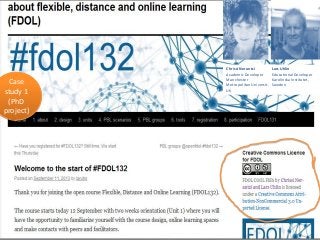
Case
study 1
(PhD
project)
Chrissi Nerantzi
AcademicDeveloper
Manchester
MetropolitanUniversity,
UK
Lars Uhlin
Educational Developer
KarolinskaInstitutet,
Sweden
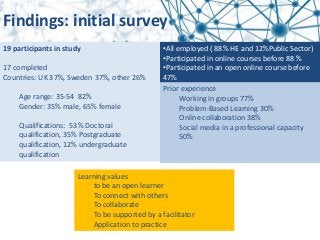
Findings: initial survey
19 participants in study
17 completed
Countries: UK 37%, Sweden 37%, other 26%
Age range: 35-54 82%
Gender: 35% male, 65% female
Qualifications: 53% Doctoral
qualification, 35% Postgraduate
qualification, 12% undergraduate
qualification
•All employed ( 88% HE and 12%Public Sector)
•Participated in online courses before 88 %
•Participated in an open online course before
47%
Learning values
to be an open learner
To connect with others
To collaborate
To be supported by a facilitator
Application to practice
Prior experience
Working in groups 77%
Problem-Based Learning 30%
Online collaboration 38%
Social media in a professional capacity
50%
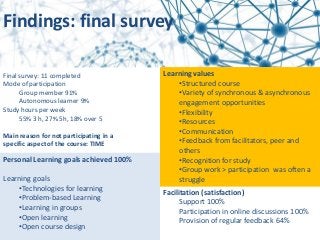
Findings: final survey
Final survey: 11 completed
Mode of participation
Group member 91%
Autonomous learner 9%
Study hours per week
55% 3 h, 27% 5h, 18% over 5
Main reason for not participating in a
specific aspect of the course: TIME
Learning values
•Structured course
•Variety of synchronous & asynchronous
engagement opportunities
•Flexibility
•Resources
•Communication
•Feedback from facilitators, peer and
others
•Recognition for study
•Group work > participation was often a
struggle
Personal Learning goals achieved 100%
Learning goals
•Technologies for learning
•Problem-based Learning
•Learning in groups
•Open learning
•Open course design
Facilitation (satisfaction)
Support 100%
Participation in online discussions 100%
Provision of regular feedback 64%
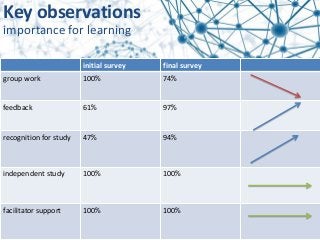
Key observations
importance for learning
initial survey final survey
group work 100% 74%
feedback 61% 97%
recognition for study 47% 94%
independent study 100% 100%
facilitator support 100% 100%
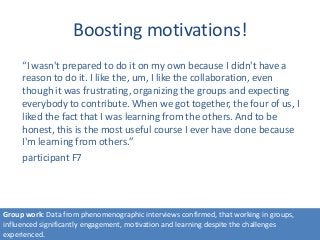
Boosting motivations!
“I wasn't prepared to do it on my own because I didn't have a
reason to do it. I like the, um, I like the collaboration, even
though it was frustrating, organizing the groups and expecting
everybody to contribute. When we got together, the four of us, I
liked the fact that I was learning from the others. And to be
honest, this is the most useful course I ever have done because
I'm learning from others.”
participant F7
Group work: Data from phenomenographic interviews confirmed, that working in groups,
influenced significantly engagement, motivation and learning despite the challenges
experienced.
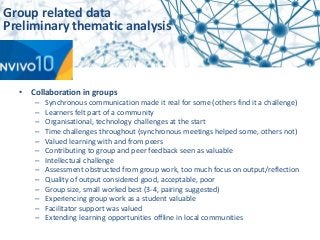
• Collaboration in groups
– Synchronous communication made it real for some (others find it a challenge)
– Learners felt part of a community
– Organisational, technology challenges at the start
– Time challenges throughout (synchronous meetings helped some, others not)
– Valued learning with and from peers
– Contributing to group and peer feedback seen as valuable
– Intellectual challenge
– Assessment obstructed from group work, too much focus on output/reflection
– Quality of output considered good, acceptable, poor
– Group size, small worked best (3-4, pairing suggested)
– Experiencing group work as a student valuable
– Facilitator support was valued
– Extending learning opportunities offline in local communities
Group related data
Preliminary thematic analysis
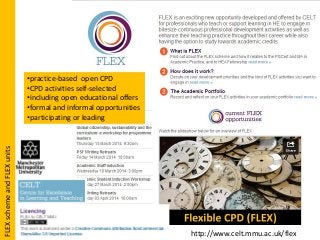
http://www.celt.mmu.ac.uk/flex
•practice-based open CPD
•CPD activities self-selected
•including open educational offers
•formal and informal opportunities
•participating or leading
FLEXschemeandFLEXunits
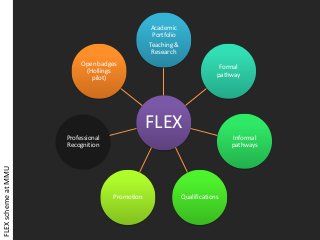
FLEX
Academic
Portfolio
Teaching &
Research
Formal
pathway
Informal
pathways
QualificationsPromotion
Professional
Recognition
Open badges
(Hollings
pilot)
FLEXschemeatMMU
Teaching and Learning
Conversations
webinar series to share innovative practices
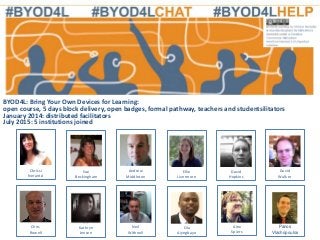
BYOD4L: Bring Your Own Devices for Learning:
open course, 5 days block delivery, open badges, formal pathway, teachers and studentsilitators
January 2014: distributed facilitators
July 2015: 5 institutions joined
Chris
Rowell
Chrissi
Nerantzi
Panos
Vlachopoulos
Ellie
Livermore
Sue
Beckingham
Kathryn
Jensen
Alex
Spiers
David
Hopkins
Andrew
Middleton
David
Walker
Neil
Withnell
Ola
Aiyegbayo
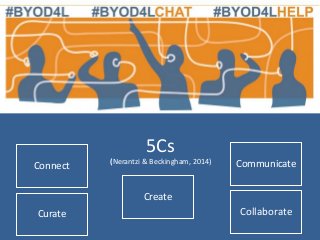
5Cs
Connect Communicate
Curate Collaborate
Create
(Nerantzi & Beckingham, 2014)
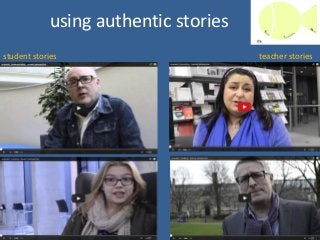
using authentic stories
student stories teacher stories
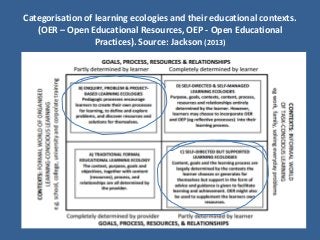
Categorisation of learning ecologies and their educational contexts.
(OER – Open Educational Resources, OEP - Open Educational
Practices). Source: Jackson (2013)
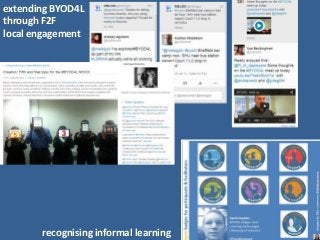
extending BYOD4L
through F2F
local engagement
recognising informal learning
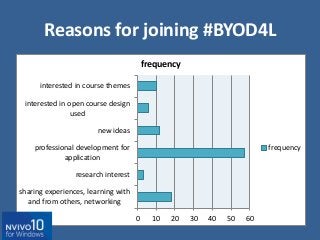
Reasons for joining #BYOD4L
0 10 20 30 40 50 60
sharing experiences, learning with
and from others, networking
research interest
professional development for
application
new ideas
interested in open course design
used
interested in course themes
frequency
frequency
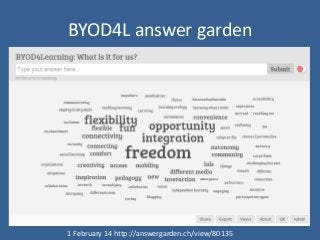
BYOD4L answer garden
1 February 14 http://answergarden.ch/view/80135
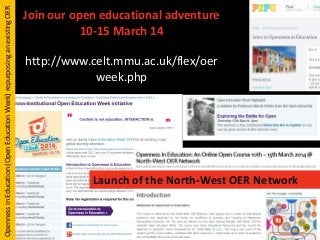
Join our open educational adventure
10-15 March 14
http://www.celt.mmu.ac.uk/flex/oer
week.php
Launch of the North-West OER Network
OpennessinEducation(OpenEducationWeek)repurposinganexistingOER
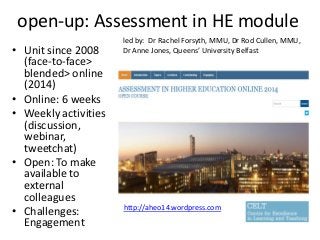
open-up: Assessment in HE module
• Unit since 2008
(face-to-face>
blended> online
(2014)
• Online: 6 weeks
• Weekly activities
(discussion,
webinar,
tweetchat)
• Open: To make
available to
external
colleagues
• Challenges:
Engagement
led by: Dr Rachel Forsyth, MMU, Dr Rod Cullen, MMU,
Dr Anne Jones, Queens’ University Belfast
http://aheo14.wordpress.com
LTHE
(30
credits)
FLEX
(30
credits)
PgCert in Higher Education with open pathway
• collaborative partners and international
• promoting an ethos of borderless cooperation and collaboration
• inquiry -and practice-based design
• blending institutional technologies with social media
open badges
credit route
open CPD
FLEX [pathway]
Useful reminder?
Computer –supported collaborative learning (CSCL)
developed in the 90s
• Content = resources for learning and can only be effective within a
motivational and interactive context.
• The Teacher effort per student is increased significantly in online
settings if compared with a face-to-face classroom. Interactions are
ongoing to create and sustain social presence and community.
• Developing collaborative learning and peer-to-peer interactions
require time and effort, careful planning and a pedagogical design
that enables this. Support is ongoing.
• Learning activities are organised in a variety of settings, not all of
them are online. Technologies are also used in face-to-face
synchronous and asynchronous interactions.
(Stahl et al. 2006, 410)
Opportunities...
• introduce integrated open pathways based on a
rationale (and clear purpose)
• find ways to recognise & formalise informal learning
• collaborate with colleagues in own and other
institutions
• create rich and collaborative learning/development
opportunities
• share, release resources/practices as open educational
resource (OER), use/repurpose OER!
• start small
References
• Gauntlett, D. (2011) Making is connecting. The social meaning of creativity, from DIY and knitting to YouTube and
Web2.0, Cambridge: Polity Press.
• Jackson, N. J. (2013) The Concept of Learning Ecologies in N Jackson and G B Cooper (Eds) Lifewide Learning, Education
and Personal Development E-Book. Chapter A5 available at
http://www.lifewideebook.co.uk/uploads/1/0/8/4/10842717/chapter_a5.pdf [accessed 9 February 2014]
• Nerantzi, C (i2014) A personal journey of discoveries through a DIY open course development for professional
development of teachers in Higher Education (invited paper),Journal of Pedagogic Development, University of
Bedfordshire, pp. 42-58.
• Redecker, C., Leis, M., Leendertse, M., Punie, Y., Gijsbers, G., Kirschner, P., Stoyanov, S. & Hoogveld, B. (2011): The
Future of Learning: Preparing for Change, JRC Scientific and Technical Reports: European Commission, Institute for
Prospective Technological Studies, available at http://ftp.jrc.es/EURdoc/JRC66836.pdf
• Stahl, G., Koschmann, T. & Suthers, D. (2006) Computer-supported collaborative learning: An historical perspective. In:
Sawyer, R. K. (ed.) Cambridge handbook of the learning sciences, Cambridge: UK: Cambridge University Press, pp. 409-
426, available at http://gerrystahl.net/cscl/CSCL_English.htm [accessed 16 July 2014]
• Weller, M. (2014) The Battle for Open Webinar, The Ed Techie, 21 March 2014, available at
http://nogoodreason.typepad.co.uk/ [accessed 22 March 2014]
• Zourou, K. (2013) Open Education: multilingual, user driven and glocalised, in: European Commission (2013) Open
Education 2030 JRC-IPTS Call for Vision Papers. Part 1: Lifelong Learning, pp. 33-37, available at
https://drive.google.com/folderview?id=0B-cuW9MpLUC4YTB6MUpnTktBbU0&usp=sharing [accessed 23 March 2014]
adventures outside MOOCland
contribution for the QAA MOOC network workshop 17 July 14, by Chrissi Nerantzi
Chrissi Nerantzi
Academic Developer
Manchester Metropolitan University
@chrissinerantzi
https://www.flickr.com/photos/chrissinerantzi/7988211847/sizes/l

Adventures outside MOOCland

  • 1.
    adventures outside MOOCland contributionfor the QAA MOOC network workshop 17 July 14, by Chrissi Nerantzi Chrissi Nerantzi Academic Developer Manchester Metropolitan University @chrissinerantzi https://www.flickr.com/photos/chrissinerantzi/7988211847/sizes/l
  • 2.
  • 3.
    Open educational practicesbeyond MOOCland? They do exist. But why do we seem to ignore them? “Bigger is better!” Is it really? “Size matters!” If it does, what do we do about it? One size doesn’t fit all! Remember? debating
  • 4.
  • 5.
    “Content is noteducation, interaction is!” Darco Jansen
  • 6.
    (Redecker, et al2011, 43) The future of learning: preparing for change: “The overall vision is that personalisation, collaboration and informalisation (informal learning) will be at the core of learning in the future. “ (Redecker, et al 2011, 9)
  • 7.
  • 8.
  • 9.
    “Don’t replace onemono- culture with another” Weller (2014, online)
  • 10.
    open CPD online resources FLEX (cc) BYOD4L (cc) FDOL(cc) Openness in Education (cc) TLC (cc) Assessment in HE open access pedagogic research openCPDofferedatMMU
  • 11.
    open CPD: Howwe are dealing with quality... • design -in open pathways to approved HE provision • approved shell units to formalise informal practice- based open CPD and gain academic credits • peer review open provision internally/externally • carry out ongoing evaluative collaborative pedagogical research on learners’ & facilitators’ experience & approach/features used for further enhancement, dissemination • facilitate collaboratively, ongoing open peer review process during facilitation • learning analytics quality assured & enhanced through peer review at all stages
  • 12.
    examples of open CPDthat follow • open course Flexible, Distance and Online Learning (FDOL) fdol.wordpress.com • FLEX, open CPD programme http://www.celt.mmu.ac.uk/flex/ • Bring your own devices for learning (BYOD4L), http://byod4learning.wordpress.com/ • Openness in Education (facilitated version of available OER), http://northwestoer.org/introduction-to-openness- in-education/ • Assessment in Higher Education, http://aheo14.wordpress.com • PgCert in Learning and Teaching in HE with open pathways (under development)
  • 13.
    open course Flexible,Distance and Online Learning (FDOL) Chrissi Nerantzi & Lars Uhlin (course developers) approved PGCAP module since July 2011 designed as open collaborative module FDOL131 - FDOL132 - FDOL141 2013, 2014
  • 14.
    Course FDOL131 FDOL132FDOL141 Course duration 11Feb – 7 May 13 12 weeks 12 Sep – 5 Dec 13 12 weeks 10 Feb - 23 March 14 6 weeks Thematic units 6 7 6 Learners 80 107 86 Learners from the UK 42 65 38 Learners from Sweden 21 20 27 Learners from other countries 17 22 21 Groups 8>4 4>3 6>4 Learners in groups/% 64/80% 31/29% 27/32% Facilitators 4>3 4 14>11 (in pairs/threes) Learners per facilitator 27 36 7 or 14 (in pairs) Learners that completed in groups 16 13 17 Completionrate based on the whole cohort insufficient information insufficient information insufficient information Completionrate based on group participation 25% 43% 63% (Nerantzi, 2014)
  • 15.
  • 16.
    Findings: initial survey 19participants in study 17 completed Countries: UK 37%, Sweden 37%, other 26% Age range: 35-54 82% Gender: 35% male, 65% female Qualifications: 53% Doctoral qualification, 35% Postgraduate qualification, 12% undergraduate qualification •All employed ( 88% HE and 12%Public Sector) •Participated in online courses before 88 % •Participated in an open online course before 47% Learning values to be an open learner To connect with others To collaborate To be supported by a facilitator Application to practice Prior experience Working in groups 77% Problem-Based Learning 30% Online collaboration 38% Social media in a professional capacity 50%
  • 17.
    Findings: final survey Finalsurvey: 11 completed Mode of participation Group member 91% Autonomous learner 9% Study hours per week 55% 3 h, 27% 5h, 18% over 5 Main reason for not participating in a specific aspect of the course: TIME Learning values •Structured course •Variety of synchronous & asynchronous engagement opportunities •Flexibility •Resources •Communication •Feedback from facilitators, peer and others •Recognition for study •Group work > participation was often a struggle Personal Learning goals achieved 100% Learning goals •Technologies for learning •Problem-based Learning •Learning in groups •Open learning •Open course design Facilitation (satisfaction) Support 100% Participation in online discussions 100% Provision of regular feedback 64%
  • 18.
    Key observations importance forlearning initial survey final survey group work 100% 74% feedback 61% 97% recognition for study 47% 94% independent study 100% 100% facilitator support 100% 100%
  • 19.
    Boosting motivations! “I wasn'tprepared to do it on my own because I didn't have a reason to do it. I like the, um, I like the collaboration, even though it was frustrating, organizing the groups and expecting everybody to contribute. When we got together, the four of us, I liked the fact that I was learning from the others. And to be honest, this is the most useful course I ever have done because I'm learning from others.” participant F7 Group work: Data from phenomenographic interviews confirmed, that working in groups, influenced significantly engagement, motivation and learning despite the challenges experienced.
  • 20.
    • Collaboration ingroups – Synchronous communication made it real for some (others find it a challenge) – Learners felt part of a community – Organisational, technology challenges at the start – Time challenges throughout (synchronous meetings helped some, others not) – Valued learning with and from peers – Contributing to group and peer feedback seen as valuable – Intellectual challenge – Assessment obstructed from group work, too much focus on output/reflection – Quality of output considered good, acceptable, poor – Group size, small worked best (3-4, pairing suggested) – Experiencing group work as a student valuable – Facilitator support was valued – Extending learning opportunities offline in local communities Group related data Preliminary thematic analysis
  • 21.
    http://www.celt.mmu.ac.uk/flex •practice-based open CPD •CPDactivities self-selected •including open educational offers •formal and informal opportunities •participating or leading FLEXschemeandFLEXunits
  • 22.
  • 23.
    Teaching and Learning Conversations webinarseries to share innovative practices
  • 24.
    BYOD4L: Bring YourOwn Devices for Learning: open course, 5 days block delivery, open badges, formal pathway, teachers and studentsilitators January 2014: distributed facilitators July 2015: 5 institutions joined Chris Rowell Chrissi Nerantzi Panos Vlachopoulos Ellie Livermore Sue Beckingham Kathryn Jensen Alex Spiers David Hopkins Andrew Middleton David Walker Neil Withnell Ola Aiyegbayo
  • 25.
  • 26.
    using authentic stories studentstories teacher stories
  • 27.
    Categorisation of learningecologies and their educational contexts. (OER – Open Educational Resources, OEP - Open Educational Practices). Source: Jackson (2013)
  • 28.
    extending BYOD4L through F2F localengagement recognising informal learning
  • 29.
    Reasons for joining#BYOD4L 0 10 20 30 40 50 60 sharing experiences, learning with and from others, networking research interest professional development for application new ideas interested in open course design used interested in course themes frequency frequency
  • 30.
    BYOD4L answer garden 1February 14 http://answergarden.ch/view/80135
  • 31.
    Join our openeducational adventure 10-15 March 14 http://www.celt.mmu.ac.uk/flex/oer week.php Launch of the North-West OER Network OpennessinEducation(OpenEducationWeek)repurposinganexistingOER
  • 32.
    open-up: Assessment inHE module • Unit since 2008 (face-to-face> blended> online (2014) • Online: 6 weeks • Weekly activities (discussion, webinar, tweetchat) • Open: To make available to external colleagues • Challenges: Engagement led by: Dr Rachel Forsyth, MMU, Dr Rod Cullen, MMU, Dr Anne Jones, Queens’ University Belfast http://aheo14.wordpress.com
  • 33.
    LTHE (30 credits) FLEX (30 credits) PgCert in HigherEducation with open pathway • collaborative partners and international • promoting an ethos of borderless cooperation and collaboration • inquiry -and practice-based design • blending institutional technologies with social media open badges credit route open CPD FLEX [pathway]
  • 34.
    Useful reminder? Computer –supportedcollaborative learning (CSCL) developed in the 90s • Content = resources for learning and can only be effective within a motivational and interactive context. • The Teacher effort per student is increased significantly in online settings if compared with a face-to-face classroom. Interactions are ongoing to create and sustain social presence and community. • Developing collaborative learning and peer-to-peer interactions require time and effort, careful planning and a pedagogical design that enables this. Support is ongoing. • Learning activities are organised in a variety of settings, not all of them are online. Technologies are also used in face-to-face synchronous and asynchronous interactions. (Stahl et al. 2006, 410)
  • 35.
    Opportunities... • introduce integratedopen pathways based on a rationale (and clear purpose) • find ways to recognise & formalise informal learning • collaborate with colleagues in own and other institutions • create rich and collaborative learning/development opportunities • share, release resources/practices as open educational resource (OER), use/repurpose OER! • start small
  • 36.
    References • Gauntlett, D.(2011) Making is connecting. The social meaning of creativity, from DIY and knitting to YouTube and Web2.0, Cambridge: Polity Press. • Jackson, N. J. (2013) The Concept of Learning Ecologies in N Jackson and G B Cooper (Eds) Lifewide Learning, Education and Personal Development E-Book. Chapter A5 available at http://www.lifewideebook.co.uk/uploads/1/0/8/4/10842717/chapter_a5.pdf [accessed 9 February 2014] • Nerantzi, C (i2014) A personal journey of discoveries through a DIY open course development for professional development of teachers in Higher Education (invited paper),Journal of Pedagogic Development, University of Bedfordshire, pp. 42-58. • Redecker, C., Leis, M., Leendertse, M., Punie, Y., Gijsbers, G., Kirschner, P., Stoyanov, S. & Hoogveld, B. (2011): The Future of Learning: Preparing for Change, JRC Scientific and Technical Reports: European Commission, Institute for Prospective Technological Studies, available at http://ftp.jrc.es/EURdoc/JRC66836.pdf • Stahl, G., Koschmann, T. & Suthers, D. (2006) Computer-supported collaborative learning: An historical perspective. In: Sawyer, R. K. (ed.) Cambridge handbook of the learning sciences, Cambridge: UK: Cambridge University Press, pp. 409- 426, available at http://gerrystahl.net/cscl/CSCL_English.htm [accessed 16 July 2014] • Weller, M. (2014) The Battle for Open Webinar, The Ed Techie, 21 March 2014, available at http://nogoodreason.typepad.co.uk/ [accessed 22 March 2014] • Zourou, K. (2013) Open Education: multilingual, user driven and glocalised, in: European Commission (2013) Open Education 2030 JRC-IPTS Call for Vision Papers. Part 1: Lifelong Learning, pp. 33-37, available at https://drive.google.com/folderview?id=0B-cuW9MpLUC4YTB6MUpnTktBbU0&usp=sharing [accessed 23 March 2014]
  • 37.
    adventures outside MOOCland contributionfor the QAA MOOC network workshop 17 July 14, by Chrissi Nerantzi Chrissi Nerantzi Academic Developer Manchester Metropolitan University @chrissinerantzi https://www.flickr.com/photos/chrissinerantzi/7988211847/sizes/l