THE DOUBLE HELIX
TRANSFORMATION
FRAMEWORKfor BetaCodex transformation and profound change
Make it real!
BetaCodex Network Associates
Niels Pflaeging & Gebhard Borck
White paper, February 2008, revised December 2011
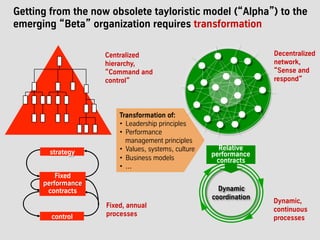
Centralized
hierarchy,
“Command and
control“
strategy
control
Fixed
performance
contracts
Decentralized
network,
“Sense and
respond“
Dynamic
coordination
Relative
performance
contracts
Dynamic,
continuous
processes
Transformation of:
•  Leadership principles
•  Performance
management principles
•  Values, systems, culture
•  Business models
•  ...
Getting from the now obsolete tayloristic model (“Alpha”) to the
emerging “Beta” organization requires transformation
Fixed, annual
processes
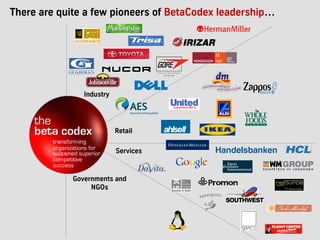
Industry
Retail
Services
Governments and
NGOs
There are quite a few pioneers of BetaCodex leadership…
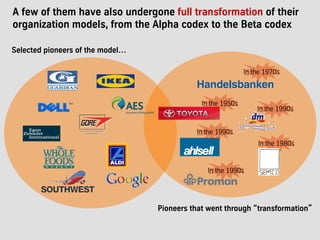
A few of them have also undergone full transformation of their
organization models, from the Alpha codex to the Beta codex
Selected pioneers of the model…
Pioneers that went through “transformation”
In the 1970s
In the 1990s
In the 1980s
In the 1990s
In the 1990s
In the 1950s
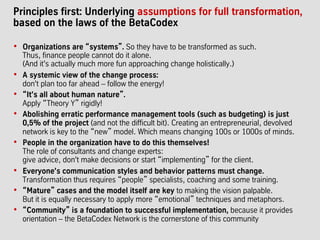
Principles first: Underlying assumptions for full transformation,
based on the laws of the BetaCodex
•  Organizations are “systems”. So they have to be transformed as such.
Thus, finance people cannot do it alone.
(And it's actually much more fun approaching change holistically.)
•  A systemic view of the change process:
don't plan too far ahead – follow the energy!
•  “It's all about human nature”.
Apply “Theory Y” rigidly!
•  Abolishing erratic performance management tools (such as budgeting) is just
0,5% of the project (and not the difficult bit). Creating an entrepreneurial, devolved
network is key to the “new” model. Which means changing 100s or 1000s of minds.
•  People in the organization have to do this themselves!
The role of consultants and change experts:
give advice, don't make decisions or start “implementing” for the client.
•  Everyone's communication styles and behavior patterns must change.
Transformation thus requires “people” specialists, coaching and some training.
•  “Mature” cases and the model itself are key to making the vision palpable.
But it is equally necessary to apply more “emotional” techniques and metaphors.
•  “Community” is a foundation to successful implementation, because it provides
orientation – the BetaCodex Network is the cornerstone of this community
Centralized
hierarchy,
“Command and
control“
strategy
control
Fixed
performance
contracts
Decentralized
network,
“Sense and
respond“
Dynamic
coordination
Relative
performance
contracts
Dynamic,
continuous
processes
Fixed, annual
processes
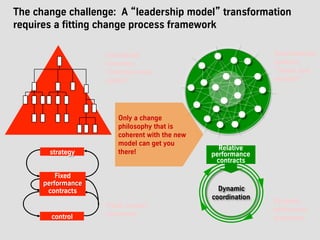
The change challenge: A “leadership model” transformation
requires a fitting change process framework
Only a change
philosophy that is
coherent with the new
model can get you
there!
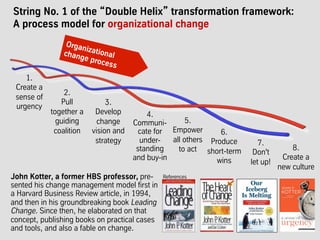
String No. 1 of the “Double Helix” transformation framework:
A process model for organizational change
John Kotter, a former HBS professor, pre-
sented his change management model first in
a Harvard Business Review article, in 1994,
and then in his groundbreaking book Leading
Change. Since then, he elaborated on that
concept, publishing books on practical cases
and tools, and also a fable on change.
3.
Develop
change
vision and
strategy
4.
Communi-
cate for
under-
standing
and buy-in
5.
Empower
all others
to act
6.
Produce
short-term
wins
7.
Don't
let up!
8.
Create a
new culture
1.
Create a
sense of
urgency
2.
Pull
together a
guiding
coalition
Organizationalchange process
References
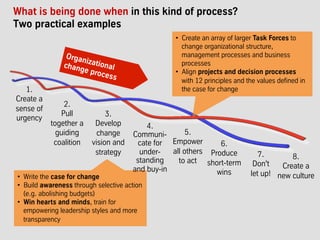
What is being done when in this kind of process?
Two practical examples
•  Write the case for change
•  Build awareness through selective action
(e.g. abolishing budgets)
•  Win hearts and minds, train for
empowering leadership styles and more
transparency
3.
Develop
change
vision and
strategy
4.
Communi-
cate for
under-
standing
and buy-in
5.
Empower
all others
to act
6.
Produce
short-term
wins
7.
Don't
let up!
8.
Create a
new culture
1.
Create a
sense of
urgency
2.
Pull
together a
guiding
coalition
Organizationalchange process
•  Create an array of larger Task Forces to
change organizational structure,
management processes and business
processes
•  Align projects and decision processes
with 12 principles and the values defined in
the case for change
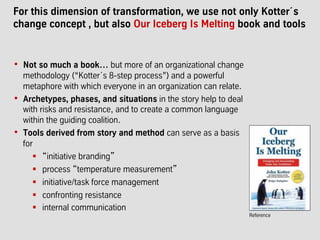
For this dimension of transformation, we use not only Kotter´s
change concept , but also Our Iceberg Is Melting book and tools
•  Not so much a book… but more of an organizational change
methodology (“Kotter´s 8-step process”) and a powerful
metaphore with which everyone in an organization can relate.
•  Archetypes, phases, and situations in the story help to deal
with risks and resistance, and to create a common language
within the guiding coalition.
•  Tools derived from story and method can serve as a basis
for
!  “initiative branding”
!  process “temperature measurement”
!  initiative/task force management
!  confronting resistance
!  internal communication
Reference
10 Paradigma Leadership Workshop, Apr 2007
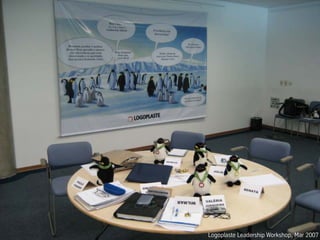
11 Logoplaste Leadership Workshop, Mar 2007
Even though the Kotter process by itself is coherent with
transformation, this approach alone cannot suffice
•  The problem: A process model for changing teams or the organization as
a whole doesn't cope with the full challenge we are facing in transforming
from command and control to “beyond budgeting”.
•  There is another dimension to change. One that is not related to groups
or the organization as a social organism, but that has to do with
each individual's transformation journey.
•  To achieve true organizational transformation, thus, another
dimension, or helix string, has to be added to the framework.
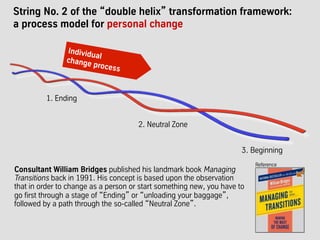
String No. 2 of the “double helix” transformation framework:
a process model for personal change
Reference
Consultant William Bridges published his landmark book Managing
Transitions back in 1991. His concept is based upon the observation
that in order to change as a person or start something new, you have to
go first through a stage of “Ending” or “unloading your baggage”,
followed by a path through the so-called “Neutral Zone”.
1. Ending
3. Beginning
2. Neutral Zone
Individualchange process
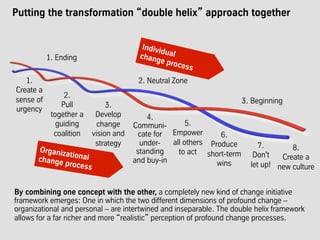
Putting the transformation “double helix” approach together
By combining one concept with the other, a completely new kind of change initiative
framework emerges: One in which the two different dimensions of profound change –
organizational and personal – are intertwined and inseparable. The double helix framework
allows for a far richer and more “realistic” perception of profound change processes.
3.
Develop
change
vision and
strategy
4.
Communi-
cate for
under-
standing
and buy-in
5.
Empower
all others
to act
6.
Produce
short-term
wins
7.
Don't
let up!
8.
Create a
new culture
1.
Create a
sense of
urgency
2.
Pull
together a
guiding
coalition
Organizationalchange process
1. Ending
3. Beginning
2. Neutral Zone
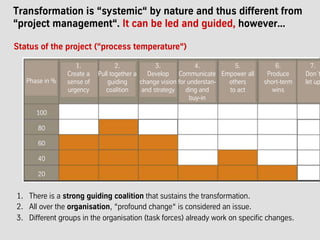
Transformation is “systemic“ by nature and thus different from
“project management“. It can be led and guided, however...
Status of the project (“process temperature“)
1.  There is a strong guiding coalition that sustains the transformation.
2.  All over the organisation, “profound change“ is considered an issue.
3.  Different groups in the organisation (task forces) already work on specific changes.
3.
Develop
change vision
and strategy
4.
Communicate
for understan-
ding and
buy-in
5.
Empower all
others
to act
6.
Produce
short-term
wins
7.
Don´t
let up
1.
Create a
sense of
urgency
2.
Pull together a
guiding
coalition
Phase in %
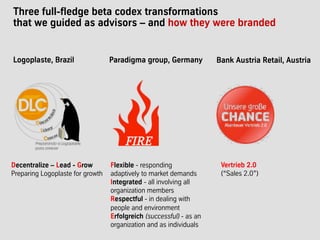
Three full-fledge beta codex transformations
that we guided as advisors – and how they were branded
FIRE
Flexible - responding
adaptively to market demands
Integrated - all involving all
organization members
Respectful - in dealing with
people and environment
Erfolgreich (successful) - as an
organization and as individuals
Paradigma group, GermanyLogoplaste, Brazil
Decentralize – Lead - Grow
Preparing Logoplaste for growth
Bank Austria Retail, Austria
Vertrieb 2.0
(“Sales 2.0”)
© BetaCodex Network – All rights reservedWhite paper – The 3 Structures of an Organization 25
Find all BetaCodex Network white papers on www.betacodex.org/papers and on Slideshare.
Special	
  
Edi+on	
  
Special	
  
Edi+on	
  
The BetaCodex Network white papers - so far
www.organizeforcomplexity.com
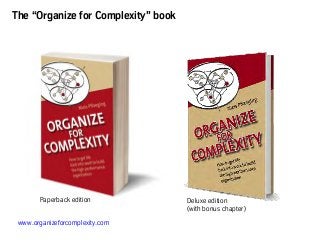
The “Organize for Complexity” book
Paperback edition Deluxe edition
(with bonus chapter)
betacodex.org
Get in touch with us for more information about leading BetaCodex transformation,
and ask us for a keynote or a workshop proposal.
Make it real!
Niels Pflaeging
contact@nielspflaeging.com
nielspflaeging.com
New York, Wiesbaden
Valérya Carvalho
mvaleriacarv@gmail.com
LinkedIn
São Paulo
Silke Hermann
silke.hermann@nsights-group.de
insights-group.de
Wiesbaden, Berlin, New York
Lars Vollmer
me@lars-vollmer.com
lars-vollmer.com
Hannover, Stuttgart

The Double Helix Transformation Framework for BetaCodex transformation and profound change (BetaCodex02)

  • 1.
    THE DOUBLE HELIX TRANSFORMATION FRAMEWORKforBetaCodex transformation and profound change Make it real! BetaCodex Network Associates Niels Pflaeging & Gebhard Borck White paper, February 2008, revised December 2011
  • 2.
    Centralized hierarchy, “Command and control“ strategy control Fixed performance contracts Decentralized network, “Sense and respond“ Dynamic coordination Relative performance contracts Dynamic, continuous processes Transformationof: •  Leadership principles •  Performance management principles •  Values, systems, culture •  Business models •  ... Getting from the now obsolete tayloristic model (“Alpha”) to the emerging “Beta” organization requires transformation Fixed, annual processes
  • 3.
    Industry Retail Services Governments and NGOs There arequite a few pioneers of BetaCodex leadership…
  • 4.
    A few ofthem have also undergone full transformation of their organization models, from the Alpha codex to the Beta codex Selected pioneers of the model… Pioneers that went through “transformation” In the 1970s In the 1990s In the 1980s In the 1990s In the 1990s In the 1950s
  • 5.
    Principles first: Underlyingassumptions for full transformation, based on the laws of the BetaCodex •  Organizations are “systems”. So they have to be transformed as such. Thus, finance people cannot do it alone. (And it's actually much more fun approaching change holistically.) •  A systemic view of the change process: don't plan too far ahead – follow the energy! •  “It's all about human nature”. Apply “Theory Y” rigidly! •  Abolishing erratic performance management tools (such as budgeting) is just 0,5% of the project (and not the difficult bit). Creating an entrepreneurial, devolved network is key to the “new” model. Which means changing 100s or 1000s of minds. •  People in the organization have to do this themselves! The role of consultants and change experts: give advice, don't make decisions or start “implementing” for the client. •  Everyone's communication styles and behavior patterns must change. Transformation thus requires “people” specialists, coaching and some training. •  “Mature” cases and the model itself are key to making the vision palpable. But it is equally necessary to apply more “emotional” techniques and metaphors. •  “Community” is a foundation to successful implementation, because it provides orientation – the BetaCodex Network is the cornerstone of this community
  • 6.
    Centralized hierarchy, “Command and control“ strategy control Fixed performance contracts Decentralized network, “Sense and respond“ Dynamic coordination Relative performance contracts Dynamic, continuous processes Fixed,annual processes The change challenge: A “leadership model” transformation requires a fitting change process framework Only a change philosophy that is coherent with the new model can get you there!
  • 7.
    String No. 1of the “Double Helix” transformation framework: A process model for organizational change John Kotter, a former HBS professor, pre- sented his change management model first in a Harvard Business Review article, in 1994, and then in his groundbreaking book Leading Change. Since then, he elaborated on that concept, publishing books on practical cases and tools, and also a fable on change. 3. Develop change vision and strategy 4. Communi- cate for under- standing and buy-in 5. Empower all others to act 6. Produce short-term wins 7. Don't let up! 8. Create a new culture 1. Create a sense of urgency 2. Pull together a guiding coalition Organizationalchange process References
  • 8.
    What is beingdone when in this kind of process? Two practical examples •  Write the case for change •  Build awareness through selective action (e.g. abolishing budgets) •  Win hearts and minds, train for empowering leadership styles and more transparency 3. Develop change vision and strategy 4. Communi- cate for under- standing and buy-in 5. Empower all others to act 6. Produce short-term wins 7. Don't let up! 8. Create a new culture 1. Create a sense of urgency 2. Pull together a guiding coalition Organizationalchange process •  Create an array of larger Task Forces to change organizational structure, management processes and business processes •  Align projects and decision processes with 12 principles and the values defined in the case for change
  • 9.
    For this dimensionof transformation, we use not only Kotter´s change concept , but also Our Iceberg Is Melting book and tools •  Not so much a book… but more of an organizational change methodology (“Kotter´s 8-step process”) and a powerful metaphore with which everyone in an organization can relate. •  Archetypes, phases, and situations in the story help to deal with risks and resistance, and to create a common language within the guiding coalition. •  Tools derived from story and method can serve as a basis for !  “initiative branding” !  process “temperature measurement” !  initiative/task force management !  confronting resistance !  internal communication Reference
  • 10.
    10 Paradigma LeadershipWorkshop, Apr 2007
  • 11.
    11 Logoplaste LeadershipWorkshop, Mar 2007
  • 12.
    Even though theKotter process by itself is coherent with transformation, this approach alone cannot suffice •  The problem: A process model for changing teams or the organization as a whole doesn't cope with the full challenge we are facing in transforming from command and control to “beyond budgeting”. •  There is another dimension to change. One that is not related to groups or the organization as a social organism, but that has to do with each individual's transformation journey. •  To achieve true organizational transformation, thus, another dimension, or helix string, has to be added to the framework.
  • 13.
    String No. 2of the “double helix” transformation framework: a process model for personal change Reference Consultant William Bridges published his landmark book Managing Transitions back in 1991. His concept is based upon the observation that in order to change as a person or start something new, you have to go first through a stage of “Ending” or “unloading your baggage”, followed by a path through the so-called “Neutral Zone”. 1. Ending 3. Beginning 2. Neutral Zone Individualchange process
  • 14.
    Individualchange process Putting thetransformation “double helix” approach together By combining one concept with the other, a completely new kind of change initiative framework emerges: One in which the two different dimensions of profound change – organizational and personal – are intertwined and inseparable. The double helix framework allows for a far richer and more “realistic” perception of profound change processes. 3. Develop change vision and strategy 4. Communi- cate for under- standing and buy-in 5. Empower all others to act 6. Produce short-term wins 7. Don't let up! 8. Create a new culture 1. Create a sense of urgency 2. Pull together a guiding coalition Organizationalchange process 1. Ending 3. Beginning 2. Neutral Zone
  • 15.
    Transformation is “systemic“by nature and thus different from “project management“. It can be led and guided, however... Status of the project (“process temperature“) 1.  There is a strong guiding coalition that sustains the transformation. 2.  All over the organisation, “profound change“ is considered an issue. 3.  Different groups in the organisation (task forces) already work on specific changes. 3. Develop change vision and strategy 4. Communicate for understan- ding and buy-in 5. Empower all others to act 6. Produce short-term wins 7. Don´t let up 1. Create a sense of urgency 2. Pull together a guiding coalition Phase in %
  • 16.
    Three full-fledge betacodex transformations that we guided as advisors – and how they were branded FIRE Flexible - responding adaptively to market demands Integrated - all involving all organization members Respectful - in dealing with people and environment Erfolgreich (successful) - as an organization and as individuals Paradigma group, GermanyLogoplaste, Brazil Decentralize – Lead - Grow Preparing Logoplaste for growth Bank Austria Retail, Austria Vertrieb 2.0 (“Sales 2.0”)
  • 17.
    © BetaCodex Network– All rights reservedWhite paper – The 3 Structures of an Organization 25 Find all BetaCodex Network white papers on www.betacodex.org/papers and on Slideshare. Special   Edi+on   Special   Edi+on   The BetaCodex Network white papers - so far
  • 18.
    www.organizeforcomplexity.com The “Organize forComplexity” book Paperback edition Deluxe edition (with bonus chapter)
  • 19.
    betacodex.org Get in touchwith us for more information about leading BetaCodex transformation, and ask us for a keynote or a workshop proposal. Make it real! Niels Pflaeging contact@nielspflaeging.com nielspflaeging.com New York, Wiesbaden Valérya Carvalho mvaleriacarv@gmail.com LinkedIn São Paulo Silke Hermann silke.hermann@nsights-group.de insights-group.de Wiesbaden, Berlin, New York Lars Vollmer me@lars-vollmer.com lars-vollmer.com Hannover, Stuttgart