Organizational Change  19- © 2009 Prentice-Hall Inc.  All rights reserved.
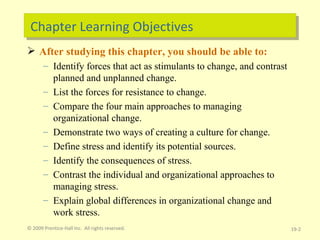
Chapter Learning Objectives After studying this chapter, you should be able to: Identify forces that act as stimulants to change, and contrast planned and unplanned change. List the forces for resistance to change. Compare the four main approaches to managing organizational change. Demonstrate two ways of creating a culture for change. Define stress and identify its potential sources. Identify the consequences of stress. Contrast the individual and organizational approaches to managing stress. Explain global differences in organizational change and work stress. © 2009 Prentice-Hall Inc.  All rights reserved. 19-
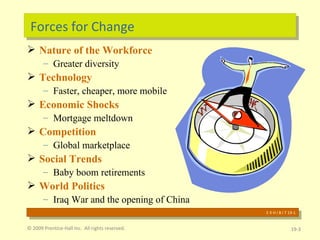
Forces for Change Nature of the Workforce Greater diversity Technology Faster, cheaper, more mobile Economic Shocks Mortgage meltdown Competition Global marketplace Social Trends Baby boom retirements World Politics Iraq War and the opening of China © 2009 Prentice-Hall Inc.  All rights reserved. 19- E X H I B I T 19-1
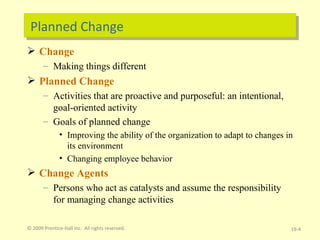
Planned Change Change Making things different Planned Change Activities that are proactive and purposeful: an intentional, goal-oriented activity Goals of planned change Improving the ability of the organization to adapt to changes in its environment Changing employee behavior Change Agents Persons who act as catalysts and assume the responsibility for managing change activities © 2009 Prentice-Hall Inc.  All rights reserved. 19-
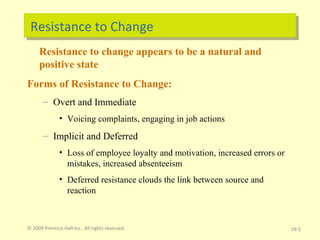
Resistance to Change Resistance to change appears to be a natural and positive state Forms of Resistance to Change: Overt and Immediate Voicing complaints, engaging in job actions Implicit and Deferred Loss of employee loyalty and motivation, increased errors or mistakes, increased absenteeism Deferred resistance clouds the link between source and reaction © 2009 Prentice-Hall Inc.  All rights reserved. 19-
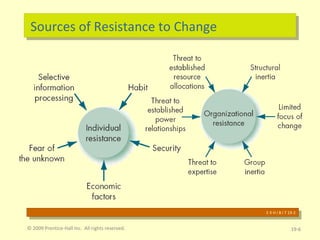
Sources of Resistance to Change © 2009 Prentice-Hall Inc.  All rights reserved. 19- E X H I B I T 19-2
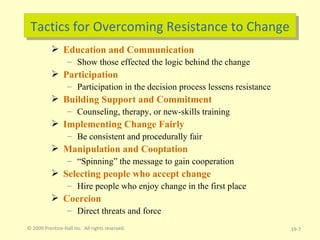
Tactics for Overcoming Resistance to Change Education and Communication Show those effected the logic behind the change Participation Participation in the decision process lessens resistance Building Support and Commitment Counseling, therapy, or new-skills training Implementing Change Fairly Be consistent and procedurally fair Manipulation and Cooptation “ Spinning” the message to gain cooperation Selecting people who accept change Hire people who enjoy change in the first place Coercion Direct threats and force © 2009 Prentice-Hall Inc.  All rights reserved. 19-
The Politics of Change Impetus for change is likely to come from outside change agents, new employees, or managers outside the main power structure. Internal change agents are most threatened by their loss of status in the organization. Long-time power holders tend to implement incremental but not radical change. The outcomes of power struggles in the organization will determine the speed and quality of change. © 2009 Prentice-Hall Inc.  All rights reserved. 19-
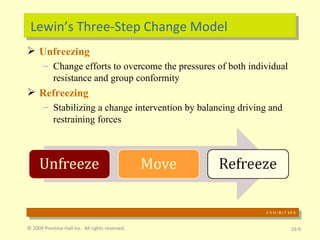
Lewin’s Three-Step Change Model Unfreezing Change efforts to overcome the pressures of both individual resistance and group conformity Refreezing Stabilizing a change intervention by balancing driving and restraining forces © 2009 Prentice-Hall Inc.  All rights reserved. 19- E X H I B I T 19-3
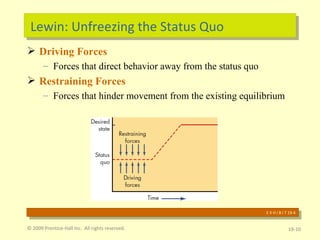
Lewin: Unfreezing the Status Quo Driving Forces Forces that direct behavior away from the status quo Restraining Forces Forces that hinder movement from the existing equilibrium © 2009 Prentice-Hall Inc.  All rights reserved. 19- E X H I B I T 19-4
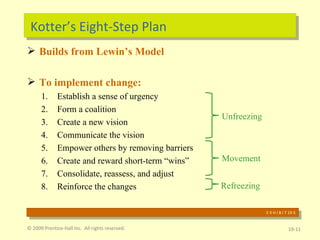
Kotter’s Eight-Step Plan Builds from Lewin’s Model To implement change: Establish a sense of urgency Form a coalition  Create a new vision Communicate the vision  Empower others by removing barriers Create and reward short-term “wins” Consolidate, reassess, and adjust Reinforce the changes  © 2009 Prentice-Hall Inc.  All rights reserved. 19- E X H I B I T 19-5 Unfreezing Movement Refreezing
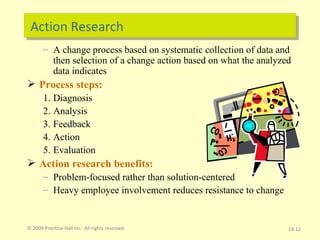
Action Research A change process based on systematic collection of data and then selection of a change action based on what the analyzed data indicates Process steps: Diagnosis Analysis Feedback Action Evaluation Action research benefits: Problem-focused rather than solution-centered Heavy employee involvement reduces resistance to change © 2009 Prentice-Hall Inc.  All rights reserved. 19-
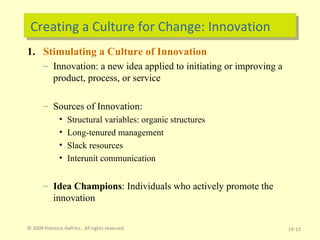
Creating a Culture for Change: Innovation Stimulating a Culture of Innovation Innovation: a new idea applied to initiating or improving a product, process, or service Sources of Innovation: Structural variables: organic structures Long-tenured management Slack resources Interunit communication Idea Champions : Individuals who actively promote the innovation © 2009 Prentice-Hall Inc.  All rights reserved. 19-
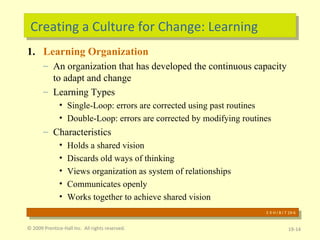
Creating a Culture for Change: Learning Learning Organization An organization that has developed the continuous capacity to adapt and change Learning Types Single-Loop: errors are corrected using past routines Double-Loop: errors are corrected by modifying routines Characteristics  Holds a shared vision Discards old ways of thinking Views organization as system of relationships Communicates openly Works together to achieve shared vision © 2009 Prentice-Hall Inc.  All rights reserved. 19- E X H I B I T 19-6
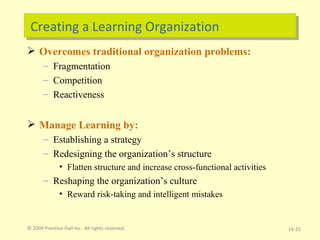
Creating a Learning Organization Overcomes traditional organization problems: Fragmentation Competition Reactiveness Manage Learning by: Establishing a strategy Redesigning the organization’s structure Flatten structure and increase cross-functional activities Reshaping the organization’s culture Reward risk-taking and intelligent mistakes © 2009 Prentice-Hall Inc.  All rights reserved. 19-
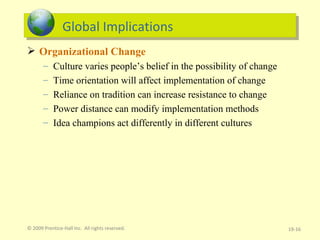
Global Implications Organizational Change Culture varies people’s belief in the possibility of change Time orientation will affect implementation of change Reliance on tradition can increase resistance to change Power distance can modify implementation methods Idea champions act differently in different cultures 19- © 2009 Prentice-Hall Inc.  All rights reserved.
Summary and Managerial Implications Organizations and the individuals within them must undergo dynamic change Managers are change agents and modifiers of organizational culture 19- © 2009 Prentice-Hall Inc.  All rights reserved.
© 2009 Prentice-Hall Inc.  All rights reserved. 19- Please Visit Us At : http://wanbk.page.tl

Chapter 15

  • 1.
    Organizational Change 19- © 2009 Prentice-Hall Inc. All rights reserved.
  • 2.
    Chapter Learning ObjectivesAfter studying this chapter, you should be able to: Identify forces that act as stimulants to change, and contrast planned and unplanned change. List the forces for resistance to change. Compare the four main approaches to managing organizational change. Demonstrate two ways of creating a culture for change. Define stress and identify its potential sources. Identify the consequences of stress. Contrast the individual and organizational approaches to managing stress. Explain global differences in organizational change and work stress. © 2009 Prentice-Hall Inc. All rights reserved. 19-
  • 3.
    Forces for ChangeNature of the Workforce Greater diversity Technology Faster, cheaper, more mobile Economic Shocks Mortgage meltdown Competition Global marketplace Social Trends Baby boom retirements World Politics Iraq War and the opening of China © 2009 Prentice-Hall Inc. All rights reserved. 19- E X H I B I T 19-1
  • 4.
    Planned Change ChangeMaking things different Planned Change Activities that are proactive and purposeful: an intentional, goal-oriented activity Goals of planned change Improving the ability of the organization to adapt to changes in its environment Changing employee behavior Change Agents Persons who act as catalysts and assume the responsibility for managing change activities © 2009 Prentice-Hall Inc. All rights reserved. 19-
  • 5.
    Resistance to ChangeResistance to change appears to be a natural and positive state Forms of Resistance to Change: Overt and Immediate Voicing complaints, engaging in job actions Implicit and Deferred Loss of employee loyalty and motivation, increased errors or mistakes, increased absenteeism Deferred resistance clouds the link between source and reaction © 2009 Prentice-Hall Inc. All rights reserved. 19-
  • 6.
    Sources of Resistanceto Change © 2009 Prentice-Hall Inc. All rights reserved. 19- E X H I B I T 19-2
  • 7.
    Tactics for OvercomingResistance to Change Education and Communication Show those effected the logic behind the change Participation Participation in the decision process lessens resistance Building Support and Commitment Counseling, therapy, or new-skills training Implementing Change Fairly Be consistent and procedurally fair Manipulation and Cooptation “ Spinning” the message to gain cooperation Selecting people who accept change Hire people who enjoy change in the first place Coercion Direct threats and force © 2009 Prentice-Hall Inc. All rights reserved. 19-
  • 8.
    The Politics ofChange Impetus for change is likely to come from outside change agents, new employees, or managers outside the main power structure. Internal change agents are most threatened by their loss of status in the organization. Long-time power holders tend to implement incremental but not radical change. The outcomes of power struggles in the organization will determine the speed and quality of change. © 2009 Prentice-Hall Inc. All rights reserved. 19-
  • 9.
    Lewin’s Three-Step ChangeModel Unfreezing Change efforts to overcome the pressures of both individual resistance and group conformity Refreezing Stabilizing a change intervention by balancing driving and restraining forces © 2009 Prentice-Hall Inc. All rights reserved. 19- E X H I B I T 19-3
  • 10.
    Lewin: Unfreezing theStatus Quo Driving Forces Forces that direct behavior away from the status quo Restraining Forces Forces that hinder movement from the existing equilibrium © 2009 Prentice-Hall Inc. All rights reserved. 19- E X H I B I T 19-4
  • 11.
    Kotter’s Eight-Step PlanBuilds from Lewin’s Model To implement change: Establish a sense of urgency Form a coalition Create a new vision Communicate the vision Empower others by removing barriers Create and reward short-term “wins” Consolidate, reassess, and adjust Reinforce the changes © 2009 Prentice-Hall Inc. All rights reserved. 19- E X H I B I T 19-5 Unfreezing Movement Refreezing
  • 12.
    Action Research Achange process based on systematic collection of data and then selection of a change action based on what the analyzed data indicates Process steps: Diagnosis Analysis Feedback Action Evaluation Action research benefits: Problem-focused rather than solution-centered Heavy employee involvement reduces resistance to change © 2009 Prentice-Hall Inc. All rights reserved. 19-
  • 13.
    Creating a Culturefor Change: Innovation Stimulating a Culture of Innovation Innovation: a new idea applied to initiating or improving a product, process, or service Sources of Innovation: Structural variables: organic structures Long-tenured management Slack resources Interunit communication Idea Champions : Individuals who actively promote the innovation © 2009 Prentice-Hall Inc. All rights reserved. 19-
  • 14.
    Creating a Culturefor Change: Learning Learning Organization An organization that has developed the continuous capacity to adapt and change Learning Types Single-Loop: errors are corrected using past routines Double-Loop: errors are corrected by modifying routines Characteristics Holds a shared vision Discards old ways of thinking Views organization as system of relationships Communicates openly Works together to achieve shared vision © 2009 Prentice-Hall Inc. All rights reserved. 19- E X H I B I T 19-6
  • 15.
    Creating a LearningOrganization Overcomes traditional organization problems: Fragmentation Competition Reactiveness Manage Learning by: Establishing a strategy Redesigning the organization’s structure Flatten structure and increase cross-functional activities Reshaping the organization’s culture Reward risk-taking and intelligent mistakes © 2009 Prentice-Hall Inc. All rights reserved. 19-
  • 16.
    Global Implications OrganizationalChange Culture varies people’s belief in the possibility of change Time orientation will affect implementation of change Reliance on tradition can increase resistance to change Power distance can modify implementation methods Idea champions act differently in different cultures 19- © 2009 Prentice-Hall Inc. All rights reserved.
  • 17.
    Summary and ManagerialImplications Organizations and the individuals within them must undergo dynamic change Managers are change agents and modifiers of organizational culture 19- © 2009 Prentice-Hall Inc. All rights reserved.
  • 18.
    © 2009 Prentice-HallInc. All rights reserved. 19- Please Visit Us At : http://wanbk.page.tl