Organizational Culture
& Power Politics
By,
Ibrahim Noorani
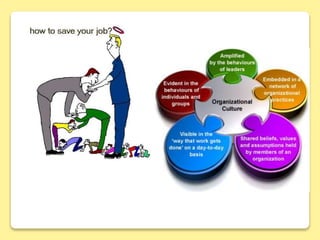
 Culture is the conventional behavior of an
organization that encompasses beliefs, customs,
knowledge, and practices. It influences human
behavior, even though it seldom enters into their
conscious thought. People depend on culture as it
gives them stability, security, understanding, and the
ability to respond to a given situation. This is why
people fear change. They fear the system will become
unstable, their security will be lost, they will not
understand the new process, and they will not know
how to respond to the new situations.
 LEVELS OF ORGANIZATION CULTURE
LEVEL 1---VISIBLE, that can be seen at
the surface level
-dress codes
-office layout [ open office]
-symbols
-slogans
-ceremonies[ monthly / annual
awards/long service/birthdays etc.
etc
HOW AN ORGANIZATION's CULTURE CAN BE
KNOWN ?
 LEVEL 2- INVISIBLE , that can be cannot
be seen but only felt.
-stories about people performance
-symbols [ flag, trademark, logos, etc]
-corporate mission statements
-recruitment/selection [ methods used]
-fairness in treatment
-social equality
-risk taking in business deals
-formality in approach
-discipline
-autonomy for departments
-responsiveness to communication
-empowerment of staff.
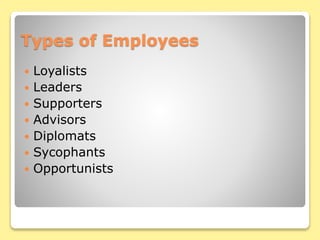
Types of Employees
 Loyalists
 Leaders
 Supporters
 Advisors
 Diplomats
 Sycophants
 Opportunists
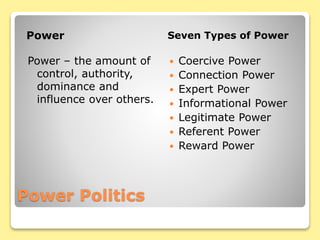
Power Politics
Power Seven Types of Power
Power – the amount of
control, authority,
dominance and
influence over others.
 Coercive Power
 Connection Power
 Expert Power
 Informational Power
 Legitimate Power
 Referent Power
 Reward Power
Organizational Change refers to a modification or
transformation of the organization’s structure, processes or
goods.
Organizational change is defined as change
that has an impact on the way work is
performed and has significant effects on staff.
8
Organizational Change
Forces for change in organization
There are two forces which foster the organization to
change:
1. External forces
2. Internal forces.
9
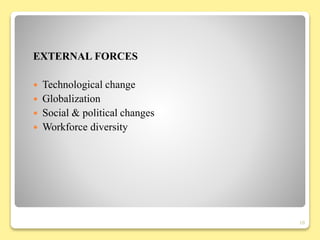
EXTERNAL FORCES
 Technological change
 Globalization
 Social & political changes
 Workforce diversity
10
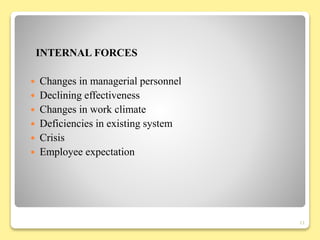
INTERNAL FORCES
 Changes in managerial personnel
 Declining effectiveness
 Changes in work climate
 Deficiencies in existing system
 Crisis
 Employee expectation
11
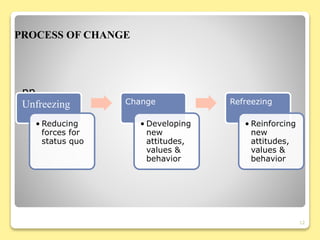
PROCESS OF CHANGE
pp
12
Unfreezing
• Reducing
forces for
status quo
Change
• Developing
new
attitudes,
values &
behavior
Refreezing
• Reinforcing
new
attitudes,
values &
behavior
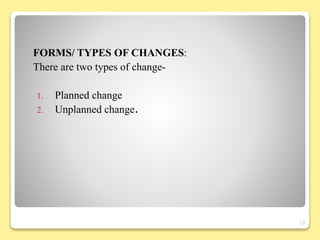
FORMS/ TYPES OF CHANGES:
There are two types of change-
1. Planned change
2. Unplanned change.
13
 Planned change:- planned change is change resulting from a
deliberate decision to alter the organization. It is an intentional,
goal – oriented activity.
 Unplanned change:- unplanned change is imposed on the
organization & is often unforeseen.
Example : change in government regulation, change in the
economy
14
RESISTANCE TO CHANGE:
There are two sources of resistance to change:
 Individual Resistance.
 Organizational Resistance
15
INDIVIDUAL RESISTANCE
Individual sources of resistance to change reside in basic human
characteristics such as perceptions, personalities & needs.
Reasons of individual resistance:
 Economic Reason –The economic reason of resistance to
change usually focus on:
 Fear of technological unemployment.
 Fear of reduced work hours & consequently less pay.
 Fear of demotion & thus reduced pay.
16
 Fear of Loss- When a change is impending, some
employees may fear losing their jobs, status particularly
when an advanced technology is introduced.
 Security – people with a high need for security are likely
to resist change because it threatens their feeling of
safety.
 Status quo- change may pose disturbance to the existing
comforts of status quo.
 Peer Pressure- individual employees may be
prepared to accept change but refuse to accept
it for the sake of the group.
.
17
 Disruption of Interpersonal Relation- employees may
resist change that threatens to limit meaningful interpersonal
relationships on the job.
 Social Displacement- Introduction of change often results
in disturbance of the existing social relationships. Change
may also result in breaking up of work groups.
18
ORGANIZATIONAL RESISTANCE
Organizations, by their very nature are conservative. They
actively resist change. Reason of organizational resistance
 Resource constraint: resources are major constraints for
many organizations. The necessary financial , material &
human resources may not be available to the organization to
make the needed changes.
 Structural inertia – some organizational structures have
in-built mechanism for resistance to change.
Eg in bureaucratic structure where jobs are
narrowly defined & lines of authority are clearly
spelled out, change would be difficult.
19
Sunk cost:- Some organization invest a huge amount of
capital in fixed assets. If an organization wishes to introduce
change, then difficulty arise because of the sunk cost.
Threat to expertise:- Change in organizational pattern may
threaten the expertise of specialized groups. Therefore,
specialists usually resist change.
Politics:- Organizational changes may also shift the existing
balance of power in an organization. Individuals
or groups who hold power under the current
arrangement may fear losing these political
advantages.
20
MANAGING RESISTANCE TO CHANGE
Some tactics are used to resist the change:
Education & Communication: Communication about
impending change is essential if employees are to adjust
effectively. The details of change should be provided & its
potential consequences. Educating employees on new work
procedures is often helpful.
Participation:- It is difficult for individuals to
resist a change decision in which they
participated. Prior to making a change, those
opposed can be brought into the decision process.
21
Empathy & Support:- Active listening is an excellent tool for
identifying the reasons behind the resistance. An expression
of concerns about the change can provide important feedback
that managers can use to improve the change process.
Negotiation:- another way to deal with resistance to change is
to exchange something of value for reduction in resistance.
Manipulation & Cooptation:- Manipulation
refers to covert influence attempts. Twisting
& distorting facts to make them appear more
attractive, withholding undesirable information &
creating false rumors to get employees to accept
a change .
22
Coercion:- Coercion is the application of direct threats or force
on the resisters. They essentially force people to accept a
change by explicitly or implicitly threatening them with the
loss of their jobs, promotion possibilities & transferring them.
23
Organizational Development
Organization Development (OD) is a planned approach to
improve employee and organizational effectiveness by
conscious interventions in those processes and structures that
have an immediate bearing on the human aspect of the
organization.
24
Features of OD
 Organizational Development is an educational strategy that
attempts to bring about a planned change.
 Organizational Development relates to real organizational
problems instead of hypothetical cases.
 Organizational Development uses sensitivity training methods
and lay emphasis on the significance of experiment based
training.
 Its change agents are almost external consultants outside of
the organization.
 The external change agents and internal
organization executives establish a collaborative
relationship that involves mutual trust, influence
and jointly determined goals.
25
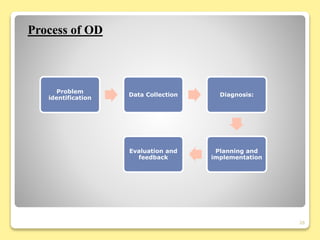
Process of OD
26
Problem
identification
Data Collection Diagnosis:
Planning and
implementation
Evaluation and
feedback

Culture & Power.pptx

  • 1.
    Organizational Culture & PowerPolitics By, Ibrahim Noorani
  • 2.
     Culture isthe conventional behavior of an organization that encompasses beliefs, customs, knowledge, and practices. It influences human behavior, even though it seldom enters into their conscious thought. People depend on culture as it gives them stability, security, understanding, and the ability to respond to a given situation. This is why people fear change. They fear the system will become unstable, their security will be lost, they will not understand the new process, and they will not know how to respond to the new situations.
  • 4.
     LEVELS OFORGANIZATION CULTURE LEVEL 1---VISIBLE, that can be seen at the surface level -dress codes -office layout [ open office] -symbols -slogans -ceremonies[ monthly / annual awards/long service/birthdays etc. etc HOW AN ORGANIZATION's CULTURE CAN BE KNOWN ?
  • 5.
     LEVEL 2-INVISIBLE , that can be cannot be seen but only felt. -stories about people performance -symbols [ flag, trademark, logos, etc] -corporate mission statements -recruitment/selection [ methods used] -fairness in treatment -social equality -risk taking in business deals -formality in approach -discipline -autonomy for departments -responsiveness to communication -empowerment of staff.
  • 6.
    Types of Employees Loyalists  Leaders  Supporters  Advisors  Diplomats  Sycophants  Opportunists
  • 7.
    Power Politics Power SevenTypes of Power Power – the amount of control, authority, dominance and influence over others.  Coercive Power  Connection Power  Expert Power  Informational Power  Legitimate Power  Referent Power  Reward Power
  • 8.
    Organizational Change refersto a modification or transformation of the organization’s structure, processes or goods. Organizational change is defined as change that has an impact on the way work is performed and has significant effects on staff. 8 Organizational Change
  • 9.
    Forces for changein organization There are two forces which foster the organization to change: 1. External forces 2. Internal forces. 9
  • 10.
    EXTERNAL FORCES  Technologicalchange  Globalization  Social & political changes  Workforce diversity 10
  • 11.
    INTERNAL FORCES  Changesin managerial personnel  Declining effectiveness  Changes in work climate  Deficiencies in existing system  Crisis  Employee expectation 11
  • 12.
    PROCESS OF CHANGE pp 12 Unfreezing •Reducing forces for status quo Change • Developing new attitudes, values & behavior Refreezing • Reinforcing new attitudes, values & behavior
  • 13.
    FORMS/ TYPES OFCHANGES: There are two types of change- 1. Planned change 2. Unplanned change. 13
  • 14.
     Planned change:-planned change is change resulting from a deliberate decision to alter the organization. It is an intentional, goal – oriented activity.  Unplanned change:- unplanned change is imposed on the organization & is often unforeseen. Example : change in government regulation, change in the economy 14
  • 15.
    RESISTANCE TO CHANGE: Thereare two sources of resistance to change:  Individual Resistance.  Organizational Resistance 15
  • 16.
    INDIVIDUAL RESISTANCE Individual sourcesof resistance to change reside in basic human characteristics such as perceptions, personalities & needs. Reasons of individual resistance:  Economic Reason –The economic reason of resistance to change usually focus on:  Fear of technological unemployment.  Fear of reduced work hours & consequently less pay.  Fear of demotion & thus reduced pay. 16
  • 17.
     Fear ofLoss- When a change is impending, some employees may fear losing their jobs, status particularly when an advanced technology is introduced.  Security – people with a high need for security are likely to resist change because it threatens their feeling of safety.  Status quo- change may pose disturbance to the existing comforts of status quo.  Peer Pressure- individual employees may be prepared to accept change but refuse to accept it for the sake of the group. . 17
  • 18.
     Disruption ofInterpersonal Relation- employees may resist change that threatens to limit meaningful interpersonal relationships on the job.  Social Displacement- Introduction of change often results in disturbance of the existing social relationships. Change may also result in breaking up of work groups. 18
  • 19.
    ORGANIZATIONAL RESISTANCE Organizations, bytheir very nature are conservative. They actively resist change. Reason of organizational resistance  Resource constraint: resources are major constraints for many organizations. The necessary financial , material & human resources may not be available to the organization to make the needed changes.  Structural inertia – some organizational structures have in-built mechanism for resistance to change. Eg in bureaucratic structure where jobs are narrowly defined & lines of authority are clearly spelled out, change would be difficult. 19
  • 20.
    Sunk cost:- Someorganization invest a huge amount of capital in fixed assets. If an organization wishes to introduce change, then difficulty arise because of the sunk cost. Threat to expertise:- Change in organizational pattern may threaten the expertise of specialized groups. Therefore, specialists usually resist change. Politics:- Organizational changes may also shift the existing balance of power in an organization. Individuals or groups who hold power under the current arrangement may fear losing these political advantages. 20
  • 21.
    MANAGING RESISTANCE TOCHANGE Some tactics are used to resist the change: Education & Communication: Communication about impending change is essential if employees are to adjust effectively. The details of change should be provided & its potential consequences. Educating employees on new work procedures is often helpful. Participation:- It is difficult for individuals to resist a change decision in which they participated. Prior to making a change, those opposed can be brought into the decision process. 21
  • 22.
    Empathy & Support:-Active listening is an excellent tool for identifying the reasons behind the resistance. An expression of concerns about the change can provide important feedback that managers can use to improve the change process. Negotiation:- another way to deal with resistance to change is to exchange something of value for reduction in resistance. Manipulation & Cooptation:- Manipulation refers to covert influence attempts. Twisting & distorting facts to make them appear more attractive, withholding undesirable information & creating false rumors to get employees to accept a change . 22
  • 23.
    Coercion:- Coercion isthe application of direct threats or force on the resisters. They essentially force people to accept a change by explicitly or implicitly threatening them with the loss of their jobs, promotion possibilities & transferring them. 23
  • 24.
    Organizational Development Organization Development(OD) is a planned approach to improve employee and organizational effectiveness by conscious interventions in those processes and structures that have an immediate bearing on the human aspect of the organization. 24
  • 25.
    Features of OD Organizational Development is an educational strategy that attempts to bring about a planned change.  Organizational Development relates to real organizational problems instead of hypothetical cases.  Organizational Development uses sensitivity training methods and lay emphasis on the significance of experiment based training.  Its change agents are almost external consultants outside of the organization.  The external change agents and internal organization executives establish a collaborative relationship that involves mutual trust, influence and jointly determined goals. 25
  • 26.
    Process of OD 26 Problem identification DataCollection Diagnosis: Planning and implementation Evaluation and feedback