Basic Challenges of
Organizational Design
Organization Design and Theory
Gibran D. Kwan
Learning Objectives
 After studying this chapter you should be able to:
 1. Describe the four basic organizational design challenges confronting
managers and consultants.
 2. Discuss the way in which these challenges must be addressed
simultaneously if a high-performing organizational structure is to be
created.
 3. Distinguish among the design choices that underlie the creation of either a
mechanistic or an organic structure.
 4. Recognize how to use contingency theory to design a structure that fits an
organization’s environment.
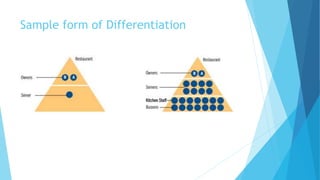
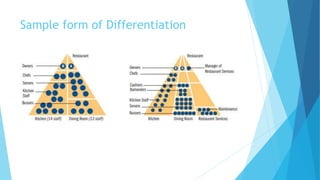
Differentiation
 The process by which an organization allocates people and
resources to organizational tasks and establishes the task
and authority relationships that allow the organization to
achieve its goals.
Sample form of Differentiation
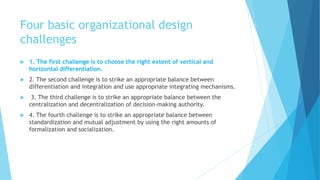
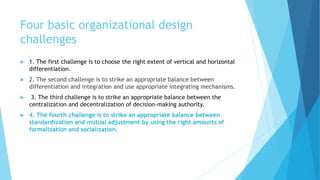
Four basic organizational design
challenges
 1. The first challenge is to choose the right extent of vertical and
horizontal differentiation.
 2. The second challenge is to strike an appropriate balance between
differentiation and integration and use appropriate integrating mechanisms.
 3. The third challenge is to strike an appropriate balance between the
centralization and decentralization of decision-making authority.
 4. The fourth challenge is to strike an appropriate balance between
standardization and mutual adjustment by using the right amounts of
formalization and socialization.
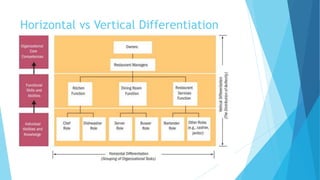
Horizontal vs Vertical Differentiation
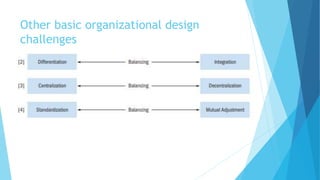
Other basic organizational design
challenges
Horizontal vs Vertical Differentiation
 Hierarchy A classification of people according to authority and rank.
 Vertical differentiation The way an organization designs its hierarchy of
authority and creates reporting relationships to link organizational roles and
subunits.
 Horizontal differentiation The way an organization groups organizational tasks
into roles and roles into subunits (functions and divisions).
Four basic organizational design
challenges
 1. The first challenge is to choose the right extent of vertical and horizontal
differentiation.
 2. The second challenge is to strike an appropriate balance between
differentiation and integration and use appropriate integrating
mechanisms.
 3. The third challenge is to strike an appropriate balance between the
centralization and decentralization of decision-making authority.
 4. The fourth challenge is to strike an appropriate balance between
standardization and mutual adjustment by using the right amounts of
formalization and socialization.
Integration and Integrating Mechanisms
 Integration The process of coordinating various tasks, functions, and divisions
so that they work together and not at cross purposes.
 HIERARCHY OF AUTHORITY - The simplest integrating technique is the
organization’s hierarchy of authority, which differentiates people by the
amount of authority they possess.
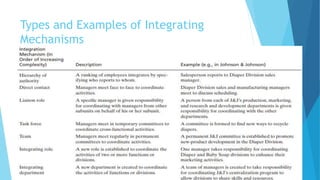
Types and Examples of Integrating
Mechanisms
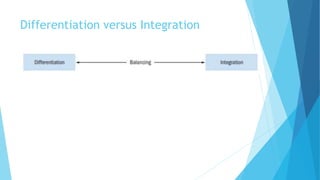
Differentiation versus Integration
Four basic organizational design
challenges
 1. The first challenge is to choose the right extent of vertical and horizontal
differentiation.
 2. The second challenge is to strike an appropriate balance between
differentiation and integration and use appropriate integrating mechanisms.
 3. The third challenge is to strike an appropriate balance between the
centralization and decentralization of decision-making authority.
 4. The fourth challenge is to strike an appropriate balance between
standardization and mutual adjustment by using the right amounts of
formalization and socialization.
Balancing Centralization and
Decentralization
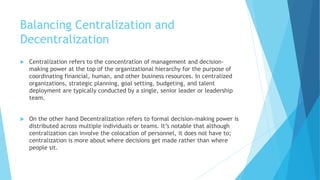
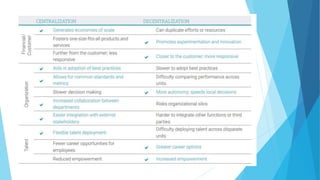
 Centralization refers to the concentration of management and decision-
making power at the top of the organizational hierarchy for the purpose of
coordinating financial, human, and other business resources. In centralized
organizations, strategic planning, goal setting, budgeting, and talent
deployment are typically conducted by a single, senior leader or leadership
team.
 On the other hand Decentralization refers to formal decision-making power is
distributed across multiple individuals or teams. It’s notable that although
centralization can involve the colocation of personnel, it does not have to;
centralization is more about where decisions get made rather than where
people sit.
Four basic organizational design
challenges
 1. The first challenge is to choose the right extent of vertical and horizontal
differentiation.
 2. The second challenge is to strike an appropriate balance between
differentiation and integration and use appropriate integrating mechanisms.
 3. The third challenge is to strike an appropriate balance between the
centralization and decentralization of decision-making authority.
 4. The fourth challenge is to strike an appropriate balance between
standardization and mutual adjustment by using the right amounts of
formalization and socialization.
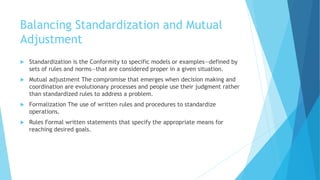
Balancing Standardization and Mutual
Adjustment
 Standardization is the Conformity to specific models or examples—defined by
sets of rules and norms—that are considered proper in a given situation.
 Mutual adjustment The compromise that emerges when decision making and
coordination are evolutionary processes and people use their judgment rather
than standardized rules to address a problem.
 Formalization The use of written rules and procedures to standardize
operations.
 Rules Formal written statements that specify the appropriate means for
reaching desired goals.
Learning Objectives
 After studying this chapter you should be able to:
 1. Describe the four basic organizational design challenges confronting
managers and consultants.
 2. Discuss the way in which these challenges must be addressed
simultaneously if a high-performing organizational structure is to be created.
 3. Distinguish among the design choices that underlie the creation of
either a mechanistic or an organic structure.
 4. Recognize how to use contingency theory to design a structure that fits an
organization’s environment.
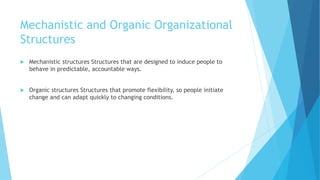
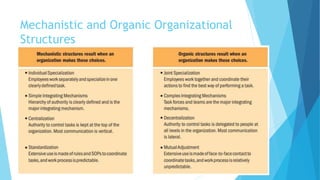
Mechanistic and Organic Organizational
Structures
 Mechanistic structures Structures that are designed to induce people to
behave in predictable, accountable ways.
 Organic structures Structures that promote flexibility, so people initiate
change and can adapt quickly to changing conditions.
Mechanistic and Organic Organizational
Structures
Learning Objectives
 After studying this chapter you should be able to:
 1. Describe the four basic organizational design challenges confronting
managers and consultants.
 2. Discuss the way in which these challenges must be addressed
simultaneously if a high-performing organizational structure is to be created.
 3. Distinguish among the design choices that underlie the creation of either a
mechanistic or an organic structure.
 4. Recognize how to use contingency theory to design a structure that fits
an organization’s environment.
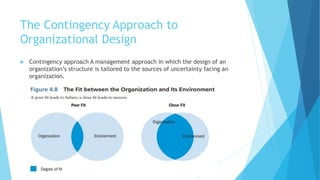
The Contingency Approach to
Organizational Design
 Contingency approach A management approach in which the design of an
organization’s structure is tailored to the sources of uncertainty facing an
organization.
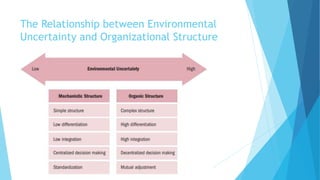
The Relationship between Environmental
Uncertainty and Organizational Structure

Basic Challenges of Organizational Design.pptx

  • 1.
    Basic Challenges of OrganizationalDesign Organization Design and Theory Gibran D. Kwan
  • 2.
    Learning Objectives  Afterstudying this chapter you should be able to:  1. Describe the four basic organizational design challenges confronting managers and consultants.  2. Discuss the way in which these challenges must be addressed simultaneously if a high-performing organizational structure is to be created.  3. Distinguish among the design choices that underlie the creation of either a mechanistic or an organic structure.  4. Recognize how to use contingency theory to design a structure that fits an organization’s environment.
  • 3.
    Differentiation  The processby which an organization allocates people and resources to organizational tasks and establishes the task and authority relationships that allow the organization to achieve its goals.
  • 4.
    Sample form ofDifferentiation
  • 5.
    Sample form ofDifferentiation
  • 6.
    Four basic organizationaldesign challenges  1. The first challenge is to choose the right extent of vertical and horizontal differentiation.  2. The second challenge is to strike an appropriate balance between differentiation and integration and use appropriate integrating mechanisms.  3. The third challenge is to strike an appropriate balance between the centralization and decentralization of decision-making authority.  4. The fourth challenge is to strike an appropriate balance between standardization and mutual adjustment by using the right amounts of formalization and socialization.
  • 7.
    Horizontal vs VerticalDifferentiation
  • 8.
    Other basic organizationaldesign challenges
  • 9.
    Horizontal vs VerticalDifferentiation  Hierarchy A classification of people according to authority and rank.  Vertical differentiation The way an organization designs its hierarchy of authority and creates reporting relationships to link organizational roles and subunits.  Horizontal differentiation The way an organization groups organizational tasks into roles and roles into subunits (functions and divisions).
  • 10.
    Four basic organizationaldesign challenges  1. The first challenge is to choose the right extent of vertical and horizontal differentiation.  2. The second challenge is to strike an appropriate balance between differentiation and integration and use appropriate integrating mechanisms.  3. The third challenge is to strike an appropriate balance between the centralization and decentralization of decision-making authority.  4. The fourth challenge is to strike an appropriate balance between standardization and mutual adjustment by using the right amounts of formalization and socialization.
  • 11.
    Integration and IntegratingMechanisms  Integration The process of coordinating various tasks, functions, and divisions so that they work together and not at cross purposes.  HIERARCHY OF AUTHORITY - The simplest integrating technique is the organization’s hierarchy of authority, which differentiates people by the amount of authority they possess.
  • 12.
    Types and Examplesof Integrating Mechanisms
  • 13.
  • 14.
    Four basic organizationaldesign challenges  1. The first challenge is to choose the right extent of vertical and horizontal differentiation.  2. The second challenge is to strike an appropriate balance between differentiation and integration and use appropriate integrating mechanisms.  3. The third challenge is to strike an appropriate balance between the centralization and decentralization of decision-making authority.  4. The fourth challenge is to strike an appropriate balance between standardization and mutual adjustment by using the right amounts of formalization and socialization.
  • 15.
    Balancing Centralization and Decentralization Centralization refers to the concentration of management and decision- making power at the top of the organizational hierarchy for the purpose of coordinating financial, human, and other business resources. In centralized organizations, strategic planning, goal setting, budgeting, and talent deployment are typically conducted by a single, senior leader or leadership team.  On the other hand Decentralization refers to formal decision-making power is distributed across multiple individuals or teams. It’s notable that although centralization can involve the colocation of personnel, it does not have to; centralization is more about where decisions get made rather than where people sit.
  • 17.
    Four basic organizationaldesign challenges  1. The first challenge is to choose the right extent of vertical and horizontal differentiation.  2. The second challenge is to strike an appropriate balance between differentiation and integration and use appropriate integrating mechanisms.  3. The third challenge is to strike an appropriate balance between the centralization and decentralization of decision-making authority.  4. The fourth challenge is to strike an appropriate balance between standardization and mutual adjustment by using the right amounts of formalization and socialization.
  • 18.
    Balancing Standardization andMutual Adjustment  Standardization is the Conformity to specific models or examples—defined by sets of rules and norms—that are considered proper in a given situation.  Mutual adjustment The compromise that emerges when decision making and coordination are evolutionary processes and people use their judgment rather than standardized rules to address a problem.  Formalization The use of written rules and procedures to standardize operations.  Rules Formal written statements that specify the appropriate means for reaching desired goals.
  • 19.
    Learning Objectives  Afterstudying this chapter you should be able to:  1. Describe the four basic organizational design challenges confronting managers and consultants.  2. Discuss the way in which these challenges must be addressed simultaneously if a high-performing organizational structure is to be created.  3. Distinguish among the design choices that underlie the creation of either a mechanistic or an organic structure.  4. Recognize how to use contingency theory to design a structure that fits an organization’s environment.
  • 20.
    Mechanistic and OrganicOrganizational Structures  Mechanistic structures Structures that are designed to induce people to behave in predictable, accountable ways.  Organic structures Structures that promote flexibility, so people initiate change and can adapt quickly to changing conditions.
  • 21.
    Mechanistic and OrganicOrganizational Structures
  • 22.
    Learning Objectives  Afterstudying this chapter you should be able to:  1. Describe the four basic organizational design challenges confronting managers and consultants.  2. Discuss the way in which these challenges must be addressed simultaneously if a high-performing organizational structure is to be created.  3. Distinguish among the design choices that underlie the creation of either a mechanistic or an organic structure.  4. Recognize how to use contingency theory to design a structure that fits an organization’s environment.
  • 23.
    The Contingency Approachto Organizational Design  Contingency approach A management approach in which the design of an organization’s structure is tailored to the sources of uncertainty facing an organization.
  • 24.
    The Relationship betweenEnvironmental Uncertainty and Organizational Structure