
The Project Academy Series:
Understanding and Implementing
Organizational Change Management
September 18th and 19th, 2014
Jacquelyn Moore:
IT Project Manager, Project Delivery, Caltrans
Jessica Chin:
Section Manager, SAP Enterprise Systems
Functional and Business Analysis, DWR
Welcome and Introductions
2
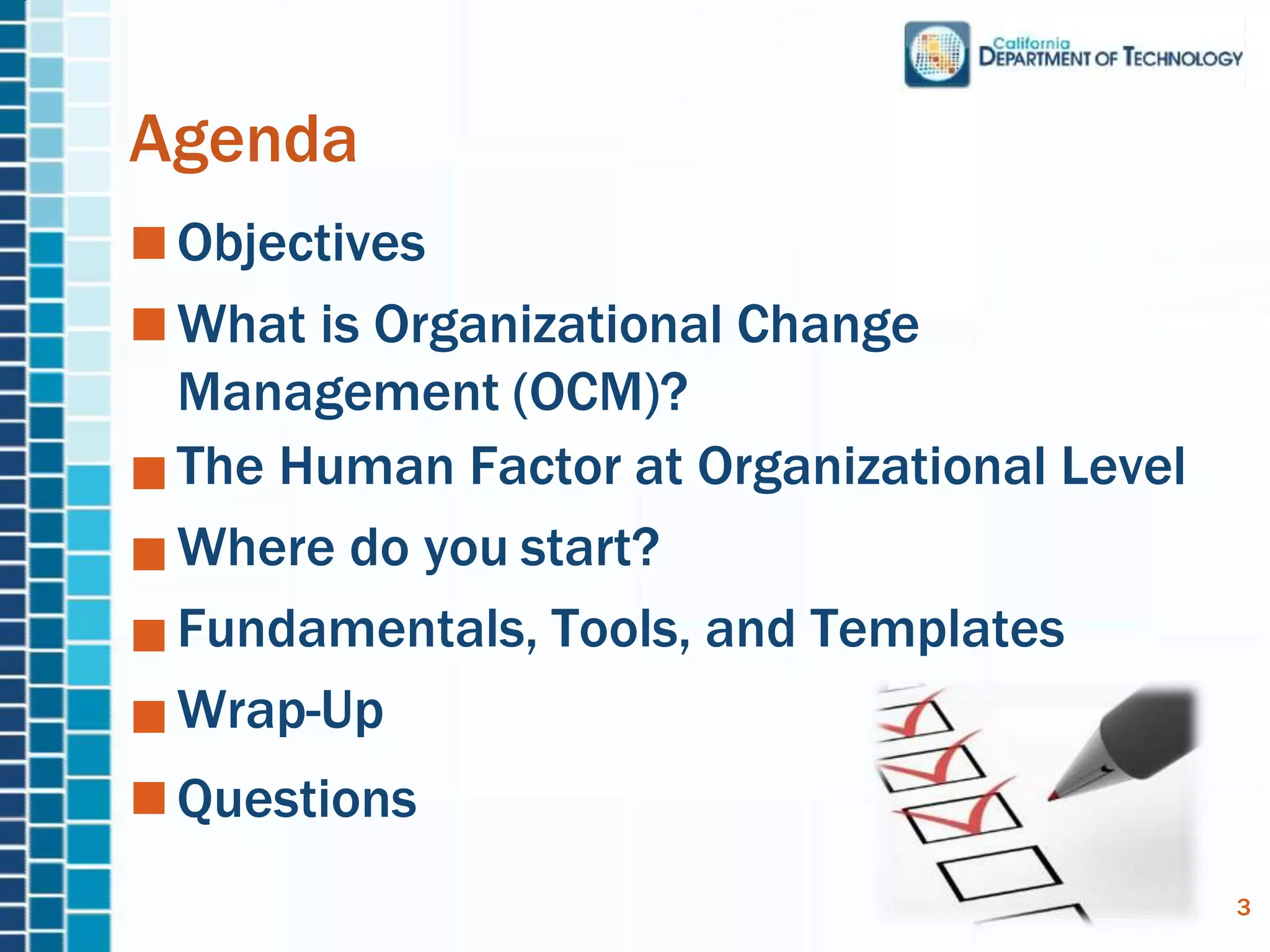
Objectives
What is Organizational Change
Management (OCM)?
The Human Factor at Organizational Level
Where do you start?
Fundamentals, Tools, and Templates
Wrap-Up
Questions
Agenda
3
What Is OCM?
Why It Is Important
The Human Factor
Organizational Goals and Objectives
Recognize the 5 Pillars of Successful
Change
Utilize OCM Tools and Templates
Objectives
4
Cross Your Arms
5
Organizational Change Management
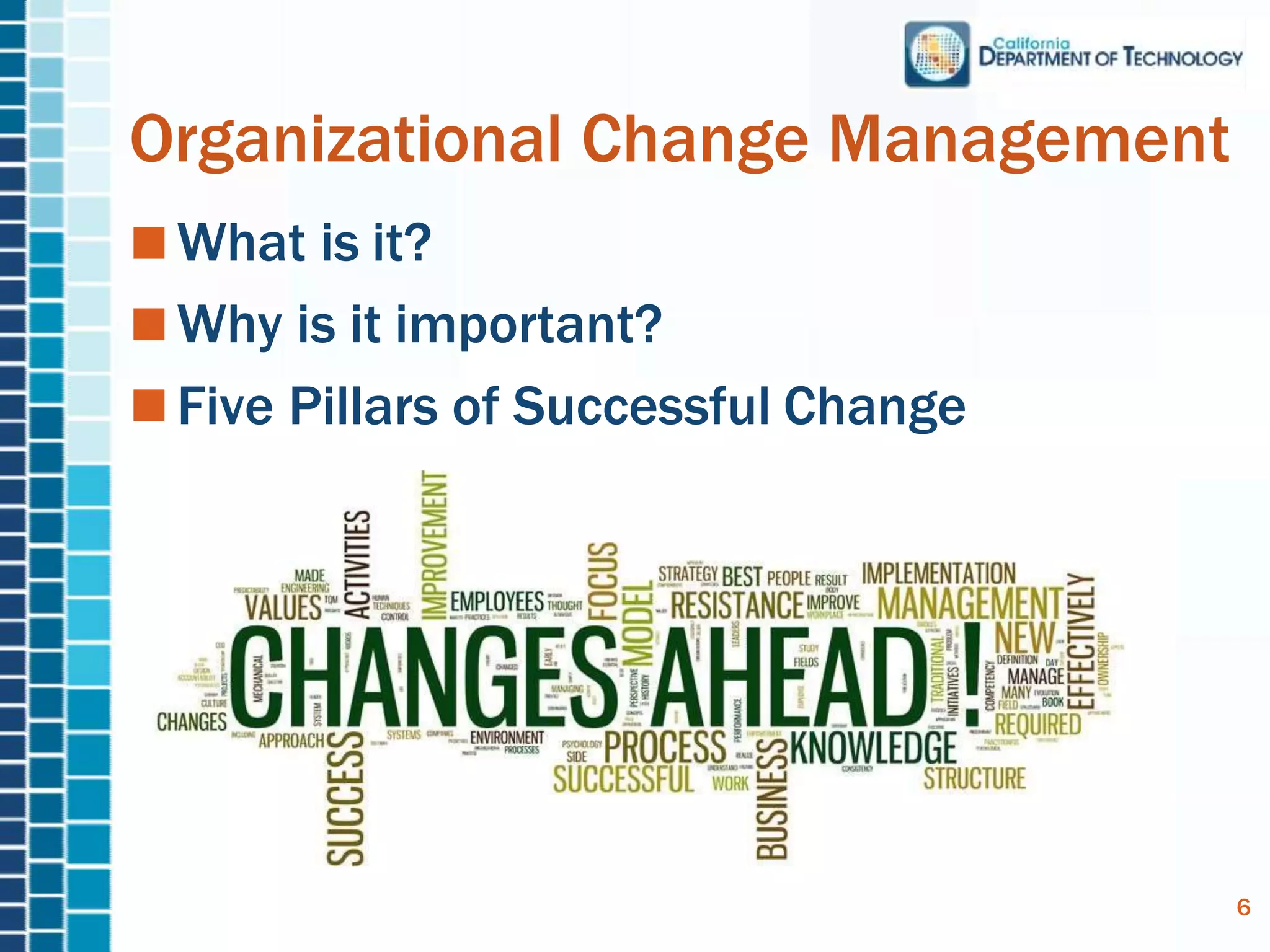
What is it?
Why is it important?
Five Pillars of Successful Change
6
Organizational Change Management
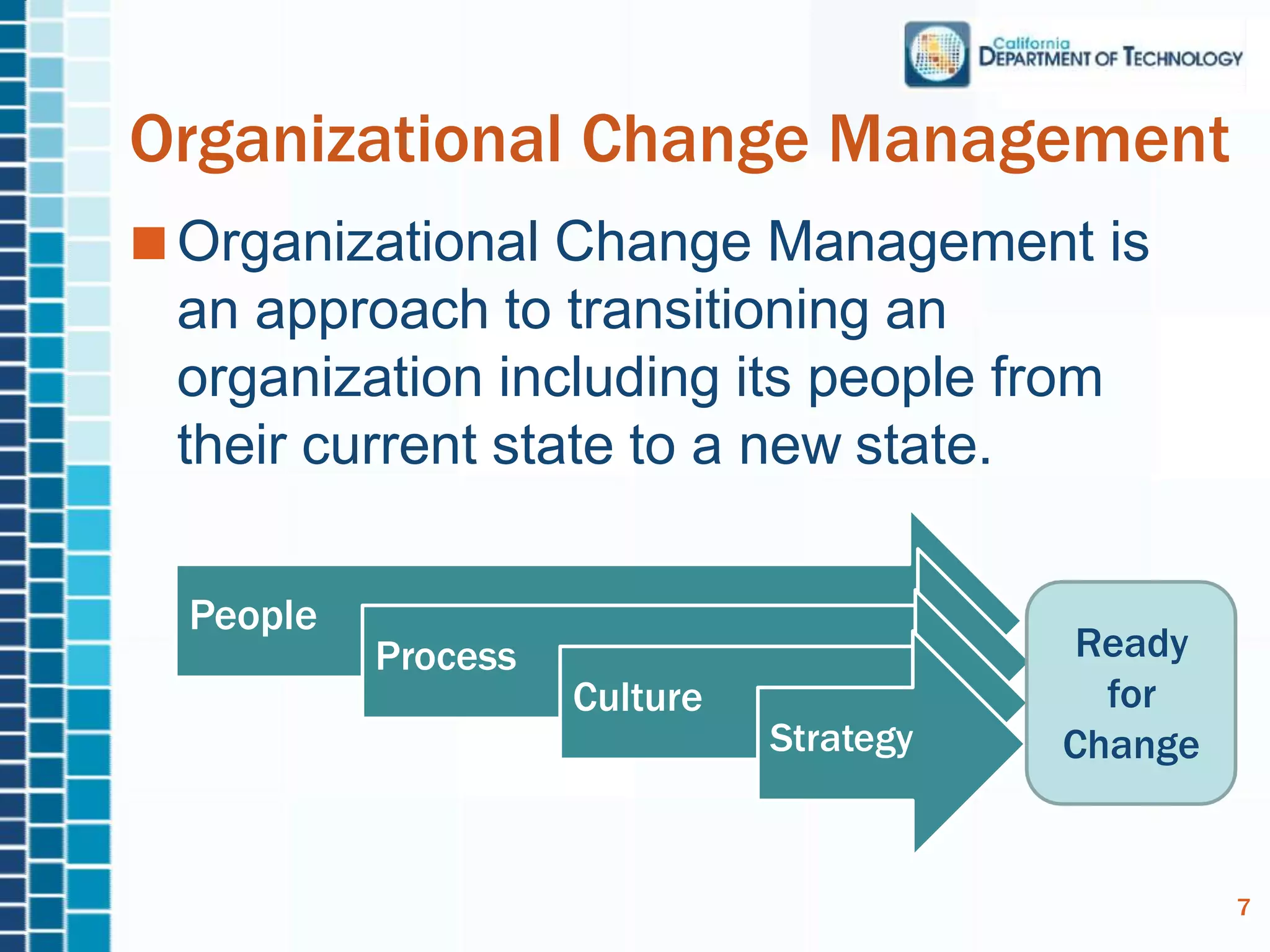
Organizational Change Management is
an approach to transitioning an
organization including its people from
their current state to a new state.
People
Process
Culture
Strategy
Ready
for
Change
7
Organizational Change Management
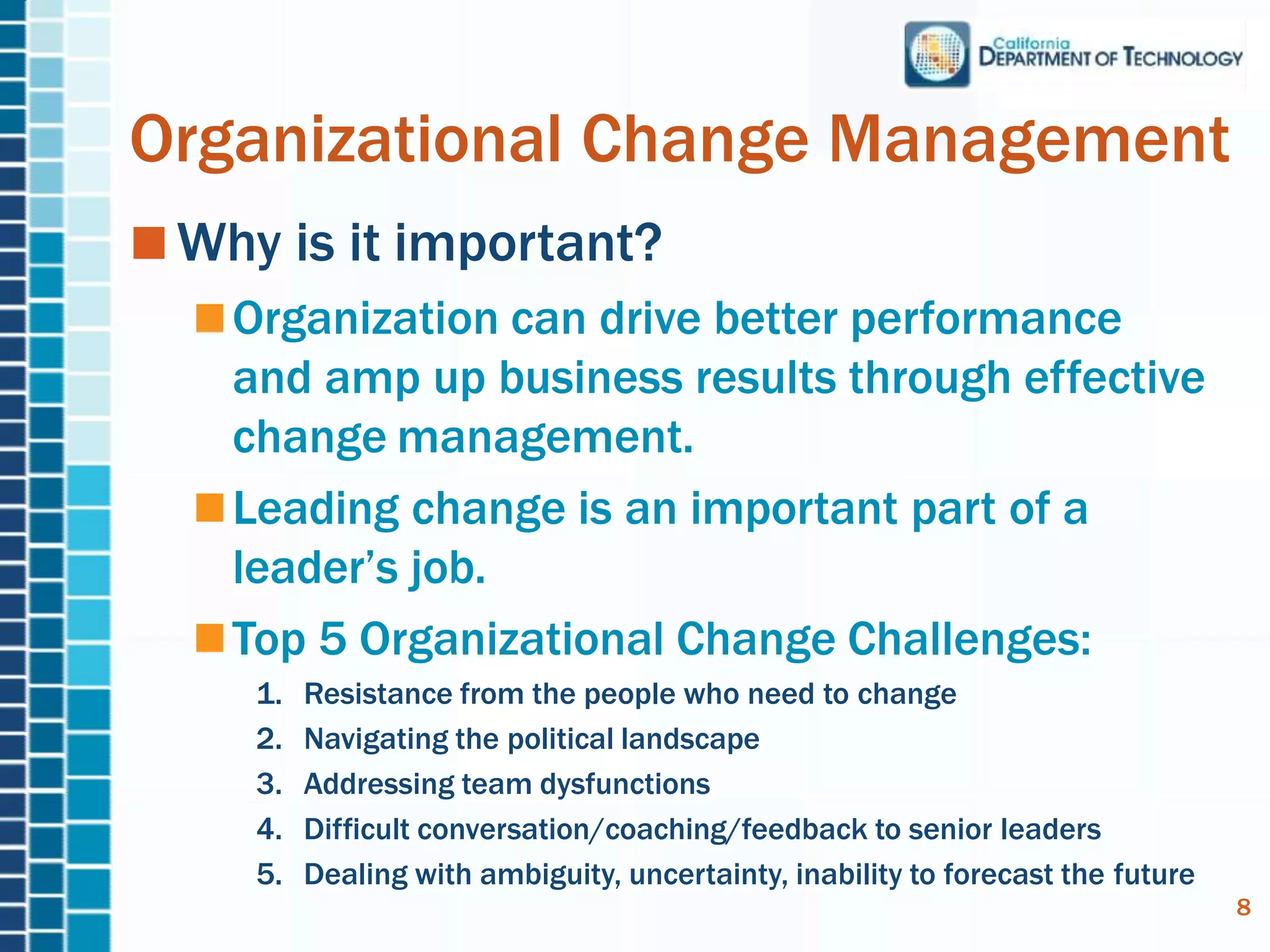
Why is it important?
Organization can drive better performance
and amp up business results through effective
change management.
Leading change is an important part of a
leader’s job.
Top 5 Organizational Change Challenges:
1. Resistance from the people who need to change
2. Navigating the political landscape
3. Addressing team dysfunctions
4. Difficult conversation/coaching/feedback to senior leaders
5. Dealing with ambiguity, uncertainty, inability to forecast the future
8
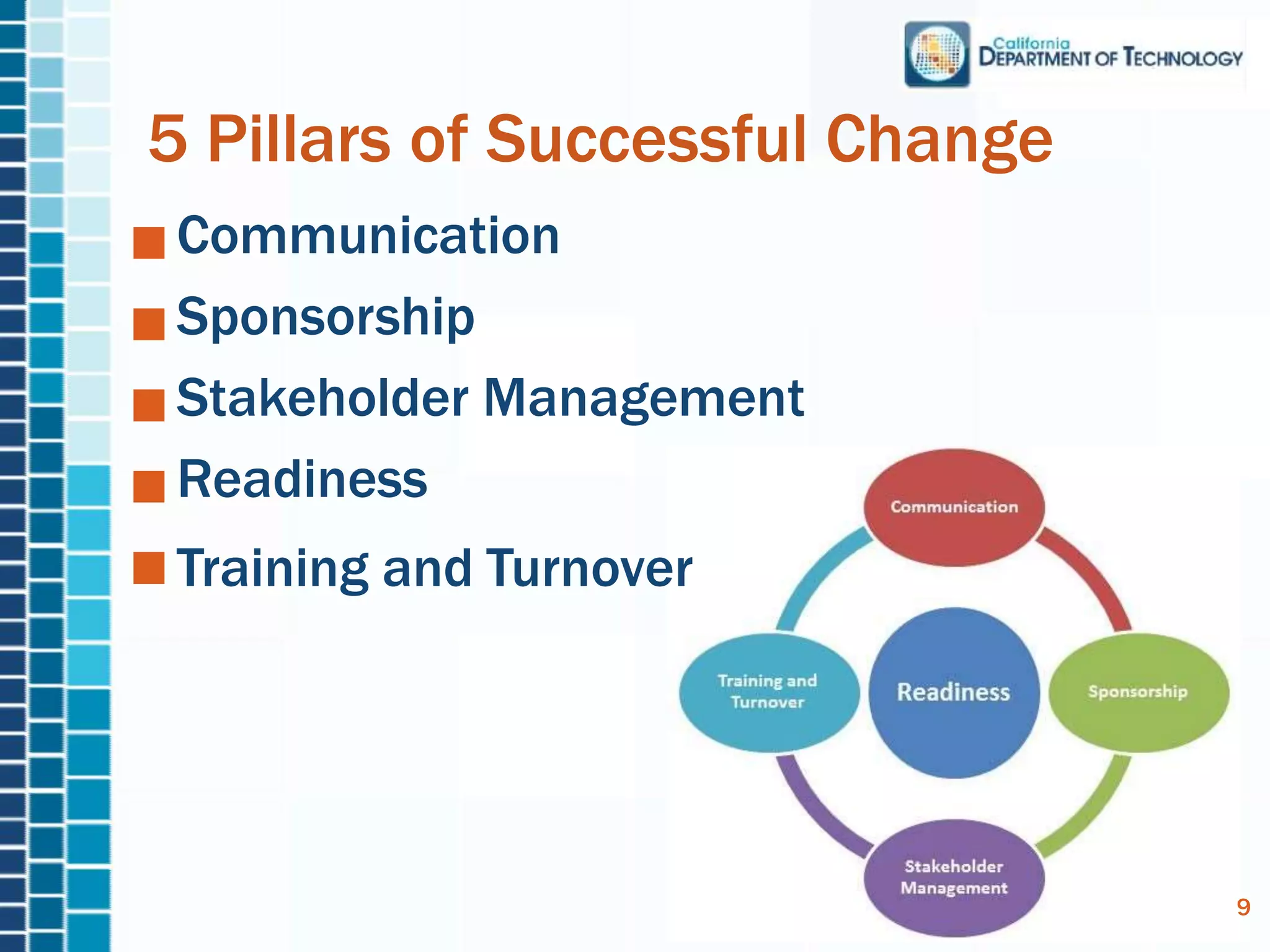
5 Pillars of Successful Change
Communication
Sponsorship
Stakeholder Management
Readiness
Training and Turnover
9
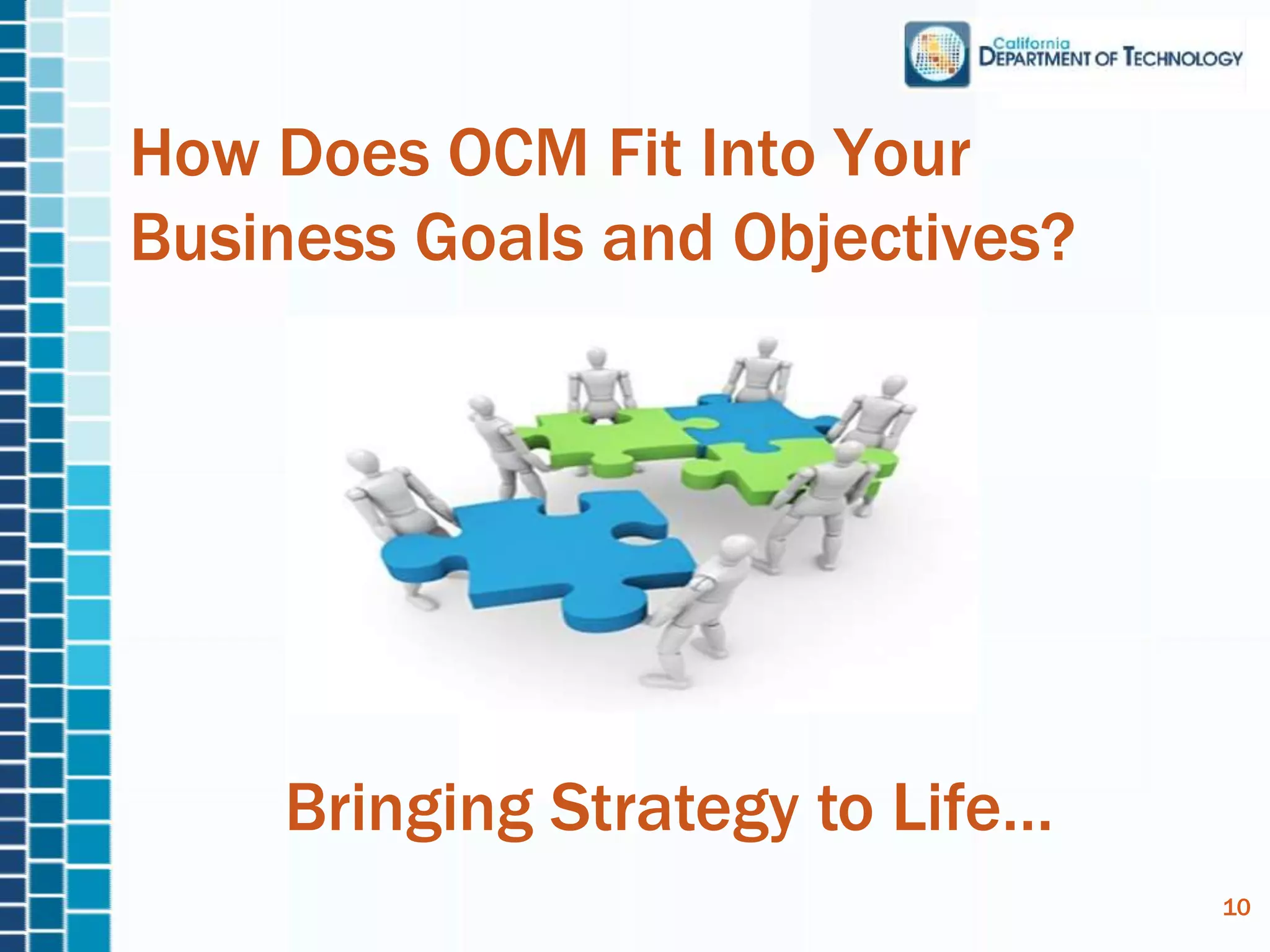
How Does OCM Fit Into Your
Business Goals and Objectives?
Bringing Strategy to Life…
10
Cultural Alignment: Making It Real
What defines an organization’s culture?
Culture generally refers to the shared set
of values, principles, assumptions, beliefs,
symbols and behaviors that reflects how
work gets designed and executed. In short,
it’s “how things are done around here.” Of
course, no two organizations’ cultures are
exactly alike.
11
What makes up a organization’s
cultural profile?
In other words what makes an
organization successful?
Efficiency, Quality, Innovation, Customer
Service, Company Image
12
13
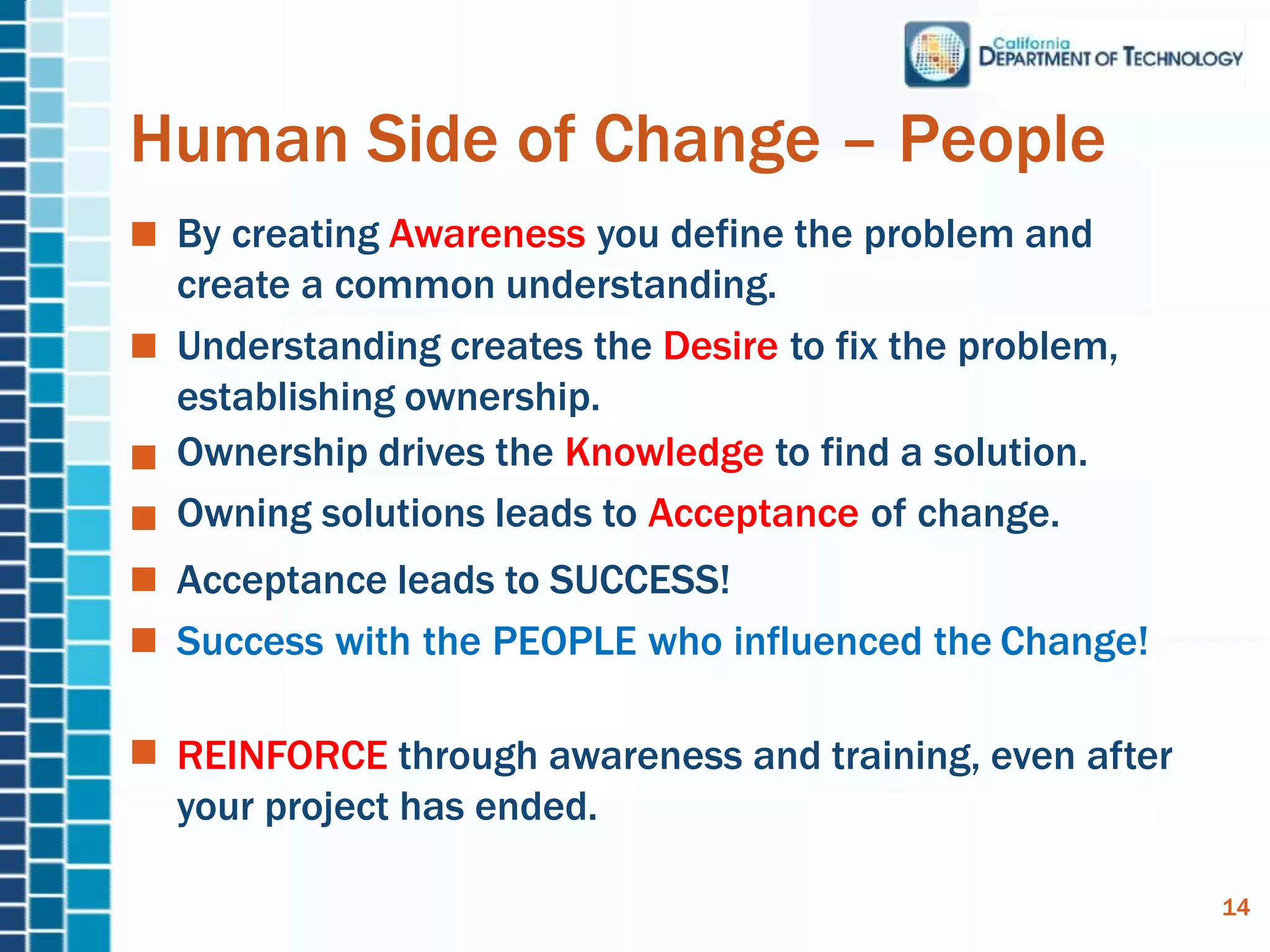
Human Side of Change – People
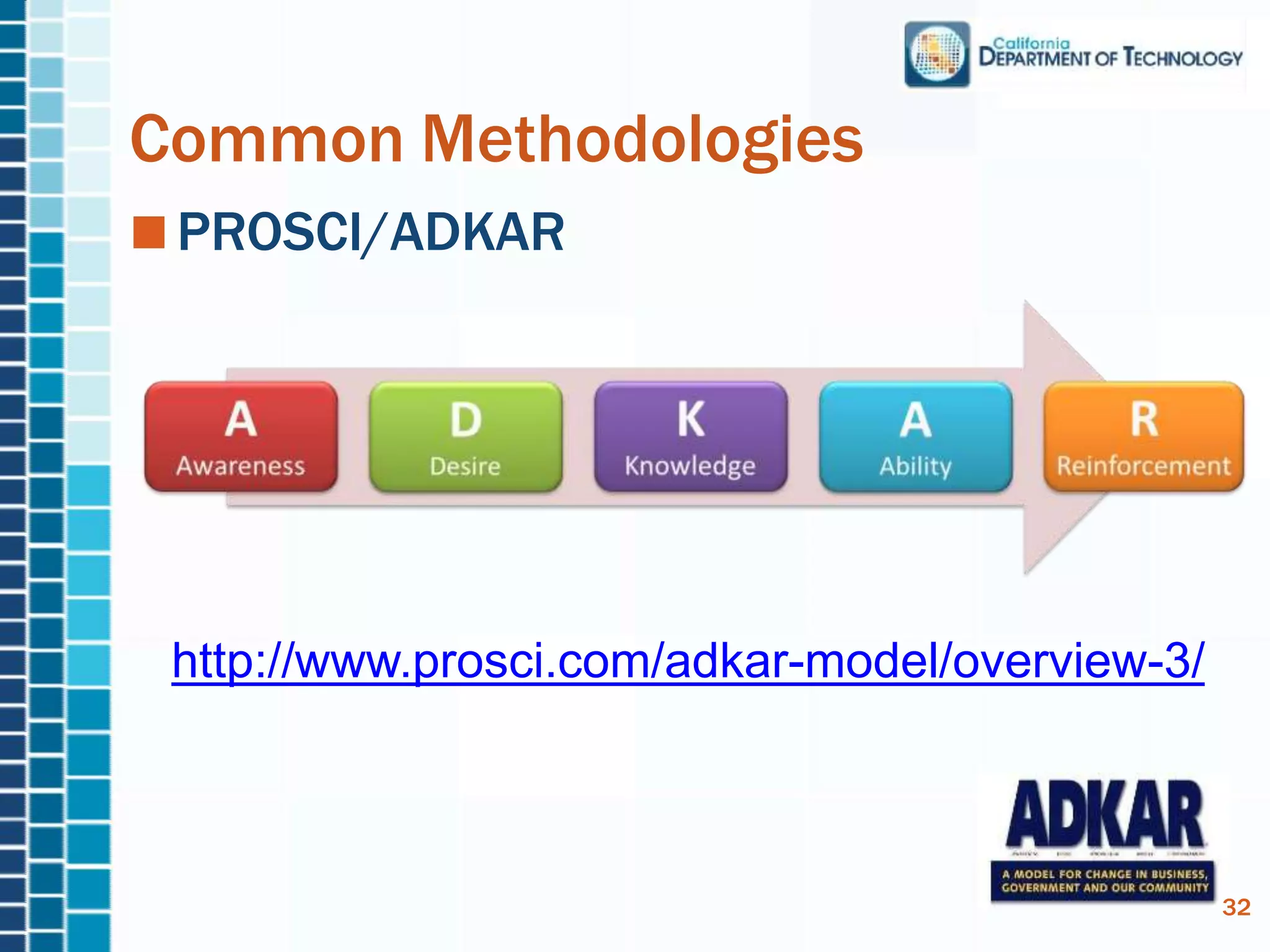
By creating Awareness you define the problem and
create a common understanding.
Understanding creates the Desire to fix the problem,
establishing ownership.
Ownership drives the Knowledge to find a solution.
Owning solutions leads to Acceptance of change.
Acceptance leads to SUCCESS!
Success with the PEOPLE who influenced the Change!
REINFORCE through awareness and training, even after
your project has ended.
14
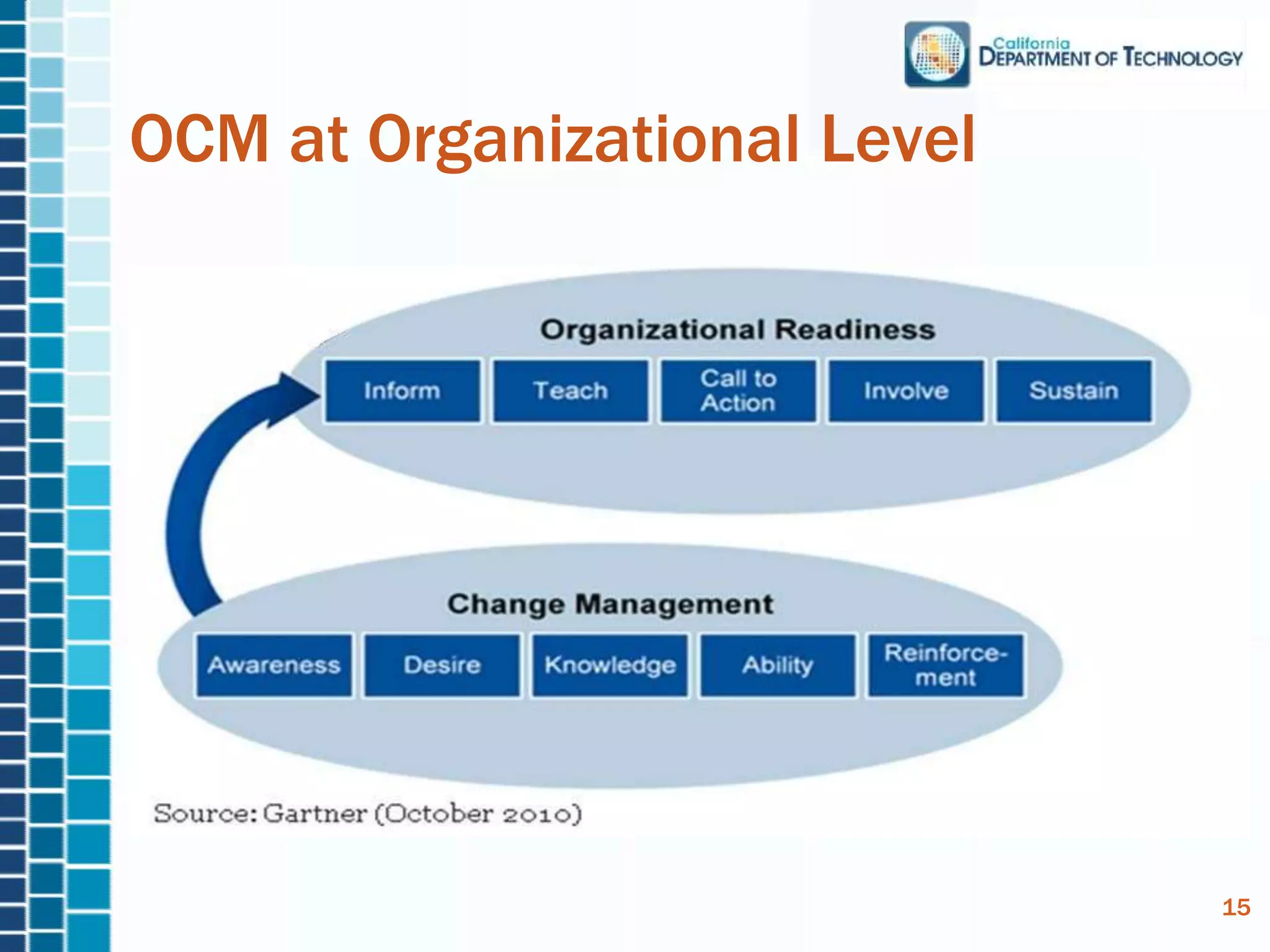
OCM at Organizational Level
15
Where Do You Start?
16
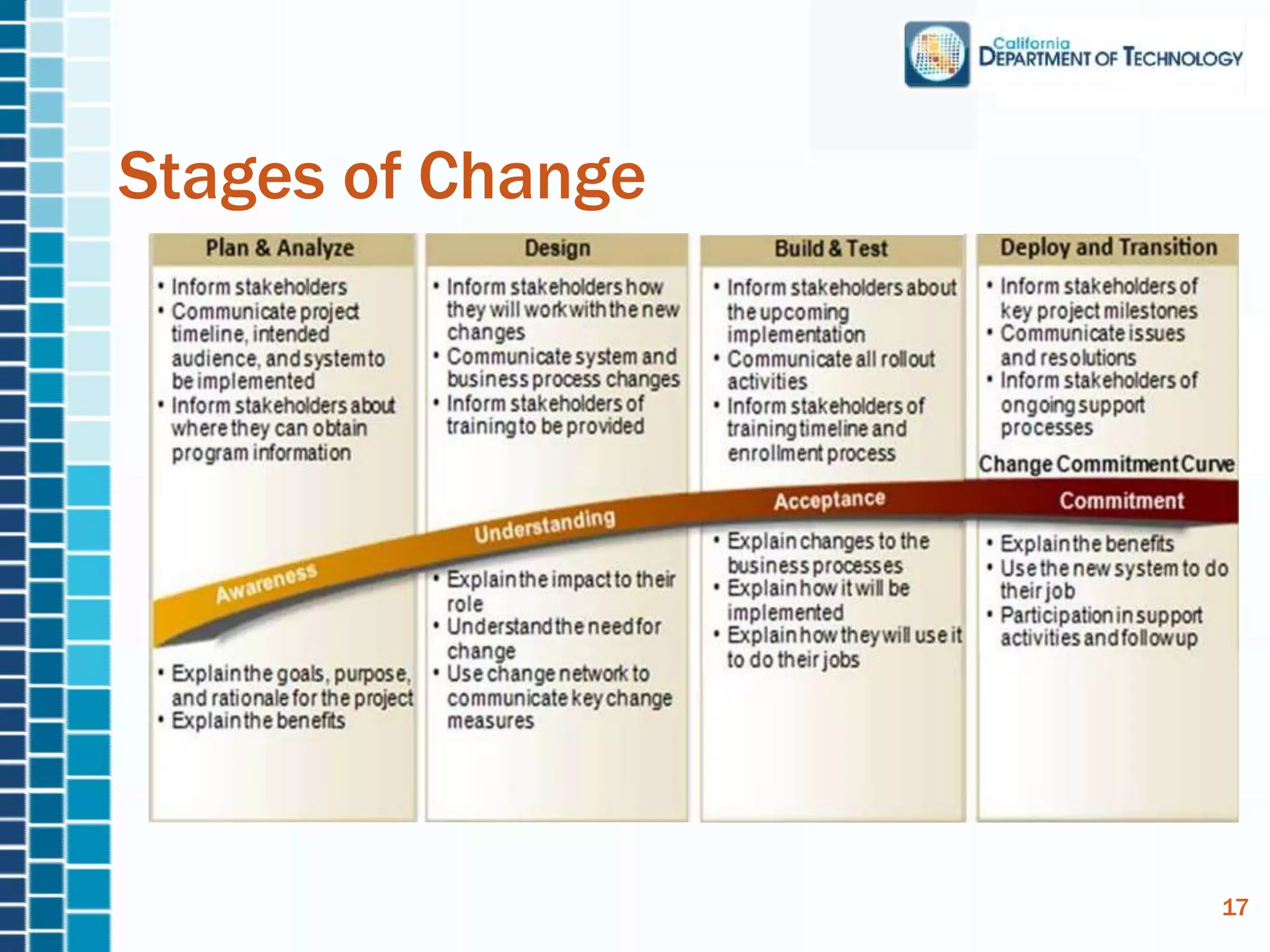
Stages of Change
17
TemplatesSample OCM Project Schedule
2007 Version.mpp
Project Work Plan (OCM WBS)
18
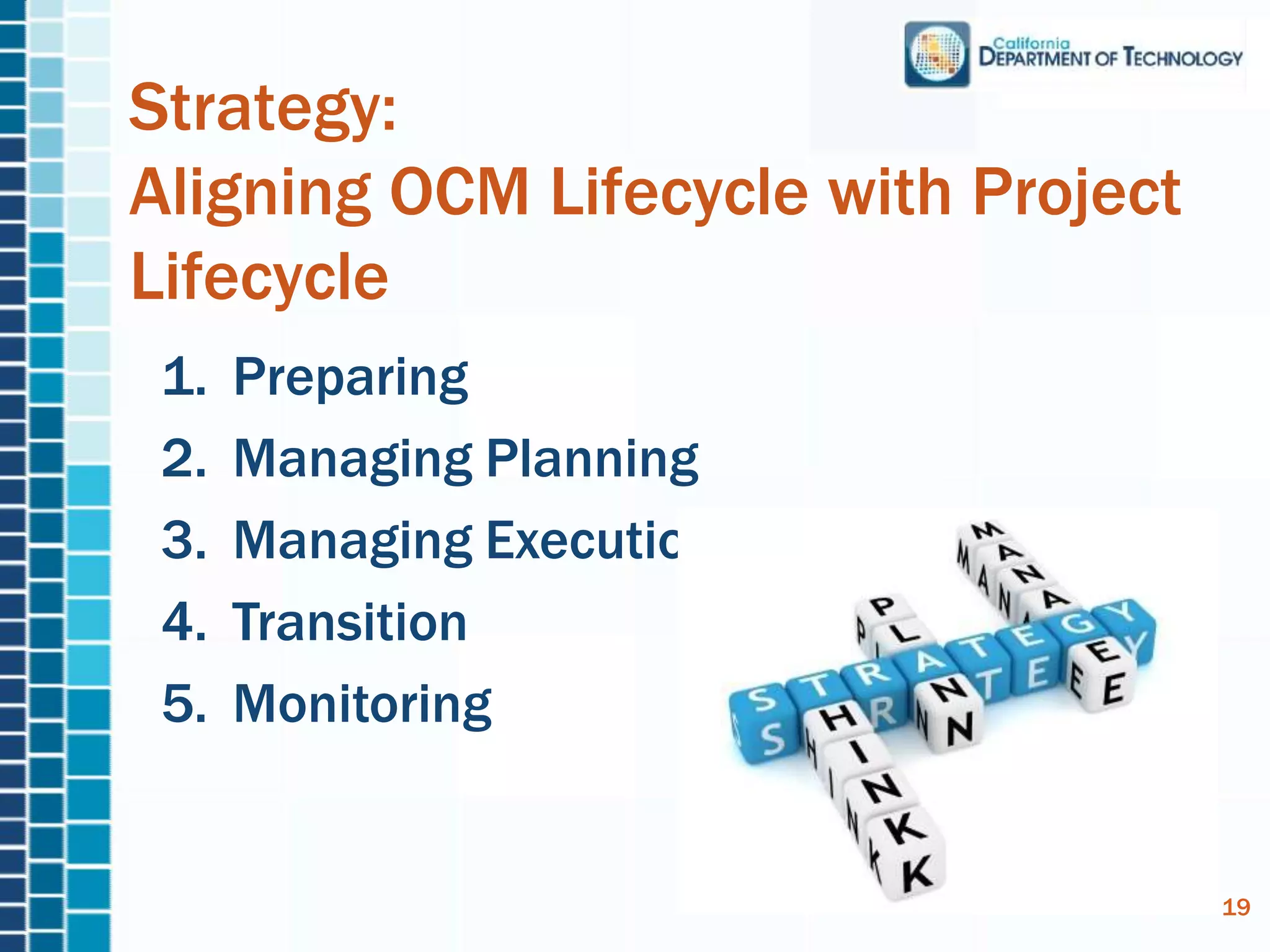
n
1. Preparing
2. Managing Planning
3. Managing Executio
4. Transition
5. Monitoring
Strategy:
Aligning OCM Lifecycle with Project
Lifecycle
19
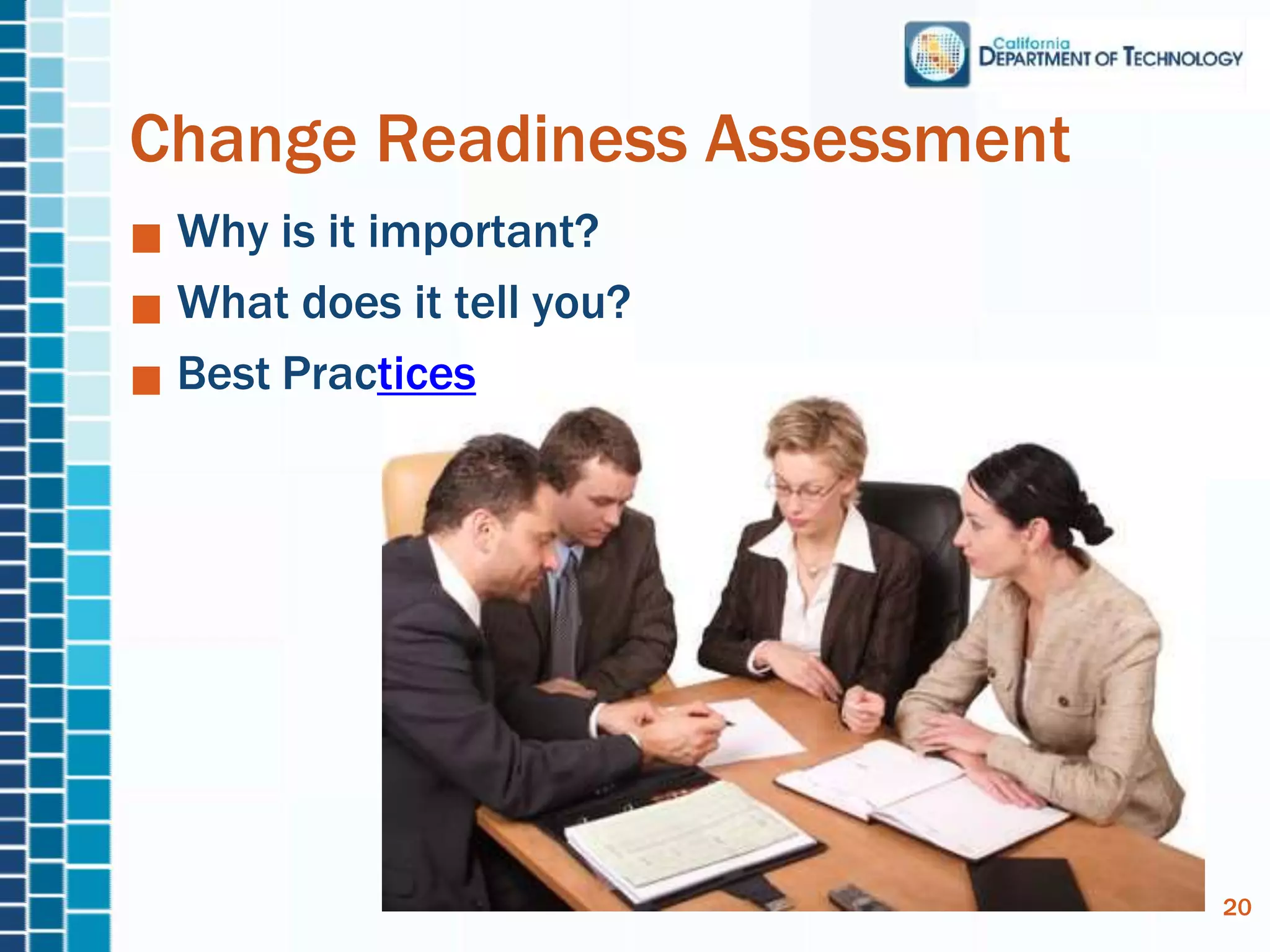
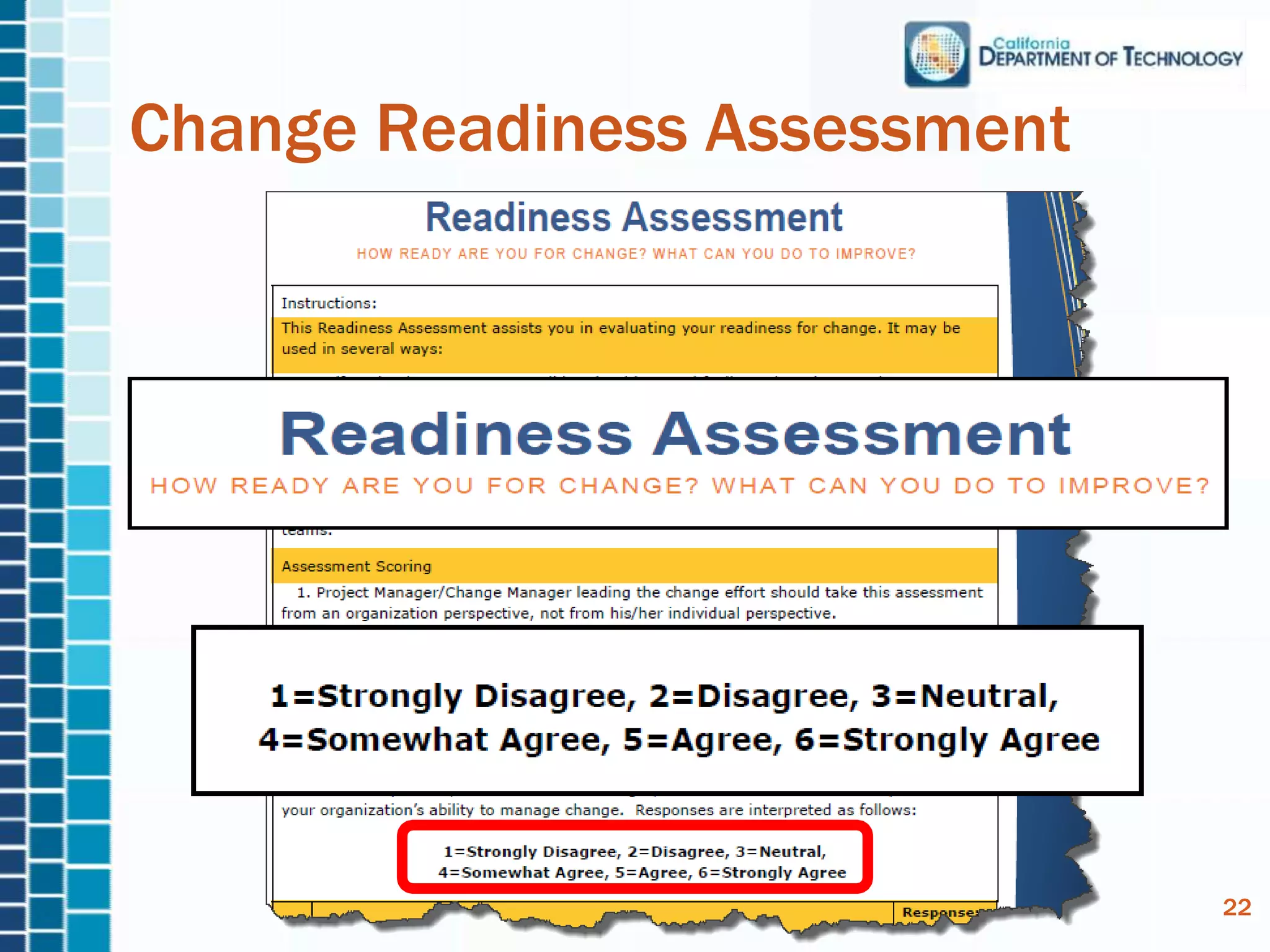
Change Readiness Assessment
Why is it important?
What does it tell you?
Best Practices
20
Culture and value system
Capacity for change
Middle management's predisposition
toward the change
Employee readiness for change
Why Is It Important?
21
Change Readiness Assessment
22
Exercise – 10 Minutes
23
Instructions
Think of a change initiative your organization
needs to implement.
Take the assessment individually based on your
role in your organization.
There are 5 short questions for each of the five
Pillars.
Enter a response that best represents your
organization’s ability to manage change.
24
Things to think about when filling
out the assessment
1.How well does your organization function during change efforts?
2.How well positioned is the organization to be able to absorb all the
changes planned without creating significant risk of overload in affected
areas?
3.What are the resources involved and what is their degree of skills and
experience?
4.What is your leadership’s capability of sponsoring and supporting
change?
5.What generates desire for the change and what creates resistance to it?
6.What do you need to improve support and reduce roadblocks for the
change?
7.What is your corporate culture and historical experience in dealing with
change?
25
What does it tell you?
Average score is calculated at each Pillar
Risks and potential obstacles
Gaps in communication, training, sponsorship,
and transition strategy required to implement
change
Special Tactics needed to support and sustain
change
26
What do you do with the results?
If your average score is below 4 for any of the
categories, this indicates the organization is not
fully prepared and should spend efforts on that
pillar to improve readiness.
Develop strategies to address areas that need
improvement.
Select a change management team model and
team size.
Select a sponsorship model and support system.
Customize communication plans, training plans,
coaching plans and sponsorship activities.
27
Best Practices
Change management team or project leaders
use the assessment as a tool to assess the
organization's readiness to change.
Independent vs. Third Party
Agile, flexible
Unbiased opinion
Include employee and manager interviews and
surveys. When collecting data from a large
number of employees, focus groups can also be
used in place of one-on-one interviews.
28
Best Practices (Continue)
Use it to plan your change management strategy
and help the project team make informed
decisions to managing change.
Use it as a planning aid and not as the bulk of
the change management effort.
29
Break – 15 Minutes
30
OCM Fundamentals, Tools, and
Templates
OCM Methodologies
OCM Strategies
Five Pillars of Change
31
Common Methodologies
PROSCI/ADKAR
http://www.prosci.com/adkar-model/overview-3/
32
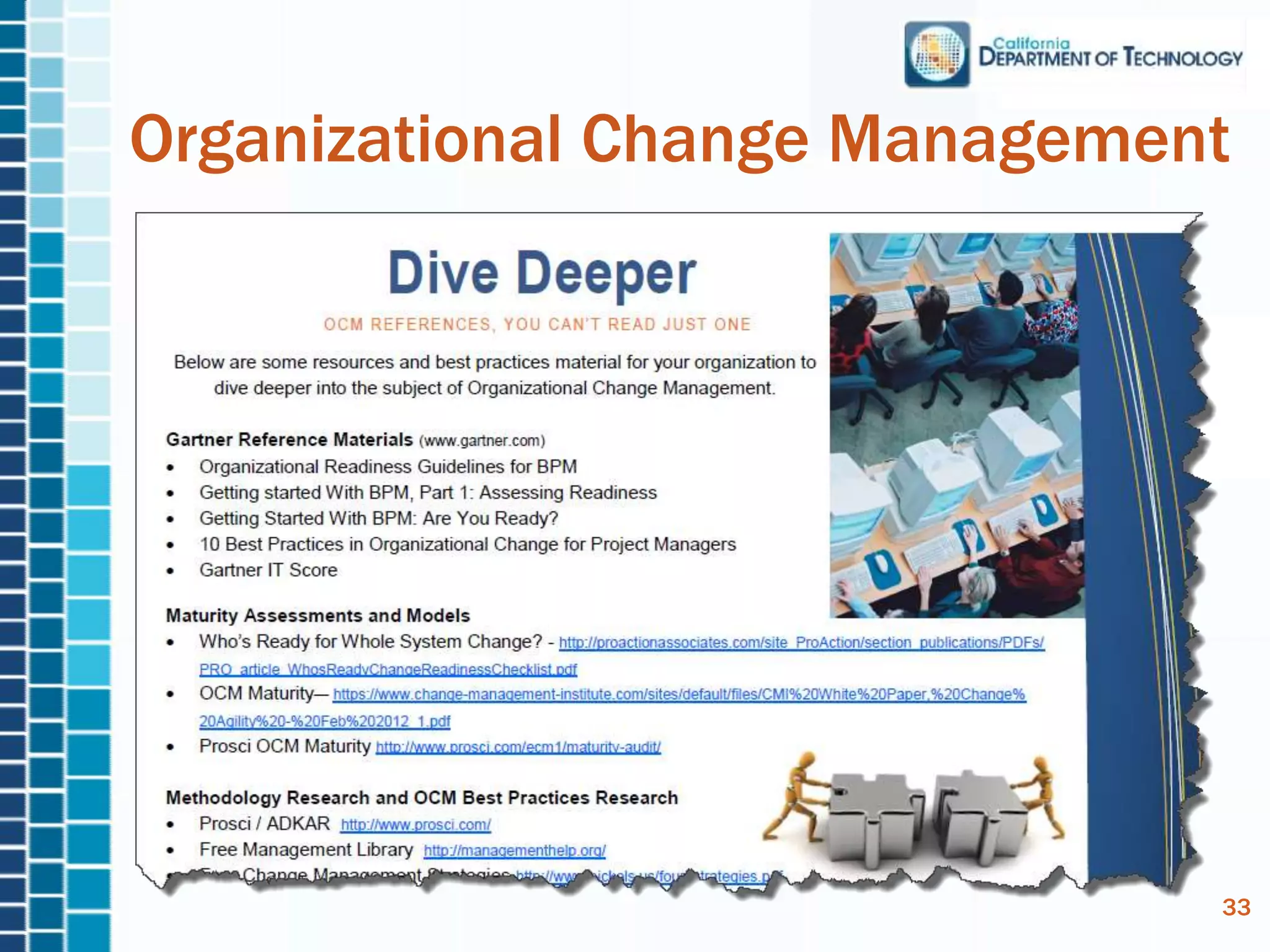
Organizational Change Management
33
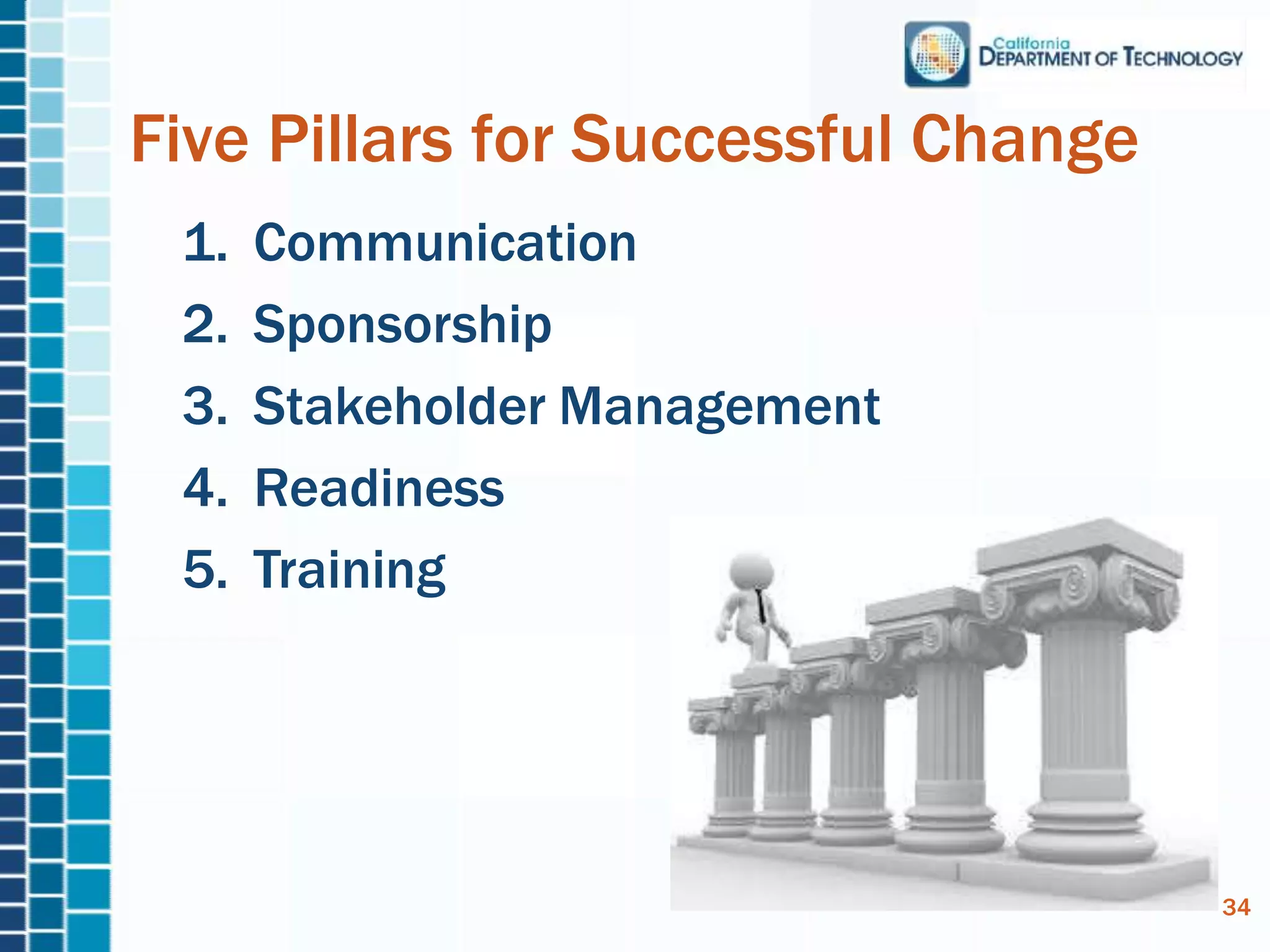
1. Communication
2. Sponsorship
3. Stakeholder Management
4. Readiness
5. Training
Five Pillars for Successful Change
34
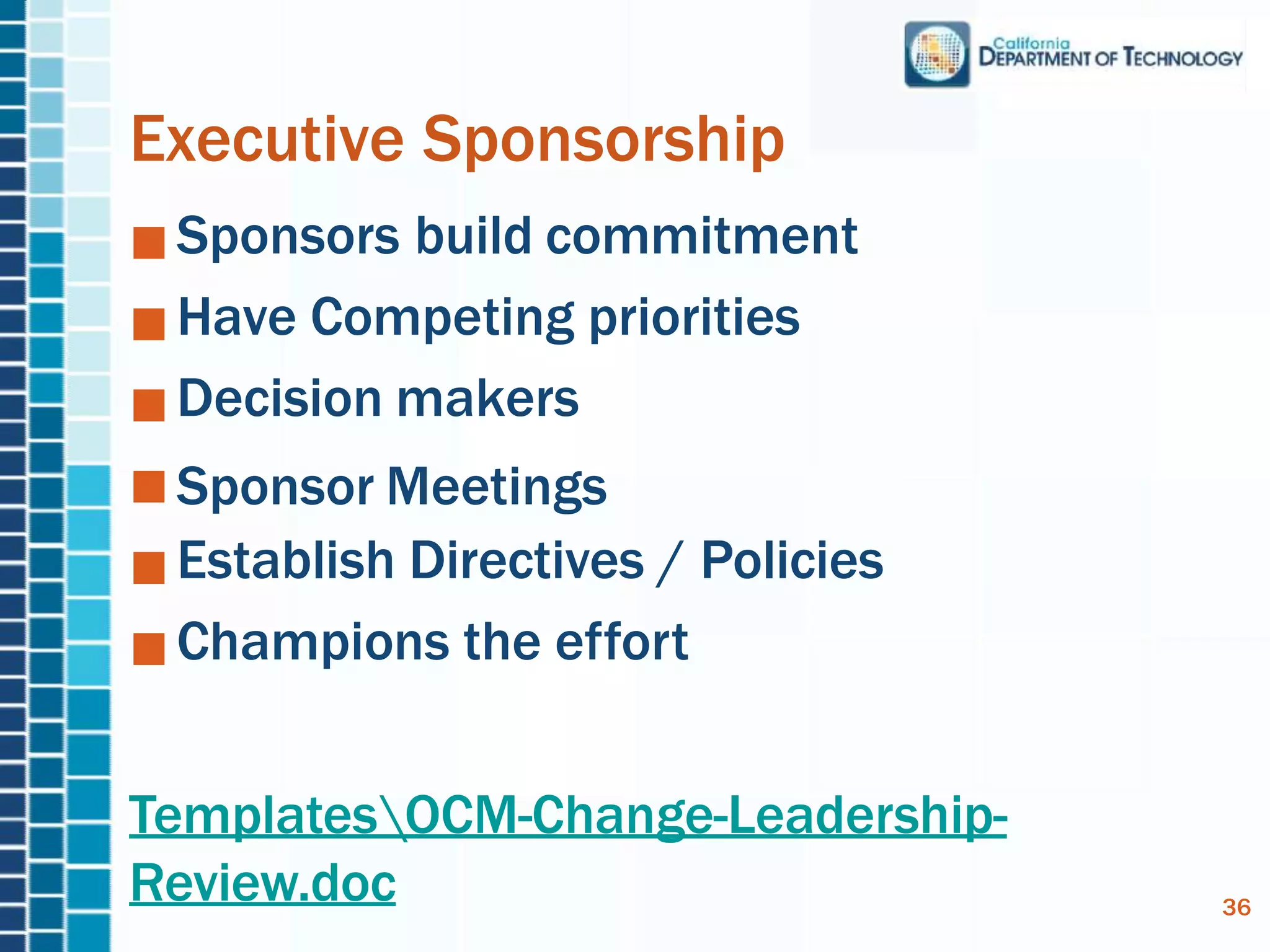
Communications Strategy and Plan
Establish audience groups
Tailor your messaging
Use multiple delivery channels
Be visible
TemplatesOCM-Communications-Plan.doc
Communication
35
Executive Sponsorship
Sponsors build commitment
Have Competing priorities
Decision makers
Sponsor Meetings
Establish Directives / Policies
Champions the effort
TemplatesOCM-Change-Leadership-
Review.doc 36
Stakeholder Management
Conduct Stakeholder Impact Analysis
Actively engage your partners and commit
to a partnership.
Understand the reason, need and benefits
of change.
Address the concerns
37
TemplatesOCM Stakeholder Map.docx
Assess your organization’s readiness
before implementation
People, Culture, Processes, Strategic
Alignment
Establish a Change Team
Celebrate success and early wins
Readiness
38
Establish a comprehensive training plan
Train your leaders and change agents in
OCM
Training Needs Assessment
Identify roles and skill building
requirements
Transition Plan
Reinforce and encourage learning
Training and Transition
39
Wrap-Up
Be ahead of Change, OCM starts at the
BEGINNING
Assess your organization’s readiness for
change
Incorporate the Five Pillars of Successful
Change
Understand the human factor of
change…the people
40
The Readiness Guides
Project Readiness Guides
http://www.cio.ca.gov/opd/itla/itla-
21.html
41
Questions
42

Understanding and Implementing Organizational Change

  • 1.
    The Project AcademySeries: Understanding and Implementing Organizational Change Management September 18th and 19th, 2014
  • 2.
    Jacquelyn Moore: IT ProjectManager, Project Delivery, Caltrans Jessica Chin: Section Manager, SAP Enterprise Systems Functional and Business Analysis, DWR Welcome and Introductions 2
  • 3.
    Objectives What is OrganizationalChange Management (OCM)? The Human Factor at Organizational Level Where do you start? Fundamentals, Tools, and Templates Wrap-Up Questions Agenda 3
  • 4.
    What Is OCM? WhyIt Is Important The Human Factor Organizational Goals and Objectives Recognize the 5 Pillars of Successful Change Utilize OCM Tools and Templates Objectives 4
  • 5.
  • 6.
    Organizational Change Management Whatis it? Why is it important? Five Pillars of Successful Change 6
  • 7.
    Organizational Change Management OrganizationalChange Management is an approach to transitioning an organization including its people from their current state to a new state. People Process Culture Strategy Ready for Change 7
  • 8.
    Organizational Change Management Whyis it important? Organization can drive better performance and amp up business results through effective change management. Leading change is an important part of a leader’s job. Top 5 Organizational Change Challenges: 1. Resistance from the people who need to change 2. Navigating the political landscape 3. Addressing team dysfunctions 4. Difficult conversation/coaching/feedback to senior leaders 5. Dealing with ambiguity, uncertainty, inability to forecast the future 8
  • 9.
    5 Pillars ofSuccessful Change Communication Sponsorship Stakeholder Management Readiness Training and Turnover 9
  • 10.
    How Does OCMFit Into Your Business Goals and Objectives? Bringing Strategy to Life… 10
  • 11.
    Cultural Alignment: MakingIt Real What defines an organization’s culture? Culture generally refers to the shared set of values, principles, assumptions, beliefs, symbols and behaviors that reflects how work gets designed and executed. In short, it’s “how things are done around here.” Of course, no two organizations’ cultures are exactly alike. 11
  • 12.
    What makes upa organization’s cultural profile? In other words what makes an organization successful? Efficiency, Quality, Innovation, Customer Service, Company Image 12
  • 13.
  • 14.
    Human Side ofChange – People By creating Awareness you define the problem and create a common understanding. Understanding creates the Desire to fix the problem, establishing ownership. Ownership drives the Knowledge to find a solution. Owning solutions leads to Acceptance of change. Acceptance leads to SUCCESS! Success with the PEOPLE who influenced the Change! REINFORCE through awareness and training, even after your project has ended. 14
  • 15.
  • 16.
    Where Do YouStart? 16
  • 17.
  • 18.
    TemplatesSample OCM ProjectSchedule 2007 Version.mpp Project Work Plan (OCM WBS) 18
  • 19.
    n 1. Preparing 2. ManagingPlanning 3. Managing Executio 4. Transition 5. Monitoring Strategy: Aligning OCM Lifecycle with Project Lifecycle 19
  • 20.
    Change Readiness Assessment Whyis it important? What does it tell you? Best Practices 20
  • 21.
    Culture and valuesystem Capacity for change Middle management's predisposition toward the change Employee readiness for change Why Is It Important? 21
  • 22.
  • 23.
    Exercise – 10Minutes 23
  • 24.
    Instructions Think of achange initiative your organization needs to implement. Take the assessment individually based on your role in your organization. There are 5 short questions for each of the five Pillars. Enter a response that best represents your organization’s ability to manage change. 24
  • 25.
    Things to thinkabout when filling out the assessment 1.How well does your organization function during change efforts? 2.How well positioned is the organization to be able to absorb all the changes planned without creating significant risk of overload in affected areas? 3.What are the resources involved and what is their degree of skills and experience? 4.What is your leadership’s capability of sponsoring and supporting change? 5.What generates desire for the change and what creates resistance to it? 6.What do you need to improve support and reduce roadblocks for the change? 7.What is your corporate culture and historical experience in dealing with change? 25
  • 26.
    What does ittell you? Average score is calculated at each Pillar Risks and potential obstacles Gaps in communication, training, sponsorship, and transition strategy required to implement change Special Tactics needed to support and sustain change 26
  • 27.
    What do youdo with the results? If your average score is below 4 for any of the categories, this indicates the organization is not fully prepared and should spend efforts on that pillar to improve readiness. Develop strategies to address areas that need improvement. Select a change management team model and team size. Select a sponsorship model and support system. Customize communication plans, training plans, coaching plans and sponsorship activities. 27
  • 28.
    Best Practices Change managementteam or project leaders use the assessment as a tool to assess the organization's readiness to change. Independent vs. Third Party Agile, flexible Unbiased opinion Include employee and manager interviews and surveys. When collecting data from a large number of employees, focus groups can also be used in place of one-on-one interviews. 28
  • 29.
    Best Practices (Continue) Useit to plan your change management strategy and help the project team make informed decisions to managing change. Use it as a planning aid and not as the bulk of the change management effort. 29
  • 30.
    Break – 15Minutes 30
  • 31.
    OCM Fundamentals, Tools,and Templates OCM Methodologies OCM Strategies Five Pillars of Change 31
  • 32.
  • 33.
  • 34.
    1. Communication 2. Sponsorship 3.Stakeholder Management 4. Readiness 5. Training Five Pillars for Successful Change 34
  • 35.
    Communications Strategy andPlan Establish audience groups Tailor your messaging Use multiple delivery channels Be visible TemplatesOCM-Communications-Plan.doc Communication 35
  • 36.
    Executive Sponsorship Sponsors buildcommitment Have Competing priorities Decision makers Sponsor Meetings Establish Directives / Policies Champions the effort TemplatesOCM-Change-Leadership- Review.doc 36
  • 37.
    Stakeholder Management Conduct StakeholderImpact Analysis Actively engage your partners and commit to a partnership. Understand the reason, need and benefits of change. Address the concerns 37 TemplatesOCM Stakeholder Map.docx
  • 38.
    Assess your organization’sreadiness before implementation People, Culture, Processes, Strategic Alignment Establish a Change Team Celebrate success and early wins Readiness 38
  • 39.
    Establish a comprehensivetraining plan Train your leaders and change agents in OCM Training Needs Assessment Identify roles and skill building requirements Transition Plan Reinforce and encourage learning Training and Transition 39
  • 40.
    Wrap-Up Be ahead ofChange, OCM starts at the BEGINNING Assess your organization’s readiness for change Incorporate the Five Pillars of Successful Change Understand the human factor of change…the people 40
  • 41.
    The Readiness Guides ProjectReadiness Guides http://www.cio.ca.gov/opd/itla/itla- 21.html 41
  • 42.