Human Resource Policies and Practices   Lecturer: Do Tien Long 09 04 51 54 46 [email_address]
Learning objectives Explain nature of human resource management (HRM), and contrast this with personnel management Analyze HRM policies, activities Human resource planning, recruitment and selection Importance of training and development Explain the system of performance appraisal Nature of employee relations
Human resource management An essential part of the process of management is that proper attention be given to the efficient use of resources, in particular human resources The efficiency & performance of staff & their commitment to organisational objectives are fostered by good human relationships at work
The significance of HR As the basis of her ‘living strategy’ Gratton proposes – There are fundamental differences between people as an asset & the traditional assets of finance or technology An understanding of fundamental differences creates a new way of thinking & working in organisations: a shift in mind-set Business strategies can only be realised through people Creating a strategic approach to people necessitates a strong dialogue across the organisation
Human resource management  or personnel management? The discussion generally centres on the extent to which HRM is a new & distinctive philosophy with a particular paradigm shift towards a more strategic approach to people management or New wine in old bottles – HRM is no more than a different term for what good personnel managers have always been doing
Human Resource Management (HRM) Involves all management decisions and practices that directly affect or influence the people, or human resources, who work for the organization Fisher  et al.
Defining HRM The design, implementation & maintenance of strategies to manage people for optimum business performance including the development of policies & processes to support these strategies   CIPD
Defining HRM Organisations that get the people thing right are the organisations that are likely to be around in the future Delaney
A strategic approach The strategic use of human resources will help managers to contribute to the release of true value by the optimum use of people’s competencies A strategic HR approach requires that the needs & talents of employees become matched with organisational goals
HRM policies & practices The formulation of HRM policies & implementation of personnel practices & procedures should be based on underlying philosophies of managing behaviour & employee relationships
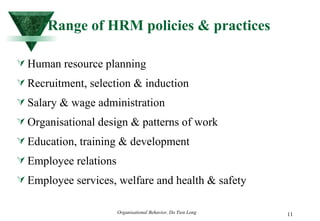
Range of HRM policies & practices Human resource planning Recruitment, selection & induction Salary & wage administration Organisational design & patterns of work Education, training & development Employee relations Employee services, welfare and health & safety
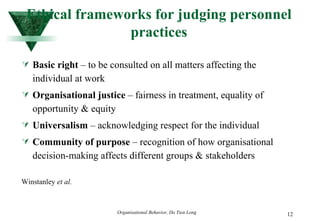
Ethical frameworks for judging personnel practices Basic right  – to be consulted on all matters affecting the individual at work Organisational justice  – fairness in treatment, equality of opportunity & equity Universalism  – acknowledging respect for the individual Community of purpose  – recognition of how organisational decision-making affects different groups & stakeholders Winstanley  et al.
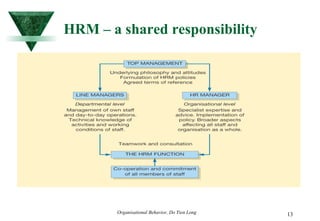
HRM – a shared responsibility
Approach taken by M&S Every manager is a personnel manager Every director is a personnel director A strong, well-trained team of personnel staff provide support, training, guidance & advice to management at all levels
To deliver organisational excellence HRM needs to become –  A partner with senior & line managers in strategy execution An expert in the way work is organised & executed to ensure costs are reduced & quality is maintained A champion for employees, representing their concerns to senior management An agent of continuous transformation Ulrich
People management – impact on profits Is critical to business performance Companies where employees have high levels of job satisfaction & commitment showed improving financial performance HR practices explained nearly one-fifth of the variation between companies in productivity and profitability  CIPD
Resourcing the organisation Whose concern is this? Managers & supervisors should have some say in the appointment of own staff Recruitment & selection of staff can be regarded as a specialist activity but all managers should be well acquainted with the basic procedures & skills involved & have access to HR department for advice
Prerequisites for an effective recruitment & selection policy The clarification of corporate objectives Design of an effective structure A system of human resource planning
HR planning A strategy for the acquisition, utilisation, improvement & retention of an organisation’s human resources
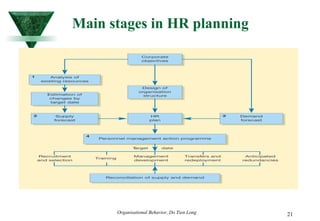
Main HR planning stages Analysis of existing staffing resources Estimating likely changes in resources by the target date Forecasting staffing requirements necessary to achieve corporate objectives by the target date Measuring the required staffing resources available as & when required
Main stages in HR planning
Value of HR planning Foresee changes & identify trends in staffing resources Adopt personnel policies that help to avoid major problems Reconcile differences between supply & demand Provides framework in which action can be taken to overcome staffing differences
Value of HR planning Continuous process that seeks to ensure flexible resourcing related to internal/external environmental influences Can help anticipate potential future difficulties while there is still a choice of action
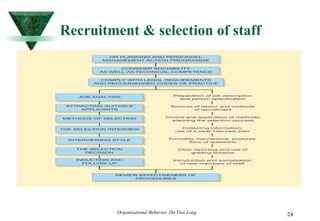
Recruitment & selection of staff
Job analysis The total process by which a job description & a person specification are produced
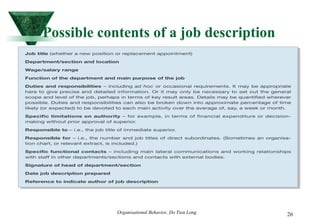
Possible contents of a job description
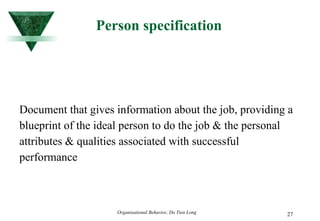
Person specification Document that gives information about the job, providing a blueprint of the ideal person to do the job & the personal attributes & qualities associated with successful performance
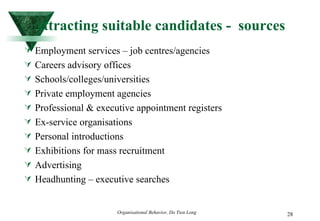
Attracting suitable candidates -  sources Employment services – job centres/agencies Careers advisory offices Schools/colleges/universities Private employment agencies Professional & executive appointment registers Ex-service organisations Personal introductions Exhibitions for mass recruitment Advertising Headhunting – executive searches
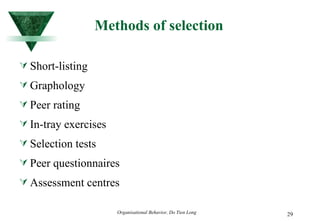
Methods of selection Short-listing Graphology Peer rating In-tray exercises Selection tests Peer questionnaires Assessment centres
The selection interview Despite constant criticisms the interview is usually a central & indispensable element of the selection process and is still a widely used method of selection
Interview style Behavioural interviews – questions about how candidates have handled past situations Situational interviews – posing hypothetical, future-oriented questions to help assess future job performance
Interview considerations Seating arrangements Types of questions to ask Purpose of questions
Interview questions Leading Time keeping is important. Are you a good time keeper? I guess you regret that now, do you?
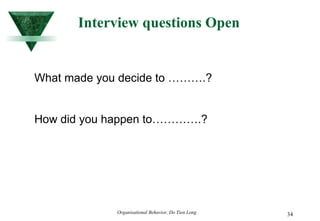
Interview questions Open What made you decide to ……….? How did you happen to………….?
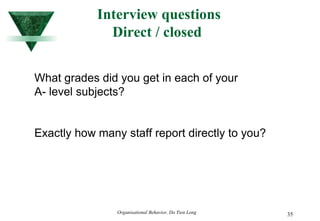
Interview questions Direct / closed  What grades did you get in each of your  A- level subjects? Exactly how many staff report directly to you?
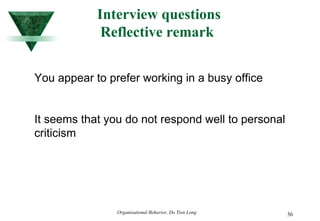
Interview questions Reflective remark  You appear to prefer working in a busy office It seems that you do not respond well to personal criticism
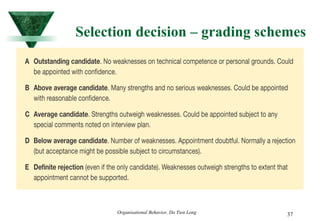
Selection decision – grading schemes
Benefits of training Training can: Increase confidence, motivation, & commitment of staff Provide recognition, enhanced responsibility, & the possibility of increased pay & promotion Give a feeling of personal satisfaction & achievement, & broaden opportunities for career progression Help to improve the availability, quality & skills of staff
A planned & systematic approach to training Clear commitment  to training throughout all levels of the organisation An objective assessment of training needs Staff themselves should feel a sense of involvement A clear set of objectives & a defined policy for training Planned training programmes
A planned & systematic approach to training Choice of the most appropriate methods of training External courses & training opportunities linked to the educational system Regard given to the training needs of those groups who are not currently active in the workforce An effective system of review & evaluation Evaluation related to objective, measurable factors
Areas of training With the rapidly changing nature of the business world and the need to maintain competitive advantage, organisations need to ensure that staff are fully trained in – Knowledge of their products/services Technical skills Human relations skills How to work with maximum effect
Growth of e-learning Learning via technology Offers opportunities to provide a standard message to large numbers of geographically-dispersed people Provides minimum disruption to people’s working lives & private lives Can reduce costs where large numbers of learners are involved Can be more accessible than other forms of training methodologies
Investors in People A standard for the training & development of people within an organisation Launched in 1991 by the Department of Employment Seeks to reward organisations that achieve prescribed standards Provides a framework for improving business performance & competitiveness Standard held for 3 years after which organisation is required to go through external assessment again
Investors in People The standard is based on the following principles: Public commitment from the top to invest & develop people to achieve business goals Planning how individuals & teams will be developed Taking relevant action to meet training & development needs Evaluating the outcomes of training & development
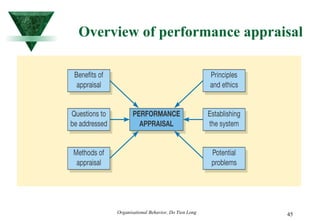
Overview of performance appraisal
Benefits to appraisal Can identify individual’s strengths & areas of development Can indicate how strengths can be utilised & weaknesses overcome Can help reveal problems that may be restricting progress Can develop a greater degree of consistency through regular feedback Can provide information for HR planning Can improve communications
Performance appraisal & psychological principles People work / learn / achieve more when they are given -  Adequate feedback as to their performance Clear attainable goals Involvement in the setting of tasks & goals James
Designing a successful appraisal system  Questions to be addressed Who should be appraised? Who should undertake the appraisal? At what frequency should appraisals be undertaken? Should the appraisal system be open?
360 degree feedback An appraisal & feedback from different groups within the work situation  Includes feedback from peers, subordinates, bosses & possibly internal & external customers
Upward appraisal feedback An upward review or appraisal system that involves subordinates’ appraisal of managers This can help to judge managers’ ability accept constructive criticism  Requires an appropriate organisational culture & open management
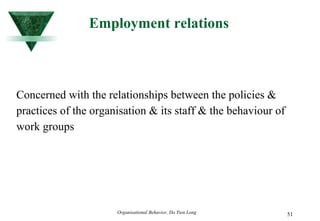
Employment relations Concerned with the relationships between the policies & practices of the organisation & its staff & the behaviour of work groups
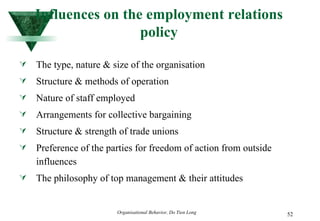
Influences on the employment relations policy The type, nature & size of the organisation Structure & methods of operation Nature of staff employed Arrangements for collective bargaining Structure & strength of trade unions Preference of the parties for freedom of action from outside influences The philosophy of top management & their attitudes
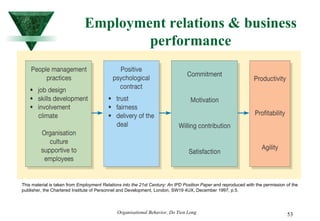
Employment relations & business performance This material is taken from  Employment Relations into the 21st Century: An IPD Position Paper  and reproduced with the permission of the publisher, the Chartered Institute of Personnel and Development, London, SW19 4UX, December 1997, p.5.
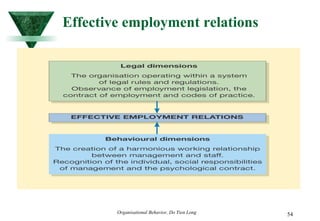
Effective employment relations
International approaches of HRM Ethnocentric approach Polycentric approach Geocentric approach Regiocentric approach Budhwar
10 ways to make HR effective Be the catalyst for making things happen Avoid being the corporate soft touch Understand the whole business Keep people-management systems simple Remember line managers manage people, not HR
10 ways to make HR effective Work with, not above, line managers Be super-efficient in the transactional stuff Be leaders in the transformational stuff Help the business to manage change Accept that good ‘people ideas’ exist outside HR Browning
At which stage of the selection process do you think a company’s culture becomes clear to an employee? Discuss with a classmate.  Chapter Check-Up:  HR Policies

Organizational Behavior - Session8

  • 1.
    Human Resource Policiesand Practices Lecturer: Do Tien Long 09 04 51 54 46 [email_address]
  • 2.
    Learning objectives Explainnature of human resource management (HRM), and contrast this with personnel management Analyze HRM policies, activities Human resource planning, recruitment and selection Importance of training and development Explain the system of performance appraisal Nature of employee relations
  • 3.
    Human resource managementAn essential part of the process of management is that proper attention be given to the efficient use of resources, in particular human resources The efficiency & performance of staff & their commitment to organisational objectives are fostered by good human relationships at work
  • 4.
    The significance ofHR As the basis of her ‘living strategy’ Gratton proposes – There are fundamental differences between people as an asset & the traditional assets of finance or technology An understanding of fundamental differences creates a new way of thinking & working in organisations: a shift in mind-set Business strategies can only be realised through people Creating a strategic approach to people necessitates a strong dialogue across the organisation
  • 5.
    Human resource management or personnel management? The discussion generally centres on the extent to which HRM is a new & distinctive philosophy with a particular paradigm shift towards a more strategic approach to people management or New wine in old bottles – HRM is no more than a different term for what good personnel managers have always been doing
  • 6.
    Human Resource Management(HRM) Involves all management decisions and practices that directly affect or influence the people, or human resources, who work for the organization Fisher et al.
  • 7.
    Defining HRM Thedesign, implementation & maintenance of strategies to manage people for optimum business performance including the development of policies & processes to support these strategies CIPD
  • 8.
    Defining HRM Organisationsthat get the people thing right are the organisations that are likely to be around in the future Delaney
  • 9.
    A strategic approachThe strategic use of human resources will help managers to contribute to the release of true value by the optimum use of people’s competencies A strategic HR approach requires that the needs & talents of employees become matched with organisational goals
  • 10.
    HRM policies &practices The formulation of HRM policies & implementation of personnel practices & procedures should be based on underlying philosophies of managing behaviour & employee relationships
  • 11.
    Range of HRMpolicies & practices Human resource planning Recruitment, selection & induction Salary & wage administration Organisational design & patterns of work Education, training & development Employee relations Employee services, welfare and health & safety
  • 12.
    Ethical frameworks forjudging personnel practices Basic right – to be consulted on all matters affecting the individual at work Organisational justice – fairness in treatment, equality of opportunity & equity Universalism – acknowledging respect for the individual Community of purpose – recognition of how organisational decision-making affects different groups & stakeholders Winstanley et al.
  • 13.
    HRM – ashared responsibility
  • 14.
    Approach taken byM&S Every manager is a personnel manager Every director is a personnel director A strong, well-trained team of personnel staff provide support, training, guidance & advice to management at all levels
  • 15.
    To deliver organisationalexcellence HRM needs to become – A partner with senior & line managers in strategy execution An expert in the way work is organised & executed to ensure costs are reduced & quality is maintained A champion for employees, representing their concerns to senior management An agent of continuous transformation Ulrich
  • 16.
    People management –impact on profits Is critical to business performance Companies where employees have high levels of job satisfaction & commitment showed improving financial performance HR practices explained nearly one-fifth of the variation between companies in productivity and profitability CIPD
  • 17.
    Resourcing the organisationWhose concern is this? Managers & supervisors should have some say in the appointment of own staff Recruitment & selection of staff can be regarded as a specialist activity but all managers should be well acquainted with the basic procedures & skills involved & have access to HR department for advice
  • 18.
    Prerequisites for aneffective recruitment & selection policy The clarification of corporate objectives Design of an effective structure A system of human resource planning
  • 19.
    HR planning Astrategy for the acquisition, utilisation, improvement & retention of an organisation’s human resources
  • 20.
    Main HR planningstages Analysis of existing staffing resources Estimating likely changes in resources by the target date Forecasting staffing requirements necessary to achieve corporate objectives by the target date Measuring the required staffing resources available as & when required
  • 21.
    Main stages inHR planning
  • 22.
    Value of HRplanning Foresee changes & identify trends in staffing resources Adopt personnel policies that help to avoid major problems Reconcile differences between supply & demand Provides framework in which action can be taken to overcome staffing differences
  • 23.
    Value of HRplanning Continuous process that seeks to ensure flexible resourcing related to internal/external environmental influences Can help anticipate potential future difficulties while there is still a choice of action
  • 24.
  • 25.
    Job analysis Thetotal process by which a job description & a person specification are produced
  • 26.
    Possible contents ofa job description
  • 27.
    Person specification Documentthat gives information about the job, providing a blueprint of the ideal person to do the job & the personal attributes & qualities associated with successful performance
  • 28.
    Attracting suitable candidates- sources Employment services – job centres/agencies Careers advisory offices Schools/colleges/universities Private employment agencies Professional & executive appointment registers Ex-service organisations Personal introductions Exhibitions for mass recruitment Advertising Headhunting – executive searches
  • 29.
    Methods of selectionShort-listing Graphology Peer rating In-tray exercises Selection tests Peer questionnaires Assessment centres
  • 30.
    The selection interviewDespite constant criticisms the interview is usually a central & indispensable element of the selection process and is still a widely used method of selection
  • 31.
    Interview style Behaviouralinterviews – questions about how candidates have handled past situations Situational interviews – posing hypothetical, future-oriented questions to help assess future job performance
  • 32.
    Interview considerations Seatingarrangements Types of questions to ask Purpose of questions
  • 33.
    Interview questions LeadingTime keeping is important. Are you a good time keeper? I guess you regret that now, do you?
  • 34.
    Interview questions OpenWhat made you decide to ……….? How did you happen to………….?
  • 35.
    Interview questions Direct/ closed What grades did you get in each of your A- level subjects? Exactly how many staff report directly to you?
  • 36.
    Interview questions Reflectiveremark You appear to prefer working in a busy office It seems that you do not respond well to personal criticism
  • 37.
    Selection decision –grading schemes
  • 38.
    Benefits of trainingTraining can: Increase confidence, motivation, & commitment of staff Provide recognition, enhanced responsibility, & the possibility of increased pay & promotion Give a feeling of personal satisfaction & achievement, & broaden opportunities for career progression Help to improve the availability, quality & skills of staff
  • 39.
    A planned &systematic approach to training Clear commitment to training throughout all levels of the organisation An objective assessment of training needs Staff themselves should feel a sense of involvement A clear set of objectives & a defined policy for training Planned training programmes
  • 40.
    A planned &systematic approach to training Choice of the most appropriate methods of training External courses & training opportunities linked to the educational system Regard given to the training needs of those groups who are not currently active in the workforce An effective system of review & evaluation Evaluation related to objective, measurable factors
  • 41.
    Areas of trainingWith the rapidly changing nature of the business world and the need to maintain competitive advantage, organisations need to ensure that staff are fully trained in – Knowledge of their products/services Technical skills Human relations skills How to work with maximum effect
  • 42.
    Growth of e-learningLearning via technology Offers opportunities to provide a standard message to large numbers of geographically-dispersed people Provides minimum disruption to people’s working lives & private lives Can reduce costs where large numbers of learners are involved Can be more accessible than other forms of training methodologies
  • 43.
    Investors in PeopleA standard for the training & development of people within an organisation Launched in 1991 by the Department of Employment Seeks to reward organisations that achieve prescribed standards Provides a framework for improving business performance & competitiveness Standard held for 3 years after which organisation is required to go through external assessment again
  • 44.
    Investors in PeopleThe standard is based on the following principles: Public commitment from the top to invest & develop people to achieve business goals Planning how individuals & teams will be developed Taking relevant action to meet training & development needs Evaluating the outcomes of training & development
  • 45.
  • 46.
    Benefits to appraisalCan identify individual’s strengths & areas of development Can indicate how strengths can be utilised & weaknesses overcome Can help reveal problems that may be restricting progress Can develop a greater degree of consistency through regular feedback Can provide information for HR planning Can improve communications
  • 47.
    Performance appraisal &psychological principles People work / learn / achieve more when they are given - Adequate feedback as to their performance Clear attainable goals Involvement in the setting of tasks & goals James
  • 48.
    Designing a successfulappraisal system Questions to be addressed Who should be appraised? Who should undertake the appraisal? At what frequency should appraisals be undertaken? Should the appraisal system be open?
  • 49.
    360 degree feedbackAn appraisal & feedback from different groups within the work situation Includes feedback from peers, subordinates, bosses & possibly internal & external customers
  • 50.
    Upward appraisal feedbackAn upward review or appraisal system that involves subordinates’ appraisal of managers This can help to judge managers’ ability accept constructive criticism Requires an appropriate organisational culture & open management
  • 51.
    Employment relations Concernedwith the relationships between the policies & practices of the organisation & its staff & the behaviour of work groups
  • 52.
    Influences on theemployment relations policy The type, nature & size of the organisation Structure & methods of operation Nature of staff employed Arrangements for collective bargaining Structure & strength of trade unions Preference of the parties for freedom of action from outside influences The philosophy of top management & their attitudes
  • 53.
    Employment relations &business performance This material is taken from Employment Relations into the 21st Century: An IPD Position Paper and reproduced with the permission of the publisher, the Chartered Institute of Personnel and Development, London, SW19 4UX, December 1997, p.5.
  • 54.
  • 55.
    International approaches ofHRM Ethnocentric approach Polycentric approach Geocentric approach Regiocentric approach Budhwar
  • 56.
    10 ways tomake HR effective Be the catalyst for making things happen Avoid being the corporate soft touch Understand the whole business Keep people-management systems simple Remember line managers manage people, not HR
  • 57.
    10 ways tomake HR effective Work with, not above, line managers Be super-efficient in the transactional stuff Be leaders in the transformational stuff Help the business to manage change Accept that good ‘people ideas’ exist outside HR Browning
  • 58.
    At which stageof the selection process do you think a company’s culture becomes clear to an employee? Discuss with a classmate. Chapter Check-Up: HR Policies