1-1 
Chapter 1 
Introduction to Human 
Resource Management 
and the Environment
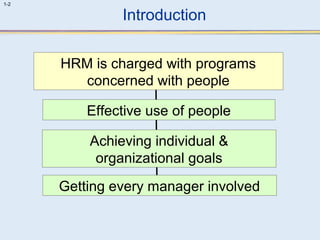
1-2 Introduction 
HRM is charged with programs 
concerned with people 
Effective use of people 
Achieving individual & 
organizational goals 
Getting every manager involved
1-3 
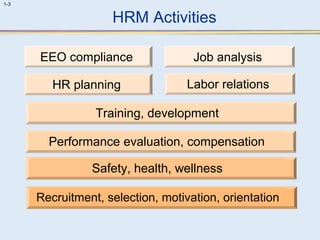
HRM Activities 
EEO compliance 
HR planning 
Job analysis 
Labor relations 
Training, development 
Performance evaluation, compensation 
Safety, health, wellness 
Recruitment, selection, motivation, orientation
1-4 
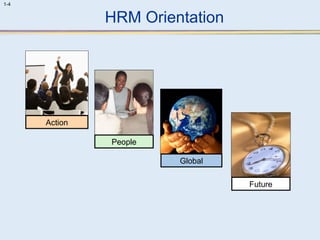
HRM Orientation 
Action 
People 
Future 
Global
1-5 
A Brief History of HRM 
Personnel departments were created to deal with: 
Drastic changes in technology 
Organizational growth 
The rise of unions 
Government intervention 
Employee-management conflict
1-6 
Strategic Importance of HRM 
Today, HRM plays a major role in: 
Clarifying the firm’s human resource problems 
Developing solutions for them 
Strategic HRM differs from traditional HRM 
Traditional arrangements… responsibility for 
managing human resources lies with specialists 
Strategic approach… people management rests with 
anyone who is in direct contact with workers or line 
managers
1-7 
Strategic Importance of HRM 
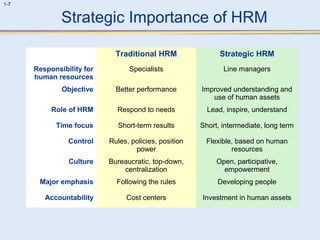
Traditional HRM Strategic HRM 
Responsibility for 
human resources 
Specialists Line managers 
Objective Better performance Improved understanding and 
use of human assets 
Role of HRM Respond to needs Lead, inspire, understand 
Time focus Short-term results Short, intermediate, long term 
Control Rules, policies, position 
power 
Flexible, based on human 
resources 
Culture Bureaucratic, top-down, 
centralization 
Open, participative, 
empowerment 
Major emphasis Following the rules Developing people 
Accountability Cost centers Investment in human assets
1-8 
Strategic Importance of HRM 
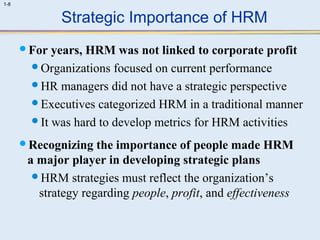
For years, HRM was not linked to corporate profit 
Organizations focused on current performance 
HR managers did not have a strategic perspective 
Executives categorized HRM in a traditional manner 
It was hard to develop metrics for HRM activities 
Recognizing the importance of people made HRM 
a major player in developing strategic plans 
HRM strategies must reflect the organization’s 
strategy regarding people, profit, and effectiveness
1-9 
Strategic Importance of HRM 
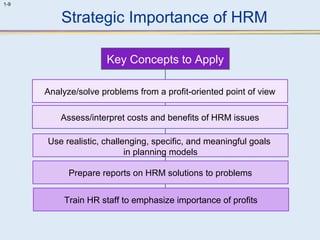
Key Concepts to Apply 
Analyze/solve problems from a profit-oriented point of view 
Assess/interpret costs and benefits of HRM issues 
Use realistic, challenging, specific, and meaningful goals 
in planning models 
Prepare reports on HRM solutions to problems 
Train HR staff to emphasize importance of profits
1-10 
Strategic Importance of HRM 
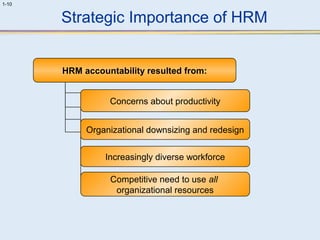
HRM accountability resulted from: 
Concerns about productivity 
Organizational downsizing and redesign 
Increasingly diverse workforce 
Competitive need to use all 
organizational resources
1-11 
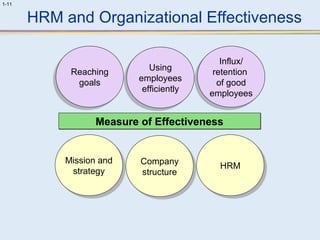
HRM and Organizational Effectiveness 
Reaching 
goals 
Reaching 
goals 
Using 
employees 
efficiently 
Using 
employees 
efficiently 
Influx/ 
retention 
of good 
employees 
Influx/ 
retention 
of good 
employees 
MMeeaassuurree ooff EEffffeeccttiivveenneessss 
Mission and 
strategy 
Mission and 
strategy 
Company 
structure HRM HRM 
Company 
structure
1-12 
HRM and Organizational Effectiveness 
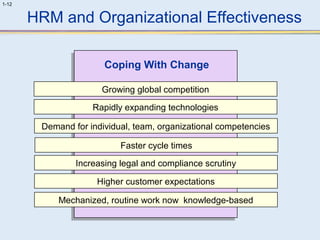
Coping With Change 
Growing global competition 
Rapidly expanding technologies 
Demand for individual, team, organizational competencies 
Faster cycle times 
Increasing legal and compliance scrutiny 
Higher customer expectations 
Mechanized, routine work now knowledge-based
1-13 
Objectives of the HRM Function 
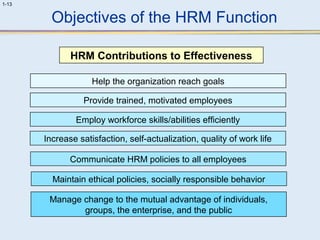
HRM Contributions to Effectiveness 
Help the organization reach goals 
Provide trained, motivated employees 
Employ workforce skills/abilities efficiently 
Increase satisfaction, self-actualization, quality of work life 
Communicate HRM policies to all employees 
Maintain ethical policies, socially responsible behavior 
Manage change to the mutual advantage of individuals, 
groups, the enterprise, and the public
1-14 
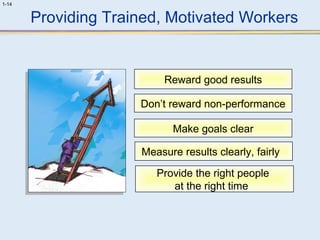
Providing Trained, Motivated Workers 
Reward good results 
Don’t reward non-performance 
Make goals clear 
Measure results clearly, fairly 
Provide the right people 
at the right time
1-15 
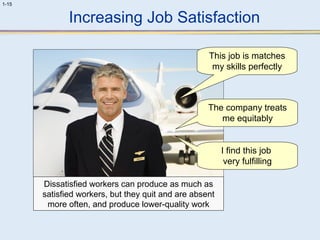
Increasing Job Satisfaction 
This job is matches 
my skills perfectly 
The company treats 
me equitably 
I find this job 
very fulfilling 
Dissatisfied workers can produce as much as 
satisfied workers, but they quit and are absent 
more often, and produce lower-quality work
1-16 
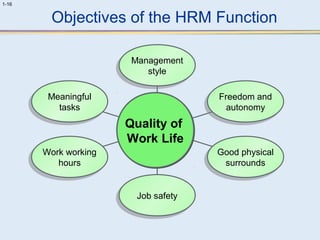
Objectives of the HRM Function 
Meaningful 
tasks 
Meaningful 
tasks 
Work working 
Work working 
hours 
hours 
Management 
style 
JJoobb s saafefetyty 
Freedom and 
autonomy 
Freedom and 
autonomy 
Good physical 
surrounds 
Good physical 
surrounds 
Management 
style 
Quality of 
Work Life
1-17 
Objectives of the HRM Function 
Communicating HRM policies to all employees: 
HRM policies, programs, and procedures 
must be communicated fully and effectively 
They must be represented to outsiders 
Top-level managers must understand what 
HRM can offer
1-18 
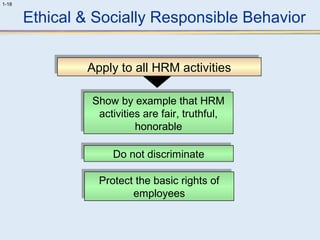
Ethical & Socially Responsible Behavior 
AAppppllyy ttoo aallll HHRRMM aaccttiivviittiieess 
Show by example that HRM 
activities are fair, truthful, 
Show by example that HRM 
activities are fair, truthful, 
honorable 
honorable 
DDoo nnoott ddisisccrrimimininaattee 
Protect the basic rights of 
employees 
employees
1-19 
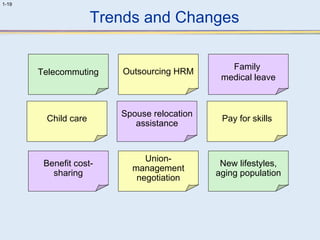
Trends and Changes 
Telecommuting Outsourcing HRM Family 
medical leave 
Child care Spouse relocation 
assistance Pay for skills 
Benefit cost-sharing 
Union-management 
negotiation 
New lifestyles, 
aging population
1-20 
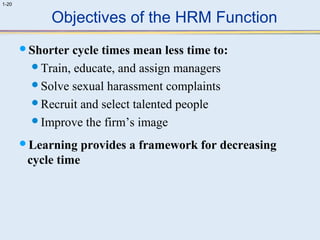
Objectives of the HRM Function 
Shorter cycle times mean less time to: 
Train, educate, and assign managers 
Solve sexual harassment complaints 
Recruit and select talented people 
Improve the firm’s image 
Learning provides a framework for decreasing 
cycle time
1-21 
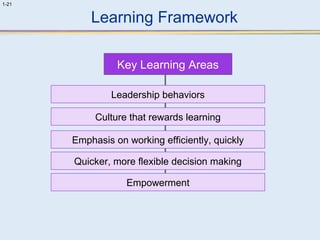
Learning Framework 
Key Learning Areas 
Leadership behaviors 
Culture that rewards learning 
Emphasis on working efficiently, quickly 
Quicker, more flexible decision making 
Empowerment
1-22 
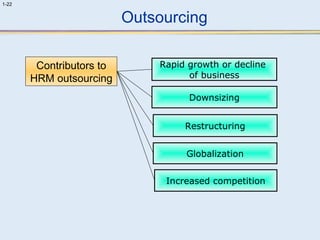
Outsourcing 
Rapid growth or decline 
of business 
Downsizing 
Restructuring 
Globalization 
Increased competition 
Contributors to 
HRM outsourcing
1-23 
Outsourcing 
Some executives assume that outsourcing can: 
Reduce costs 
Improve flexibility 
Permit the hiring of specialized expertise 
There is little empirical support for these 
assumptions
1-24 
Developing a Competitive Advantage 
These must become so important and effective that 
every unit in the firm knows they are needed for 
success: 
The compensation system 
Training opportunities 
Diversity management programs
1-25 
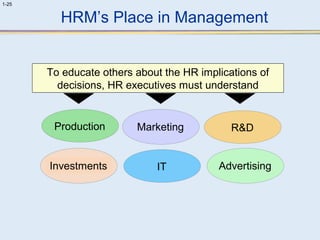
HRM’s Place in Management 
To educate others about the HR implications of 
decisions, HR executives must understand 
Production Marketing 
Investments Advertising 
IT 
R&D
1-26 
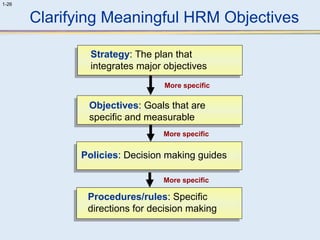
Clarifying Meaningful HRM Objectives 
Strategy: The plan that 
integrates major objectives 
More specific 
Objectives: Goals that are 
specific and measurable 
More specific 
Policies: Decision making guides 
More specific 
Procedures/rules: Specific 
directions for decision making
1-27 
HRM Policy 
A policy is a general guide that expresses 
limits within which action should occur 
Arises from past or potential problems 
Frees managers from making certain 
decisions 
Ensures some consistency 
in behavior 
Allows managers to concentrate 
on decisions where they have the most 
experience and knowledge
1-28 
HRM Procedures 
Procedures (rules) are specific directions 
In standard operating procedure (SOP) manuals 
Helps ensure consistent decision making 
Should be well-developed, but not excessive 
Develop for only the most vital areas
1-29 
Organization of an HR Department 
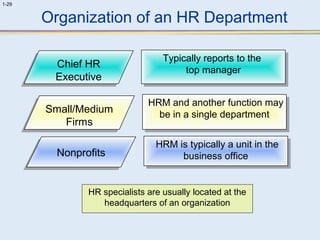
Chief HR 
Executive 
Typically reports to the 
top manager 
Small/Medium 
HRM and another function may 
be in a single department 
HRM and another function may 
be in a single department 
Firms 
HRM HRM is is typically typically a a unit unit in in the 
NNoonnpprrooffititss the 
business office 
HR specialists are usually located at the 
headquarters of an organization 
Chief HR 
Executive 
Typically reports to the 
top manager 
Small/Medium 
Firms 
business office

1 introduction to hrm

  • 1.
    1-1 Chapter 1 Introduction to Human Resource Management and the Environment
  • 2.
    1-2 Introduction HRMis charged with programs concerned with people Effective use of people Achieving individual & organizational goals Getting every manager involved
  • 3.
    1-3 HRM Activities EEO compliance HR planning Job analysis Labor relations Training, development Performance evaluation, compensation Safety, health, wellness Recruitment, selection, motivation, orientation
  • 4.
    1-4 HRM Orientation Action People Future Global
  • 5.
    1-5 A BriefHistory of HRM Personnel departments were created to deal with: Drastic changes in technology Organizational growth The rise of unions Government intervention Employee-management conflict
  • 6.
    1-6 Strategic Importanceof HRM Today, HRM plays a major role in: Clarifying the firm’s human resource problems Developing solutions for them Strategic HRM differs from traditional HRM Traditional arrangements… responsibility for managing human resources lies with specialists Strategic approach… people management rests with anyone who is in direct contact with workers or line managers
  • 7.
    1-7 Strategic Importanceof HRM Traditional HRM Strategic HRM Responsibility for human resources Specialists Line managers Objective Better performance Improved understanding and use of human assets Role of HRM Respond to needs Lead, inspire, understand Time focus Short-term results Short, intermediate, long term Control Rules, policies, position power Flexible, based on human resources Culture Bureaucratic, top-down, centralization Open, participative, empowerment Major emphasis Following the rules Developing people Accountability Cost centers Investment in human assets
  • 8.
    1-8 Strategic Importanceof HRM For years, HRM was not linked to corporate profit Organizations focused on current performance HR managers did not have a strategic perspective Executives categorized HRM in a traditional manner It was hard to develop metrics for HRM activities Recognizing the importance of people made HRM a major player in developing strategic plans HRM strategies must reflect the organization’s strategy regarding people, profit, and effectiveness
  • 9.
    1-9 Strategic Importanceof HRM Key Concepts to Apply Analyze/solve problems from a profit-oriented point of view Assess/interpret costs and benefits of HRM issues Use realistic, challenging, specific, and meaningful goals in planning models Prepare reports on HRM solutions to problems Train HR staff to emphasize importance of profits
  • 10.
    1-10 Strategic Importanceof HRM HRM accountability resulted from: Concerns about productivity Organizational downsizing and redesign Increasingly diverse workforce Competitive need to use all organizational resources
  • 11.
    1-11 HRM andOrganizational Effectiveness Reaching goals Reaching goals Using employees efficiently Using employees efficiently Influx/ retention of good employees Influx/ retention of good employees MMeeaassuurree ooff EEffffeeccttiivveenneessss Mission and strategy Mission and strategy Company structure HRM HRM Company structure
  • 12.
    1-12 HRM andOrganizational Effectiveness Coping With Change Growing global competition Rapidly expanding technologies Demand for individual, team, organizational competencies Faster cycle times Increasing legal and compliance scrutiny Higher customer expectations Mechanized, routine work now knowledge-based
  • 13.
    1-13 Objectives ofthe HRM Function HRM Contributions to Effectiveness Help the organization reach goals Provide trained, motivated employees Employ workforce skills/abilities efficiently Increase satisfaction, self-actualization, quality of work life Communicate HRM policies to all employees Maintain ethical policies, socially responsible behavior Manage change to the mutual advantage of individuals, groups, the enterprise, and the public
  • 14.
    1-14 Providing Trained,Motivated Workers Reward good results Don’t reward non-performance Make goals clear Measure results clearly, fairly Provide the right people at the right time
  • 15.
    1-15 Increasing JobSatisfaction This job is matches my skills perfectly The company treats me equitably I find this job very fulfilling Dissatisfied workers can produce as much as satisfied workers, but they quit and are absent more often, and produce lower-quality work
  • 16.
    1-16 Objectives ofthe HRM Function Meaningful tasks Meaningful tasks Work working Work working hours hours Management style JJoobb s saafefetyty Freedom and autonomy Freedom and autonomy Good physical surrounds Good physical surrounds Management style Quality of Work Life
  • 17.
    1-17 Objectives ofthe HRM Function Communicating HRM policies to all employees: HRM policies, programs, and procedures must be communicated fully and effectively They must be represented to outsiders Top-level managers must understand what HRM can offer
  • 18.
    1-18 Ethical &Socially Responsible Behavior AAppppllyy ttoo aallll HHRRMM aaccttiivviittiieess Show by example that HRM activities are fair, truthful, Show by example that HRM activities are fair, truthful, honorable honorable DDoo nnoott ddisisccrrimimininaattee Protect the basic rights of Protect the basic rights of employees employees
  • 19.
    1-19 Trends andChanges Telecommuting Outsourcing HRM Family medical leave Child care Spouse relocation assistance Pay for skills Benefit cost-sharing Union-management negotiation New lifestyles, aging population
  • 20.
    1-20 Objectives ofthe HRM Function Shorter cycle times mean less time to: Train, educate, and assign managers Solve sexual harassment complaints Recruit and select talented people Improve the firm’s image Learning provides a framework for decreasing cycle time
  • 21.
    1-21 Learning Framework Key Learning Areas Leadership behaviors Culture that rewards learning Emphasis on working efficiently, quickly Quicker, more flexible decision making Empowerment
  • 22.
    1-22 Outsourcing Rapidgrowth or decline of business Downsizing Restructuring Globalization Increased competition Contributors to HRM outsourcing
  • 23.
    1-23 Outsourcing Someexecutives assume that outsourcing can: Reduce costs Improve flexibility Permit the hiring of specialized expertise There is little empirical support for these assumptions
  • 24.
    1-24 Developing aCompetitive Advantage These must become so important and effective that every unit in the firm knows they are needed for success: The compensation system Training opportunities Diversity management programs
  • 25.
    1-25 HRM’s Placein Management To educate others about the HR implications of decisions, HR executives must understand Production Marketing Investments Advertising IT R&D
  • 26.
    1-26 Clarifying MeaningfulHRM Objectives Strategy: The plan that integrates major objectives More specific Objectives: Goals that are specific and measurable More specific Policies: Decision making guides More specific Procedures/rules: Specific directions for decision making
  • 27.
    1-27 HRM Policy A policy is a general guide that expresses limits within which action should occur Arises from past or potential problems Frees managers from making certain decisions Ensures some consistency in behavior Allows managers to concentrate on decisions where they have the most experience and knowledge
  • 28.
    1-28 HRM Procedures Procedures (rules) are specific directions In standard operating procedure (SOP) manuals Helps ensure consistent decision making Should be well-developed, but not excessive Develop for only the most vital areas
  • 29.
    1-29 Organization ofan HR Department Chief HR Executive Typically reports to the top manager Small/Medium HRM and another function may be in a single department HRM and another function may be in a single department Firms HRM HRM is is typically typically a a unit unit in in the NNoonnpprrooffititss the business office HR specialists are usually located at the headquarters of an organization Chief HR Executive Typically reports to the top manager Small/Medium Firms business office