
1
Objectives
 Define the term human resource management.
 Describe the strategic importance of human resource
  management (HRM) activities.
 Explain what career opportunities are available in the
  HRM field.
 Discuss the role that specialists and operating managers
  play in performing HRM activities.
 List the main objectives pursued by HRM units.


                                                        2
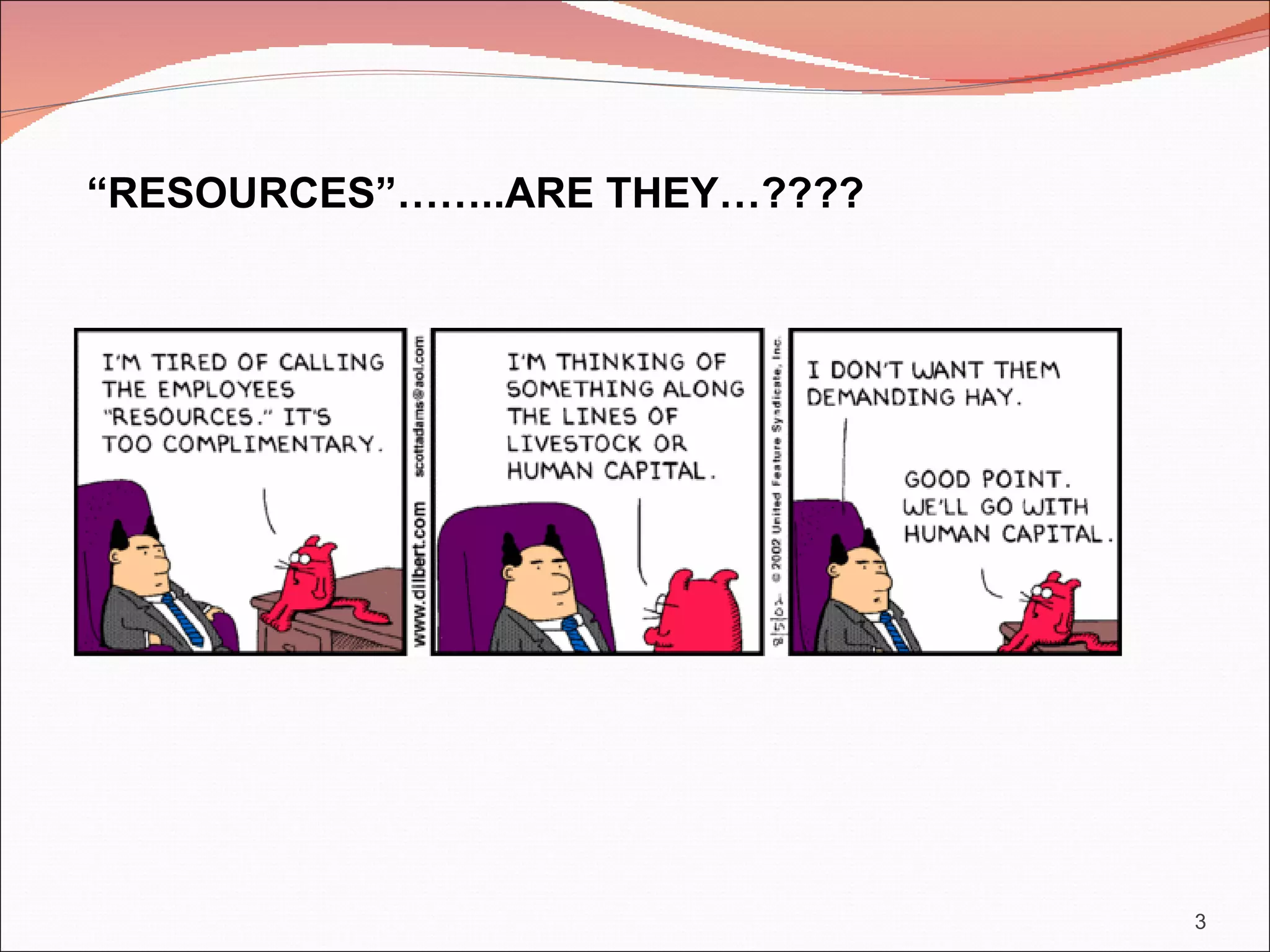
“RESOURCES”……..ARE THEY…????


                               3
Jack Welch- Winning
“Elevate HR to a position of power and primacy in
the organization, and make sure HR people have
the special qualities to help managers build leaders
and careers. In fact, the best HR types are pastors
and parents in the same package.”

“The head of human resources at any company
should be at least as important as the CFO.”


                                                       4
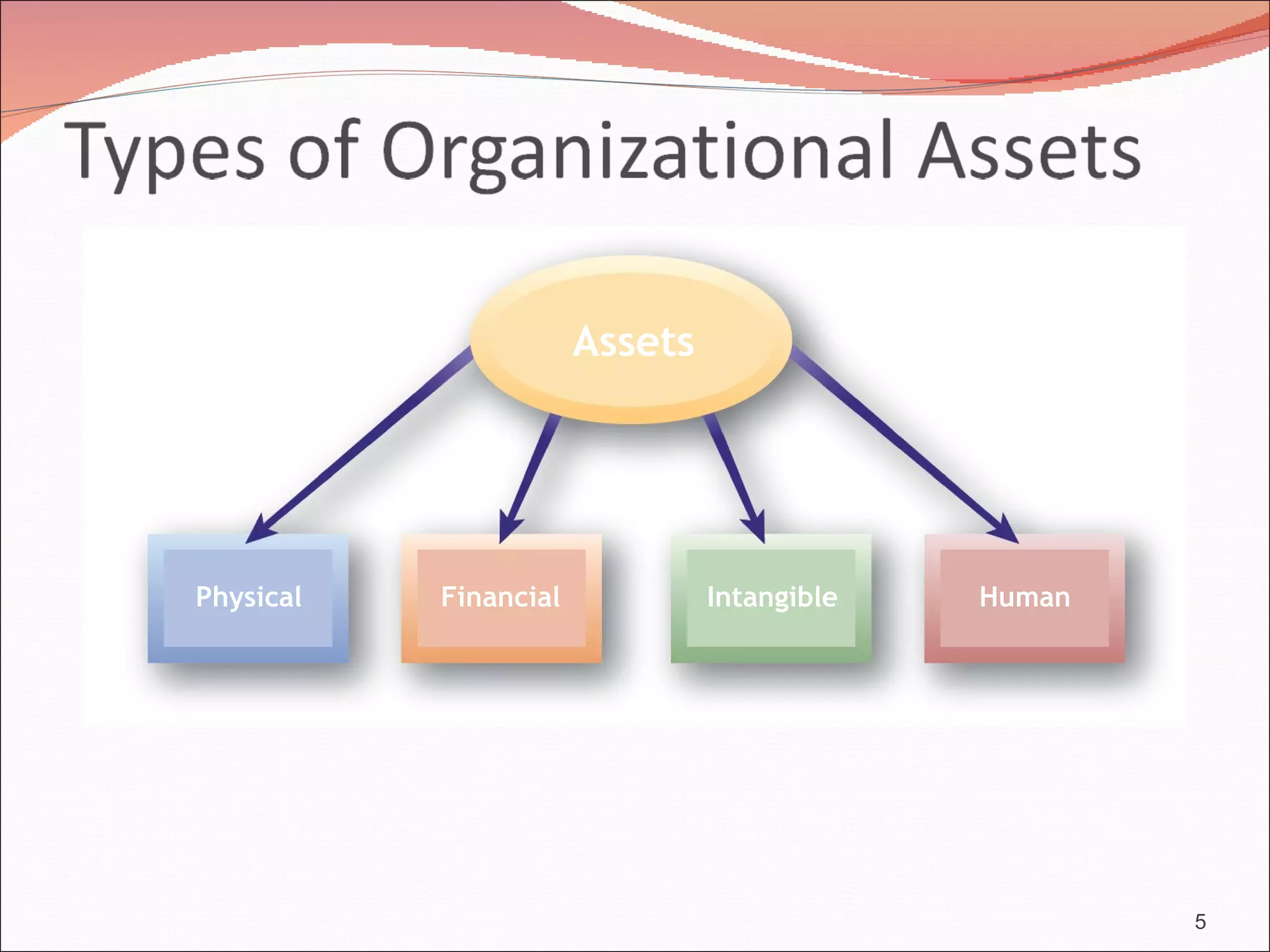
Assets


Physical   Financial            Intangible   Human


                                                     5
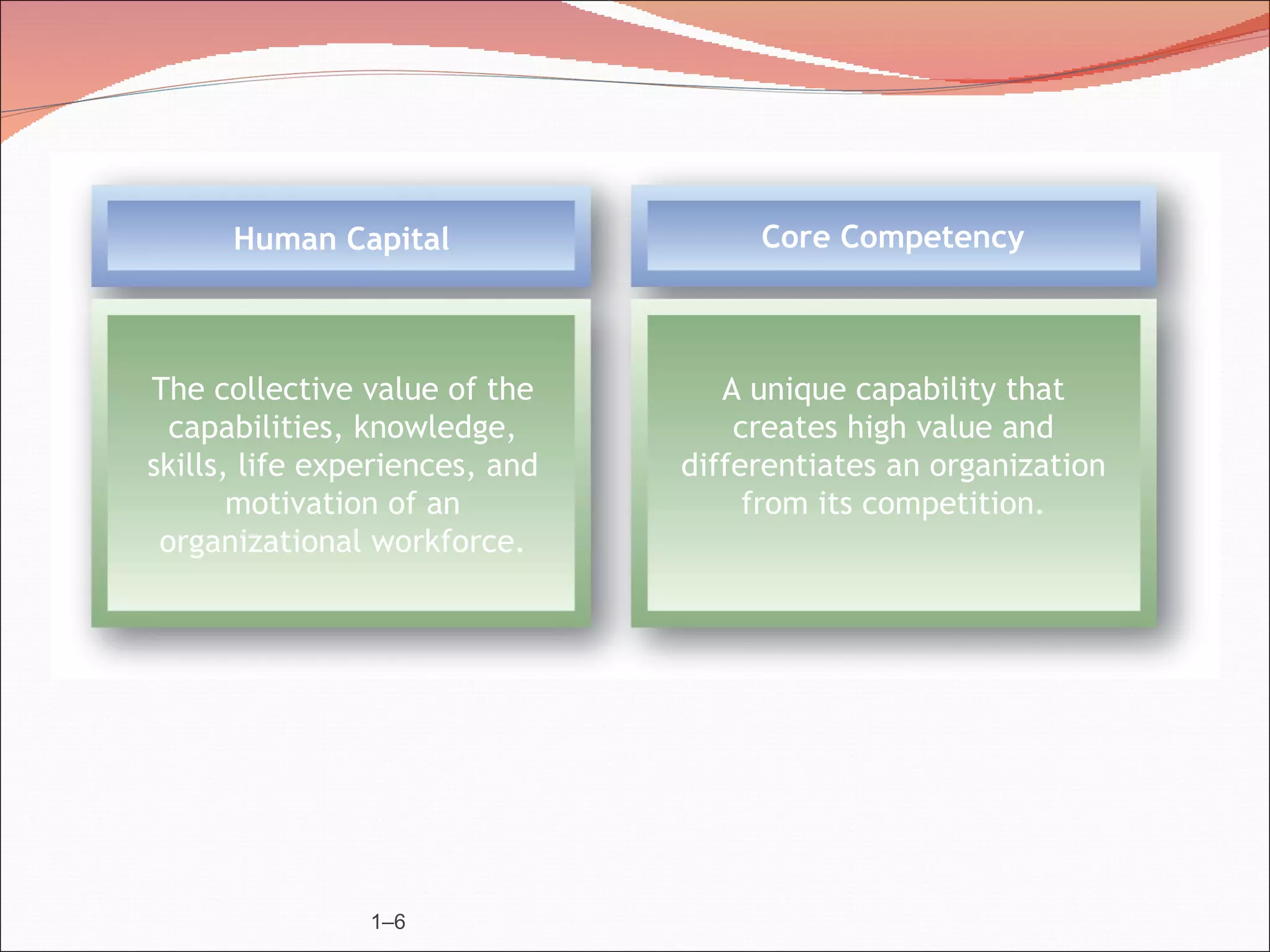
Human Capital                  Core Competency


The collective value of the        A unique capability that
  capabilities, knowledge,          creates high value and
skills, life experiences, and   differentiates an organization
       motivation of an              from its competition.
 organizational workforce.


                1–6
Leaders are Readers
 Peter Drucker
 The Essential Drucker (2008)
 “Business management must always, in every decision
 and action, put economic performance first.”


                                                        7
Human Resource Management:

      A strategic approach to managing
employment relations which emphasizes that
 leveraging people’s capabilities is critical to
 achieving competitive advantage. This being
     achieved through a distinctive set of
integrated employment policies, programmes
                and practices.


                                                   8
 Human resource management (HRM) is the
 effective management of people at work
   The goal: make workers more satisfied and productive
   When an organization is concerned about people, its
   total philosophy, culture, and orientation reflect it
 Every manager must be concerned with people,
 whether or not there is a human resources department


                                                           9
The Nature of Human Resource
        Management
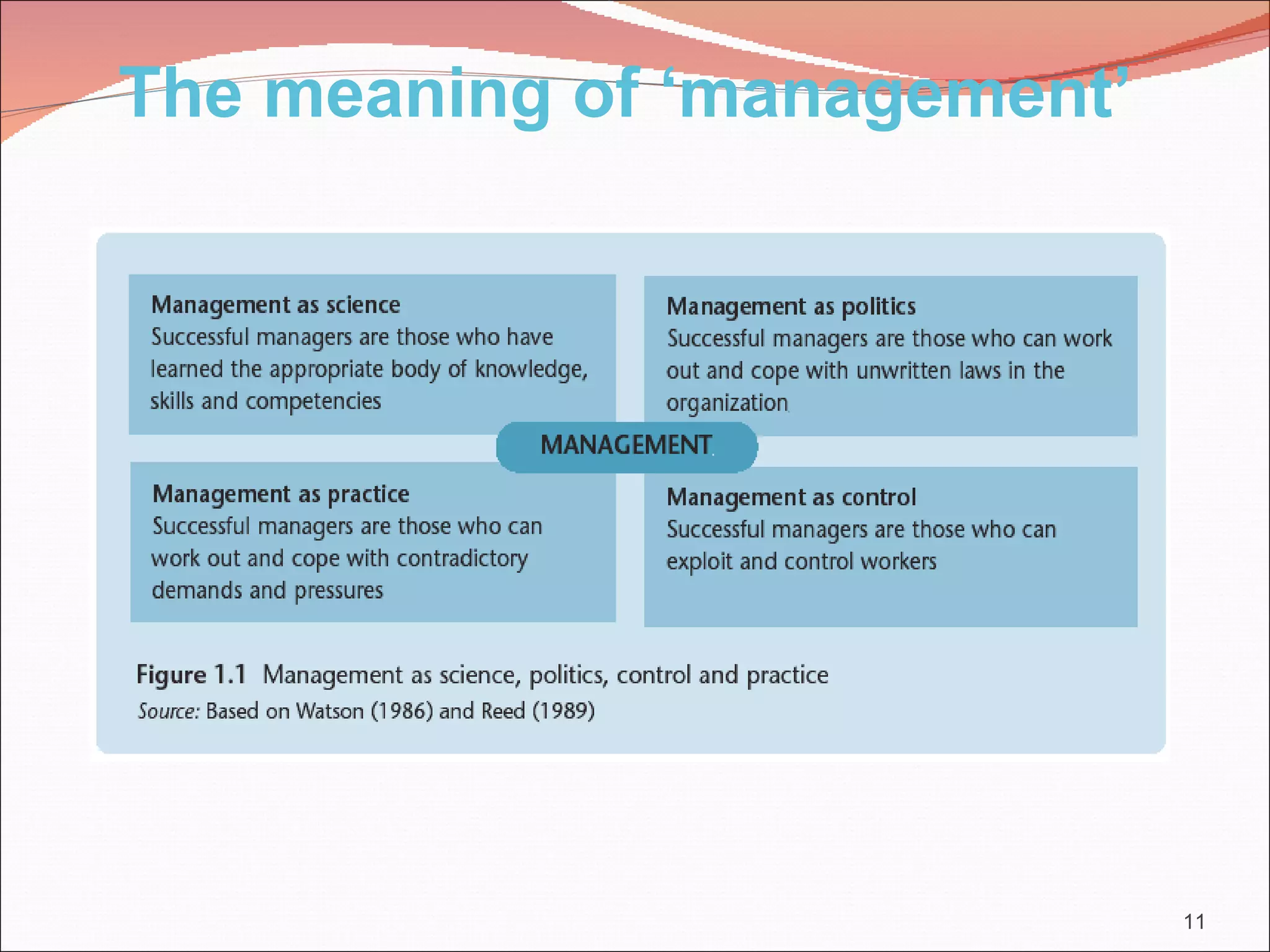
          Management:
     The science perspective
     The political perspective
     The control perspective
     The practice perspective


                                 10
The meaning of ‘management’


                              11
Leaders are Readers
 Good to Great
 Jim Collins (2001)
 “Good is the enemy of great.”


                                  12
The Nature of the Employment
        Relationship

Describes dynamic interlocking relations that
  exist between individuals and their work
              organizations.
   Considers economic, legal, social and
         psychological relations.


                                                13
The Nature of the Employment
        Relationship
   Economic – exchange of pay for work.
   Legal – network of common law and
 statutory rights and obligations affecting
                both parties.
Social – ‘social norms’ influence employees’
           actions in the workplace.
Psychological – dynamic, two-way exchange
  of perceived promises and obligations.
                                               14
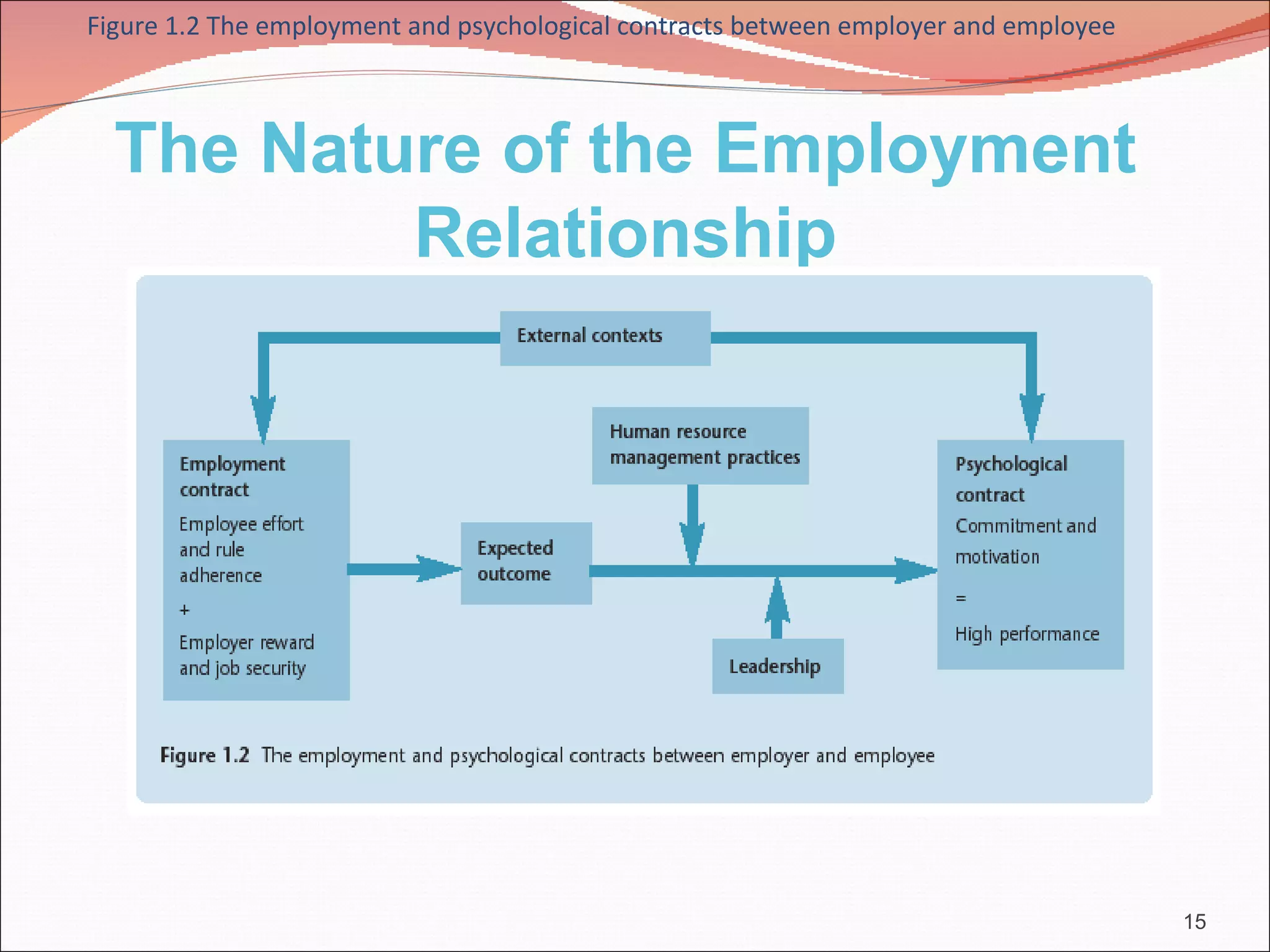
Figure 1.2 The employment and psychological contracts between employer and employee


  The Nature of the Employment
          Relationship


                                                                                      15
Figure 1–2
             16
12–17
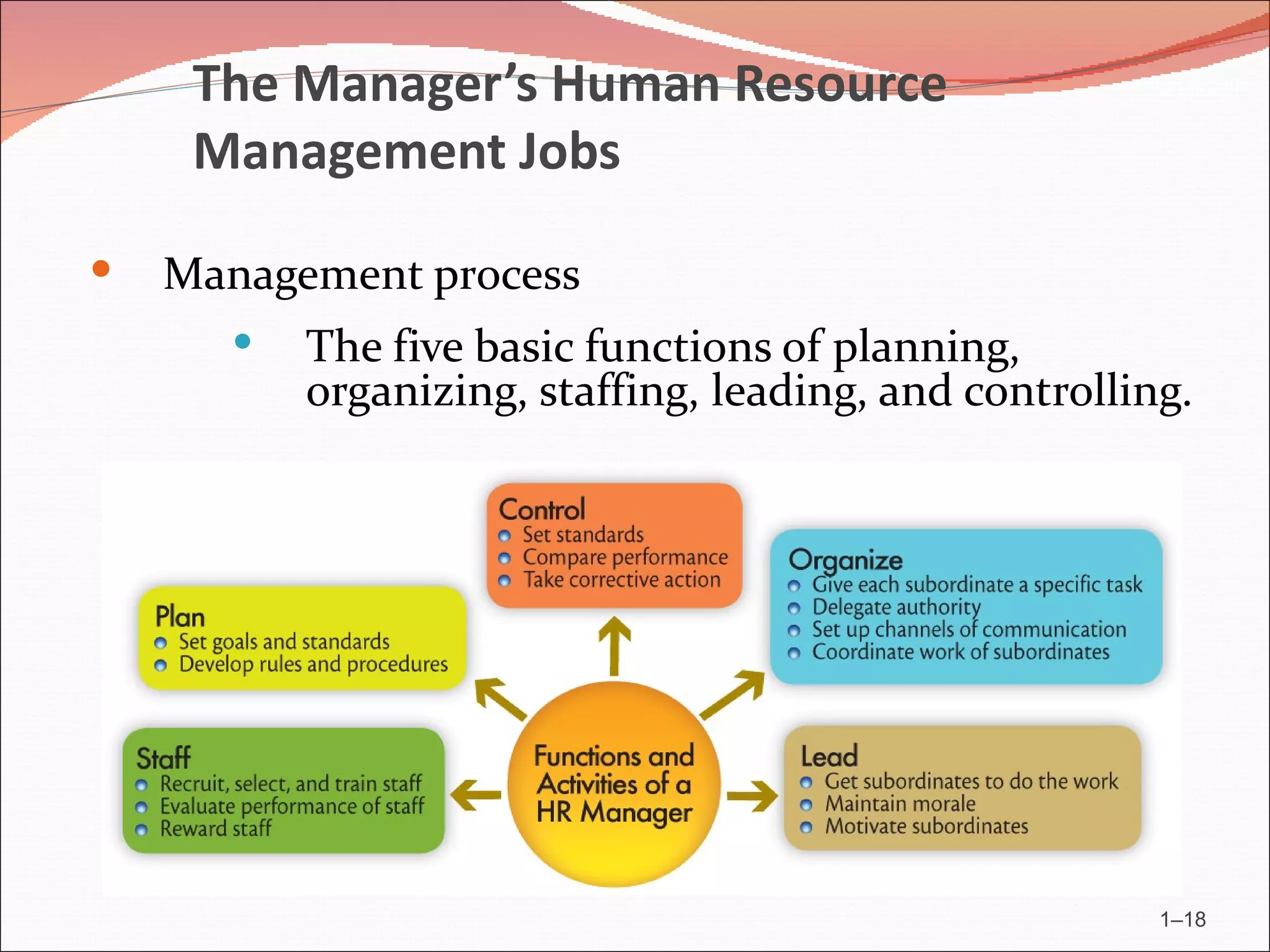
The Manager’s Human Resource
     Management Jobs

   Management process
         The five basic functions of planning,
          organizing, staffing, leading, and controlling.


                                                       1–18
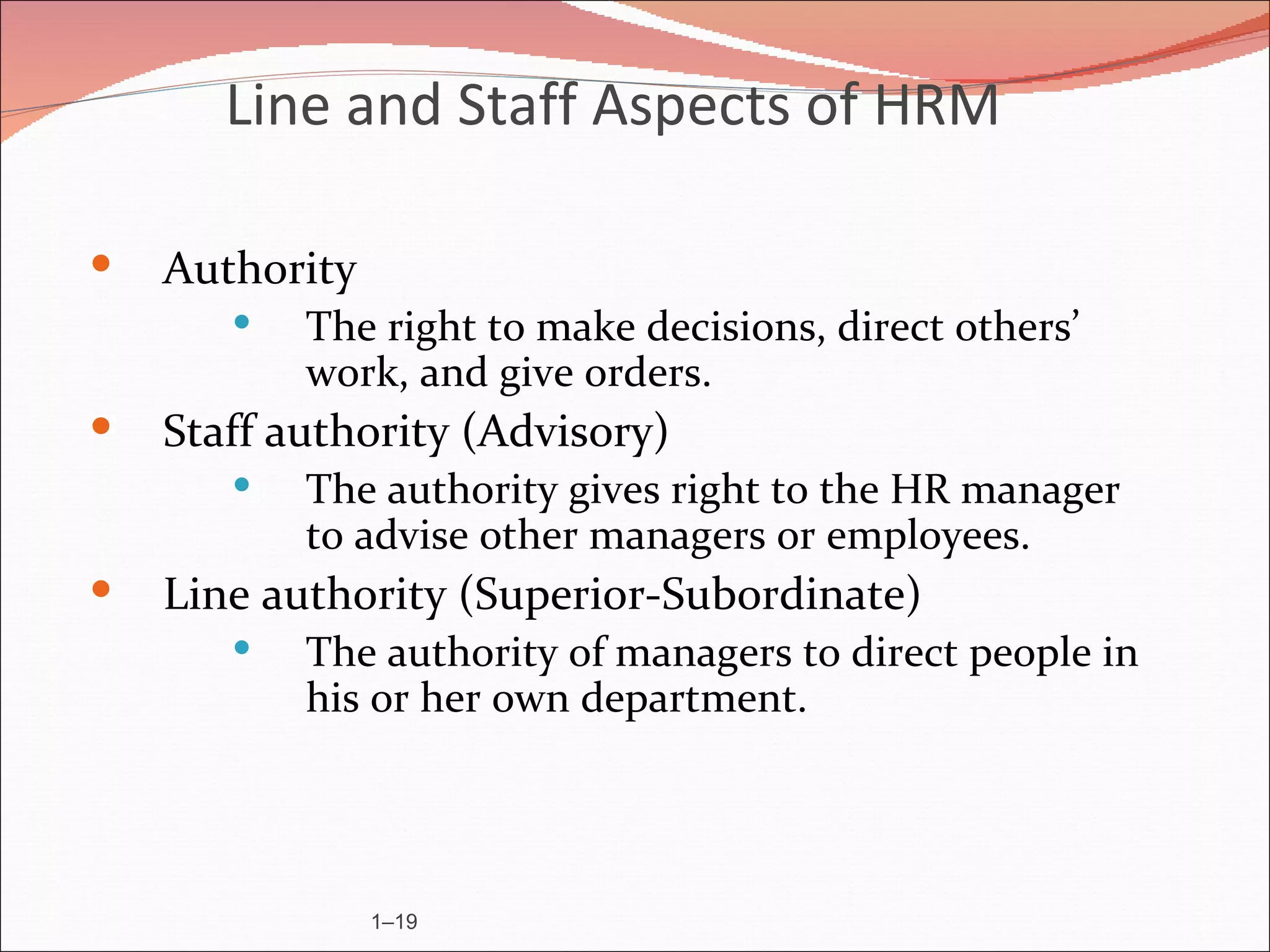
Line and Staff Aspects of HRM

   Authority
          The right to make decisions, direct others’
           work, and give orders.
   Staff authority (Advisory)
          The authority gives right to the HR manager
           to advise other managers or employees.
   Line authority (Superior-Subordinate)
          The authority of managers to direct people in
           his or her own department.


                1–19
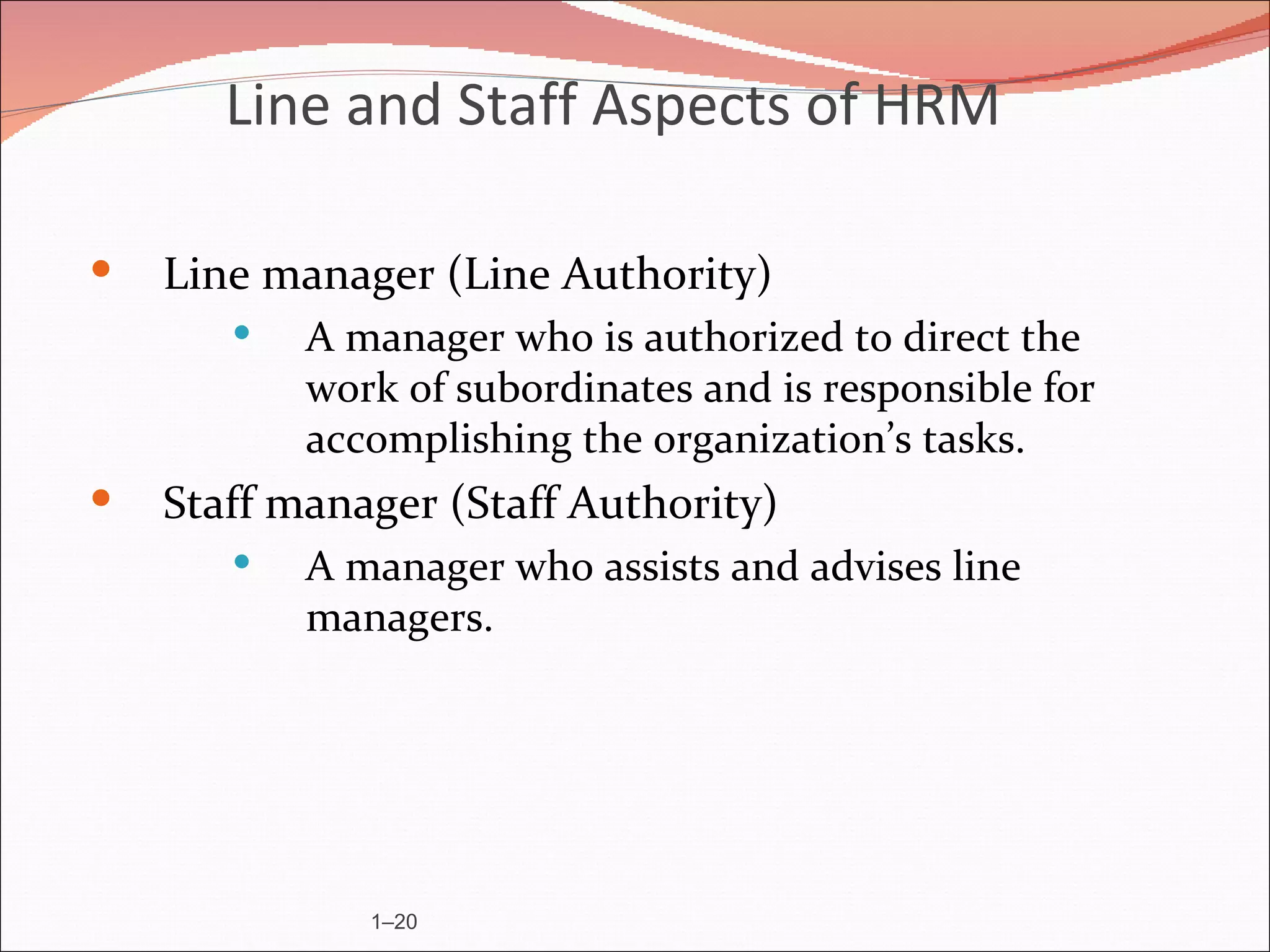
Line and Staff Aspects of HRM

   Line manager (Line Authority)
          A manager who is authorized to direct the
           work of subordinates and is responsible for
           accomplishing the organization’s tasks.
   Staff manager (Staff Authority)
          A manager who assists and advises line
           managers.


              1–20
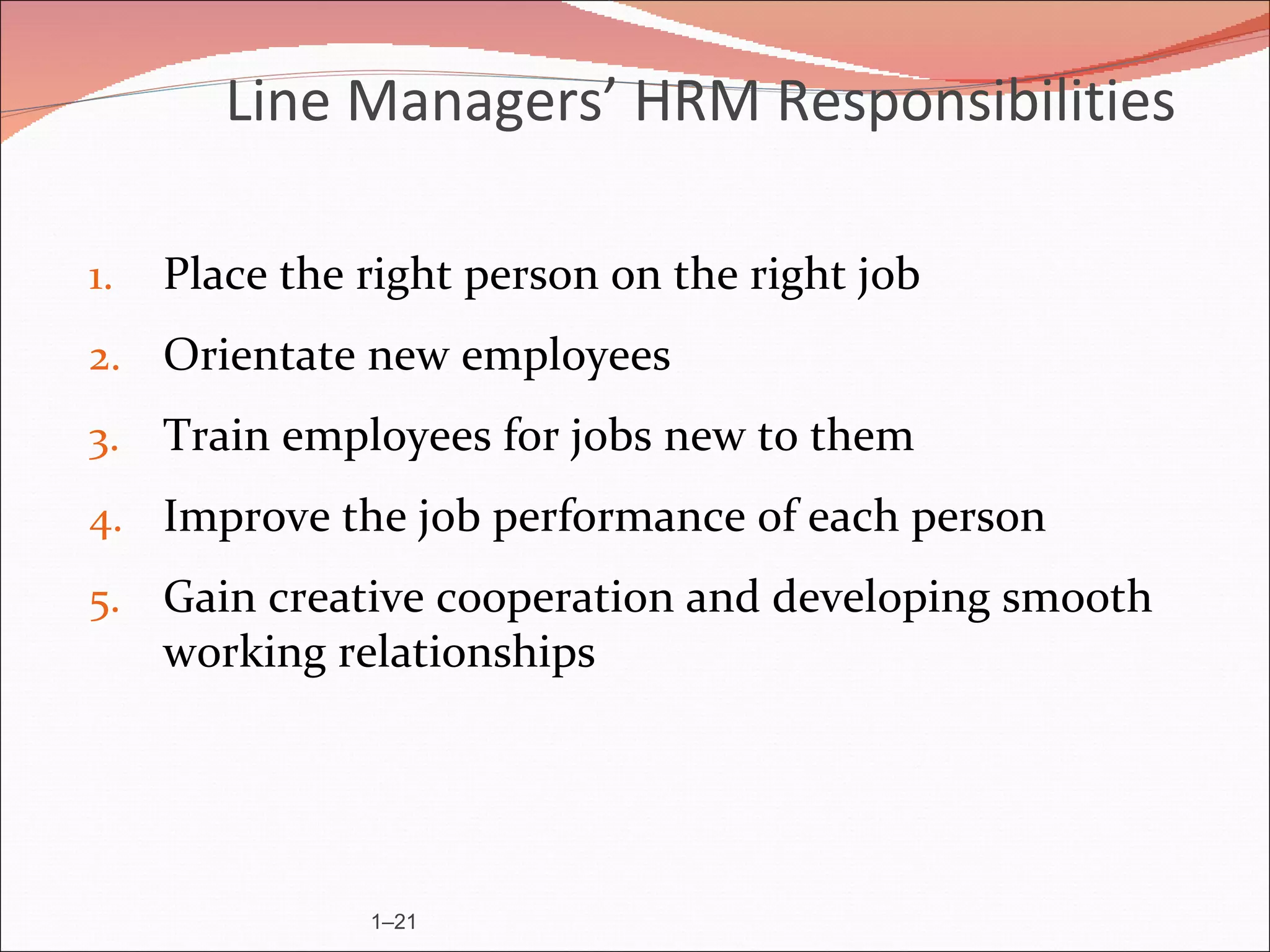
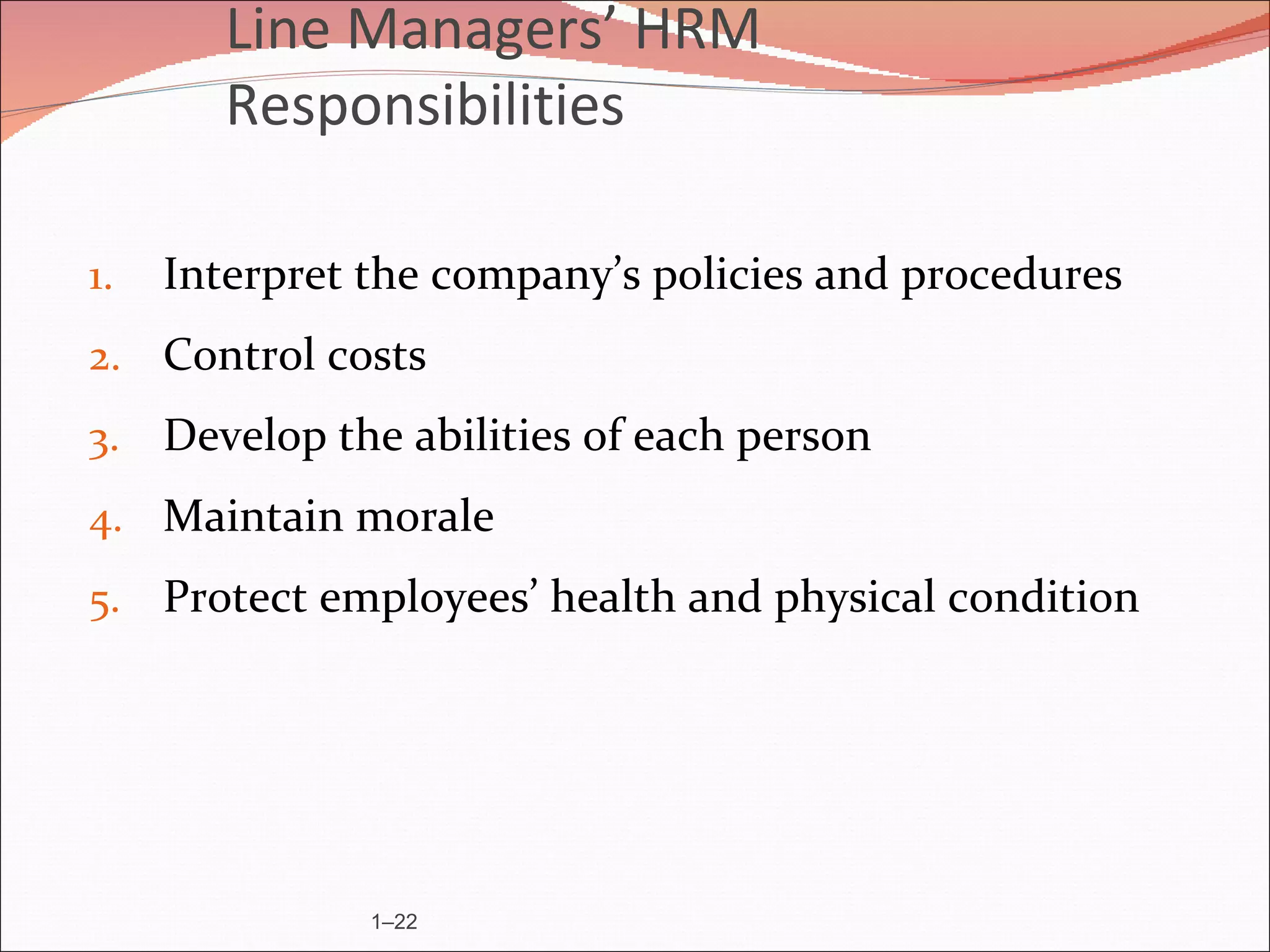
Line Managers’ HRM Responsibilities

1.   Place the right person on the right job
2. Orientate new employees
3. Train employees for jobs new to them
4. Improve the job performance of each person
5. Gain creative cooperation and developing smooth
     working relationships


               1–21
Line Managers’ HRM
        Responsibilities

1.   Interpret the company’s policies and procedures
2. Control costs
3. Develop the abilities of each person
4. Maintain morale
5. Protect employees’ health and physical condition


               1–22
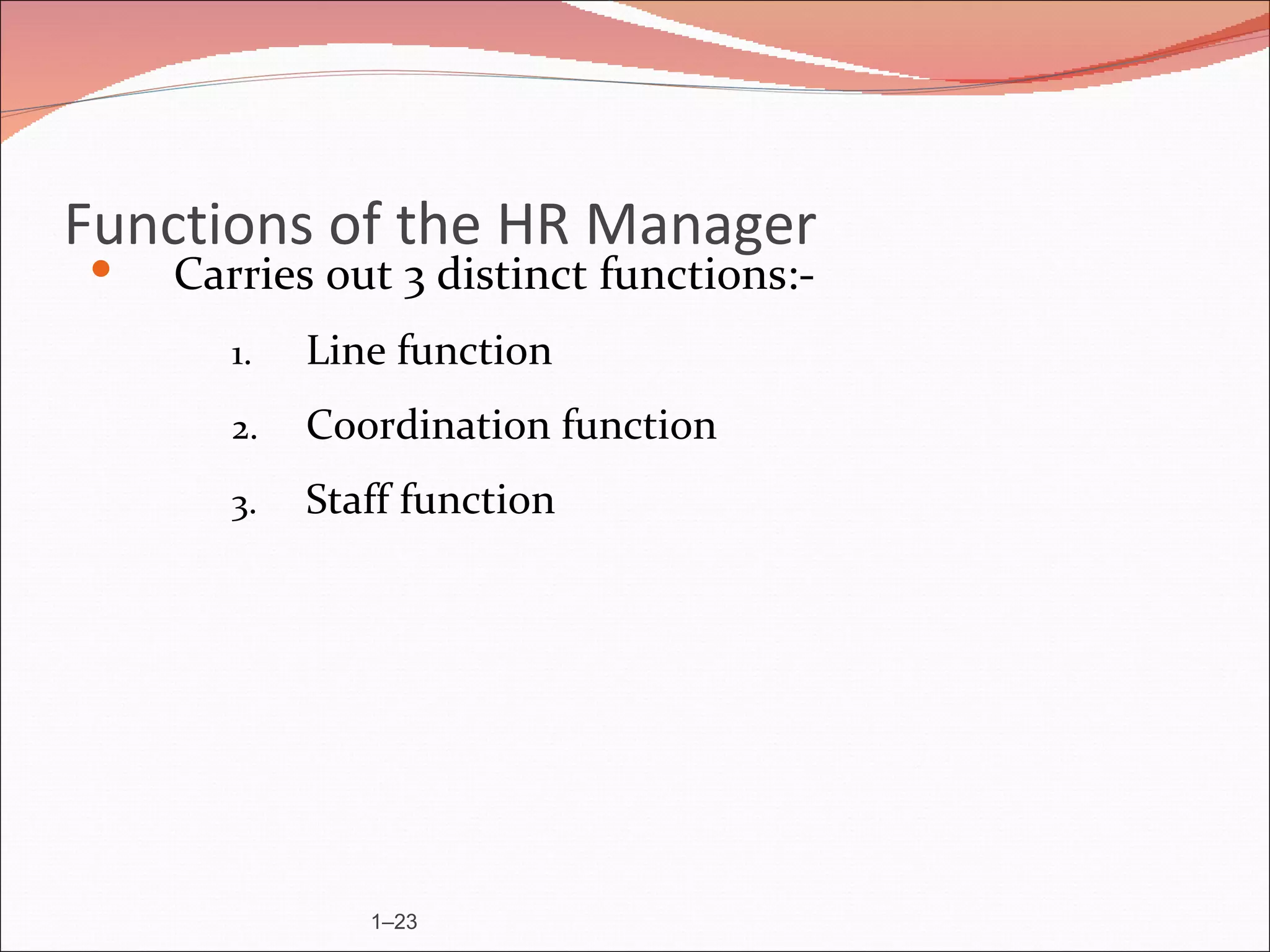
Functions of the HR Manager
   Carries out 3 distinct functions:-
       1.   Line function
       2.   Coordination function
       3.   Staff function


               1–23
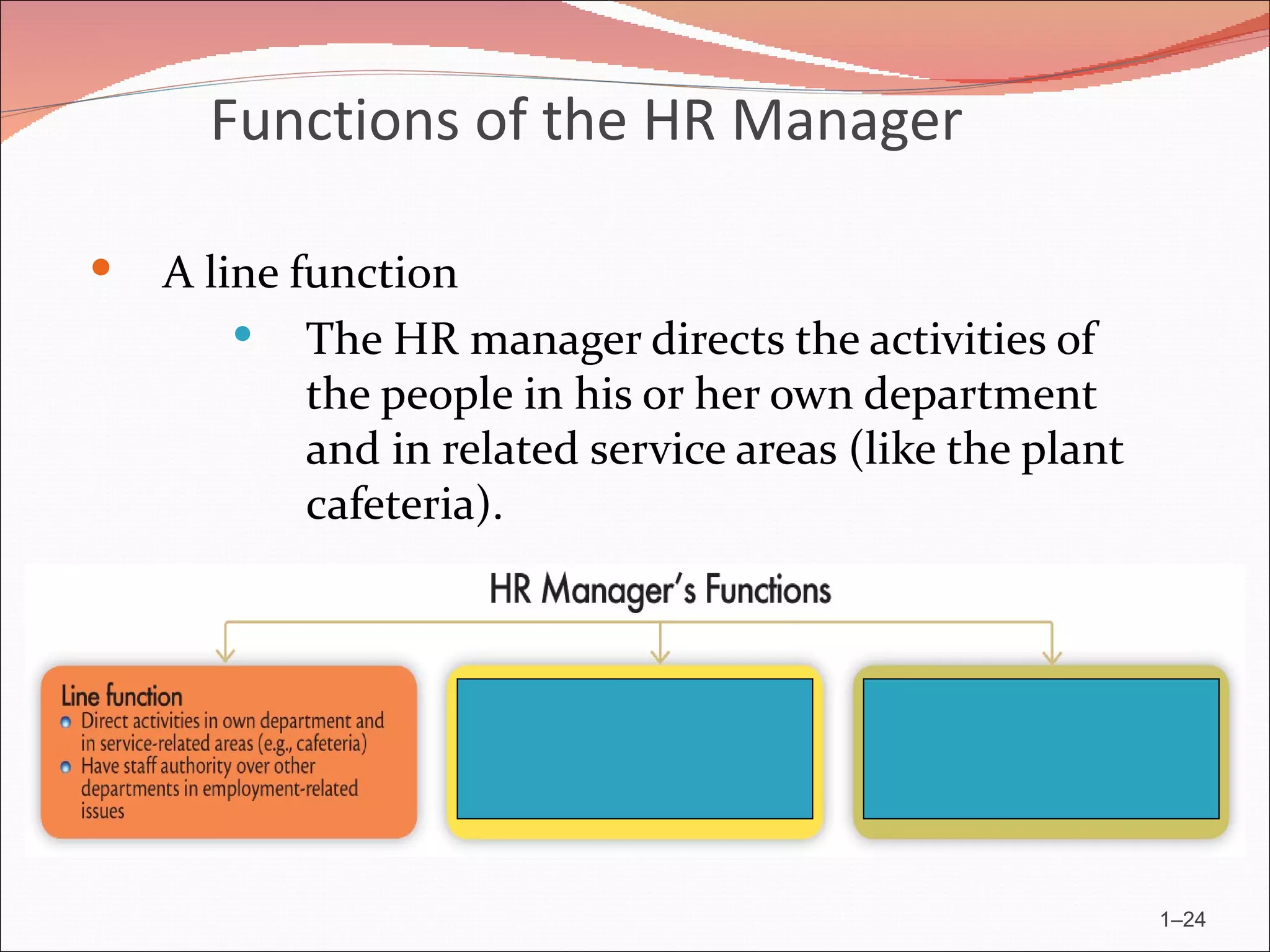
Functions of the HR Manager

   A line function
         The HR manager directs the activities of
            the people in his or her own department
            and in related service areas (like the plant
            cafeteria).


                                                           1–24
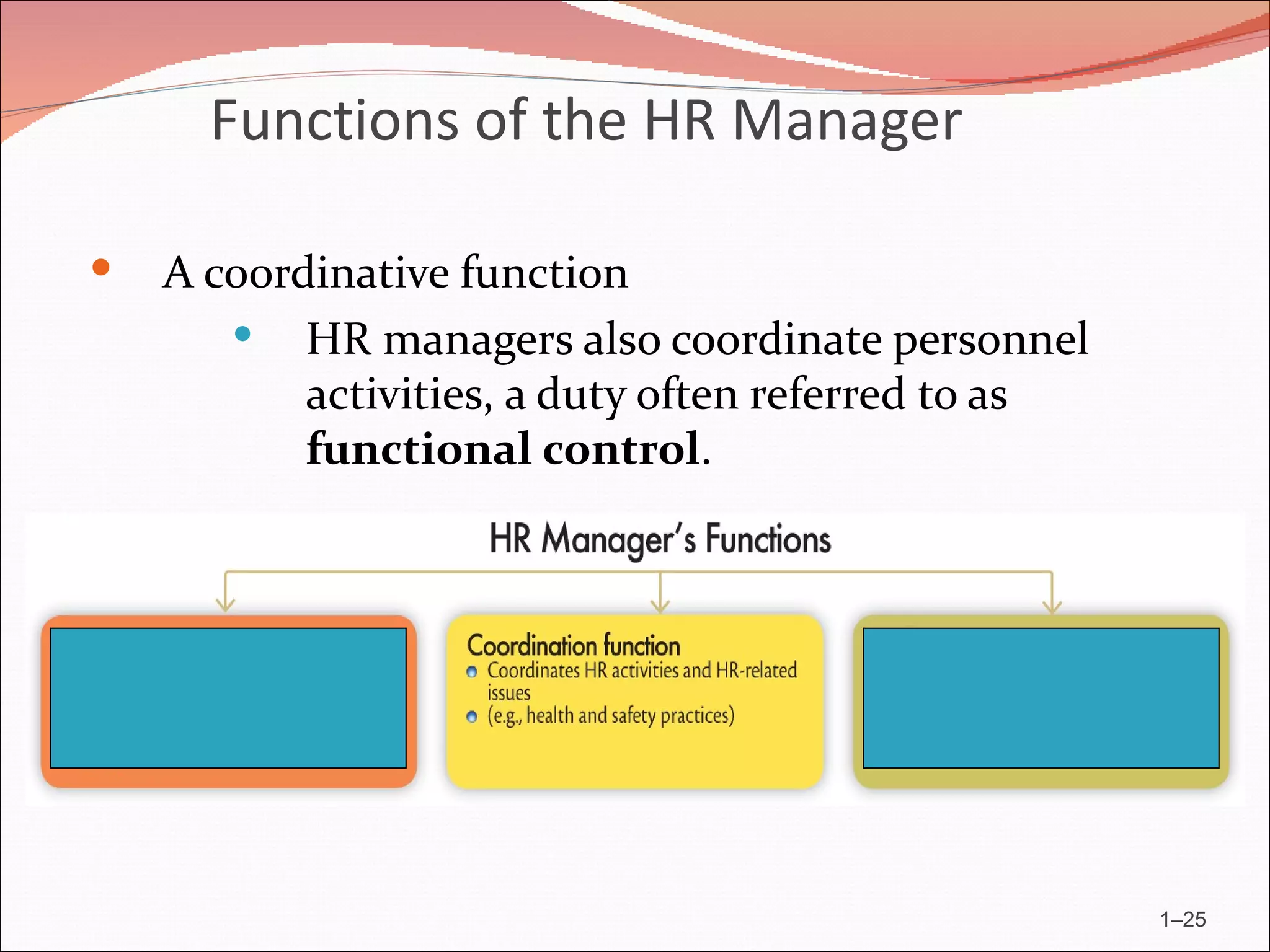
Functions of the HR Manager

   A coordinative function
        HR managers also coordinate personnel
           activities, a duty often referred to as
           functional control.


                                                     1–25
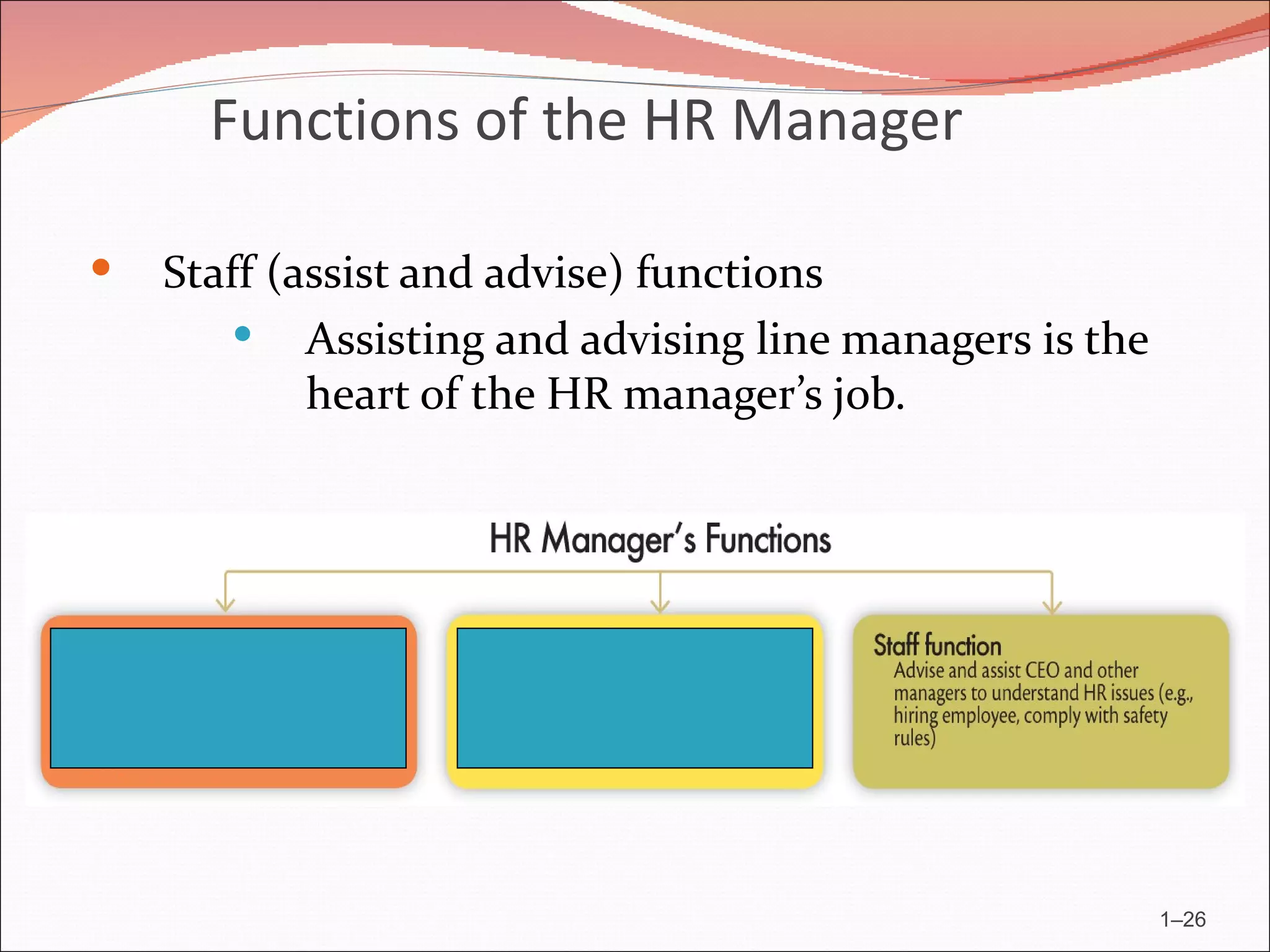
Functions of the HR Manager

   Staff (assist and advise) functions
        Assisting and advising line managers is the
            heart of the HR manager’s job.


                                                       1–26
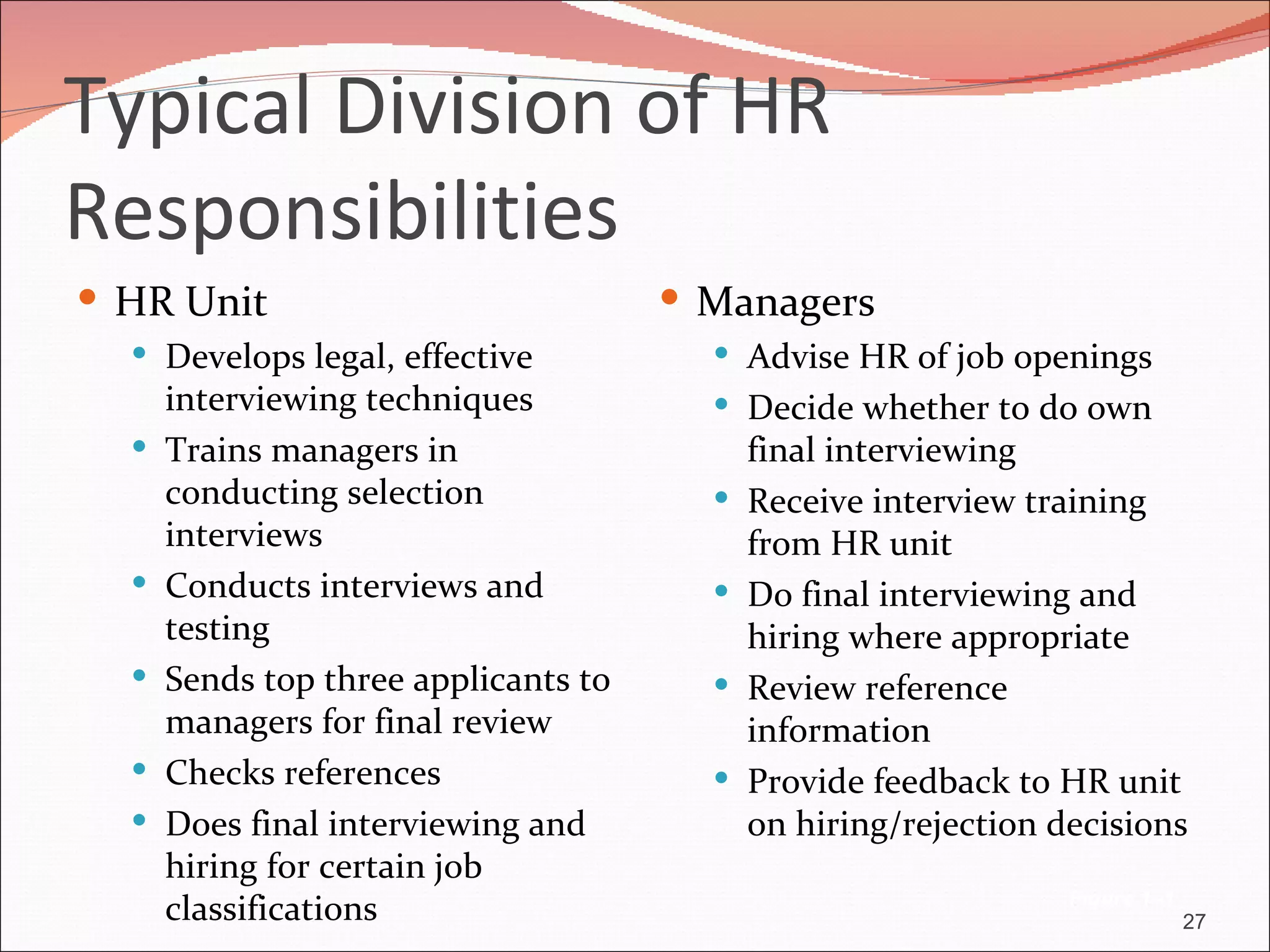
Typical Division of HR
Responsibilities
 HR Unit                              Managers
   Develops legal, effective            Advise HR of job openings
      interviewing techniques            Decide whether to do own
     Trains managers in                    final interviewing
      conducting selection                 Receive interview training
      interviews                            from HR unit
     Conducts interviews and              Do final interviewing and
      testing                               hiring where appropriate
     Sends top three applicants to        Review reference
      managers for final review             information
     Checks references                    Provide feedback to HR unit
     Does final interviewing and           on hiring/rejection decisions
      hiring for certain job
                                                                 Figure 1–1
      classifications                                                         27
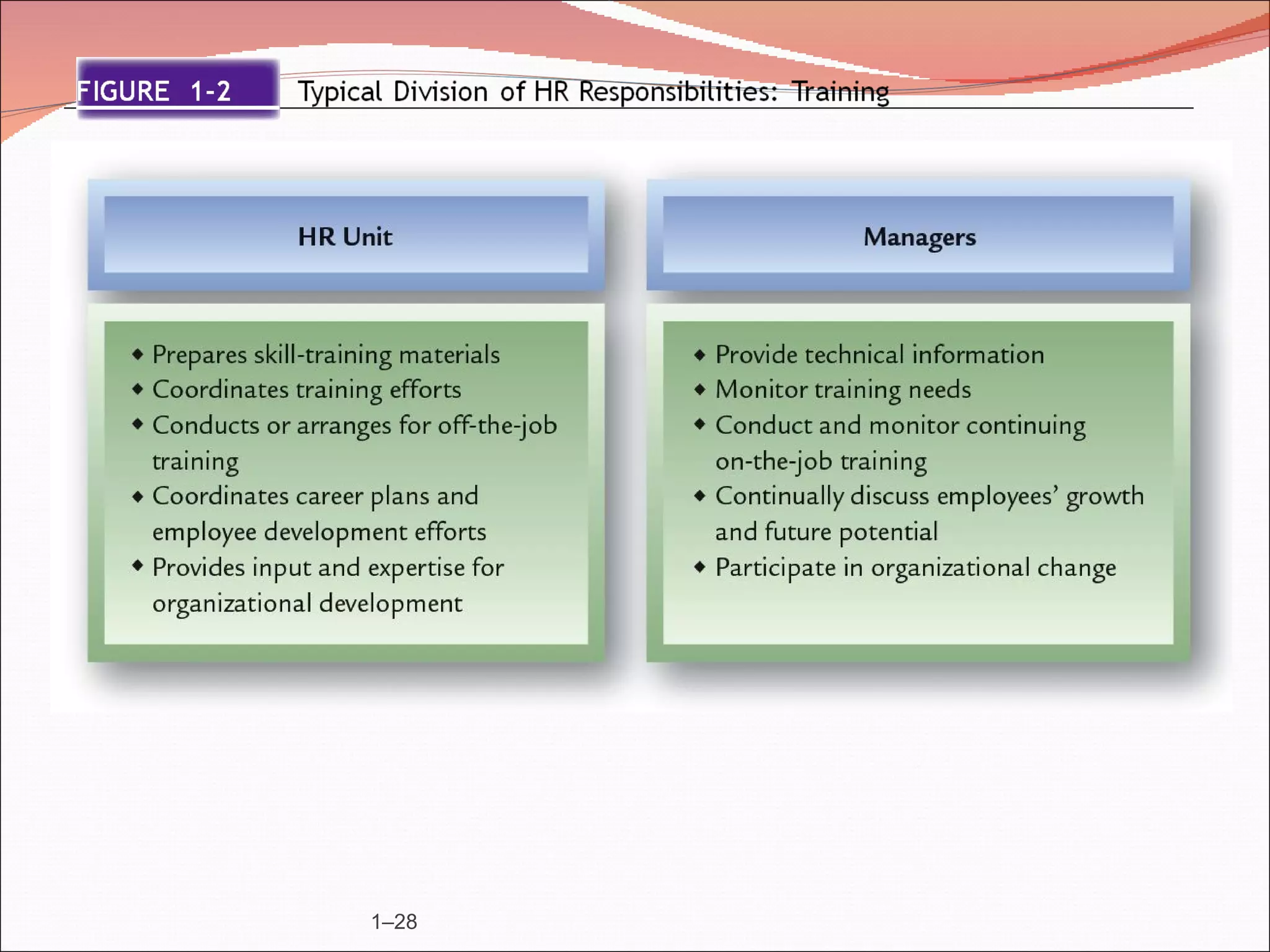
1–28
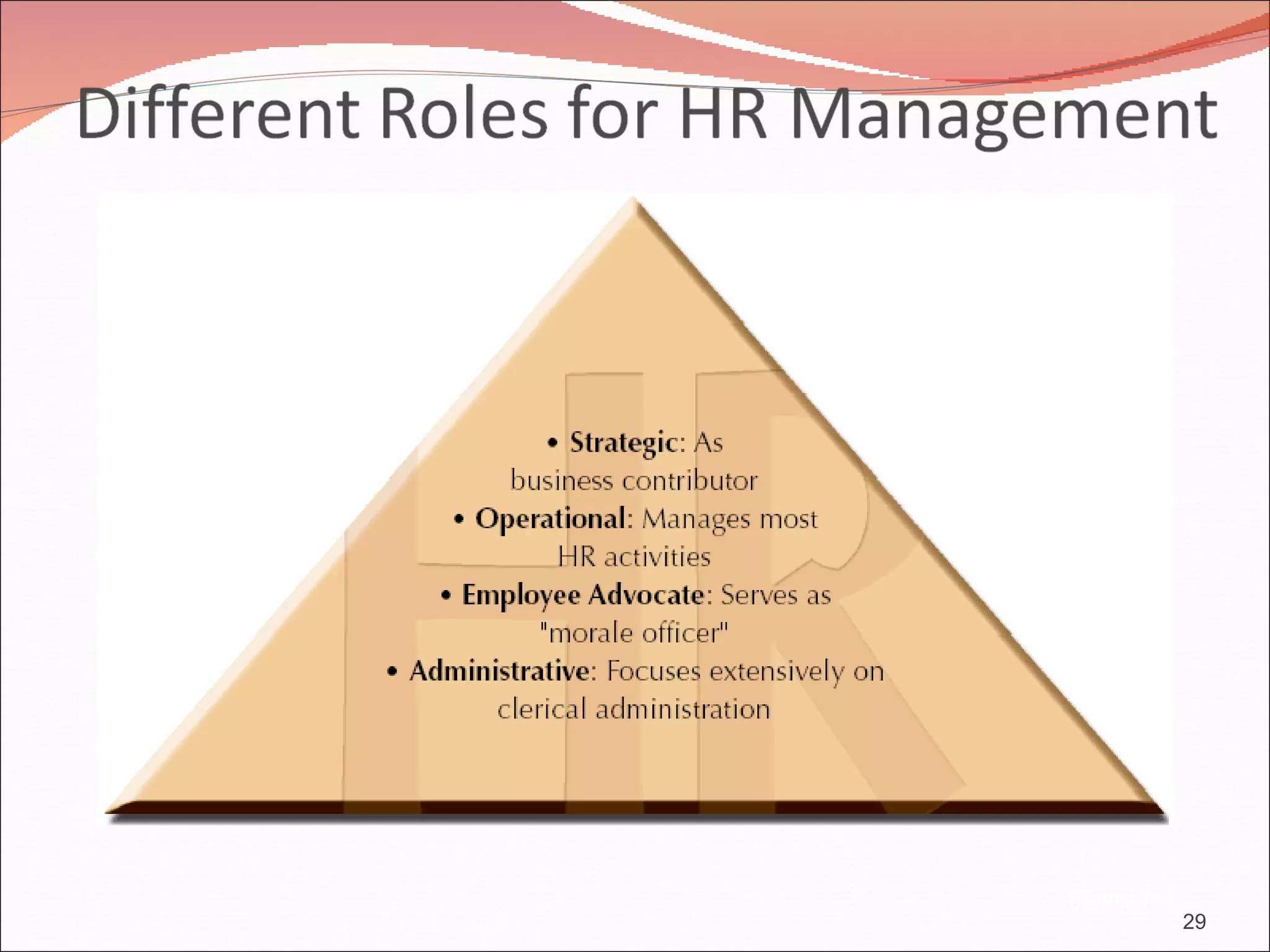
Figure 1–5
             29
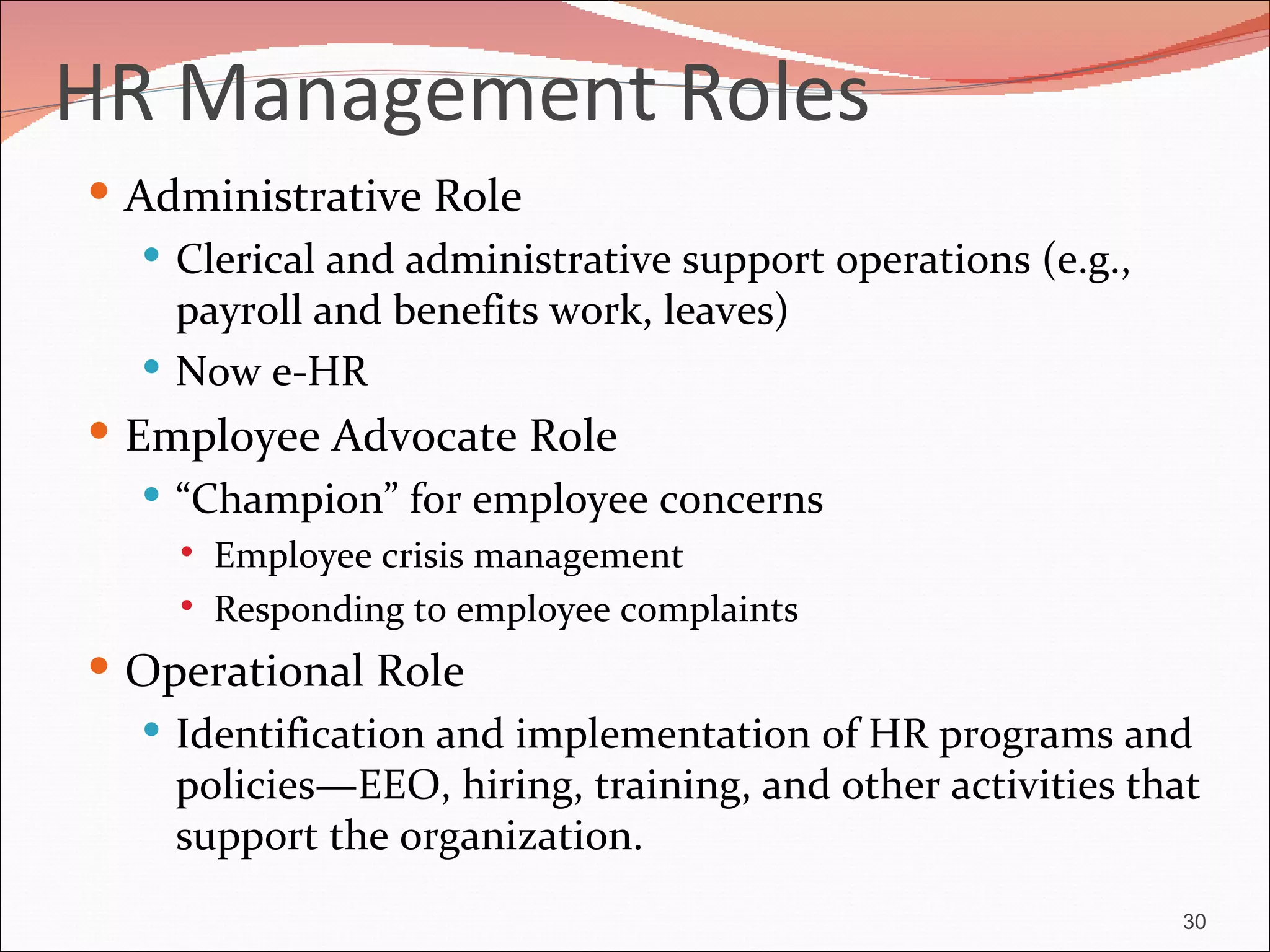
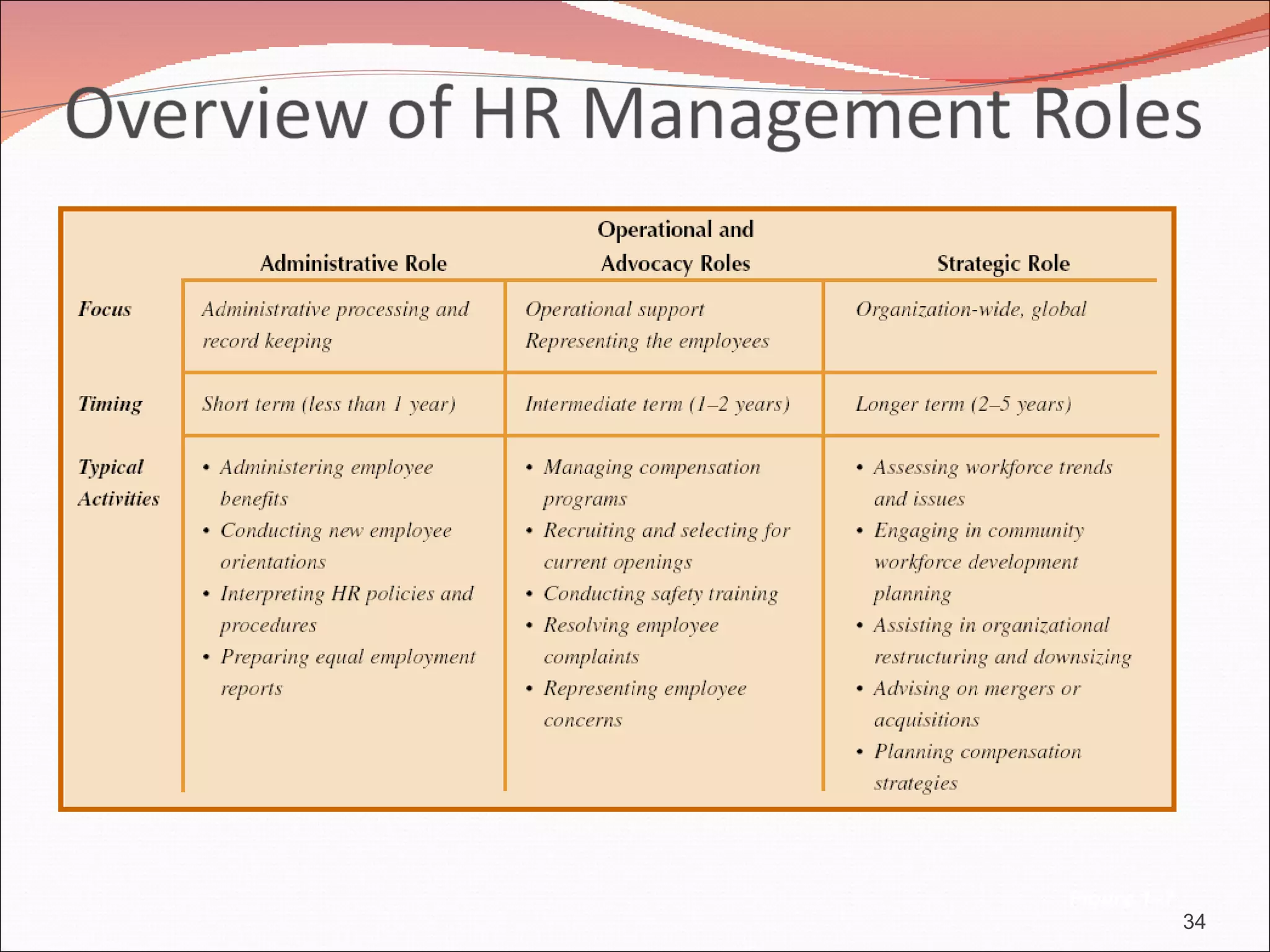
HR Management Roles
 Administrative Role
    Clerical and administrative support operations (e.g.,
     payroll and benefits work, leaves)
    Now e-HR
 Employee Advocate Role
    “Champion” for employee concerns
        Employee crisis management
        Responding to employee complaints
 Operational Role
   Identification and implementation of HR programs and
    policies—EEO, hiring, training, and other activities that
    support the organization.
                                                             30
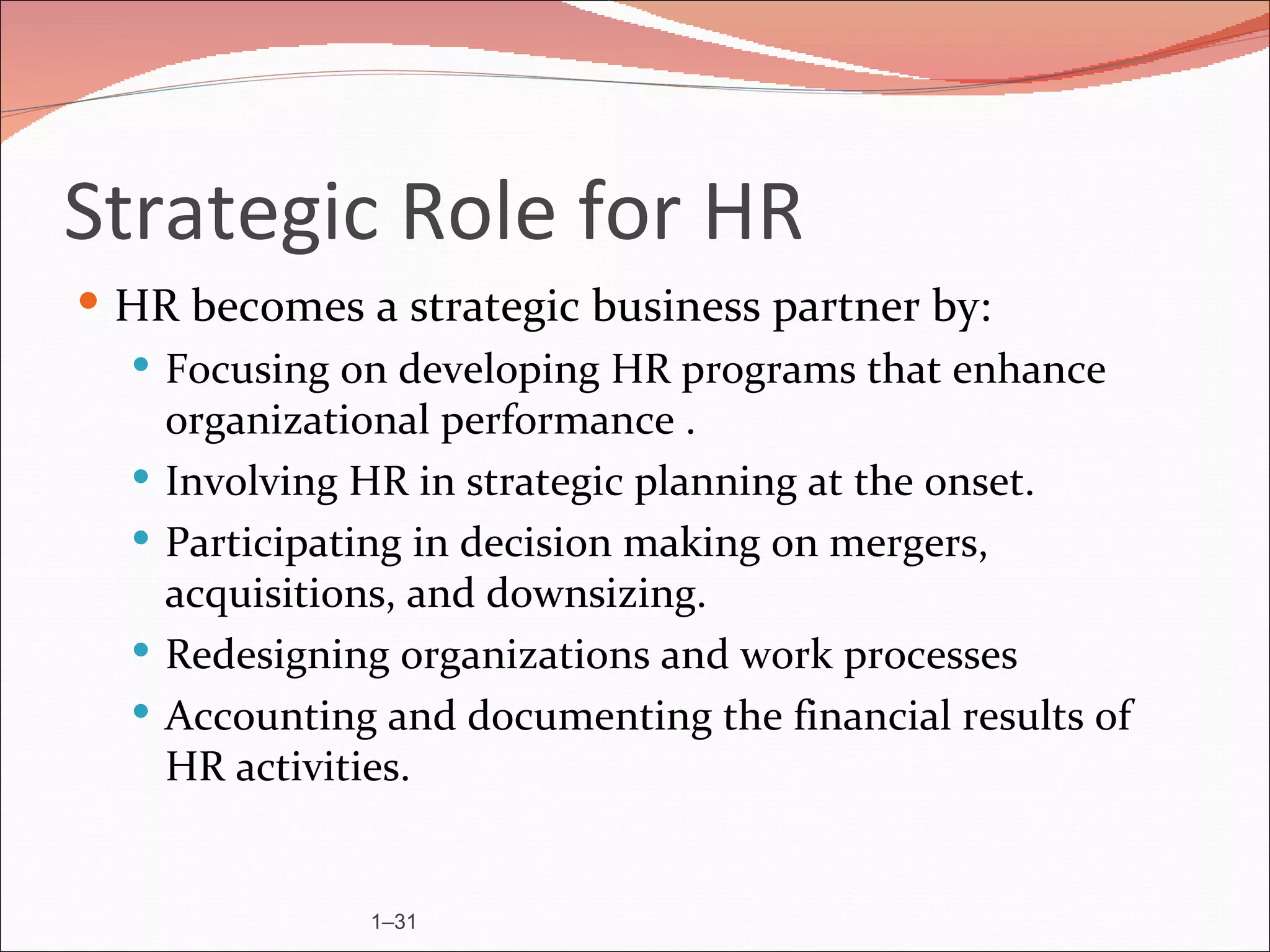
Strategic Role for HR
 HR becomes a strategic business partner by:
   Focusing on developing HR programs that enhance
    organizational performance .
   Involving HR in strategic planning at the onset.
   Participating in decision making on mergers,
    acquisitions, and downsizing.
   Redesigning organizations and work processes
   Accounting and documenting the financial results of
    HR activities.


               1–31
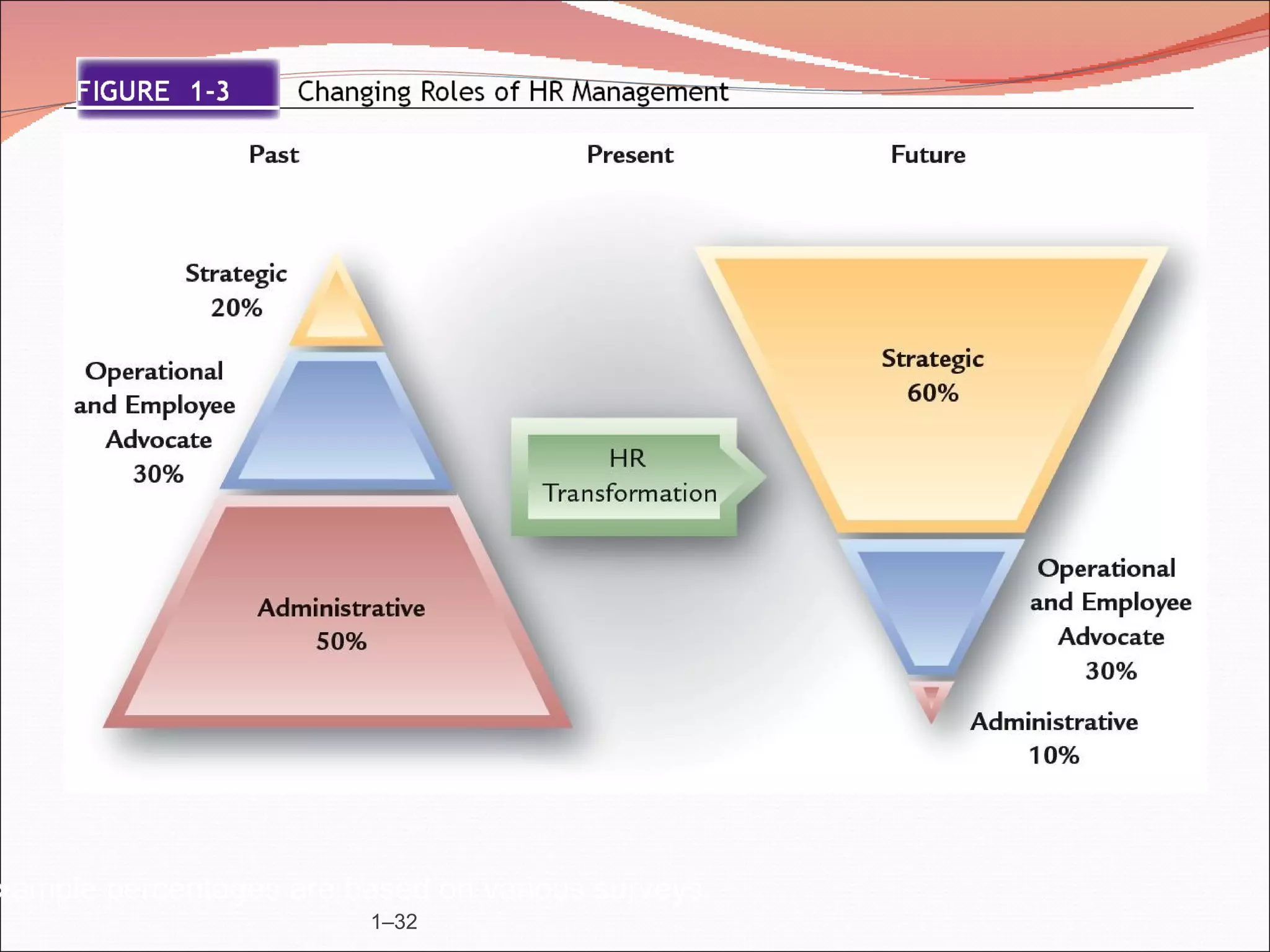
xample percentages are based on various surveys.
                         1–32
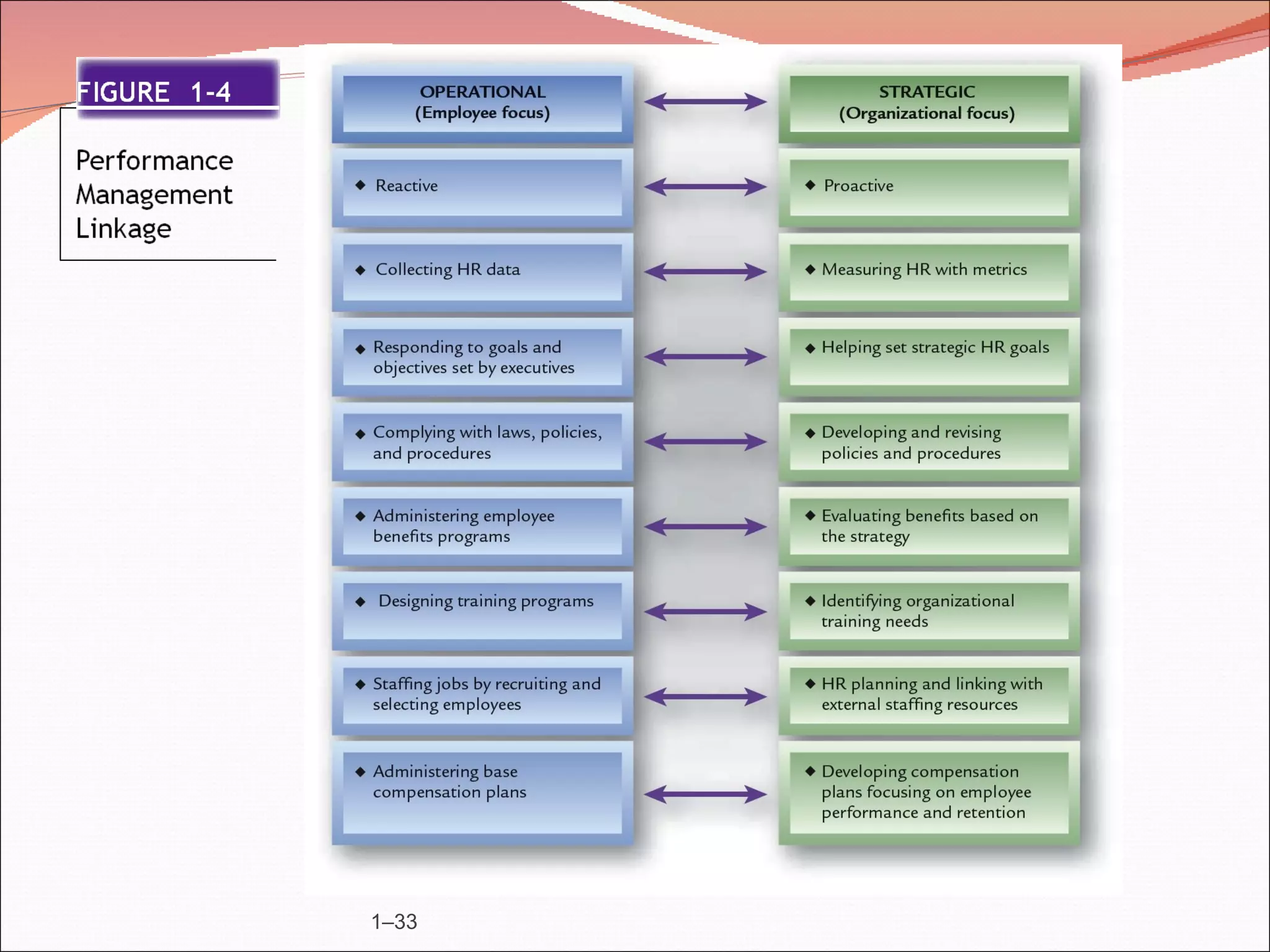
1–33
Figure 1–7
             34
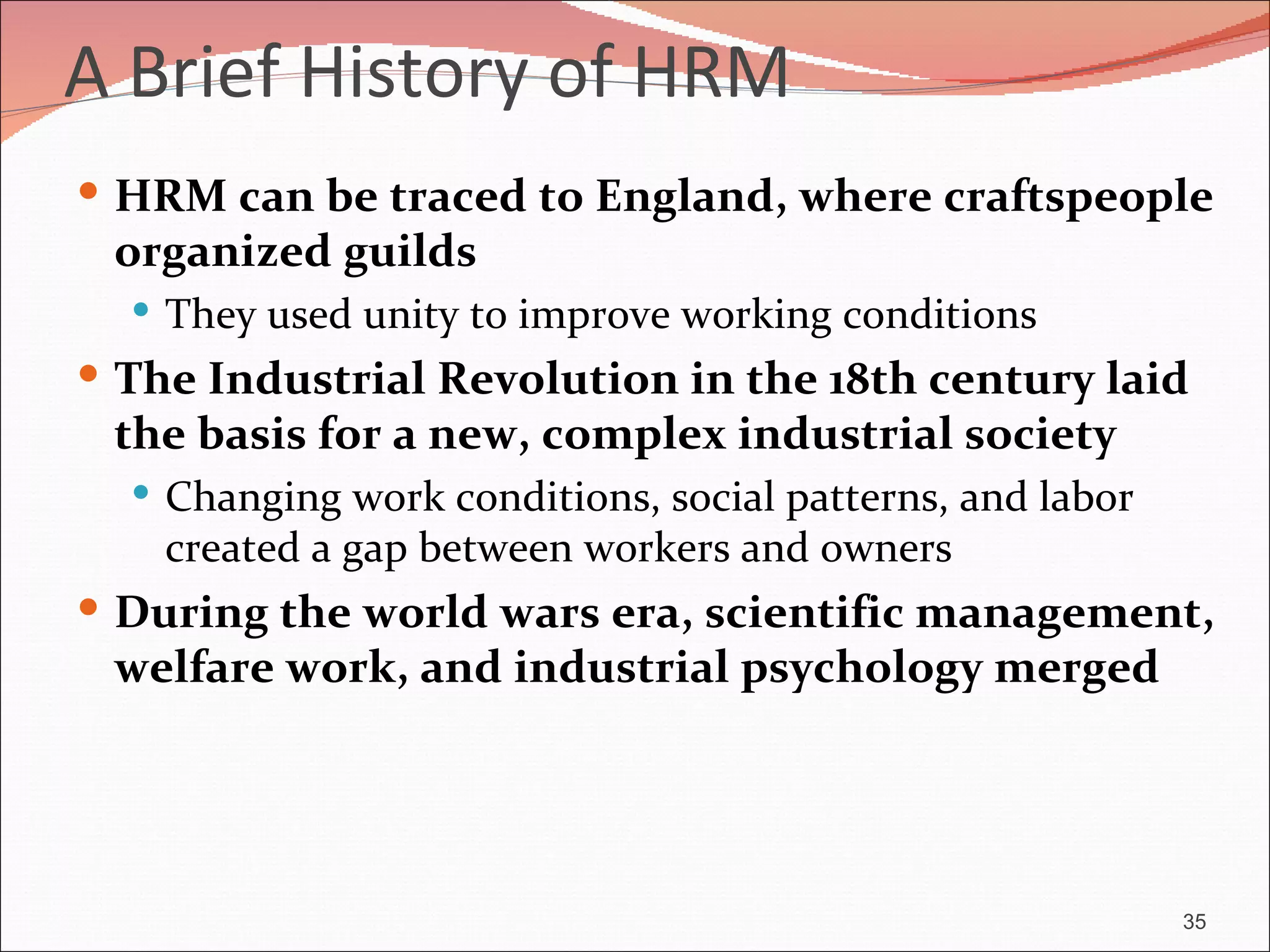
A Brief History of HRM
 HRM can be traced to England, where craftspeople
 organized guilds
   They used unity to improve working conditions
 The Industrial Revolution in the 18th century laid
 the basis for a new, complex industrial society
   Changing work conditions, social patterns, and labor
    created a gap between workers and owners
 During the world wars era, scientific management,
 welfare work, and industrial psychology merged


                                                           35
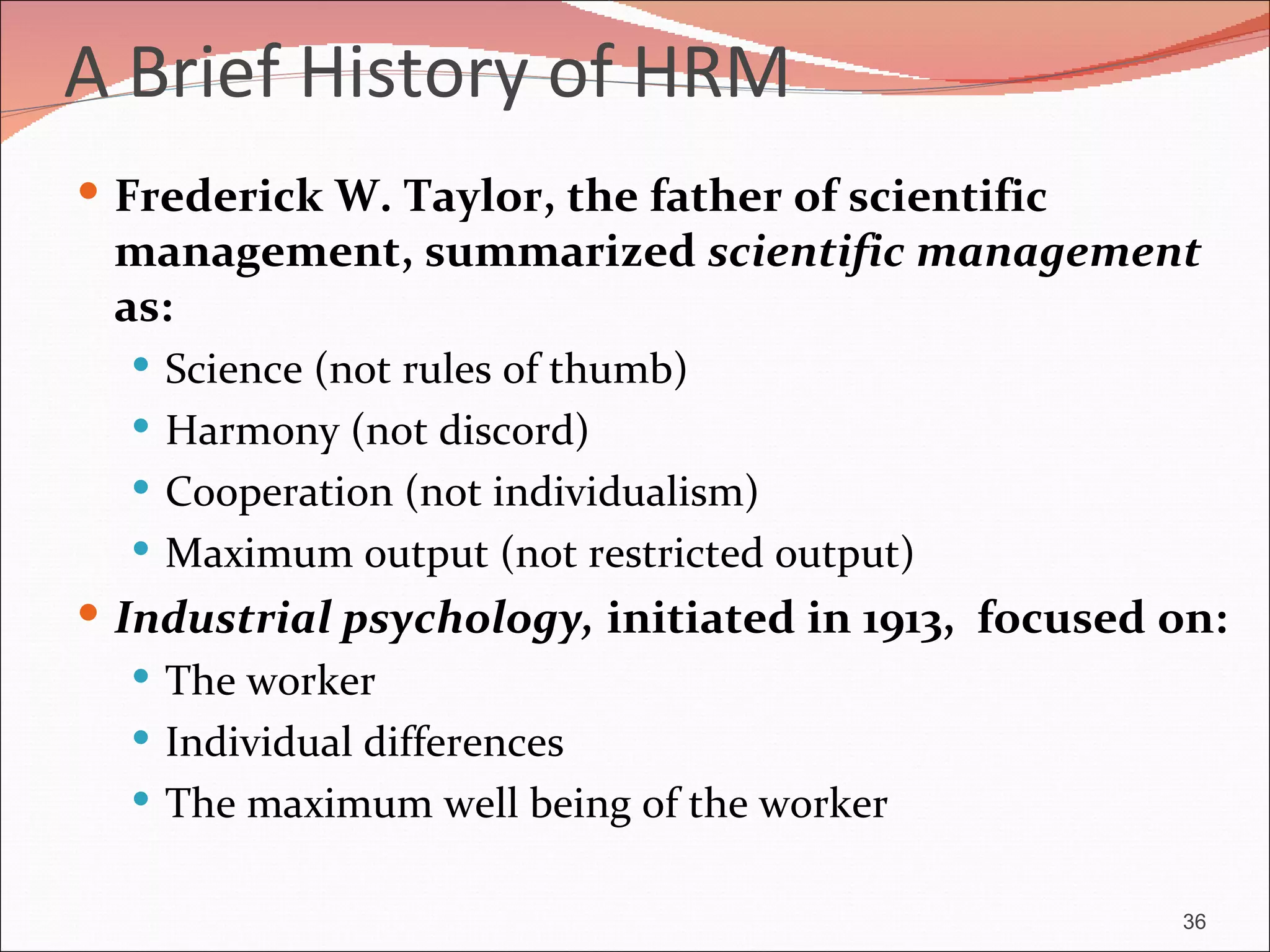
A Brief History of HRM
 Frederick W. Taylor, the father of scientific
 management, summarized scientific management
 as:
   Science (not rules of thumb)
   Harmony (not discord)
   Cooperation (not individualism)
   Maximum output (not restricted output)
 Industrial psychology, initiated in 1913, focused on:
    The worker
    Individual differences
    The maximum well being of the worker


                                                    36
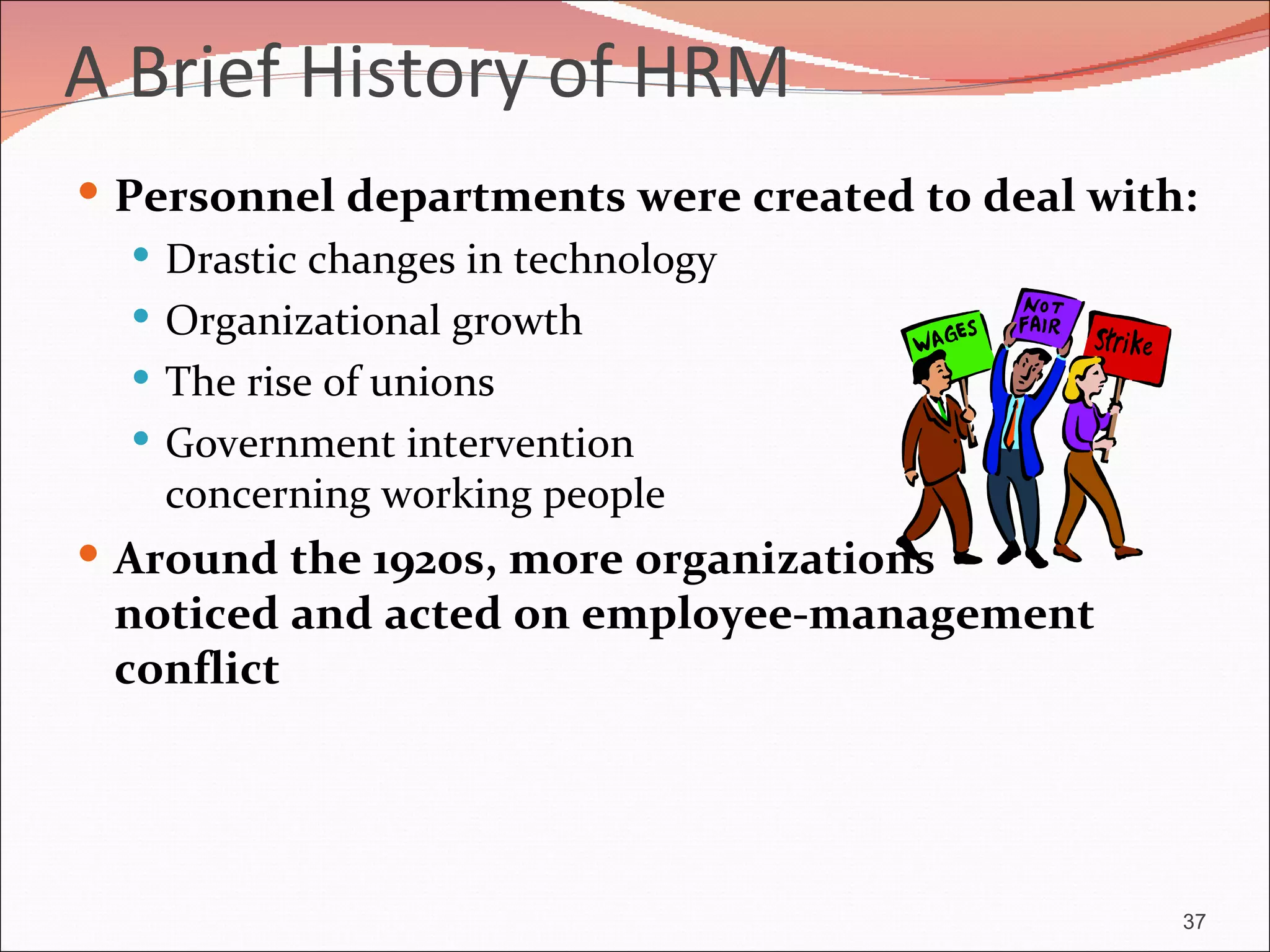
A Brief History of HRM
 Personnel departments were created to deal with:
    Drastic changes in technology
    Organizational growth
    The rise of unions
    Government intervention
     concerning working people
 Around the 1920s, more organizations
 noticed and acted on employee-management
 conflict


                                                 37
A Brief History of HRM
 The Hawthorne studies (1924 to 1933):
    Were to determine the effects of
     illumination on workers and their output
    Rather, it pointed out the importance of
     social interaction on output and satisfaction
 Until the 1960s, the personnel function was
  concerned only with blue-collar employees
    File clerk, house-keeper, social worker, firefighter, and
    union trouble defuser


                                                                 38
Malden Mills (Lawrence, Massachusetts)
 Aaron, Feuerstein
 Dec 11, 1995
 1400 displaced employees
 Salary for 3 months
 Extended health benefits
 600 employees completed courses (computer skills for
  running new machines)
 More than 90% returned to work.


                                                     39
Outsourcing
 Outsourcing HRM activities is growing in
 popularity because of:
   Downsizing
   Rapid growth or decline of business
   Globalization
   Increased competition
   Restructuring


                                             40
Outsourcing
 Some executives assume that outsourcing can:
    Reduce costs
    Improve flexibility
    Permit the hiring of specialized expertise

 The choice to outsource HRM activities is being
 made with little empirical support


                                                    41
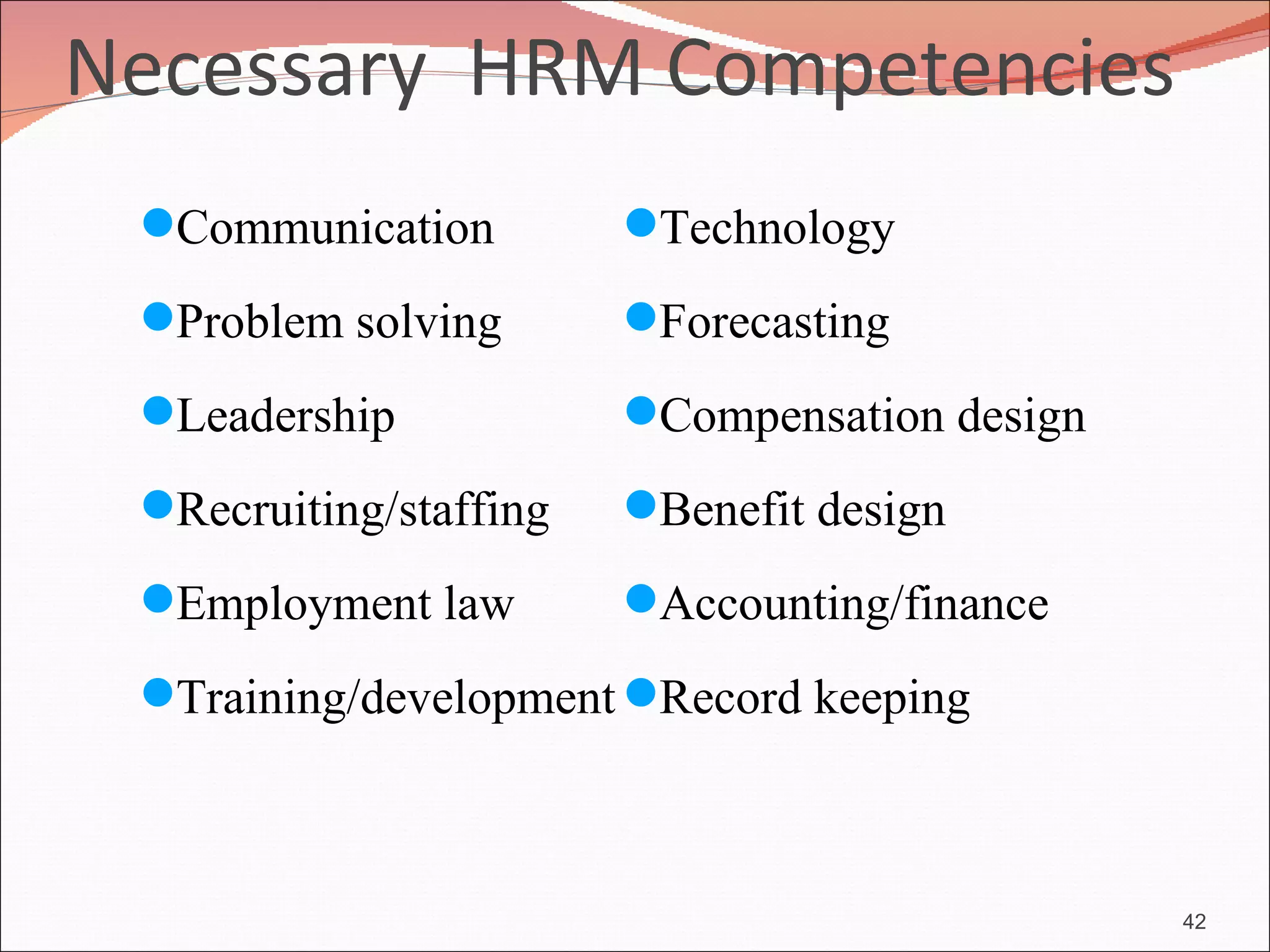
Necessary HRM Competencies
 Communication         Technology
 Problem solving       Forecasting
 Leadership            Compensation design
 Recruiting/staffing   Benefit design
 Employment law        Accounting/finance
 Training/development Record keeping


                                               42
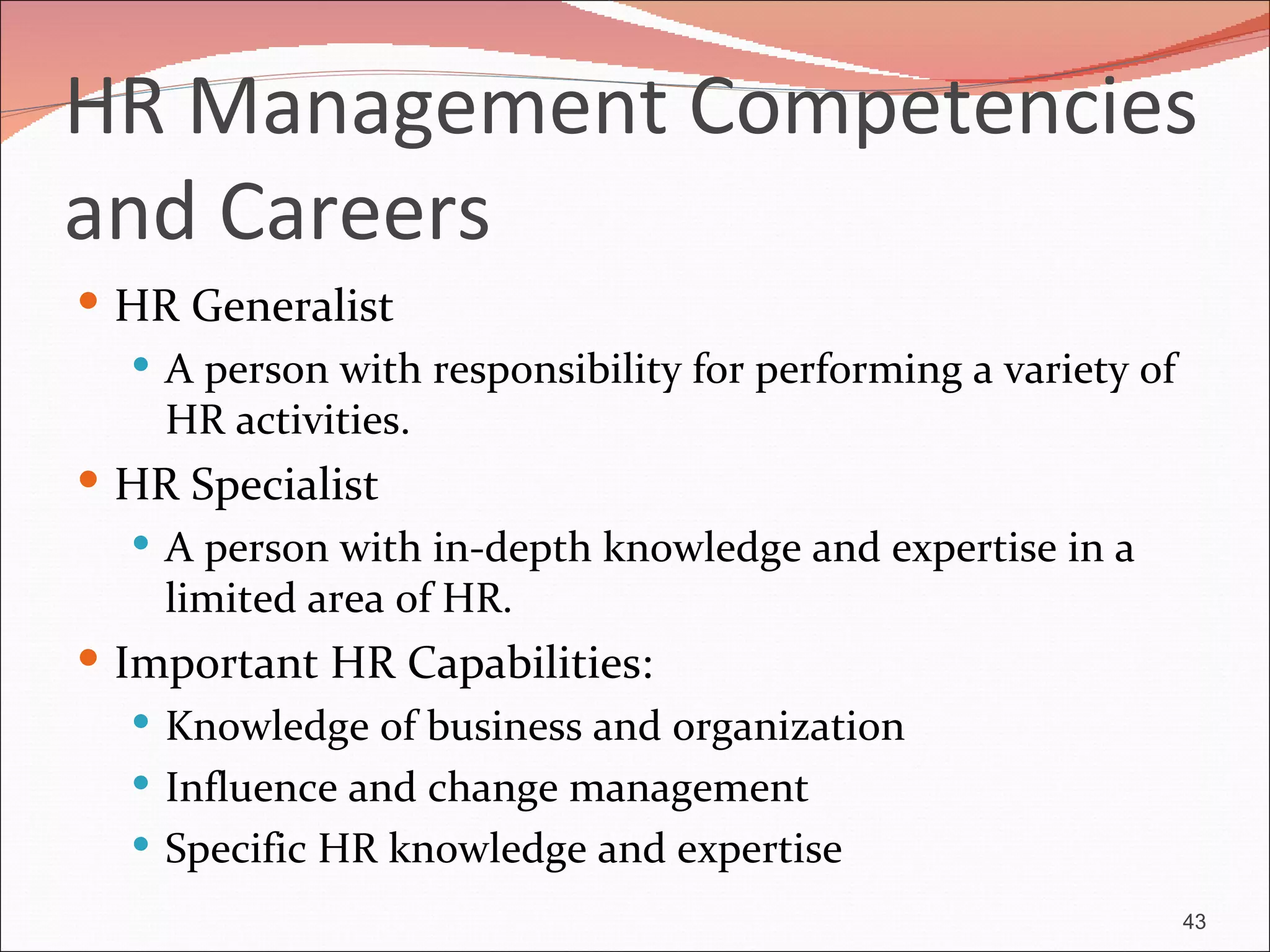
HR Management Competencies
and Careers
 HR Generalist
   A person with responsibility for performing a variety of
    HR activities.
 HR Specialist
   A person with in-depth knowledge and expertise in a
    limited area of HR.
 Important HR Capabilities:
    Knowledge of business and organization
    Influence and change management
    Specific HR knowledge and expertise

                                                               43
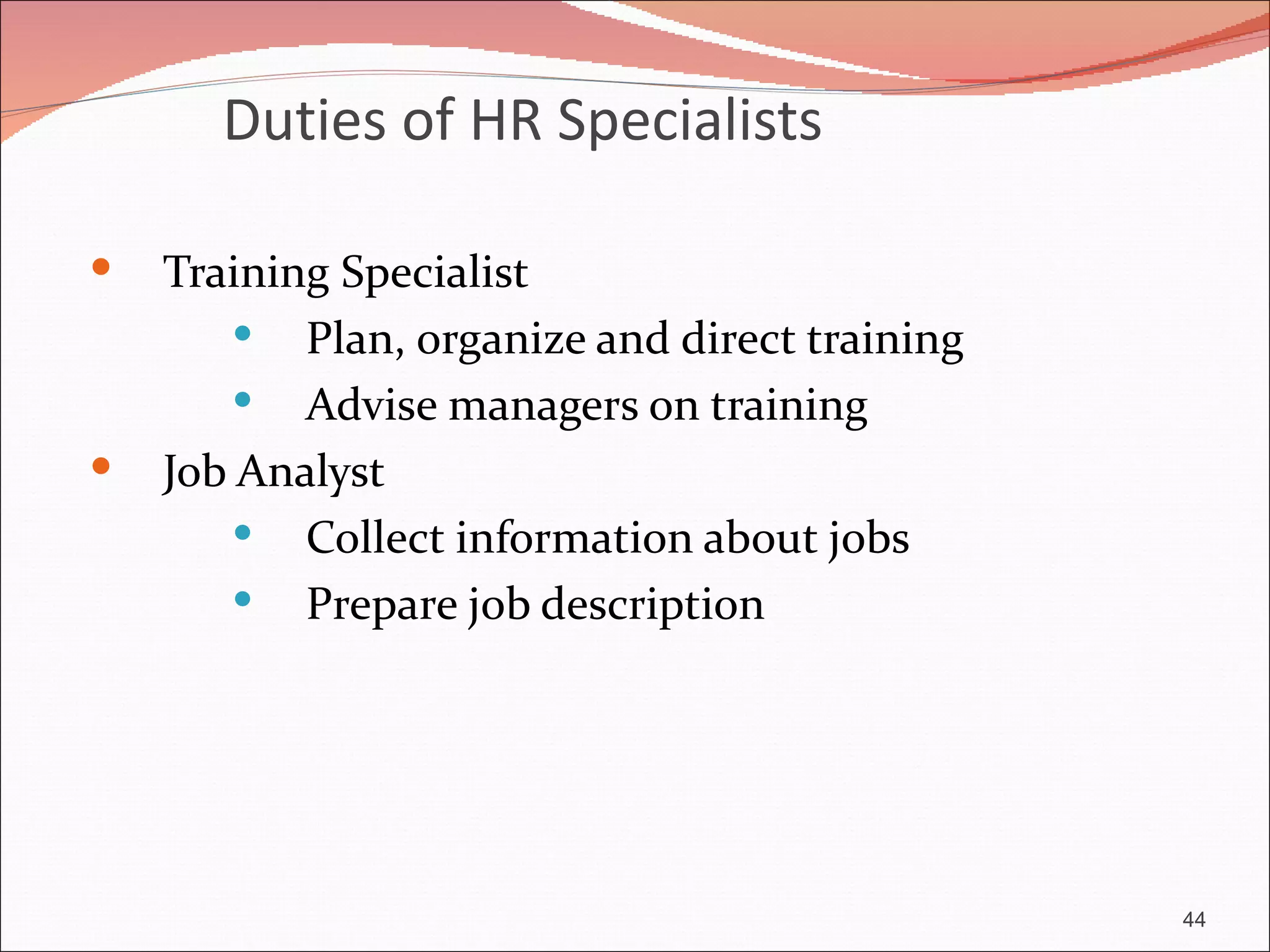
Duties of HR Specialists

   Training Specialist
         Plan, organize and direct training
         Advise managers on training
   Job Analyst
         Collect information about jobs
         Prepare job description


                                               44
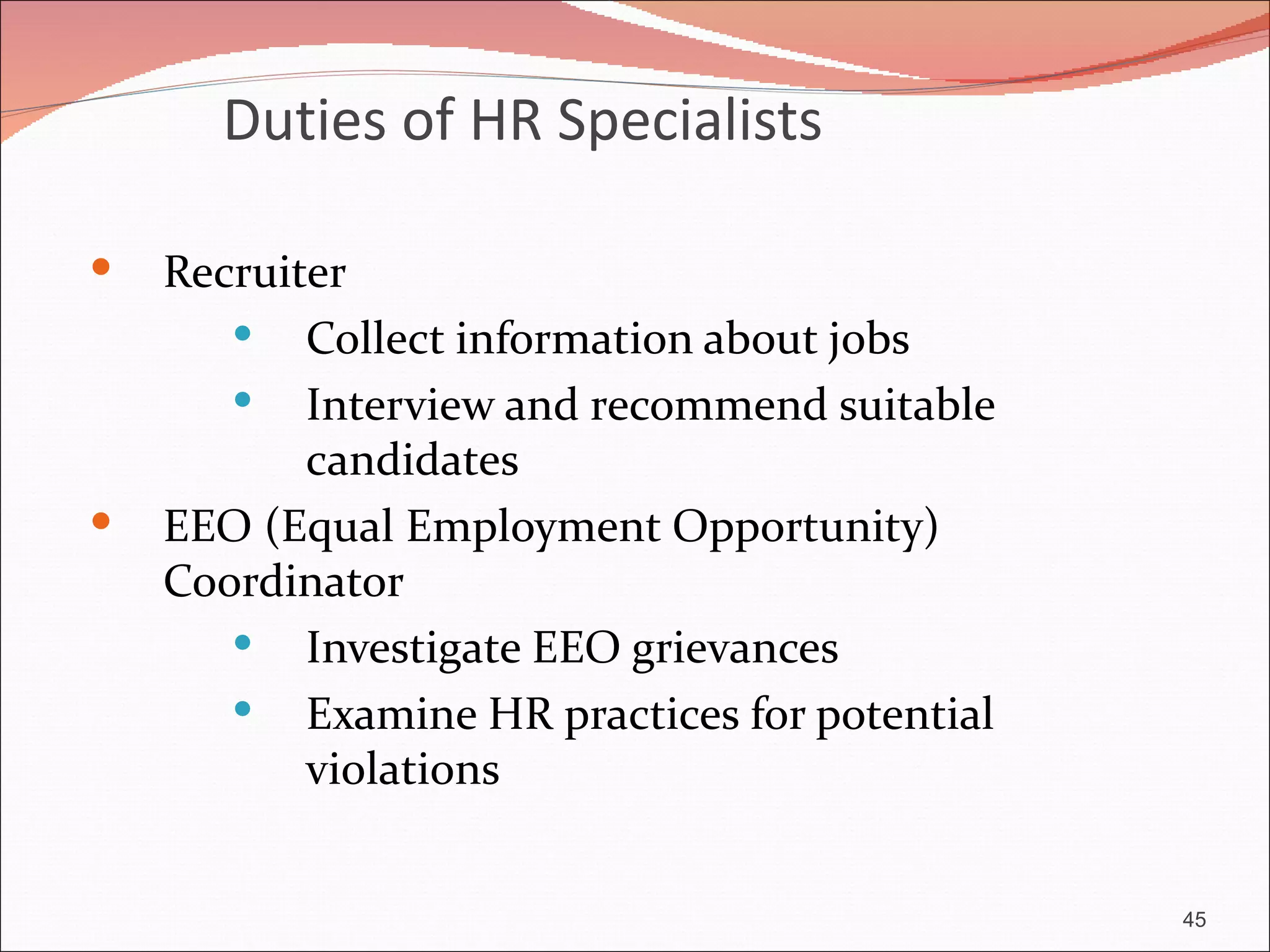
Duties of HR Specialists

   Recruiter
        Collect information about jobs
        Interview and recommend suitable
           candidates
   EEO (Equal Employment Opportunity)
    Coordinator
        Investigate EEO grievances
        Examine HR practices for potential
           violations


                                              45
Duties of HR Specialists

   Compensation Manager
       Develop compensation plans
       Handle employee benefits program
   Employment relations specialist
       Advise managers on ER issues
       Negotiate with unions


                                           46
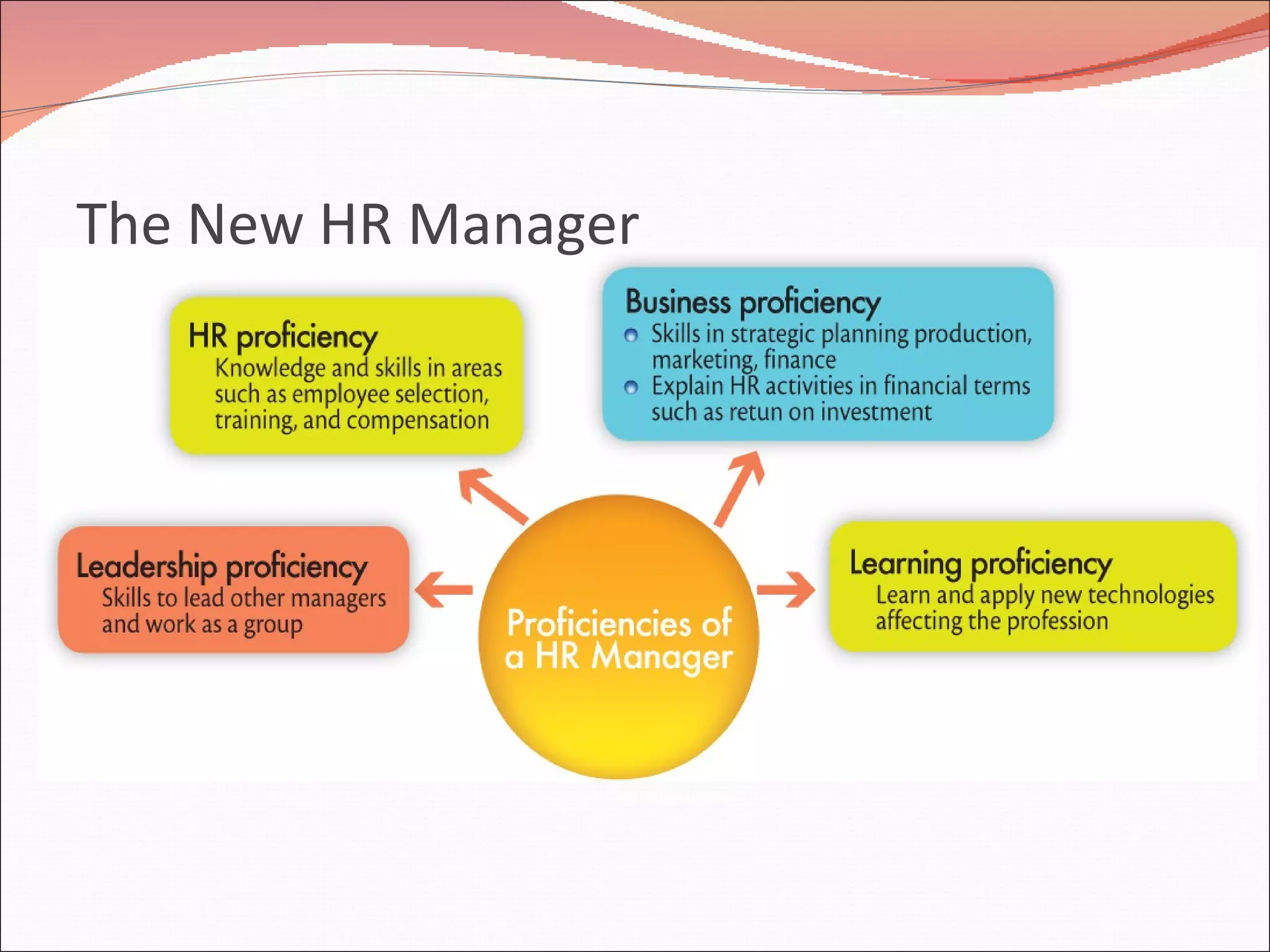
The New HR Manager

   New Proficiencies
          HR proficiency
          Business proficiency
          Leadership proficiency
          Learning proficiency


                                    47
The New HR Manager

1 intro to hrm

  • 1.
  • 2.
    Objectives  Define theterm human resource management.  Describe the strategic importance of human resource management (HRM) activities.  Explain what career opportunities are available in the HRM field.  Discuss the role that specialists and operating managers play in performing HRM activities.  List the main objectives pursued by HRM units. 2
  • 3.
  • 4.
    Jack Welch- Winning “ElevateHR to a position of power and primacy in the organization, and make sure HR people have the special qualities to help managers build leaders and careers. In fact, the best HR types are pastors and parents in the same package.” “The head of human resources at any company should be at least as important as the CFO.” 4
  • 5.
    Assets Physical Financial Intangible Human 5
  • 6.
    Human Capital Core Competency The collective value of the A unique capability that capabilities, knowledge, creates high value and skills, life experiences, and differentiates an organization motivation of an from its competition. organizational workforce. 1–6
  • 7.
    Leaders are Readers Peter Drucker  The Essential Drucker (2008)  “Business management must always, in every decision and action, put economic performance first.” 7
  • 8.
    Human Resource Management: A strategic approach to managing employment relations which emphasizes that leveraging people’s capabilities is critical to achieving competitive advantage. This being achieved through a distinctive set of integrated employment policies, programmes and practices. 8
  • 9.
     Human resourcemanagement (HRM) is the effective management of people at work  The goal: make workers more satisfied and productive  When an organization is concerned about people, its total philosophy, culture, and orientation reflect it  Every manager must be concerned with people, whether or not there is a human resources department 9
  • 10.
    The Nature ofHuman Resource Management Management: The science perspective The political perspective The control perspective The practice perspective 10
  • 11.
    The meaning of‘management’ 11
  • 12.
    Leaders are Readers Good to Great  Jim Collins (2001)  “Good is the enemy of great.” 12
  • 13.
    The Nature ofthe Employment Relationship Describes dynamic interlocking relations that exist between individuals and their work organizations. Considers economic, legal, social and psychological relations. 13
  • 14.
    The Nature ofthe Employment Relationship Economic – exchange of pay for work. Legal – network of common law and statutory rights and obligations affecting both parties. Social – ‘social norms’ influence employees’ actions in the workplace. Psychological – dynamic, two-way exchange of perceived promises and obligations. 14
  • 15.
    Figure 1.2 Theemployment and psychological contracts between employer and employee The Nature of the Employment Relationship 15
  • 16.
  • 17.
  • 18.
    The Manager’s HumanResource Management Jobs  Management process  The five basic functions of planning, organizing, staffing, leading, and controlling. 1–18
  • 19.
    Line and StaffAspects of HRM  Authority  The right to make decisions, direct others’ work, and give orders.  Staff authority (Advisory)  The authority gives right to the HR manager to advise other managers or employees.  Line authority (Superior-Subordinate)  The authority of managers to direct people in his or her own department. 1–19
  • 20.
    Line and StaffAspects of HRM  Line manager (Line Authority)  A manager who is authorized to direct the work of subordinates and is responsible for accomplishing the organization’s tasks.  Staff manager (Staff Authority)  A manager who assists and advises line managers. 1–20
  • 21.
    Line Managers’ HRMResponsibilities 1. Place the right person on the right job 2. Orientate new employees 3. Train employees for jobs new to them 4. Improve the job performance of each person 5. Gain creative cooperation and developing smooth working relationships 1–21
  • 22.
    Line Managers’ HRM Responsibilities 1. Interpret the company’s policies and procedures 2. Control costs 3. Develop the abilities of each person 4. Maintain morale 5. Protect employees’ health and physical condition 1–22
  • 23.
    Functions of theHR Manager  Carries out 3 distinct functions:- 1. Line function 2. Coordination function 3. Staff function 1–23
  • 24.
    Functions of theHR Manager  A line function  The HR manager directs the activities of the people in his or her own department and in related service areas (like the plant cafeteria). 1–24
  • 25.
    Functions of theHR Manager  A coordinative function  HR managers also coordinate personnel activities, a duty often referred to as functional control. 1–25
  • 26.
    Functions of theHR Manager  Staff (assist and advise) functions  Assisting and advising line managers is the heart of the HR manager’s job. 1–26
  • 27.
    Typical Division ofHR Responsibilities  HR Unit  Managers  Develops legal, effective  Advise HR of job openings interviewing techniques  Decide whether to do own  Trains managers in final interviewing conducting selection  Receive interview training interviews from HR unit  Conducts interviews and  Do final interviewing and testing hiring where appropriate  Sends top three applicants to  Review reference managers for final review information  Checks references  Provide feedback to HR unit  Does final interviewing and on hiring/rejection decisions hiring for certain job Figure 1–1 classifications 27
  • 28.
  • 29.
  • 30.
    HR Management Roles Administrative Role  Clerical and administrative support operations (e.g., payroll and benefits work, leaves)  Now e-HR  Employee Advocate Role  “Champion” for employee concerns  Employee crisis management  Responding to employee complaints  Operational Role  Identification and implementation of HR programs and policies—EEO, hiring, training, and other activities that support the organization. 30
  • 31.
    Strategic Role forHR  HR becomes a strategic business partner by:  Focusing on developing HR programs that enhance organizational performance .  Involving HR in strategic planning at the onset.  Participating in decision making on mergers, acquisitions, and downsizing.  Redesigning organizations and work processes  Accounting and documenting the financial results of HR activities. 1–31
  • 32.
    xample percentages arebased on various surveys. 1–32
  • 33.
  • 34.
  • 35.
    A Brief Historyof HRM  HRM can be traced to England, where craftspeople organized guilds  They used unity to improve working conditions  The Industrial Revolution in the 18th century laid the basis for a new, complex industrial society  Changing work conditions, social patterns, and labor created a gap between workers and owners  During the world wars era, scientific management, welfare work, and industrial psychology merged 35
  • 36.
    A Brief Historyof HRM  Frederick W. Taylor, the father of scientific management, summarized scientific management as:  Science (not rules of thumb)  Harmony (not discord)  Cooperation (not individualism)  Maximum output (not restricted output)  Industrial psychology, initiated in 1913, focused on:  The worker  Individual differences  The maximum well being of the worker 36
  • 37.
    A Brief Historyof HRM  Personnel departments were created to deal with:  Drastic changes in technology  Organizational growth  The rise of unions  Government intervention concerning working people  Around the 1920s, more organizations noticed and acted on employee-management conflict 37
  • 38.
    A Brief Historyof HRM  The Hawthorne studies (1924 to 1933):  Were to determine the effects of illumination on workers and their output  Rather, it pointed out the importance of social interaction on output and satisfaction  Until the 1960s, the personnel function was concerned only with blue-collar employees  File clerk, house-keeper, social worker, firefighter, and union trouble defuser 38
  • 39.
    Malden Mills (Lawrence,Massachusetts)  Aaron, Feuerstein  Dec 11, 1995  1400 displaced employees  Salary for 3 months  Extended health benefits  600 employees completed courses (computer skills for running new machines)  More than 90% returned to work. 39
  • 40.
    Outsourcing  Outsourcing HRMactivities is growing in popularity because of:  Downsizing  Rapid growth or decline of business  Globalization  Increased competition  Restructuring 40
  • 41.
    Outsourcing  Some executivesassume that outsourcing can:  Reduce costs  Improve flexibility  Permit the hiring of specialized expertise  The choice to outsource HRM activities is being made with little empirical support 41
  • 42.
    Necessary HRM Competencies Communication Technology Problem solving Forecasting Leadership Compensation design Recruiting/staffing Benefit design Employment law Accounting/finance Training/development Record keeping 42
  • 43.
    HR Management Competencies andCareers  HR Generalist  A person with responsibility for performing a variety of HR activities.  HR Specialist  A person with in-depth knowledge and expertise in a limited area of HR.  Important HR Capabilities:  Knowledge of business and organization  Influence and change management  Specific HR knowledge and expertise 43
  • 44.
    Duties of HRSpecialists  Training Specialist  Plan, organize and direct training  Advise managers on training  Job Analyst  Collect information about jobs  Prepare job description 44
  • 45.
    Duties of HRSpecialists  Recruiter  Collect information about jobs  Interview and recommend suitable candidates  EEO (Equal Employment Opportunity) Coordinator  Investigate EEO grievances  Examine HR practices for potential violations 45
  • 46.
    Duties of HRSpecialists  Compensation Manager  Develop compensation plans  Handle employee benefits program  Employment relations specialist  Advise managers on ER issues  Negotiate with unions 46
  • 47.
    The New HRManager  New Proficiencies  HR proficiency  Business proficiency  Leadership proficiency  Learning proficiency 47
  • 48.
    The New HRManager