CHAPTERCHAPTER
11
Managing
and the
Manager’s Job
CopyrightCopyright © by Houghton Mifflin Company.© by Houghton Mifflin Company.
All rights reserved.All rights reserved.
PowerPoint PresentationPowerPoint Presentation
by Charlie Cookby Charlie Cook
Copyright © by Houghton Mifflin Company. All rights reserved. 1–2
Learning ObjectivesLearning Objectives
After studying this chapter, you should be able to:
– Describe the nature of management, define management and
managers, and characterize their importance.
– Identify and briefly explain the four basic management
functions in organizations.
– Describe the kinds of managers found at different levels and
in different areas of the organization.
– Identify the basic managerial roles that managers may play
and the skills they need to be successful.
– Discuss the science and the art of management and describe
how people become managers.
– Summarize the scope of management in organizations.
Copyright © by Houghton Mifflin Company. All rights reserved. 1–3
Chapter OutlineChapter Outline
• The Management Process
– Planning and Decision
Making: Determining Courses
of Action
– Organizing: Coordinating
Activities and Resources
– Leading: Motivating and
Managing People
– Controlling: Monitoring and
Evaluating Activities
• Kinds of Managers
– Managing at Different Levels
of the Organization
– Managing in Different Areas of
the Organization
• Basic Managerial Roles
and Skills
– Managerial Roles
– Managerial Skills
• The Nature of Managerial
Work
– The Science and the Art of
Management
– Becoming a Manager
• The Scope of Management
– Managing in Profit-Seeking
Organizations
– Managing in Not-for-Profit
Organizations
Copyright © by Houghton Mifflin Company. All rights reserved. 1–4
What is an organization?What is an organization?
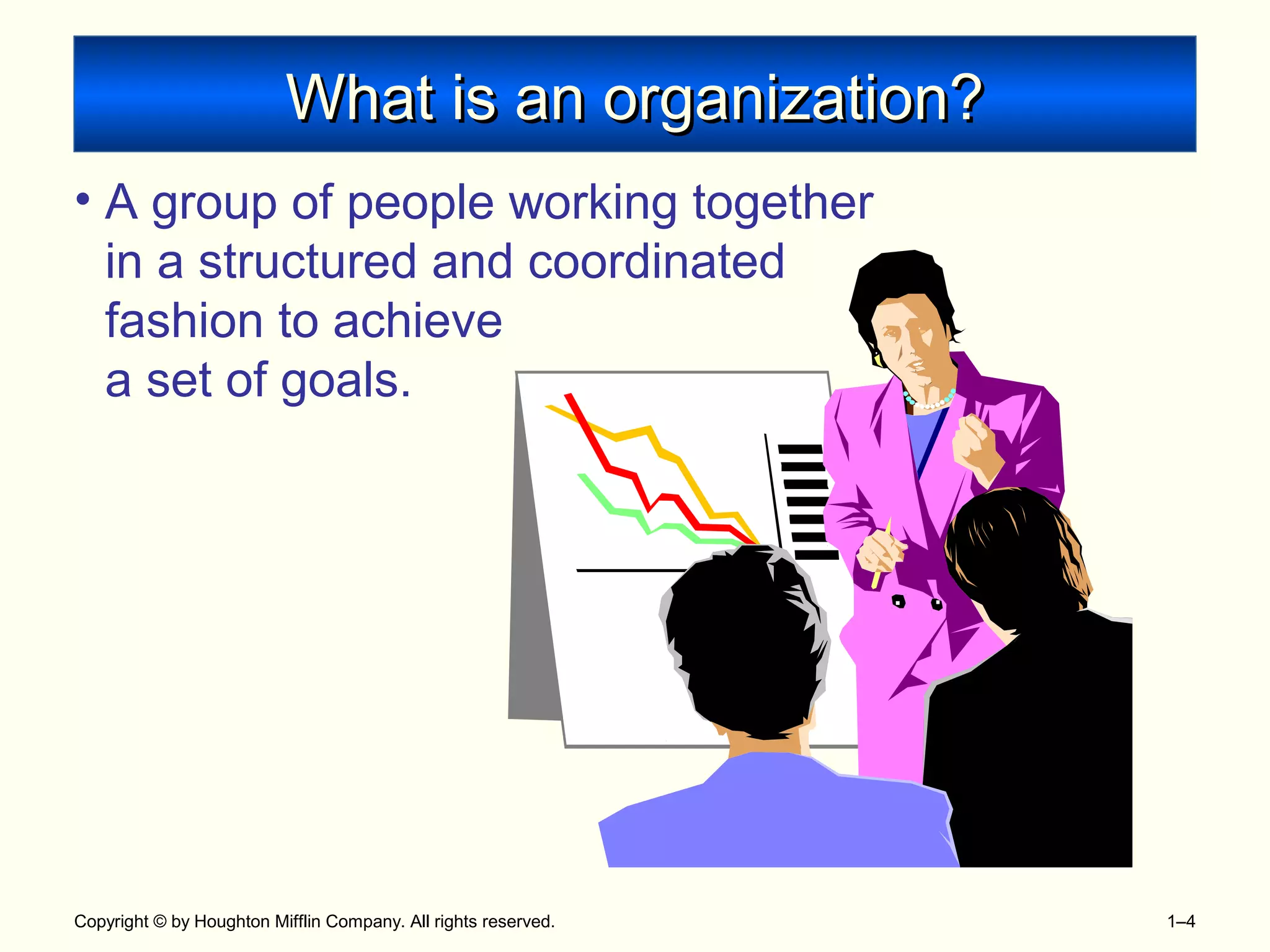
• A group of people working together
in a structured and coordinated
fashion to achieve
a set of goals.
Copyright © by Houghton Mifflin Company. All rights reserved. 1–5
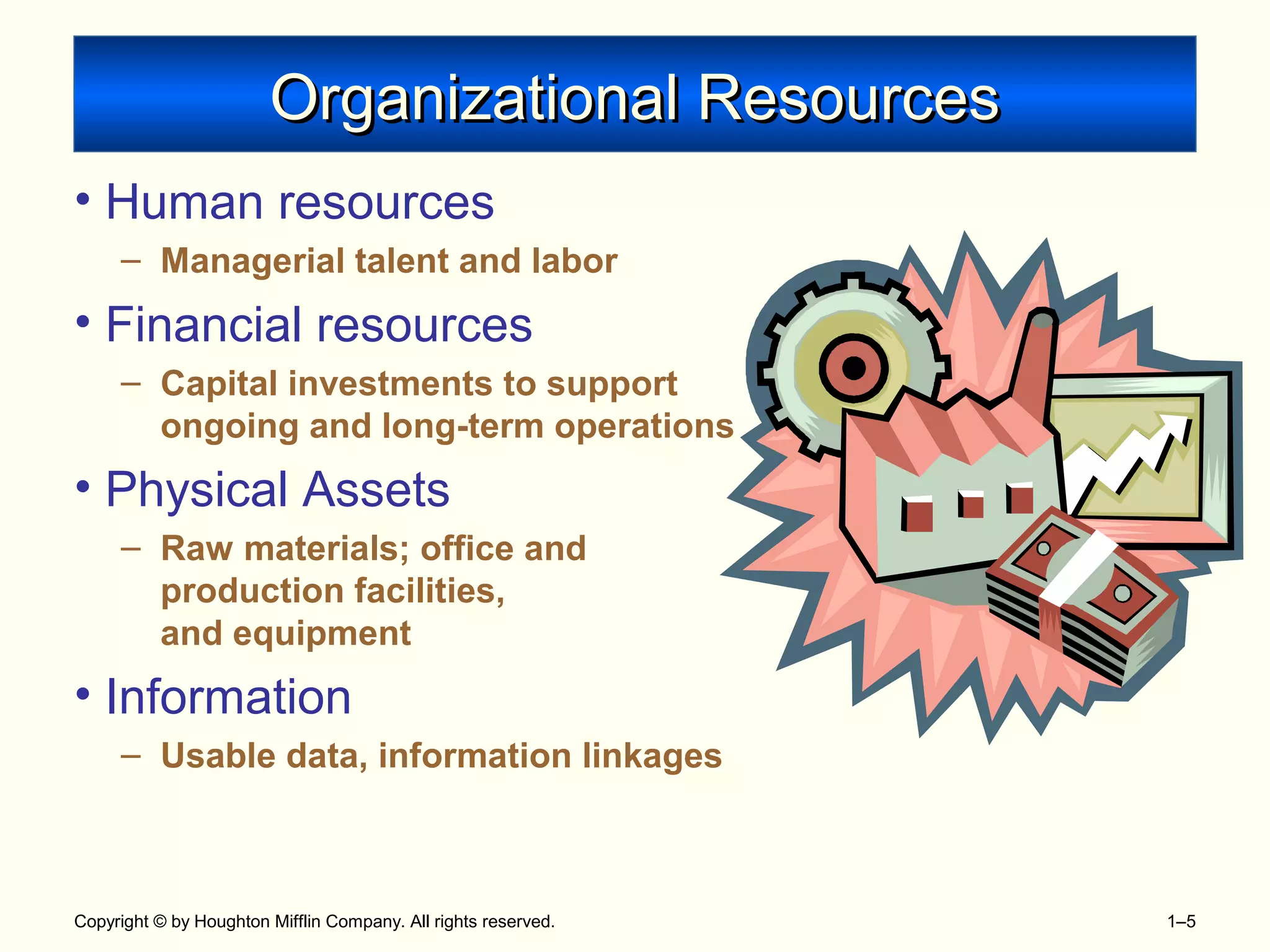
Organizational ResourcesOrganizational Resources
• Human resources
– Managerial talent and labor
• Financial resources
– Capital investments to support
ongoing and long-term operations
• Physical Assets
– Raw materials; office and
production facilities,
and equipment
• Information
– Usable data, information linkages
Copyright © by Houghton Mifflin Company. All rights reserved. 1–6
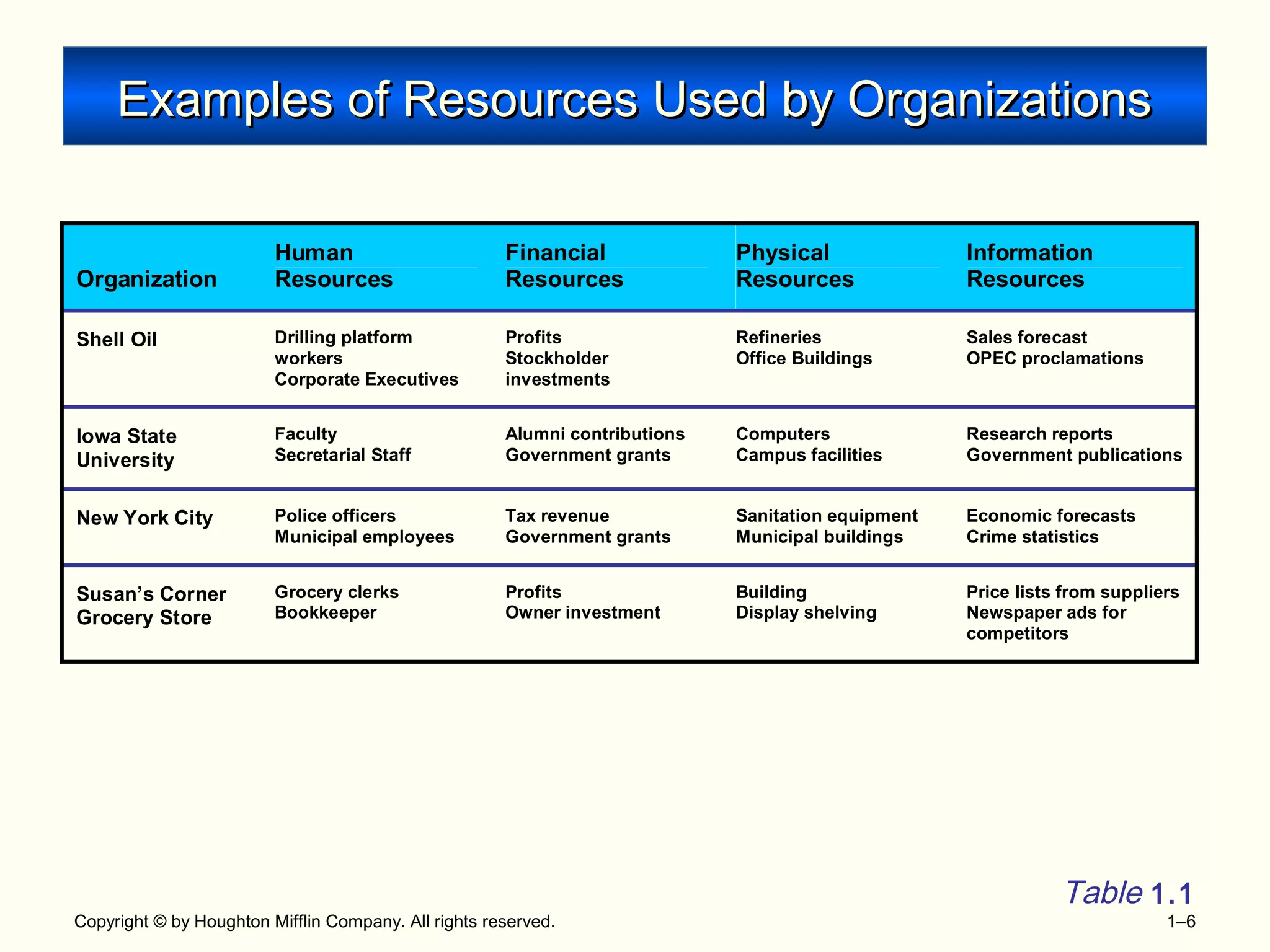
Organization
Human
Resources
Financial
Resources
Physical
Resources
Information
Resources
Shell Oil Drilling platform
workers
Corporate Executives
Profits
Stockholder
investments
Refineries
Office Buildings
Sales forecast
OPEC proclamations
Iowa State
University
Faculty
Secretarial Staff
Alumni contributions
Government grants
Computers
Campus facilities
Research reports
Government publications
New York City Police officers
Municipal employees
Tax revenue
Government grants
Sanitation equipment
Municipal buildings
Economic forecasts
Crime statistics
Susan’s Corner
Grocery Store
Grocery clerks
Bookkeeper
Profits
Owner investment
Building
Display shelving
Price lists from suppliers
Newspaper ads for
competitors
Examples of Resources Used by OrganizationsExamples of Resources Used by Organizations
Table 1.1
Copyright © by Houghton Mifflin Company. All rights reserved. 1–7
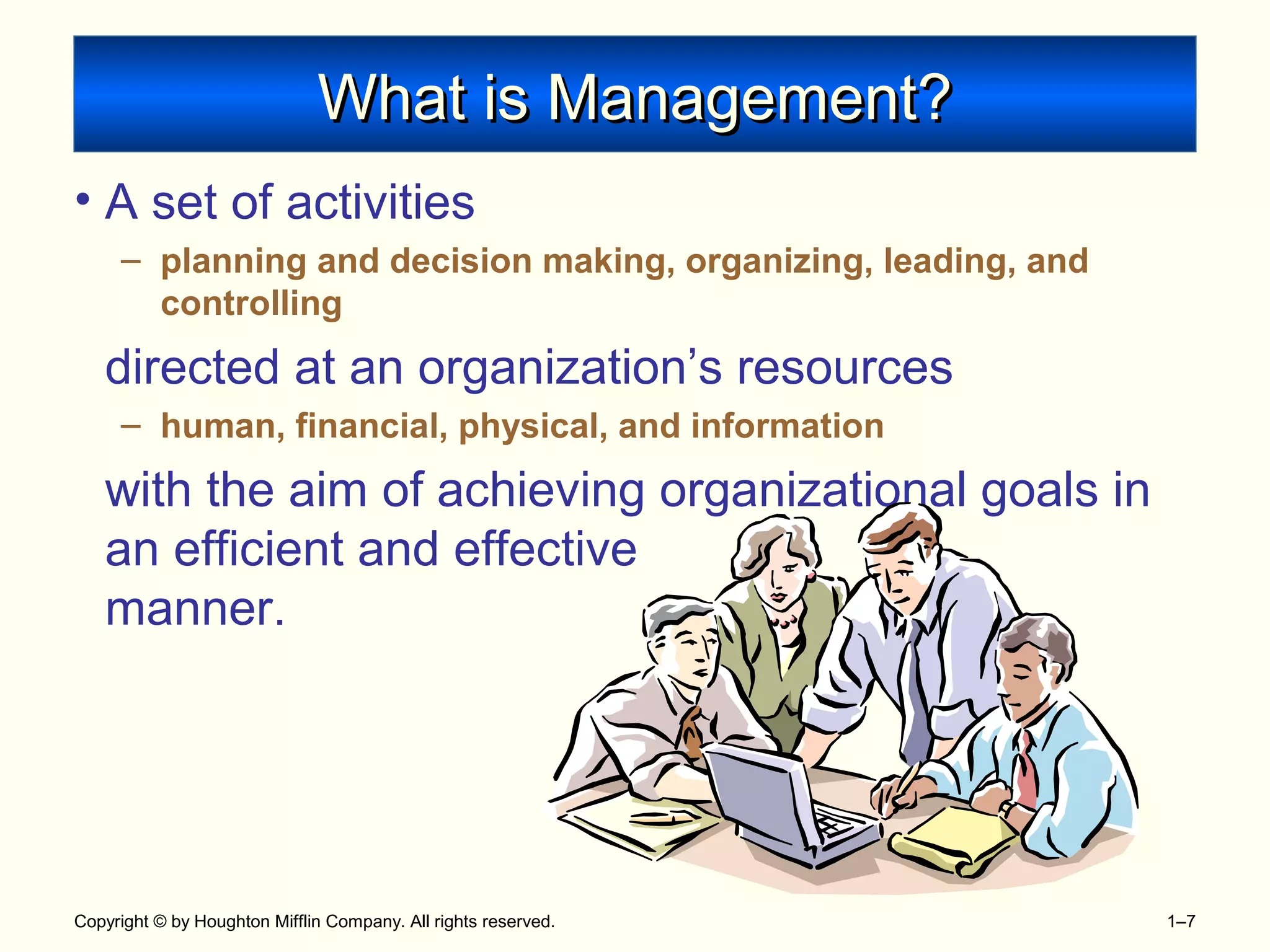
What is Management?What is Management?
• A set of activities
– planning and decision making, organizing, leading, and
controlling
directed at an organization’s resources
– human, financial, physical, and information
with the aim of achieving organizational goals in
an efficient and effective
manner.
Copyright © by Houghton Mifflin Company. All rights reserved. 1–8
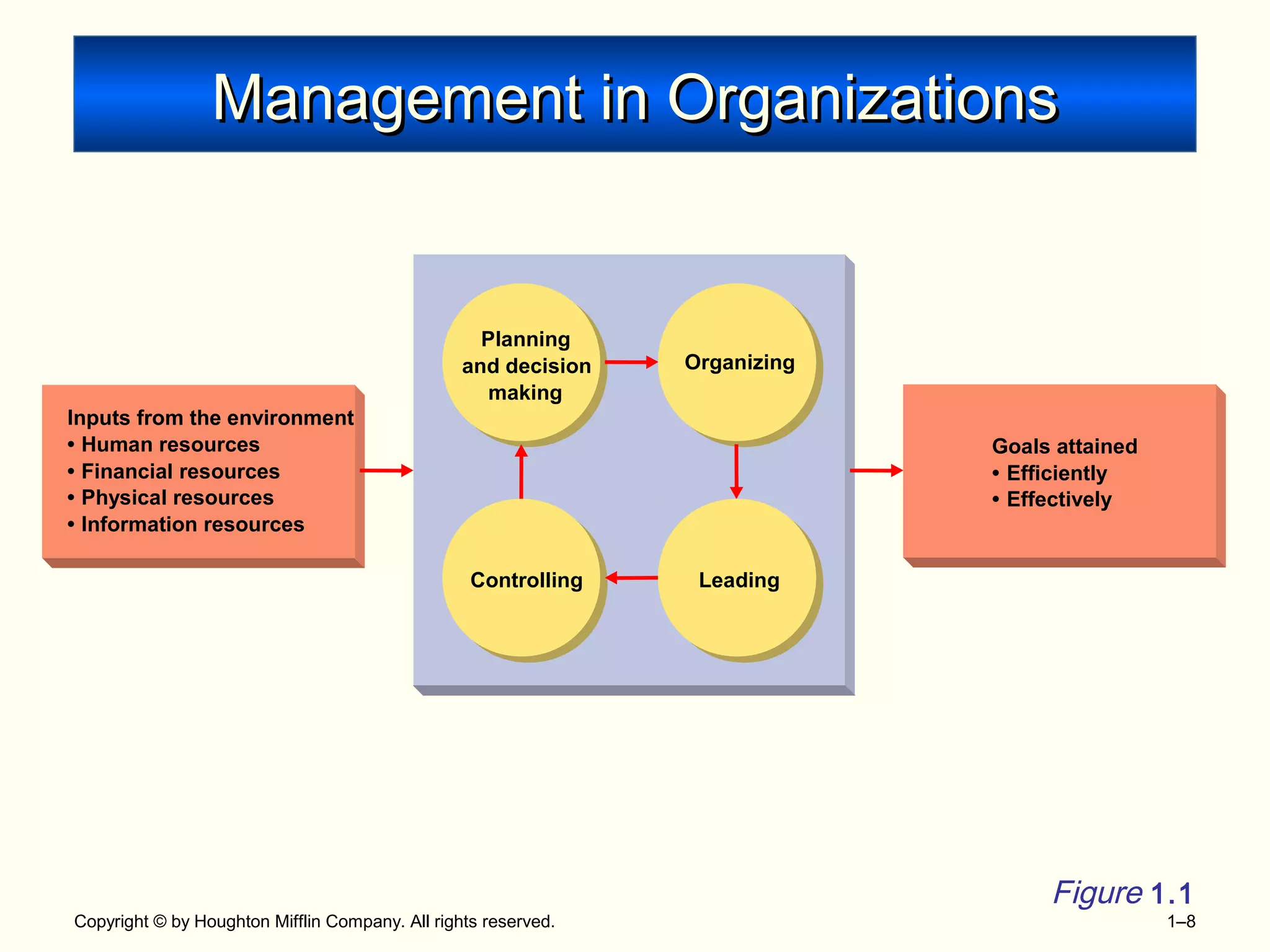
Management in OrganizationsManagement in Organizations
Inputs from the environment
• Human resources
• Financial resources
• Physical resources
• Information resources
Planning
and decision
making
Leading
Organizing
Controlling
Goals attained
• Efficiently
• Effectively
Figure 1.1
Copyright © by Houghton Mifflin Company. All rights reserved. 1–9
Basic Purpose of ManagementBasic Purpose of Management
EFFICIENTLY
Using resources wisely and
in a cost-effective way
EFFECTIVELYEFFECTIVELY
Making the right decisions andMaking the right decisions and
successfully implementing themsuccessfully implementing them
AndAnd
Copyright © by Houghton Mifflin Company. All rights reserved. 1–10
What is a Manager?What is a Manager?
• Someone whose primary responsibility is to carry
out the management process.
• Someone who plans and makes decisions,
organizes, leads, and controls
human, financial, physical,
and information resources.
Copyright © by Houghton Mifflin Company. All rights reserved. 1–11
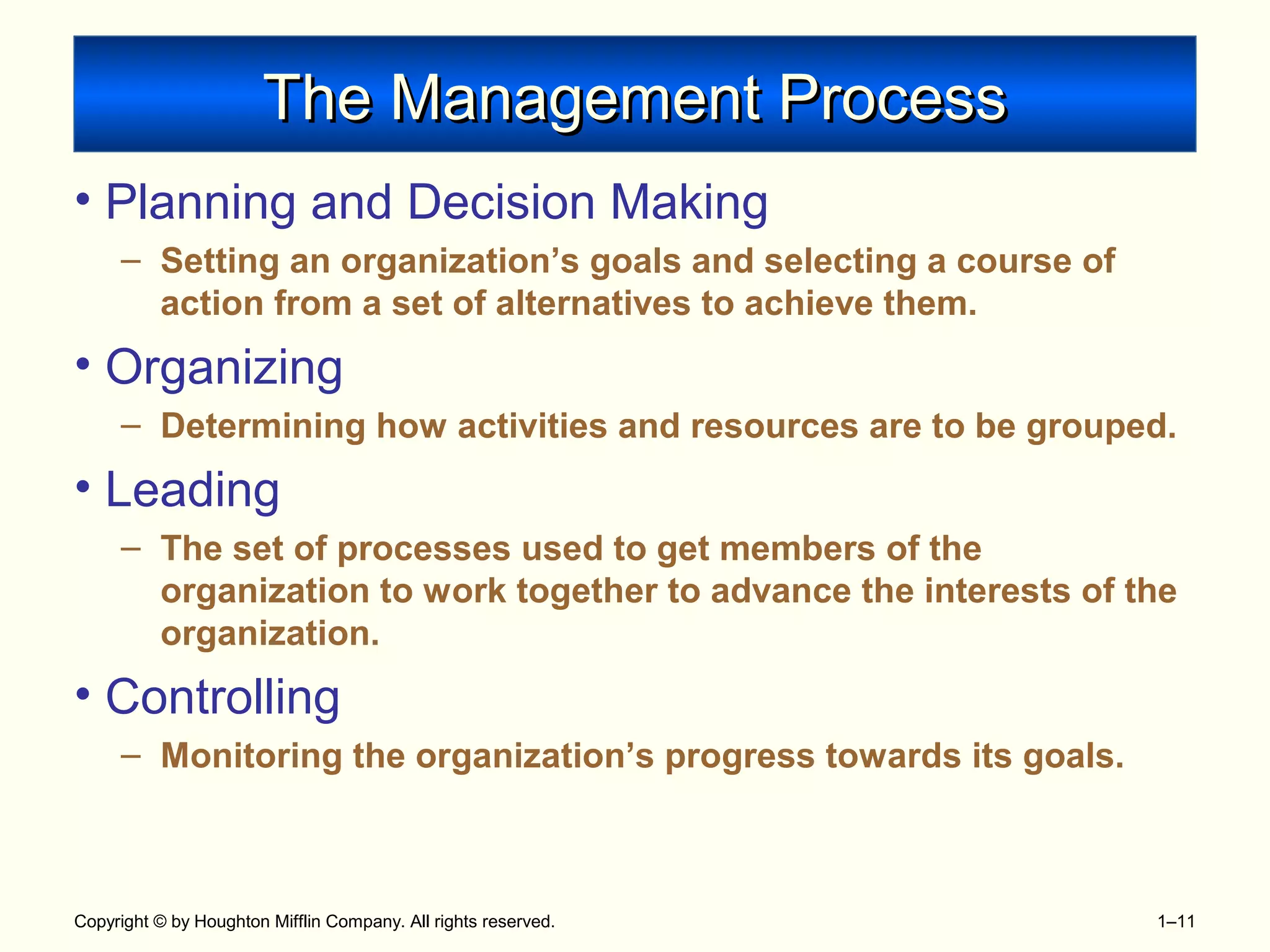
The Management ProcessThe Management Process
• Planning and Decision Making
– Setting an organization’s goals and selecting a course of
action from a set of alternatives to achieve them.
• Organizing
– Determining how activities and resources are to be grouped.
• Leading
– The set of processes used to get members of the
organization to work together to advance the interests of the
organization.
• Controlling
– Monitoring the organization’s progress towards its goals.
Copyright © by Houghton Mifflin Company. All rights reserved. 1–12
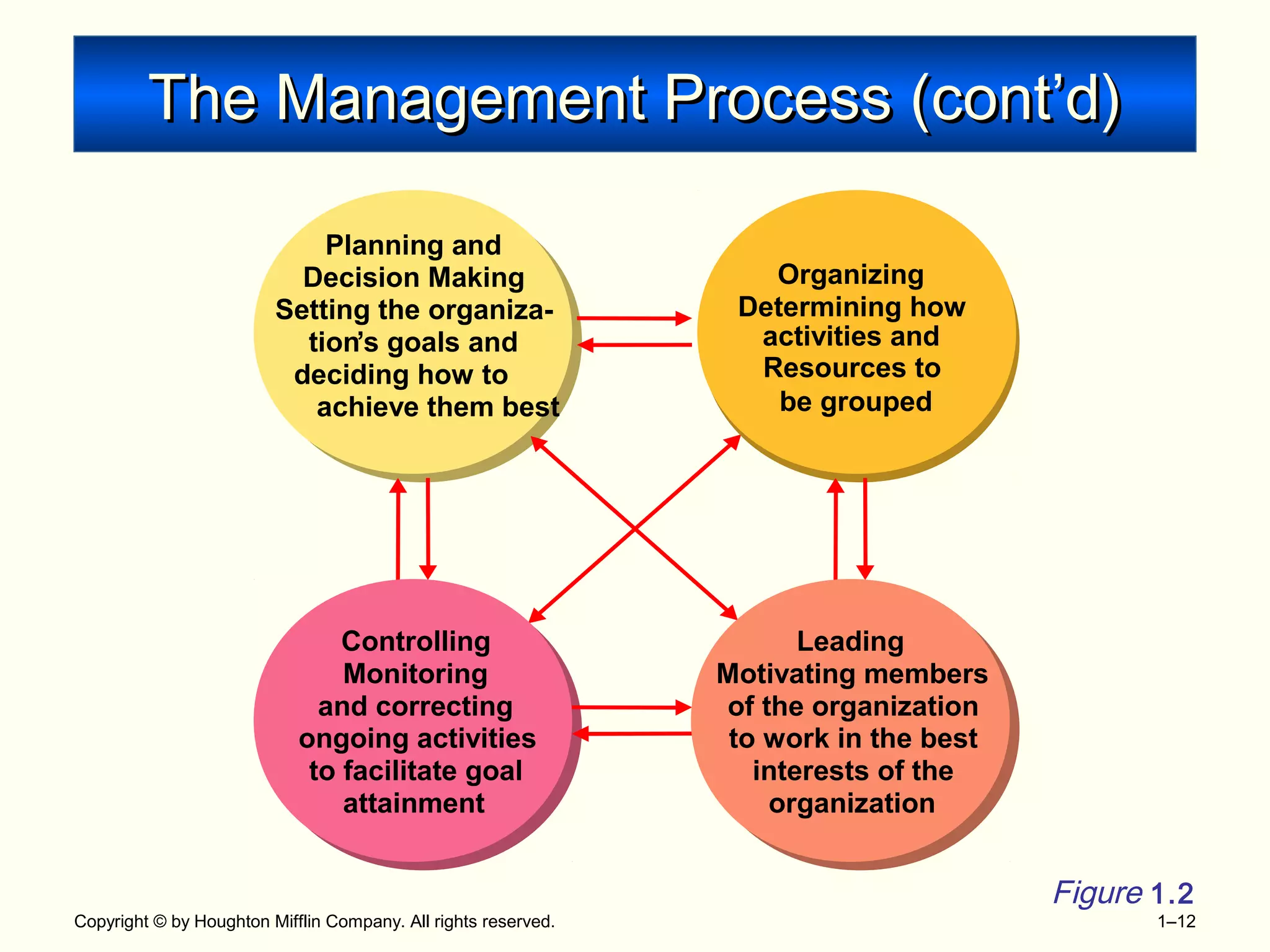
The Management Process (cont’d)The Management Process (cont’d)
Organizing
Determining how
activities and
Resources to
be grouped
Controlling
Monitoring
and correcting
ongoing activities
to facilitate goal
attainment
Planning and
Decision Making
Setting the organiza-
tion’s goals and
deciding how to
achieve them best
Leading
Motivating members
of the organization
to work in the best
interests of the
organization
Figure 1.2
Copyright © by Houghton Mifflin Company. All rights reserved. 1–13
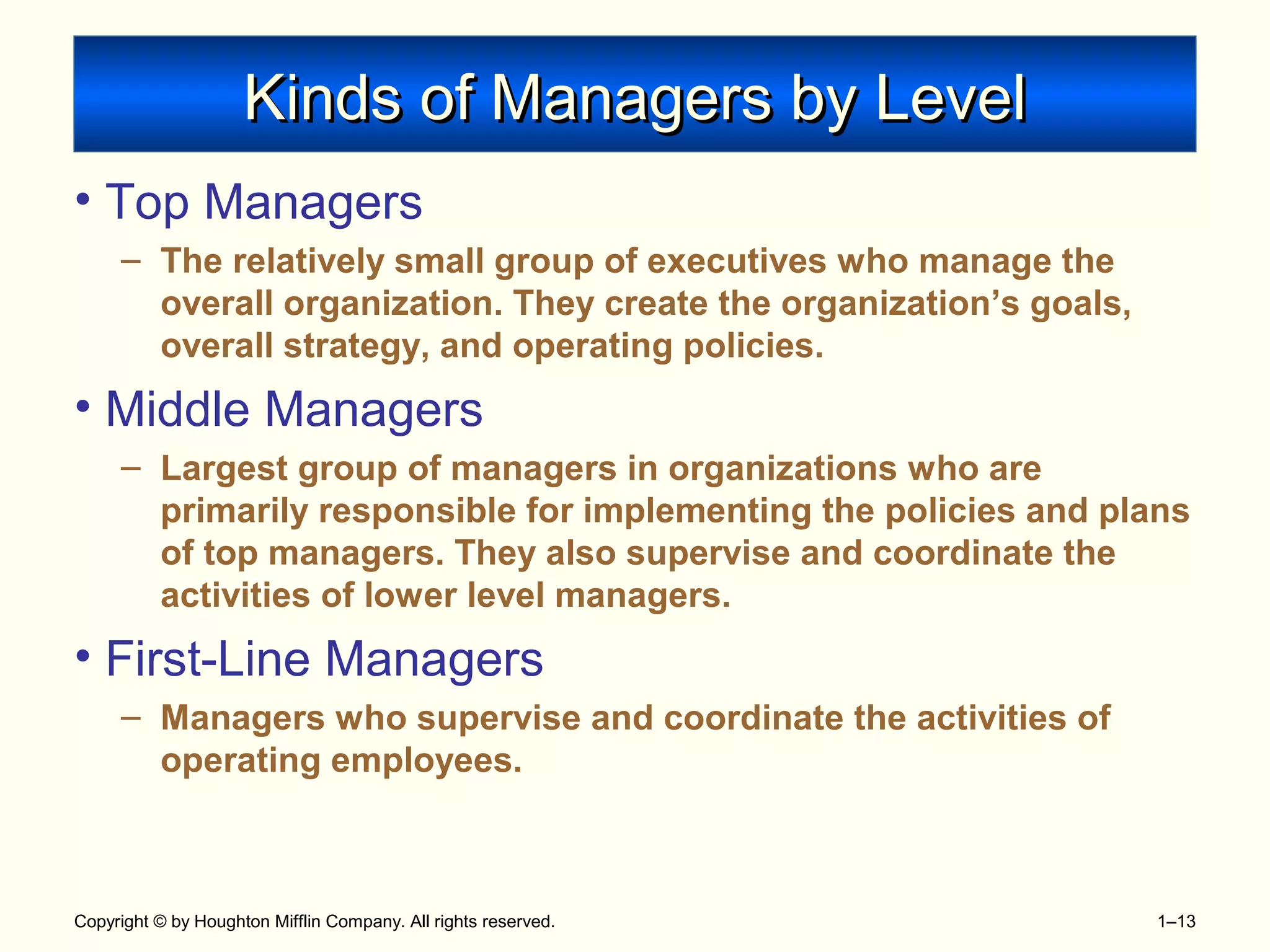
Kinds of Managers by LevelKinds of Managers by Level
• Top Managers
– The relatively small group of executives who manage the
overall organization. They create the organization’s goals,
overall strategy, and operating policies.
• Middle Managers
– Largest group of managers in organizations who are
primarily responsible for implementing the policies and plans
of top managers. They also supervise and coordinate the
activities of lower level managers.
• First-Line Managers
– Managers who supervise and coordinate the activities of
operating employees.
Copyright © by Houghton Mifflin Company. All rights reserved. 1–14
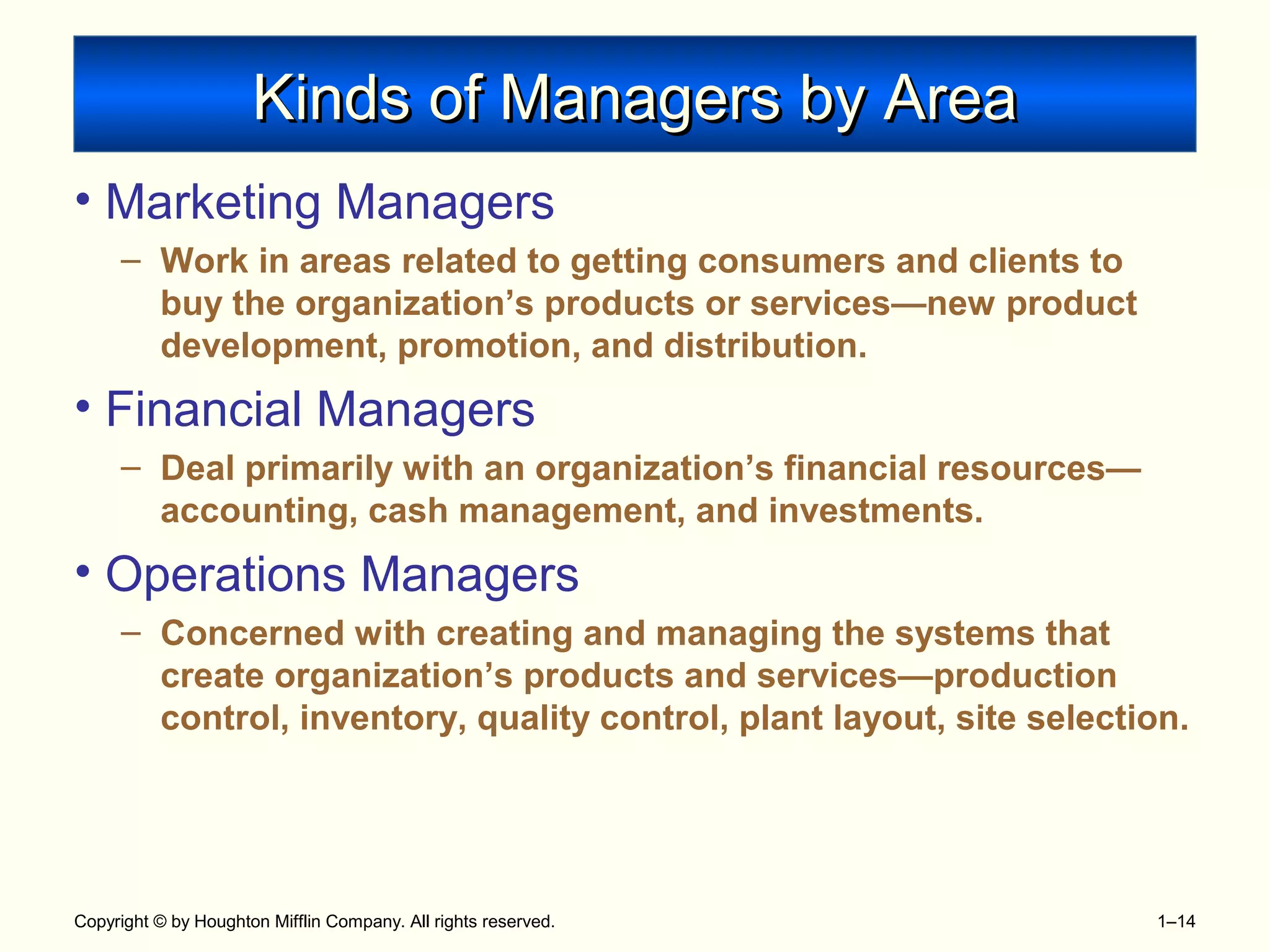
Kinds of Managers by AreaKinds of Managers by Area
• Marketing Managers
– Work in areas related to getting consumers and clients to
buy the organization’s products or services—new product
development, promotion, and distribution.
• Financial Managers
– Deal primarily with an organization’s financial resources—
accounting, cash management, and investments.
• Operations Managers
– Concerned with creating and managing the systems that
create organization’s products and services—production
control, inventory, quality control, plant layout, site selection.
Copyright © by Houghton Mifflin Company. All rights reserved. 1–15
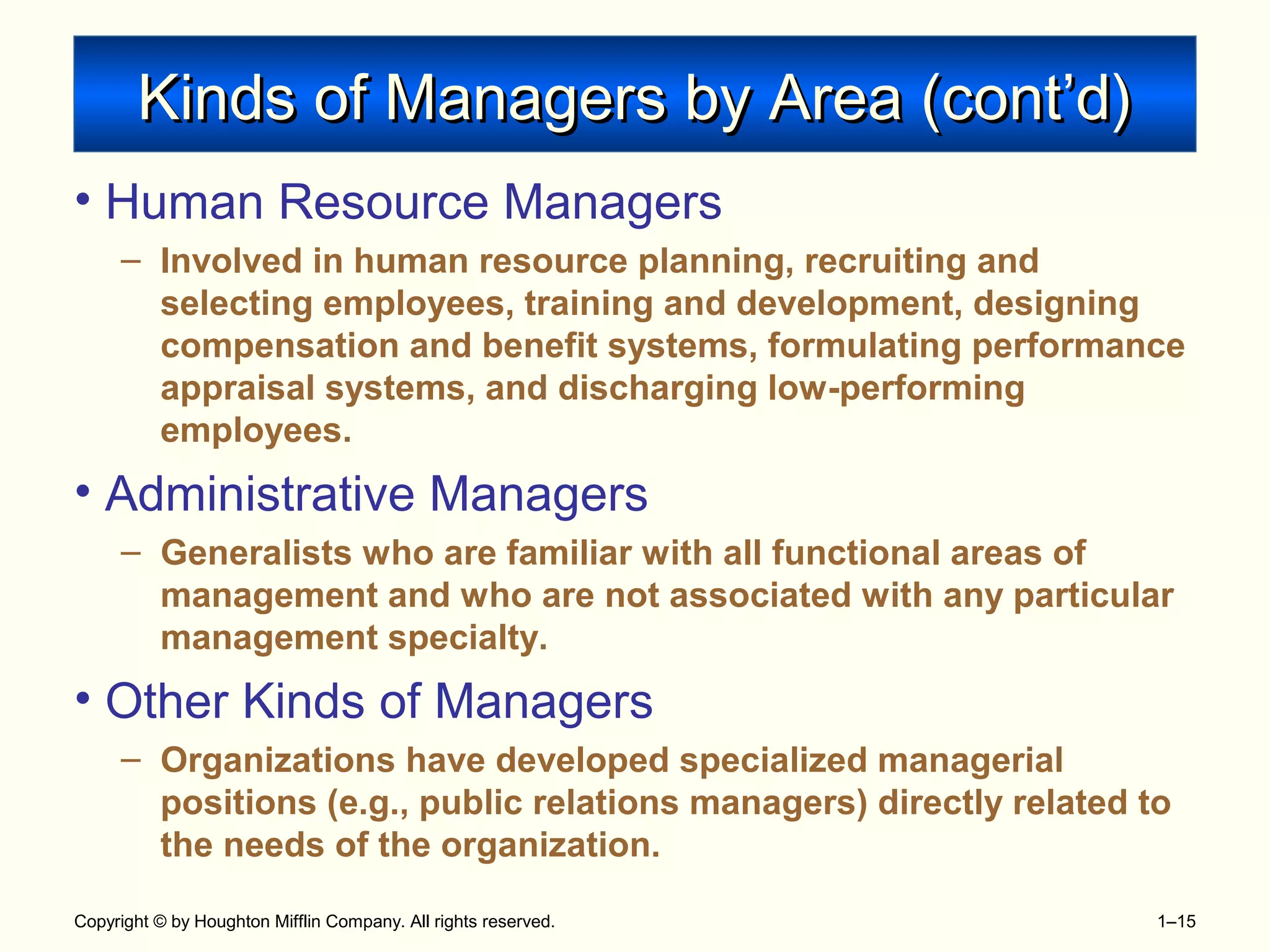
Kinds of Managers by Area (cont’d)Kinds of Managers by Area (cont’d)
• Human Resource Managers
– Involved in human resource planning, recruiting and
selecting employees, training and development, designing
compensation and benefit systems, formulating performance
appraisal systems, and discharging low-performing
employees.
• Administrative Managers
– Generalists who are familiar with all functional areas of
management and who are not associated with any particular
management specialty.
• Other Kinds of Managers
– Organizations have developed specialized managerial
positions (e.g., public relations managers) directly related to
the needs of the organization.
Copyright © by Houghton Mifflin Company. All rights reserved. 1–16
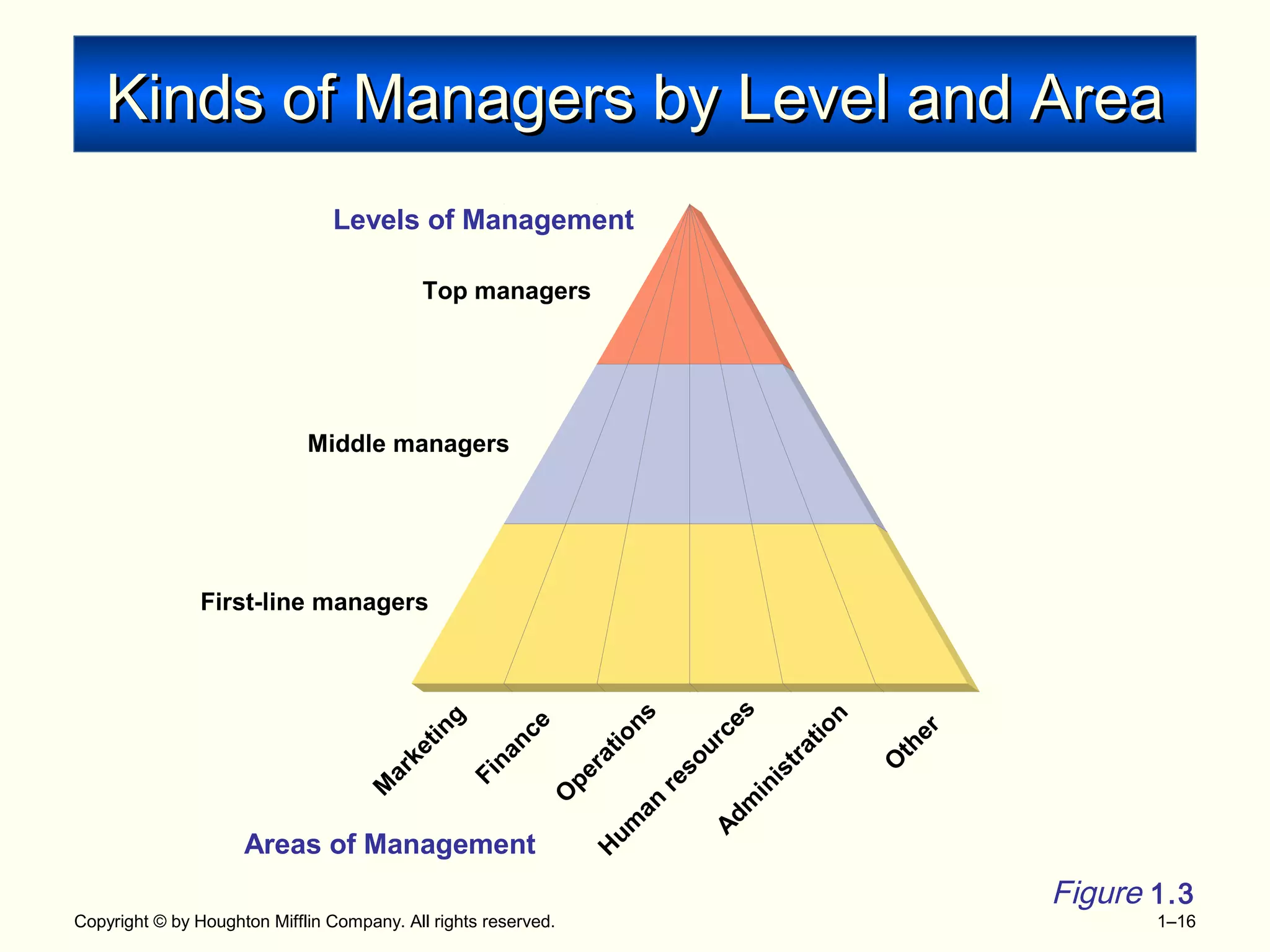
Kinds of Managers by Level and AreaKinds of Managers by Level and Area
M
arketing
Adm
inistration
O
ther
H
um
an
resources
O
perations
Finance
Middle managers
Areas of Management
Levels of Management
First-line managers
Top managers
Figure 1.3
Copyright © by Houghton Mifflin Company. All rights reserved. 1–17
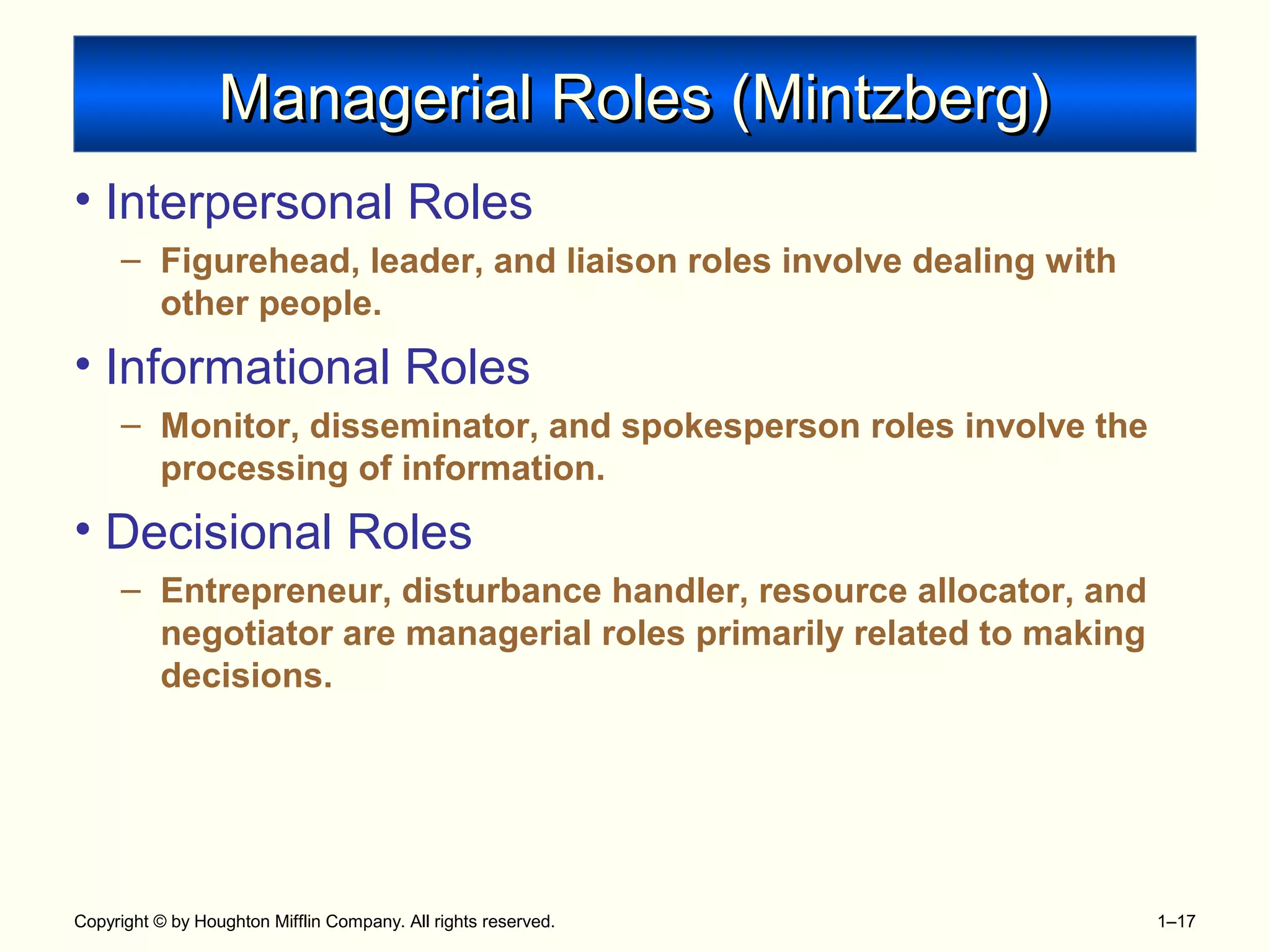
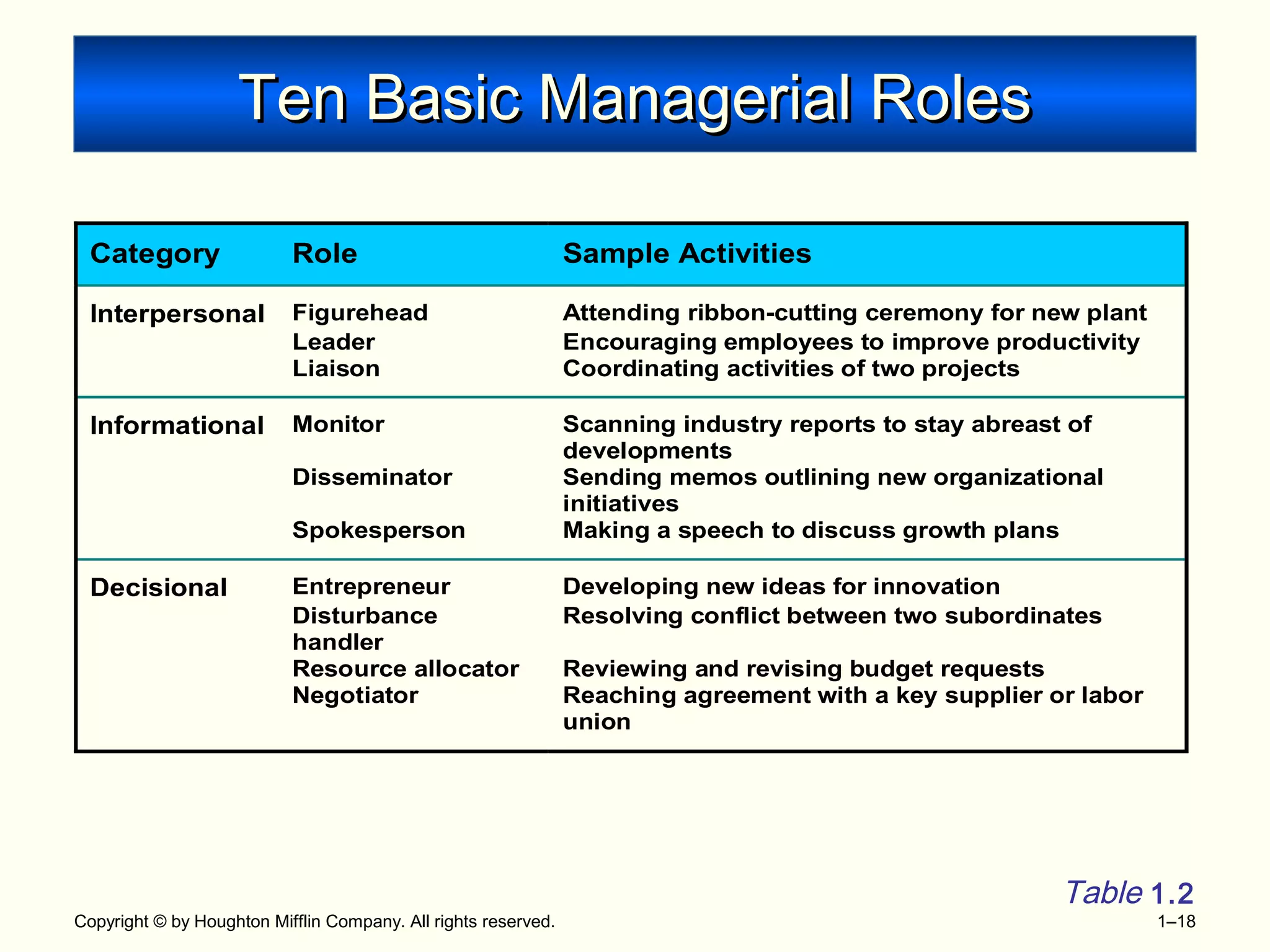
Managerial Roles (Mintzberg)Managerial Roles (Mintzberg)
• Interpersonal Roles
– Figurehead, leader, and liaison roles involve dealing with
other people.
• Informational Roles
– Monitor, disseminator, and spokesperson roles involve the
processing of information.
• Decisional Roles
– Entrepreneur, disturbance handler, resource allocator, and
negotiator are managerial roles primarily related to making
decisions.
Copyright © by Houghton Mifflin Company. All rights reserved. 1–18
Ten Basic Managerial RolesTen Basic Managerial Roles
Category Role Sample Activities
Interpersonal Figurehead Attending ribbon-cutting ceremony for new plant
Leader Encouraging employees to improve productivity
Liaison Coordinating activities of two projects
Informational Monitor Scanning industry reports to stay abreast of
developments
Disseminator Sending memos outlining new organizational
initiatives
Spokesperson Making a speech to discuss growth plans
Decisional Entrepreneur Developing new ideas for innovation
Disturbance
handler
Resolving conflict between two subordinates
Resource allocator Reviewing and revising budget requests
Negotiator Reaching agreement with a key supplier or labor
union
Table 1.2
Copyright © by Houghton Mifflin Company. All rights reserved. 1–19
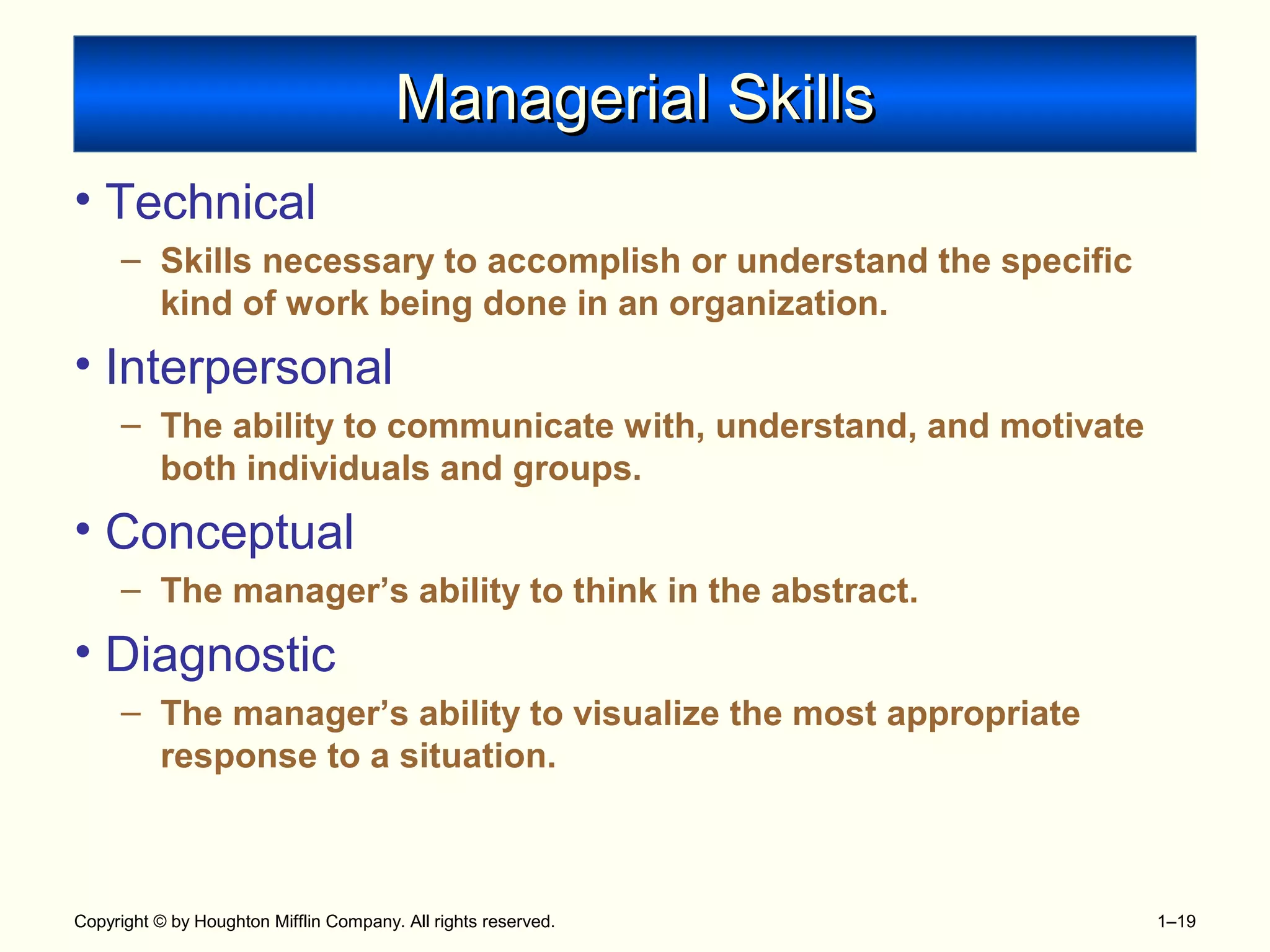
Managerial SkillsManagerial Skills
• Technical
– Skills necessary to accomplish or understand the specific
kind of work being done in an organization.
• Interpersonal
– The ability to communicate with, understand, and motivate
both individuals and groups.
• Conceptual
– The manager’s ability to think in the abstract.
• Diagnostic
– The manager’s ability to visualize the most appropriate
response to a situation.
Copyright © by Houghton Mifflin Company. All rights reserved. 1–20
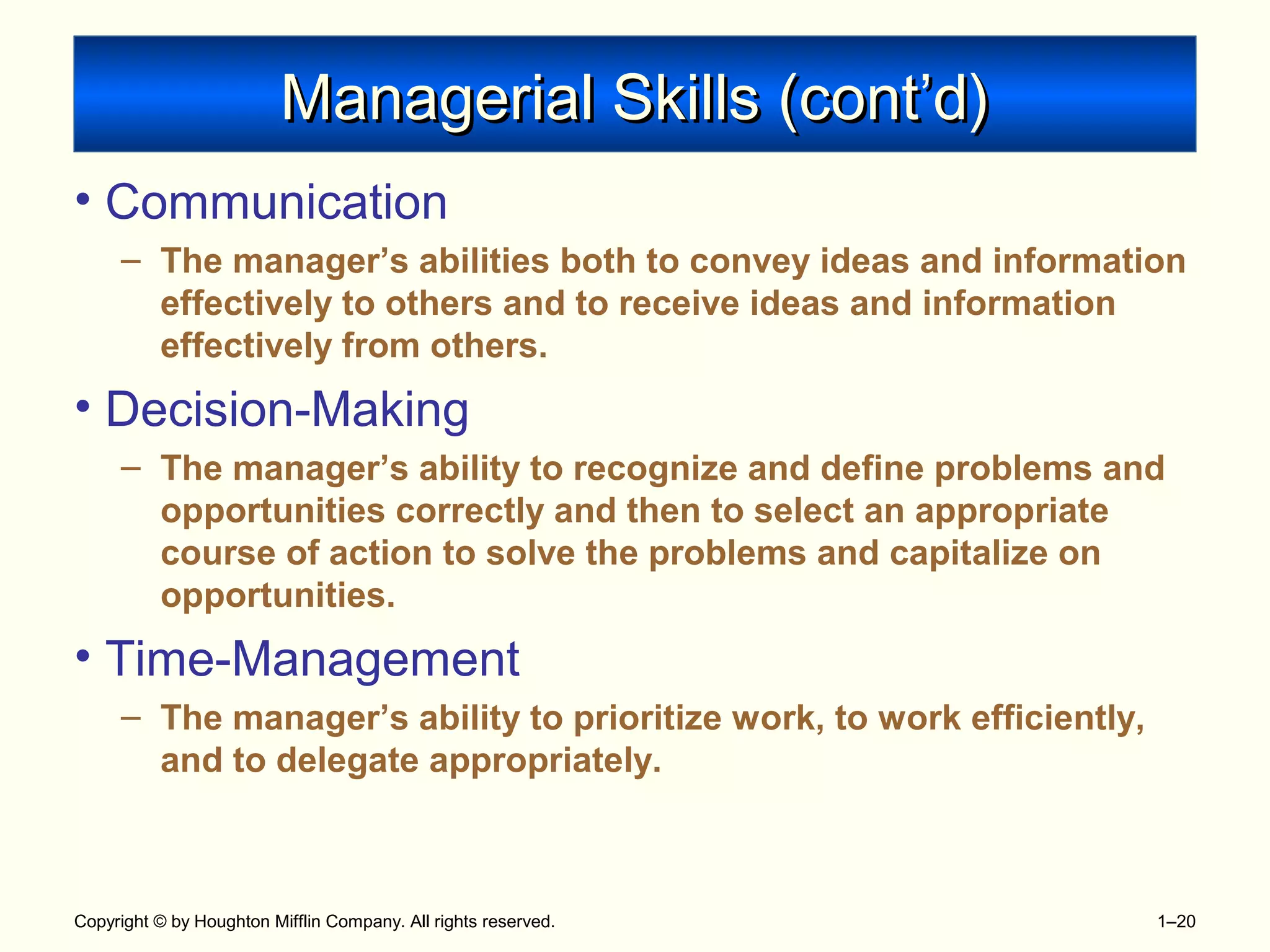
Managerial Skills (cont’d)Managerial Skills (cont’d)
• Communication
– The manager’s abilities both to convey ideas and information
effectively to others and to receive ideas and information
effectively from others.
• Decision-Making
– The manager’s ability to recognize and define problems and
opportunities correctly and then to select an appropriate
course of action to solve the problems and capitalize on
opportunities.
• Time-Management
– The manager’s ability to prioritize work, to work efficiently,
and to delegate appropriately.
Copyright © by Houghton Mifflin Company. All rights reserved. 1–21
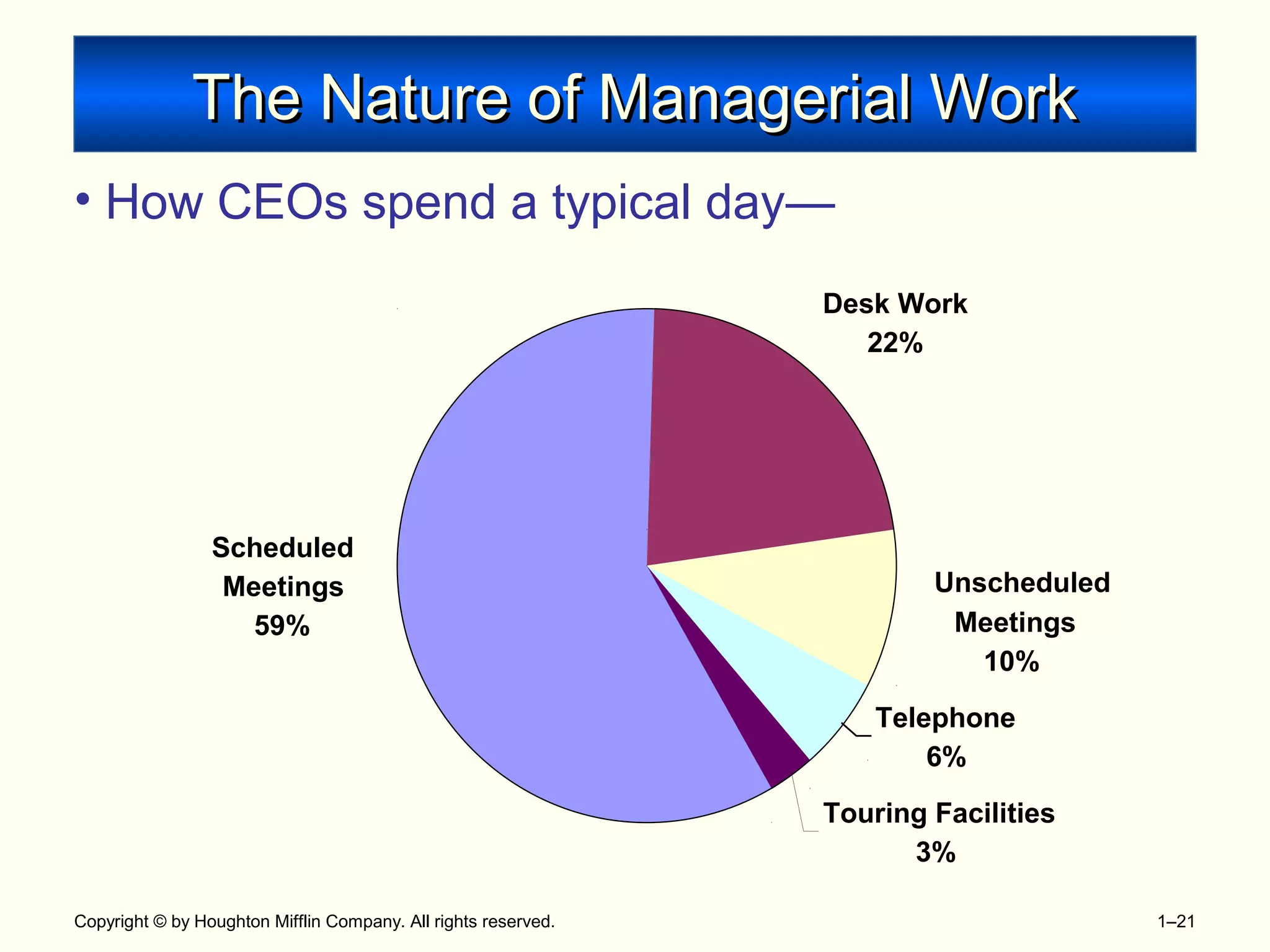
The Nature of Managerial WorkThe Nature of Managerial Work
• How CEOs spend a typical day—
Unscheduled
Scheduled
Meetings
59%
Desk Work
22%
Meetings
10%
Telephone
6%
Touring Facilities
3%
Copyright © by Houghton Mifflin Company. All rights reserved. 1–22
Management: Science or Art?Management: Science or Art?
• Science of Management
– Assumes that problems can be approached using rational,
logical, objective, and systematic ways.
– Requires the use of technical, diagnostic, and decision-
making skills and techniques to solve problems.
• Art of Management
– Decisions are made and problems solved using a blend of
intuition, experience, instinct, and personal insights.
– Requires the use of conceptual, communication,
interpersonal, and time-management skills to successfully
accomplish the tasks associated with managerial activities.
Copyright © by Houghton Mifflin Company. All rights reserved. 1–23
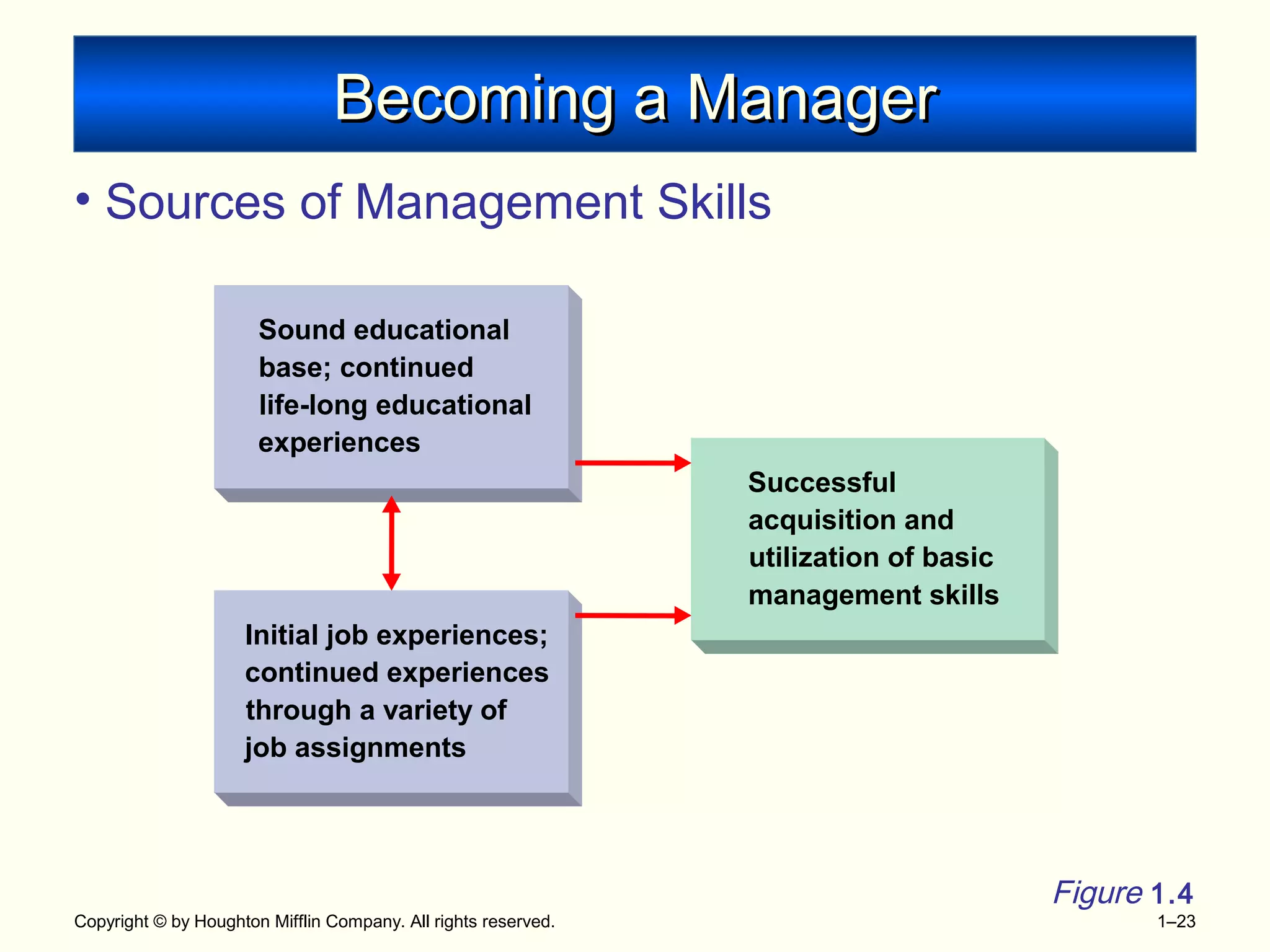
Becoming a ManagerBecoming a Manager
• Sources of Management Skills
Sound educational
base; continued
life-long educational
experiences
Successful
acquisition and
utilization of basic
management skills
Initial job experiences;
continued experiences
through a variety of
job assignments
Figure 1.4
Copyright © by Houghton Mifflin Company. All rights reserved. 1–24
Managing in OrganizationsManaging in Organizations
• For-profit Organizations
– Large businesses
• Industrial firms, commercial banks, insurance companies, retailers,
transportation companies, utilities, communication companies, service
organizations
– Small businesses and start-up businesses
– International management
• Not-for-profit Organizations
– Governmental organizations—local, state, and federal
– Educational organizations—public and private schools,
colleges, and universities
– Healthcare facilities—public hospitals and HMOs
– Nontraditional settings—community, social, spiritual groups

Griffinchap01 110410121102-phpapp02

  • 1.
    CHAPTERCHAPTER 11 Managing and the Manager’s Job CopyrightCopyright© by Houghton Mifflin Company.© by Houghton Mifflin Company. All rights reserved.All rights reserved. PowerPoint PresentationPowerPoint Presentation by Charlie Cookby Charlie Cook
  • 2.
    Copyright © byHoughton Mifflin Company. All rights reserved. 1–2 Learning ObjectivesLearning Objectives After studying this chapter, you should be able to: – Describe the nature of management, define management and managers, and characterize their importance. – Identify and briefly explain the four basic management functions in organizations. – Describe the kinds of managers found at different levels and in different areas of the organization. – Identify the basic managerial roles that managers may play and the skills they need to be successful. – Discuss the science and the art of management and describe how people become managers. – Summarize the scope of management in organizations.
  • 3.
    Copyright © byHoughton Mifflin Company. All rights reserved. 1–3 Chapter OutlineChapter Outline • The Management Process – Planning and Decision Making: Determining Courses of Action – Organizing: Coordinating Activities and Resources – Leading: Motivating and Managing People – Controlling: Monitoring and Evaluating Activities • Kinds of Managers – Managing at Different Levels of the Organization – Managing in Different Areas of the Organization • Basic Managerial Roles and Skills – Managerial Roles – Managerial Skills • The Nature of Managerial Work – The Science and the Art of Management – Becoming a Manager • The Scope of Management – Managing in Profit-Seeking Organizations – Managing in Not-for-Profit Organizations
  • 4.
    Copyright © byHoughton Mifflin Company. All rights reserved. 1–4 What is an organization?What is an organization? • A group of people working together in a structured and coordinated fashion to achieve a set of goals.
  • 5.
    Copyright © byHoughton Mifflin Company. All rights reserved. 1–5 Organizational ResourcesOrganizational Resources • Human resources – Managerial talent and labor • Financial resources – Capital investments to support ongoing and long-term operations • Physical Assets – Raw materials; office and production facilities, and equipment • Information – Usable data, information linkages
  • 6.
    Copyright © byHoughton Mifflin Company. All rights reserved. 1–6 Organization Human Resources Financial Resources Physical Resources Information Resources Shell Oil Drilling platform workers Corporate Executives Profits Stockholder investments Refineries Office Buildings Sales forecast OPEC proclamations Iowa State University Faculty Secretarial Staff Alumni contributions Government grants Computers Campus facilities Research reports Government publications New York City Police officers Municipal employees Tax revenue Government grants Sanitation equipment Municipal buildings Economic forecasts Crime statistics Susan’s Corner Grocery Store Grocery clerks Bookkeeper Profits Owner investment Building Display shelving Price lists from suppliers Newspaper ads for competitors Examples of Resources Used by OrganizationsExamples of Resources Used by Organizations Table 1.1
  • 7.
    Copyright © byHoughton Mifflin Company. All rights reserved. 1–7 What is Management?What is Management? • A set of activities – planning and decision making, organizing, leading, and controlling directed at an organization’s resources – human, financial, physical, and information with the aim of achieving organizational goals in an efficient and effective manner.
  • 8.
    Copyright © byHoughton Mifflin Company. All rights reserved. 1–8 Management in OrganizationsManagement in Organizations Inputs from the environment • Human resources • Financial resources • Physical resources • Information resources Planning and decision making Leading Organizing Controlling Goals attained • Efficiently • Effectively Figure 1.1
  • 9.
    Copyright © byHoughton Mifflin Company. All rights reserved. 1–9 Basic Purpose of ManagementBasic Purpose of Management EFFICIENTLY Using resources wisely and in a cost-effective way EFFECTIVELYEFFECTIVELY Making the right decisions andMaking the right decisions and successfully implementing themsuccessfully implementing them AndAnd
  • 10.
    Copyright © byHoughton Mifflin Company. All rights reserved. 1–10 What is a Manager?What is a Manager? • Someone whose primary responsibility is to carry out the management process. • Someone who plans and makes decisions, organizes, leads, and controls human, financial, physical, and information resources.
  • 11.
    Copyright © byHoughton Mifflin Company. All rights reserved. 1–11 The Management ProcessThe Management Process • Planning and Decision Making – Setting an organization’s goals and selecting a course of action from a set of alternatives to achieve them. • Organizing – Determining how activities and resources are to be grouped. • Leading – The set of processes used to get members of the organization to work together to advance the interests of the organization. • Controlling – Monitoring the organization’s progress towards its goals.
  • 12.
    Copyright © byHoughton Mifflin Company. All rights reserved. 1–12 The Management Process (cont’d)The Management Process (cont’d) Organizing Determining how activities and Resources to be grouped Controlling Monitoring and correcting ongoing activities to facilitate goal attainment Planning and Decision Making Setting the organiza- tion’s goals and deciding how to achieve them best Leading Motivating members of the organization to work in the best interests of the organization Figure 1.2
  • 13.
    Copyright © byHoughton Mifflin Company. All rights reserved. 1–13 Kinds of Managers by LevelKinds of Managers by Level • Top Managers – The relatively small group of executives who manage the overall organization. They create the organization’s goals, overall strategy, and operating policies. • Middle Managers – Largest group of managers in organizations who are primarily responsible for implementing the policies and plans of top managers. They also supervise and coordinate the activities of lower level managers. • First-Line Managers – Managers who supervise and coordinate the activities of operating employees.
  • 14.
    Copyright © byHoughton Mifflin Company. All rights reserved. 1–14 Kinds of Managers by AreaKinds of Managers by Area • Marketing Managers – Work in areas related to getting consumers and clients to buy the organization’s products or services—new product development, promotion, and distribution. • Financial Managers – Deal primarily with an organization’s financial resources— accounting, cash management, and investments. • Operations Managers – Concerned with creating and managing the systems that create organization’s products and services—production control, inventory, quality control, plant layout, site selection.
  • 15.
    Copyright © byHoughton Mifflin Company. All rights reserved. 1–15 Kinds of Managers by Area (cont’d)Kinds of Managers by Area (cont’d) • Human Resource Managers – Involved in human resource planning, recruiting and selecting employees, training and development, designing compensation and benefit systems, formulating performance appraisal systems, and discharging low-performing employees. • Administrative Managers – Generalists who are familiar with all functional areas of management and who are not associated with any particular management specialty. • Other Kinds of Managers – Organizations have developed specialized managerial positions (e.g., public relations managers) directly related to the needs of the organization.
  • 16.
    Copyright © byHoughton Mifflin Company. All rights reserved. 1–16 Kinds of Managers by Level and AreaKinds of Managers by Level and Area M arketing Adm inistration O ther H um an resources O perations Finance Middle managers Areas of Management Levels of Management First-line managers Top managers Figure 1.3
  • 17.
    Copyright © byHoughton Mifflin Company. All rights reserved. 1–17 Managerial Roles (Mintzberg)Managerial Roles (Mintzberg) • Interpersonal Roles – Figurehead, leader, and liaison roles involve dealing with other people. • Informational Roles – Monitor, disseminator, and spokesperson roles involve the processing of information. • Decisional Roles – Entrepreneur, disturbance handler, resource allocator, and negotiator are managerial roles primarily related to making decisions.
  • 18.
    Copyright © byHoughton Mifflin Company. All rights reserved. 1–18 Ten Basic Managerial RolesTen Basic Managerial Roles Category Role Sample Activities Interpersonal Figurehead Attending ribbon-cutting ceremony for new plant Leader Encouraging employees to improve productivity Liaison Coordinating activities of two projects Informational Monitor Scanning industry reports to stay abreast of developments Disseminator Sending memos outlining new organizational initiatives Spokesperson Making a speech to discuss growth plans Decisional Entrepreneur Developing new ideas for innovation Disturbance handler Resolving conflict between two subordinates Resource allocator Reviewing and revising budget requests Negotiator Reaching agreement with a key supplier or labor union Table 1.2
  • 19.
    Copyright © byHoughton Mifflin Company. All rights reserved. 1–19 Managerial SkillsManagerial Skills • Technical – Skills necessary to accomplish or understand the specific kind of work being done in an organization. • Interpersonal – The ability to communicate with, understand, and motivate both individuals and groups. • Conceptual – The manager’s ability to think in the abstract. • Diagnostic – The manager’s ability to visualize the most appropriate response to a situation.
  • 20.
    Copyright © byHoughton Mifflin Company. All rights reserved. 1–20 Managerial Skills (cont’d)Managerial Skills (cont’d) • Communication – The manager’s abilities both to convey ideas and information effectively to others and to receive ideas and information effectively from others. • Decision-Making – The manager’s ability to recognize and define problems and opportunities correctly and then to select an appropriate course of action to solve the problems and capitalize on opportunities. • Time-Management – The manager’s ability to prioritize work, to work efficiently, and to delegate appropriately.
  • 21.
    Copyright © byHoughton Mifflin Company. All rights reserved. 1–21 The Nature of Managerial WorkThe Nature of Managerial Work • How CEOs spend a typical day— Unscheduled Scheduled Meetings 59% Desk Work 22% Meetings 10% Telephone 6% Touring Facilities 3%
  • 22.
    Copyright © byHoughton Mifflin Company. All rights reserved. 1–22 Management: Science or Art?Management: Science or Art? • Science of Management – Assumes that problems can be approached using rational, logical, objective, and systematic ways. – Requires the use of technical, diagnostic, and decision- making skills and techniques to solve problems. • Art of Management – Decisions are made and problems solved using a blend of intuition, experience, instinct, and personal insights. – Requires the use of conceptual, communication, interpersonal, and time-management skills to successfully accomplish the tasks associated with managerial activities.
  • 23.
    Copyright © byHoughton Mifflin Company. All rights reserved. 1–23 Becoming a ManagerBecoming a Manager • Sources of Management Skills Sound educational base; continued life-long educational experiences Successful acquisition and utilization of basic management skills Initial job experiences; continued experiences through a variety of job assignments Figure 1.4
  • 24.
    Copyright © byHoughton Mifflin Company. All rights reserved. 1–24 Managing in OrganizationsManaging in Organizations • For-profit Organizations – Large businesses • Industrial firms, commercial banks, insurance companies, retailers, transportation companies, utilities, communication companies, service organizations – Small businesses and start-up businesses – International management • Not-for-profit Organizations – Governmental organizations—local, state, and federal – Educational organizations—public and private schools, colleges, and universities – Healthcare facilities—public hospitals and HMOs – Nontraditional settings—community, social, spiritual groups