(eBook PDF) Organisational Behaviour Core
Concepts Applications 4th install download
https://ebookluna.com/product/ebook-pdf-organisational-behaviour-
core-concepts-applications-4th/
Download more ebook from https://ebookluna.com
Instant digital products (PDF, ePub, MOBI) ready for you
Download now and discover formats that fit your needs...
(eBook PDF) Organisational Behaviour: Core Concepts and
Applications, 5th Australasian Edition
https://ebookluna.com/product/ebook-pdf-organisational-behaviour-core-
concepts-and-applications-5th-australasian-edition/
ebookluna.com
(eBook PDF) Management & Organisational Behaviour, 11th
Edition
https://ebookluna.com/product/ebook-pdf-management-organisational-
behaviour-11th-edition/
ebookluna.com
(Original PDF) Organisational Behaviour 8th Australia
Edition
https://ebookluna.com/product/original-pdf-organisational-
behaviour-8th-australia-edition/
ebookluna.com
(eBook PDF) Organisational Behaviour: Managing People and
Organisations
https://ebookluna.com/product/ebook-pdf-organisational-behaviour-
managing-people-and-organisations/
ebookluna.com
(eBook PDF) Organizational Behaviour Concepts,
Controversies, Applications, 8th Canadian Edition
https://ebookluna.com/product/ebook-pdf-organizational-behaviour-
concepts-controversies-applications-8th-canadian-edition/
ebookluna.com
(eBook PDF) Organisational Behaviour Emerging Knowledge
Global Insights 5th
https://ebookluna.com/product/ebook-pdf-organisational-behaviour-
emerging-knowledge-global-insights-5th/
ebookluna.com
(eBook PDF) Organisational Behaviour Individuals Groups
Organisation 5th Edition
https://ebookluna.com/product/ebook-pdf-organisational-behaviour-
individuals-groups-organisation-5th-edition/
ebookluna.com
(eBook PDF) Organisational Behaviour in the Workplace 12th
Editio
https://ebookluna.com/product/ebook-pdf-organisational-behaviour-in-
the-workplace-12th-editio/
ebookluna.com
(eBook PDF) Organisational Behaviour 9th Edition By
Stephen P. Robbins
https://ebookluna.com/product/ebook-pdf-organisational-behaviour-9th-
edition-by-stephen-p-robbins/
ebookluna.com
F O U R T H A U S T R A L A S I A N E D I T I O N
Jack WOOD
Rachid ZEFFANE
Michele FROMHOLTZ
Retha WIESNER
Rachel MORRISON
Aharon FACTOR
Tui MCKEOWN
CORE CONCEPTS AND APPLICATIONS
BEHAVIOUR
ORGANISATIONAL
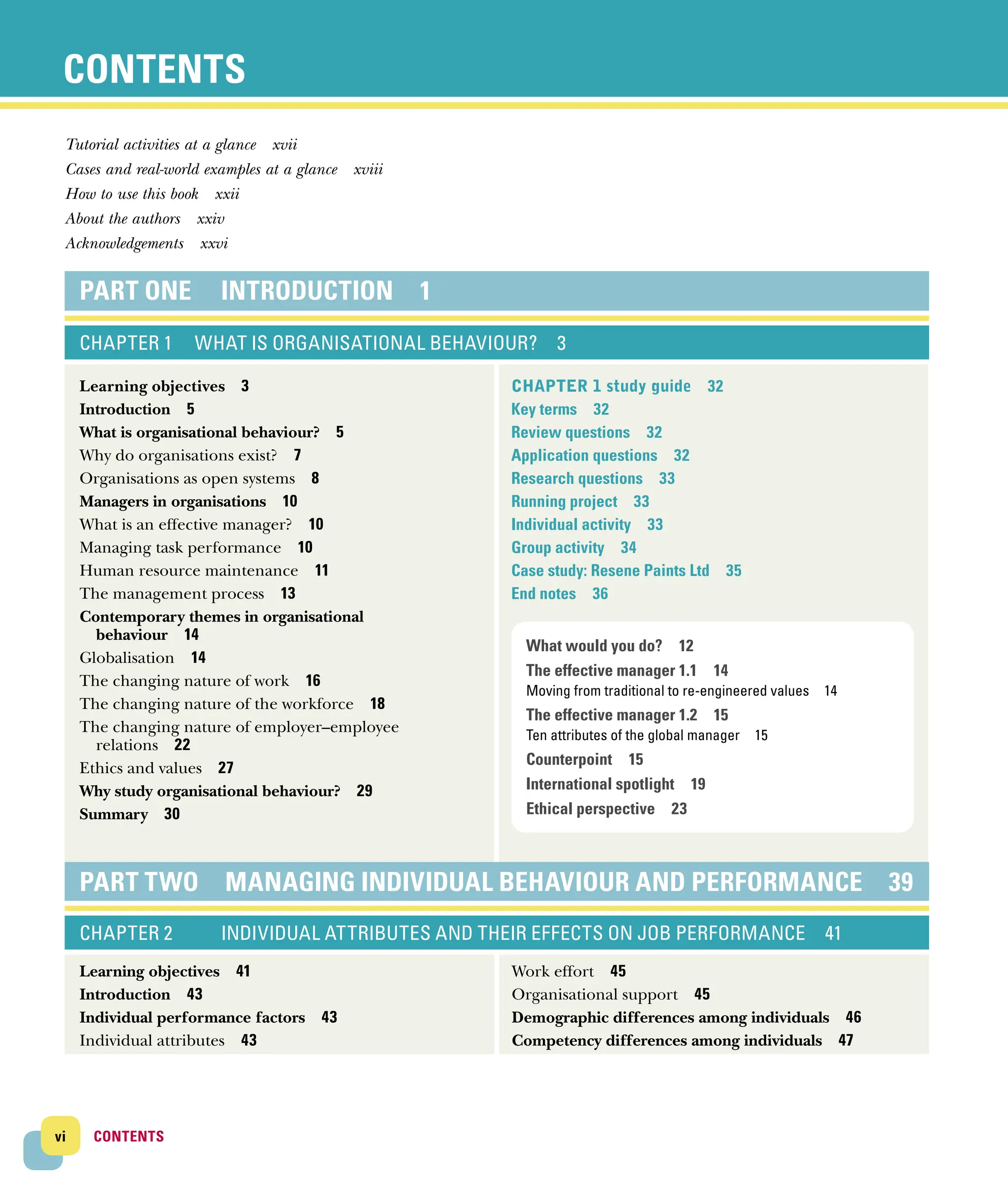
vi CONTENTS
PART ONE INTRODUCTION 1
CHAPTER 1 WHAT IS ORGANISATIONAL BEHAVIOUR? 3
Learning objectives 3
Introduction 5
What is organisational behaviour? 5
Why do organisations exist? 7
Organisations as open systems 8
Managers in organisations 10
What is an effective manager? 10
Managing task performance 10
Human resource maintenance 11
The management process 13
Contemporary themes in organisational
­behaviour 14
Globalisation 14
The changing nature of work 16
The changing nature of the workforce 18
The changing nature of employer–employee
­relations 22
Ethics and values 27
Why study organisational behaviour? 29
Summary 30
Chapter 1 study guide 32
Key terms 32
Review questions 32
Application questions 32
Research questions 33
Running project 33
Individual activity 33
Group activity 34
Case study: Resene Paints Ltd 35
End notes 36
PART TWO MANAGING INDIVIDUAL BEHAVIOUR AND PERFORMANCE 39
CHAPTER 2 INDIVIDUAL ATTRIBUTES AND THEIR EFFECTS ON JOB PERFORMANCE 41
Learning objectives 41
Introduction 43
Individual performance factors 43
Individual attributes 43
Work effort 45
Organisational support 45
Demographic differences among individuals 46
Competency differences among individuals 47
CONTENTS
Tutorial activities at a glance xvii
Cases and real-world examples at a glance xviii
How to use this book xxii
About the authors xxiv
Acknowledgements xxvi
What would you do? 12
The effective manager 1.1 14
Moving from traditional to re-engineered values 14
The effective manager 1.2 15
Ten attributes of the global manager 15
Counterpoint 15
International spotlight 19
Ethical perspective 23
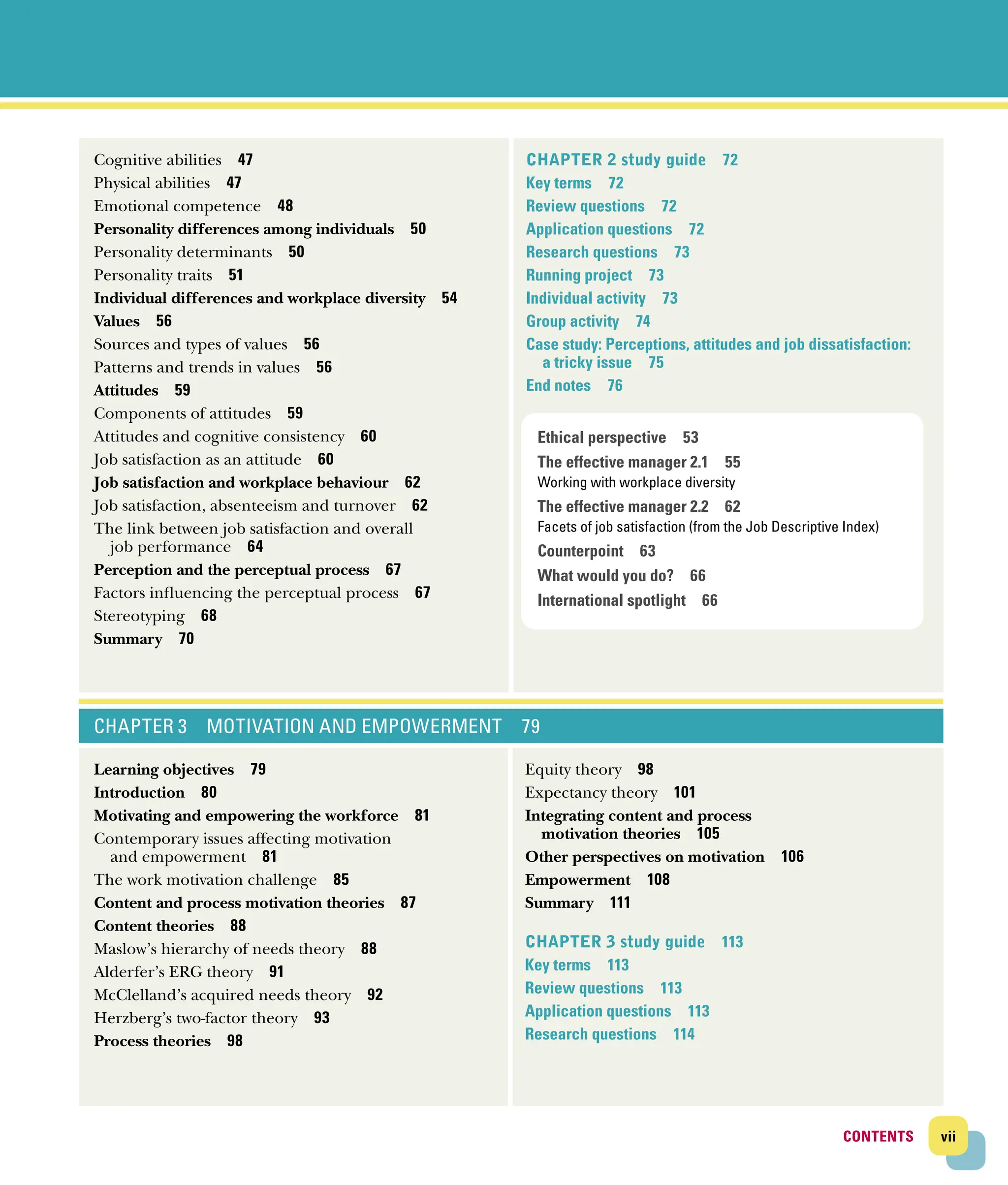
Cognitive abilities 47
Physical abilities 47
Emotional competence 48
Personality differences among individuals 50
Personality determinants 50
Personality traits 51
Individual differences and workplace diversity 54
Values 56
Sources and types of values 56
Patterns and trends in values 56
Attitudes 59
Components of attitudes 59
Attitudes and cognitive consistency 60
Job satisfaction as an attitude 60
Job satisfaction and workplace behaviour 62
Job satisfaction, absenteeism and turnover 62
The link between job satisfaction and overall
job ­performance 64
Perception and the perceptual process 67
Factors influencing the perceptual process 67
Stereotyping 68
Summary 70
CHAPTER 2 study guide 72
Key terms 72
Review questions 72
Application questions 72
Research questions 73
Running project 73
Individual activity 73
Group activity 74
Case study: Perceptions, attitudes and job dissatisfaction:
a tricky issue 75
End notes 76
CHAPTER 3 MOTIVATION AND EMPOWERMENT 79
Learning objectives 79
Introduction 80
Motivating and empowering the workforce 81
Contemporary issues affecting motivation
and ­empowerment 81
The work motivation challenge 85
Content and process motivation theories 87
Content theories 88
Maslow’s hierarchy of needs theory 88
Alderfer’s ERG theory 91
McClelland’s acquired needs theory 92
Herzberg’s two‐factor theory 93
Process theories 98
Equity theory 98
Expectancy theory 101
Integrating content and process
motivation theories 105
Other perspectives on motivation 106
Empowerment 108
Summary 111
Chapter 3 study guide 113
Key terms 113
Review questions 113
Application questions 113
Research questions 114
Ethical perspective 53
The effective manager 2.1 55
Working with workplace diversity
The effective manager 2.2 62
Facets of job satisfaction (from the Job Descriptive Index)
Counterpoint 63
What would you do? 66
International spotlight 66
CONTENTS vii
CONTENTS
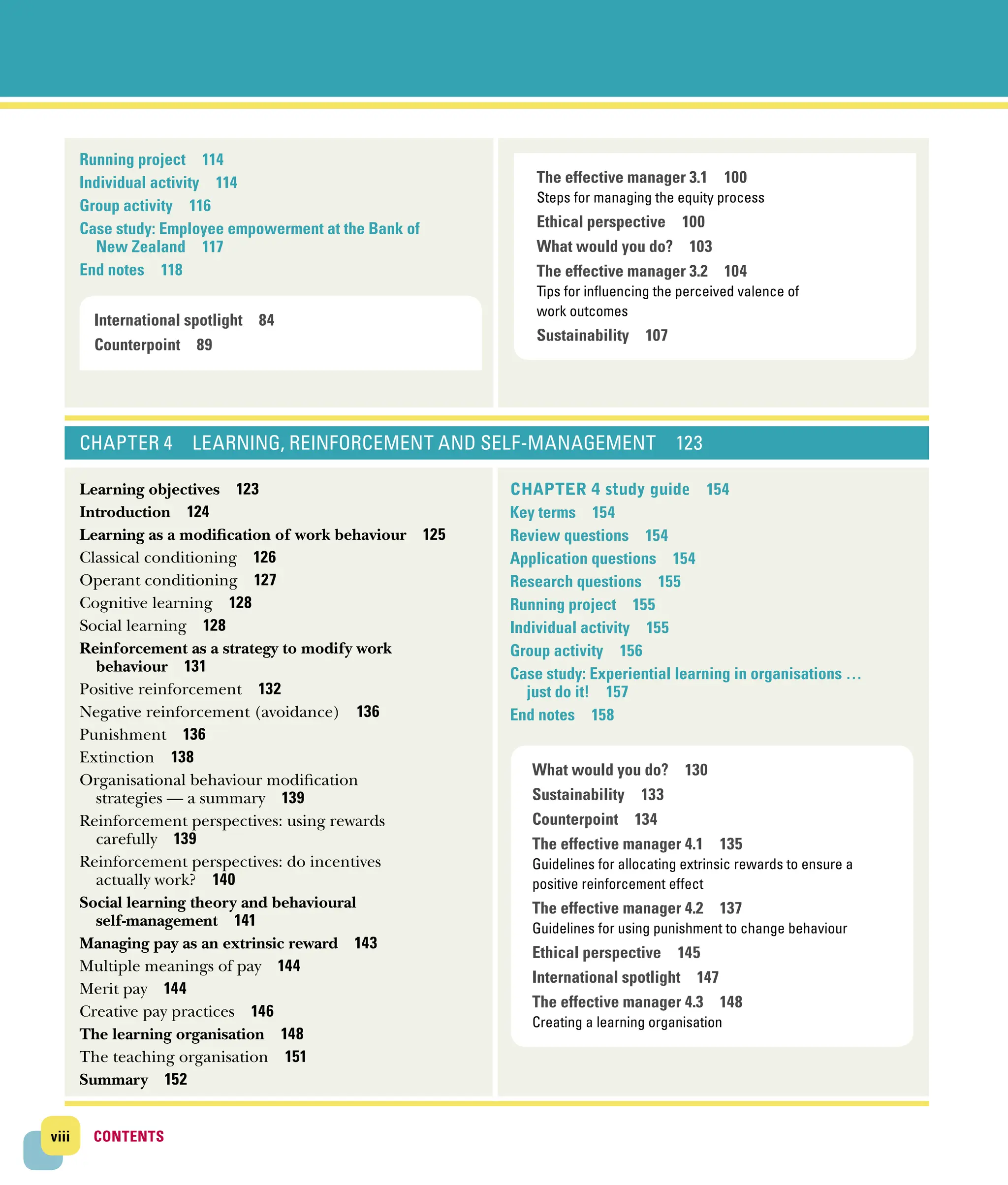
viii CONTENTS
CONTENTS
Running project 114
Individual activity 114
Group activity 116
Case study: Employee empowerment at the Bank of
New Zealand 117
End notes 118
CHAPTER 4 Learning, reinforcement and self-management  123
Learning objectives 123
Introduction 124
Learning as a modification of work behaviour 125
Classical conditioning 126
Operant conditioning 127
Cognitive learning 128
Social learning 128
Reinforcement as a strategy to modify work
­behaviour 131
Positive reinforcement 132
Negative reinforcement (avoidance) 136
Punishment 136
Extinction 138
Organisational behaviour modification
­strategies — a summary 139
Reinforcement perspectives: using rewards
­carefully 139
Reinforcement perspectives: do incentives
­actually work? 140
Social learning theory and behavioural ­
self‐management 141
Managing pay as an extrinsic reward 143
Multiple meanings of pay 144
Merit pay 144
Creative pay practices 146
The learning organisation 148
The teaching organisation 151
Summary 152
Chapter 4 study guide 154
Key terms 154
Review questions 154
Application questions 154
Research questions 155
Running project 155
Individual activity 155
Group activity 156
Case study: Experiential learning in organisations …
just do it! 157
End notes 158
The effective manager 3.1 100
Steps for managing the equity process
Ethical perspective 100
What would you do? 103
The effective manager 3.2 104
Tips for influencing the perceived valence of
work outcomes
Sustainability 107
What would you do? 130
Sustainability 133
Counterpoint 134
The effective manager 4.1 135
Guidelines for allocating extrinsic rewards to ensure a
­
positive reinforcement effect
The effective manager 4.2 137
Guidelines for using punishment to change behaviour
Ethical perspective 145
International spotlight 147
The effective manager 4.3 148
Creating a learning organisation
International spotlight 84
Counterpoint 89
ix
CONTENTS
CONTENTS
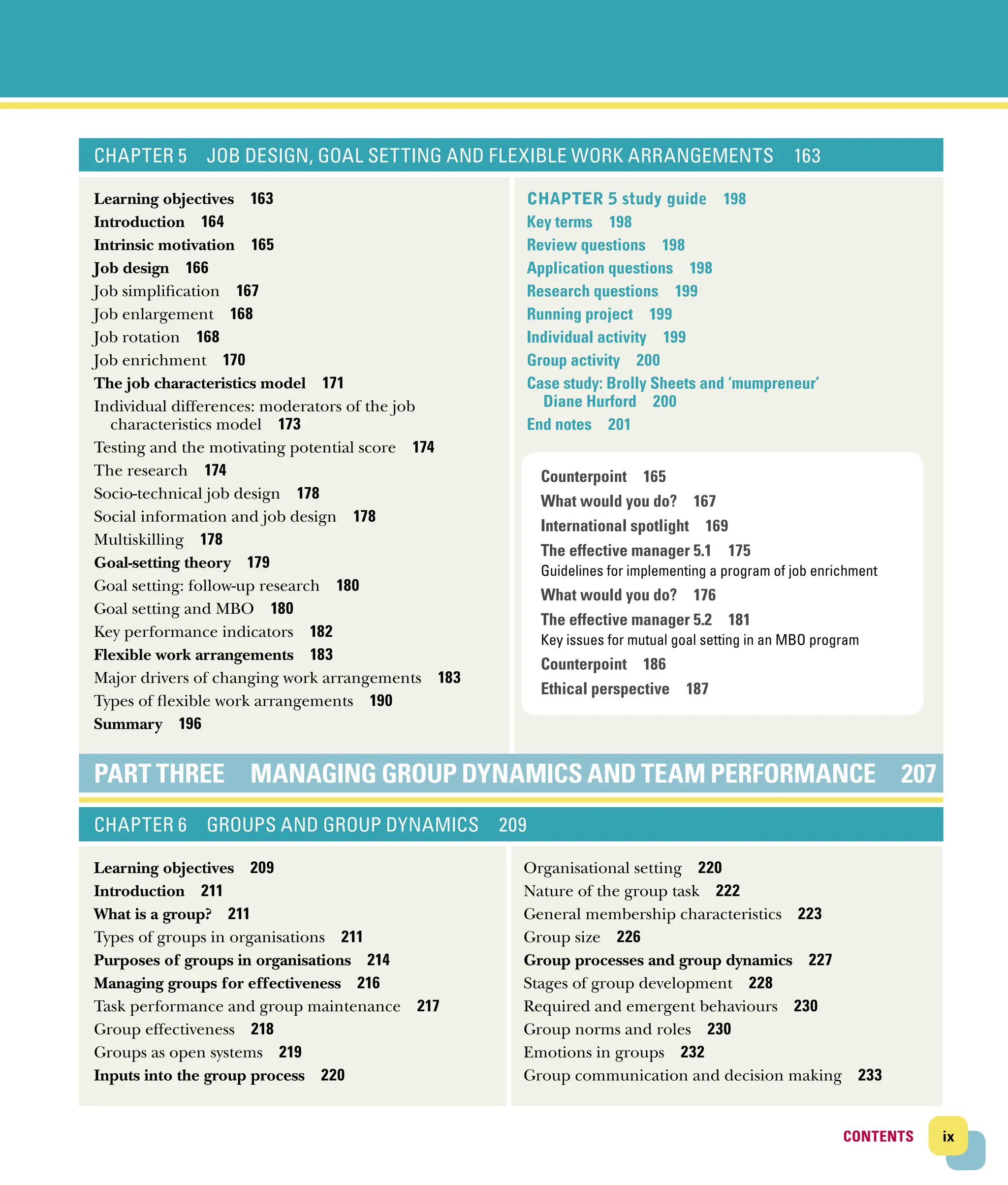
CHAPTER 5 JOB DESIGN, GOAL SETTING AND FLEXIBLE WORK ARRANGEMENTS 163
Learning objectives 163
Introduction 164
Intrinsic motivation 165
Job design 166
Job simplification 167
Job enlargement 168
Job rotation 168
Job enrichment 170
The job characteristics model 171
Individual differences: moderators of the job
­characteristics model 173
Testing and the motivating potential score 174
The research 174
Socio‐technical job design 178
Social information and job design 178
Multiskilling 178
Goal‐setting theory 179
Goal setting: follow‐up research 180
Goal setting and MBO 180
Key performance indicators 182
Flexible work arrangements 183
Major drivers of changing work arrangements 183
Types of flexible work arrangements 190
Summary 196
Chapter 5 study guide 198
Key terms 198
Review questions 198
Application questions 198
Research questions 199
Running project 199
Individual activity 199
Group activity 200
Case study: Brolly Sheets and ‘mumpreneur’
Diane Hurford 200
End notes 201
PART THREE MANAGING GROUP DYNAMICS AND TEAM ­
PERFORMANCE 207
CHAPTER 6 GROUPS AND GROUP DYNAMICS 209
Learning objectives 209
Introduction 211
What is a group? 211
Types of groups in organisations 211
Purposes of groups in organisations 214
Managing groups for effectiveness 216
Task performance and group maintenance 217
Group effectiveness 218
Groups as open systems 219
Inputs into the group process 220
Organisational setting 220
Nature of the group task 222
General membership characteristics 223
Group size 226
Group processes and group dynamics 227
Stages of group development 228
Required and emergent behaviours 230
Group norms and roles 230
Emotions in groups 232
Group communication and decision making 233
Counterpoint 165
What would you do? 167
International spotlight 169
The effective manager 5.1 175
Guidelines for implementing a program of job enrichment
What would you do? 176
The effective manager 5.2 181
Key issues for mutual goal setting in an MBO program
Counterpoint 186
Ethical perspective 187
x CONTENTS
CONTENTS
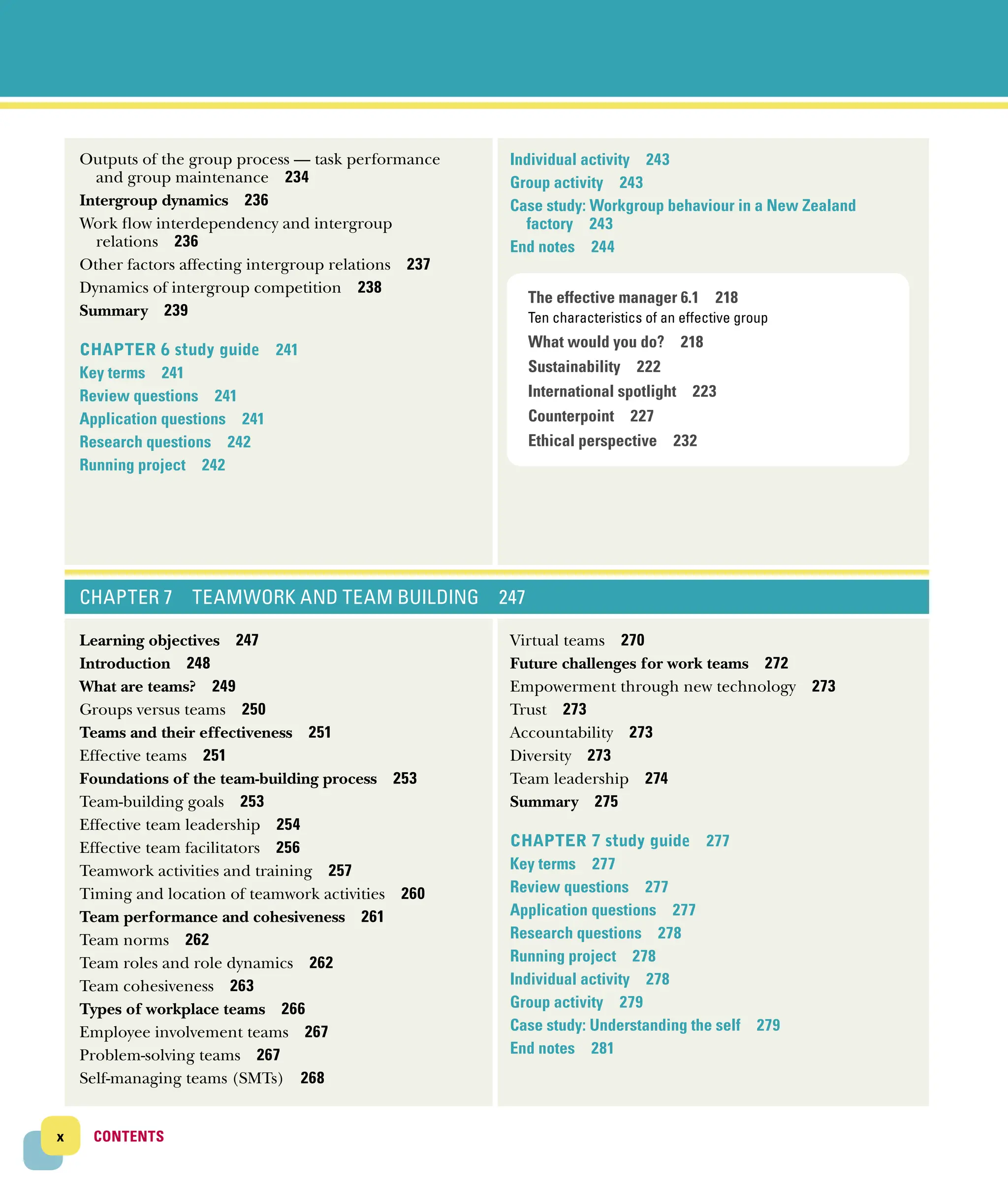
Outputs of the group process — task performance
and group maintenance 234
Intergroup dynamics 236
Work flow interdependency and intergroup
­relations 236
Other factors affecting intergroup relations 237
Dynamics of intergroup competition 238
Summary 239
Chapter 6 study guide 241
Key terms 241
Review questions 241
Application questions 241
Research questions 242
Running project 242
Individual activity 243
Group activity 243
Case study: Workgroup behaviour in a New Zealand
­factory 243
End notes 244
CHAPTER 7 TEAMWORK AND TEAM BUILDING 247
Learning objectives 247
Introduction 248
What are teams? 249
Groups versus teams 250
Teams and their effectiveness 251
Effective teams 251
Foundations of the team‐building process 253
Team‐building goals 253
Effective team leadership 254
Effective team facilitators 256
Teamwork activities and training 257
Timing and location of teamwork activities 260
Team performance and cohesiveness 261
Team norms 262
Team roles and role dynamics 262
Team cohesiveness 263
Types of workplace teams 266
Employee involvement teams 267
Problem‐solving teams 267
Self‐managing teams (SMTs) 268
Virtual teams 270
Future challenges for work teams 272
Empowerment through new technology 273
Trust 273
Accountability 273
Diversity 273
Team leadership 274
Summary 275
Chapter 7 study guide 277
Key terms 277
Review questions 277
Application questions 277
Research questions 278
Running project 278
Individual activity 278
Group activity 279
Case study: Understanding the self 279
End notes 281
The effective manager 6.1 218
Ten characteristics of an effective group
What would you do? 218
Sustainability 222
International spotlight 223
Counterpoint 227
Ethical perspective 232
xi
CONTENTS
CONTENTS
What would you do? 257
The effective manager 7.3 262
Seven steps for leaders to encourage positive team norms
Counterpoint 265
International spotlight 249
The effective manager 7.1 254
How to build a high-performing team
Ethical perspective 255
The effective manager 7.2 256
Ten rules for team leaders to create effective teams
Part Four 
MANAGING ORGANISATIONAL PROCESSES
AND ­
PERFORMANCE 283
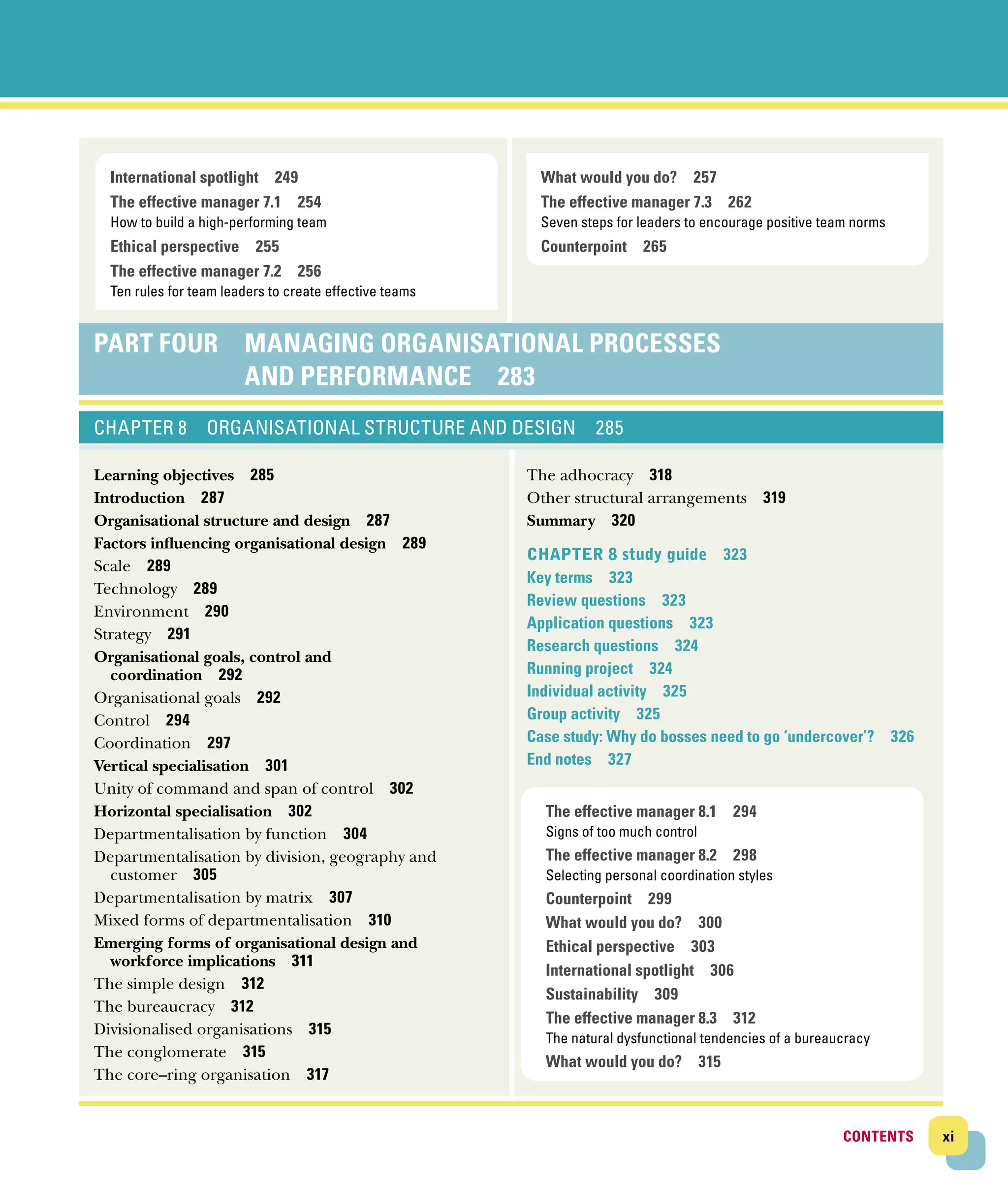
CHAPTER 8 ORGANISATIONAL STRUCTURE AND DESIGN 285
Learning objectives 285
Introduction 287
Organisational structure and design 287
Factors influencing organisational design 289
Scale 289
Technology 289
Environment 290
Strategy 291
Organisational goals, control and
coordination 292
Organisational goals 292
Control 294
Coordination 297
Vertical specialisation 301
Unity of command and span of control 302
Horizontal specialisation 302
Departmentalisation by function 304
Departmentalisation by division, geography and
­customer 305
Departmentalisation by matrix 307
Mixed forms of departmentalisation 310
Emerging forms of organisational design and
­workforce implications 311
The simple design 312
The bureaucracy 312
Divisionalised organisations 315
The conglomerate 315
The core–ring organisation 317
The adhocracy 318
Other structural arrangements 319
Summary 320
Chapter 8 study guide 323
Key terms 323
Review questions 323
Application questions 323
Research questions 324
Running project 324
Individual activity 325
Group activity 325
Case study: Why do bosses need to go ‘undercover’? 326
End notes 327
The effective manager 8.1 294
Signs of too much control
The effective manager 8.2 298
Selecting personal coordination styles
Counterpoint 299
What would you do? 300
Ethical perspective 303
International spotlight 306
Sustainability 309
The effective manager 8.3 312
The natural dysfunctional tendencies of a bureaucracy
What would you do? 315
xii CONTENTS
CONTENTS
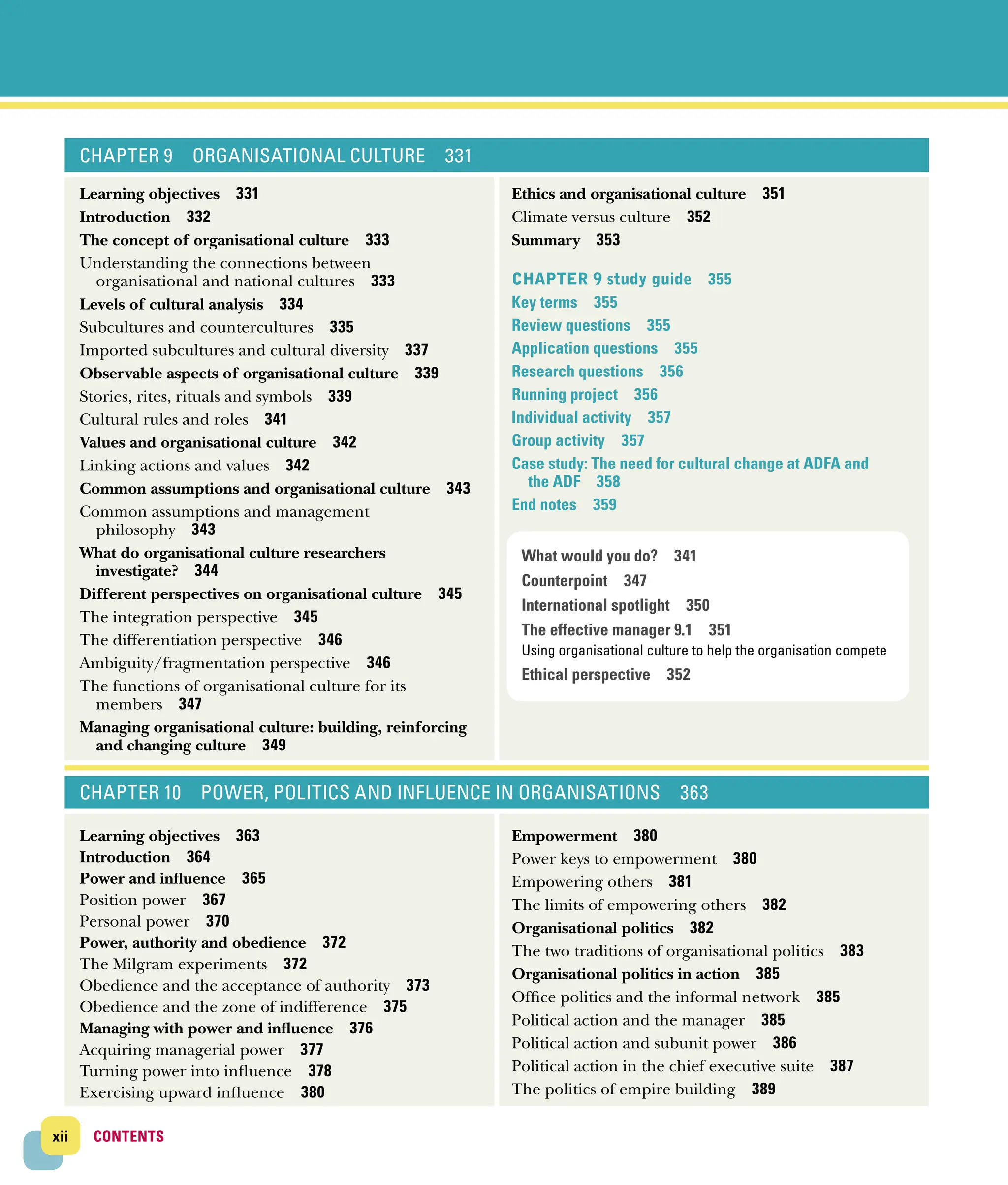
CHAPTER 9 ORGANISATIONAL CULTURE 331
Learning objectives 331
Introduction 332
The concept of organisational culture 333
Understanding the connections between
­
organisational and national cultures 333
Levels of cultural analysis 334
Subcultures and countercultures 335
Imported subcultures and cultural diversity 337
Observable aspects of organisational culture 339
Stories, rites, rituals and symbols 339
Cultural rules and roles 341
Values and organisational culture 342
Linking actions and values 342
Common assumptions and organisational culture 343
Common assumptions and management
­philosophy 343
What do organisational culture researchers
­investigate? 344
Different perspectives on organisational culture 345
The integration perspective 345
The differentiation perspective 346
Ambiguity/fragmentation perspective 346
The functions of organisational culture for its
­members 347
Managing organisational culture: building, reinforcing
and changing culture 349
Ethics and organisational culture 351
Climate versus culture 352
Summary 353
Chapter 9 study guide 355
Key terms 355
Review questions 355
Application questions 355
Research questions 356
Running project 356
Individual activity 357
Group activity 357
Case study: The need for cultural change at ADFA and
the ADF 358
End notes 359
CHAPTER 10 POWER, POLITICS AND INFLUENCE IN ORGANISATIONS 363
Learning objectives 363
Introduction 364
Power and influence 365
Position power 367
Personal power 370
Power, authority and obedience 372
The Milgram experiments 372
Obedience and the acceptance of authority 373
Obedience and the zone of indifference 375
Managing with power and influence 376
Acquiring managerial power 377
Turning power into influence 378
Exercising upward influence 380
Empowerment 380
Power keys to empowerment 380
Empowering others 381
The limits of empowering others 382
Organisational politics 382
The two traditions of organisational politics 383
Organisational politics in action 385
Office politics and the informal network 385
Political action and the manager 385
Political action and subunit power 386
Political action in the chief executive suite 387
The politics of empire building 389
What would you do? 341
Counterpoint 347
International spotlight 350
The effective manager 9.1 351
Using organisational culture to help the organisation compete
Ethical perspective 352
xiii
CONTENTS
CONTENTS
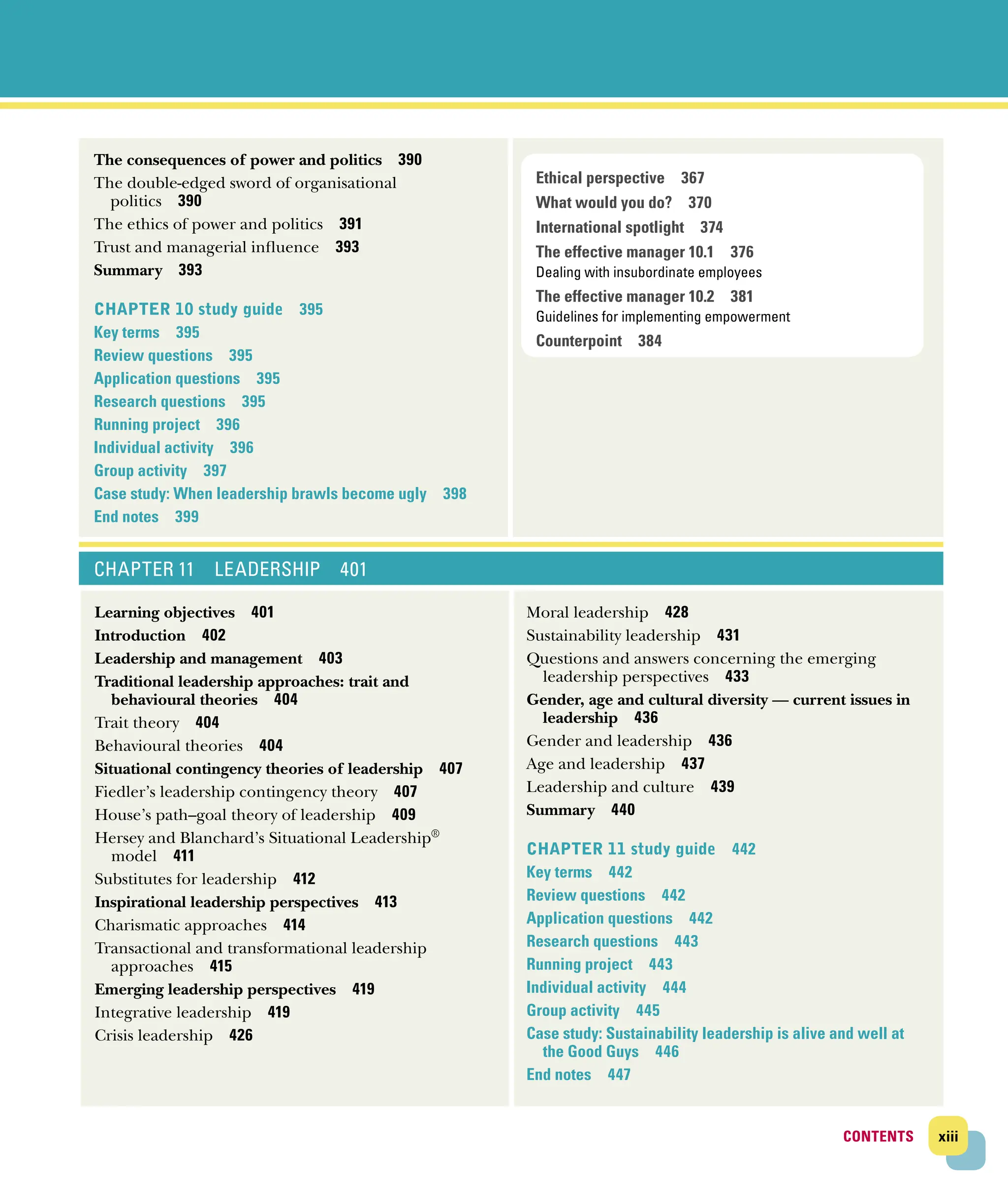
The consequences of power and politics 390
The double‐edged sword of organisational
­politics 390
The ethics of power and politics 391
Trust and managerial influence 393
Summary 393
Chapter 10 study guide 395
Key terms 395
Review questions 395
Application questions 395
Research questions 395
Running project 396
Individual activity 396
Group activity 397
Case study: When leadership brawls become ugly 398
End notes 399
CHAPTER 11 LEADERSHIP 401
Learning objectives 401
Introduction 402
Leadership and management 403
Traditional leadership approaches: trait and
­behavioural theories 404
Trait theory 404
Behavioural theories 404
Situational contingency theories of leadership 407
Fiedler’s leadership contingency theory 407
House’s path–goal theory of leadership 409
Hersey and Blanchard’s Situational Leadership®
model 411
Substitutes for leadership 412
Inspirational leadership perspectives 413
Charismatic approaches 414
Transactional and transformational leadership
approaches 415
Emerging leadership perspectives 419
Integrative leadership 419
Crisis leadership 426
Moral leadership 428
Sustainability leadership 431
Questions and answers concerning the emerging
leadership perspectives 433
Gender, age and cultural diversity — current issues in
leadership 436
Gender and leadership 436
Age and leadership 437
Leadership and culture 439
Summary 440
CHAPTER 11 study guide 442
Key terms 442
Review questions 442
Application questions 442
Research questions 443
Running project 443
Individual activity 444
Group activity 445
Case study: Sustainability leadership is alive and well at
the Good Guys 446
End notes 447
Ethical perspective 367
What would you do? 370
International spotlight 374
The effective manager 10.1 376
Dealing with insubordinate employees
The effective manager 10.2 381
Guidelines for implementing empowerment
Counterpoint 384
xiv CONTENTS
CONTENTS
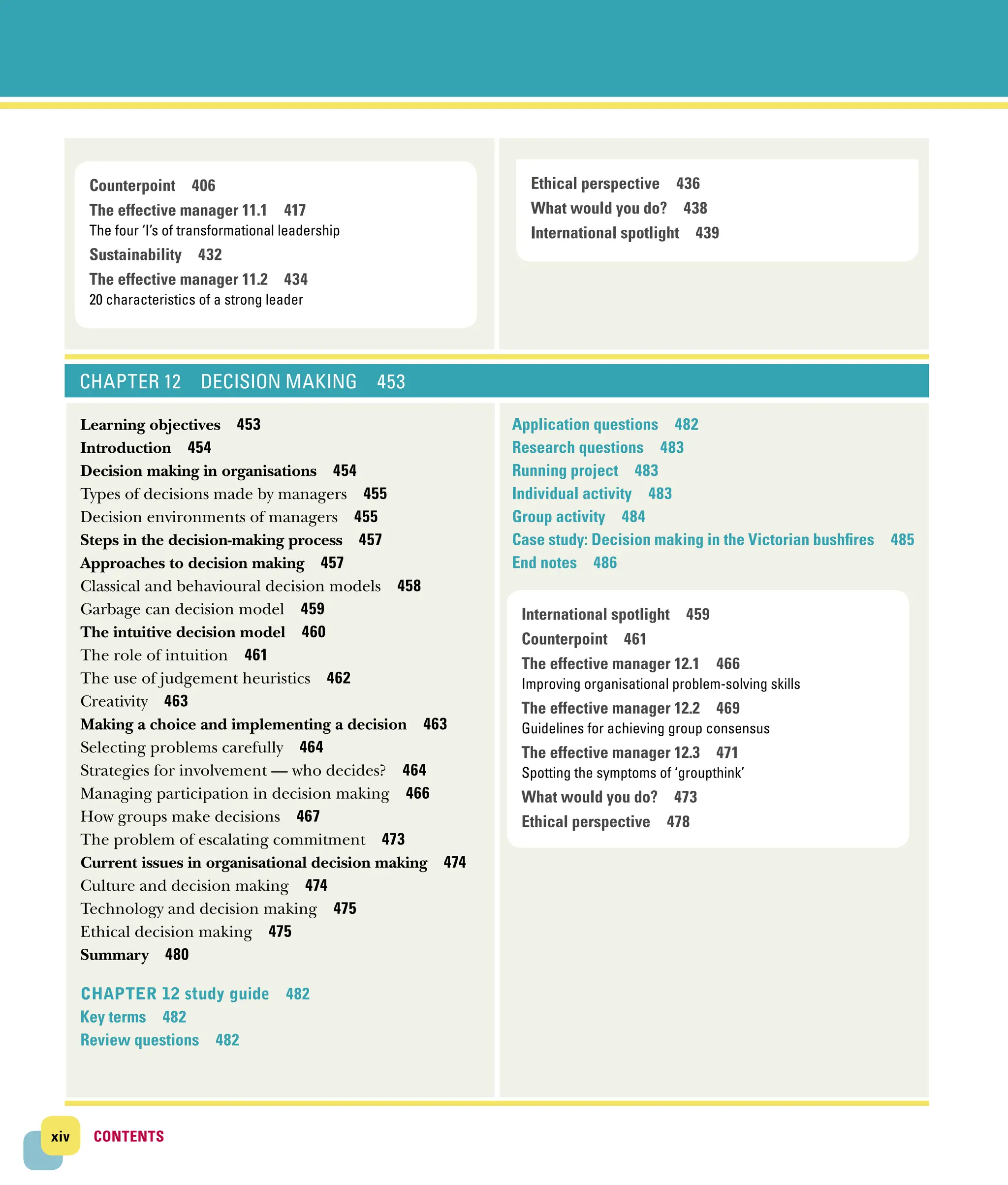
CHAPTER 12 DECISION MAKING 453
Learning objectives 453
Introduction 454
Decision making in organisations 454
Types of decisions made by managers 455
Decision environments of managers 455
Steps in the decision‐making process 457
Approaches to decision making 457
Classical and behavioural decision models 458
Garbage can decision model 459
The intuitive decision model 460
The role of intuition 461
The use of judgement heuristics 462
Creativity 463
Making a choice and implementing a decision 463
Selecting problems carefully 464
Strategies for involvement — who decides? 464
Managing participation in decision making 466
How groups make decisions 467
The problem of escalating commitment 473
Current issues in organisational decision ­
making 474
Culture and decision making 474
Technology and decision making 475
Ethical decision making 475
Summary 480
CHAPTER 12 study guide 482
Key terms 482
Review questions 482
Application questions 482
Research questions 483
Running project 483
Individual activity 483
Group activity 484
Case study: Decision making in the Victorian ­
bushfires 485
End notes 486
Counterpoint 406
The effective manager 11.1 417
The four ‘I’s of transformational leadership
Sustainability 432
The effective manager 11.2 434
20 characteristics of a strong leader
Ethical perspective 436
What would you do? 438
International spotlight 439
International spotlight 459
Counterpoint 461
The effective manager 12.1 466
Improving organisational problem-solving skills
The effective manager 12.2 469
Guidelines for achieving group consensus
The effective manager 12.3 471
Spotting the symptoms of ‘groupthink’
What would you do? 473
Ethical perspective 478
xv
CONTENTS
CONTENTS
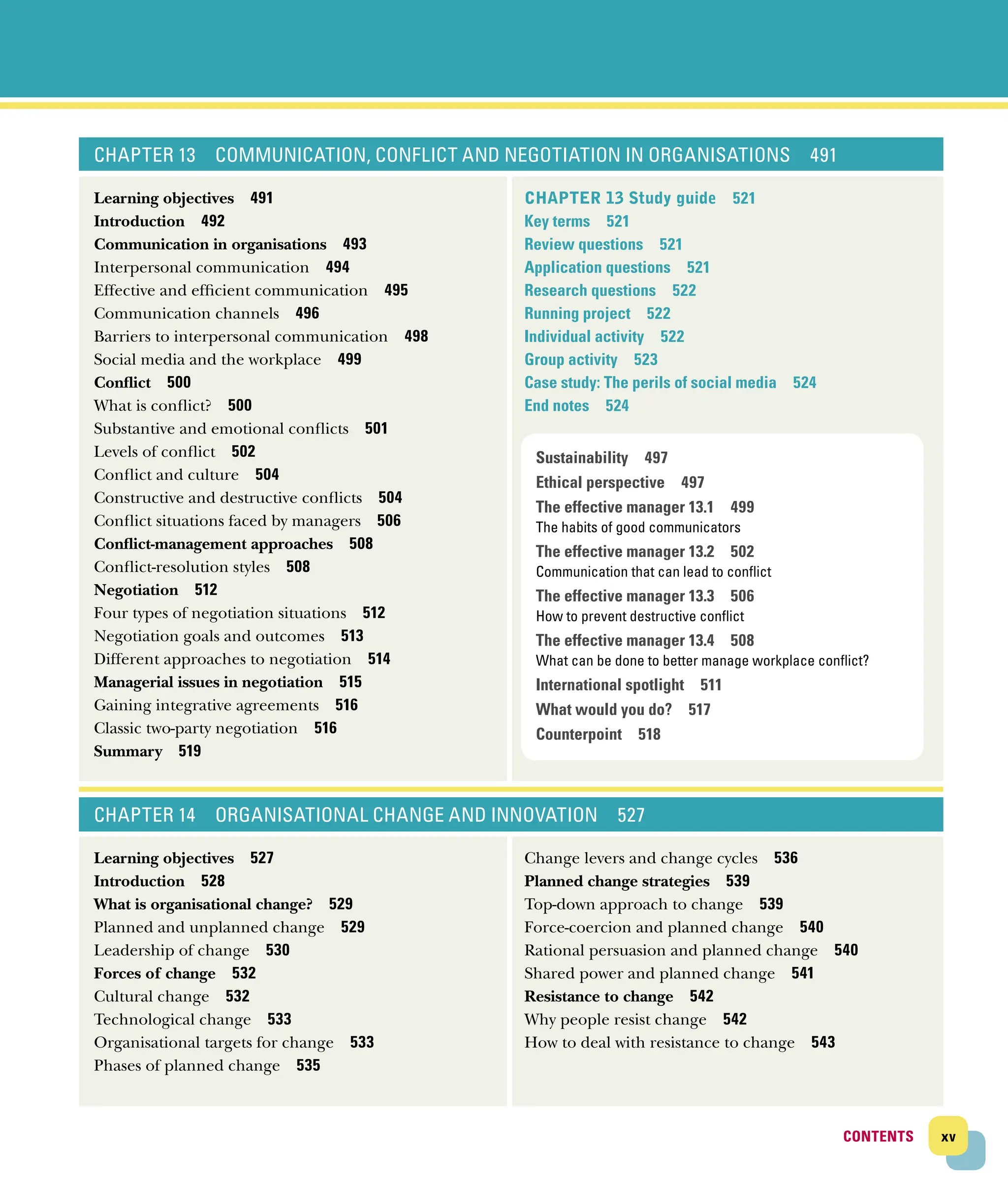
CHAPTER 13 COMMUNICATION, CONFLICT AND NEGOTIATION IN ORGANISATIONS 491
Learning objectives 491
Introduction 492
Communication in organisations 493
Interpersonal communication 494
Effective and efficient communication 495
Communication channels 496
Barriers to interpersonal communication 498
Social media and the workplace 499
Conflict 500
What is conflict? 500
Substantive and emotional conflicts 501
Levels of conflict 502
Conflict and culture 504
Constructive and destructive conflicts 504
Conflict situations faced by managers 506
Conflict‐management approaches 508
Conflict‐resolution styles 508
Negotiation 512
Four types of negotiation situations 512
Negotiation goals and outcomes 513
Different approaches to negotiation 514
Managerial issues in negotiation 515
Gaining integrative agreements 516
Classic two‐party negotiation 516
Summary 519
CHAPTER 13 Study guide 521
Key terms 521
Review questions 521
Application questions 521
Research questions 522
Running project 522
Individual activity 522
Group activity 523
Case study: The perils of social media 524
End notes 524
CHAPTER 14 ORGANISATIONAL CHANGE AND INNOVATION 527
Learning objectives 527
Introduction 528
What is organisational change? 529
Planned and unplanned change 529
Leadership of change 530
Forces of change 532
Cultural change 532
Technological change 533
Organisational targets for change 533
Phases of planned change 535
Change levers and change cycles 536
Planned change strategies 539
Top‐down approach to change 539
Force‐coercion and planned change 540
Rational persuasion and planned change 540
Shared power and planned change 541
Resistance to change 542
Why people resist change 542
How to deal with resistance to change 543
Sustainability 497
Ethical perspective 497
The effective manager 13.1 499
The habits of good communicators
The effective manager 13.2 502
Communication that can lead to conflict
The effective manager 13.3 506
How to prevent destructive conflict
The effective manager 13.4 508
What can be done to better manage workplace conflict?
International spotlight 511
What would you do? 517
Counterpoint 518
xvi CONTENTS
CONTENTS
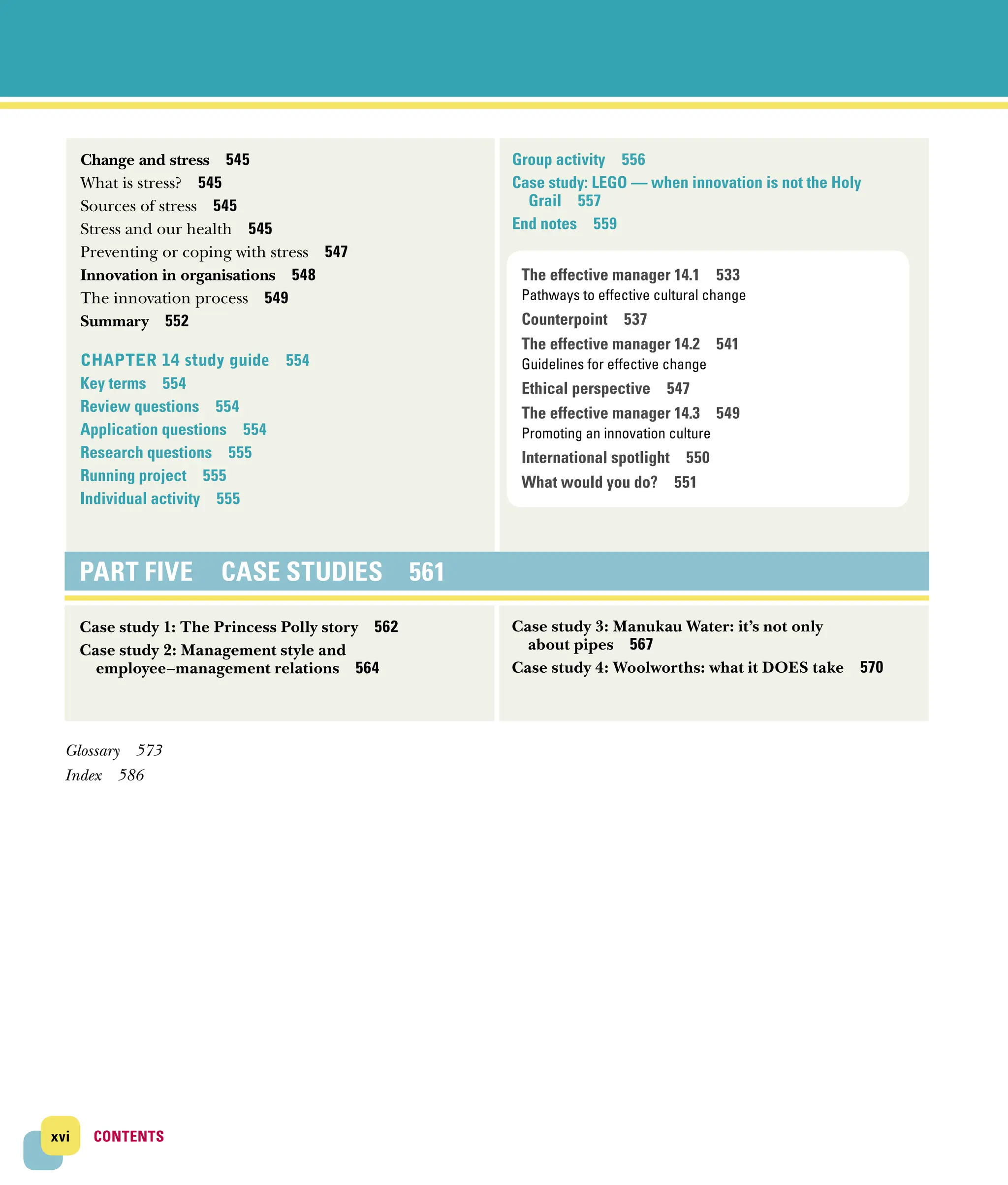
Change and stress 545
What is stress? 545
Sources of stress 545
Stress and our health 545
Preventing or coping with stress 547
Innovation in organisations 548
The innovation process 549
Summary 552
CHAPTER 14 study guide 554
Key terms 554
Review questions 554
Application questions 554
Research questions 555
Running project 555
Individual activity 555
Group activity 556
Case study: LEGO — when innovation is not the Holy
Grail 557
End notes 559
PART FIVE CASE STUDIES 561
Case study 1: The Princess Polly story 562
Case study 2: Management style and
employee–management relations 564
Case study 3: Manukau Water: it’s not only
about pipes 567
Case study 4: Woolworths: what it does take 570
Glossary 573
Index 586
The effective manager 14.1 533
Pathways to effective cultural change
Counterpoint 537
The effective manager 14.2 541
Guidelines for effective change
Ethical perspective 547
The effective manager 14.3 549
Promoting an innovation culture
International spotlight 550
What would you do? 551
xvii
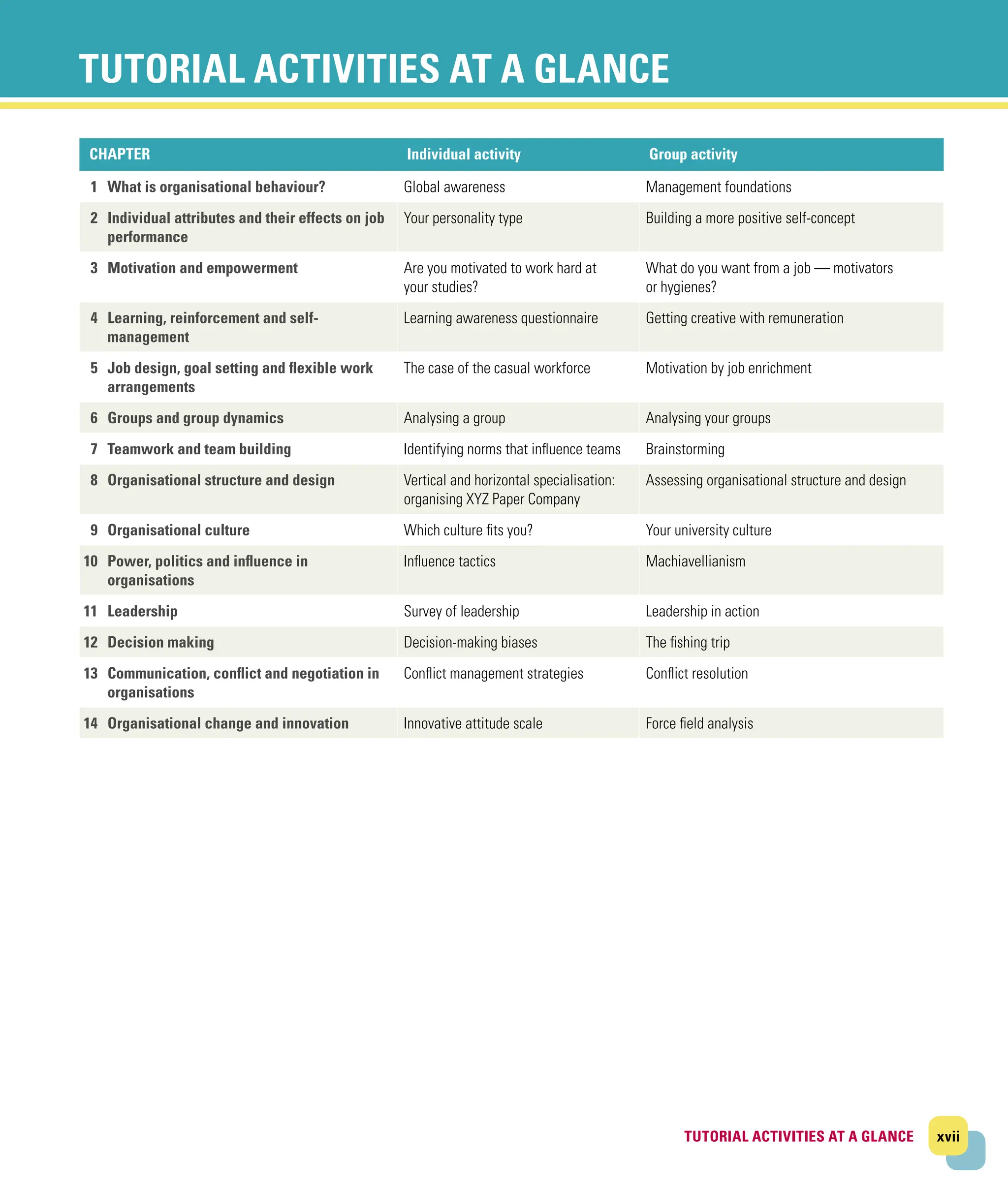
TUTORIAL ACTIVITIES AT A GLANCE
CHAPTER Individual activity Group activity
1 What is organisational behaviour? Global awareness Management foundations
2 Individual attributes and their effects on job
performance
Your personality type Building a more positive self‐concept
3 Motivation and empowerment Are you motivated to work hard at
your studies?
What do you want from a job — motivators
or hygienes?
4 Learning, reinforcement and self‐­
management
Learning awareness questionnaire Getting creative with remuneration
5 Job design, goal setting and flexible work
arrangements
The case of the casual workforce Motivation by job enrichment
6 Groups and group dynamics Analysing a group Analysing your groups
7 Teamwork and team building Identifying norms that influence teams Brainstorming
8 Organisational structure and design Vertical and horizontal specialisation:
organising XYZ Paper Company
Assessing organisational structure and design
9 Organisational culture Which culture fits you? Your university culture
10 Power, politics and influence in
­organisations
Influence tactics Machiavellianism
11 Leadership Survey of leadership Leadership in action
12 Decision making Decision‐making biases The fishing trip
13 Communication, conflict and negotiation in
organisations
Conflict management strategies Conflict resolution
14 Organisational change and innovation Innovative attitude scale Force field analysis
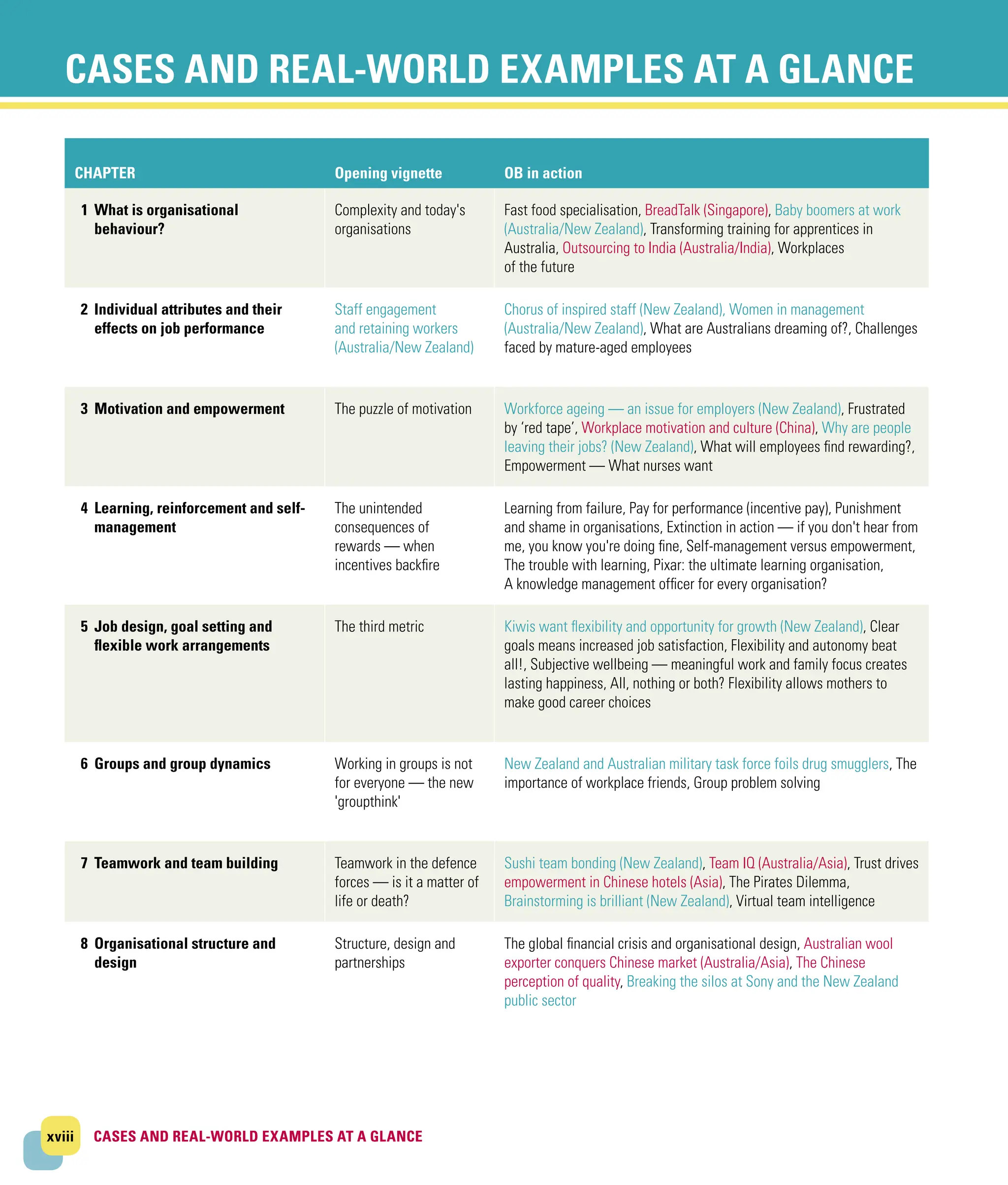
xviii CASES AND REAL-WORLD EXAMPLES AT A GLANCE
CASES AND REAL-WORLD EXAMPLES AT A GLANCE
CHAPTER Opening vignette OB in action
1 What is organisational
­behaviour?
Complexity and today's
organisations
Fast food specialisation, BreadTalk (Singapore), Baby boomers at work
(Australia/New Zealand), Transforming training for apprentices in
Australia, Outsourcing to India (Australia/India), Workplaces
of the future
2 Individual attributes and their
effects on job performance
Staff engagement
and retaining workers
­(Australia/New Zealand)
Chorus of inspired staff (New Zealand), Women in management
(Australia/New Zealand), What are Australians dreaming of?, Challenges
faced by mature‐aged employees
3 Motivation and empowerment The puzzle of motivation Workforce ageing — an issue for employers (New Zealand), Frustrated
by ‘red tape’, Workplace motivation and culture (China), Why are people
leaving their jobs? (New Zealand), What will employees find rewarding?,
Empowerment — What nurses want
4 Learning, reinforcement and self‐
management
The unintended
­consequences of
rewards — when
­incentives backfire
Learning from failure, Pay for performance (incentive pay), Punishment
and shame in organisations, Extinction in action — if you don't hear from
me, you know you're doing fine, Self‐management versus empowerment,
The trouble with learning, Pixar: the ultimate learning organisation,
A knowledge management officer for every organisation?
5 Job design, goal setting and
flexible work arrangements
The third metric Kiwis want flexibility and opportunity for growth (New Zealand), Clear
goals means increased job satisfaction, Flexibility and autonomy beat
all!, Subjective wellbeing — meaningful work and family focus creates
lasting happiness, All, nothing or both? Flexibility allows mothers to
make good career choices
6 Groups and group dynamics Working in groups is not
for everyone — the new
'groupthink'
New Zealand and Australian military task force foils drug smugglers, The
importance of workplace friends, Group problem solving
7 Teamwork and team building Teamwork in the defence
forces — is it a matter of
life or death?
Sushi team bonding (New Zealand), Team IQ (Australia/Asia), Trust drives
empowerment in Chinese hotels (Asia), The Pirates Dilemma,
Brainstorming is brilliant (New Zealand), Virtual team intelligence
8 Organisational structure and
design
Structure, design and
partnerships
The global financial crisis and organisational design, Australian wool
exporter conquers Chinese market (Australia/Asia), The Chinese
perception of quality, Breaking the silos at Sony and the New Zealand
public sector
CASES AND REAL-WORLD EXAMPLES AT A GLANCE
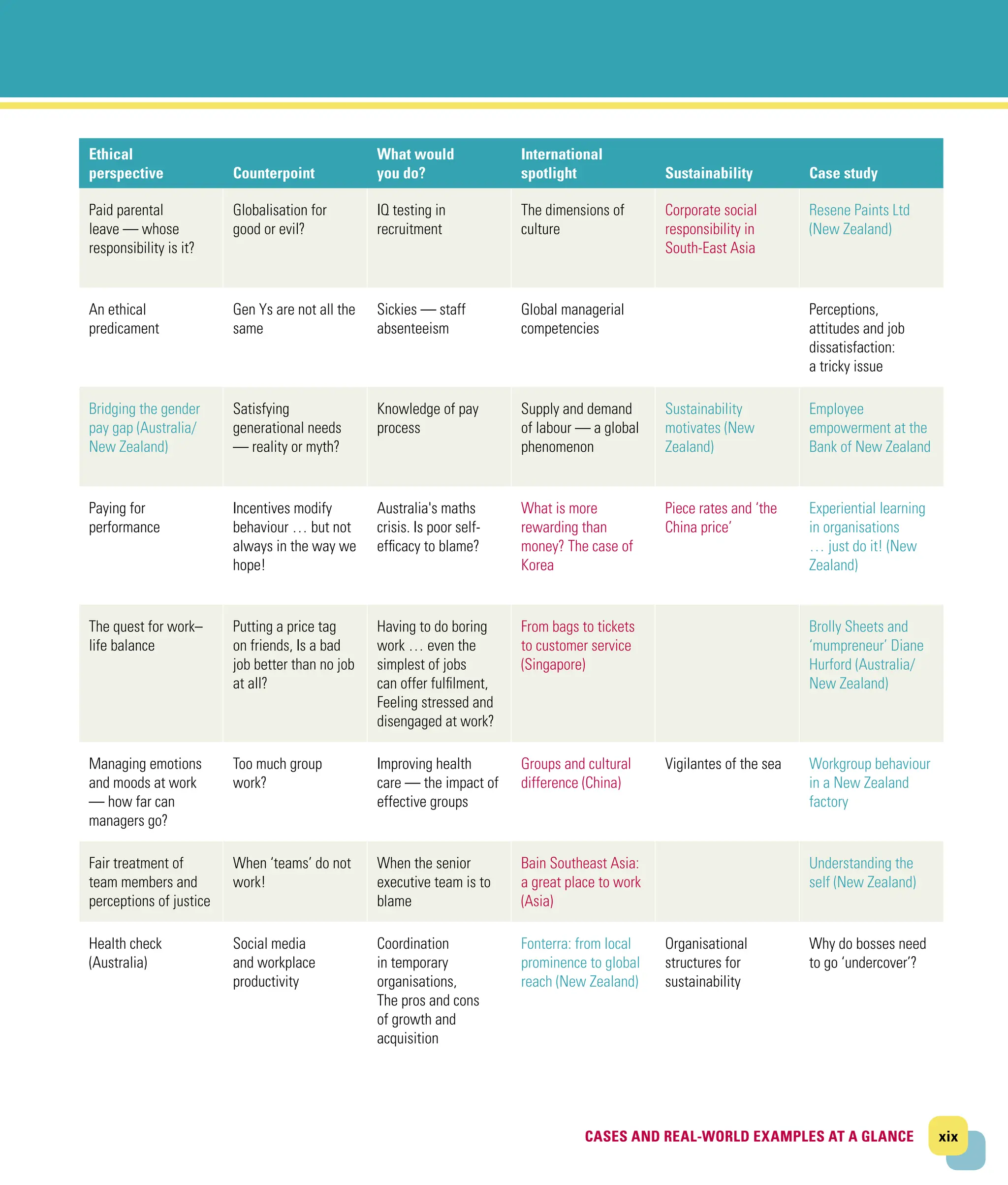
xix
CASES AND REAL-WORLD EXAMPLES AT A GLANCE
Ethical
­perspective Counterpoint
What would
you do?
International
spotlight Sustainability Case study
Paid parental
leave — whose
responsibility is it?
Globalisation for
good or evil?
IQ testing in
recruitment
The dimensions of
culture
Corporate social
responsibility in
South‐East Asia
Resene Paints Ltd
(New Zealand)
An ethical
predicament
Gen Ys are not all the
same
Sickies — staff
absenteeism
Global managerial
competencies
Perceptions,
attitudes and job
dissatisfaction:
a tricky issue
Bridging the gender
pay gap (Australia/
New Zealand)
Satisfying
generational needs
— reality or myth?
Knowledge of pay
process
Supply and demand
of labour — a global
phenomenon
Sustainability
motivates (New
Zealand)
Employee
empowerment at the
Bank of New Zealand
Paying for
performance
Incentives modify
behaviour … but not
always in the way we
hope!
Australia's maths
crisis. Is poor self‐
efficacy to blame?
What is more
rewarding than
money? The case of
Korea
Piece rates and ‘the
China price’
Experiential learning
in organisations
… just do it! (New
Zealand)
The quest for work–
life balance
Putting a price tag
on friends, Is a bad
job better than no job
at all?
Having to do boring
work … even the
simplest of jobs
can offer fulfilment,
Feeling stressed and
disengaged at work?
From bags to tickets
to customer service
(Singapore)
Brolly Sheets and
‘mumpreneur’ Diane
Hurford (Australia/
New Zealand)
Managing emotions
and moods at work
— how far can
managers go?
Too much group
work?
Improving health
care — the impact of
effective groups
Groups and cultural
difference (China)
Vigilantes of the sea Workgroup behaviour
in a New Zealand
factory
Fair treatment of
team members and
perceptions of justice
When ‘teams’ do not
work!
When the senior
executive team is to
blame
Bain Southeast Asia:
a great place to work
(Asia)
Understanding the
self (New Zealand)
Health check
(Australia)
Social media
and workplace
productivity
Coordination
in temporary
organisations,
The pros and cons
of growth and
acquisition
Fonterra: from local
prominence to global
reach (New Zealand)
Organisational
structures for
sustainability
Why do bosses need
to go ‘undercover’?
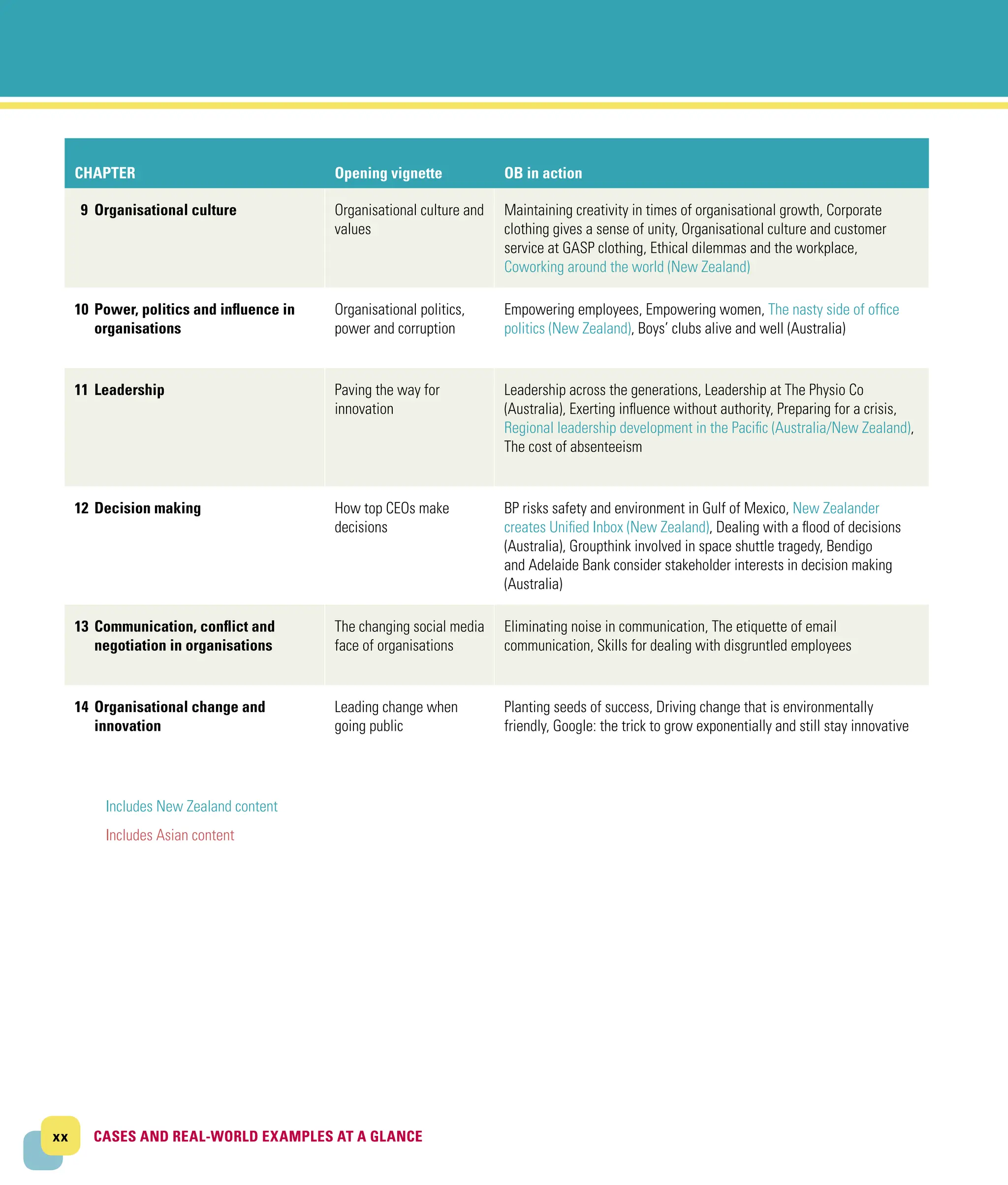
xx CASES AND REAL-WORLD EXAMPLES AT A GLANCE
CASES AND REAL-WORLD EXAMPLES AT A GLANCE
CHAPTER Opening vignette OB in action
9 Organisational culture Organisational culture and
values
Maintaining creativity in times of organisational growth, Corporate
clothing gives a sense of unity, Organisational culture and customer
service at GASP clothing, Ethical dilemmas and the workplace,
Coworking around the world (New Zealand)
10 Power, politics and influence in
organisations
Organisational politics,
power and corruption
Empowering employees, Empowering women, The nasty side of office
politics (New Zealand), Boys’ clubs alive and well (Australia)
11 Leadership Paving the way for
innovation
Leadership across the generations, Leadership at The Physio Co
(Australia), Exerting influence without authority, Preparing for a crisis,
Regional leadership development in the Pacific (Australia/New Zealand),
The cost of absenteeism
12 Decision making How top CEOs make
decisions
BP risks safety and environment in Gulf of Mexico, New Zealander
creates Unified Inbox (New Zealand), Dealing with a flood of decisions
(Australia), Groupthink involved in space shuttle tragedy, Bendigo
and Adelaide Bank consider stakeholder interests in decision making
(Australia)
13 Communication, conflict and
negotiation in organisations
The changing social media
face of organisations
Eliminating noise in communication, The etiquette of email
communication, Skills for dealing with disgruntled employees
14 Organisational change and
innovation
Leading change when
going public
Planting seeds of success, Driving change that is environmentally
friendly, Google: the trick to grow exponentially and still stay innovative
Includes New Zealand content
Includes Asian content
xxi
CASES AND REAL-WORLD EXAMPLES AT A GLANCE
Ethical
­perspective Counterpoint
What would
you do?
International
spotlight Sustainability Case study
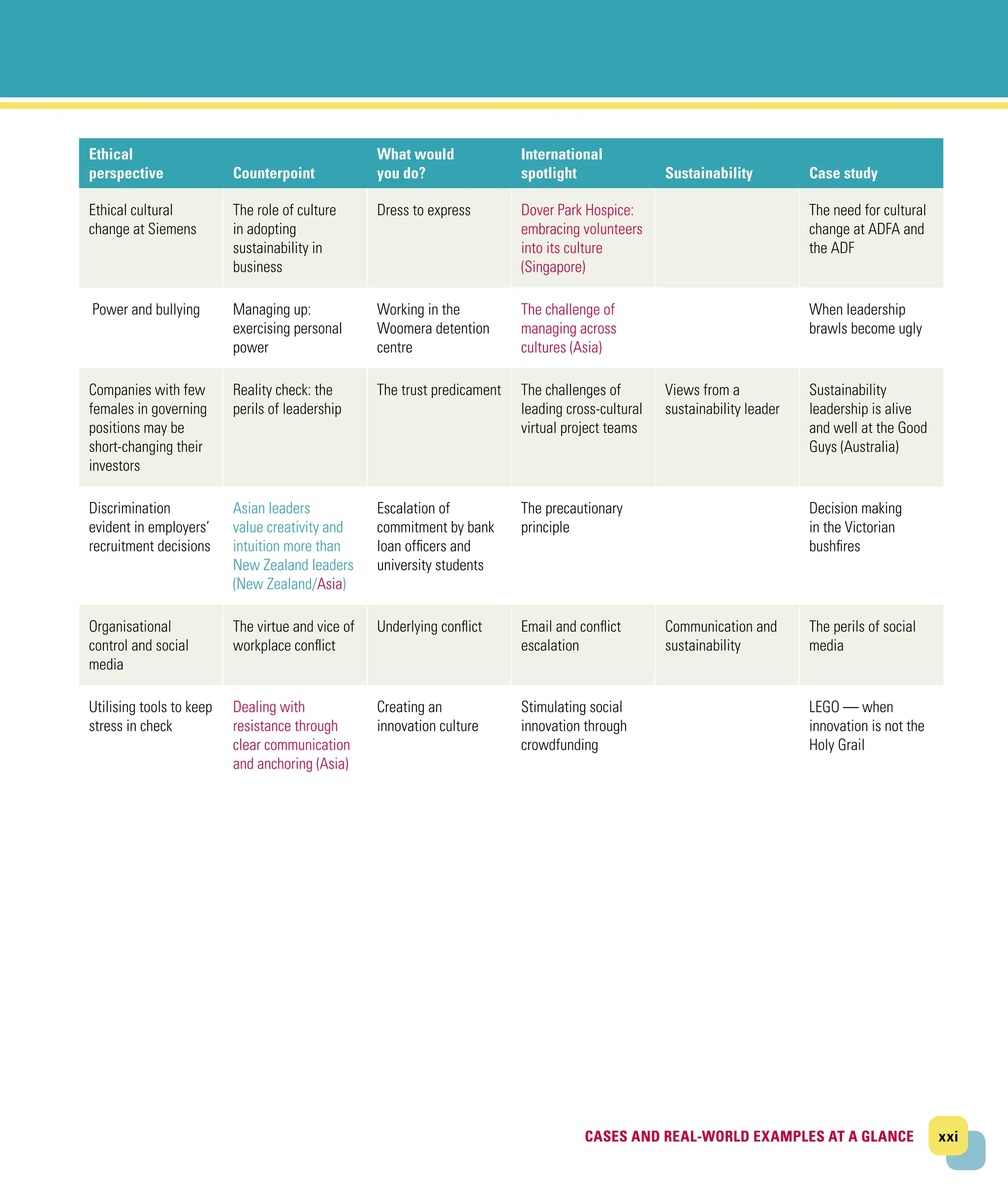
Ethical cultural
change at Siemens
The role of culture
in adopting
sustainability in
business
Dress to express Dover Park Hospice:
embracing volunteers
into its culture
(Singapore)
The need for cultural
change at ADFA and
the ADF
Power and bullying Managing up:
exercising personal
power
Working in the
Woomera detention
centre
The challenge of
managing across
cultures (Asia)
When leadership
brawls become ugly
Companies with few
females in governing
positions may be
short-changing their
investors
Reality check: the
perils of leadership
The trust predicament The challenges of
leading cross‐cultural
virtual project teams
Views from a
sustainability leader
Sustainability
leadership is alive
and well at the Good
Guys (Australia)
Discrimination
evident in employers’
recruitment decisions
Asian leaders
value creativity and
intuition more than
New Zealand leaders
(New Zealand/Asia)
Escalation of
commitment by bank
loan officers and
university students
The precautionary
principle
Decision making
in the Victorian
bushfires
Organisational
control and social
media
The virtue and vice of
workplace conflict
Underlying conflict Email and conflict
escalation
Communication and
sustainability
The perils of social
media
Utilising tools to keep
stress in check
Dealing with
resistance through
clear communication
and anchoring (Asia)
Creating an
innovation culture
Stimulating social
innovation through
crowdfunding
LEGO — when
innovation is not the
Holy Grail
xxii HOW TO USE THIS BOOK
HOW TO USE THIS BOOK
Organisational Behaviour: Core Concepts and Applications, 4th Australasian edition, has been
designed with you, the student, in mind. We aim to provide you with a tool that best com-
municates the subject matter and facilitates learning. The following elements have been
developed to assist you.
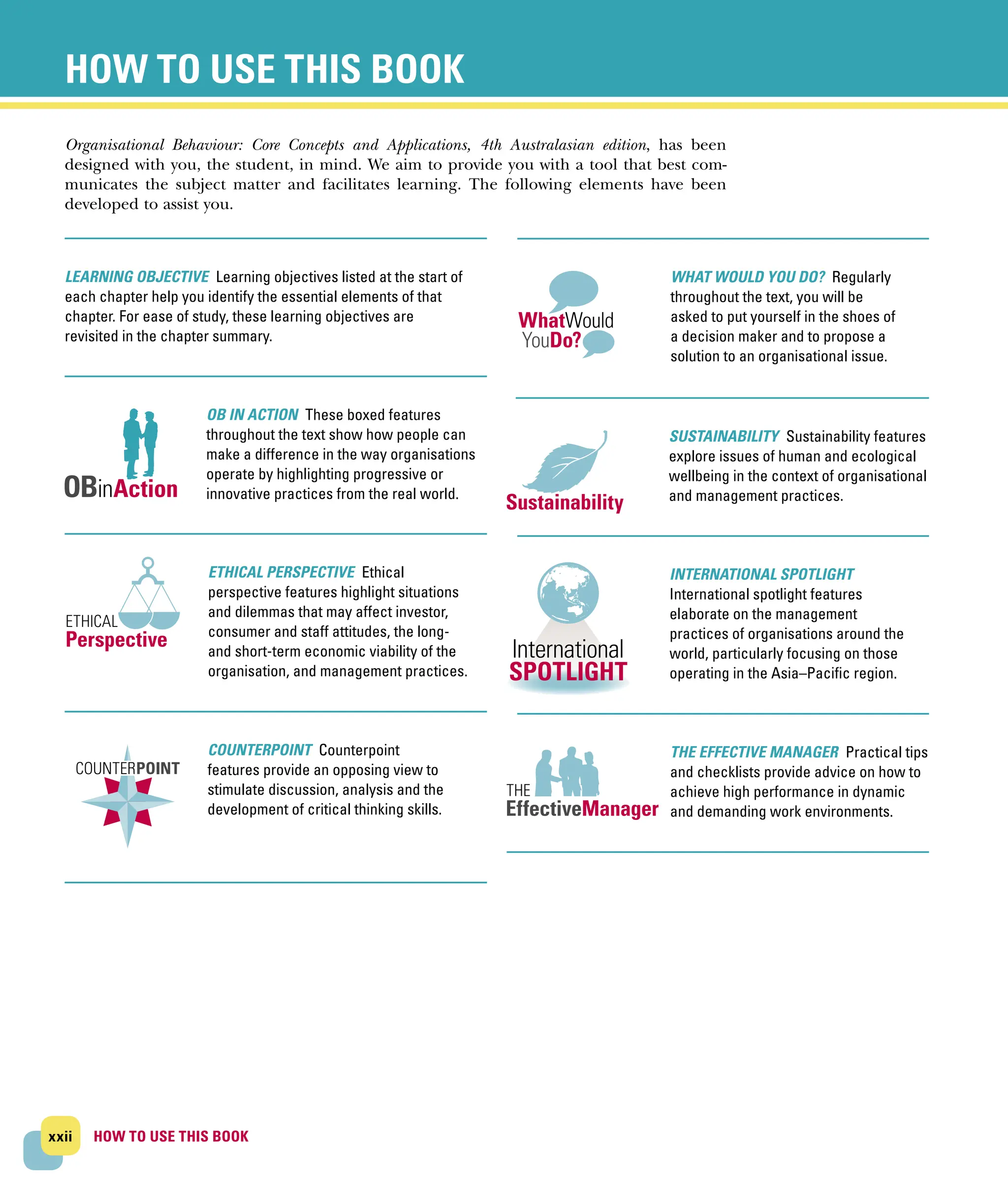
LEARNING OBJECTIVE Learning objectives listed at the start of
each chapter help you identify the essential elements of that
chapter. For ease of study, these learning objectives are
revisited in the chapter summary.
COUNTERPOINT
OB IN ACTION These boxed features
throughout the text show how people can
make a difference in the way organisations
operate by highlighting progressive or
innovative practices from the real world.
ETHICAL PERSPECTIVE Ethical
perspective features highlight situations
and dilemmas that may affect investor,
consumer and staff attitudes, the long‐
and short‐term economic viability of the
organisation, and management practices.
COUNTERPOINT Counterpoint
features provide an opposing view to
stimulate discussion, analysis and the
development of critical thinking skills.
WHAT WOULD YOU DO? Regularly
throughout the text, you will be
asked to put yourself in the shoes of
a decision maker and to propose a
solution to an organisational issue.
SUSTAINABILITY Sustainability features
explore issues of human and ecological
wellbeing in the context of organisational
and management practices.
INTERNATIONAL SPOTLIGHT
International spotlight features
elaborate on the management
practices of organisations around the
world, particularly focusing on those
operating in the Asia–Pacific region.
THE EFFECTIVE MANAGER Practical tips
and checklists provide advice on how to
achieve high performance in dynamic
and demanding work environments.
xxiii
HOW TO USE THIS BOOK
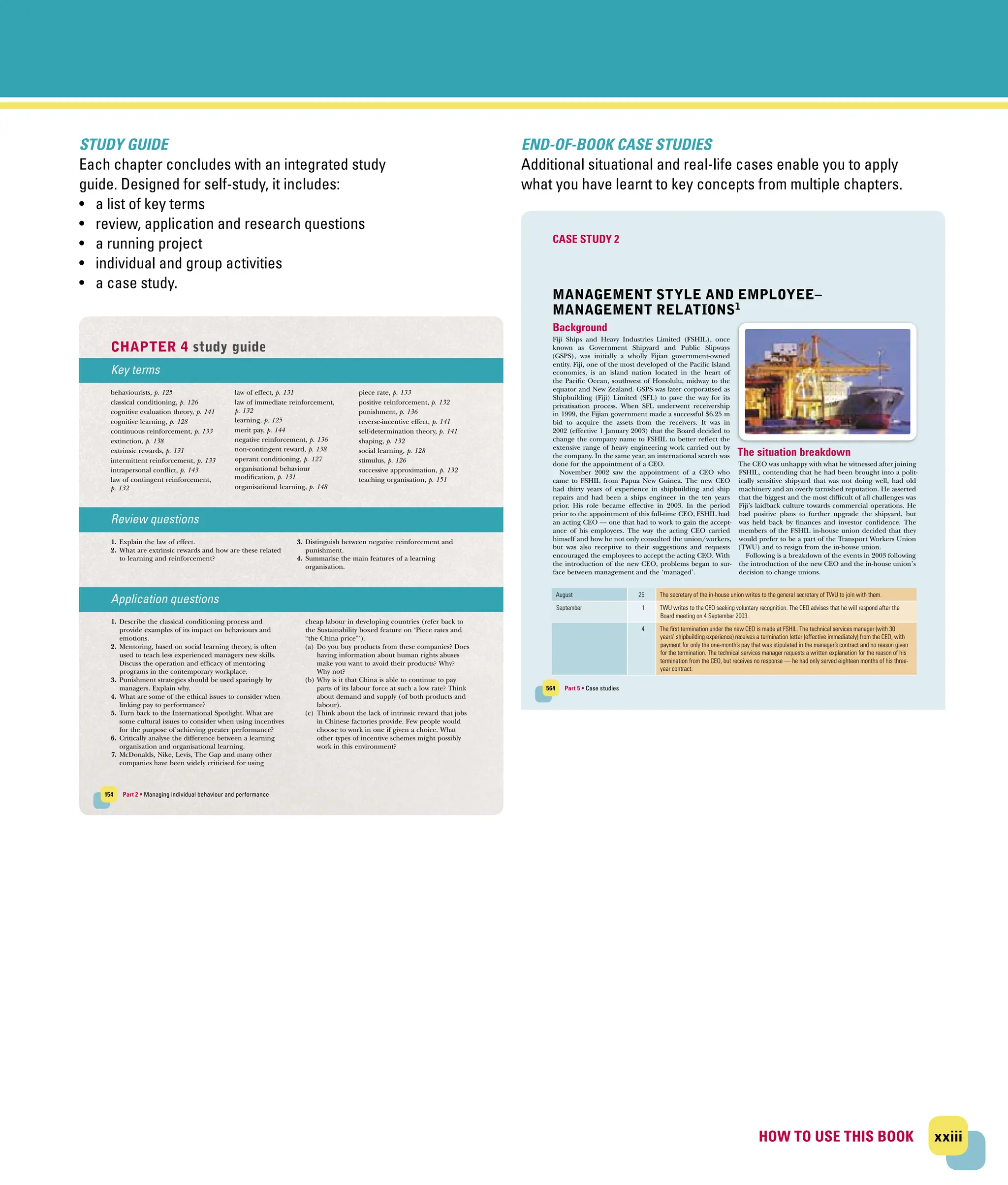
STUDY GUIDE
Each chapter concludes with an integrated study
guide. Designed for self‐study, it includes:
• a list of key terms
• review, application and research questions
• a running project
• individual and group activities
• a case study.
154 Part 2 • Managing individual behaviour and performance
Key terms
behaviourists, p. 125
classical conditioning, p. 126
cognitive evaluation theory, p. 141
cognitive learning, p. 128
continuous reinforcement, p. 133
extinction, p. 138
extrinsic rewards, p. 131
intermittent reinforcement, p. 133
intrapersonal conflict, p. 143
law of contingent reinforcement,
p. 132
law of effect, p. 131
law of immediate reinforcement,
p. 132
learning, p. 125
merit pay, p. 144
negative reinforcement, p. 136
non-contingent reward, p. 138
operant conditioning, p. 127
organisational behaviour
modification, p. 131
organisational learning, p. 148
piece rate, p. 133
positive reinforcement, p. 132
punishment, p. 136
reverse-incentive effect, p. 141
self-determination theory, p. 141
shaping, p. 132
social learning, p. 128
stimulus, p. 126
successive approximation, p. 132
teaching organisation, p. 151
Review questions
1. Explain the law of effect.
2. What are extrinsic rewards and how are these related
to learning and reinforcement?
3. Distinguish between negative reinforcement and
punishment.
4. Summarise the main features of a learning
organisation.
Application questions
1. Describe the classical conditioning process and
provide examples of its impact on behaviours and
emotions.
2. Mentoring, based on social learning theory, is often
used to teach less experienced managers new skills.
Discuss the operation and efficacy of mentoring
programs in the contemporary workplace.
3. Punishment strategies should be used sparingly by
managers. Explain why.
4. What are some of the ethical issues to consider when
linking pay to performance?
5. Turn back to the International Spotlight. What are
some cultural issues to consider when using incentives
for the purpose of achieving greater performance?
6. Critically analyse the difference between a learning
organisation and organisational learning.
7. McDonalds, Nike, Levis, The Gap and many other
companies have been widely criticised for using
cheap labour in developing countries (refer back to
the Sustainability boxed feature on ‘Piece rates and
“the China price”’).
(a) Do you buy products from these companies? Does
having information about human rights abuses
make you want to avoid their products? Why?
Why not?
(b) Why is it that China is able to continue to pay
parts of its labour force at such a low rate? Think
about demand and supply (of both products and
labour).
(c) Think about the lack of intrinsic reward that jobs
in Chinese factories provide. Few people would
choose to work in one if given a choice. What
other types of incentive schemes might possibly
work in this environment?
CHAPTER 4 study guide
F/HDUQLQJ5HLQIRUFHPHQW$QG6HOI0DQDJHPHQWLQGG 30
END‐OF‐BOOK CASE STUDIES
Additional situational and real‐life cases enable you to apply
what you have learnt to key concepts from multiple chapters.
564 Part 5 • Case studies
MANAGEMENT STYLE AND EMPLOYEE–
MANAGEMENT RELATIONS1
Background
Fiji Ships and Heavy Industries Limited (FSHIL), once
known as Government Shipyard and Public Slipways
(GSPS), was initially a wholly Fijian government‐owned
entity. Fiji, one of the most developed of the Pacific Island
economies, is an island nation located in the heart of
the Pacific Ocean, southwest of Honolulu, midway to the
equator and New Zealand. GSPS was later corporatised as
Shipbuilding (Fiji) Limited (SFL) to pave the way for its
privatisation process. When SFL underwent receivership
in 1999, the Fijian government made a successful $6.25 m
bid to acquire the assets from the receivers. It was in
2002 (effective 1 January 2003) that the Board decided to
change the company name to FSHIL to better reflect the
extensive range of heavy engineering work carried out by
the company. In the same year, an international search was
done for the appointment of a CEO.
November 2002 saw the appointment of a CEO who
came to FSHIL from Papua New Guinea. The new CEO
had thirty years of experience in shipbuilding and ship
repairs and had been a ships engineer in the ten years
prior. His role became effective in 2003. In the period
prior to the appointment of this full‐time CEO, FSHIL had
an acting CEO — one that had to work to gain the accept-
ance of his employees. The way the acting CEO carried
himself and how he not only consulted the union/workers,
but was also receptive to their suggestions and requests
encouraged the employees to accept the acting CEO. With
the introduction of the new CEO, problems began to sur-
face between management and the ‘managed’.
The situation breakdown
The CEO was unhappy with what he witnessed after joining
FSHIL, contending that he had been brought into a polit-
ically sensitive shipyard that was not doing well, had old
machinery and an overly tarnished reputation. He asserted
that the biggest and the most difficult of all challenges was
Fiji’s laidback culture towards commercial operations. He
had positive plans to further upgrade the shipyard, but
was held back by finances and investor confidence. The
members of the FSHIL in‐house union decided that they
would prefer to be a part of the Transport Workers Union
(TWU) and to resign from the in‐house union.
Following is a breakdown of the events in 2003 following
the introduction of the new CEO and the in‐house union’s
decision to change unions.
CASE STUDY 2
August 25 The secretary of the in‐house union writes to the general secretary of TWU to join with them.
September 1 TWU writes to the CEO seeking voluntary recognition. The CEO advises that he will respond after the
Board meeting on 4 September 2003.
4 The first termination under the new CEO is made at FSHIL. The technical services manager (with 30
years’ shipbuilding experience) receives a termination letter (effective immediately) from the CEO, with
payment for only the one‐month’s pay that was stipulated in the manager’s contract and no reason given
for the termination. The technical services manager requests a written explanation for the reason of his
termination from the CEO, but receives no response — he had only served eighteen months of his three‐
year contract.
%0DVH6WXGLHVLQGG $0
Other documents randomly have
different content
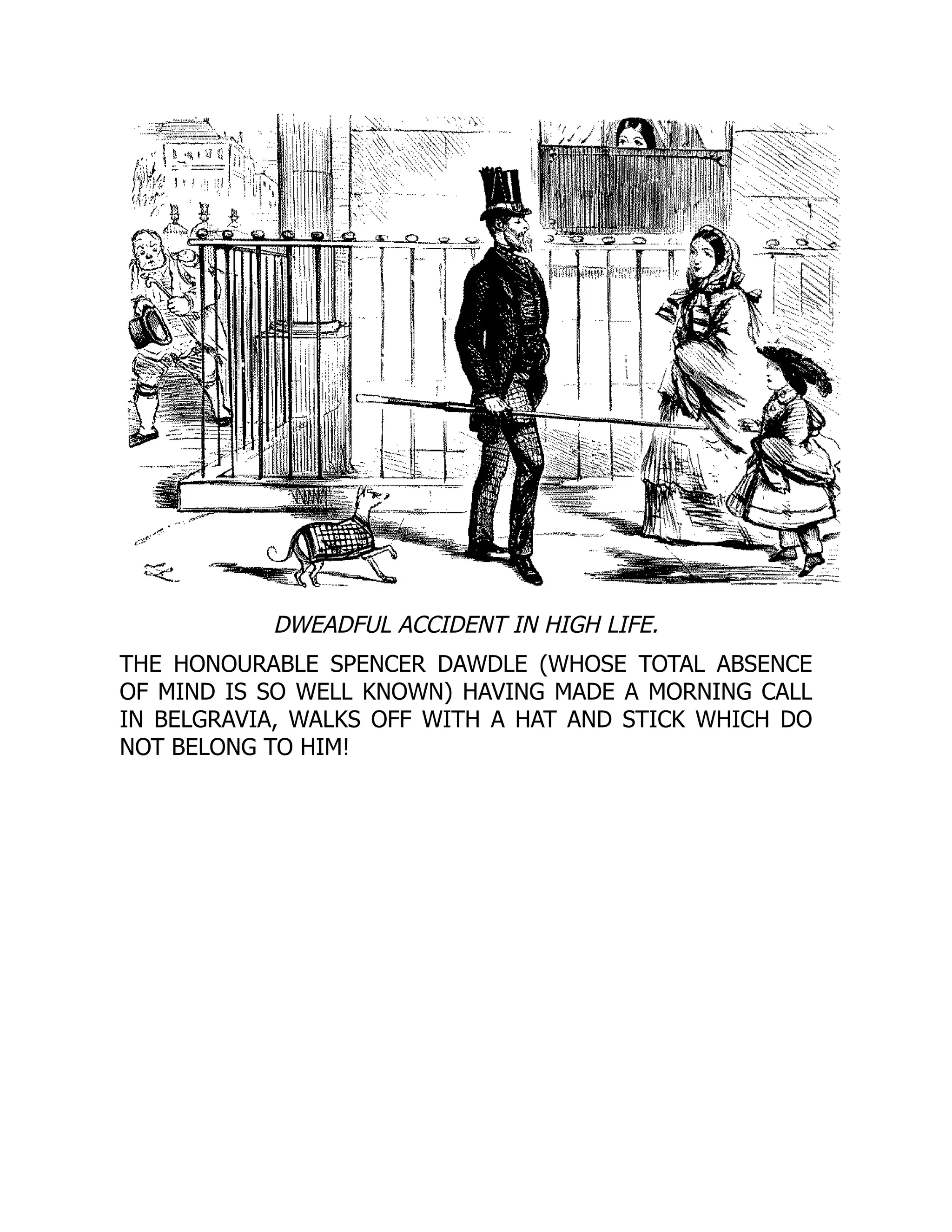
DWEADFUL ACCIDENT IN HIGH LIFE.
THE HONOURABLE SPENCER DAWDLE (WHOSE TOTAL ABSENCE
OF MIND IS SO WELL KNOWN) HAVING MADE A MORNING CALL
IN BELGRAVIA, WALKS OFF WITH A HAT AND STICK WHICH DO
NOT BELONG TO HIM!
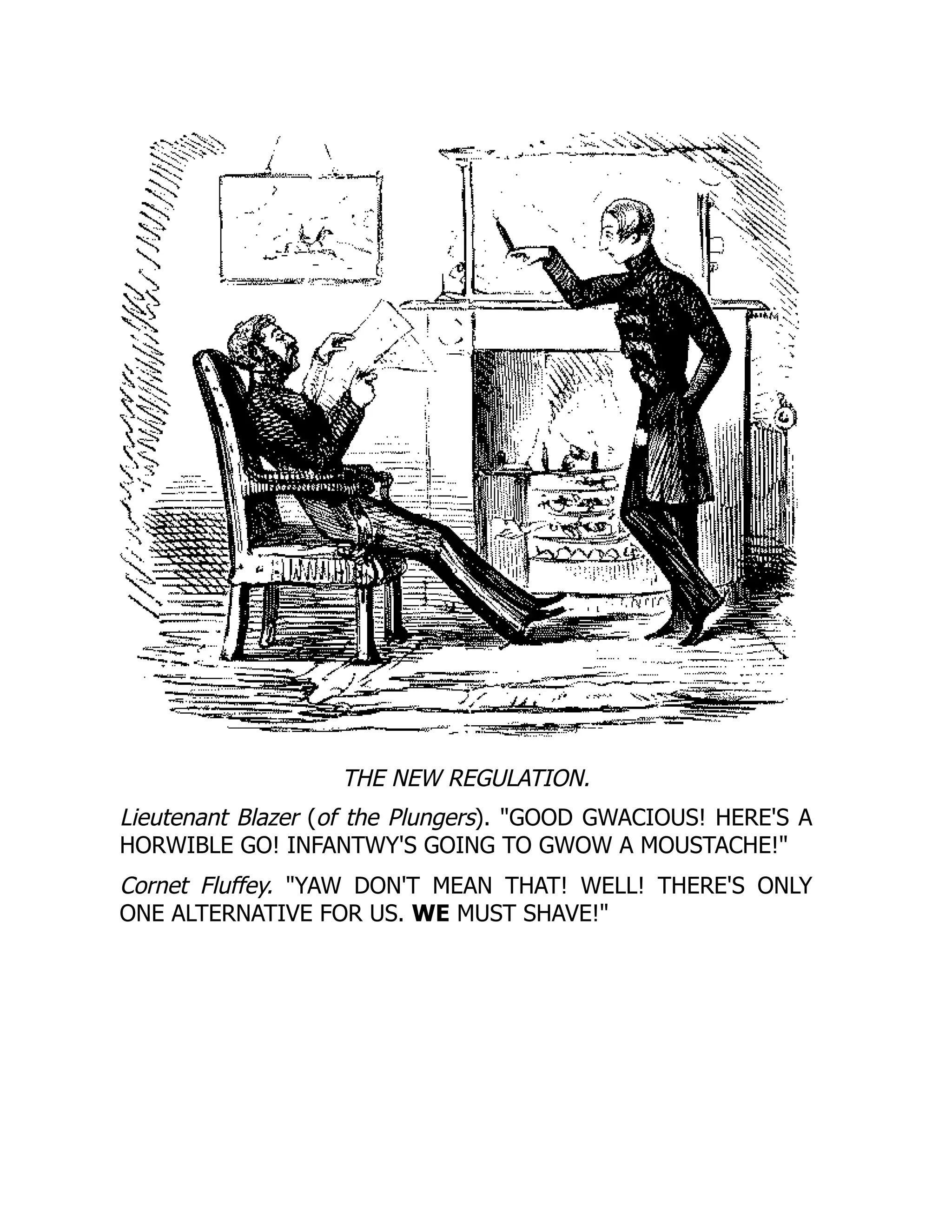
THE NEW REGULATION.
Lieutenant Blazer (of the Plungers). GOOD GWACIOUS! HERE'S A
HORWIBLE GO! INFANTWY'S GOING TO GWOW A MOUSTACHE!
Cornet Fluffey. YAW DON'T MEAN THAT! WELL! THERE'S ONLY
ONE ALTERNATIVE FOR US. WE MUST SHAVE!
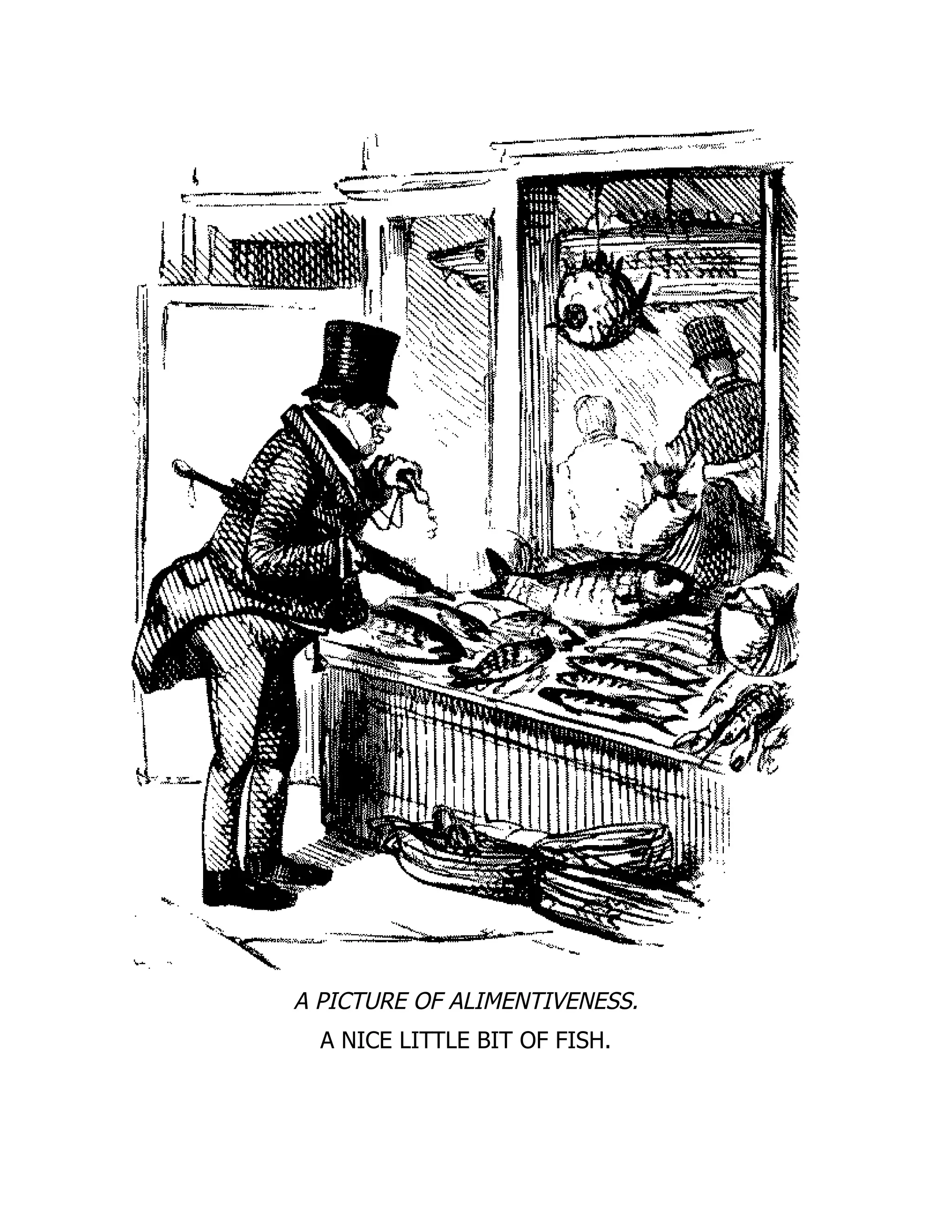
A PICTURE OF ALIMENTIVENESS.
A NICE LITTLE BIT OF FISH.
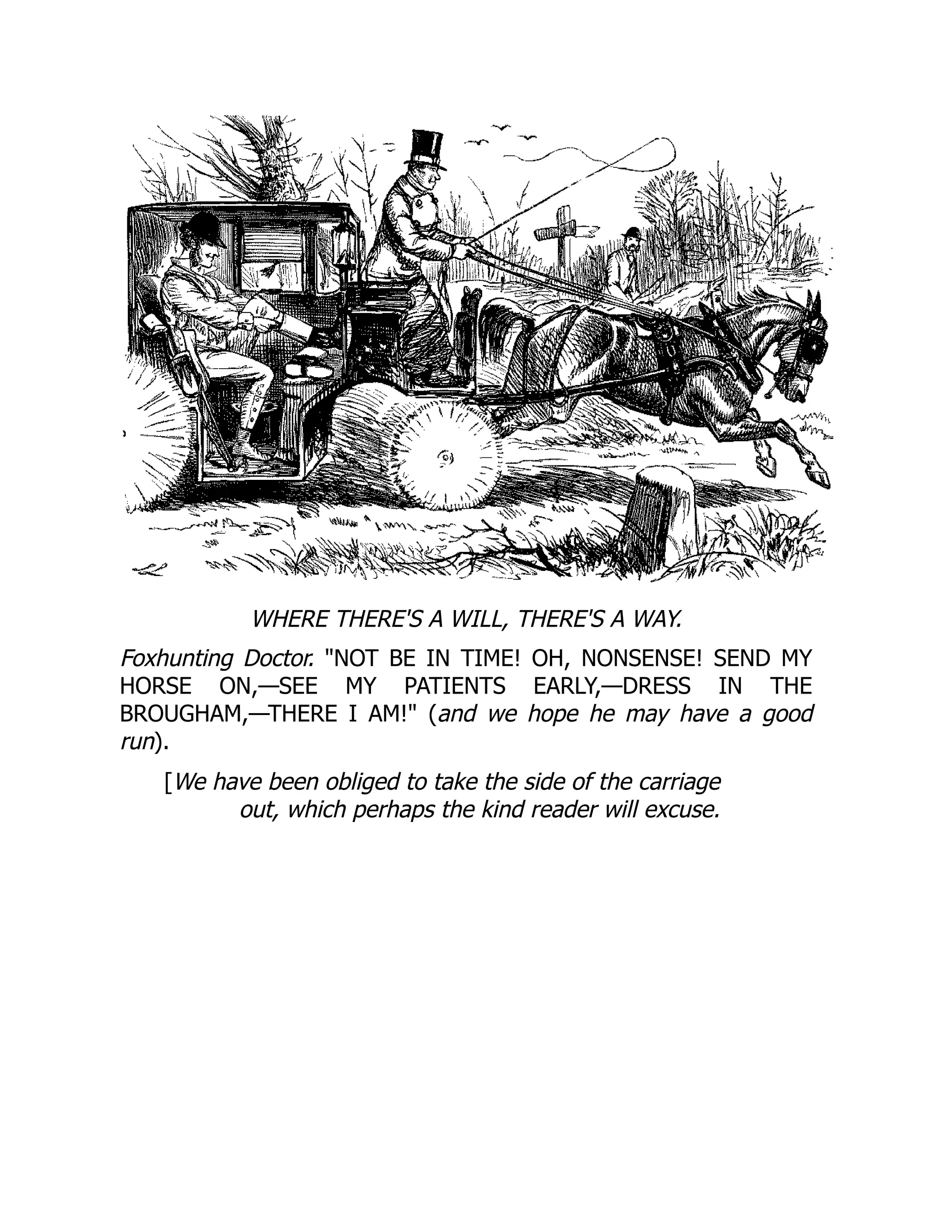
WHERE THERE'S A WILL, THERE'S A WAY.
Foxhunting Doctor. NOT BE IN TIME! OH, NONSENSE! SEND MY
HORSE ON,—SEE MY PATIENTS EARLY,—DRESS IN THE
BROUGHAM,—THERE I AM! (and we hope he may have a good
run).
[We have been obliged to take the side of the carriage
out, which perhaps the kind reader will excuse.
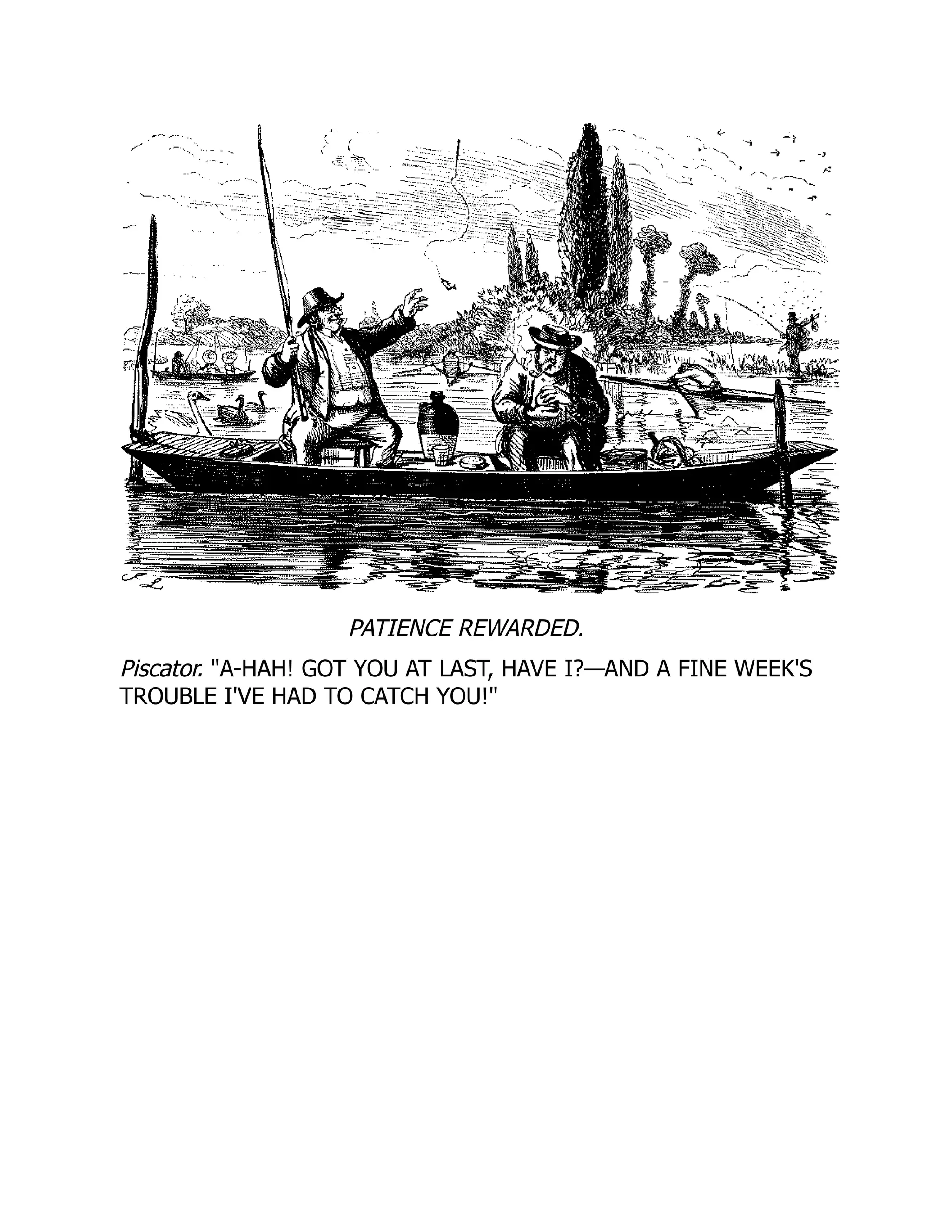
PATIENCE REWARDED.
Piscator. A-HAH! GOT YOU AT LAST, HAVE I?—AND A FINE WEEK'S
TROUBLE I'VE HAD TO CATCH YOU!
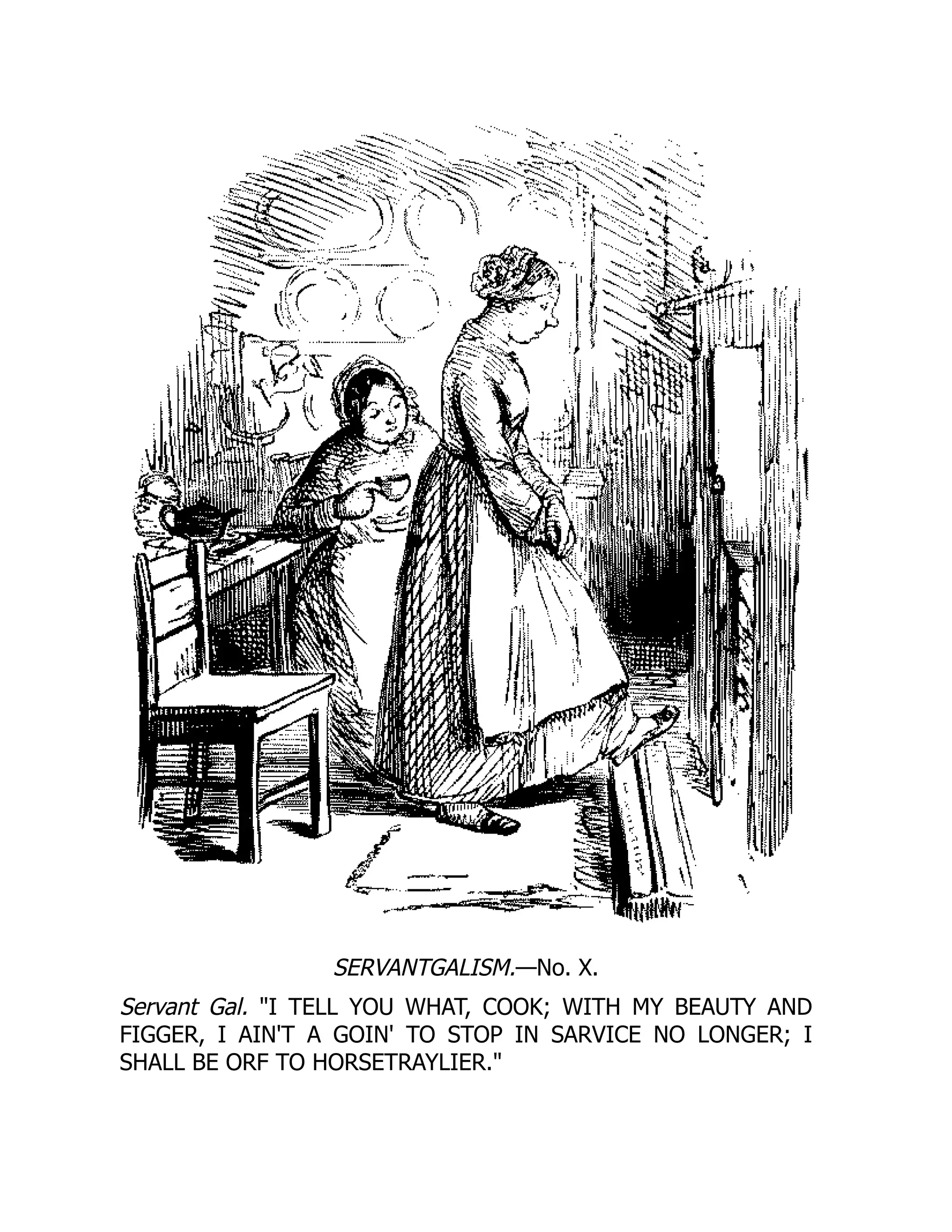
SERVANTGALISM.—No. X.
Servant Gal. I TELL YOU WHAT, COOK; WITH MY BEAUTY AND
FIGGER, I AIN'T A GOIN' TO STOP IN SARVICE NO LONGER; I
SHALL BE ORF TO HORSETRAYLIER.
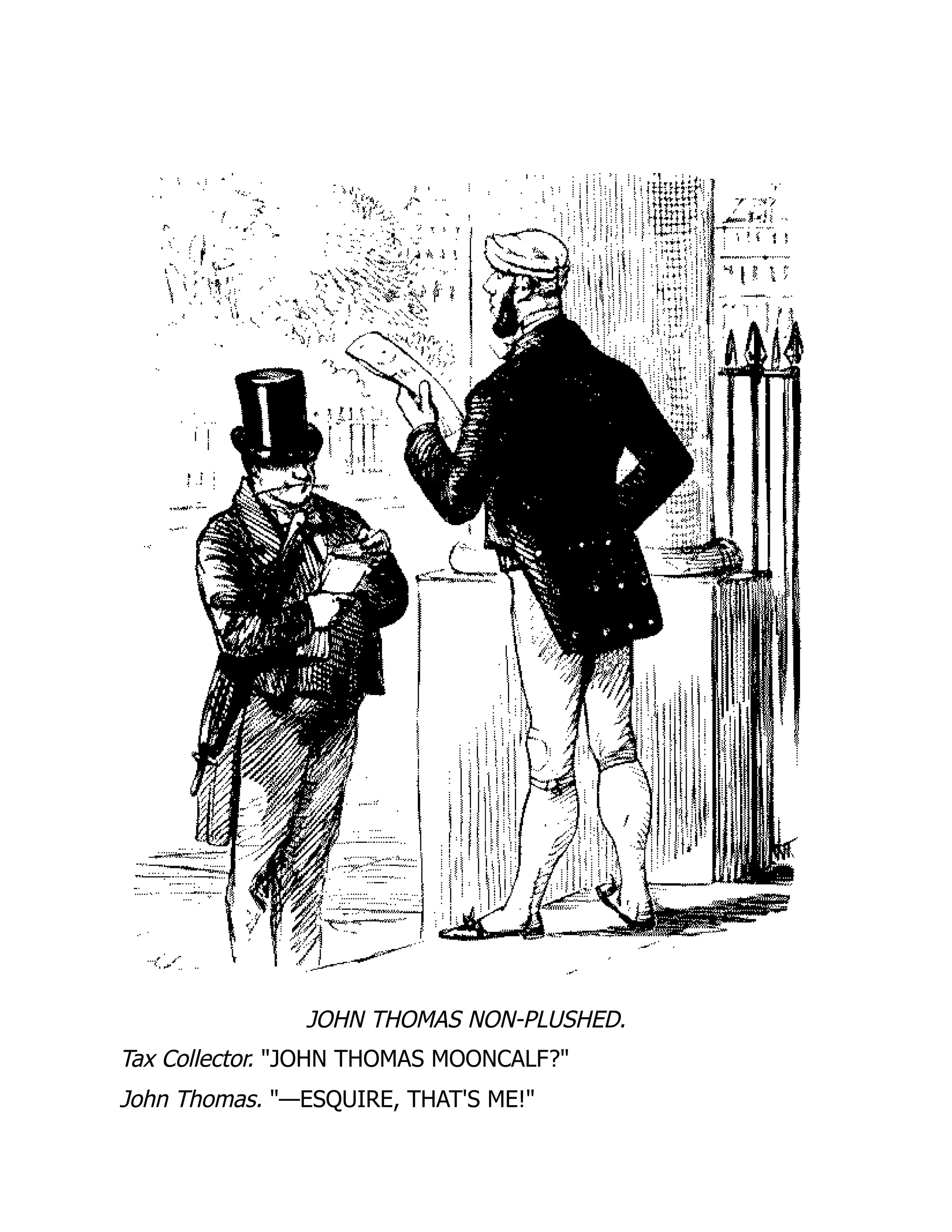
JOHN THOMAS NON-PLUSHED.
Tax Collector. JOHN THOMAS MOONCALF?
John Thomas. —ESQUIRE, THAT'S ME!
Tax Collector. THEN BE SO GOOD AS TO FILL UP THIS INCOME-
TAX PAPER AND RETURN IT TO ME BEFORE TWENTY DAYS!
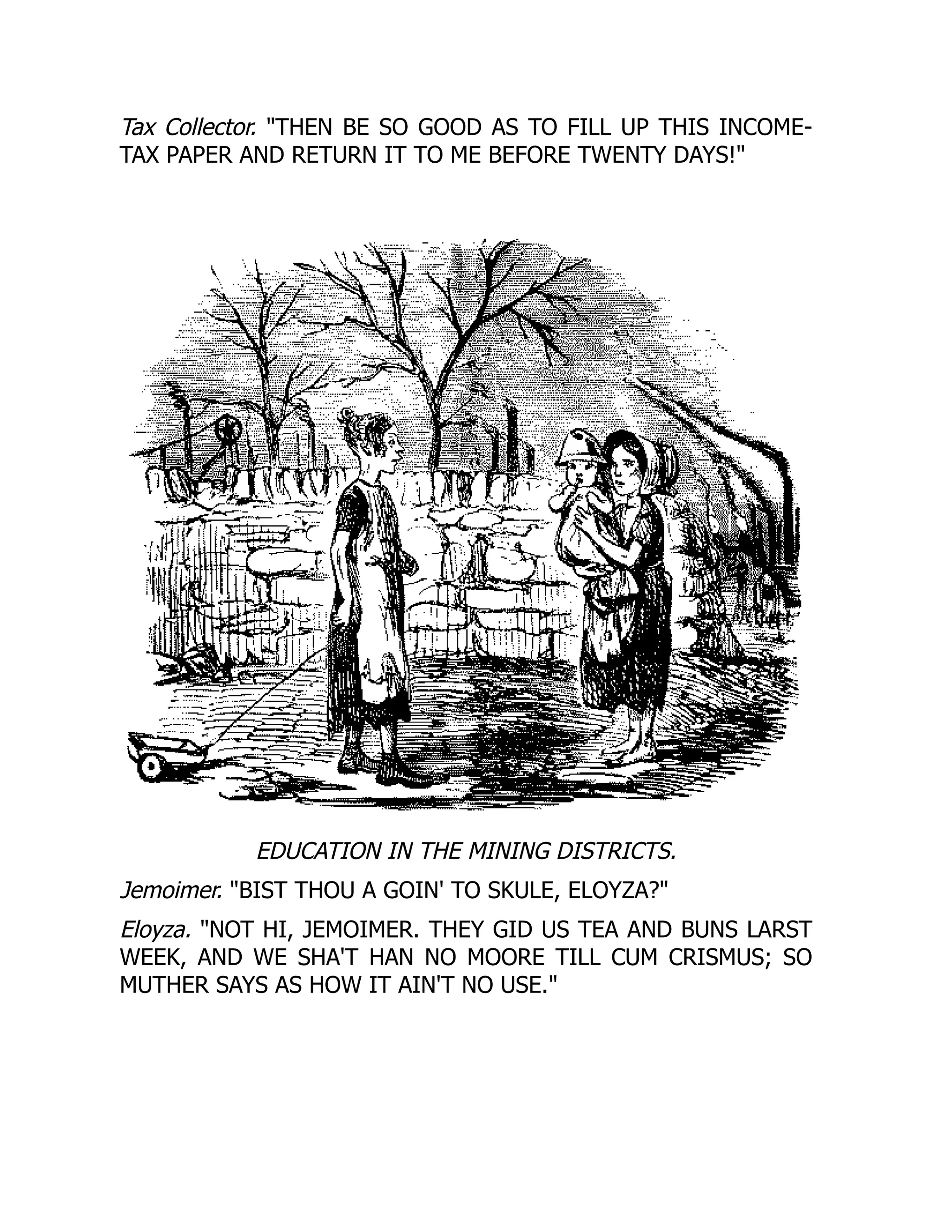
EDUCATION IN THE MINING DISTRICTS.
Jemoimer. BIST THOU A GOIN' TO SKULE, ELOYZA?
Eloyza. NOT HI, JEMOIMER. THEY GID US TEA AND BUNS LARST
WEEK, AND WE SHA'T HAN NO MOORE TILL CUM CRISMUS; SO
MUTHER SAYS AS HOW IT AIN'T NO USE.
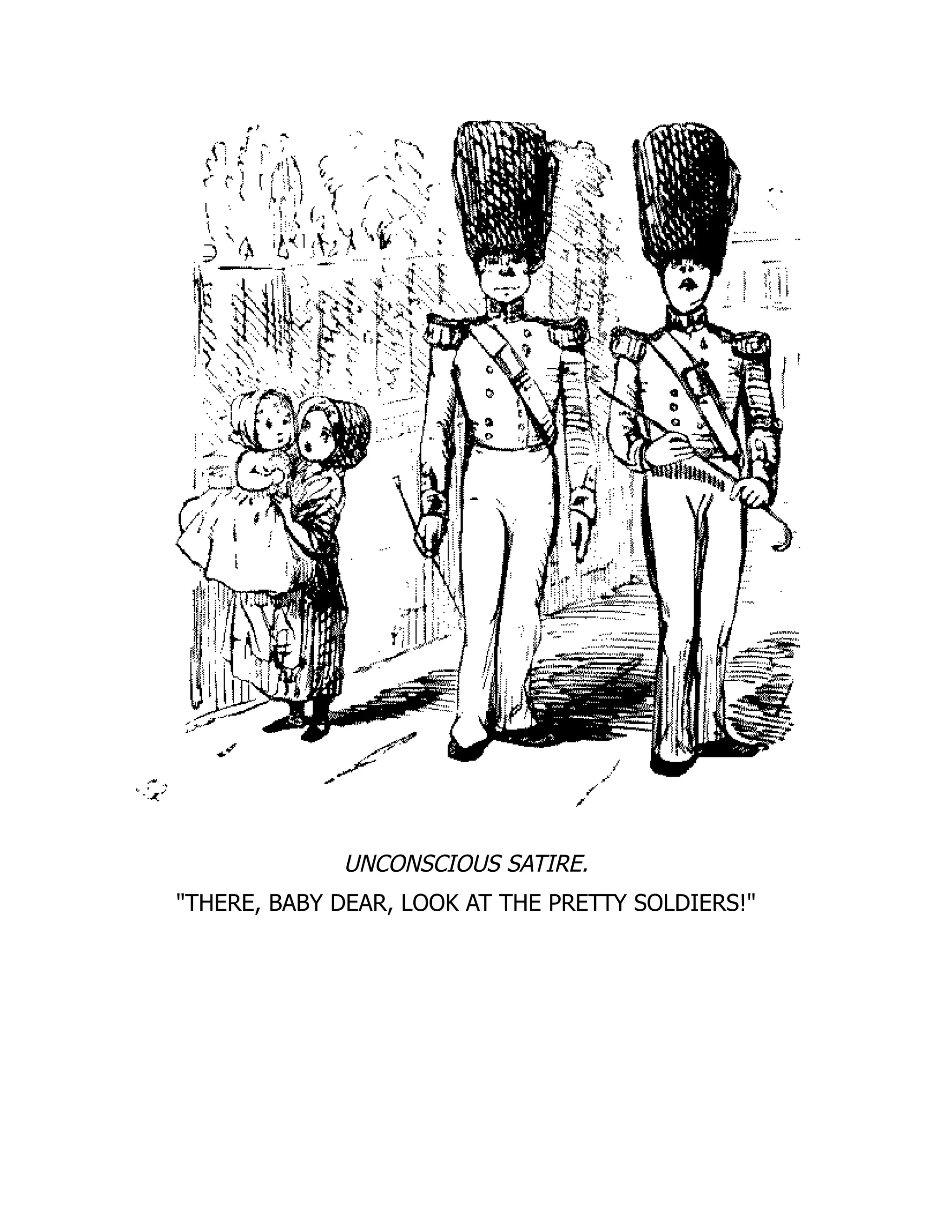
UNCONSCIOUS SATIRE.
THERE, BABY DEAR, LOOK AT THE PRETTY SOLDIERS!
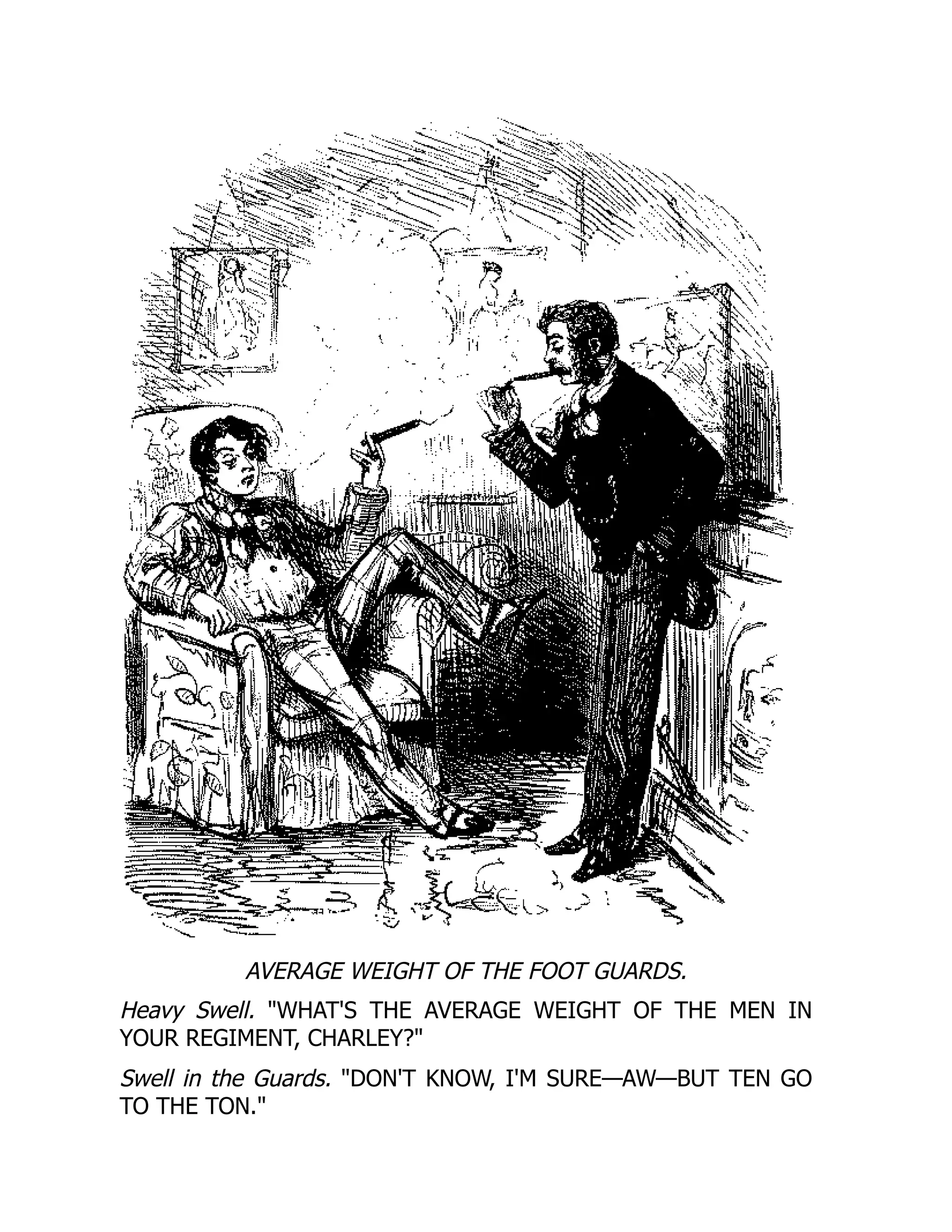
AVERAGE WEIGHT OF THE FOOT GUARDS.
Heavy Swell. WHAT'S THE AVERAGE WEIGHT OF THE MEN IN
YOUR REGIMENT, CHARLEY?
Swell in the Guards. DON'T KNOW, I'M SURE—AW—BUT TEN GO
TO THE TON.
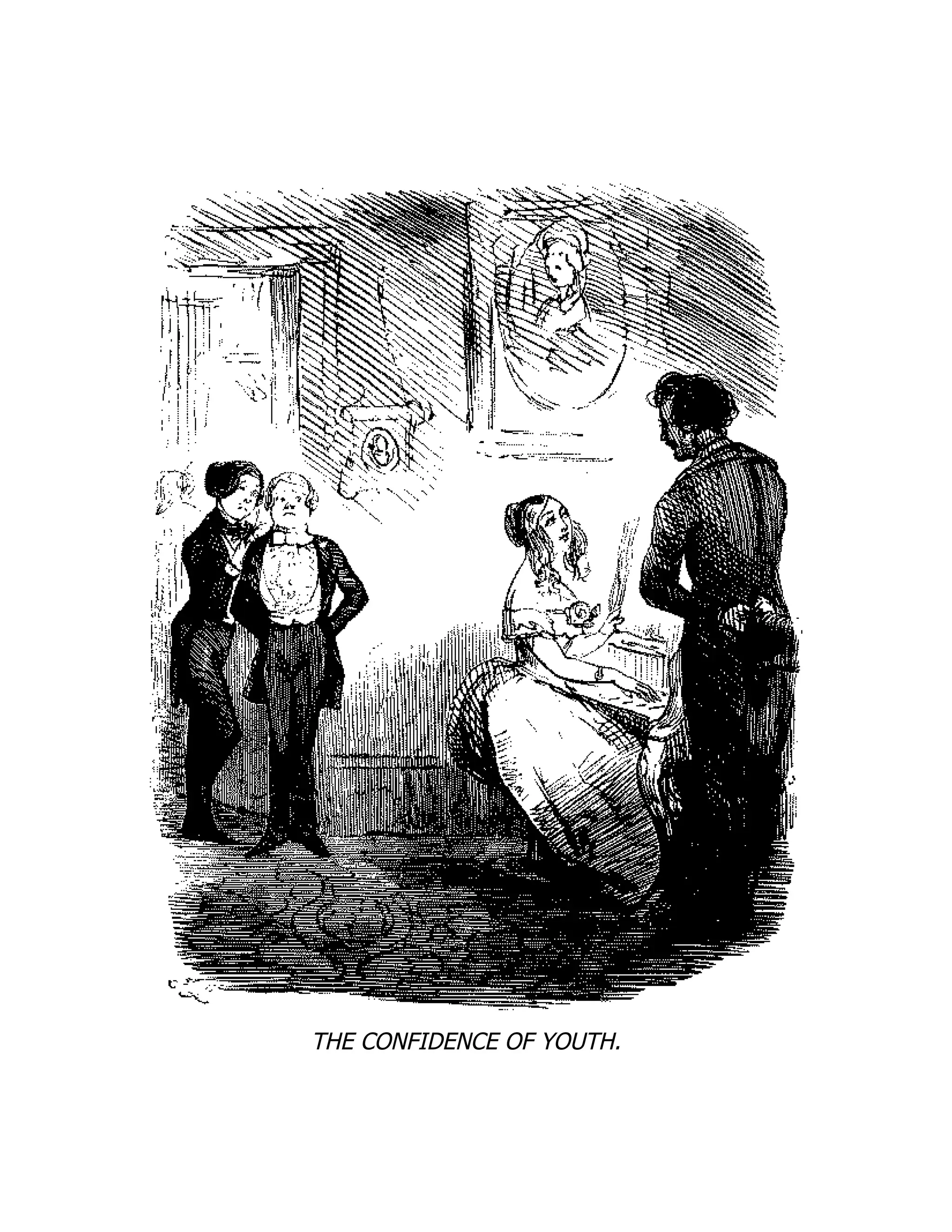
THE CONFIDENCE OF YOUTH.
Juvenile. I WONDER WHETHER THAT GURL HAS GOT ANY TIN—
FOR I FEEL MOST OWDACIOUSLY INCLINED TO GO AND CUT
THAT FELLOW OUT.
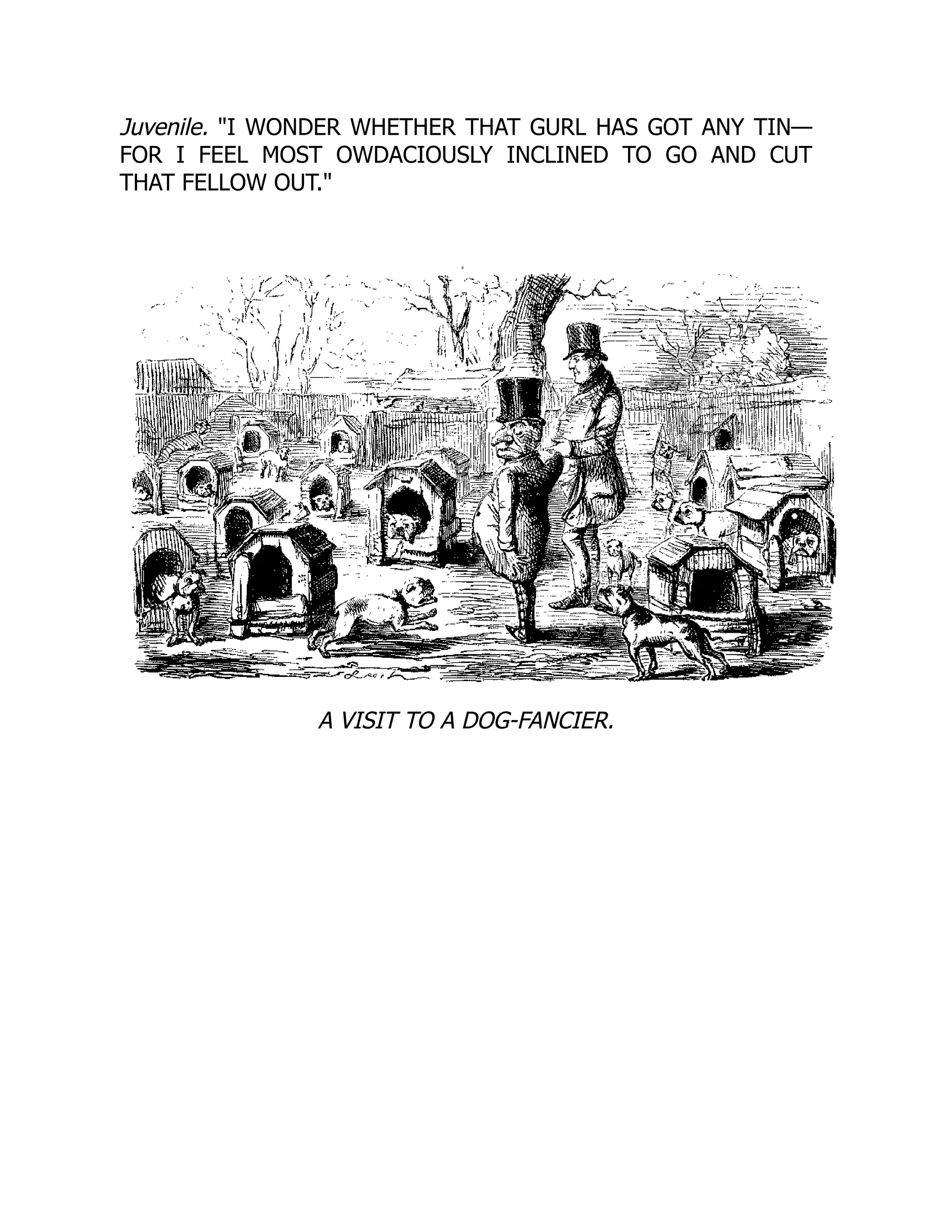
A VISIT TO A DOG-FANCIER.
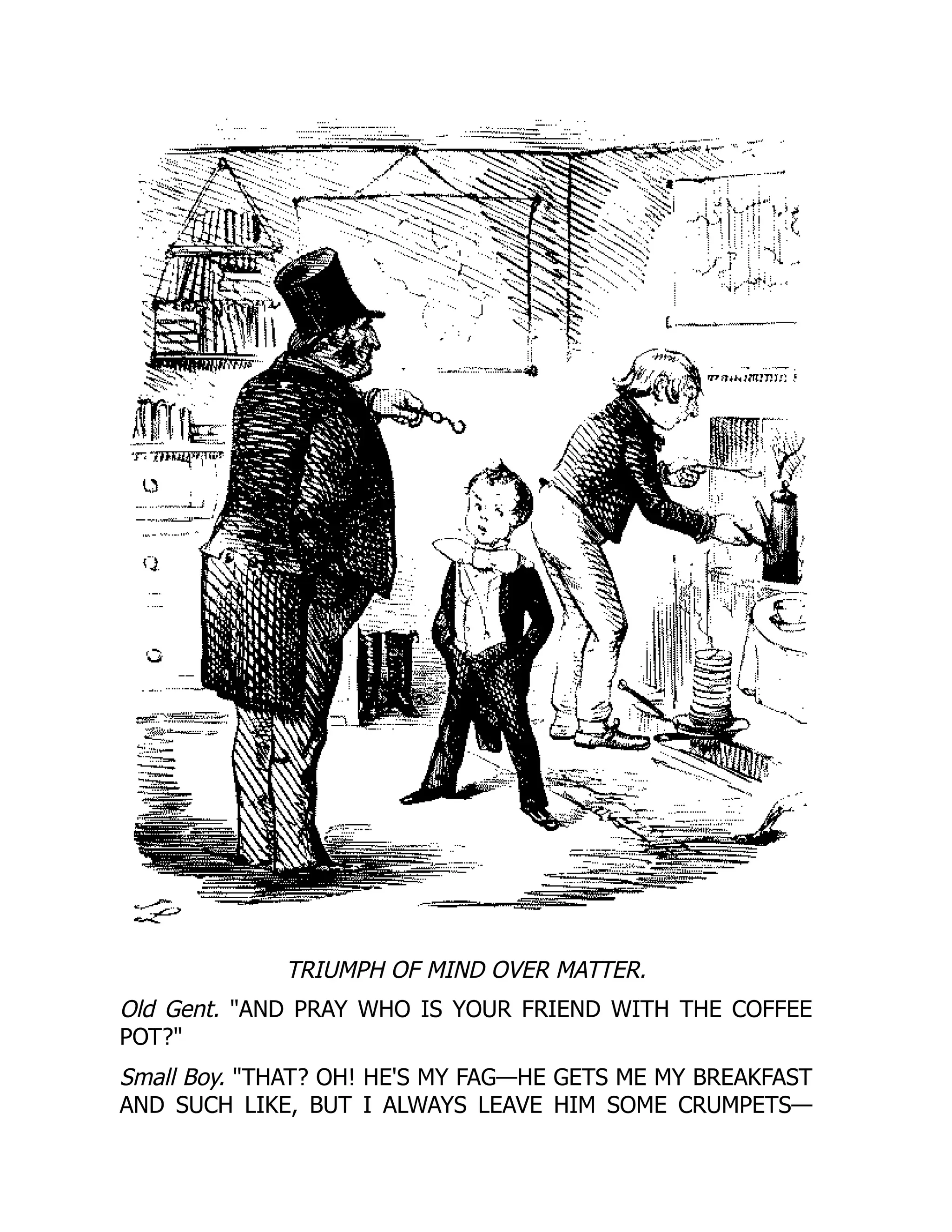
TRIUMPH OF MIND OVER MATTER.
Old Gent. AND PRAY WHO IS YOUR FRIEND WITH THE COFFEE
POT?
Small Boy. THAT? OH! HE'S MY FAG—HE GETS ME MY BREAKFAST
AND SUCH LIKE, BUT I ALWAYS LEAVE HIM SOME CRUMPETS—
AND NEVER BULLY HIM!
WHAT, INDEED?
Stern Parent. I TELL YOU, SIR, I WILL NOT ALLOW IT—AND
DON'T LET ME SEE ANY MORE NASTY PIPES OR TOBACCO IN THIS
HOUSE.
Young Williams. BOO-HOO—AND WHAT'S A FELLOW TO DO
WHEN ALL THE MEN OF HIS OWN AGE SMOKE?
DID YOU EVER!
Friend. WELL, SPRAT, MY BOY—AND HOW DO YOU GET ON, NOW
YOU'RE MARRIED?
Sprat. H'M! PRETTY BOBBISH—BUT THERE'S ONE THING MAKES
IT DOOCID UNCOMFORTABLE SOMETIMES—ENTRE NOUS—MRS.
S. IS SO CONFOUNDEDLY JEALOUS OF ME.
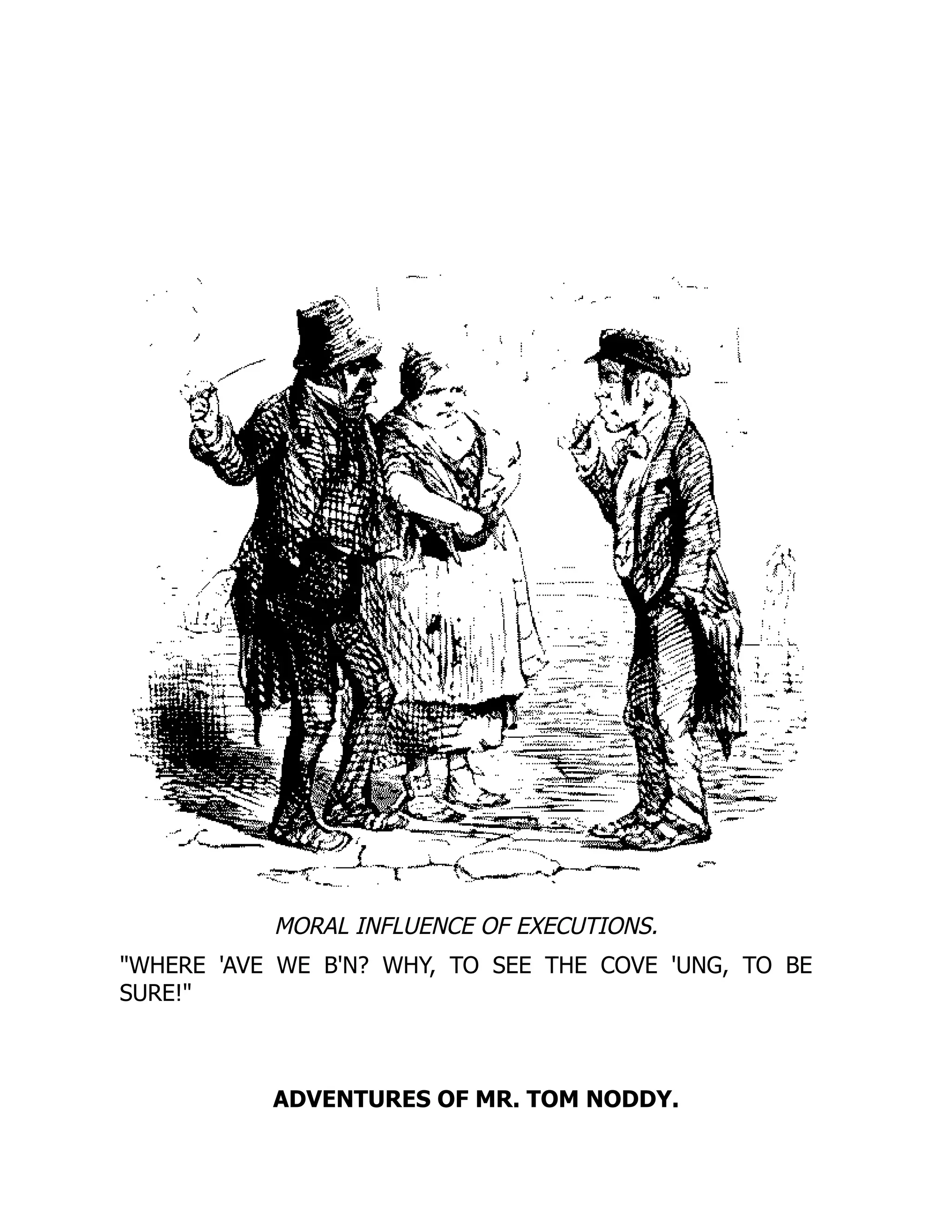
MORAL INFLUENCE OF EXECUTIONS.
WHERE 'AVE WE B'N? WHY, TO SEE THE COVE 'UNG, TO BE
SURE!
ADVENTURES OF MR. TOM NODDY.
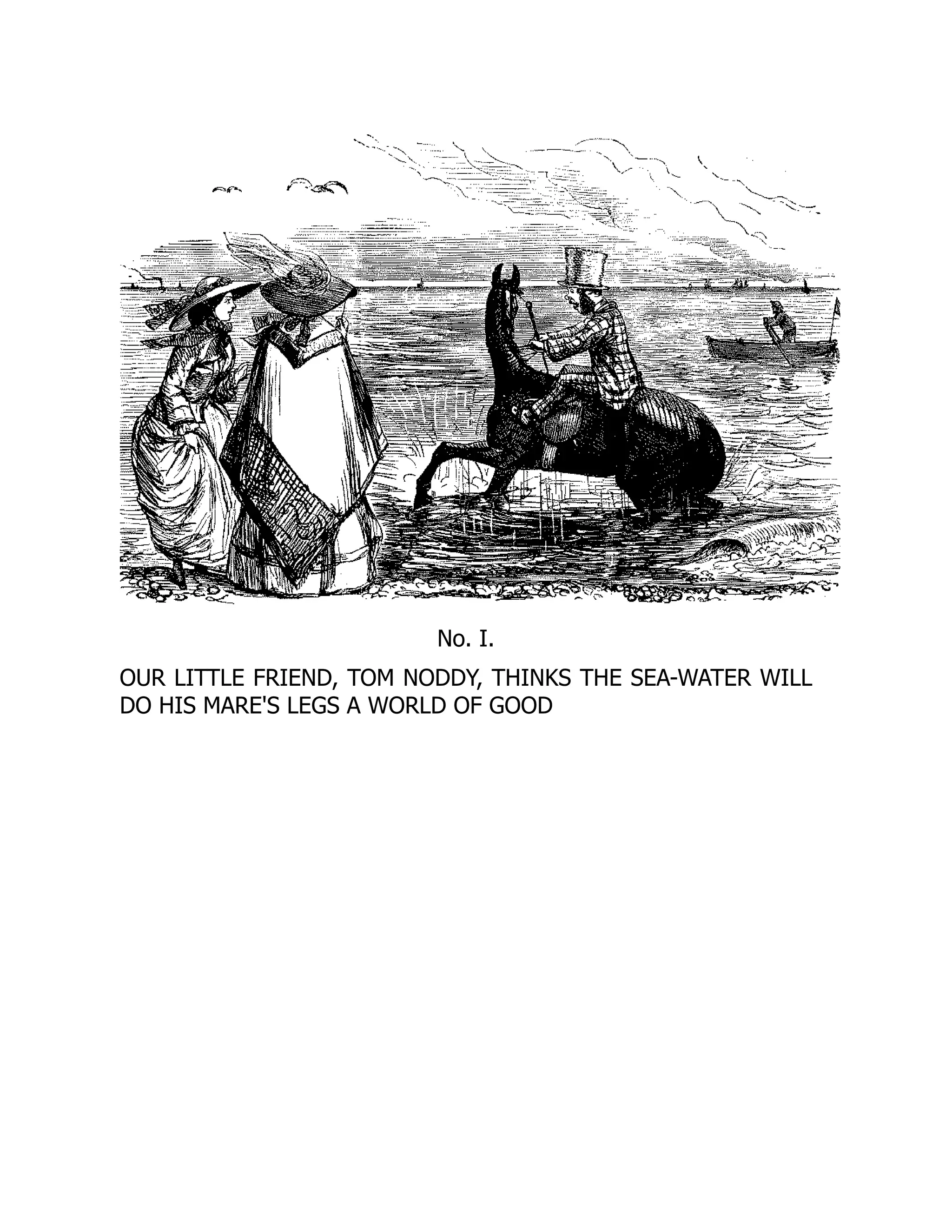
No. I.
OUR LITTLE FRIEND, TOM NODDY, THINKS THE SEA-WATER WILL
DO HIS MARE'S LEGS A WORLD OF GOOD
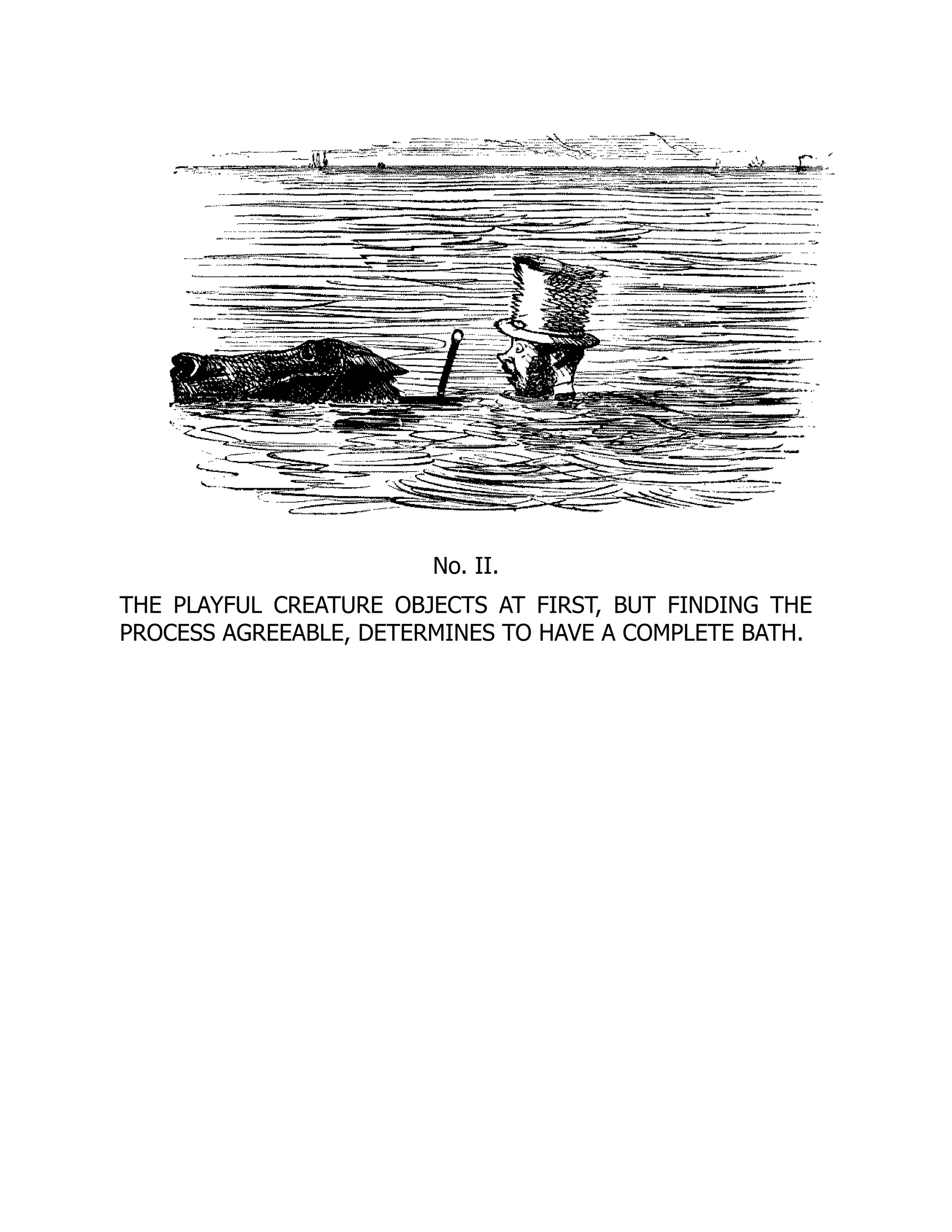
No. II.
THE PLAYFUL CREATURE OBJECTS AT FIRST, BUT FINDING THE
PROCESS AGREEABLE, DETERMINES TO HAVE A COMPLETE BATH.
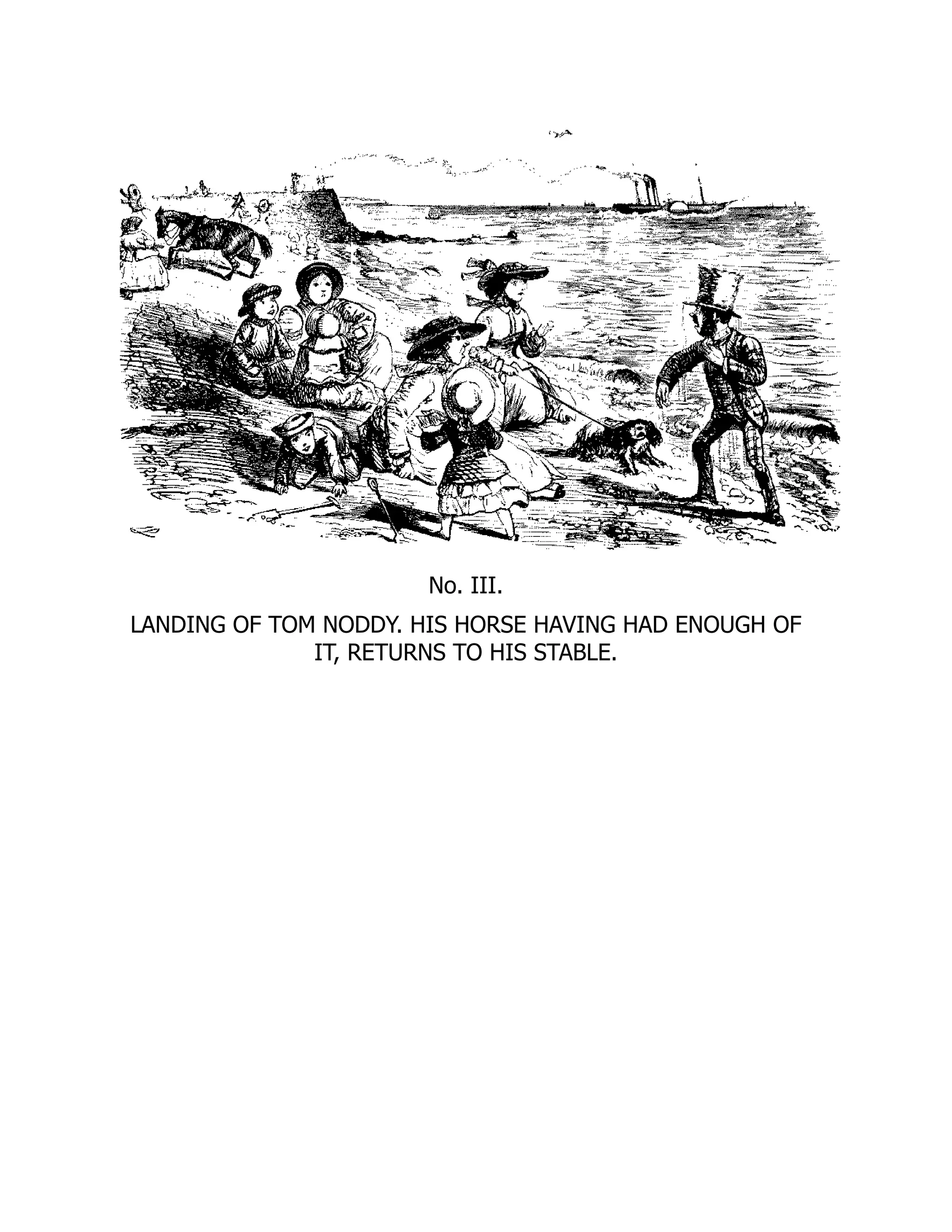
No. III.
LANDING OF TOM NODDY. HIS HORSE HAVING HAD ENOUGH OF
IT, RETURNS TO HIS STABLE.
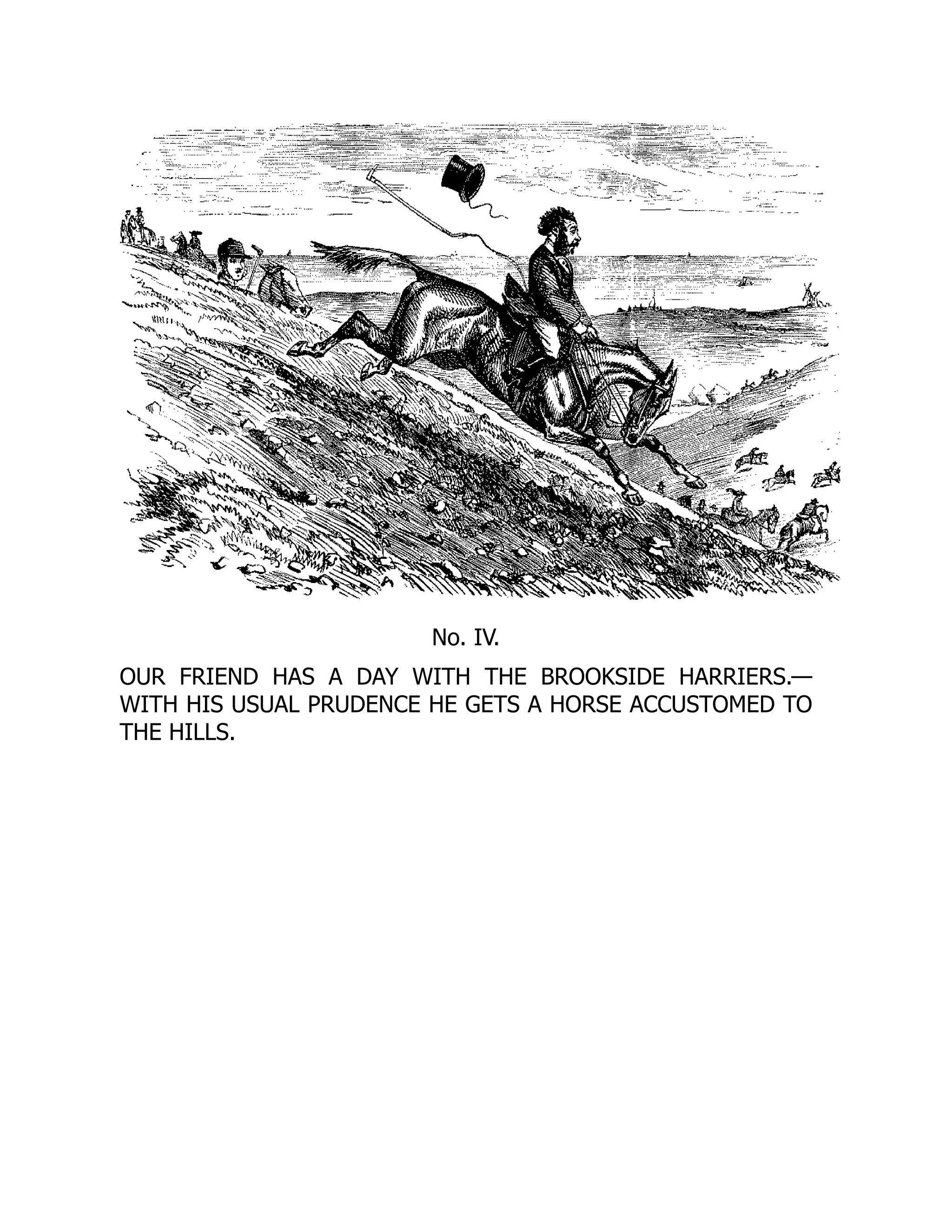
No. IV.
OUR FRIEND HAS A DAY WITH THE BROOKSIDE HARRIERS.—
WITH HIS USUAL PRUDENCE HE GETS A HORSE ACCUSTOMED TO
THE HILLS.
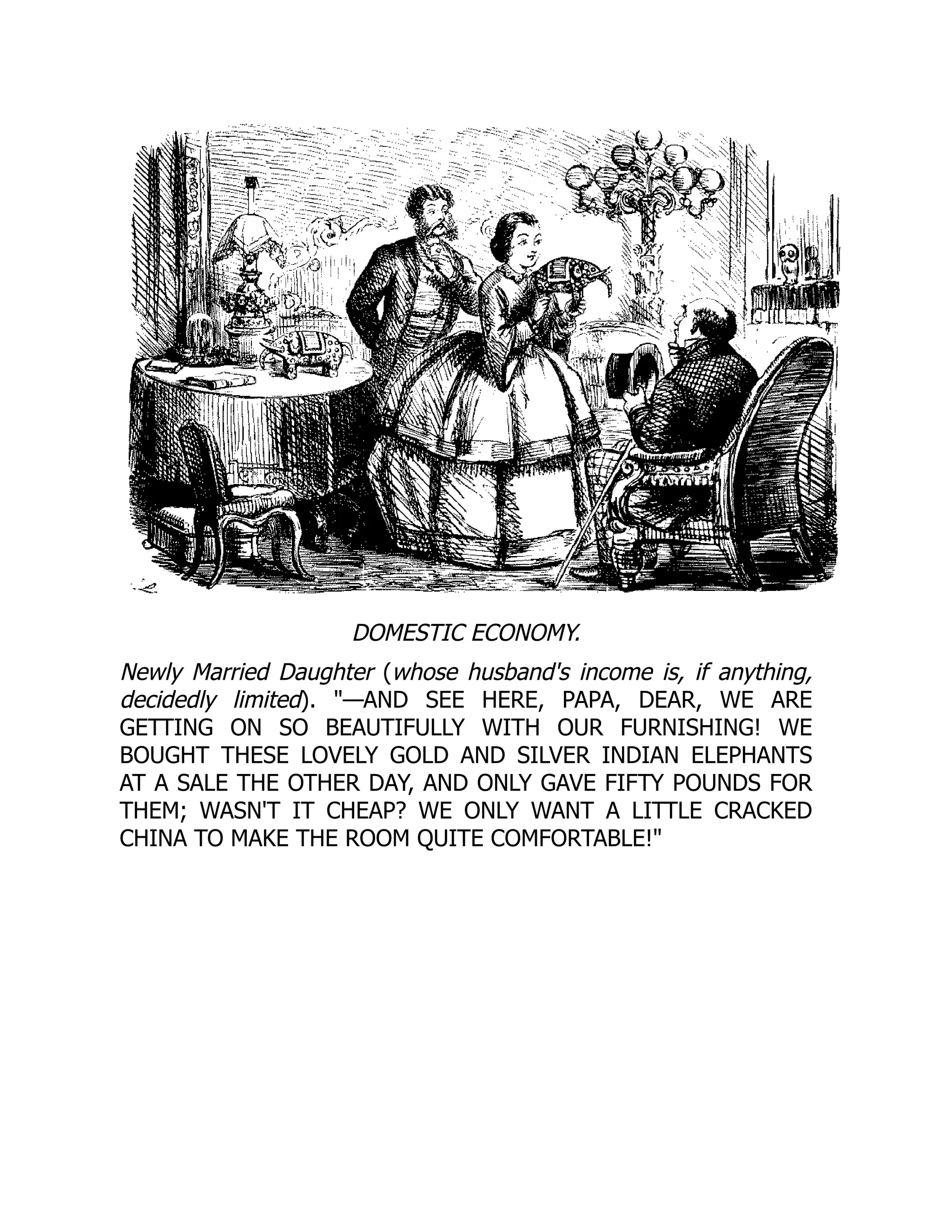
DOMESTIC ECONOMY.
Newly Married Daughter (whose husband's income is, if anything,
decidedly limited). —AND SEE HERE, PAPA, DEAR, WE ARE
GETTING ON SO BEAUTIFULLY WITH OUR FURNISHING! WE
BOUGHT THESE LOVELY GOLD AND SILVER INDIAN ELEPHANTS
AT A SALE THE OTHER DAY, AND ONLY GAVE FIFTY POUNDS FOR
THEM; WASN'T IT CHEAP? WE ONLY WANT A LITTLE CRACKED
CHINA TO MAKE THE ROOM QUITE COMFORTABLE!
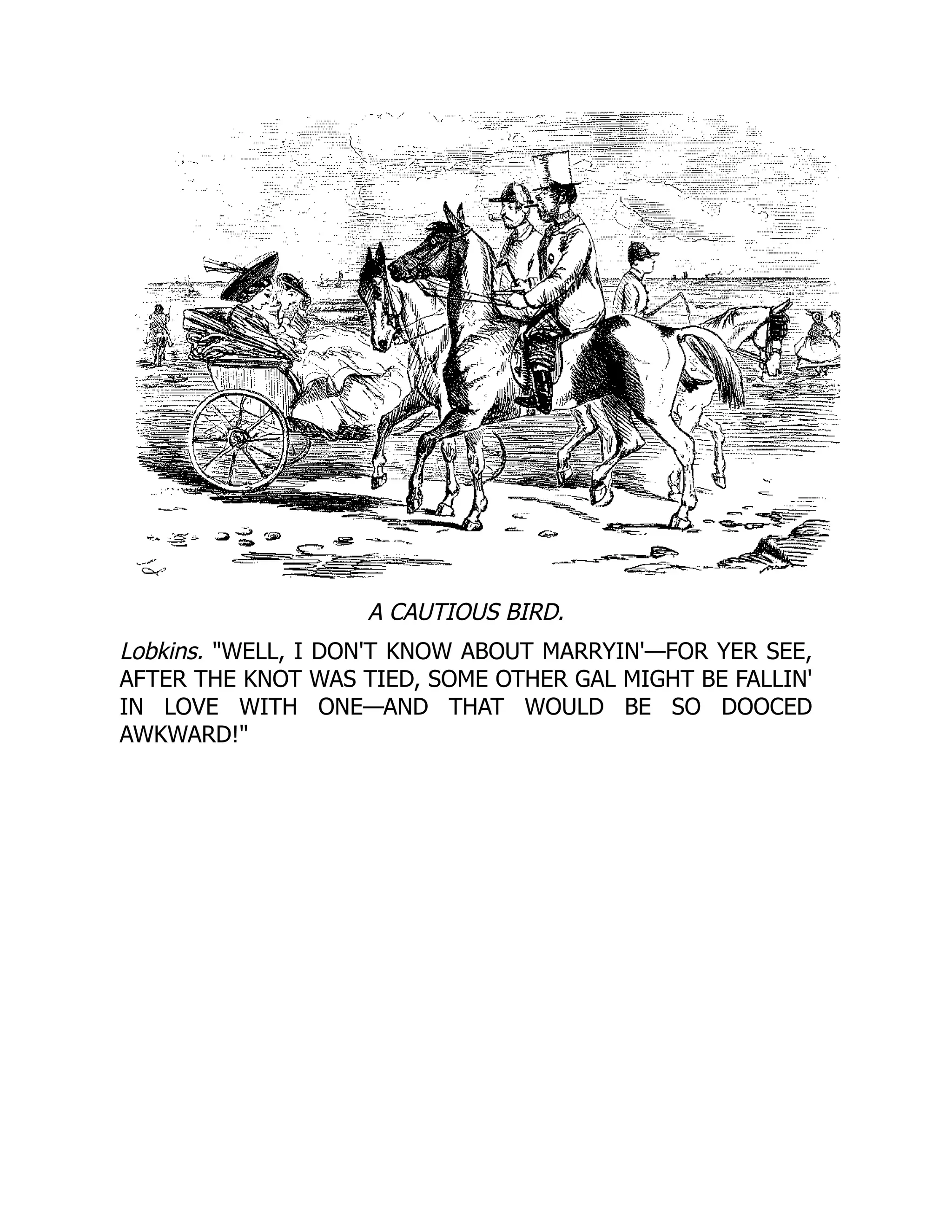
A CAUTIOUS BIRD.
Lobkins. WELL, I DON'T KNOW ABOUT MARRYIN'—FOR YER SEE,
AFTER THE KNOT WAS TIED, SOME OTHER GAL MIGHT BE FALLIN'
IN LOVE WITH ONE—AND THAT WOULD BE SO DOOCED
AWKWARD!
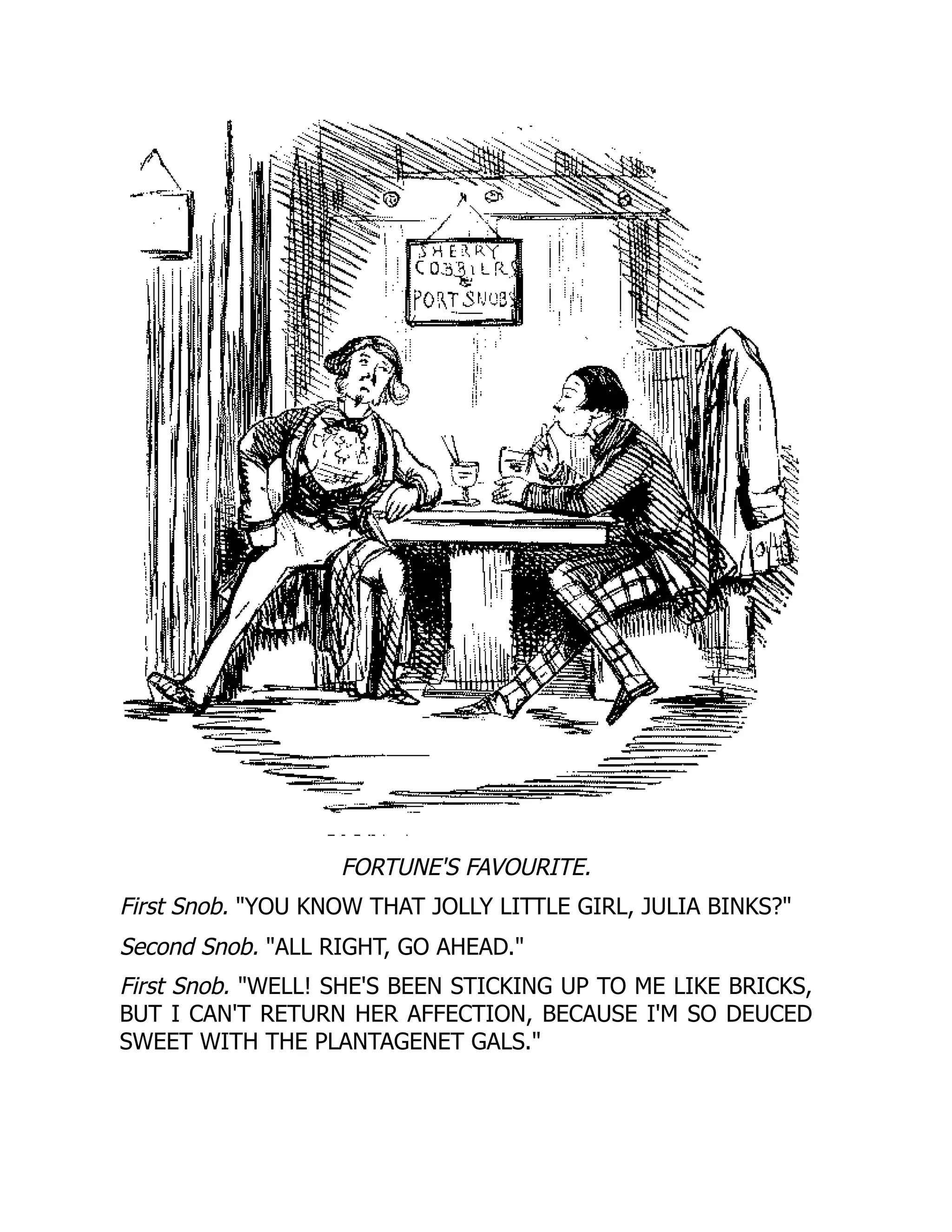
FORTUNE'S FAVOURITE.
First Snob. YOU KNOW THAT JOLLY LITTLE GIRL, JULIA BINKS?
Second Snob. ALL RIGHT, GO AHEAD.
First Snob. WELL! SHE'S BEEN STICKING UP TO ME LIKE BRICKS,
BUT I CAN'T RETURN HER AFFECTION, BECAUSE I'M SO DEUCED
SWEET WITH THE PLANTAGENET GALS.
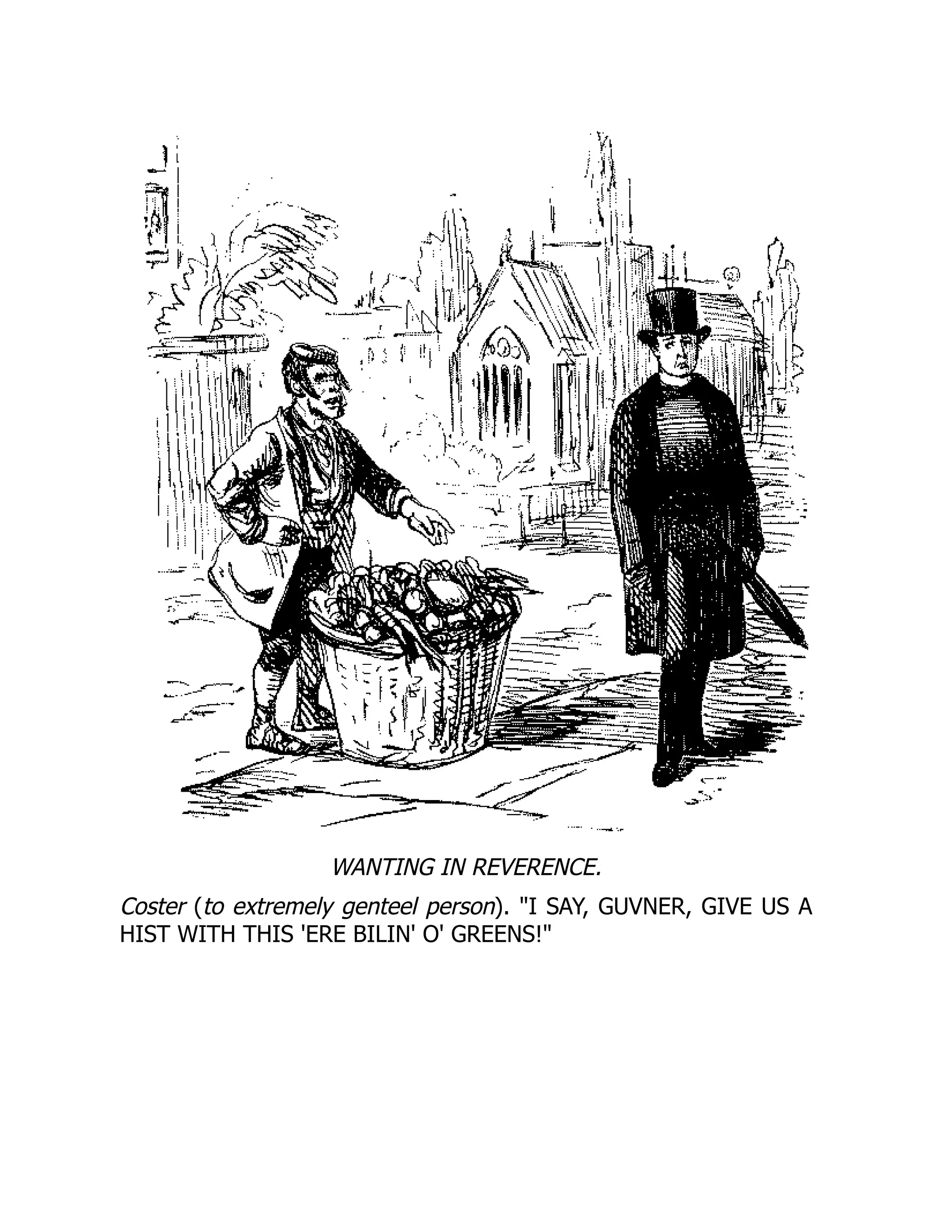
WANTING IN REVERENCE.
Coster (to extremely genteel person). I SAY, GUVNER, GIVE US A
HIST WITH THIS 'ERE BILIN' O' GREENS!
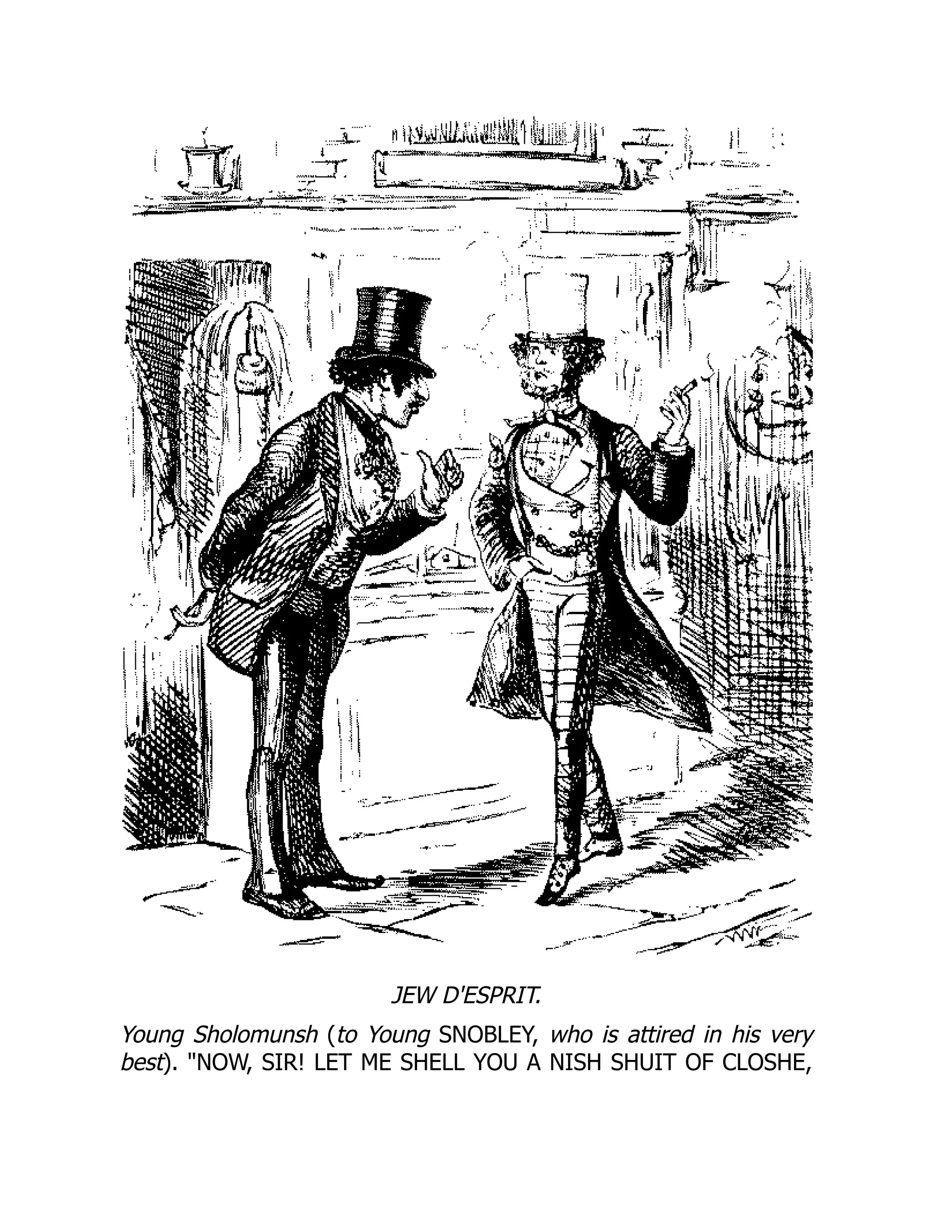
JEW D'ESPRIT.
Young Sholomunsh (to Young SNOBLEY, who is attired in his very
best). NOW, SIR! LET ME SHELL YOU A NISH SHUIT OF CLOSHE,
(eBook PDF) Organisational Behaviour Core Concepts Applications 4th

  • 1.
    (eBook PDF) OrganisationalBehaviour Core Concepts Applications 4th install download https://ebookluna.com/product/ebook-pdf-organisational-behaviour- core-concepts-applications-4th/ Download more ebook from https://ebookluna.com
  • 2.
    Instant digital products(PDF, ePub, MOBI) ready for you Download now and discover formats that fit your needs... (eBook PDF) Organisational Behaviour: Core Concepts and Applications, 5th Australasian Edition https://ebookluna.com/product/ebook-pdf-organisational-behaviour-core- concepts-and-applications-5th-australasian-edition/ ebookluna.com (eBook PDF) Management & Organisational Behaviour, 11th Edition https://ebookluna.com/product/ebook-pdf-management-organisational- behaviour-11th-edition/ ebookluna.com (Original PDF) Organisational Behaviour 8th Australia Edition https://ebookluna.com/product/original-pdf-organisational- behaviour-8th-australia-edition/ ebookluna.com (eBook PDF) Organisational Behaviour: Managing People and Organisations https://ebookluna.com/product/ebook-pdf-organisational-behaviour- managing-people-and-organisations/ ebookluna.com
  • 3.
    (eBook PDF) OrganizationalBehaviour Concepts, Controversies, Applications, 8th Canadian Edition https://ebookluna.com/product/ebook-pdf-organizational-behaviour- concepts-controversies-applications-8th-canadian-edition/ ebookluna.com (eBook PDF) Organisational Behaviour Emerging Knowledge Global Insights 5th https://ebookluna.com/product/ebook-pdf-organisational-behaviour- emerging-knowledge-global-insights-5th/ ebookluna.com (eBook PDF) Organisational Behaviour Individuals Groups Organisation 5th Edition https://ebookluna.com/product/ebook-pdf-organisational-behaviour- individuals-groups-organisation-5th-edition/ ebookluna.com (eBook PDF) Organisational Behaviour in the Workplace 12th Editio https://ebookluna.com/product/ebook-pdf-organisational-behaviour-in- the-workplace-12th-editio/ ebookluna.com (eBook PDF) Organisational Behaviour 9th Edition By Stephen P. Robbins https://ebookluna.com/product/ebook-pdf-organisational-behaviour-9th- edition-by-stephen-p-robbins/ ebookluna.com
  • 5.
    F O UR T H A U S T R A L A S I A N E D I T I O N Jack WOOD Rachid ZEFFANE Michele FROMHOLTZ Retha WIESNER Rachel MORRISON Aharon FACTOR Tui MCKEOWN CORE CONCEPTS AND APPLICATIONS BEHAVIOUR ORGANISATIONAL
  • 6.
    vi CONTENTS PART ONEINTRODUCTION 1 CHAPTER 1 WHAT IS ORGANISATIONAL BEHAVIOUR? 3 Learning objectives 3 Introduction 5 What is organisational behaviour? 5 Why do organisations exist? 7 Organisations as open systems 8 Managers in organisations 10 What is an effective manager? 10 Managing task performance 10 Human resource maintenance 11 The management process 13 Contemporary themes in organisational ­behaviour 14 Globalisation 14 The changing nature of work 16 The changing nature of the workforce 18 The changing nature of employer–employee ­relations 22 Ethics and values 27 Why study organisational behaviour? 29 Summary 30 Chapter 1 study guide 32 Key terms 32 Review questions 32 Application questions 32 Research questions 33 Running project 33 Individual activity 33 Group activity 34 Case study: Resene Paints Ltd 35 End notes 36 PART TWO MANAGING INDIVIDUAL BEHAVIOUR AND PERFORMANCE 39 CHAPTER 2 INDIVIDUAL ATTRIBUTES AND THEIR EFFECTS ON JOB PERFORMANCE 41 Learning objectives 41 Introduction 43 Individual performance factors 43 Individual attributes 43 Work effort 45 Organisational support 45 Demographic differences among individuals 46 Competency differences among individuals 47 CONTENTS Tutorial activities at a glance xvii Cases and real-world examples at a glance xviii How to use this book xxii About the authors xxiv Acknowledgements xxvi What would you do? 12 The effective manager 1.1 14 Moving from traditional to re-engineered values 14 The effective manager 1.2 15 Ten attributes of the global manager 15 Counterpoint 15 International spotlight 19 Ethical perspective 23
  • 7.
    Cognitive abilities 47 Physicalabilities 47 Emotional competence 48 Personality differences among individuals 50 Personality determinants 50 Personality traits 51 Individual differences and workplace diversity 54 Values 56 Sources and types of values 56 Patterns and trends in values 56 Attitudes 59 Components of attitudes 59 Attitudes and cognitive consistency 60 Job satisfaction as an attitude 60 Job satisfaction and workplace behaviour 62 Job satisfaction, absenteeism and turnover 62 The link between job satisfaction and overall job ­performance 64 Perception and the perceptual process 67 Factors influencing the perceptual process 67 Stereotyping 68 Summary 70 CHAPTER 2 study guide 72 Key terms 72 Review questions 72 Application questions 72 Research questions 73 Running project 73 Individual activity 73 Group activity 74 Case study: Perceptions, attitudes and job dissatisfaction: a tricky issue 75 End notes 76 CHAPTER 3 MOTIVATION AND EMPOWERMENT 79 Learning objectives 79 Introduction 80 Motivating and empowering the workforce 81 Contemporary issues affecting motivation and ­empowerment 81 The work motivation challenge 85 Content and process motivation theories 87 Content theories 88 Maslow’s hierarchy of needs theory 88 Alderfer’s ERG theory 91 McClelland’s acquired needs theory 92 Herzberg’s two‐factor theory 93 Process theories 98 Equity theory 98 Expectancy theory 101 Integrating content and process motivation theories 105 Other perspectives on motivation 106 Empowerment 108 Summary 111 Chapter 3 study guide 113 Key terms 113 Review questions 113 Application questions 113 Research questions 114 Ethical perspective 53 The effective manager 2.1 55 Working with workplace diversity The effective manager 2.2 62 Facets of job satisfaction (from the Job Descriptive Index) Counterpoint 63 What would you do? 66 International spotlight 66 CONTENTS vii CONTENTS
  • 8.
    viii CONTENTS CONTENTS Running project114 Individual activity 114 Group activity 116 Case study: Employee empowerment at the Bank of New Zealand 117 End notes 118 CHAPTER 4 Learning, reinforcement and self-management  123 Learning objectives 123 Introduction 124 Learning as a modification of work behaviour 125 Classical conditioning 126 Operant conditioning 127 Cognitive learning 128 Social learning 128 Reinforcement as a strategy to modify work ­behaviour 131 Positive reinforcement 132 Negative reinforcement (avoidance) 136 Punishment 136 Extinction 138 Organisational behaviour modification ­strategies — a summary 139 Reinforcement perspectives: using rewards ­carefully 139 Reinforcement perspectives: do incentives ­actually work? 140 Social learning theory and behavioural ­ self‐management 141 Managing pay as an extrinsic reward 143 Multiple meanings of pay 144 Merit pay 144 Creative pay practices 146 The learning organisation 148 The teaching organisation 151 Summary 152 Chapter 4 study guide 154 Key terms 154 Review questions 154 Application questions 154 Research questions 155 Running project 155 Individual activity 155 Group activity 156 Case study: Experiential learning in organisations … just do it! 157 End notes 158 The effective manager 3.1 100 Steps for managing the equity process Ethical perspective 100 What would you do? 103 The effective manager 3.2 104 Tips for influencing the perceived valence of work outcomes Sustainability 107 What would you do? 130 Sustainability 133 Counterpoint 134 The effective manager 4.1 135 Guidelines for allocating extrinsic rewards to ensure a ­ positive reinforcement effect The effective manager 4.2 137 Guidelines for using punishment to change behaviour Ethical perspective 145 International spotlight 147 The effective manager 4.3 148 Creating a learning organisation International spotlight 84 Counterpoint 89
  • 9.
    ix CONTENTS CONTENTS CHAPTER 5 JOBDESIGN, GOAL SETTING AND FLEXIBLE WORK ARRANGEMENTS 163 Learning objectives 163 Introduction 164 Intrinsic motivation 165 Job design 166 Job simplification 167 Job enlargement 168 Job rotation 168 Job enrichment 170 The job characteristics model 171 Individual differences: moderators of the job ­characteristics model 173 Testing and the motivating potential score 174 The research 174 Socio‐technical job design 178 Social information and job design 178 Multiskilling 178 Goal‐setting theory 179 Goal setting: follow‐up research 180 Goal setting and MBO 180 Key performance indicators 182 Flexible work arrangements 183 Major drivers of changing work arrangements 183 Types of flexible work arrangements 190 Summary 196 Chapter 5 study guide 198 Key terms 198 Review questions 198 Application questions 198 Research questions 199 Running project 199 Individual activity 199 Group activity 200 Case study: Brolly Sheets and ‘mumpreneur’ Diane Hurford 200 End notes 201 PART THREE MANAGING GROUP DYNAMICS AND TEAM ­ PERFORMANCE 207 CHAPTER 6 GROUPS AND GROUP DYNAMICS 209 Learning objectives 209 Introduction 211 What is a group? 211 Types of groups in organisations 211 Purposes of groups in organisations 214 Managing groups for effectiveness 216 Task performance and group maintenance 217 Group effectiveness 218 Groups as open systems 219 Inputs into the group process 220 Organisational setting 220 Nature of the group task 222 General membership characteristics 223 Group size 226 Group processes and group dynamics 227 Stages of group development 228 Required and emergent behaviours 230 Group norms and roles 230 Emotions in groups 232 Group communication and decision making 233 Counterpoint 165 What would you do? 167 International spotlight 169 The effective manager 5.1 175 Guidelines for implementing a program of job enrichment What would you do? 176 The effective manager 5.2 181 Key issues for mutual goal setting in an MBO program Counterpoint 186 Ethical perspective 187
  • 10.
    x CONTENTS CONTENTS Outputs ofthe group process — task performance and group maintenance 234 Intergroup dynamics 236 Work flow interdependency and intergroup ­relations 236 Other factors affecting intergroup relations 237 Dynamics of intergroup competition 238 Summary 239 Chapter 6 study guide 241 Key terms 241 Review questions 241 Application questions 241 Research questions 242 Running project 242 Individual activity 243 Group activity 243 Case study: Workgroup behaviour in a New Zealand ­factory 243 End notes 244 CHAPTER 7 TEAMWORK AND TEAM BUILDING 247 Learning objectives 247 Introduction 248 What are teams? 249 Groups versus teams 250 Teams and their effectiveness 251 Effective teams 251 Foundations of the team‐building process 253 Team‐building goals 253 Effective team leadership 254 Effective team facilitators 256 Teamwork activities and training 257 Timing and location of teamwork activities 260 Team performance and cohesiveness 261 Team norms 262 Team roles and role dynamics 262 Team cohesiveness 263 Types of workplace teams 266 Employee involvement teams 267 Problem‐solving teams 267 Self‐managing teams (SMTs) 268 Virtual teams 270 Future challenges for work teams 272 Empowerment through new technology 273 Trust 273 Accountability 273 Diversity 273 Team leadership 274 Summary 275 Chapter 7 study guide 277 Key terms 277 Review questions 277 Application questions 277 Research questions 278 Running project 278 Individual activity 278 Group activity 279 Case study: Understanding the self 279 End notes 281 The effective manager 6.1 218 Ten characteristics of an effective group What would you do? 218 Sustainability 222 International spotlight 223 Counterpoint 227 Ethical perspective 232
  • 11.
    xi CONTENTS CONTENTS What would youdo? 257 The effective manager 7.3 262 Seven steps for leaders to encourage positive team norms Counterpoint 265 International spotlight 249 The effective manager 7.1 254 How to build a high-performing team Ethical perspective 255 The effective manager 7.2 256 Ten rules for team leaders to create effective teams Part Four  MANAGING ORGANISATIONAL PROCESSES AND ­ PERFORMANCE 283 CHAPTER 8 ORGANISATIONAL STRUCTURE AND DESIGN 285 Learning objectives 285 Introduction 287 Organisational structure and design 287 Factors influencing organisational design 289 Scale 289 Technology 289 Environment 290 Strategy 291 Organisational goals, control and coordination 292 Organisational goals 292 Control 294 Coordination 297 Vertical specialisation 301 Unity of command and span of control 302 Horizontal specialisation 302 Departmentalisation by function 304 Departmentalisation by division, geography and ­customer 305 Departmentalisation by matrix 307 Mixed forms of departmentalisation 310 Emerging forms of organisational design and ­workforce implications 311 The simple design 312 The bureaucracy 312 Divisionalised organisations 315 The conglomerate 315 The core–ring organisation 317 The adhocracy 318 Other structural arrangements 319 Summary 320 Chapter 8 study guide 323 Key terms 323 Review questions 323 Application questions 323 Research questions 324 Running project 324 Individual activity 325 Group activity 325 Case study: Why do bosses need to go ‘undercover’? 326 End notes 327 The effective manager 8.1 294 Signs of too much control The effective manager 8.2 298 Selecting personal coordination styles Counterpoint 299 What would you do? 300 Ethical perspective 303 International spotlight 306 Sustainability 309 The effective manager 8.3 312 The natural dysfunctional tendencies of a bureaucracy What would you do? 315
  • 12.
    xii CONTENTS CONTENTS CHAPTER 9ORGANISATIONAL CULTURE 331 Learning objectives 331 Introduction 332 The concept of organisational culture 333 Understanding the connections between ­ organisational and national cultures 333 Levels of cultural analysis 334 Subcultures and countercultures 335 Imported subcultures and cultural diversity 337 Observable aspects of organisational culture 339 Stories, rites, rituals and symbols 339 Cultural rules and roles 341 Values and organisational culture 342 Linking actions and values 342 Common assumptions and organisational culture 343 Common assumptions and management ­philosophy 343 What do organisational culture researchers ­investigate? 344 Different perspectives on organisational culture 345 The integration perspective 345 The differentiation perspective 346 Ambiguity/fragmentation perspective 346 The functions of organisational culture for its ­members 347 Managing organisational culture: building, reinforcing and changing culture 349 Ethics and organisational culture 351 Climate versus culture 352 Summary 353 Chapter 9 study guide 355 Key terms 355 Review questions 355 Application questions 355 Research questions 356 Running project 356 Individual activity 357 Group activity 357 Case study: The need for cultural change at ADFA and the ADF 358 End notes 359 CHAPTER 10 POWER, POLITICS AND INFLUENCE IN ORGANISATIONS 363 Learning objectives 363 Introduction 364 Power and influence 365 Position power 367 Personal power 370 Power, authority and obedience 372 The Milgram experiments 372 Obedience and the acceptance of authority 373 Obedience and the zone of indifference 375 Managing with power and influence 376 Acquiring managerial power 377 Turning power into influence 378 Exercising upward influence 380 Empowerment 380 Power keys to empowerment 380 Empowering others 381 The limits of empowering others 382 Organisational politics 382 The two traditions of organisational politics 383 Organisational politics in action 385 Office politics and the informal network 385 Political action and the manager 385 Political action and subunit power 386 Political action in the chief executive suite 387 The politics of empire building 389 What would you do? 341 Counterpoint 347 International spotlight 350 The effective manager 9.1 351 Using organisational culture to help the organisation compete Ethical perspective 352
  • 13.
    xiii CONTENTS CONTENTS The consequences ofpower and politics 390 The double‐edged sword of organisational ­politics 390 The ethics of power and politics 391 Trust and managerial influence 393 Summary 393 Chapter 10 study guide 395 Key terms 395 Review questions 395 Application questions 395 Research questions 395 Running project 396 Individual activity 396 Group activity 397 Case study: When leadership brawls become ugly 398 End notes 399 CHAPTER 11 LEADERSHIP 401 Learning objectives 401 Introduction 402 Leadership and management 403 Traditional leadership approaches: trait and ­behavioural theories 404 Trait theory 404 Behavioural theories 404 Situational contingency theories of leadership 407 Fiedler’s leadership contingency theory 407 House’s path–goal theory of leadership 409 Hersey and Blanchard’s Situational Leadership® model 411 Substitutes for leadership 412 Inspirational leadership perspectives 413 Charismatic approaches 414 Transactional and transformational leadership approaches 415 Emerging leadership perspectives 419 Integrative leadership 419 Crisis leadership 426 Moral leadership 428 Sustainability leadership 431 Questions and answers concerning the emerging leadership perspectives 433 Gender, age and cultural diversity — current issues in leadership 436 Gender and leadership 436 Age and leadership 437 Leadership and culture 439 Summary 440 CHAPTER 11 study guide 442 Key terms 442 Review questions 442 Application questions 442 Research questions 443 Running project 443 Individual activity 444 Group activity 445 Case study: Sustainability leadership is alive and well at the Good Guys 446 End notes 447 Ethical perspective 367 What would you do? 370 International spotlight 374 The effective manager 10.1 376 Dealing with insubordinate employees The effective manager 10.2 381 Guidelines for implementing empowerment Counterpoint 384
  • 14.
    xiv CONTENTS CONTENTS CHAPTER 12DECISION MAKING 453 Learning objectives 453 Introduction 454 Decision making in organisations 454 Types of decisions made by managers 455 Decision environments of managers 455 Steps in the decision‐making process 457 Approaches to decision making 457 Classical and behavioural decision models 458 Garbage can decision model 459 The intuitive decision model 460 The role of intuition 461 The use of judgement heuristics 462 Creativity 463 Making a choice and implementing a decision 463 Selecting problems carefully 464 Strategies for involvement — who decides? 464 Managing participation in decision making 466 How groups make decisions 467 The problem of escalating commitment 473 Current issues in organisational decision ­ making 474 Culture and decision making 474 Technology and decision making 475 Ethical decision making 475 Summary 480 CHAPTER 12 study guide 482 Key terms 482 Review questions 482 Application questions 482 Research questions 483 Running project 483 Individual activity 483 Group activity 484 Case study: Decision making in the Victorian ­ bushfires 485 End notes 486 Counterpoint 406 The effective manager 11.1 417 The four ‘I’s of transformational leadership Sustainability 432 The effective manager 11.2 434 20 characteristics of a strong leader Ethical perspective 436 What would you do? 438 International spotlight 439 International spotlight 459 Counterpoint 461 The effective manager 12.1 466 Improving organisational problem-solving skills The effective manager 12.2 469 Guidelines for achieving group consensus The effective manager 12.3 471 Spotting the symptoms of ‘groupthink’ What would you do? 473 Ethical perspective 478
  • 15.
    xv CONTENTS CONTENTS CHAPTER 13 COMMUNICATION,CONFLICT AND NEGOTIATION IN ORGANISATIONS 491 Learning objectives 491 Introduction 492 Communication in organisations 493 Interpersonal communication 494 Effective and efficient communication 495 Communication channels 496 Barriers to interpersonal communication 498 Social media and the workplace 499 Conflict 500 What is conflict? 500 Substantive and emotional conflicts 501 Levels of conflict 502 Conflict and culture 504 Constructive and destructive conflicts 504 Conflict situations faced by managers 506 Conflict‐management approaches 508 Conflict‐resolution styles 508 Negotiation 512 Four types of negotiation situations 512 Negotiation goals and outcomes 513 Different approaches to negotiation 514 Managerial issues in negotiation 515 Gaining integrative agreements 516 Classic two‐party negotiation 516 Summary 519 CHAPTER 13 Study guide 521 Key terms 521 Review questions 521 Application questions 521 Research questions 522 Running project 522 Individual activity 522 Group activity 523 Case study: The perils of social media 524 End notes 524 CHAPTER 14 ORGANISATIONAL CHANGE AND INNOVATION 527 Learning objectives 527 Introduction 528 What is organisational change? 529 Planned and unplanned change 529 Leadership of change 530 Forces of change 532 Cultural change 532 Technological change 533 Organisational targets for change 533 Phases of planned change 535 Change levers and change cycles 536 Planned change strategies 539 Top‐down approach to change 539 Force‐coercion and planned change 540 Rational persuasion and planned change 540 Shared power and planned change 541 Resistance to change 542 Why people resist change 542 How to deal with resistance to change 543 Sustainability 497 Ethical perspective 497 The effective manager 13.1 499 The habits of good communicators The effective manager 13.2 502 Communication that can lead to conflict The effective manager 13.3 506 How to prevent destructive conflict The effective manager 13.4 508 What can be done to better manage workplace conflict? International spotlight 511 What would you do? 517 Counterpoint 518
  • 16.
    xvi CONTENTS CONTENTS Change andstress 545 What is stress? 545 Sources of stress 545 Stress and our health 545 Preventing or coping with stress 547 Innovation in organisations 548 The innovation process 549 Summary 552 CHAPTER 14 study guide 554 Key terms 554 Review questions 554 Application questions 554 Research questions 555 Running project 555 Individual activity 555 Group activity 556 Case study: LEGO — when innovation is not the Holy Grail 557 End notes 559 PART FIVE CASE STUDIES 561 Case study 1: The Princess Polly story 562 Case study 2: Management style and employee–management relations 564 Case study 3: Manukau Water: it’s not only about pipes 567 Case study 4: Woolworths: what it does take 570 Glossary 573 Index 586 The effective manager 14.1 533 Pathways to effective cultural change Counterpoint 537 The effective manager 14.2 541 Guidelines for effective change Ethical perspective 547 The effective manager 14.3 549 Promoting an innovation culture International spotlight 550 What would you do? 551
  • 17.
    xvii TUTORIAL ACTIVITIES ATA GLANCE TUTORIAL ACTIVITIES AT A GLANCE TUTORIAL ACTIVITIES AT A GLANCE CHAPTER Individual activity Group activity 1 What is organisational behaviour? Global awareness Management foundations 2 Individual attributes and their effects on job performance Your personality type Building a more positive self‐concept 3 Motivation and empowerment Are you motivated to work hard at your studies? What do you want from a job — motivators or hygienes? 4 Learning, reinforcement and self‐­ management Learning awareness questionnaire Getting creative with remuneration 5 Job design, goal setting and flexible work arrangements The case of the casual workforce Motivation by job enrichment 6 Groups and group dynamics Analysing a group Analysing your groups 7 Teamwork and team building Identifying norms that influence teams Brainstorming 8 Organisational structure and design Vertical and horizontal specialisation: organising XYZ Paper Company Assessing organisational structure and design 9 Organisational culture Which culture fits you? Your university culture 10 Power, politics and influence in ­organisations Influence tactics Machiavellianism 11 Leadership Survey of leadership Leadership in action 12 Decision making Decision‐making biases The fishing trip 13 Communication, conflict and negotiation in organisations Conflict management strategies Conflict resolution 14 Organisational change and innovation Innovative attitude scale Force field analysis
  • 18.
    xviii CASES ANDREAL-WORLD EXAMPLES AT A GLANCE CASES AND REAL-WORLD EXAMPLES AT A GLANCE CHAPTER Opening vignette OB in action 1 What is organisational ­behaviour? Complexity and today's organisations Fast food specialisation, BreadTalk (Singapore), Baby boomers at work (Australia/New Zealand), Transforming training for apprentices in Australia, Outsourcing to India (Australia/India), Workplaces of the future 2 Individual attributes and their effects on job performance Staff engagement and retaining workers ­(Australia/New Zealand) Chorus of inspired staff (New Zealand), Women in management (Australia/New Zealand), What are Australians dreaming of?, Challenges faced by mature‐aged employees 3 Motivation and empowerment The puzzle of motivation Workforce ageing — an issue for employers (New Zealand), Frustrated by ‘red tape’, Workplace motivation and culture (China), Why are people leaving their jobs? (New Zealand), What will employees find rewarding?, Empowerment — What nurses want 4 Learning, reinforcement and self‐ management The unintended ­consequences of rewards — when ­incentives backfire Learning from failure, Pay for performance (incentive pay), Punishment and shame in organisations, Extinction in action — if you don't hear from me, you know you're doing fine, Self‐management versus empowerment, The trouble with learning, Pixar: the ultimate learning organisation, A knowledge management officer for every organisation? 5 Job design, goal setting and flexible work arrangements The third metric Kiwis want flexibility and opportunity for growth (New Zealand), Clear goals means increased job satisfaction, Flexibility and autonomy beat all!, Subjective wellbeing — meaningful work and family focus creates lasting happiness, All, nothing or both? Flexibility allows mothers to make good career choices 6 Groups and group dynamics Working in groups is not for everyone — the new 'groupthink' New Zealand and Australian military task force foils drug smugglers, The importance of workplace friends, Group problem solving 7 Teamwork and team building Teamwork in the defence forces — is it a matter of life or death? Sushi team bonding (New Zealand), Team IQ (Australia/Asia), Trust drives empowerment in Chinese hotels (Asia), The Pirates Dilemma, Brainstorming is brilliant (New Zealand), Virtual team intelligence 8 Organisational structure and design Structure, design and partnerships The global financial crisis and organisational design, Australian wool exporter conquers Chinese market (Australia/Asia), The Chinese perception of quality, Breaking the silos at Sony and the New Zealand public sector CASES AND REAL-WORLD EXAMPLES AT A GLANCE
  • 19.
    xix CASES AND REAL-WORLDEXAMPLES AT A GLANCE CASES AND REAL-WORLD EXAMPLES AT A GLANCE Ethical ­perspective Counterpoint What would you do? International spotlight Sustainability Case study Paid parental leave — whose responsibility is it? Globalisation for good or evil? IQ testing in recruitment The dimensions of culture Corporate social responsibility in South‐East Asia Resene Paints Ltd (New Zealand) An ethical predicament Gen Ys are not all the same Sickies — staff absenteeism Global managerial competencies Perceptions, attitudes and job dissatisfaction: a tricky issue Bridging the gender pay gap (Australia/ New Zealand) Satisfying generational needs — reality or myth? Knowledge of pay process Supply and demand of labour — a global phenomenon Sustainability motivates (New Zealand) Employee empowerment at the Bank of New Zealand Paying for performance Incentives modify behaviour … but not always in the way we hope! Australia's maths crisis. Is poor self‐ efficacy to blame? What is more rewarding than money? The case of Korea Piece rates and ‘the China price’ Experiential learning in organisations … just do it! (New Zealand) The quest for work– life balance Putting a price tag on friends, Is a bad job better than no job at all? Having to do boring work … even the simplest of jobs can offer fulfilment, Feeling stressed and disengaged at work? From bags to tickets to customer service (Singapore) Brolly Sheets and ‘mumpreneur’ Diane Hurford (Australia/ New Zealand) Managing emotions and moods at work — how far can managers go? Too much group work? Improving health care — the impact of effective groups Groups and cultural difference (China) Vigilantes of the sea Workgroup behaviour in a New Zealand factory Fair treatment of team members and perceptions of justice When ‘teams’ do not work! When the senior executive team is to blame Bain Southeast Asia: a great place to work (Asia) Understanding the self (New Zealand) Health check (Australia) Social media and workplace productivity Coordination in temporary organisations, The pros and cons of growth and acquisition Fonterra: from local prominence to global reach (New Zealand) Organisational structures for sustainability Why do bosses need to go ‘undercover’?
  • 20.
    xx CASES ANDREAL-WORLD EXAMPLES AT A GLANCE CASES AND REAL-WORLD EXAMPLES AT A GLANCE CHAPTER Opening vignette OB in action 9 Organisational culture Organisational culture and values Maintaining creativity in times of organisational growth, Corporate clothing gives a sense of unity, Organisational culture and customer service at GASP clothing, Ethical dilemmas and the workplace, Coworking around the world (New Zealand) 10 Power, politics and influence in organisations Organisational politics, power and corruption Empowering employees, Empowering women, The nasty side of office politics (New Zealand), Boys’ clubs alive and well (Australia) 11 Leadership Paving the way for innovation Leadership across the generations, Leadership at The Physio Co (Australia), Exerting influence without authority, Preparing for a crisis, Regional leadership development in the Pacific (Australia/New Zealand), The cost of absenteeism 12 Decision making How top CEOs make decisions BP risks safety and environment in Gulf of Mexico, New Zealander creates Unified Inbox (New Zealand), Dealing with a flood of decisions (Australia), Groupthink involved in space shuttle tragedy, Bendigo and Adelaide Bank consider stakeholder interests in decision making (Australia) 13 Communication, conflict and negotiation in organisations The changing social media face of organisations Eliminating noise in communication, The etiquette of email communication, Skills for dealing with disgruntled employees 14 Organisational change and innovation Leading change when going public Planting seeds of success, Driving change that is environmentally friendly, Google: the trick to grow exponentially and still stay innovative Includes New Zealand content Includes Asian content
  • 21.
    xxi CASES AND REAL-WORLDEXAMPLES AT A GLANCE CASES AND REAL-WORLD EXAMPLES AT A GLANCE Ethical ­perspective Counterpoint What would you do? International spotlight Sustainability Case study Ethical cultural change at Siemens The role of culture in adopting sustainability in business Dress to express Dover Park Hospice: embracing volunteers into its culture (Singapore) The need for cultural change at ADFA and the ADF Power and bullying Managing up: exercising personal power Working in the Woomera detention centre The challenge of managing across cultures (Asia) When leadership brawls become ugly Companies with few females in governing positions may be short-changing their investors Reality check: the perils of leadership The trust predicament The challenges of leading cross‐cultural virtual project teams Views from a sustainability leader Sustainability leadership is alive and well at the Good Guys (Australia) Discrimination evident in employers’ recruitment decisions Asian leaders value creativity and intuition more than New Zealand leaders (New Zealand/Asia) Escalation of commitment by bank loan officers and university students The precautionary principle Decision making in the Victorian bushfires Organisational control and social media The virtue and vice of workplace conflict Underlying conflict Email and conflict escalation Communication and sustainability The perils of social media Utilising tools to keep stress in check Dealing with resistance through clear communication and anchoring (Asia) Creating an innovation culture Stimulating social innovation through crowdfunding LEGO — when innovation is not the Holy Grail
  • 22.
    xxii HOW TOUSE THIS BOOK HOW TO USE THIS BOOK HOW TO USE THIS BOOK Organisational Behaviour: Core Concepts and Applications, 4th Australasian edition, has been designed with you, the student, in mind. We aim to provide you with a tool that best com- municates the subject matter and facilitates learning. The following elements have been developed to assist you. LEARNING OBJECTIVE Learning objectives listed at the start of each chapter help you identify the essential elements of that chapter. For ease of study, these learning objectives are revisited in the chapter summary. COUNTERPOINT OB IN ACTION These boxed features throughout the text show how people can make a difference in the way organisations operate by highlighting progressive or innovative practices from the real world. ETHICAL PERSPECTIVE Ethical perspective features highlight situations and dilemmas that may affect investor, consumer and staff attitudes, the long‐ and short‐term economic viability of the organisation, and management practices. COUNTERPOINT Counterpoint features provide an opposing view to stimulate discussion, analysis and the development of critical thinking skills. WHAT WOULD YOU DO? Regularly throughout the text, you will be asked to put yourself in the shoes of a decision maker and to propose a solution to an organisational issue. SUSTAINABILITY Sustainability features explore issues of human and ecological wellbeing in the context of organisational and management practices. INTERNATIONAL SPOTLIGHT International spotlight features elaborate on the management practices of organisations around the world, particularly focusing on those operating in the Asia–Pacific region. THE EFFECTIVE MANAGER Practical tips and checklists provide advice on how to achieve high performance in dynamic and demanding work environments.
  • 23.
    xxiii HOW TO USETHIS BOOK HOW TO USE THIS BOOK STUDY GUIDE Each chapter concludes with an integrated study guide. Designed for self‐study, it includes: • a list of key terms • review, application and research questions • a running project • individual and group activities • a case study. 154 Part 2 • Managing individual behaviour and performance Key terms behaviourists, p. 125 classical conditioning, p. 126 cognitive evaluation theory, p. 141 cognitive learning, p. 128 continuous reinforcement, p. 133 extinction, p. 138 extrinsic rewards, p. 131 intermittent reinforcement, p. 133 intrapersonal conflict, p. 143 law of contingent reinforcement, p. 132 law of effect, p. 131 law of immediate reinforcement, p. 132 learning, p. 125 merit pay, p. 144 negative reinforcement, p. 136 non-contingent reward, p. 138 operant conditioning, p. 127 organisational behaviour modification, p. 131 organisational learning, p. 148 piece rate, p. 133 positive reinforcement, p. 132 punishment, p. 136 reverse-incentive effect, p. 141 self-determination theory, p. 141 shaping, p. 132 social learning, p. 128 stimulus, p. 126 successive approximation, p. 132 teaching organisation, p. 151 Review questions 1. Explain the law of effect. 2. What are extrinsic rewards and how are these related to learning and reinforcement? 3. Distinguish between negative reinforcement and punishment. 4. Summarise the main features of a learning organisation. Application questions 1. Describe the classical conditioning process and provide examples of its impact on behaviours and emotions. 2. Mentoring, based on social learning theory, is often used to teach less experienced managers new skills. Discuss the operation and efficacy of mentoring programs in the contemporary workplace. 3. Punishment strategies should be used sparingly by managers. Explain why. 4. What are some of the ethical issues to consider when linking pay to performance? 5. Turn back to the International Spotlight. What are some cultural issues to consider when using incentives for the purpose of achieving greater performance? 6. Critically analyse the difference between a learning organisation and organisational learning. 7. McDonalds, Nike, Levis, The Gap and many other companies have been widely criticised for using cheap labour in developing countries (refer back to the Sustainability boxed feature on ‘Piece rates and “the China price”’). (a) Do you buy products from these companies? Does having information about human rights abuses make you want to avoid their products? Why? Why not? (b) Why is it that China is able to continue to pay parts of its labour force at such a low rate? Think about demand and supply (of both products and labour). (c) Think about the lack of intrinsic reward that jobs in Chinese factories provide. Few people would choose to work in one if given a choice. What other types of incentive schemes might possibly work in this environment? CHAPTER 4 study guide F/HDUQLQJ5HLQIRUFHPHQW$QG6HOI0DQDJHPHQWLQGG 30 END‐OF‐BOOK CASE STUDIES Additional situational and real‐life cases enable you to apply what you have learnt to key concepts from multiple chapters. 564 Part 5 • Case studies MANAGEMENT STYLE AND EMPLOYEE– MANAGEMENT RELATIONS1 Background Fiji Ships and Heavy Industries Limited (FSHIL), once known as Government Shipyard and Public Slipways (GSPS), was initially a wholly Fijian government‐owned entity. Fiji, one of the most developed of the Pacific Island economies, is an island nation located in the heart of the Pacific Ocean, southwest of Honolulu, midway to the equator and New Zealand. GSPS was later corporatised as Shipbuilding (Fiji) Limited (SFL) to pave the way for its privatisation process. When SFL underwent receivership in 1999, the Fijian government made a successful $6.25 m bid to acquire the assets from the receivers. It was in 2002 (effective 1 January 2003) that the Board decided to change the company name to FSHIL to better reflect the extensive range of heavy engineering work carried out by the company. In the same year, an international search was done for the appointment of a CEO. November 2002 saw the appointment of a CEO who came to FSHIL from Papua New Guinea. The new CEO had thirty years of experience in shipbuilding and ship repairs and had been a ships engineer in the ten years prior. His role became effective in 2003. In the period prior to the appointment of this full‐time CEO, FSHIL had an acting CEO — one that had to work to gain the accept- ance of his employees. The way the acting CEO carried himself and how he not only consulted the union/workers, but was also receptive to their suggestions and requests encouraged the employees to accept the acting CEO. With the introduction of the new CEO, problems began to sur- face between management and the ‘managed’. The situation breakdown The CEO was unhappy with what he witnessed after joining FSHIL, contending that he had been brought into a polit- ically sensitive shipyard that was not doing well, had old machinery and an overly tarnished reputation. He asserted that the biggest and the most difficult of all challenges was Fiji’s laidback culture towards commercial operations. He had positive plans to further upgrade the shipyard, but was held back by finances and investor confidence. The members of the FSHIL in‐house union decided that they would prefer to be a part of the Transport Workers Union (TWU) and to resign from the in‐house union. Following is a breakdown of the events in 2003 following the introduction of the new CEO and the in‐house union’s decision to change unions. CASE STUDY 2 August 25 The secretary of the in‐house union writes to the general secretary of TWU to join with them. September 1 TWU writes to the CEO seeking voluntary recognition. The CEO advises that he will respond after the Board meeting on 4 September 2003. 4 The first termination under the new CEO is made at FSHIL. The technical services manager (with 30 years’ shipbuilding experience) receives a termination letter (effective immediately) from the CEO, with payment for only the one‐month’s pay that was stipulated in the manager’s contract and no reason given for the termination. The technical services manager requests a written explanation for the reason of his termination from the CEO, but receives no response — he had only served eighteen months of his three‐ year contract. %0DVH6WXGLHVLQGG $0
  • 24.
    Other documents randomlyhave different content
  • 25.
    DWEADFUL ACCIDENT INHIGH LIFE. THE HONOURABLE SPENCER DAWDLE (WHOSE TOTAL ABSENCE OF MIND IS SO WELL KNOWN) HAVING MADE A MORNING CALL IN BELGRAVIA, WALKS OFF WITH A HAT AND STICK WHICH DO NOT BELONG TO HIM!
  • 26.
    THE NEW REGULATION. LieutenantBlazer (of the Plungers). GOOD GWACIOUS! HERE'S A HORWIBLE GO! INFANTWY'S GOING TO GWOW A MOUSTACHE! Cornet Fluffey. YAW DON'T MEAN THAT! WELL! THERE'S ONLY ONE ALTERNATIVE FOR US. WE MUST SHAVE!
  • 27.
    A PICTURE OFALIMENTIVENESS. A NICE LITTLE BIT OF FISH.
  • 28.
    WHERE THERE'S AWILL, THERE'S A WAY. Foxhunting Doctor. NOT BE IN TIME! OH, NONSENSE! SEND MY HORSE ON,—SEE MY PATIENTS EARLY,—DRESS IN THE BROUGHAM,—THERE I AM! (and we hope he may have a good run). [We have been obliged to take the side of the carriage out, which perhaps the kind reader will excuse.
  • 29.
    PATIENCE REWARDED. Piscator. A-HAH!GOT YOU AT LAST, HAVE I?—AND A FINE WEEK'S TROUBLE I'VE HAD TO CATCH YOU!
  • 30.
    SERVANTGALISM.—No. X. Servant Gal.I TELL YOU WHAT, COOK; WITH MY BEAUTY AND FIGGER, I AIN'T A GOIN' TO STOP IN SARVICE NO LONGER; I SHALL BE ORF TO HORSETRAYLIER.
  • 31.
    JOHN THOMAS NON-PLUSHED. TaxCollector. JOHN THOMAS MOONCALF? John Thomas. —ESQUIRE, THAT'S ME!
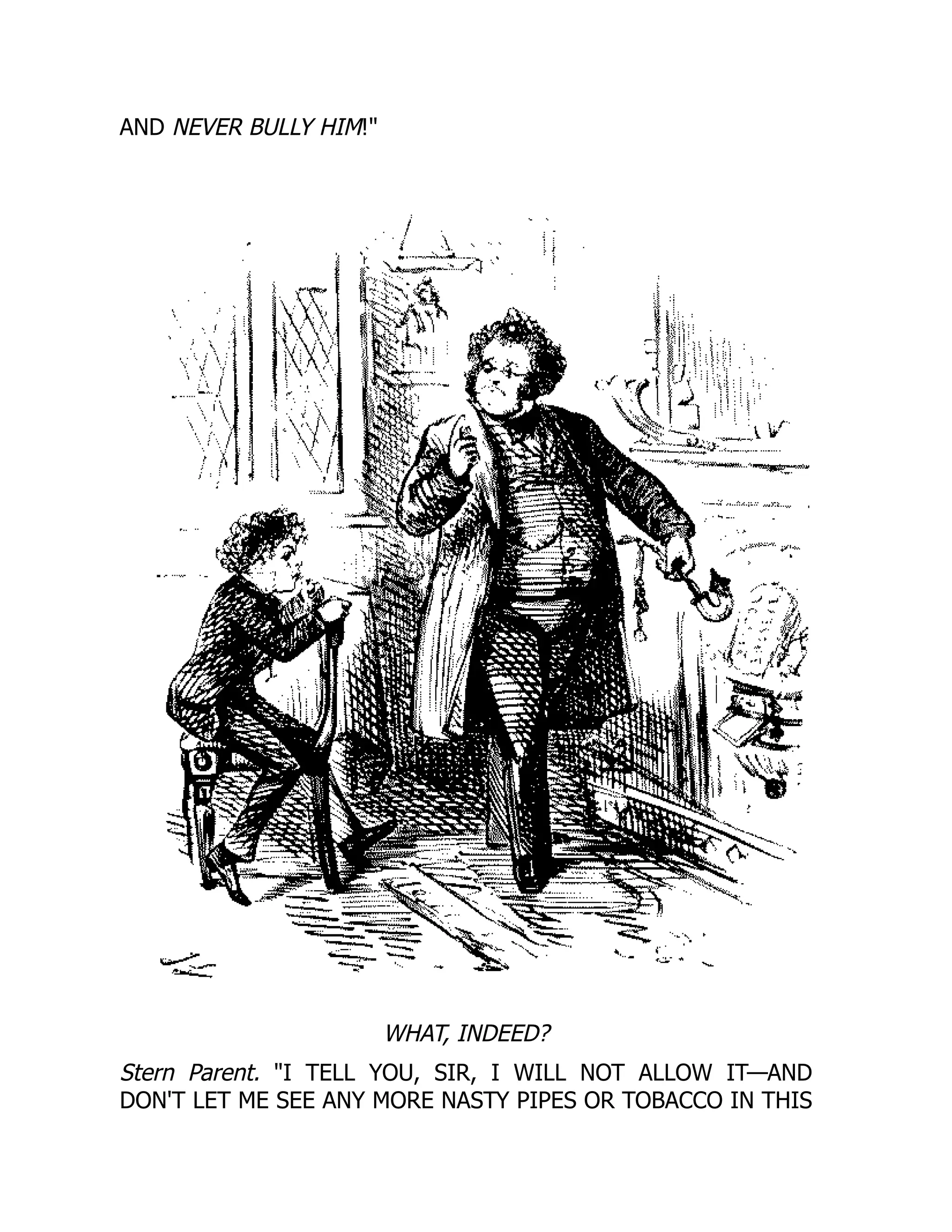
  • 32.
    Tax Collector. THENBE SO GOOD AS TO FILL UP THIS INCOME- TAX PAPER AND RETURN IT TO ME BEFORE TWENTY DAYS! EDUCATION IN THE MINING DISTRICTS. Jemoimer. BIST THOU A GOIN' TO SKULE, ELOYZA? Eloyza. NOT HI, JEMOIMER. THEY GID US TEA AND BUNS LARST WEEK, AND WE SHA'T HAN NO MOORE TILL CUM CRISMUS; SO MUTHER SAYS AS HOW IT AIN'T NO USE.
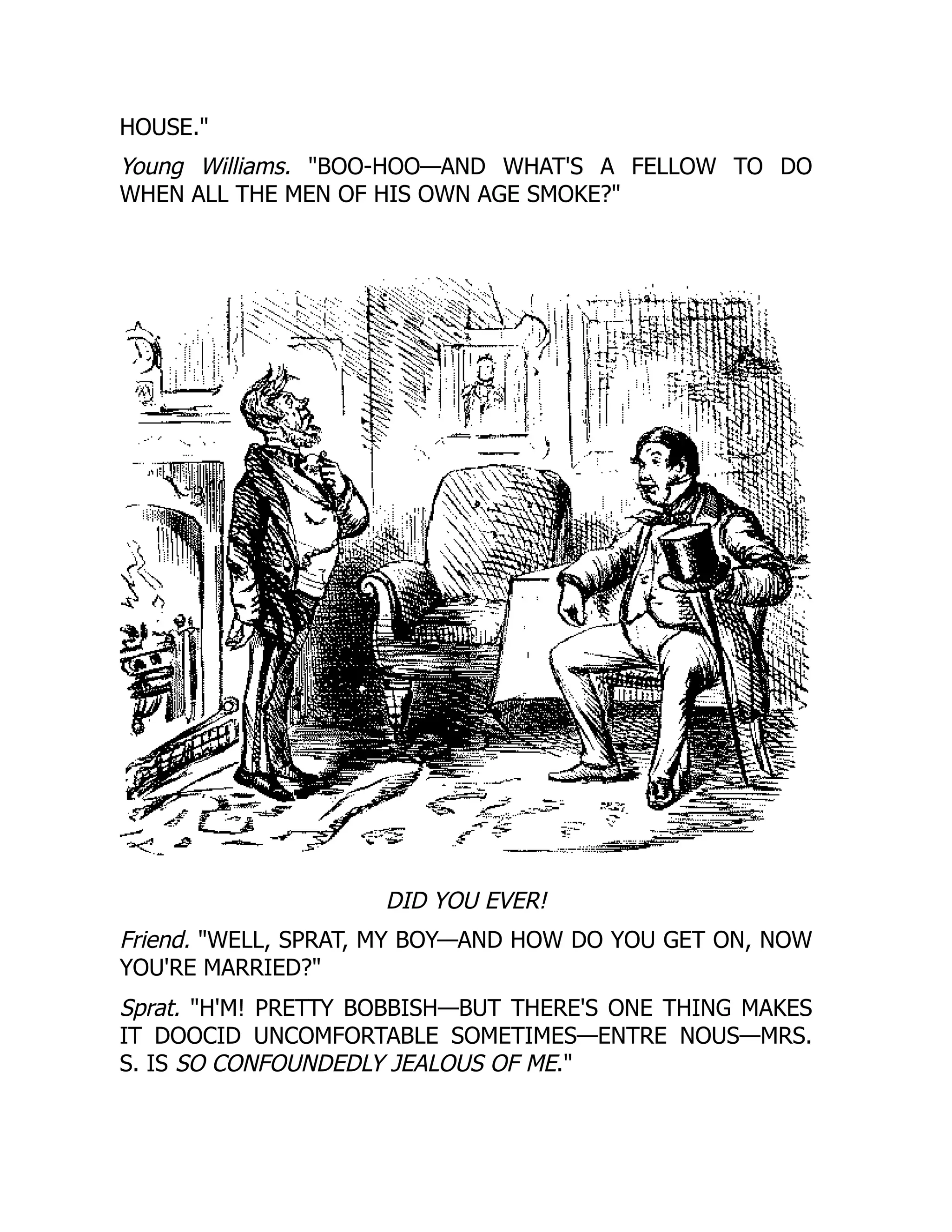
  • 33.
    UNCONSCIOUS SATIRE. THERE, BABYDEAR, LOOK AT THE PRETTY SOLDIERS!
  • 34.
    AVERAGE WEIGHT OFTHE FOOT GUARDS. Heavy Swell. WHAT'S THE AVERAGE WEIGHT OF THE MEN IN YOUR REGIMENT, CHARLEY? Swell in the Guards. DON'T KNOW, I'M SURE—AW—BUT TEN GO TO THE TON.
  • 35.
  • 36.
    Juvenile. I WONDERWHETHER THAT GURL HAS GOT ANY TIN— FOR I FEEL MOST OWDACIOUSLY INCLINED TO GO AND CUT THAT FELLOW OUT. A VISIT TO A DOG-FANCIER.
  • 37.
    TRIUMPH OF MINDOVER MATTER. Old Gent. AND PRAY WHO IS YOUR FRIEND WITH THE COFFEE POT? Small Boy. THAT? OH! HE'S MY FAG—HE GETS ME MY BREAKFAST AND SUCH LIKE, BUT I ALWAYS LEAVE HIM SOME CRUMPETS—
  • 38.
    AND NEVER BULLYHIM! WHAT, INDEED? Stern Parent. I TELL YOU, SIR, I WILL NOT ALLOW IT—AND DON'T LET ME SEE ANY MORE NASTY PIPES OR TOBACCO IN THIS
  • 39.
    HOUSE. Young Williams. BOO-HOO—ANDWHAT'S A FELLOW TO DO WHEN ALL THE MEN OF HIS OWN AGE SMOKE? DID YOU EVER! Friend. WELL, SPRAT, MY BOY—AND HOW DO YOU GET ON, NOW YOU'RE MARRIED? Sprat. H'M! PRETTY BOBBISH—BUT THERE'S ONE THING MAKES IT DOOCID UNCOMFORTABLE SOMETIMES—ENTRE NOUS—MRS. S. IS SO CONFOUNDEDLY JEALOUS OF ME.
  • 40.
    MORAL INFLUENCE OFEXECUTIONS. WHERE 'AVE WE B'N? WHY, TO SEE THE COVE 'UNG, TO BE SURE! ADVENTURES OF MR. TOM NODDY.
  • 41.
    No. I. OUR LITTLEFRIEND, TOM NODDY, THINKS THE SEA-WATER WILL DO HIS MARE'S LEGS A WORLD OF GOOD
  • 42.
    No. II. THE PLAYFULCREATURE OBJECTS AT FIRST, BUT FINDING THE PROCESS AGREEABLE, DETERMINES TO HAVE A COMPLETE BATH.
  • 43.
    No. III. LANDING OFTOM NODDY. HIS HORSE HAVING HAD ENOUGH OF IT, RETURNS TO HIS STABLE.
  • 44.
    No. IV. OUR FRIENDHAS A DAY WITH THE BROOKSIDE HARRIERS.— WITH HIS USUAL PRUDENCE HE GETS A HORSE ACCUSTOMED TO THE HILLS.
  • 45.
    DOMESTIC ECONOMY. Newly MarriedDaughter (whose husband's income is, if anything, decidedly limited). —AND SEE HERE, PAPA, DEAR, WE ARE GETTING ON SO BEAUTIFULLY WITH OUR FURNISHING! WE BOUGHT THESE LOVELY GOLD AND SILVER INDIAN ELEPHANTS AT A SALE THE OTHER DAY, AND ONLY GAVE FIFTY POUNDS FOR THEM; WASN'T IT CHEAP? WE ONLY WANT A LITTLE CRACKED CHINA TO MAKE THE ROOM QUITE COMFORTABLE!
  • 46.
    A CAUTIOUS BIRD. Lobkins.WELL, I DON'T KNOW ABOUT MARRYIN'—FOR YER SEE, AFTER THE KNOT WAS TIED, SOME OTHER GAL MIGHT BE FALLIN' IN LOVE WITH ONE—AND THAT WOULD BE SO DOOCED AWKWARD!
  • 47.
    FORTUNE'S FAVOURITE. First Snob.YOU KNOW THAT JOLLY LITTLE GIRL, JULIA BINKS? Second Snob. ALL RIGHT, GO AHEAD. First Snob. WELL! SHE'S BEEN STICKING UP TO ME LIKE BRICKS, BUT I CAN'T RETURN HER AFFECTION, BECAUSE I'M SO DEUCED SWEET WITH THE PLANTAGENET GALS.
  • 48.
    WANTING IN REVERENCE. Coster(to extremely genteel person). I SAY, GUVNER, GIVE US A HIST WITH THIS 'ERE BILIN' O' GREENS!
  • 49.
    JEW D'ESPRIT. Young Sholomunsh(to Young SNOBLEY, who is attired in his very best). NOW, SIR! LET ME SHELL YOU A NISH SHUIT OF CLOSHE,