ORGANIZATIONAL
BEHAVIOUR &
MANAGEMENT
BU 604 – Chapter 1 & 2
Atiqa Marium
Lazaridis School of Business and
Economics
Today: Introduction to OB
2
Topics Required Readings Assignments
and Deliverables
• Introduction &
Perception,
Personality &
Emotions
• Langton, Chapter 1,
What is Organizational
Behaviour
• Langton, Chapter 2,
Perception, Personality
& Emotions
• Case Incident for In-class
discussion: Marriott
• Review the course
outline & Content
on MyLS
• Enrol yourself in
group on MyLS for
OB Debate
Defining Organizational
Behaviour
• A field of study that looks at the impact that
individuals, groups, and structure have on
behaviour within organizations
• Its aim is to apply such knowledge toward
improving organizational effectiveness
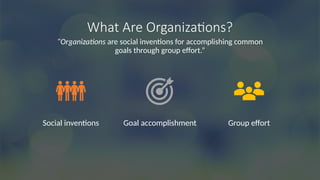
What Are Organizations?
“Organizations are social inventions for accomplishing common
goals through group effort.”
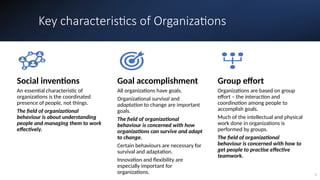
Social inventions Goal accomplishment Group effort
Key characteristics of Organizations
5
Social inventions
An essential characteristic of
organizations is the coordinated
presence of people, not things.
The field of organizational
behaviour is about understanding
people and managing them to work
effectively.
Goal accomplishment
All organizations have goals.
Organizational survival and
adaptation to change are important
goals.
The field of organizational
behaviour is concerned with how
organizations can survive and adapt
to change.
Certain behaviours are necessary for
survival and adaptation.
Innovation and flexibility are
especially important for
organizations.
Group effort
Organizations are based on group
effort – the interaction and
coordination among people to
accomplish goals.
Much of the intellectual and physical
work done in organizations is
performed by groups.
The field of organizational
behaviour is concerned with how to
get people to practise effective
teamwork.
Why Study
Organizational
Behaviour?
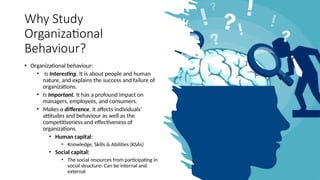
• Organizational behaviour:
• Is Interesting. It is about people and human
nature, and explains the success and failure of
organizations.
• Is Important. It has a profound impact on
managers, employees, and consumers.
• Makes a difference. It affects individuals’
attitudes and behaviour as well as the
competitiveness and effectiveness of
organizations.
• Human capital:
• Knowledge, Skills & Abilities (KSAs)
• Social capital:
• The social resources from participating in
social structure- Can be internal and
external
Goals of Organizational Behaviour
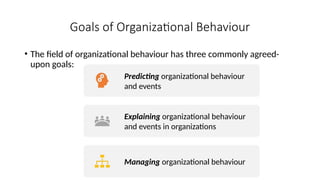
• The field of organizational behaviour has three commonly agreed-
upon goals:
Predicting organizational behaviour
and events
Explaining organizational behaviour
and events in organizations
Managing organizational behaviour
Predicting Organizational Behaviour
In organizations, there is
considerable interest in
predicting when people will
make ethical decisions, create
innovative products, or
engage in sexual harassment.
Through systematic study, the
field of organizational
behaviour provides a scientific
foundation that helps
improve predictions of
organizational events.
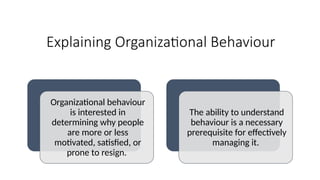
Explaining Organizational Behaviour
Organizational behaviour
is interested in
determining why people
are more or less
motivated, satisfied, or
prone to resign.
The ability to understand
behaviour is a necessary
prerequisite for effectively
managing it.
Managing Organizational Behaviour
• Management is the art of getting things accomplished in organizations
through others.
• If behaviour can be predicted and explained, it can often be managed.
• Prediction and explanation involves analysis while management is about
action.
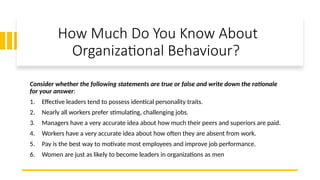
How Much Do You Know About
Organizational Behaviour?
Consider whether the following statements are true or false and write down the rationale
for your answer:
1. Effective leaders tend to possess identical personality traits.
2. Nearly all workers prefer stimulating, challenging jobs.
3. Managers have a very accurate idea about how much their peers and superiors are paid.
4. Workers have a very accurate idea about how often they are absent from work.
5. Pay is the best way to motivate most employees and improve job performance.
6. Women are just as likely to become leaders in organizations as men
How Much Do You Know About Organizational
Behaviour?
• Now assume the correct answer is the opposite to the one you have given
and provide a one-sentence rationale why this opposite answer could also be
correct.
The Study of Organizational Behaviour
People are very good at giving sensible reasons why the same
statement is either true or false.
Common sense develops through unsystematic and incomplete
experiences with organizational behaviour.
Management practice should be based on informed opinion and
systematic study.
Is it possible to
predict Human
Behaviour?
Systematic Study
•“Looking at relationships, attempting to attribute causes and effects, and
drawing conclusions based on scientific evidence.”
• Behaviour is generally predictable.
• There are differences between individuals.
• There are fundamental consistencies.
• There are rules (written and unwritten) in almost every setting.
Evidence-based
management
• The basing of managerial decisions on the best
available scientific evidence.
• Complements systematic study.
• Vast majority of management decisions are
still made “on the fly,” with little or no
systematic study of available evidence.
• Many managers hold “common sense”
opinions regarding effective management
that have been flatly refuted by empirical
evidence.
Complementing “Intuition”
with Systematic Study
• An instinctive feeling not necessarily supported by
research.
• Also called “gut feelings”.
• The things you have come to believe in an
unsystematic way are not necessarily incorrect.
• But you may be missing data or you overestimate
the accuracy of what we think we know or you may
rely on “common sense” or fads that may not be
supported by empirical research.
The Rigour of OB
• OB Looks Beyond Common Sense.
• Systematic study of the behaviours in organization
• Belief behaviour is not random.
O B Has Few Absolutes
• Human beings are very complex.
• There are few simple and universal principles that explain organizational
behaviour.
• Humans are not alike, which limits the ability to make simple, accurate, and
sweeping generalizations.
O B Takes a Contingency Approach
• An approach taken by OB that considers
behaviour within the context in which it
occurs.
• Depends on the situation.
• People are complex and complicated, so
theories developed to explain their actions
must also consider the context or situation.
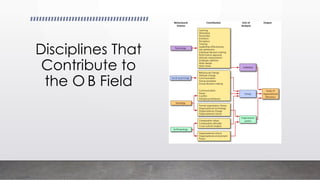
Disciplines That
Contribute to
the O B Field
Challenges and Opportunities in the
Canadian Workplace
• Dramatic changes in organizations.
• Understanding O B has never been more important
for managers.
• Change has resulted in new employment options
being offered or requested by employees.
• May depend on career timing or preferences.
What people-
related
challenges
have you
noticed in the
workplace?
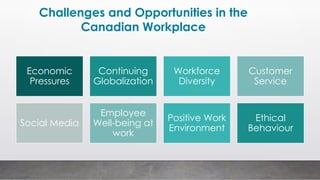
Challenges and Opportunities in the
Canadian Workplace
Economic
Pressures
Continuing
Globalization
Workforce
Diversity
Customer
Service
Social Media
Employee
Well-being at
work
Positive Work
Environment
Ethical
Behaviour
Developing an OB Model
• Overview
• A model is a simplified representation of a
real-world phenomenon
• Proposes three types of variables
(individual, group, organizational)
• Proceeds from left to right
• Inputs leading to processes; processes
leading to outcomes
• Outcomes can also influence inputs in the
future
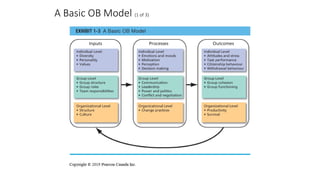
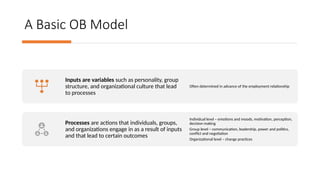
A Basic OB Model (1 of 3)
A Basic OB Model
Inputs are variables such as personality, group
structure, and organizational culture that lead
to processes
Often determined in advance of the employment relationship
Processes are actions that individuals, groups,
and organizations engage in as a result of inputs
and that lead to certain outcomes
Individual level – emotions and moods, motivation, perception,
decision making
Group level – communication, leadership, power and politics,
conflict and negotiation
Organizational level – change practices
A Basic OB Model
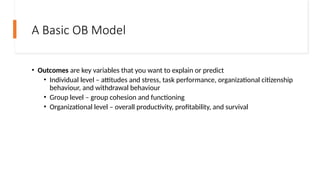
• Outcomes are key variables that you want to explain or predict
• Individual level – attitudes and stress, task performance, organizational citizenship
behaviour, and withdrawal behaviour
• Group level – group cohesion and functioning
• Organizational level – overall productivity, profitability, and survival
Lets Discuss?
27
Consider a group situation in which you have worked.
To what extent did the group rely on the technical skills
of the group members versus their interpersonal skills?
Which skills seemed most important in helping the
group function well?
Identify some examples of “worst jobs.” What
conditions of these jobs made them unpleasant? To
what extent were these conditions related to
behaviours of individuals?
Chapter 2
Perception, Personality, and Emotions
28
Perception
“The process by which individuals
organize and interpret their
impressions to give meaning to
their environment.”
• It can be different from the
objective reality
• Why perception is important for OB?
• Because behaviour is based on
perception of what reality is, not on
reality itself.
• The world as it is perceived is the
world that is behaviourally
important.
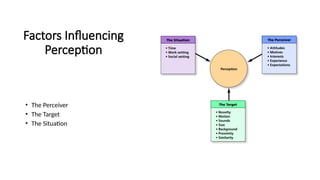
Factors Influencing
Perception
• The Perceiver
• The Target
• The Situation
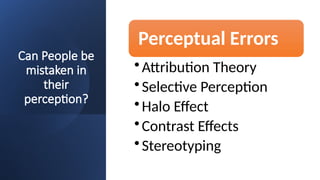
Can People be
mistaken in
their
perception?
Perceptual Errors
•Attribution Theory
•Selective Perception
•Halo Effect
•Contrast Effects
•Stereotyping
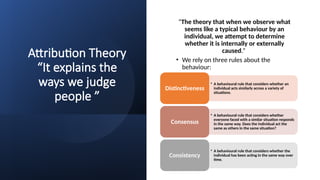
Attribution Theory
“It explains the
ways we judge
people ”
“The theory that when we observe what
seems like a typical behaviour by an
individual, we attempt to determine
whether it is internally or externally
caused.”
• We rely on three rules about the
behaviour:
• A behavioural rule that considers whether an
individual acts similarly across a variety of
situations.
Distinctiveness
• A behavioural rule that considers whether
everyone faced with a similar situation responds
in the same way. Does the individual act the
same as others in the same situation?
Consensus
• A behavioural rule that considers whether the
individual has been acting in the same way over
time.
Consistency
Attribution
Theory
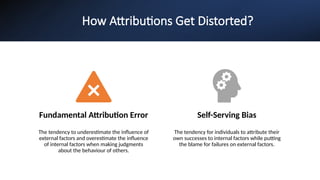
How Attributions Get Distorted?
Fundamental Attribution Error
The tendency to underestimate the influence of
external factors and overestimate the influence
of internal factors when making judgments
about the behaviour of others.
Self-Serving Bias
The tendency for individuals to attribute their
own successes to internal factors while putting
the blame for failures on external factors.
How Attributions Get Distorted?
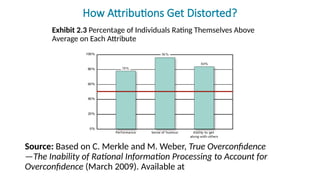
Exhibit 2.3 Percentage of Individuals Rating Themselves Above
Average on Each Attribute
Source: Based on C. Merkle and M. Weber, True Overconfidence
—The Inability of Rational Information Processing to Account for
Overconfidence (March 2009). Available at
Perceptual Errors
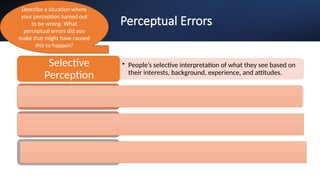
• People’s selective interpretation of what they see based on
their interests, background, experience, and attitudes.
Selective
Perception
• Drawing a general impression of an individual on the basis of
a single characteristic.
Halo Effect
• The concept that our reaction to one person is often
influenced by other people we have recently encountered.
Contrast Effects
• Judging someone on the basis of one’s perception of the
group to which that person belongs.
Stereotyping
Describe a situation where
your perception turned out
to be wrong. What
perceptual errors did you
make that might have caused
this to happen?
Why Do
Perception
and
Judgment
Matter?
• Most obvious applications of
judgment shortcuts in the
workplace:
• Employment interviews
• How?
• Performance expectations
• How?
• Performance evaluations
• How?
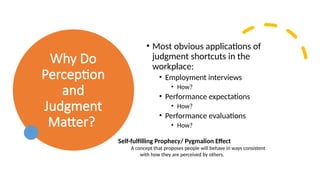
Self-fulfilling Prophecy/ Pygmalion Effect
A concept that proposes people will behave in ways consistent
with how they are perceived by others.
What is Personality?
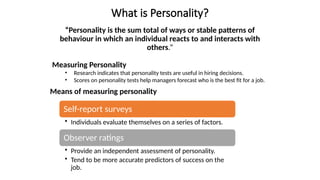
“Personality is the sum total of ways or stable patterns of
behaviour in which an individual reacts to and interacts with
others.”
Measuring Personality
• Research indicates that personality tests are useful in hiring decisions.
• Scores on personality tests help managers forecast who is the best fit for a job.
Means of measuring personality
Self-report surveys
• Individuals evaluate themselves on a series of factors.
Observer ratings
• Provide an independent assessment of personality.
• Tend to be more accurate predictors of success on the
job.
Are people born with
their personalities?
•Personality Determinants
• Heredity
• Environmental factors
• Personality Traits
• Personality traits are enduring
characteristics that describe an individual’s
behaviour.
• The Myers-Briggs Type Indicator (MBTI)
• The Big Five Personality Model
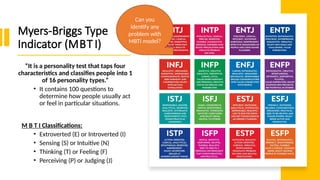
Myers-Briggs Type
Indicator (MBTI)
“It is a personality test that taps four
characteristics and classifies people into 1
of 16 personality types.”
• It contains 100 questions to
determine how people usually act
or feel in particular situations.
M B T I Classifications:
• Extroverted (E) or Introverted (I)
• Sensing (S) or Intuitive (N)
• Thinking (T) or Feeling (F)
• Perceiving (P) or Judging (J)
Can you
identify any
problem with
MBTI model?
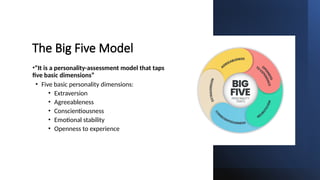
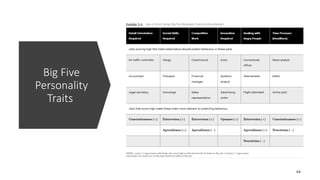
The Big Five Model
•“It is a personality-assessment model that taps
five basic dimensions”
• Five basic personality dimensions:
• Extraversion
• Agreeableness
• Conscientiousness
• Emotional stability
• Openness to experience
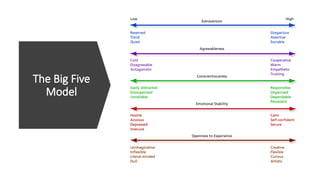
The Big Five
Model
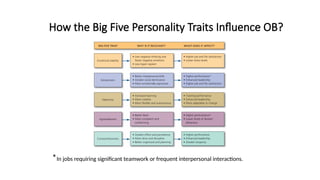
How the Big Five Personality Traits Influence OB?
*In jobs requiring significant teamwork or frequent interpersonal interactions.
Big Five
Personality
Traits
44
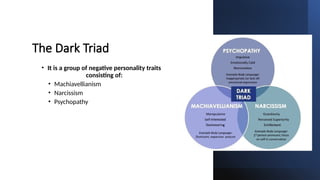
The Dark Triad
• It is a group of negative personality traits
consisting of:
• Machiavellianism
• Narcissism
• Psychopathy
Dark Triad
Machiavellianism is the degree to which an individual is pragmatic, maintains emotional distance, and believes
that ends can justify mean.
• High Machs versus Low Machs
• manipulate more
• win more
• are persuaded less
• persuade others more
Narcissism is the tendency to be arrogant, have a grandiose sense of self-importance, require
excessive admiration, and have a sense of entitlement.
• Narcissists tend to think that they are better leaders than their colleagues; but their supervisors
tend to rate them as worse.
Psychopathy is the tendency for a lack of concern for others and a lack of guilt or remorse when one’s actions
cause harm.
• Related to the use of hard influence tactics (threats, manipulation) and bullying work behaviour (physical or
verbal threatening).
• They may be cunning, which helps them gain power in an organization, but they do not use that power
toward healthy ends for themselves or their organization.
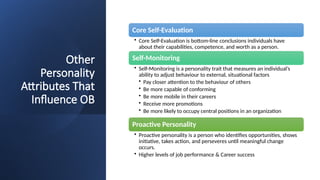
Other
Personality
Attributes That
Influence OB
Core Self-Evaluation
• Core Self-Evaluation is bottom-line conclusions individuals have
about their capabilities, competence, and worth as a person.
Self-Monitoring
• Self-Monitoring is a personality trait that measures an individual’s
ability to adjust behaviour to external, situational factors
• Pay closer attention to the behaviour of others
• Be more capable of conforming
• Be more mobile in their careers
• Receive more promotions
• Be more likely to occupy central positions in an organization
Proactive Personality
• Proactive personality is a person who identifies opportunities, shows
initiative, takes action, and perseveres until meaningful change
occurs.
• Higher levels of job performance & Career success
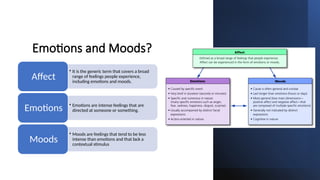
Emotions and Moods?
• It is the generic term that covers a broad
range of feelings people experience,
including emotions and moods.
Affect
• Emotions are intense feelings that are
directed at someone or something.
Emotions
• Moods are feelings that tend to be less
intense than emotions and that lack a
contextual stimulus
Moods
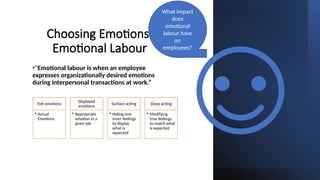
Choosing Emotions:
Emotional Labour
•“Emotional labour is when an employee
expresses organizationally desired emotions
during interpersonal transactions at work.”
Felt emotions
• Actual
Emotions
Displayed
emotions
• Appropriate
emotion in a
given job
Surface acting
• Hiding one
inner feelings
to display
what is
expected
Deep acting
• Modifying
true feelings
to match what
is expected
What impact
does
emotional
labour have
on
employees?
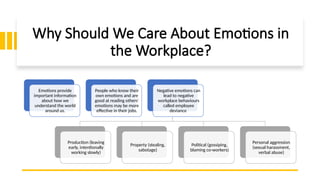
Why Should We Care About Emotions in
the Workplace?
Emotions provide
important information
about how we
understand the world
around us.
People who know their
own emotions and are
good at reading others’
emotions may be more
effective in their jobs.
Negative emotions can
lead to negative
workplace behaviours
called employee
deviance
Production (leaving
early, intentionally
working slowly)
Property (stealing,
sabotage)
Political (gossiping,
blaming co-workers)
Personal aggression
(sexual harassment,
verbal abuse)
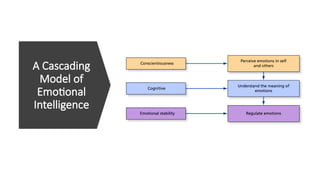
Emotional Intelligence (EI)
• It includes:
• Perceive emotions in self and others
• Understand the meaning of these emotions
• Regulate one’s emotions accordingly in a cascading model
“It is the ability to detect and to manage emotional cues and
information”
A Cascading
Model of
Emotional
Intelligence
Case Analysis: Marriott
• Can you think of other jobs in Marriott where Big Five dimensions other than agreeableness and
conscientiousness would be vital?
• If you applied for a job that involved a personality assessment, would you be honest in your responses
or would you exaggerate your answers to appear more desirable? Why?
• What other approaches might companies use to assess personality during hiring, other than an
interview or assessment? What strengths and weaknesses might those other approaches have?
53

Introduction & Perception, Persoanlity & Emotion.pptx

  • 1.
    ORGANIZATIONAL BEHAVIOUR & MANAGEMENT BU 604– Chapter 1 & 2 Atiqa Marium Lazaridis School of Business and Economics
  • 2.
    Today: Introduction toOB 2 Topics Required Readings Assignments and Deliverables • Introduction & Perception, Personality & Emotions • Langton, Chapter 1, What is Organizational Behaviour • Langton, Chapter 2, Perception, Personality & Emotions • Case Incident for In-class discussion: Marriott • Review the course outline & Content on MyLS • Enrol yourself in group on MyLS for OB Debate
  • 3.
    Defining Organizational Behaviour • Afield of study that looks at the impact that individuals, groups, and structure have on behaviour within organizations • Its aim is to apply such knowledge toward improving organizational effectiveness
  • 4.
    What Are Organizations? “Organizationsare social inventions for accomplishing common goals through group effort.” Social inventions Goal accomplishment Group effort
  • 5.
    Key characteristics ofOrganizations 5 Social inventions An essential characteristic of organizations is the coordinated presence of people, not things. The field of organizational behaviour is about understanding people and managing them to work effectively. Goal accomplishment All organizations have goals. Organizational survival and adaptation to change are important goals. The field of organizational behaviour is concerned with how organizations can survive and adapt to change. Certain behaviours are necessary for survival and adaptation. Innovation and flexibility are especially important for organizations. Group effort Organizations are based on group effort – the interaction and coordination among people to accomplish goals. Much of the intellectual and physical work done in organizations is performed by groups. The field of organizational behaviour is concerned with how to get people to practise effective teamwork.
  • 6.
    Why Study Organizational Behaviour? • Organizationalbehaviour: • Is Interesting. It is about people and human nature, and explains the success and failure of organizations. • Is Important. It has a profound impact on managers, employees, and consumers. • Makes a difference. It affects individuals’ attitudes and behaviour as well as the competitiveness and effectiveness of organizations. • Human capital: • Knowledge, Skills & Abilities (KSAs) • Social capital: • The social resources from participating in social structure- Can be internal and external
  • 7.
    Goals of OrganizationalBehaviour • The field of organizational behaviour has three commonly agreed- upon goals: Predicting organizational behaviour and events Explaining organizational behaviour and events in organizations Managing organizational behaviour
  • 8.
    Predicting Organizational Behaviour Inorganizations, there is considerable interest in predicting when people will make ethical decisions, create innovative products, or engage in sexual harassment. Through systematic study, the field of organizational behaviour provides a scientific foundation that helps improve predictions of organizational events.
  • 9.
    Explaining Organizational Behaviour Organizationalbehaviour is interested in determining why people are more or less motivated, satisfied, or prone to resign. The ability to understand behaviour is a necessary prerequisite for effectively managing it.
  • 10.
    Managing Organizational Behaviour •Management is the art of getting things accomplished in organizations through others. • If behaviour can be predicted and explained, it can often be managed. • Prediction and explanation involves analysis while management is about action.
  • 11.
    How Much DoYou Know About Organizational Behaviour? Consider whether the following statements are true or false and write down the rationale for your answer: 1. Effective leaders tend to possess identical personality traits. 2. Nearly all workers prefer stimulating, challenging jobs. 3. Managers have a very accurate idea about how much their peers and superiors are paid. 4. Workers have a very accurate idea about how often they are absent from work. 5. Pay is the best way to motivate most employees and improve job performance. 6. Women are just as likely to become leaders in organizations as men
  • 12.
    How Much DoYou Know About Organizational Behaviour? • Now assume the correct answer is the opposite to the one you have given and provide a one-sentence rationale why this opposite answer could also be correct.
  • 13.
    The Study ofOrganizational Behaviour People are very good at giving sensible reasons why the same statement is either true or false. Common sense develops through unsystematic and incomplete experiences with organizational behaviour. Management practice should be based on informed opinion and systematic study.
  • 14.
    Is it possibleto predict Human Behaviour?
  • 15.
    Systematic Study •“Looking atrelationships, attempting to attribute causes and effects, and drawing conclusions based on scientific evidence.” • Behaviour is generally predictable. • There are differences between individuals. • There are fundamental consistencies. • There are rules (written and unwritten) in almost every setting.
  • 16.
    Evidence-based management • The basingof managerial decisions on the best available scientific evidence. • Complements systematic study. • Vast majority of management decisions are still made “on the fly,” with little or no systematic study of available evidence. • Many managers hold “common sense” opinions regarding effective management that have been flatly refuted by empirical evidence.
  • 17.
    Complementing “Intuition” with SystematicStudy • An instinctive feeling not necessarily supported by research. • Also called “gut feelings”. • The things you have come to believe in an unsystematic way are not necessarily incorrect. • But you may be missing data or you overestimate the accuracy of what we think we know or you may rely on “common sense” or fads that may not be supported by empirical research.
  • 18.
    The Rigour ofOB • OB Looks Beyond Common Sense. • Systematic study of the behaviours in organization • Belief behaviour is not random. O B Has Few Absolutes • Human beings are very complex. • There are few simple and universal principles that explain organizational behaviour. • Humans are not alike, which limits the ability to make simple, accurate, and sweeping generalizations.
  • 19.
    O B Takesa Contingency Approach • An approach taken by OB that considers behaviour within the context in which it occurs. • Depends on the situation. • People are complex and complicated, so theories developed to explain their actions must also consider the context or situation.
  • 20.
  • 21.
    Challenges and Opportunitiesin the Canadian Workplace • Dramatic changes in organizations. • Understanding O B has never been more important for managers. • Change has resulted in new employment options being offered or requested by employees. • May depend on career timing or preferences. What people- related challenges have you noticed in the workplace?
  • 22.
    Challenges and Opportunitiesin the Canadian Workplace Economic Pressures Continuing Globalization Workforce Diversity Customer Service Social Media Employee Well-being at work Positive Work Environment Ethical Behaviour
  • 23.
    Developing an OBModel • Overview • A model is a simplified representation of a real-world phenomenon • Proposes three types of variables (individual, group, organizational) • Proceeds from left to right • Inputs leading to processes; processes leading to outcomes • Outcomes can also influence inputs in the future
  • 24.
    A Basic OBModel (1 of 3)
  • 25.
    A Basic OBModel Inputs are variables such as personality, group structure, and organizational culture that lead to processes Often determined in advance of the employment relationship Processes are actions that individuals, groups, and organizations engage in as a result of inputs and that lead to certain outcomes Individual level – emotions and moods, motivation, perception, decision making Group level – communication, leadership, power and politics, conflict and negotiation Organizational level – change practices
  • 26.
    A Basic OBModel • Outcomes are key variables that you want to explain or predict • Individual level – attitudes and stress, task performance, organizational citizenship behaviour, and withdrawal behaviour • Group level – group cohesion and functioning • Organizational level – overall productivity, profitability, and survival
  • 27.
    Lets Discuss? 27 Consider agroup situation in which you have worked. To what extent did the group rely on the technical skills of the group members versus their interpersonal skills? Which skills seemed most important in helping the group function well? Identify some examples of “worst jobs.” What conditions of these jobs made them unpleasant? To what extent were these conditions related to behaviours of individuals?
  • 28.
  • 29.
    Perception “The process bywhich individuals organize and interpret their impressions to give meaning to their environment.” • It can be different from the objective reality • Why perception is important for OB? • Because behaviour is based on perception of what reality is, not on reality itself. • The world as it is perceived is the world that is behaviourally important.
  • 30.
    Factors Influencing Perception • ThePerceiver • The Target • The Situation
  • 31.
    Can People be mistakenin their perception? Perceptual Errors •Attribution Theory •Selective Perception •Halo Effect •Contrast Effects •Stereotyping
  • 32.
    Attribution Theory “It explainsthe ways we judge people ” “The theory that when we observe what seems like a typical behaviour by an individual, we attempt to determine whether it is internally or externally caused.” • We rely on three rules about the behaviour: • A behavioural rule that considers whether an individual acts similarly across a variety of situations. Distinctiveness • A behavioural rule that considers whether everyone faced with a similar situation responds in the same way. Does the individual act the same as others in the same situation? Consensus • A behavioural rule that considers whether the individual has been acting in the same way over time. Consistency
  • 33.
  • 34.
    How Attributions GetDistorted? Fundamental Attribution Error The tendency to underestimate the influence of external factors and overestimate the influence of internal factors when making judgments about the behaviour of others. Self-Serving Bias The tendency for individuals to attribute their own successes to internal factors while putting the blame for failures on external factors.
  • 35.
    How Attributions GetDistorted? Exhibit 2.3 Percentage of Individuals Rating Themselves Above Average on Each Attribute Source: Based on C. Merkle and M. Weber, True Overconfidence —The Inability of Rational Information Processing to Account for Overconfidence (March 2009). Available at
  • 36.
    Perceptual Errors • People’sselective interpretation of what they see based on their interests, background, experience, and attitudes. Selective Perception • Drawing a general impression of an individual on the basis of a single characteristic. Halo Effect • The concept that our reaction to one person is often influenced by other people we have recently encountered. Contrast Effects • Judging someone on the basis of one’s perception of the group to which that person belongs. Stereotyping Describe a situation where your perception turned out to be wrong. What perceptual errors did you make that might have caused this to happen?
  • 37.
    Why Do Perception and Judgment Matter? • Mostobvious applications of judgment shortcuts in the workplace: • Employment interviews • How? • Performance expectations • How? • Performance evaluations • How? Self-fulfilling Prophecy/ Pygmalion Effect A concept that proposes people will behave in ways consistent with how they are perceived by others.
  • 38.
    What is Personality? “Personalityis the sum total of ways or stable patterns of behaviour in which an individual reacts to and interacts with others.” Measuring Personality • Research indicates that personality tests are useful in hiring decisions. • Scores on personality tests help managers forecast who is the best fit for a job. Means of measuring personality Self-report surveys • Individuals evaluate themselves on a series of factors. Observer ratings • Provide an independent assessment of personality. • Tend to be more accurate predictors of success on the job.
  • 39.
    Are people bornwith their personalities? •Personality Determinants • Heredity • Environmental factors • Personality Traits • Personality traits are enduring characteristics that describe an individual’s behaviour. • The Myers-Briggs Type Indicator (MBTI) • The Big Five Personality Model
  • 40.
    Myers-Briggs Type Indicator (MBTI) “Itis a personality test that taps four characteristics and classifies people into 1 of 16 personality types.” • It contains 100 questions to determine how people usually act or feel in particular situations. M B T I Classifications: • Extroverted (E) or Introverted (I) • Sensing (S) or Intuitive (N) • Thinking (T) or Feeling (F) • Perceiving (P) or Judging (J) Can you identify any problem with MBTI model?
  • 41.
    The Big FiveModel •“It is a personality-assessment model that taps five basic dimensions” • Five basic personality dimensions: • Extraversion • Agreeableness • Conscientiousness • Emotional stability • Openness to experience
  • 42.
  • 43.
    How the BigFive Personality Traits Influence OB? *In jobs requiring significant teamwork or frequent interpersonal interactions.
  • 44.
  • 45.
    The Dark Triad •It is a group of negative personality traits consisting of: • Machiavellianism • Narcissism • Psychopathy
  • 46.
    Dark Triad Machiavellianism isthe degree to which an individual is pragmatic, maintains emotional distance, and believes that ends can justify mean. • High Machs versus Low Machs • manipulate more • win more • are persuaded less • persuade others more Narcissism is the tendency to be arrogant, have a grandiose sense of self-importance, require excessive admiration, and have a sense of entitlement. • Narcissists tend to think that they are better leaders than their colleagues; but their supervisors tend to rate them as worse. Psychopathy is the tendency for a lack of concern for others and a lack of guilt or remorse when one’s actions cause harm. • Related to the use of hard influence tactics (threats, manipulation) and bullying work behaviour (physical or verbal threatening). • They may be cunning, which helps them gain power in an organization, but they do not use that power toward healthy ends for themselves or their organization.
  • 47.
    Other Personality Attributes That Influence OB CoreSelf-Evaluation • Core Self-Evaluation is bottom-line conclusions individuals have about their capabilities, competence, and worth as a person. Self-Monitoring • Self-Monitoring is a personality trait that measures an individual’s ability to adjust behaviour to external, situational factors • Pay closer attention to the behaviour of others • Be more capable of conforming • Be more mobile in their careers • Receive more promotions • Be more likely to occupy central positions in an organization Proactive Personality • Proactive personality is a person who identifies opportunities, shows initiative, takes action, and perseveres until meaningful change occurs. • Higher levels of job performance & Career success
  • 48.
    Emotions and Moods? •It is the generic term that covers a broad range of feelings people experience, including emotions and moods. Affect • Emotions are intense feelings that are directed at someone or something. Emotions • Moods are feelings that tend to be less intense than emotions and that lack a contextual stimulus Moods
  • 49.
    Choosing Emotions: Emotional Labour •“Emotionallabour is when an employee expresses organizationally desired emotions during interpersonal transactions at work.” Felt emotions • Actual Emotions Displayed emotions • Appropriate emotion in a given job Surface acting • Hiding one inner feelings to display what is expected Deep acting • Modifying true feelings to match what is expected What impact does emotional labour have on employees?
  • 50.
    Why Should WeCare About Emotions in the Workplace? Emotions provide important information about how we understand the world around us. People who know their own emotions and are good at reading others’ emotions may be more effective in their jobs. Negative emotions can lead to negative workplace behaviours called employee deviance Production (leaving early, intentionally working slowly) Property (stealing, sabotage) Political (gossiping, blaming co-workers) Personal aggression (sexual harassment, verbal abuse)
  • 51.
    Emotional Intelligence (EI) •It includes: • Perceive emotions in self and others • Understand the meaning of these emotions • Regulate one’s emotions accordingly in a cascading model “It is the ability to detect and to manage emotional cues and information”
  • 52.
  • 53.
    Case Analysis: Marriott •Can you think of other jobs in Marriott where Big Five dimensions other than agreeableness and conscientiousness would be vital? • If you applied for a job that involved a personality assessment, would you be honest in your responses or would you exaggerate your answers to appear more desirable? Why? • What other approaches might companies use to assess personality during hiring, other than an interview or assessment? What strengths and weaknesses might those other approaches have? 53

Editor's Notes

  • #1 NOTE: To change the image on this slide, select the picture and delete it. Then click the Pictures icon in the placeholder to insert your own image.
  • #3 LO2; Material pertinent to this discussion is found under “Defining Organizational Behaviour.”
  • #15  Material pertinent to this discussion is found under “O B: Making Sense of Behaviour in Organizations.”
  • #16  Material pertinent to this discussion is found under “O B: Making Sense of Behaviour in Organizations.”
  • #17 Material pertinent to this discussion is found under “O B: Making Sense of Behaviour in Organizations.”
  • #19 L O5; Material pertinent to this discussion is found “O B has few absolutes.” OB concepts must reflect situational or contingency conditions, and hence predictions about human behaviour are at best probabilistic, not absolute. That is, X is likely to lead to Y, but only under conditions specified in Z (the contingency variables).
  • #20 This Exhibits provides a visual representation of the contributions of various behavioural science disciplines on the study of O B. Use as speaking notes to provide a macro level view of the O B discipline. Long Description: Four columns are as follows: Behavioural science, Contribution, Unit of Analysis, and Output. The behavioural science Psychology points to the contribution as follows: Learning, Motivation, Personality, Emotions, Perception, Training, Leadership effectiveness, Job satisfaction, Individual decision making, Performance appraisal, Attitude measurement, Employee selection, Work design, and Work stress. The unit of Analysis is Individual and the Output is Study of Organizational Behaviour. The behavioural science Social Psychology points to the contribution as follows: Behavioural change, Attitude change, Communication, Group processes, and Group decision making. The unit of Analysis is the group and the Output is Study of Organizational Behaviour. The behavioural science Sociology points to the contribution as follows: Communication; Power, Conflict, Intergroup Behaviour. The unit of Analysis is the group and the Output is Study of Organizational Behaviour. The behavioural science Sociology points to another contribution as follows: Formal organization theory, Organizational technology, Organizational change, Organizational culture. The unit of Analysis is the Organization system and the Output is Study of Organizational Behaviour. The behavioural science Anthropology points to the contribution as follows: Comparative values, Comparative attitudes, Cross-cultural analysis. The unit of Analysis is the group and the Output is Study of Organizational Behaviour. The behavioural science Sociology points to another contribution as follows: Formal organization theory, Organizational technology, Organizational change, Organizational culture. The unit of Analysis is organizational system and the Output is Study of Organizational Behaviour. The behavioural science Anthropology points to the contribution as follows: Organizational culture, Organizational environment Power. The unit of Analysis is organizational system and the Output is Study of Organizational Behaviour.
  • #23 LO6; Material pertinent to this discussion is found under “Challenges and Opportunities in the Canadian Workplace.”
  • #24 LO7; Material pertinent to this discussion is found under “Coming Attractions: Developing an OB Model”
  • #25 LO7; Material pertinent to this discussion is found under “Coming Attractions: Developing an OB Model”
  • #26 LO7; Material pertinent to this discussion is found under “Coming Attractions: Developing an OB Model”
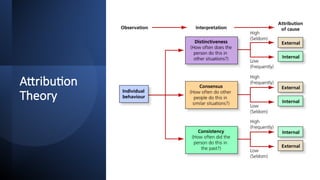
  • #33 Long Description: The processes involved are Observation, Interpretation, and Attribution of the cause. The process begins with the observation of individual behaviour which is interpreted as Distinctiveness, Consensus and Consistency. The three interpretations are explained as follows: Distinctiveness (How often does the person do this in other situations?); Consensus (How often do other people do this in similar situations?); Consistency (How often did the person do this in the past?). Each of the interpretations is further branched out to the attribution of cause. Distinctiveness with seldom high points to external and frequently low points to Internal. Consensus with frequently high points to external and seldom low points to Internal. Consistency with frequently high points to internal and seldom low points to external.
  • #35 Long Description: The x-axis has the attributes: performance, sense of humour, and ability to get along with others. The y-axis represents percentage from 0 to 100 with increments of 20 percent. The data are as follows: performance, 78 percent; sense of humour, 96 percent and ability to get along with others, 84 percent. The average is shown by a red horizontal line at 50 percent.
  • #42 Long Description: The personality traits and corresponding low extreme behaviours are listed as follows. Extraversion: Reserved, timid, quiet. Agreeableness: Cold, disagreeable, antagonistic. Conscientiousness: Easily distracted, disorganized, unreliable. Emotional stability: Hostile, anxious, depressed, insecure. Openness to experience: Unimaginative, inflexible, literal-minded, dull. The personality traits and corresponding high extreme behaviours are listed as follows. Extraversion: Gregarious, assertive, sociable. Agreeableness: Cooperative, warm, empathetic, trusting. Conscientiousness: Responsible, organized, dependable, persistent. Emotional stability: Calm, self-confident, secure. Openness to Experience: Creative, flexible, curious, artistic.
  • #43 Long Description: The five big traits that are listed one below the other are Emotional stability, Extraversion, Openness, Agreeableness, Conscientiousness. The traits point to, “Why is it relevant?” The details are as follows: Emotional stability: Less negative thinking and fewer negative emotions, Less hyper vigilant. Extraversion: Better interpersonal skills, Greater social dominance, More emotionally expressive. Openness: Increased learning, More creative, More flexible and autonomous. Agreeableness: Better liked, More compliant and conforming. Conscientiousness: Greater effort and persistence, More drive and discipline, Better organized and planning. The relevance points to, “What does it affect?” The details are as follows: Emotional stability: Higher job and life satisfaction, Lower stress levels. Extraversion: Higher performance asterisk, Enhanced leadership, Higher job and life satisfaction. Openness: Training performance, Enhanced leadership, More adaptable to change. Agreeableness: Higher performance asterisk, Lower levels of deviant behaviour. Conscientiousness: Higher performance, Enhanced leadership, Greater longevity.
  • #52 Long Description: The model proceeds as follows. Conscientiousness perceive emotions in self and others. Cognitive process understands the meaning of emotions. Emotional stability regulates emotions. Each of the processes is arranged from top to bottom connected by downward arrows.